

Introduction
Passion fruit, with the scientific name Passiflora edulis Sims, is an herbaceous vine of the genus Passionflower. As early as the 1980s, passion fruit was planted on a large scale in Fujian Province, China. However, due to restrictions such as market acceptance, it was eventually suspended. In recent years, due to the considerable economic benefits and low planting difficulty of passion fruit, a large number of fruit farmers have been inspired to plant it [1, 2]. However, during the planting process, meteorological disasters, pest control, and other problems are encountered, resulting in loss of yield, among which low temperature and frost damage in winter are the most important meteorological disasters affecting passion fruit production.
Passion fruit has a long and vigorous growth period throughout the year, but after many fruit bearings, the tree will be damaged. It has the characteristics of good fruit in one year, more fruit in two years, and poor fruit in three years [3]. The main limitation of its introduction to the subtropical region of Fujian is the temperature. In recent years, in order to reduce the occurrence of stem base rot, root rot, and other diseases, and ensure quality and fruit quantity, the cultivation mode of passion fruit in Fujian Province has been adjusted to be planted once a year. Therefore, the problem of overwintering can be successfully avoided. However, to compete for the first batch of fruit markets, some fruit farmers adjusted the planting time and advanced it to winter planting, or delayed planting to fill the gap in the winter and spring passion fruit market, resulting in a certain level of winter frost damage. Therefore, low temperature and frost damage in winter will seriously affect the fruit growth and quality of the last batch of passion fruit and severely affect the seedling cultivation and planting work of passion fruit in winter.
Affected by global climate change, extreme weather events such as strong cold waves occur more frequently. However, some fruit farmers ignore the low cold resistance of passion fruit or the difference in cold resistance among varieties, do not follow the climate law in production, and blindly introduce seeds into subsuitable or unsuitable planting areas, resulting in an increasing and aggravating trend of low temperature and frost damage losses, which seriously affects the output of fruit and income of fruit farmers and restricts the healthy and stable development of the passion fruit industry.
There are only a few studies on the frost damage level index and risk regionalization of fruit trees in foreign countries [4-10], while there has been much research on the frost damage indicators of banana, lychee, mango, loquat, and other fruit trees in China [11-14], and the established grade index has been successfully used to carry out the research and business services of cold and frost damage monitoring and early warning and zoning [15-17]. Research on passion fruit mainly focuses on introduction and trial planting, cultivation techniques, and fruit application research [18-20]. Although some scholars have noted that passion fruit can withstand slight freezing and can grow normally at a temperature not lower than -2ºC. When the temperature is lower than 0ºC, the growth of plants is inhibited, and when the temperature is lower than -2ºC, the plants will suffer severe frost damage and even death [21-24]; but these scholars only indicated the low temperature critical threshold of passion fruit damage and did not differentiate specific frost damage level thresholds for different damage symptoms of fruit trees. The indicators mostly came from field planting experience and lacked systematic, quantitative, and verified frost damage index grading. Moreover, research on the grade index of frost damage and the risk regionalization of frost damage of different varieties of passion fruit is basically lacking.
In this study, the main varieties of passion fruit in Fujian Province, passion fruit No. 1 (purple fruit) and passion fruit No. 3 (golden fruit), were selected as the research objects, and various methods, such as historical disaster inversion, orchard positioning observation, and geographical displacement experiments, were synthesized, combined with the grading standards of passion fruit victimization symptoms cold, and mathematical statistical methods were used to obtain the frost damage grade index. According to the historical disaster situation collected in the literature and the results of the simulated low-temperature test of the artificial climatic chamber, the frost damage grade index of each main cultivar was determined. Based on this, the cold and frost damage risk assessment model of passion fruit was established, and the cold and frost damage risk regionalization of the main cultivars of passion fruit in Fujian Province was compiled. The research results can help establish objective, quantitative, and varietal cold and frost damage grade indicators, provide technical support for the fine monitoring, early warning assessment, and regionalization of passion fruit cold and frost damage in our province, and provide a scientific basis for local agricultural production departments to formulate appropriate decisions and measures for seed introduction, expansion, and disaster prevention and mitigation.
Data and Method
The daily minimum temperature data of the Fujian Provincial Meteorological Observation Station during the winters of 2016-2021 (December of one year to February of the following year) were provided by the Fujian Meteorological Information Center. The extreme minimum temperature corresponding to the passion fruit frost damage sample was revised from the automatic weather station in the passion fruit orchard or the adjacent regional automatic weather station. The extreme minimum temperature is the lowest temperature (Tmin) in a louver box 1.5 m above the ground.
Research Method
Disaster Data
At present, the passion fruit varieties grown in Fujian Province are primarily passion fruit No. 1 (purple fruit) and passion fruit No. 3 (golden fruit). This paper collects historical and actual disaster data through field investigations, fruit farmer visits, literature collection, orchard positioning observations, and geographical displacement experiments. According to the needs of disaster investigation and geographical displacement experiments, the passion fruit disaster questionnaire was designed to record the disaster time, detailed disaster situation, and tree morphological changes of the disaster consequence of fruit trees at the survey point, and the test observers were required to record the symptoms of fruit tree leaves, branches, trunks, and fruits in detail when the process of frost damage occurred. The disaster data are aggregated to establish a disaster sample set.
Orchard Positioning Observation Test
Since 2018, automatic microclimate observation equipment (HOBO U12 type) has been deployed in disaster-prone orchards and parallel observation points of passion fruit, and temperature, humidity, and other data are automatically recorded every 15 minutes for frost damage monitoring (see Table 1).
Geographical Displacement Experiment
The potting method was used to cultivate passion fruit No. 1 and No. 3 fruit seedlings in spring, planting one plant per pot, cultivating under natural light conditions, watering as needed, fertilizing once every 15-20 days, and geo-relocating after the fruit seedlings were robust. During the test, each plant was kept in its natural state, and no artificial changes were made. In this paper, three pots of passion fruit seedlings of two varieties were placed near the observation field of Changtai County, Pinghe County, and Nanjing County Meteorological Bureau in Zhangzhou County, as well as the Zhangzhou Tianbao Hot Crop Test Station and the Nanjing County Gaogang Village Test Site before the winter of 2018/2019, 2019/2020, and 2020/2021, respectively, and test observers were arranged, requiring that when there is a cold air process, the symptoms of frost damage of two varieties of passion fruit should be recorded and photographed day by day.
Low-Temperature Simulation Test of the Artificial Climatic Chamber
To this point, the low-temperature simulation test of artificial climatic chambers has been widely used in the revision and determination of cold and frost damage grade indices, such as tea plants and fruit trees [25, 26]. To obtain sufficient disaster samples, this paper conducted a two-day cold frost damage low-temperature simulation test of passion fruit in the large artificial climate chamber of the Zhangzhou Tropical Crop Meteorological Experimental Station (model: Beijing Kuran artificial climate laboratory, the temperature can be set within the range of -10ºC~45ºC, with an accuracy of ±0.5ºC) in the winter of 2019/2020. The test was performed in weather below 20ºC. The test seedlings were passion fruit No. 1 and No. 3 potted seedlings, the test temperature setting range was 3.0~-4.0ºC, and 8 temperatures were set to 3.0ºC, 2.0ºC, 1.0ºC, 0ºC, -1.0ºC, -2.0ºC, -3.0ºC, and -4.0ºC. Each temperature was maintained at a constant for 2 h and 4 h, and each treatment method used 3 pots of passion fruit No. 1 and No. 3 seedlings, for a total of 96 pots of seedling samples. First, each sample was put into the artificial climatic chamber, imitating natural cooling to the set starting temperature, and each temperature was maintained at a constant for 2 h and 4 h. After reaching the processing temperature, the fruit seedlings were removed and placed into the room for marking. Each cooling process was maintained at a rate of 1 h to cool 1ºC, and the test process was repeated until the temperature was reduced to -4.0ºC. After 4 h, the potted fruit seedlings were placed outdoors for one week, and then the morphological changes of each treated fruit seedling were observed and recorded to determine the damage grade.
Method for Determining the Grade Index of Passion Fruit Cold and Frost Damage
According to the grading standards of passion fruit cold and frost damage symptoms, the cold and frost damage level of each disaster sample was determined, and the extreme minimum temperature (Tmin) of the process corresponding to each disaster sample could be corrected by using the existing and self-built passion fruit orchard automatic weather monitoring equipment data or using the Tmin data of recent county weather stations or regional automatic stations and the low temperature data of each disaster point to calculate the extreme minimum temperature of the process in the winter of each sample. The mathematical statistical method was used to analyze the disaster sample set, and the fitting equation between extreme minimum temperature and disaster level was established to preliminarily determine the cold frost damage grade index of passion fruit. Then, the low temperature simulation test of the artificial climatic chamber and the historical disaster samples collected from the literature were used for verification, and the low temperature grade index of passion fruit subcultivars was finally determined.
Table 1.
Overview of orchard positioning observation points.
Results and Analysis
Grading Standard for Passion Fruit Cold and Frost Damage Symptoms
After fruit trees are damaged by cold and freezing, their leaves, branches, trunks, etc., will change morphology, and symptoms of damage will appear. Some scholars have graded and clarified the symptoms of fruit trees such as lotus mist, mango, jujube and banana after being damaged by freezing. However, the grading standards for passion fruit frost damage symptoms are essentially nonexistent, which makes it difficult to determine a passion fruit frost damage index. Therefore, by comparing the morphological changes of trees after frost damage in six disaster-prone passion fruit plantations and then combining with literature, expert interviews, and disaster survey results, this paper graded the trees according to the degree of damage, set four levels of cold and frost damage grading of mild, moderate, severe and most severe, and summarized the symptoms of leaf, branch and main stem in each level to obtain the grading standard of passion fruit frost damage symptoms (Table 2).
Preliminary Determination of the Passion Fruit Frost Damage Grade Index
According to the results of winter observation tests in 2018/2019 and 2020/2021, combined with the collection and inversion of historical disaster samples, a total of 52 passion fruit cultivars with clear dates, locations, fruit tree morphological changes, and extreme minimum temperatures in the process under natural conditions were obtained (Table 3), including 12 passion fruit No. 1 disaster samples and 40 passion fruit No. 3 disaster samples. According to the grading standard for passion fruit cold and frost damage victims, 52 samples were graded to determine the damage level of fruit trees, and 0, 1, 2, 3, and 4 represented no cold and frost damage, mild cold and frost damage, moderate cold and frost damage, severe cold and frost damage, and most severe cold and frost damage, respectively, and 0.5, 1.5, 2.5, and 3.5 represented no~mild, mild~moderate, moderate~severe, and severe~most severe grade, respectively. Each victim symptom level corresponded to the local extreme minimum temperature at that time.
The correlation between the frost damage grade X and the extreme minimum temperature Tmin of the passion fruit disaster samples was analyzed, and a dot aggregation map was drawn (Fig. 1). According to the correlation results, the extreme minimum temperature and frost damage grade of passion fruit No. 1 and No. 3 were negatively correlated, with correlation coefficients of -0.884 and -0.931, respectively.
The two varieties of passion fruit frost damage grade X and the lowest temperature Tmin of the process were fitted by univariate quadratic, tertiary, and quaternal equations, and showed good fitting effects, among which the fitting degree (R²) of passion fruit equation No. 1 was between 0.8486~0.8854, the fitting degree (R²) of passion fruit equation No. 3 was between 0.8944~0.9288 (Table 4), and the F test results reached a very significant level (P<0.01).
Table 2.
Grading standards for passion fruit cold and frost damage symptoms.
Table 3.
Passion fruit field observations and geographical displacement experiment samples.
The above fitted equations were substituted with the frost damage grades X = 0.5, 1.5, 2.5, and 3.5, and each equation could preliminarily obtain the critical low temperature threshold Tmin of no~mild, mild~moderate, moderate~severe, sever~most severe grades, and the Tmin values obtained by the same frost damage grade X of the three equations were averaged to obtain the thresholds of each grade of passion fruit No. 1 as 0.44ºC, -0.87ºC, -1.92ºC, -3.67ºC, and the thresholds of each grade of passion fruit No. 3 were 2.37ºC, -0.31ºC, -1.70ºC, and -3.11ºC. For the convenience of application, at 0.5ºC, the passion fruit No. 1 cold and frost damage low temperature grade indices were preliminarily determined: Tmin> 0.5ºC, no cold and frost damage; -0.5ºC<Tmin≤0.5ºC, mild; -1.5ºC<Tmin≤-0.5ºC, moderate; -3.5ºC<Tmin ≤-1.5ºC, severe; and Tmin≤-3.5ºC, most severe. The low temperature grades of passion fruit No. 3 cold and frost damage were as follows: Tmin>2.5ºC, no cold and frost damage; 0ºC<Tmin≤2.5ºC, mild; -1.5ºC<Tmin≤0ºC, moderate; -3.0ºC<Tmin≤-1.5ºC, severe; and Tmin≤-3.0ºC, most severe.
Fig. 1.
Passion fruit cultivar by frost damage grade and extreme minimum temperature scatter diagram: a) Passion fruit No. 1; b) Passion fruit No. 3.
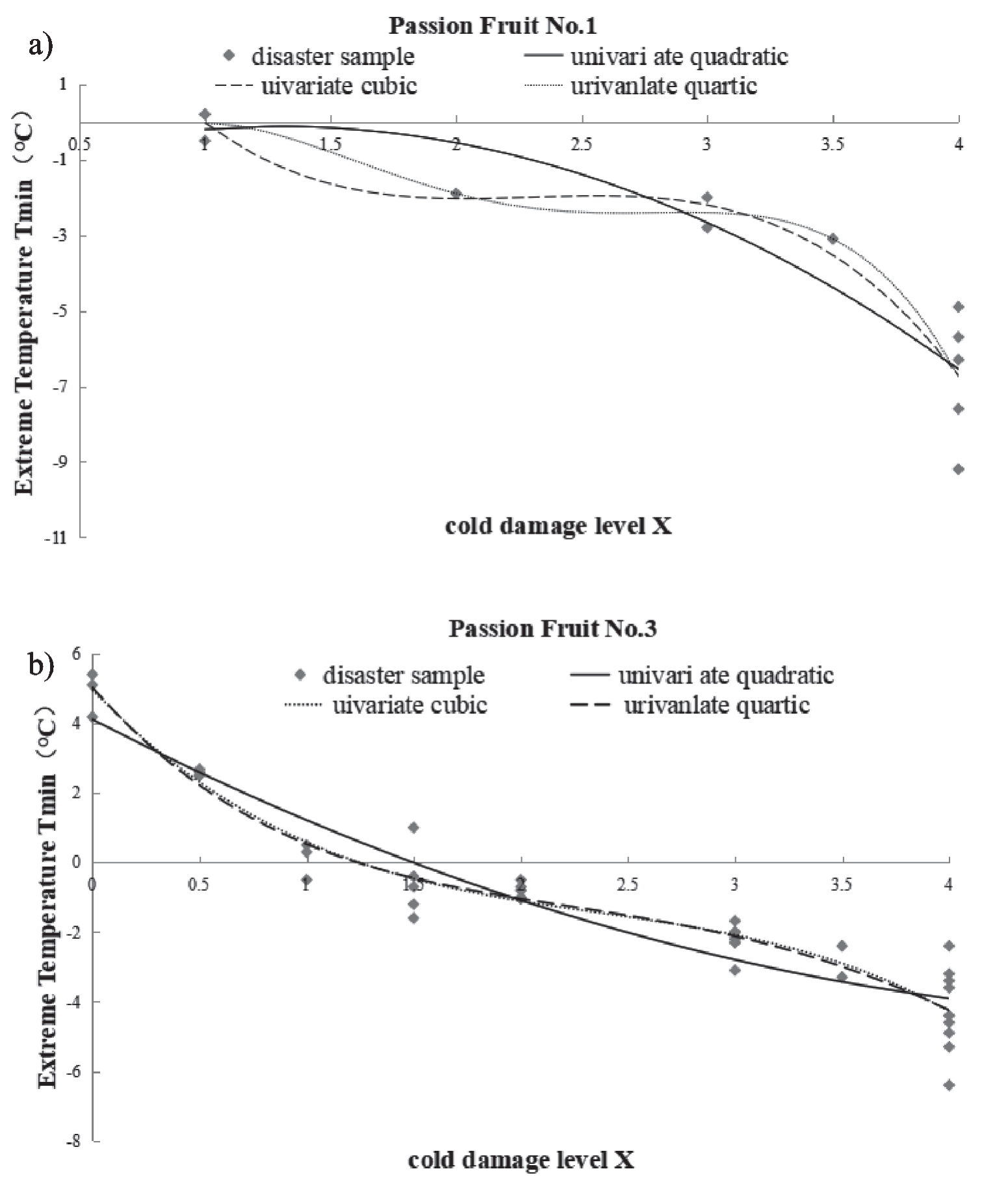
Table 4.
Fitting results of cold and frost damage grades and extreme minimum temperature of two cultivars of passion fruit.
Table 5.
Basic instructions.
The results showed (see Table 5) that when passion fruit was frost damaged, the freezing damage of the two species of passion fruit tended to be severe with the decrease in extreme minimum temperature Tmin. The critical threshold of each frost damage grade of passion fruit No. 1 was lower than that of passion fruit No. 1, except for the severe grade of passion fruit No. 3 (all -1.5ºC), indicating that passion fruit No. 1 was more resistant to low temperature and stronger cold resistance than passion fruit No. 3.
Preliminary Determination of the Passion Fruit Frost Damage Grade Index
Low Temperature Simulation Test of Artificial Climatic Chamber Test
According to the results of the low-temperature simulation test of the artificial climate chamber, the actual frost damage grades of passion fruit No. 1 and No. 3 seedlings were obtained according to the grading standards of passion fruit cold and frost damage, and the frost damage grades calculated according to the preliminarily determined indicators were compared. The results are shown in Table 6 and Table 7.
Table 6.
Comparison and verification of the low-temperature simulation test in the artificial climate chamber (passion fruit No. 1 seedling).
Table 7.
Comparison and verification of the low-temperature simulation test in the artificial climate chamber (passion fruit No. 3 seedling).
As shown in Tables 6 and 7, the lower the extreme minimum temperature, the more severe the symptoms of frost damage in passion fruit seedlings. The results of the comparison and verification of frost damage grades showed that under 8 temperature levels, 25 samples from 32 samples of Passion Fruit No. 1 seedlings matched with each other, with a coincidence rate of 78%, and 28 samples from 32 samples of Passion Fruit No. 3 seedlings matched with each other, with a coincidence rate of 87.5%. Under the same extreme minimum temperature treatment, passion fruit No. 1 seedlings had milder cold and frost damage symptoms than passion fruit No. 3 seedlings. In the 3ºC, 2ºC, and 1ºC treatments, passion fruit No. 1 seedlings had cold symptoms, but quickly resumed growth, and passion fruit No. 3 seedlings from 2ºC suffered from cold and frost damage, which adversely affected later growth, suggesting passion fruit No. 1 seedlings have stronger cold resistance and can withstand lower temperature cold damage. This is consistent with the preliminary results of the frost damage grade index of the two varieties of passion fruit.
The main reasons for the frost damage grade error in the analysis test are as follows. First, the cold and frost resistance of passion fruit seedlings is weaker than that of adult trees, so the symptoms of cold and frost damage are more obvious at the same low temperature. Second, in this low-temperature disaster test, the treatment of each low-temperature duration was increased, so the longer the low-temperature duration, the more serious the cold frost damage symptoms of passion fruit.
Comparative Confirmation of Disaster Situation in Literature Collection
At present, purple passion fruit, yellow passion fruit, purple fruit, and yellow fruit hybrids are the three main cultivated populations. China’s main passion fruit varieties are Tainong No. 1 (purple-yellow hybrid), golden passion fruit, purple fragrance No. 1, and Mantianxing. Fujian Province passion fruit No. 1 and No. 3 are new varieties after the improvement and domestication of Tainong No. 1 and golden passion fruit, so there is little difference between the original varieties. Therefore, through literature collection [27- 30], some passion fruit frost damage information was obtained, and the preliminary frost damage grade was verified through the analysis of disaster data.
From the passion fruit disaster samples in Table 8, it can be seen that 8 of the 10 samples’ actual frost damage grades are consistent with the grades judged by the preliminary indicators, indicating an agreement rate of 80%. The reason for the error of the 2 incorrectly judged samples is related to the duration of low temperature and the weaker cold resistance of fruit seedlings than that of adult trees. The literature of samples 1, 5, 6, and 8 all pointed out that the cold resistance of purple fruit cultivars is stronger than that of yellow fruit cultivars, and the literature of sample 6 also showed that the cold resistance of purple-yellow hybrids is also stronger than that of yellow fruit varieties, which is consistent with the results obtained in this study that passion fruit No. 1 (purple-yellow hybrid) has stronger cold resistance than No. 3 (yellow fruit).
Final Determination of the Passion Fruit Frost Damage Grade Index
From the above experiments and literature disaster analysis, it can be seen that through the verification of two methods of artificial climatic chamber low-temperature disaster tests and literature collection, the frost damage grade index of the two varieties of passion fruit is mostly consistent with the actual frost damage grade of 81.8% (average), indicating that the preliminarily determined frost damage index is reliable. Combined with the symptoms of passion fruit frost damage, the grade indicators of passion fruit No. 1 and No. 3 frost damage were finally determined (see Table 9).
Climatic Risk Regionalization for Cold and Frost Damage Planting of the Main Varieties of Passion Fruit
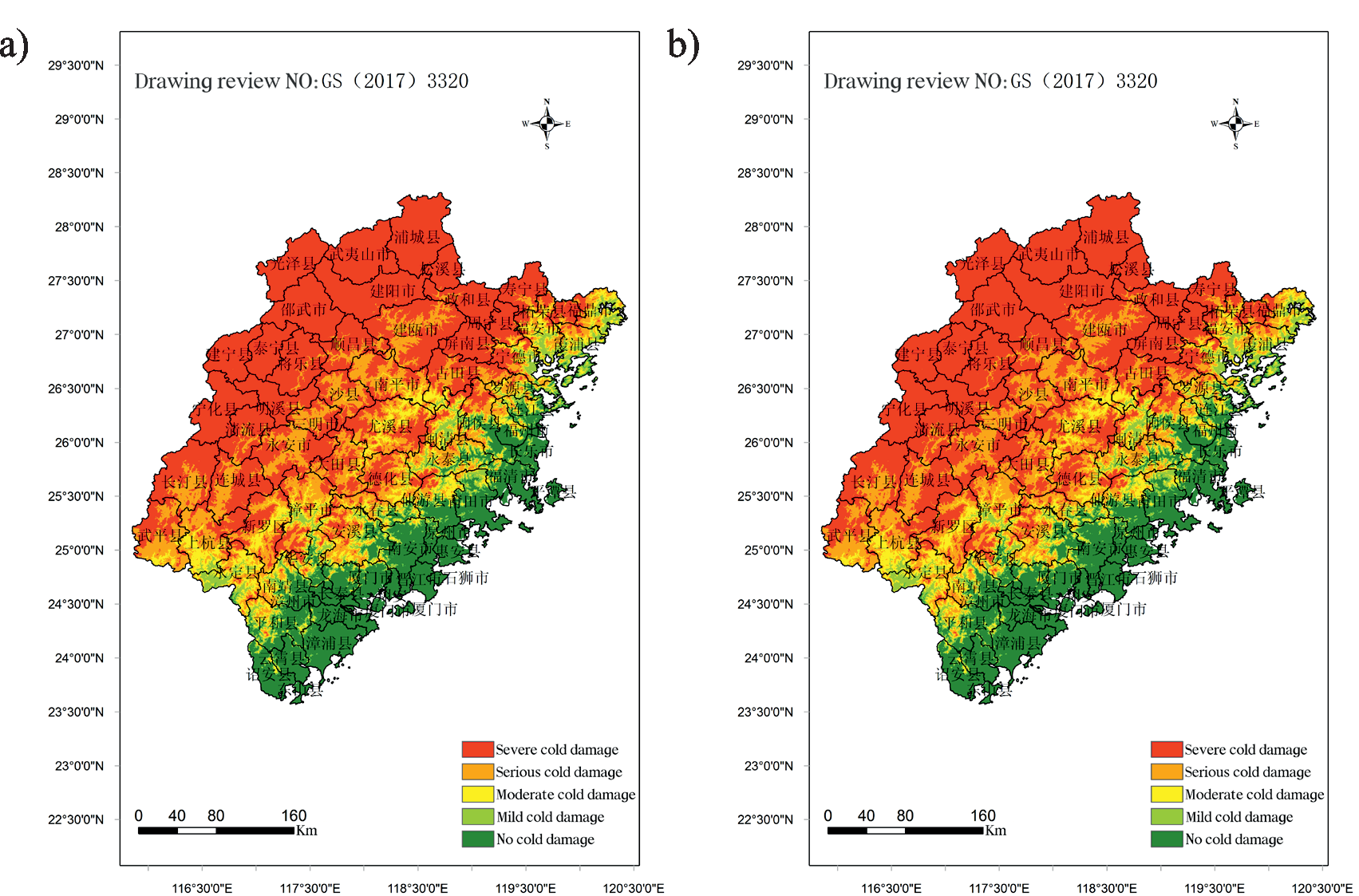
According to the extreme minimum temperature of the low temperature process, we refer to the determined passion fruit frost damage grade index, construct the passion fruit frost damage risk index, establish a multiple regression model of passion fruit cold and frost damage risk index and the longitude, latitude, and altitude of the measuring station, use GIS technology to geo-interpolate the frost damage risk index, convert the point data into surface grid data, and realize the spatial continuous distribution of the frost damage risk index.
From the climatic risk regionalization map of the two main cultivars of passion fruit (Fig. 2), the areas of passion fruit No. 1 and No. 3 with no cold and frost damage to mild frost damage are mainly distributed in the coastal areas of Fujian Province, which is therefore the area with the lowest risk of cold and frost damage in passion fruit No. 1 and No. 3 in Fujian Province, and is thus suitable for the introduction and expansion of passion fruit No. 1 and No. 3. However, in the winter cold air process, irrigation, straw covering, smoke, trunk bandaging, increased application of hot phosphorus and potassium fertilizer, spraying fruit tree antifreeze, and other cold prevention measures should be adopted to reduce or avoid frost damage losses. Passion fruit No. 1 has stronger cold resistance, and its northern boundary of planting could reach Fuding City in Fujian Province. Its inland planting area can reach Shanghang County, Zhangping City, and Gutian County, and its frost-free planting area is also wider than that of passion fruit No. 3. Its northern boundary can reach Lianjiang County, so passion fruit No. 1 is more suitable for the introduction of seeds in the inland and northern areas of our province. Moderate frost damage areas are mainly distributed in the central and southern inland areas of our province. Fujian Province introduced passion fruit disaster risk as a low-risk area, and the rest of the areas include severe-most severe frost damage areas. Due to the high cost of planting in facility greenhouses, in Fujian Province, passion fruit planting is less popular and applied, so it is recommended that moderate frost damage areas should not change the planting time and should still adopt the spring planting method to avoid the loss caused by the winter cold air process.
Table 8.
Verification of preliminary indicators by literature review of disaster samples.
Table 9.
Passion fruit No. 1 and No. 3 frost damage grade indicators and damage symptoms.
Discussion
The occurrence and extent of cold and frost damage to fruit trees are related not only to the intensity of low temperatures, but also to the duration of low temperatures. Therefore, some scholars have established comprehensive climate indicators for cold and frost damage with multiple disaster-causing factors, such as extreme minimum temperatures, maximum cooling amplitude, duration days, and harmful accumulated cold values, to monitor and evaluate the process of cold and freezing damage to fruit trees [31-34], but this indicator requires long-term forecast data and lacks practicality in real-time warning of cold and frost damage. Therefore, this study considers the practicality of an index in early warning detection and uses the extreme minimum temperature to determine the grading index of the passion fruit frost damage level. Since fruit trees may also be related to their own botanical characteristics in the process of suffering from frost damage [35, 36], research on the changes in plant physiological indicators after passion fruit frost damage can be conducted, and in future research on fruit tree frost damage, in addition to temperature factors, meteorological factors, such as precipitation, wind, sunshine, and other meteorological factors can be added to construct comprehensive meteorological disaster indicators of low temperature processes, so that the early warning effect of cold and frost damage is more accurate.
Conclusions
1. In this study, passion fruit No. 1 and passion fruit No. 3, the main cultivars of passion fruit in Fujian Province, were taken as the research objects, and combined with various methods such as historical disaster inversion, orchard positioning observation, and geographical displacement experiment. Combined with the grading standards of passion fruit cold and frost damage victims, mathematical statistical methods were used to determine the cold and frost damage grade index of passion fruit subcultivars, and it was found that passion fruit No. 1 was more resistant to low temperature than passion fruit No. 3, and its cold resistance was stronger.
Fig. 2.
Climatic Risk Regionalization for Passion Fruit Cold and Frost Damage Planting: a) Passion fruit No. 1; b) Passion fruit No. 3.
2. Through the verification of two methods of artificial climatic chamber low-temperature disaster tests and literature collection, the preliminary obtained frost damage grade index of passion fruit and the actual frost damage grade agreement rate reached 81.8%, indicating that the determined frost damage index is reliable. The main reasons for the deviation in the analysis of frost damage grade are as follows: first, the cold and frost resistance of passion fruit seedlings is weaker than that of adult trees, so the symptoms of frost damage are more obvious at the same low temperature; second, the longer the duration of low temperature in the sample, the more serious the symptoms of passion fruit frost damage.
3. According to the results of passion fruit cold frost damage planting climate risk regionalization, passion fruit No. 1 and No. 3 no cold and frost damage - mild frost damage areas in Fujian Province are mainly distributed in the coastal areas of Fujian Province, which is the area with the lowest risk of passion fruit planting No. 1 and No. 3 in Fujian Province, and is suitable for the introduction and expansion of passion fruit No. 1 and No. 3. Due to its stronger cold resistance, passion fruit No. 1 can be planted in a wider area throughout the province, which makes it more suitable for introduction in the inland and northern areas of Fujian Province.
The research results can establish objective and quantitative low-temperature cold and frost damage grade indicators, and provide technical support for the fine monitoring, early warning assessment and regionalization of passion fruit cold and frost damage in our province, and a scientific basis for local agricultural production departments to formulate appropriate decisions and measures for seed introduction, expansion, disaster prevention, and mitigation.

