

Introduction
The inability to adequately utilize macromolecules (carbohydrates, proteins, and lipids) leads to hyperglycemic states and an increased risk of cardiovascular disease in people with diabetes mellitus (DM). Diabetes mellitus is a group of metabolic disorders characterized by impaired glucose regulation due to impaired insulin production [1]. Diabetes mellitus (DM) is believed to be a worldwide disease that results from either a genetic predisposition or an acquired inability of the pancreas to produce sufficient insulin, leading to insulin resistance at peripheral receptors or an inability of insulin to perform its function [2]. Without insulin, a diabetic’s metabolism is unable to control blood glucose levels, resulting in increased abnormal production of fats, proteins, and carbohydrates [3]. Multi-organ failure, dysfunction, and persistently high blood glucose are among the most serious consequences of diabetes mellitus [4]. Hyperglycemia, the hallmark of diabetes mellitus (DM), increases cardiovascular risks at both microvascular and macrovascular levels, impairs carbohydrate, lipid, and protein metabolism, and causes chronic damage that eventually leads to organ failure at sites such as the kidneys, eyes, nerves, heart, and blood vessels [5, 6]. According to recent statistics, more than 150 million people worldwide have diabetes, and this number is expected to increase to about 300 million by 2025. In 2014, about 8.5% of adults were diagnosed with diabetes, and in 2017, about 1.6 million deaths were associated with diabetes [7]. Pakistan has the seventh-highest prevalence of diabetes in the world and is among the top 10 countries with the highest prevalence of this disease. The prevalence of diabetes in Pakistan was recently estimated to be 7.6-11% and is expected to reach 15% by 2030, which would rank Pakistan fourth in the world [1]. Globally, over 700 billion (10%) more is spent annually on diabetes, and common medications have harmful consequences with prolonged used. Therefore, there is a growing interest in diabetes prevention and treatment options that are more natural and less intrusive. Some natural products have been shown to effectively control glucose metabolism and halt the health decline of sufferers, at low cost and with minimal risk of adverse consequences [8-9].
C. tuberculata, a member of the Apocynaceae family, is known for its medicinal properties. C. tuberculata is an annual plant that can reach a height of 45 cm. At the end of the stem there is a cyme in which the flowers grow. The flowers are black, yellow, red, dark, and brown, but they aren’t very fragrant [10]. C. tuberculata has a variety of enriched phytochemicals. Polyphenols and flavonoids are two types of phytochemicals that can help treat DM by eliminating free radicals and reducing oxidative damage [11]. By binding to glucose transporters, they can lower blood sugar levels by preventing competition between α - amylase and α-glucosidase. Saponins, terpenoids, ferulic acid, and gallic acid have also been shown to improve pancreatic function and reduce the amount of glucose absorbed by the intestine. These phytochemicals increase insulin secretion, accelerating glucose uptake and utilization. There are several ideas about how these plants can help people with diabetes. Some of them are that more insulin sticks to the receptors, insulin resistance decreases, glucose tolerance increases, and more insulin comes out of the pancreatic β-cells. The way glucose is utilised in the body is better, as well as the size and activity of β-cells, the amount of insulin in plasma, and the amount of glucose in blood [12]. Alloxan-induced diabetes in mice responded well to the antidiabetic potential of Caralluma europaea plant [13].
The aim of this study was to investigate the effects of C. tuberculata extract on some physiological parameters in mice suffering from diabetes. Few studies have been conducted on the antidiabetic effects of this species. Therefore, we hypothesized that the tested physiological parameters would improve in diabetic animals after administration of C. tuberculata extracts to highlight for the first time the antidiabetic properties of this species and to show a relationship between its traditional use and scientific research. Bioactive constituents have been identified in several Caralluma species, indicating that are evidence of their therapeutic and pharmacological potential. They are helpful against diabetes, cancer, inflammation, and microorganisms. Several Caralluma species have also been described in traditional medicine as effective against diabetes, cancer, inflammation, skin rashes, scabies, and fever [14-15]. The aim of this study is to establish a link between the traditional and scientific uses of C. tuberculata by investigating the effects of the extract on various physiological parameters in mice suffering from diabetes. The goal of this study was to see how C. tuberculata affected the blood sugar levels and organ weights of diabetic mice.
Materials and Methods
Collecting the Plant
C. tuberculata was collected in Khushab, District Punjab, Pakistan. The plant (C. tuberculata) was identified by the herbarium botanist, Department of Botany, Sargodha University, Punjab, Pakistan, and compared with other available literature [14, 15].
Extraction of Plant
For 15 days the plant sample was dried in shade. The dry parts were pounded into fine powder using a mortar and pestle and the powder was stored at room temperature in an Eppendorf tube for further use. The entire process was performed according to the protocol described by [16-18] with a slight modification.
Experimental Animals
The animals used for the experiment were maintained and kept in the animal house of the Zoology Department of the Sargodha University, Punjab, Pakistan. A total of 60 male albino mice (Mus musculus) were used for the experiment. The mice weighed were 25-30 g and were 5-6 weeks old when the first treatments were administered. The mice were housed for one week before being used in the experiments to ensure that they were acclimated to their new environment. Each group was housed separately in a clear polycarbonate cage with a sturdy stainless steel lid. Animals were maintained in a controlled environment with a 12-h light/dark cycle, a temperature of 20-25ºC, and a humidity of 60±1%. They were provided food (standard pellets) and drink during this period.
Induction of Diabetes Mellitus
Individually identifiable animals were chosen, weighed, and marked. The desired dose of 150 mg/kg/bw of alloxan, purchased from Sigma-Aldrich, was prepared in phosphate-buffered saline (PBS). To induce diabetes, 40 mice weighing 30-35 g received an intraperitoneal injection of alloxan [20]. After one hour of alloxan administration, to combat the early hypoglycemia shock, a solution of dextrose with a concentration of 5% was administered by feeding bottle for one full day. After 72 h, animals whose blood glucose concentrations were above 250 mg/dL were classified as diabetic and deemed appropriate for the study.
Experimental Protocol
Dose Preparation and Administration
For oral administration (gavages), the powdered extract was mixed in corn oil, then the mixture was homogenized and stored at room temperature. Corn oil was used as the vehicle. It is reported that C. tuberculata proved to be more significant when taken with cooking oil [21].
Dose Regime
120 mg/kg metformin hydrochloride, a commercially available diabetes drug, was administered to the metformin-treated groups, while the dose-treated groups received 200 mg/kg/bodyweight of a simultaneously prepared and powdered extract. The experiment was continued for four weeks.
Grouping
Sixty male mice weighing 25 to 30 g and 5 to 6 weeks of age were randomly selected and divided into six groups (n = 10).
Sixty mice were also divided into six groups of ten mice each (n = 10). Initial body weight was determined using a digital scale (HI-500), and animals were divided according to the following schedule:
Group I control (C): This group remained untreated throughout the experiment.
Group II C. tuberculata extract (CTE): In this group, animals were treated with powdered extract at a dose of 200 mg/kg/bodyweight [19, 20].
Group III Diabetic Mellitus (DM): This group consist of animals suffering from diabetes.
Group IV Diabetic Mellitus and Cooking oil (DM + oil): This group consist of animals suffering from diabetes and given cooking oil.
Group V Diabetic Mellitus + C. tuberculata extract (DM + CTE): In this group, the diabetic animals were treated with the prepared extract at a dose of 200 mg/kg/bodyweight [19-20-21]
Group VI Metformin-treated diabetic group (DM + metformin): This group consist of mice with diabetes treated with metformin at a dose of 120 mg/kg/ bodyweight [20].
Statistical Analysis
The data was shown as a mean with a standard error of the mean (SEM). For normality analysis, the D’Agostino and Pearson tests were used to determine the normality of the data. One-way analysis of variance (ANOVA) was used to compare the groups, and then Tukey’s test was used to determine statistical significance. Statistical analysis was performed using GraphPad Prism software version 8.0.1. At a p-value of 0.05, the difference was determined to be statistically significant.
Results
Mean Sugar Level
The results of one-way analysis of variance showed a statistically significant difference in mean sugar level in subject with diabetes mellitus which were significantly higher at 24 h (p<0.001) and 48 h (p<0.01) than in the control and CTE groups. Compared to the CTE group sugar levels were higher at 72 h (p<0.01) and 96 h (p<0.05). The mean sugar level in the DM + oil groups also showed a similar trend after 24 h, 48 h (p<0.01), and 72 h, 96 h (p<0.001) compared to the control and CTE groups. Compared to diabetes mellitus group, DM + CTE group showed significantly greater recovery of sugar level at 24 h (p<0.01) significant recovery at 24 h (p<0.05), 72 h (p<0.05), and 96 h (p<0.01) in the DM + oil group. In the DM + metformin group, sugar levels decreased at 96 h (p<0.05) compared to the DM + oil treated group. Administration of CTE significantly reduced the effects of diabetes (Table 1).
Mean Brain Weight
The diabetes mellitus group’s mean brain weight was significantly larger (p<0.001) than that of the control, CTE, and DM + oil treatment groups, according to an ANOVA analysis. Significantly, the mean brain weight of the DM + metformin group decreased more than that of the control, CTE, and DM + oil groups (p<0.001). Administration of CTE considerably redued diabetes’s negative consequences (Fig. 1).
Mean Heart Weight
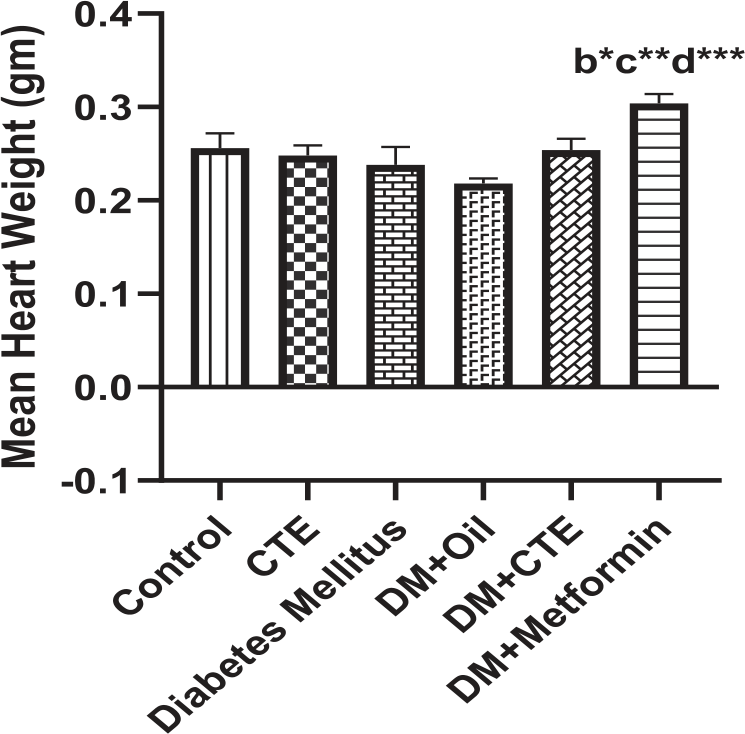
According to a one-way ANOVA, the mean heart weight in the DM + metformin group was significantly higher than the CTE (p<0.05), diabetes mellitus (p<0.01), and DM + oil (p<0.001) treated groups (Fig. 2).
Mean Lungs Weight
According to the one-way analysis of variance, the diabetes mellitus group had a significantly lower mean lung weight (p<0.01) than the CTE-treated group. The administration of CTE and metformin significantly reduced the effects of diabetes (Fig. 3).
Mean Pancreas Weight
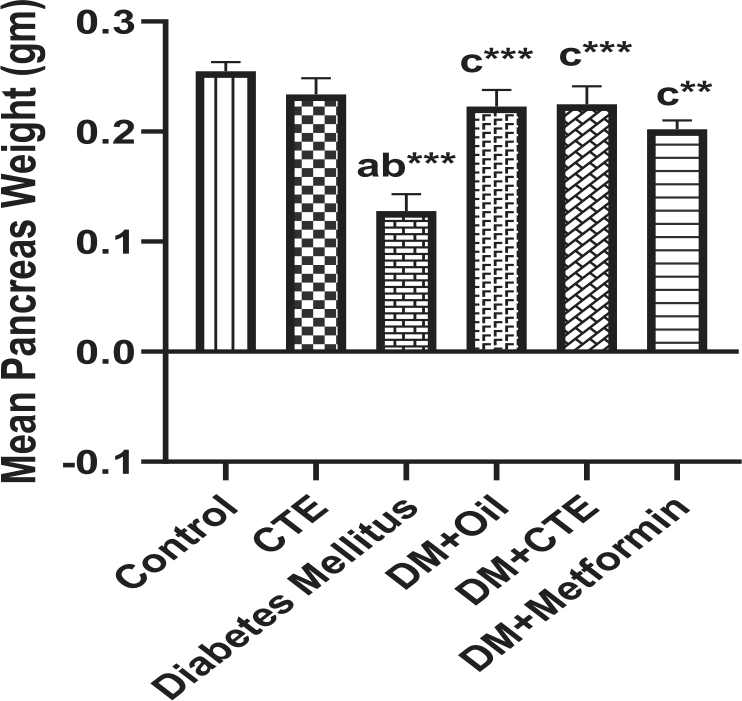
According to the statistical analysis, the diabetes mellitus group had significantly lower mean pancreas weight than the control (p<0.001), CTE (p<0.001), DM + oil (p<0.001), DM + CTE (p<0.001), and DM + metformin (p<0.01) treated groups. The administration of CTE and metformin significantly reduced the effects of diabetes (Fig. 4).
Mean Spleen Weight
Average spleen weight was found to be considerably greater in the CTE group (p<0.01), the diabetic mellitus group (p<0.001), the DM + CTE group (p < 0.001), and the DM + Metformin group (p<0.001). When comparing the two groups, those with DM + CTE had a considerably bigger spleen on average (p<0.05). Compared to the DM + oil group, both the DM + CTE and DM + metformin groups had considerably heavier spleens (p < 0.001 and p<0.05, respectively) (Fig. 5).
Table 1.
The effect of C. tuberculata extract on mean sugar level (mg/dl) in alloxan-induced diabetic adult male mice.
[i] Note: Values are presented as Mean±SEM, a = control group versus treated (CTE, Diabetes Mellitus, DM + Oil, DM + CTE, and DM + Metformin) groups; b = CTE group versus Diabetes Mellitus, DM + Oil, DM + CTE, and DM + Metformin; c = DM + Oil, DM + CTE, and DM + Metformin; d = DM + CTE, and DM + Metformin, ***p<0.001, **p<0.01, *p<0.05
Fig. 1.
Mean brain weight of control, CTE (200 mg/kg/bw), Diabetes Mellitus (alloxan 150 mg/kg/ bodyweight), DM + oil (2 mL/kg/ bodyweight), DM + CTE (200 mg/kg/ bodyweight), DM + metformin (120 mg/kg/ bodyweight) treated mice (n = 10) after 4 weeks of experimental period. Values are presented as mean±SEM, ***p<0.001.
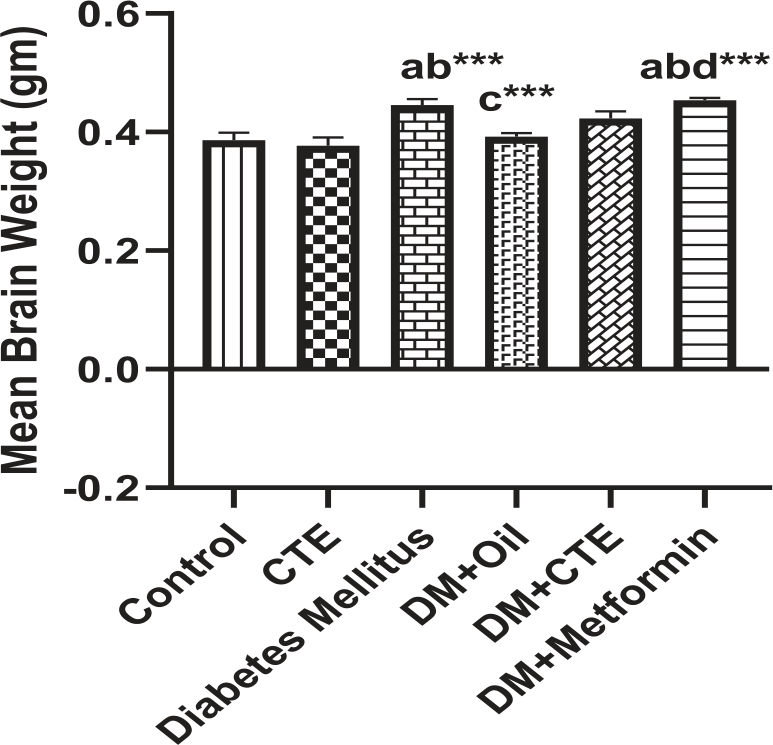
Fig. 2.
Mean heart weight of control, CTE (200 mg/kg/bw), Diabetes Mellitus (alloxan 150 mg/kg/ bodyweight), DM + oil (2 mL/kg/ bodyweight), DM + CTE (200 mg/kg/ bodyweight), DM + metformin (120 mg/kg/ bodyweight) treated mice (n = 10) after 28 days of experimental period. Values are presented as mean±SEM, ***p<0.001, **p<0.01, *p<0.05.
Mean Stomach Weight
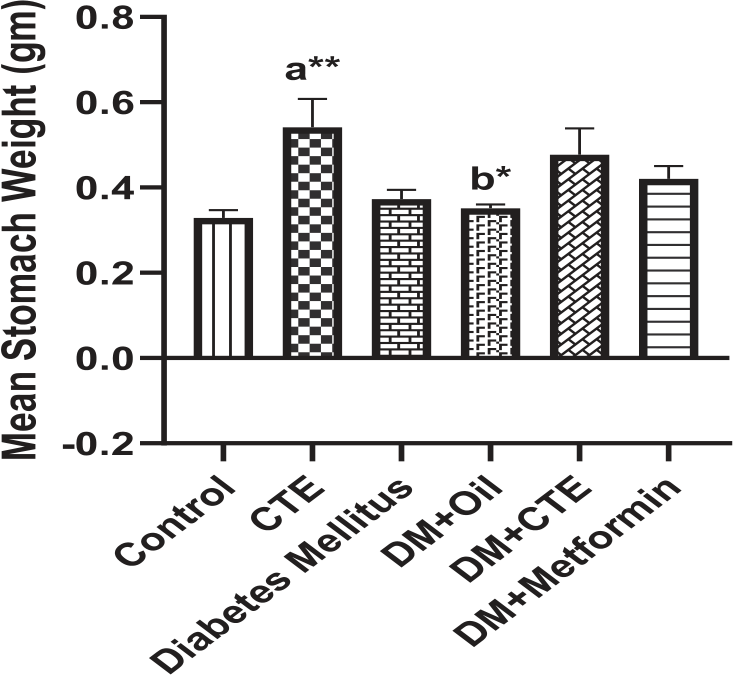
The CTE group was found to have a significantly higher mean stomach weight as compared to the control group and the DM + oil group (p< 0.01). The combined use of CTE and metformin mitigated the disease’s consequences (Fig. 6).
Fig. 3.
Mean lungs weight of control, CTE (200 mg/kg/bw), Diabetes Mellitus (alloxan 150 mg/kg/ bodyweight), DM + oil (2 mL/kg/ bodyweight), DM + CTE (200 mg/kg/ bodyweight), DM + metformin (120 mg/kg/ bodyweight) treated mice (n = 10) after 4 weeks of experimental period. Values are presented as mean±SEM, **p<0.01.
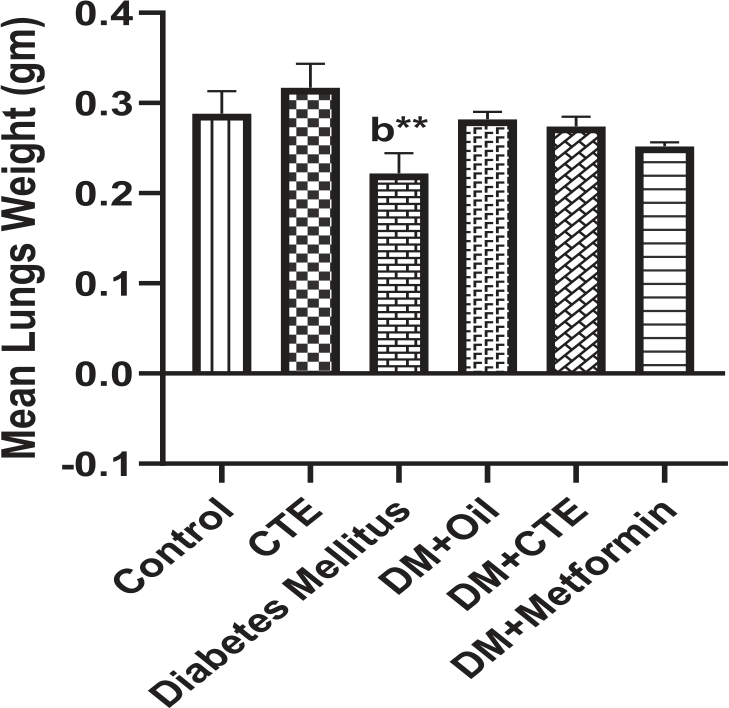
Fig. 4.
Mean pancreas weight of control, CTE (200 mg/kg/bw), Diabetes Mellitus (alloxan 150 mg/kg/ bodyweight), DM + oil (2 mL/kg/ bodyweight), DM + CTE (200 mg/kg/ bodyweight), DM + metformin (120 mg/kg/ bodyweight) treated mice (n = 10) after 28 days of experimental period. Values are presented as mean±SEM, ***p<0.001, **p<0.01.
Discussion
Pandemic diabetes mellitus (DM) affects people all over the world. Researchers began searching for antidiabetic components in traditional herbal remedies bodyweight), DM + oil (2 mL/kg/ bodyweight), DM + CTE (200 mg/kg/ bodyweight), DM + metformin (120 mg/kg/ bodyweight) treated mice (n = 10) after 28 days of experimental period. Values are presented as mean±SEM, **p<0.01, *p<0.05. as DM cases rose. Traditional herbal remedies for DM have produced positive outcomes. Because they are affordable and have few side effects, herbal treatments are extensively used. Research investigations have demonstrated the antidiabetic effectiveness of numerous active plant-based substances [27]. Herbal medications can be made from a variety of plant parts, including leaves, stems, roots, bark, flowers, seeds, and fruits [28-29]. Several Caralluma species, such as Caralluma attenuate Wight [30], Caralluma sinaica (Decne.) A. Berger, and Caralluma edulis (Edgew.) Benth. ex Hook.f., are particularly successful in treating DM by lowering blood glucose levels. [31-32].
Fig. 5.
Mean spleen weight of control, CTE (200 mg/kg/bw), Diabetes Mellitus (alloxan 150 mg/kg/ bodyweight), DM + oil (2 mL/kg/ bodyweight), DM + CTE (200 mg/kg/ bodyweight), DM + metformin (120mg/kg/ bodyweight) treated mice (n = 10) after 4 weeks of experimental period. Values are presented as mean±SEM, ***p<0.001, **p<0.01, *p<0.05.
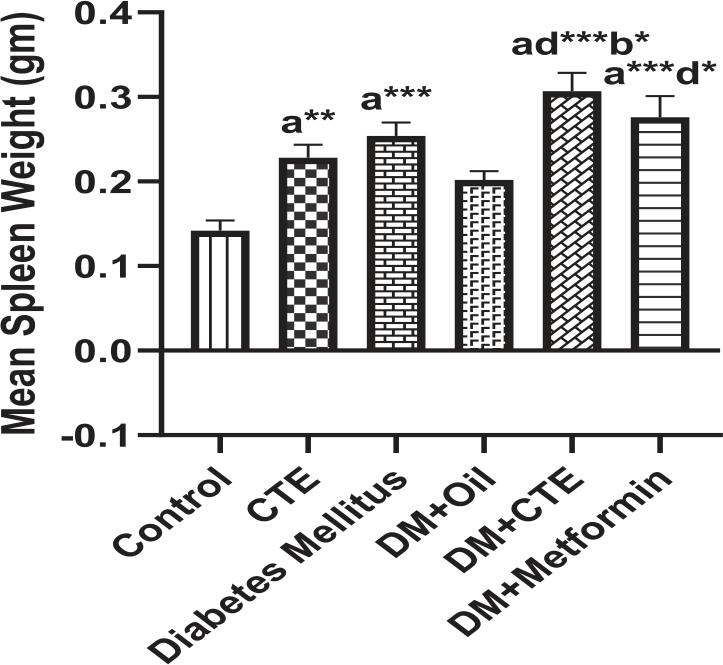
Fig. 6.
Mean stomach weight of control, CTE (200 mg/kg/ bodyweight), Diabetes Mellitus (alloxan 150 mg/kg/ bodyweight), DM + oil (2 mL/kg/ bodyweight), DM + CTE
This study showed that C. tuberculata extracts reduced blood glucose levels in diabetic mice, indicating that they might have a comparable effect in people. CTE has also been demonstrated to have anti-hyperglycemic effects by binding to glucose transporters and competitively blocking α -amylase and α -glucosidase. The inclusion of terpenoids, gallic acid, ferulic acid, and saponins has been linked to improved pancreatic tissue function, faster glucose uptake and utilization, and decreased intestinal absorption. Utilizing these plants increases the affinity of pancreatic B cell receptors for insulin-like growth factor 1 (IGF-1) and glucagon-like peptide-1 (GLP-1) and thus improves insulin sensitivity, lowers insulin resistance, and improves glucose tolerance. Plasma insulin levels are boosted, glucose metabolism is enhanced, B-cell growth and function are improved, and blood sugar levels are decreased [33]. Plant parts such as leaves, stems, roots, bark, flowers, seeds, and fruits can all be used to make herbal medicines. DM can be effectively treated with a number of Caralluma species, including C. attenuate, C. sinaica, C. tuberculata, and C. edulis [34]. The concentrations of glucose can significantly drop as a result of these organisms. Several Caralluma species have been reported to be both edible and therapeutic in the past [24]. In addition to suppressing appetite, C. fimbriata Wall. is used to treat diabetes, pain, inflammation, and fever in India [35]. C. tuberculata is commonly used as an antipyretic, to treat diabetes, rheumatism, and leprosy in addition to being ingested [36]. Black pepper and C. attenuata juice are used to treat diabetes and to relieve migraines, respectively [37]. Both C. umbellate Haw. and C. adscendens (Roxb.) R.Br. have been shown to have antilipidemic effects. Furthermore, C. fimbriata has demonstrated anti-obesity qualities [37]. Pregnane glycosides, flavone glycosides, megastigmane glycosides, and triterpenes are the phytochemical components of Caralluma that have beneficial physiological effects [32]. The data show that C. fimbriata extract has reduced food intake, body weight, body mass index, hip circumference, and body fat. Similar results have been demonstrated by Lawrence and Choudhary [38]. In rats with streptozotocin-induced diabetes, several C. tuberculata extracts demonstrated their potential and mechanisms of antidiabetic action [39]. The strongest portions were the water and methanolic extract, with the latter showing higher activity. The methanolic extract’s antihyperglycemic activity has been linked to increased skeletal muscle glucose uptake, the inhibition of hepatic gluconeogenesis, and the stimulation of insulin secretion. In rats with STZ-induced diabetes, oral administration of a methanol extract of C. fimbriata caused substantial drops in blood glucose levels [40]. There may be substances similar to pregnane glycosides in the aerial parts of Caralluma europaea (Guss.) N.E.Br. and C. tuberculata that have hypoglycemic activity. A methanolic extract of aerial parts of various Caralluma species was previously found to have a hypoglycemic effect on streptozotocin-induced diabetic mice. The acetylated and nonacetylated pregnane glycosides of C. tuberculata are what give the plant its hypoglycemic properties [13, 41, 42].
The effect was seen in this study when mice received dosages of 100 and 200 mg/kg body weight, respectively, and was stable throughout treatment durations. In a nutshell, the findings of the present investigation demonstrated that the combination of CTE and metformin effectively reduced the negative consequences of diabetes in rats. According to the in vivo trial’s findings, CTE may be able to decreased the effects of alloxan on organ weight and glucose levels, two symptoms of diabetes. This protective effect is thought to be caused by pancreatic beta cells stimulating the synthesis of insulin. As a result, pharmacologically addressing CTE may be an effective diabetic treatment plan.
Conclusions
A plant-based assay that uses the medicinal plant’s extracts is efficient for the treatment of diabetes mellitus. In the current investigation, extract fractions from the plant C. tuberculata, which has historically been used to treat diabetes mellitus, were found to have significant anti-diabetic effectiveness in generated diabetic mice. Because of this, it is essential to do additional research, including safety assessments as well as the isolation and characterization of the bioactive chemical or compounds responsible for its antidiabetic activity, and to speculate on the likely mechanism of action.

