

Introduction
Public Risk Perception of Environment
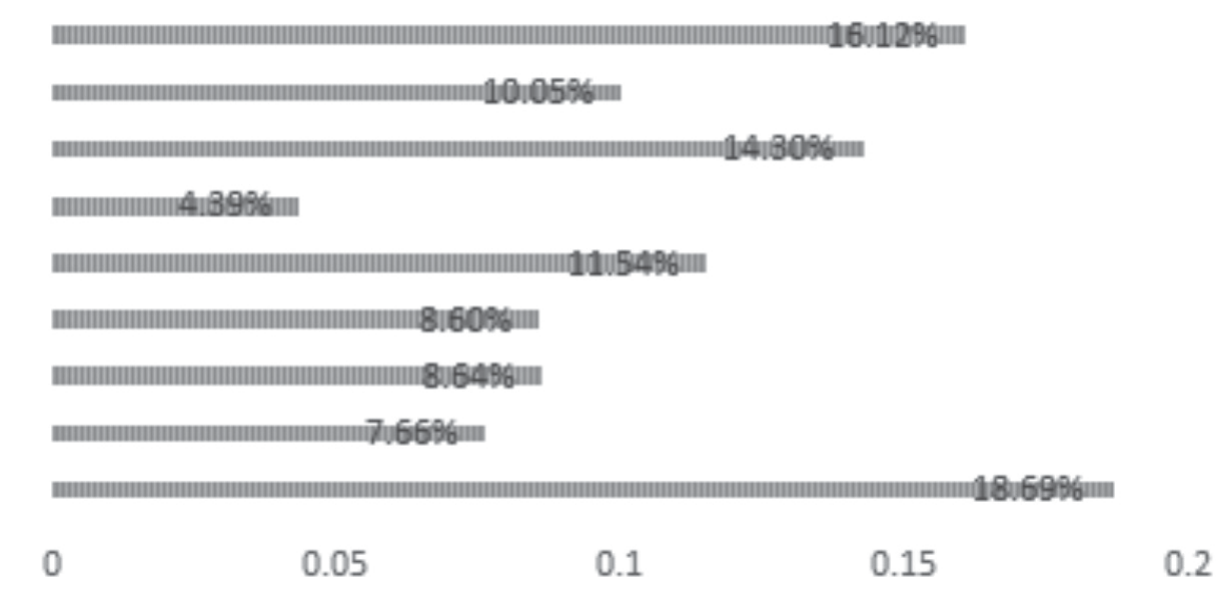
As the Chinese economy has grown rapidly over the past years, environmental degradation has become increasingly more prominent. Concerns about environmental protection with industrial pollution and poor environmental quality have risen over the years in China. According to our survey, respondents consider environmental risk to be the issue of greatest concern in contemporary China; and environmental risk is one of the three most highlighted issues, preceded only by economic growth and education (Fig. 1). The notations in Fig. 1 are as follows: ESE: Elementary and Secondary Education, PHMC: public healthcare and medical service, FS: food safety; EG: economic growth; GOC Government officers’ corruption; WO: Work opportunity; EP: environment protection; NDDP: national defense and domestic policies; ARP: Gap between the Rich and the Poor. Government authorities mostly make decisions respecting to the industrial practice activities, as well as the experts’ scientific estimation of risks, while residents’ risk judgments are not well understood or considered. Due to the differences over the risk knowledge, exposure and attitudes among residents and government authorities, appropriate risk communications are critical to mitigate residents’ anxieties [1].
Somewhat related to risk concerns are considerations of the roles of information and knowledge in the formation of environmental beliefs and risk perceptions [2]. The exposure of information on environmental issues to the public seems to have a large effect on the variance of their perception and responses to potential environmental risk [3]. Environmental information and knowledge may increase or, in some cases, decrease perceptions of risk [4]. Thus, it is assumed in this paper that due to the variance in the content, timing, and frequency of the risk information in different information channels, different information sources gain different rates of credibility from their audience. In turn, different information channels differently influence the public’s risk perception. Therefore, how to achieve a more detailed understanding of how people increasingly evaluate environmental risks from diverse information sources is a pivotal task for governments and can help governments optimize crisis communication design [5].
Regarding the effects of information communication on risk perception, different information sources with various credibility may be key determinants [6]. In China, due to the gap in the effects of governmental information regulations on different channels, such as official media, commercial media, and the internet, the public’s exposure and trust in different sources vary. Accordingly, the preference of information source potentially an important influencing factor for residents’ risk perception of environment problems and the political practice. Additionally, income, gender and education level represent individual characteristics and thereby they normally shape peoples risk perception. Differently from existing studies, we include individual characteristics in our regression models. Additionally, most of the research in this area neglects the growing diversity in the population, especially regional (urban-rural/east-west) differences and those for China. Meanwhile, most of related researches did the research based on the survey data from specific communities or areas, this study addresses the analysis with a national wide surveyed data that provides more diversity of samples.
A national survey by Asia Barometer Survey was conducted in 2015 in the mainland China, whose questionnaire includes people’s perception of environmental risks and preferred information sources. Although the terms ‘‘values,’’ ‘‘beliefs,’’ ‘‘attitudes,’’ and even ‘‘paradigms’’ are somewhat interchangeable in the existing literature, we use the term ‘‘general environmental beliefs’’ to refer to non-issue-specific cognitive orientations [7]. Additionally, we explore the relationships between information access and people’s physiological risk perception of the environment. This paper contributes to the knowledge gap by further understanding the influence of information preference on environmental risk perceptions in China.
Problem Description and Hypothesis
Risk is a set of destructive consequences that people believe to be possible in current situation at real time [8]. Risk consists of the thoughts and beliefs about the severity, possibility and exposure of a risk issue [9]. Risk perception refers to people’s subjective judgments about a risk. Risk perception is central to many behaviors and risk avoidance studies [10]. Existing research states that previous beliefs and values influence the process of receiving and processing risk-related information by individuals [7].
Social contraction of risk perception suggests that information enables to shape the risk perceptions even the individual has not the corresponding experience over the risk [11]. The information of risk including the recorded/reported information, the people involved and the type of risk is very critical and important in estimating the volume of risk. In order to know more of risks, the public enable access environmental risks by all kinds of information media, e.g., the TV, radio broadcasts, magazines or even the face-to-face talks. Because the media, people are equitably and easily to access environmental risks and uncertain situations that arise in lives [12]. The nature of constructive perceptions of risk shapes the public’s psychological feelings and reactions, which provide the government and experts to pay some influence on it [13]. In practice, the essential strategical methods are normally employed to conduct the risk communications in which the institutional trust are contributors in the communication process [14]. As for the environmental issues, the governments enable to communicate with public to reduce their anxieties and seek to appropriate reactions. Thus, perfect risk information communication of environmental risk helps to elicit residents’ understanding and support for governmental management of programs. Meanwhile, the government is able to take effective risk solutions for environmental protection effects with the general public. Some studies found the positive relations between the information seeking behaviors and risk perception, but there is little consensus on the effective way to provide public with risk information exists [15]. Meanwhile, some scholars claims that there exist indirect associations between information resources and the public perception risk and thereby media are probably not a significant strong causal factor in risk perception. Moreover, media sources have more effects on general risk perception comparing with the effects to personal risk perception [16].
The risk communication method (verbal and numerical) is one of the key variables that influence risk perception. Due to the public’s bounded rationality and incompetence in information processing, they have to choose to trust some sources, such as authorities and experts. Therefore, we see that trust has an important effect on an individual’s risk perception. The public can obtain information through a wide array of sources and channels in the information society [17]. Two communication paths play the primary role in risk amplification: the media and interpersonal discussion [18]. Various degrees of credibility of different information sources and the degree of trust in an institution uphold the efficacy and preference of risk information communication. Many studies have generally found negative correlations between trust and perceived risk. Notably, in the face of low personal control over risk, people prefer only those messages that come from sources they perceive as trustworthy. Therefore, trust is especially important when risks are difficult for the public to control or understand. The absence of trust in information sources can amplify the amount of risk a person perceives [19].
For the general public, the media are main information sources in their daily life. In many cases, medias illustrate the causes and reality of risky situations in reports and comments, thereby the media potentially shape risk perceptions significantly [20]. Over the past several decades, China’s media have been more diverse and international in terms of sources and programs. As known to many people in the world, the media marketizations process has started from the early 1980s, and many commercial medias established to compete for their target populations and developed into disseminating various types for heterogeneous public preference. Except for the traditional medias (e.g., radio, television, newspapers and magazines), many internet-based medias including mobile communications and informal networks of friends arises in China society [21]. Different information sources have variance on official propaganda and information regulation polices in China. Meanwhile, various media differ in terms of information exposure and credibility, we suppose medias have different effects on shaping the public perception of environmental risk. Thus, we have hypothesis 1.
Hypothesis 1: Citizens’ general perceived risk about environmental issues will differ depending on the various channels of information access in China.
In China, the majority of the population can access television and radio in rural and urban areas. The government is usually chosen as the most reliable source of information. All television and radio stations are normally owned by governments and used for propaganda purposes in China. Government control of the media tends to be more extensive and might lead to more positive coverage. Positive information can be regarded as self-serving [22].
By the late 1990s, newer risk communication models were emerging. Older risk communication models (passive effect of individuals and a monopolistic effect of government agencies on the information sources) were being dismantled [19]. As said above, commercial media have become the second preferred traditional media channel [23]. The emergence of an open market-oriented economy in the last three decades has shaken the top-down communication monopoly of state media [24]. Media commercialization allows Chinese media to be more effective in disseminating information [25]. Commercial media inevitably offer more negative stories to attract readers and increase economic profits [26]. Among these media, magazines are somewhat more loosely controlled than newspapers [27]. Compared with television and radio with more positive coverage, related more diverse and controversial information about environmental issues exists in magazines and newspapers. In recent years, the public has preferred to seek reliable information provided by commercial media with high credibility instead of official media. Therefore,
Hypothesis 2: Concerning traditional media, citizens who depend on traditional media (television and radio) tends to express a lower degree of environmental risk than people whose commercial media sources include magazines and newspapers.
The emergence of the internet gradually prevailed for the public, replacing the top-down risk communication approach with traditional media. Traditional risk communication generally neglects the role of citizens as receivers; and traditional media controlled more or less by governments convey disinterest, over bureaucratese and jargon in the public’s opinion. As a result, the public is often frustrated and disappointed by the risk information provided by governments. Some studies state that newspapers and TV/radio have little direct influence on an independent evaluation of risk [28]. Due to the timeliness, sufficiency, and accuracy of the information on risk perception [29], online information via the internet will soon play a crucial role in risk information provision and communication with the general public. Along with the government’s decision to open up China to the world, internet sources became available to the Chinese people. The internet is often compared to the most commercialized papers in terms of its degree of marketization and the reduced ability of the state to control its content. The internet offers the public paths to learn about uncensored fast-breaking information inside and outside China. For example, the public in China was more dependent on the internet during the 2003 SARS outbreak when there was no information available from traditional mass media such as television or radio [30].
A previous study states that information from social media has a stronger impact on public risk perception than information from traditional media [31]. More negative information is exposed to social media. People are more likely to pay attention to warnings when they perceive that the source of information is ‘‘in the same boat’’ as them. The type of shared involvement between the information source and the receiver is likely to enhance risk perception [32]. Therefore, we have Hypothesis 3.
Hypothesis 3: Citizens who rely on social media for main information tends to express a higher degree of risk perception of environment than those who employ traditional media as their main information source.
Interpersonal exchange through social networks can initiate and amplify the process of the social diffusion of risk information. Individuals receive risk information from interpersonal networks such as family, friends, and neighbors. In turn, individuals also formulate their risk opinions and talk to others [33]. Interpersonal information sometimes has larger impacts on an individual’s risk perception than media [34]. For example, the greater the extent to which climate change is viewed as a risk by friends, family, etc., the more it amplifies and intensifies an individual’s risk perception [9]. In China, the instant messaging platform WeChat, as a new interpersonal exchange platform among friends in work and family since 2011, has experienced very strong growth. China’s netizens started disseminating potentially sensitive information via closed “friendship circles” (personal contact groups of up to 100 people), which were very difficult for the state censors to filter [35]. Once controversial information emerges on environmental issues, interpersonal communication enjoys more credibility than other traditional or social media platforms for citizens. Therefore, we have Hypothesis 4.
Hypothesis 4: Citizens who depend on interpersonal exchange as information source, tends to perceive a higher degree of risk about environment than traditional media and social media.
Moreover, scholars have proffered demographic characteristics of age, gender, personal experience, and education as important variables for understanding both environmental risk perception and willingness to act [36-38]. For example, women, especially women who are meal planners and caregivers for children, tend to express greater concern about the risks associated with environmental issues than men [39].
Second, people risk perception of environment is generally found to be affected by age. Most research shows that younger people report being more environmentally concerned than older people [40]. However, some researches state that older people are considered to have more life experience [41-43]. Thus, older people may have more chances to undergo more environment pollution issue and thereby perceive greater risk than younger people [44].
Third, educational attainment is an important predictor of public risk perception worldwide [45]. Some researches have found that less educated people usually exhibit higher levels of risk perception [46-48]. However, some researches made the opposite conclusion that individuals with higher education usually exhibit higher levels of risk perception [49-51]. The third branch finds that the impact of income on risk perception appears to be marginal.
Fourth, household income is correlated with the risk perception of environmental issues by the public [52]. Higher earners may be able to devote more energy and time to environmental issues due to their environmental knowledge than those who are less affluent. Additionally, homeowners also possess higher levels of perceived risk than those who rent a residence [53].
Huge economic gaps between urban and rural areas in many countries. As a result, there exists significant difference on peoples’ environmental perception between urban areas and rural areas, where the urban citizens have more requirements on quality of lives and the rural citizens seeks more basic needs of survival. Therefore, the urban residents perceive more risks than those in rural areas due to the economic dependency and concerns on quality of lives. Similarly, the good educated tends to have more income and have more desires on quality of life such as environment. The females are often more sensitive to social issues and concerns more on living conditions [54], we suppose the females perceive higher levels of environmental risks than males. Thus, we suppose lower-income, poorly educated residents who lives in rural areas are the least aware of environment risk whereas those who are highly-educated with high income living in urban. Based on the analysis above, we propose Hypothesis 5 and Hypothesis 6 as follows.
Hypothesis 5: Females who live in rural tend to perceive higher environmental risks than others.
Hypothesis 6: As else being equal, people with lower incomes with less education experience perceive greater risk concerning environmental issues.
Material and Methods
Data Survey
Our team conducted the mainland China part of the Asia Barometer Survey 2015 (ABS 2015), which is conducted in every three to five years by the cooperative network of universities in Asia. The surveys in ABSs are conducted cross-sectional by face-to-face all over the target countries. 6013 eligible samples were drawn in mainland China and surveyed in from July 1, 2015 to March 6 2016. The target population includes the people lives in rural and urban areas that aged 18 and above who have been living in the target communities for more than one month. The survey finally had 4068 completed and valid interviews with the valid response rate of the survey in mainland China of 67.65%.GPS assisted area sampling method combining with stratification and multistage PPS (probabilities proportional to size) is used to determine the samples [55]. In order to have valid and completed interview, the survey took three-round of review process. That is, the completed interview was reviewed by the field supervisor immediately after leaving the dwelling and later by the data manager. The unqualified survey was re-conducted or discarded in final.
Variables and Measurements
Our control variables of demographic variables are included in the questionnaire. Meanwhile, the behavior factors (information communication source) and explained factor of risk perception of environmental issues are measured by several items in the questionnaire. In the survey, the respondents were asked to denote their perceptions regarding environmental problems based on their past and present experiences. We employed one of the risk perception types by Slovic [56], perceived severity (the extent of harm a hazard would cause), to measure the public’s perception of environmental risk [10]. Ten-point Likert scale ranging from 1 (extremely bad) to 10 (extremely good) was used to measure people’s risk perception of environmental issues where the positive attitude is given higher values. The survey suggests that 49.38% of respondents’ level of education is as high as primary school, it is very doubtful that they can preciously present their perception level toward environmental issues. Because of the semantic differences, the respondents’ risk perception may not be measured accurately. However, the respondents’ attitudes direction, i.e., positive or negative, are significantly in survey. Thus, we deem the respondent’s perceived risk is negative when the measured values are equal to or above 6. Correspondently, we believe that the respondents perceive negative if they score environmental issues at 5 or below in interval [1, 10]; thus, their attitude is deemed unsafe.
This study aims to explore the underlining relations between residents’ information source and their risk perception of environment. In the survey, the respondents are survey by face-to-face and asked the most used media to access international and domestic news. The candidate options for the respondents consists of TV programs, newspapers and magazines, websites, radio broadcasts, text/Weibo/WeChat messages, and daily face-to-face communications. Thus, the information source enables to be divided into four categories which includes TV and radio broadcasts, messages, websites, and face-to-face communications. Because the TV and radio broadcasts are most common information sources, they present the reference group as traditional source in regressions.
Since the respondents’ perception of environmental risk is a binary explained variable, the ordinal logistic regression model is thereby used to explore its determinants. To formulate the regression models, we consider two sets of variables: demographic variables which includes gender, education level, family income, age, living locations and numbers of child in family, and the explained variables, that measures the mostly used information sources in daily life (Table 1). To explore sample representativeness, the study compares the characteristics of valid samples to benchmarks of the China National Survey at the end of 2015 when the ABS was conducted [57]. Based on the China National Survey 2015, 51.22% of the Chinese population (703.56 million) is male and 48.78% (669.93 million) is female. The gender proportion of respondents in our survey is slightly different (2.23%) from the Chinese population; thus, our survey represents the total gender of Chinese residents. In the past several decades, China has promoted the significant development of the education sector. Among the Chinese population, 170.93 million (12.44%) residents have a college education or above, 210.84 million (15.35%) have a high school (and equivalent) education, and the rest of the population, 101.17 million (72.21%), have a middle school (and below) education. In the ABS 2015, the proportions of the population with educational backgrounds of college and above, high school (and equivalent), and middle school (and below) were 74.87%, 15.35% and 12.44, respectively. Thus, the educational background of respondents in the ABS is similar to that of the Chinese population. Comparisons between samples and benchmarks reveal that the samples of the ABS wave 4 we used in this study achieved high degrees of representativeness.
Table 1.
Sociodemographic statistics of completed interviews.
Results
Empirical Results
Two regression models (M1 and M2 in Table 2) are employed to present the influences of information source and demographic factors. The empirical analysis in regression models generate interesting insights and observations comparing with the existing related literature. Generally, except for citizens with internet access who have a higher perception of environmental risk, other information patterns do not have significant effects on the degree of risk perception about environmental issues. In other words, there is no difference between traditional TV and radio, newspapers/magazines, and interpersonal communication. The environmental information exposure to netizens is strong, and online information is easily accepted by citizens. In China, most TV and radio stations, newspapers and magazines are run by governmental agents. Since the managerial policies of the media are similar and the fundamental principles apply to all the media, it is unsurprising that people prefer such media that hold the same view of the state of the environment. Additionally, some main aspects of the findings of the socioeconomic mediating variables are presented in Table 2.
The factor of age was found to be related to the degree of risk perception. In the survey, all the interviewers randomly selected were aged 18 and above. We find that younger people have a higher risk perception about environmental issues while older citizens express a lower rate of perceived risk. For example, given two respondents where one respondent is one year older than the other respondent, the older respondent is 1.9% more likely to perceive the environment to be safe. Educational attainment is one of the factors that influences the public’s general environmental risk perception. More educated people are more likely to recognize general environmental risk. Specifically, only 93.3% of people perceived the environment to be safe compared with people with one more year of education.
There was no difference between males and females regarding their perception of environmental risk. We take females as our reference group in the regression model, and the males do not present significant differences from the females. This might explain why men and women both care about the common environmental circumstances that indistinguishably threaten their health. In the survey, we found that 87.8% of respondents had habitation experience, e.g., married, living as married, widowed, divorced, etc. Similarly, we also find from the regression model that habitation experience does not significantly affect residents’ risk perception of the environment. The findings are opposite to our hypothesis.
Table 2.
Determinants of Risk Perception about Environment.
Hukou is a household registration system applied in mainland China. A household registration record officially identifies a person as a resident of a certain area and allows them to obtain local social benefits including a retirement pension, education and health care. Since people’s hukou is often referred to as rural and urban, citizens with rural and urban household registrations (hukou) have considerably different feelings regarding environmental risk. We find that people with rural hukou perceive less environmental risk. People with rural registration feel less risk of environment, with ORs of 1.304 and 1.318 in Models M1 and M2, respectively, where urban residents are the reference group. To explore the difference in ER among rural residents, we classify the cities selected into three types: towns with fewer than 0.1 million residents, central cities with more than 1 million residents, and regional cities with a population between 0.1 million and 1 million. We find that the people who live in central cities perceive less environmental risk than people who live in towns and regional cities while the people in regional cities perceive more environmental risk than people in towns. As we expected in our hypothesis, citizens with children indeed express a higher concern and perception about environmental risk than others without children. People who have underage children are 21% more likely to perceive environmental risk. A family’s economic state is also considered in our regression model since it is usually deemed one of the key variables in risk perception. We find that people who do not experience economic pressure feel less environmental risk.
Among the demographic variables, we find from the logic model in Table 1 that gender does not affect people’s risk perception. Furthermore, education, location of residence, underage children, and family economics all have significant influences on people’s risk perception of the environment. The OR value (1.361) of family economic status is the largest among the values of the demographic variables. Therefore, family economic status is the most important determinant among all demographic variables.
Discussion
Generally, citizens with internet access have a higher perception of environmental risk. This conclusion is in line with most previous research [58]. On the one hand, the public in China prefers to obtain information provided by commercial social media with more information than orthodox official media [59]. The exposure of netizens to environmental information is strong, and the provision of information over social media reshapes public risk perception by increasing self-reported knowledge, reducing trust, and making people more fearful. On the other hand, diverse information by social media means more negative information than the positive stories provided through traditional media by governments. The public more easily receives and trusts negative information rather than positive information when they think governments prefer to monopolize information, as this paper finds that other information patterns do not have significant effects on the degree of risk perception about environmental issues. In China, the internet plays an amplification role in the transformation process and is a powerful weapon against the abuse of authority and wrongdoing on environmental issues.
In terms of demographic factors, empirical analysis reveals that elderly, less-educated, rural people without underage children and with good family economic states perceive relatively less environmental risk. This paper finds that younger people have a higher perception of the risk from environmental issues. Additionally, the more educated people are, the more likely they are to recognize general environmental risk. This result is consistent with the theory that people who are younger and more educated have more environmental concerns because of their higher level of involvement and awareness of environmental issues due to their greater knowledge of the effects of environmental pollution on health [60]. Thus, environmental knowledge may play a key bridging role between information channel factors and cognitive evaluation factors.
Furthermore, citizens with children indeed express a higher concern and perception about environmental risk than citizens without children. People who do not experience economic pressure feel less environmental risk. However, there was no difference between males and females regarding their perception of environmental risk. Habitation experience does not significantly affect residents’ perception of environmental risks.
It is interesting, but not surprising, that the people living in regional cities perceive more risk than people living in towns and central cities. In most central cities, such as Beijing, Shanghai, and Shenzhen, land rents are more expensive than ever before, and more manufacturing industries have relocated to regional cities and small towns. For example, increasingly more manufacturers have relocated their plants from Shanghai to neighboring cities, such as Wuxi, Kunshan, and Suzhou, which have relatively better conditions for plants, e.g., human resources, transportation, supplier distance, etc. As a result, cleaner industries such as finance, R&D centers, and accounting remain in central cities, but more polluting industries, i.e., manufacturing, relocate to regional cities and towns. This explains why the people in central cities perceive less environmental risk than people living in regional cities and towns.
Another possible explanation is that the experience of living in bad environmental conditions mitigates people’s risk perception. For example, elderly people in rural areas have experienced more pollution in their past lives. One case is the use of coal stoves for heating and cooking in most Chinese rural families in the 1990s; but clean energy, such as natural gas, has been widely used in rural areas in recent years. Elderly people have experienced historical changes and positively perceive progress in environmental protection. Younger residents who live in urban areas normally have more advantage economic conditions to obtain high-level education and get well with modern communication facilities, e.g., smart phones, minicomputers. Therefore, they have more chances to know of the environmental scandals and present more pessimistic attitude about environment. Furthermore, gender does not significantly affect the public’s perception of environmental risk, which is contrary to our initial hypothesis but is explainable. One possible explanation is that men and women both know that environmental pollution will equally threaten their health and subsequent generations. For example, more people believe that people face a higher risk of cancer as a result of environmental pollution.
Compared to the poorest group of family economic status, people who have good family economic status are 36.1% more likely to feel safe in the environment. This result reflects the social characteristics under the steady and well-known rapid development of China’s economy in the past several decades. The economic gap among Chinese residents has widened since China’s reform and opening-up in the 1980s, and the Gini coefficient has reached very high levels in recent years [61]. The economic disparities of Chinese residents further increase the inequality in the intensity of environmental risks [62]. Families with good economic status have more cognitive ability and financial capacity to avoid environmental risks. For example, rich families are able to pay high prices for safe foods, live in eco-friendly apartments, and work or study in modern facilities. Thus, unequal distributions of family wealth contribute to the unequal distribution of environmental risks. As a result, poor families are exposed to more environmental hazards, which generates more health damage and vulnerability to risks. All of these results explain that unequally distributed family wealth generates different impacts on individuals’ environmental risk perception in China.
Conclusion
This paper explores citizens’ fundamental understanding of general environmental risk judgments and identifies the informational factors contributing to perceived risks. Unlike previous studies, this study collected data from a mass-scale national survey in China where the regulation of information channels differs from that of many countries in the world. The findings from an analysis of the ABS survey data reveal certain patterns in public attitudes toward environmental risk and significant linkages between environmental concerns and information patterns. In this study, information preference factors, such as TV reports and broadcasts, newspapers, magazines, internet sources, and interpersonal communication, are included in the analysis. Basic demographic variables, such as gender, age, educational attainment, household income, and location, mediate the correlation between information preferences and risk perception. A national survey of residents supports the exploration of the research hypotheses.
Generally, to effectively communicate risks to the public and to effectively mitigate residents’ perception of environmental risk, this study highlights and examined different impacts of information source to peoples’ risk perception of environment. We recommend that relevant parties consider that risk information on environmental issues communicated over the internet can best facilitate comprehension and interpretation. This study also suggests the government authorities to strategically employ the information channels in environmental risk communication. Risk communication should be intensified by emphasizing the credibility of both information content and information channels. From this perspective, risk communication is not only the substantial content about the risk object but also a social reality that provides legitimacy. To a large extent, risk communication is instrumentally framed and seen as serving to increase the legitimacy of a regulator while attempting to achieve more effective regulation.
The different influences of various information resources are examined in this study. Future studies could include more demographic variables (e.g., occupation, race, health situation, party member, members in family, religion), which may potentially lead to more research achievements. Public risk perception is also affected by many regional factors. For example, explanatory factors at the regional level, which include populations of cities or villages, economic development, local culture and the performance of local government, potentially shape people’s environmental risk perception. Thus, county-tier and city-tier analyses offer many potential research opportunities and could allow more extensive observations.

