

Introduction
With the improvement of living standards, people have developed a more comprehensive understanding of health. Health is no longer solely focused on physical well-being but also includes the integration of physiological, psychological, and social cognitive aspects, known as holistic health. Therefore, individuals are increasingly paying attention to their own health and well-being [1]. Rehabilitation landscape, as a novel form of landscape that can alleviate physical and mental sub-health symptoms, holds significant practical significance and warrants exploration and research [2].
Forest parks, as places where people can relax their minds and bodies through outdoor activities, have a positive impact on human health and are gradually gaining attention. Currently, domestic research on rehabilitation landscapes mainly focuses on landscape design elements, plant landscape configuration, and the creation of rehabilitative rest spaces [3]. Foreign scholars have also conducted relevant studies on the principles, design methods, and development trends of rehabilitation landscapes.
Foreign studies are as follows: Environmental behaviorist Roger Ulrich, a pioneer of horticultural therapy, proposed the theory of nature’s beneficial hypothesis in the 1970s. In 1983, he further introduced the theory of stress recovery and the concept of design thinking based on evidence-based medicine and environmental psychology, which gained wide acceptance. Japanese scholar Miyazaki conducted experiments using brain monitors to show participants various forest landscape photos. Almost all participants subjectively described the experience as comfortable, natural, and calming. Yamane and others studied the impact of horticultural activities on the quality of life of elderly individuals and found a positive correlation between the duration of daily gardening operations and the vitality and mental health of older adults. Relf summarized the relationship between humans and plants in four aspects, emphasizing that horticultural therapy is the most important part of the close connection between plants and humans. In the 21st century, therapeutic landscapes gradually integrated neuroscience. American landscape designer Clare Cooper Marcus conducted research on over 100 medical gardens in the West in 2005 and proposed four guiding principles for rehabilitation garden landscape design. Based on these principles, she further emphasized the importance of visibility, accessibility, affinity, quiet comfort, and artistry with positive meanings in design requirements.
Chinese researchers, such as Tan Shaohua, Li Shuhua, and Chen Luyao, have put forth the following viewpoints: Tan Shaohua and others believe that natural environments can effectively alleviate physical and mental health issues caused by unhealthy lifestyles. They point out that park environments play a positive role in stress relief, health restoration, and increased social cognitive abilities. This implies that people can improve their physical and mental health and alleviate daily life stress through contact with natural environments and participation in park activities. Li Shuhua’s research focuses on the impact of horticultural therapy on the mechanisms of human health. By observing residents’ behaviors, he proposes a path for horticultural therapy to promote health recovery. This indicates that horticultural therapy can facilitate physical and mental health restoration through activities such as plant cultivation and gardening [4]. Chen Luyao analyzes the influence mechanism of sound elements on residents’ health from the perspective of residents’ psychological needs for health. He believes that natural sounds can promote psychological rehabilitation. These studies have important implications for revealing the positive effects of natural environments and parks on human health, providing us with a deeper understanding of rehabilitation landscapes and their impact on physical and mental well-being, and guiding the development of related fields.
However, there is currently limited research on the evaluation of rehabilitation landscapes in forest parks. Such research would contribute to further promoting the development of rehabilitation landscapes in forest parks, making it necessary to construct a scientifically reasonable evaluation indicator system for rehabilitation landscapes in forest parks. In this study, Jigongshan Bolden Forest Park is taken as an example, and the GST method and AHP method are used to construct an evaluation model for the rehabilitation landscape in forest parks [5]. Quantitative and qualitative screening and calculation of evaluation indicators for the rehabilitation landscape in forest parks are conducted, providing theoretical guidance for the planning, construction, and evaluation of rehabilitation landscapes in forest parks.
Materials and Methods
Description of the Experimental Site
Bolden Forest Park is located in Jigongshan National Nature Reserve in Xinyang City. It is approximately 28 kilometers away from the city center and covers an area of over 200 hectares. The park is situated in the transition zone from a subtropical to a warm temperate climate, characterized by a mild climate, abundant rainfall, fertile soil, and diverse wildlife and plant species [6]. The forest ecosystem landscape in the park is beautiful. It was named after the British forester Bolden and Chinese forester Han An, who established a forest plantation here in 1918. Bolden Forest Park is currently one of the largest forest parks of its kind in the country.
Experimental Methods
Screening and Evaluation of Indicators with Grey System Theory (GST)
Grey System Theory (GST) is a statistical method that utilizes whitening functions for mathematical operations and statistics to effectively handle a large number of unknown values within a background model framework. Whitening functions analyze the whitening statistics of given values, and whitening values describe the degree of certainty about the research object. When grayness is equal to 1, the set’s whiteness is 0, indicating no knowledge about the research object. When grayness is equal to 0, whiteness is 1, indicating complete knowledge about the research object [7].
Preliminary Selection of GST Evaluation Indicators
The rationality of evaluation indicators directly influences the scientificity, reliability, and accuracy of the evaluation results. Building upon previous research, this study comprehensively considers the impact of rehabilitation landscapes on individuals’ physiological health, psychological health, social health, and cognitive abilities [8]. Through literature research and consultation with experts in relevant fields, the indicators for the evaluation system were further determined and categorized into four major indicator sets: landscape comfort, landscape safety, psychological health, and physiological health. However, this preliminary indicator set still has issues of incompleteness and immaturity, requiring further analysis and processing using gray whitening functions to improve its scientificity and accuracy.
Calculation of Gray Whitening Functions
According to the GST method, we can construct gray whitening segmented functions based on the levels of “high,” “medium,” and “low” to obtain the preliminary indicator set for the evaluation of rehabilitation landscapes in forest parks. In this case, we assume that the function fk(ab) represents the whitening function value of the bth indicator with importance level a, where k represents the number of grayness levels (e.g., 1, 2, 3). We also assume h(ab) as the assigned value for the importance level a of the bth indicator. The specific segmented formula is as follows: (a = 1, 2, 3…, 7; b = 1, 2, 3…, 33).
When k = 1, the formula for calculating the whitening function corresponding to “high importance level” is as follows:
When k = 2, the formula for calculating the whitening function corresponding to “high importance level” is as follows:
When k = 3, the formula for calculating the whitening function corresponding to “high importance level” is as follows:
Calculation of Grey Decision Vector Screening Results
By applying the above formulas, we can determine the importance level and numerical values of gray whitening segmented functions for the corresponding indicators, thereby constructing the preliminary indicator set for the evaluation of rehabilitation landscapes in forest parks. This will serve as the basis for subsequent evaluation analysis and further research.
According to the above formula, fk(ab) is determined through corresponding segmented quantization. By multiplying it with L(ab), the number of experts corresponding to the bth index with a value of a, and then weighted accumulation, the overall gray decision coefficient is formed. The formula is as follows:
ηk(b) = ∑ L(ab) × fk(ab)
The gray decision vector of each preliminary evaluation index consists of three categories: “high,” “medium,” and “low,” are represented as {η1(b), η2(b), η3(b)}. By comparing the weighted assignment results of each index’s gray decision vector, the final screening result of the evaluation index can be obtained.
Through the design of a grey statistical questionnaire using the Likert scale method, and after data organization and entry, classification and statisticalprocessing are carried out according to gray correlation analysis [9]. At the same time, suggestions on the importance of evaluation indexes are sought from relevant experts and scholars in the field of rehabilitation landscape research. Finally, through screening, a total of 25 indexes with high importance levels are selected in the gray statistics, as shown in Table 1.
As shown in the table 1, the selected indicators from the survey reveal significant differences in performance among the various indicators, which are widely distributed across different types of indicators and lack distinctive features [10].
Table 1.
Gray Statistical Screening Results of Forest Park Rehabilitation Landscape Evaluation Indicators.
Among them, the importance evaluation of landscape culture, stone setting facilities, and physical enhancement is low, indicating that these indicators are relatively detached from the practical needs of rehabilitation activities. Their importance within the survey system is relatively weak and may not be applicable to the general rehabilitation landscape evaluation system. In particular, the landscape culture indicator shows significantly low evaluation results, with the majority of respondents giving it moderate to low ratings. This indicates that most design aspects related to rehabilitation landscapes do not examine the specific manifestations of this feature within the landscape. On the other hand, the various indicators that have relatively high requirements for rehabilitation activities receive moderate to high ratings [11]. Overall, the analysis results of the gray statistics are in line with the overall trend of the survey questionnaire and common knowledge.
Among them, the relaxation indicator in psychological well-being demonstrates relatively high importance, with respondents generally rating its importance as above average. There is a significant number of respondents who rate its importance as high, indicating the uniqueness and contradiction of this indicator among the moderately important indicators. Relaxation plays a certain role in the psychological well-being of rehabilitation landscapes but also faces potential conflicts with rehabilitation treatment activities. Based on this, the respondents’ evaluation results also show certain differentiation. According to the results compiled by the GST method in this study, the evaluation results are of a high importance [12]. Considering the relatively large scale of the indicator system involved in this study, there are a significant number of indicators rated as moderately important. Therefore, only the indicators with higher importance evaluation results will proceed to the next stage.
AHP Weight Evaluation of Indicators
AHP (Analytic Hierarchy Process) is a method that involves multi-level decomposition. It can be used for qualitative and quantitative analysis of decision-related indicators, as well as the calculation and ranking of weights. By comparing the relative importance of elements within the same level and the previous level, it avoids the subjectivity of subjective evaluation. This method is relatively simple and mathematically feasible, which can help construct a more reasonable evaluation system for forest park rehabilitation landscapes. The article first uses the GST method to screen indicators and then uses the AHP method to calculate the weight results and rankings of the indicators in order to construct a more reasonable evaluation system for forest park rehabilitation landscapes [13].
Determining Evaluation Indicator Factors
Based on the evaluation indicator screening results from the GST method, the research indicator system for rehabilitation landscapes in this article is compiled. It includes a total of 25 indicators, specifically landscape colorfulness, landscape spatial scale, landscape coherence, landscape functionality, landscape recreational facilities, landscape material usage, landscape hierarchy, landscape diversity, road network layout, spatial layout, fitness facilities, lighting facilities, water facilities, plant facilities, stress relief, loneliness reduction, confidence enhancement, relaxation, tension reduction, depression relief, disease prevention, fatigue reduction, blood pressure reduction, eye comfort, and mental clarity. These indicators are further utilized in the AHP hierarchical analysis method.
Construction of an Evaluation Indicator System
The Analytic Hierarchy Process (AHP) is applied to the evaluation of park rehabilitation landscapes, considering four criteria layers: landscape comfort, landscape safety, psychological well-being, and physiological health. Under these criteria, there are 25 scheme layers: C1 landscape colorfulness, C2 landscape spatial scale, C3 landscape coherence, C4 landscape functionality, C5 landscape recreational facilities, C6 landscape material usage, C7 landscape hierarchy, C8 landscape diversity, C9 road network layout, C10 spatial layout, C11 fitness facilities, C12 lighting facilities, C13 water facilities, C14 plant facilities, C15 stress relief, C16 loneliness reduction, C17 confidence enhancement, C18 relaxation, C19 tension reduction, C20 depression relief, C21 disease prevention, C22 fatigue reduction, C23 blood pressure reduction, C24 eye comfort, and C25 mental clarity. These layers ultimately form the evaluation indicator system for forest park rehabilitation landscapes (as shown in Table 2).
Data Analysis
In this study, 15 experts in landscape architecture and related fields were invited to evaluate the importance of each indicator factor. The importance of each indicator factor was assigned a score using the 1-9 scale method, with the scale and meanings shown in Table 3.
To calculate the weights of each level, the weights of each level are multiplied to obtain the overall weight. In practice, weights of 1, 3, 5, 7, and 9 are commonly chosen to represent relative importance. Therefore, the scoring of this evaluation can be found in the Table 3.
Normalize the judgment matrix to obtain the weight coefficients of the evaluation indicators. Then, perform a consistency test by calculating the Consistency Ratio (CR) and Consistency Index (CI) values using formulas (1) and (2). To pass the consistency test, it is necessary to satisfy CR<0.10. If the calculated CR value is greater than 0.10, the judgment matrix needs to be adjusted until the CR value is less than 0.10 [14].
Table 2.
Forest Park Health Landscape Evaluation Indicators.
Table 3.
1-9 scale method.
The test coefficient for the consistency test is:
Where λmax represents the maximum eigenvalue, n represents the dimension of the judgment matrix, and RI represents the Random Index of Consistency [15].
Average Random Index (RI):
The RI is dependent on the order or size of the judgment matrix; thus, a dimension table for the RI can be obtained as shown in Table 4.
Results and Discussion
Ranking of Weighted Evaluation Indicators
According to the Analytic Hierarchy Process, the weighted indicators of the criteria layers and scheme layers for the rehabilitation landscape of forest parks were obtained, as well as the total weights (as shown in Table 5). It can be observed that the criteria layer of psychological well-being has the highest weight value of 0.385, followed by landscape safety with a weight of 0.297. The weights for physiological health and landscape comfort are similar, at 0.176 and 0.142, respectively. In the scheme layer, the top three factors are relaxation, spatial layout, and stress relief, with total weights of 0.143, 0.106, and 0.091, respectively. These results indicate that among the main factors in the evaluation of rehabilitation landscapes in forest parks, psychological well-being, and landscape safety are more important than physiological health and landscape comfort [16]. The ranking of the scheme layer is essentially consistent with the ranking of the criteria layer, demonstrating the scientific nature of the weights in the evaluation of rehabilitation landscapes in forest parks.
Table 5.
Comprehensive evaluation of the weights of indicators at all levels.
According to the standards, the 25 evaluation factors are categorized into three groups: important factors (≥0.08), moderately important factors (0.04-0.08), and general factors (≤0.04) (as shown in Fig. 1).
From Fig. 1, it can be seen that there are three important factors in the evaluation, ranked in descending order of weight: relaxation, spatial layout, and stress relief, with a total weight of 0.340. There are five moderately important factors, ranked in descending order of weight: road network layout, depression relief, disease prevention, tension reduction, and fitness facilities, with a total weight of 0.291. There are seventeen general factors, ranked in descending order of weight: fatigue reduction, landscape spatial scale, plant facilities, mental clarity, landscape coherence, loneliness reduction, blood pressure reduction, water facilities, eye comfort, landscape recreational facilities, landscape hierarchy, landscape functionality, landscape diversity, lighting facilities, confidence enhancement, landscape colorfulness, and landscape material usage, with a total weight of 0.369.
Survey Questionnaire Results
A total of 100 questionnaires were randomly distributed to park visitors for the survey. The Likert scale method was used to score various indicator elements, with a scale of 1-5 and five levels: “very poor (1 point), not so good (2 points), fair (3 points), good (4 points), very good (5 points)”. The scores for each indicator factor and the overall score were calculated using formula (3). Please refer to Table 6 for detailed evaluation results.
Then, the landscape effect S value was divided into four levels (“excellent,” “good,” “fair,” and “poor”) using the difference method. Please refer to Table 7 for specifics.
Where “S” represents the overall rating of the rehabilitation landscape in the forest park, “Wi” represents the weight value of the i-th evaluation factor, and “Ci” represents the average value of the i-th evaluation factor.
The data above indicates that the rehabilitation landscape rating of Bolden Forest Park is “good,” with a composite score of 3.924. This suggests that Bolden Forest Park provides a favorable environment for the public in terms of rehabilitation landscapes and can meet the rehabilitation needs of the general population. The design of rehabilitation landscapes typically aims to provide an environment that supports physical and mental well-being and facilitates the rehabilitation process. A “good” rating indicates that the park demonstrates positive characteristics and functions in terms of rehabilitation landscapes.
Specifically, the comfort level of the landscape is rated as “good,” with a composite score of 3.810. From the indicators’ perspective, visitors in the park are more concerned about the rationality of spatial scale, the convenience and comfort of landscape recreational facilities, and the diversity of landscape design scenarios [17]. However, they do not pay excessive attention to the colorfulness of the landscape or the use of landscape materials. This suggests that visitors are more focused on the layout of the park and the comfort of recreational facilities rather than being sensitive to visual elements such as colorfulness and material usage in landscapes. To improve landscape comfort, consideration can be The function of the blue line is to show the trend of the importance degree of each
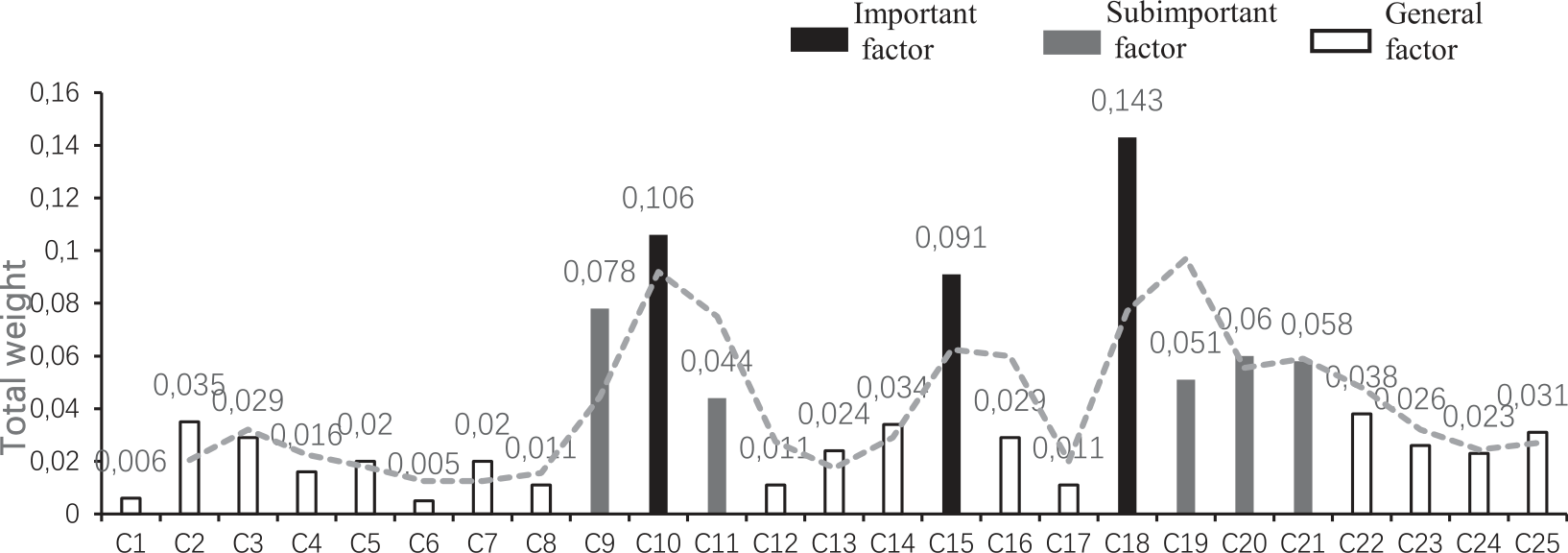
evaluation index more intuitively. given to optimizing spatial scale in the park, providing more convenient and comfortable recreational facilities, and further enhancing the diversity of landscape design to meet visitors’ expectations for comfortable and engaging landscapes. Additionally, using a more diverse range of colors and landscape materials can be considered in the landscape design to increase attractiveness and diversity [18].
Table 6.
Statistics on Comprehensive Scores of the Wellness Landscape in Bolden Forest Park.
Table 7.
Evaluation and Grading Standards for the Forest Park Health Landscape.
| Park Landscape Index | (4≤S<5) | (3≤S<4) | (2≤S<3) | (1≤S<2) |
|---|---|---|---|---|
| Range | Ⅰ | Ⅱ | Ⅲ | Ⅳ |
| implication | Excellent | Good | Average | Poor |
The safety level of the landscape is rated as “good,” with a composite score of 3.967. From the indicators’ perspective, visitors’ requirements for landscape spatial layout and road network layout are significantly higher than other indicators, indicating that visitors are more concerned about the convenience and efficiency of spatial layout and road network passages in the park. To enhance visitors’ viewing experience, it is recommended to further strengthen the optimization of spatial layout and road network passages in the park, ensuring that visitors can conveniently and quickly enjoy the scenery [19]. This may include improving road connections, adding pathway options between attractions, and providing reasonable signage and indications to provide better guidance and convenience.
The psychological well-being level is rated as “excellent,” with a composite score of 4.081, which is the highest among the four criteria layers. This indicates that the greatest benefit of the forest park for visitors is the ability to relax and relieve mental stress. From the indicators’ perspective, relaxation has the highest score, followed by stress relief, depression relief, and then loneliness reduction and tension reduction. This suggests that the forest park performs well in providing a comfortable and tranquil environment, offering visitors opportunities for relaxation and rejuvenation. This is closely related to the unique charm of nature and the health benefits of the forest environment [20]. Therefore, the forest park can continue to emphasize the provision of relaxing and stress-relieving experiences, through the addition of comfortable rest areas, and offering activities such as yoga or meditation to further enhance visitors’ sense of psychological well-being.
The physiological health level is rated as “good,” with a composite score of 3.602. From the indicators’ perspective, visitors initially feel eye comfort and mental clarity when entering the forest park, which may be associated with the natural environment, green vegetation, and fresh air. However, visitors do not have a strong perception of disease prevention. This indicates that visitors are more focused on physical comfort in the forest park, but may not have a significant perception or experience of specific health benefits. To further enhance the physiological health aspect of the forest park, promotion, and education can be strengthened to introduce the positive impact of the forest on health, such as providing oxygen, enhancing immunity, reducing fatigue, etc. Additionally, considering the provision of fitness or wellness activities such as hiking or outdoor sports can help visitors have a deeper experience and perception of the physiological health benefits of the forest.
Note: Please note that the translations provided here are based on the given context and may not be an exact representation of the original text.
Conclusions
This study demonstrates that the 25 selected evaluation indicators based on the GST method can scientifically and objectively measure the landscape quality of rehabilitation landscapes and reflect the landscape characteristics of these environments. The evaluation system of rehabilitation landscapes in forest parks, constructed using the AHP method, is consistent with previous research. Such as Professor Yang Fangrong’s evaluation of the Zhengzhou City Park health landscape based on the AHP method, and Professor Li Shuhua’s research on the intervention effect of horticultural activities based on the quantitative measurement of physical and mental health indicators of the elderly.
The 25 indicators under the four criteria layers are independent, clear in purpose, easy to measure, and have a reasonable weight assignment, achieving a qualitative and quantitative study of multiple factors. The evaluation system is constructed based on the four dimensions of landscape comfort, landscape safety, psychological well-being, and physiological health, which comprehensively and systematically measure the landscape characteristics of rehabilitation landscapes and categorize the 25 indicators into different factors. The results indicate that Bolden Forest Park has an overall good level of rehabilitation landscape effectiveness, which reflects its characteristics.
Among them, the psychological well-being rating is excellent, with a composite score of 4.081, which is the highest among the four dimensions. The landscape comfort rating is good, with a composite score of 3.810. The landscape safety rating is good, with a composite score of 3.967. The physiological health rating is good, with a composite score of 3.602. This indicates that more emphasis has been placed on aspects such as psychological well-being and landscape safety in the construction of rehabilitation landscapes in the forest park.
Therefore, in the planning of future rehabilitation landscapes in forest parks, the following aspects can be focused on: Firstly, pay attention to landscape designs that influence psychological activities, such as plant therapy, landscape spatial therapy, and horticultural therapy, to enhance the psychological rehabilitation function. Secondly, focus on landscape safety construction, and conduct scientific forest therapy and aromatherapy, while ensuring the safety and reliability of visitors during the process of enjoying the rehabilitation landscape benefits. Finally, in the landscape planning of comfort and physiological health, follow theories such as landscape aesthetics and environmental psychology, pay attention to the arrangement of plant spatial levels, and grasp spatial scales to enhance the color and design beauty of artificial landscapes. By considering these factors comprehensively, the quality and effectiveness of the rehabilitation landscapes in forest parks can be further improved.

