

Introduction
In the marine environment, wide arrays of bacterial communities are found,; some of them are pathogenic. Marine pathogenic bacteria are thought to be the cause of a number of infectious diseases in both human and marine organisms [1]. Natural marine pathogens of the genera Vibrio, Aeromonas, Shewanella, Halomonas, and Pseudomonas are extremely important for human health [2, 3]. Many human activities, including agricultural runoff, urban runoff, sewage effluent, and recreational activities, are responsible for the presence of most of the human pathogens in coastal marine ecosystems [4, 5]. Several members belonging to Enterobacteriaceae, such as Salmonella, Klebsiella, Proteus, Escherichia, Serratia, Providencia, Shigella, and Enterobacter, arrive in marine environments as a result of human and animal fecal contamination [6]. Staphylococci are a diverse genus of Gram-positive bacteria commonly found in the human microbiota of the skin and mucosal membranes [7]. Based on their ability to produce the clotting enzyme coagulase, they are divided into coagulase-positive staphylococci (CoPS) such as Staphylococcus aureus and coagulase-negative staphylococci (CoNS), including S. epidermidis, S. haemolyticus, S. lugdunensis, S. equorum, S. xylosus, S. capitis, S. hominis, and S. warneri. Staphylococcus aureus has been considered an important human pathogen for many years, while coagulase-negative staphylococci have been regarded as being non-pathogenic. At the moment, CoNS is admitted as a major nosocomial pathogen, with S. epidermidis and S. haemolyticus being the foremost critical species [8]. The presence of potentially pathogenic Staphylococcus species such as S. aureus, S. pseudintermedius and various CoNS has been confirmed in surface waters [9].
The growth of pathogenic bacteria in marine water is influenced by various aspects, including temperature, pH value, dissolved oxygen, and salinity. Moreover, higher concentrations of nutrients in association with suspended matter have been recorded to boost the persistence of pathogenic bacteria in coastal marine water [10, 11]. The excessive use of antibiotics has led to the reduction of susceptible pathogenic bacteria and the increment of resistant populations against multiple antibiotics. Several studies have reported the presence of antibiotic-resistant bacteria in different aquatic environments, including surface waters [12], wastewater [13], and recreational coastal waters [14]. An increased number of researchers have concentrated on studying the antibiotic resistance in clinical isolates, but more consideration should be given to the investigation of the bacterial antibiotic resistance in natural environments [15, 16]. In marine environments, mainly the coastal waters, waste effluent discharged into marine water is associated with a wide array of bacteria carrying various antibiotic resistance genes that can be transferred into other marine bacteria. The current study aimed to evaluate the antibiotic resistance profile of pathogenic bacteria isolated from coastal marine water in Jazan.
Material and Methods
Marine Water Sample Collection and Physicochemical Analyses
Red Sea coastal marine water samples were gathered from different locations at Jazan, Kingdom of Saudi Arabia. Fig. 1: Al-Marjan Beach (16°50’06”N 42°34’26”E), near the Sewage Treatment Plant in Jazan (16°46’59”N 42°40’22”E), and in front of Jazan University (16°57’53”N 42°32’13”E). Sampling was conducted from September 2019 – July 2021. Water samples were collected in sterile water bottles for laboratory analyses and kept at 4ºC until their processing. Surface seawater was collected using clean polypropylene bottles. Salinity and specific gravity were tested using the Iwaki Refractometer (Iwaki, Japan). Temperature, pH, and electrical conductivity (EC) were measured using a SevenMulti pH/conductivity meter, (Mettler Toledo, Greifensee, Switzerland).
All media used in this study were purchased from HiMedia, India, and prepared according to the manufacturer’s instructions. MacConkey agar, mannitol salt agar, and blood sheep agar were prepared according to the manual instructions. Pathogenic bacteria were isolated from coastal marine water in Jazan, Saudi Arabia: isolates MG3, MG12, and MG16 from Al-Marjan Beach; isolates MG13, MG14, MG17, and MG18 from seawater near Jazan Sewage Treatment Plant; and isolates MG1, MG7, and MG15 from seawater in front of Jazan University. One hundred microliters of each dilution were plated on Mannitol Salt, MacConkey, and Blood Sheep Agar plates. After incubation for 24 hours at 37ºC, the colonies were examined. The developed colonies were repeatedly streaked onto new plates to obtain pure isolates. Then the purified isolates were maintained at -50ºC in 50% glycerol for further analysis. The purified isolates were subjected to Gram staining in order to classify the bacterial isolates according to the staining characteristics conferred by their cell walls. The bacterial isolates were subjected to different biochemical assays, including the oxidase reaction, catalase, and coagulase tests [17].
Fig. 1.
Sites of bacterial isolation from Red Sea coastal water at Jazan (Saudi Arabia), where a) Al-Marjan Beach, b) near Jazan Sewage Treatment Plant, and c) in front of Jazan University.
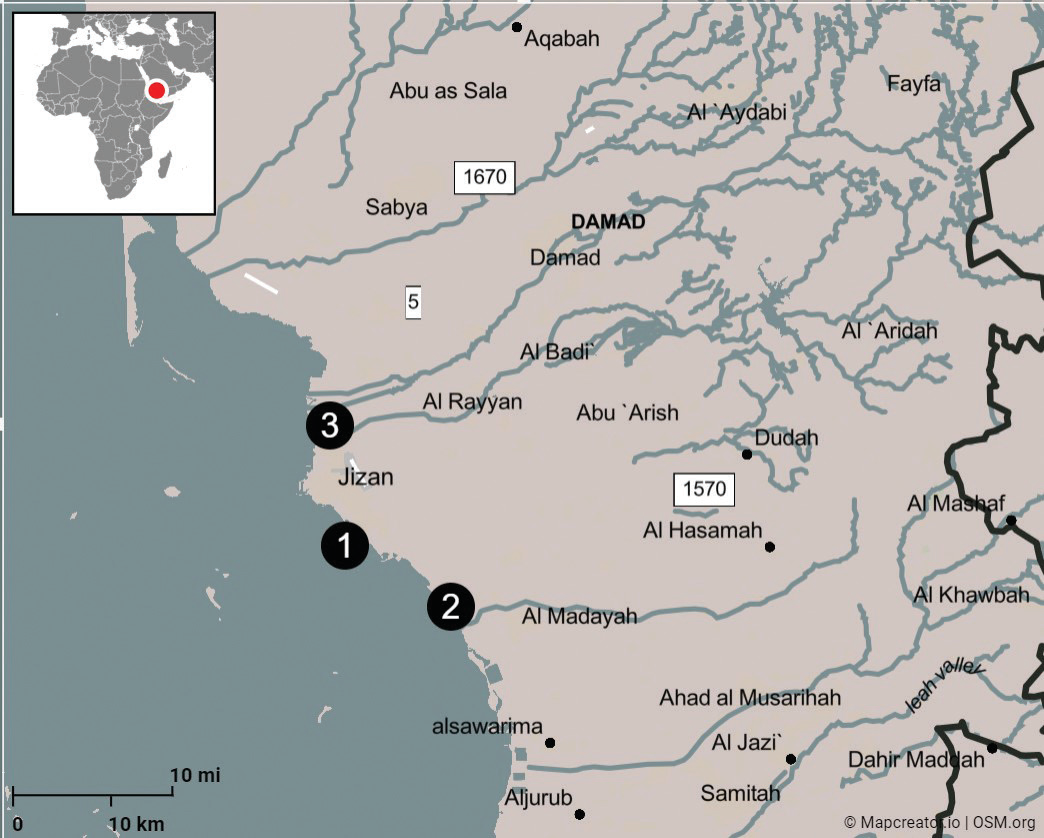
Table 2.
Physiological and biochemical characterization of the Gram-positive bacteria isolated from coastal marine water in Jazan, Saudi Arabia.
Biochemical Characterization and Antibiotic Susceptibility Tests of the Bacterial Isolates
The MicroScan WalkAway 96 Plus automated system (Siemens Healthcare Diagnostics, West Sacramento, CA, USA) was utilized to investigate the biochemical characterization of the isolates [18] according to the manufacturer’s guidelines. A single colony of overnight cultures was standardized promptly using the prompt inoculation system. Results were recorded and transferred to the LabPro software (Version 2.0). The system uses fluorogenic substrates and a pH indicator. The antibiotic sensitivity test of the bacterial isolates was performed using the MicroScan WalkAway 96 Plus automated system. Antibiotic susceptibility test results were interpreted, and bacterial isolates were categorized as susceptible (S), intermediate (I), and resistant (R).
Molecular Identification of Bacteria
The pathogenic bacteria isolated from coastal marine water in Jazan were subjected to 16S rRNA gene sequencing at the National Center for Disease Prevention and Control (Jazan, Saudi Arabia), where the standard bacterial procedure was used to extract the genomic DNA [19]. The PCR reaction was performed using the primers 16S F2 (5’-TCCTACGGGAGGCAGCAGT-3’) and 16S R2 (5’- GGACTACCAGGGTATCTAATC CTGTT-3’). The PCR mixture was prepared according to the method described by Essa et al. [20], and the PCR was run for 35 cycles under the following conditions: denaturation for 30 seconds at 94ºC, annealing for 30 seconds at 58ºC, extension for one minute at 72ºC, and a final extension for five minutes. The PCR products were examined by electrophoresis on a 0.7% horizontal agarose gel at 15 V cm-1 for 60 minutes. After purification, the PCR products were sequenced at Macrogen Co., Ltd., Seoul, South Korea. The sequence analysis was accomplished using the sequence alignment software BLAST (NCBI database; http://www.ncbi.nlm.nih.gov). The evolutionary history of the bacteria was inferred based on the 16S rRNA gene sequences using the Neighbor-Joining method. The evolutionary distances were computed using the Maximum Composite Likelihood method and are in units of the number of base substitutions per site. This analysis involved seven nucleotide sequences. All ambiguous positions were removed for each sequence pair (pairwise deletion option). Evolutionary analyses were conducted in MEGA11 [21].
Table 3.
Molecular identification of the bacteria isolated from coastal marine water in Jazan, Saudi Arabia.
Results and Discussion
Isolation and Identification of the Marine Pathogenic Bacteria
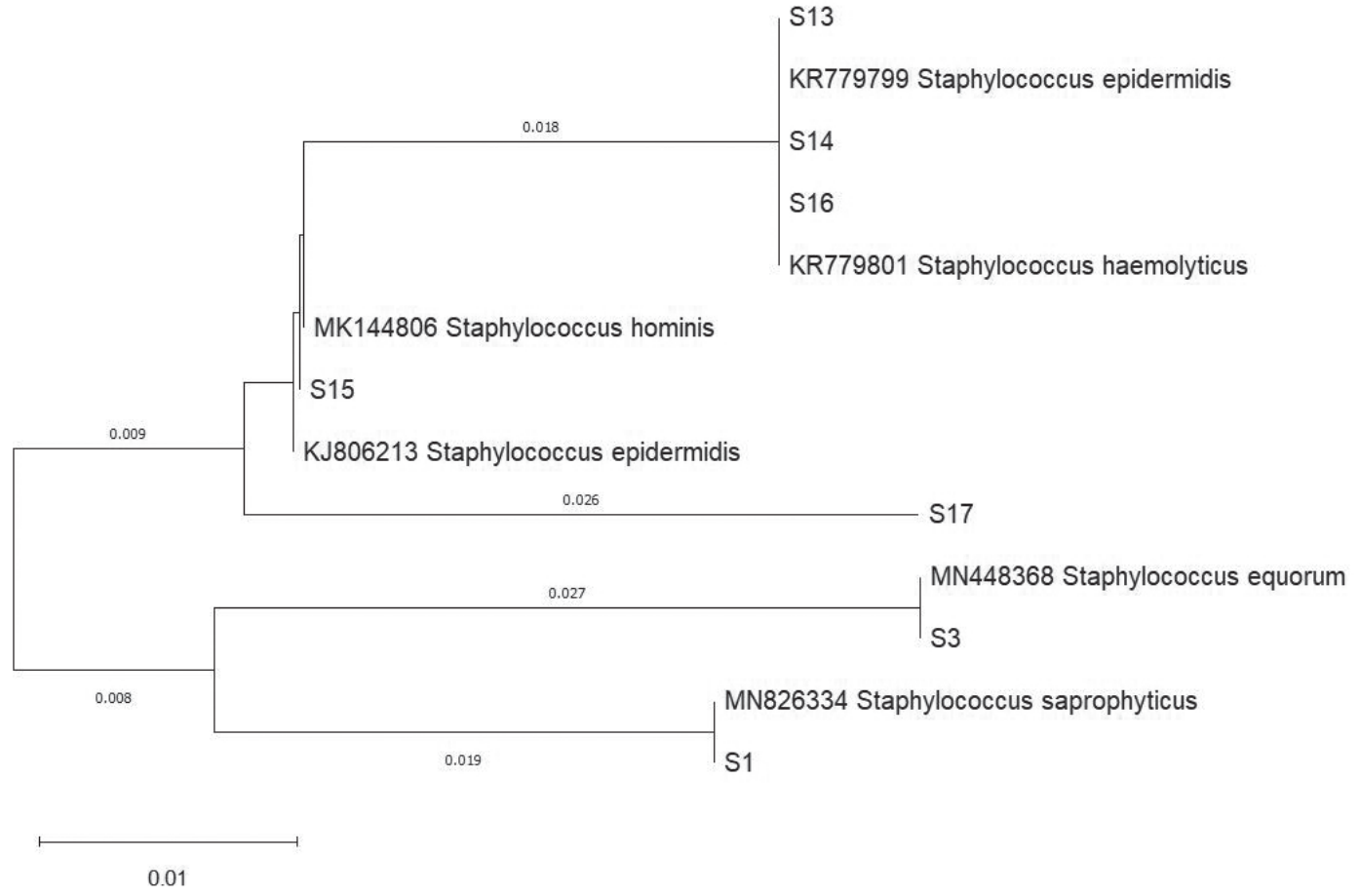
The data in Table 1 demonstrated the physicochemical characteristics of the seawater from the different locations at Jazan (Saudi Arabia). The averages for salinity, pH value, specific gravity, and electrical conductivity were 35.6 ppt, 7.9, 1.026, and 68.7 ms/cm, respectively. The bacterial isolates obtained from coastal marine water at different locations in Jazan, Saudi Arabia, were subjected to various physiological and biochemical analyses. The Gram-positive isolates MG1, MG3, MG13, MG14, MG15, MG16, and MG17 all showed positive results with the catalase test and negative results with the coagulase test. The data listed in Table 2 demonstrated the biochemical characters of the Gram-positive isolates. These bacteria isolated belonged to coagulase-negative staphylococci. The bacterial isolates were identified using the 16S rRNA gene sequencing technique, and the obtained DNA sequences were aligned with the corresponding sequences in GenBank using the BLAST program, and the 16S rRNA gene sequences of the isolates were deposited in GenBank (Table 3). The isolates MG1, MG3, MG13, MG14, MG15, MG16, and MG17 were identified as Staphylococcus saprophyticus, Staphylococcus equorum, Staphylococcus epidermidis, Staphylococcus haemolyticus, Staphylococcus hominis, Staphylococcus haemolyticus, and Staphylococcus epidermidis, respectively. A phylogenetic tree based on the 16S rRNA gene sequences of the coagulase-negative staphylococci has been constructed. It is clear that these isolates are closely related to the Staphylococcus genus (Fig. 2). Similar results were recorded by Soge et al. [22], who isolated Staphylococcus aureus, Staphylococcus capitis, Staphylococcus epidermidis, Staphylococcus saprophyticus, Staphylococcus sciuri, and Staphylococcus simulans from marine water and the intertidal beach sand of public beaches in Washington, USA. Coagulase-negative staphylococci are typical opportunists that represent one of the major nosocomial pathogens affecting human life and health, including Staphylococcus epidermidis, Staphylococcus lugdunensis, Staphylococcus haemolyticus, Staphylococcus capitis, Staphylococcus hominis, Staphylococcus simulans, and Staphylococcus warneri [8]. The presence of Staphylococcus spp. in marine water is mainly attributed to anthropogenic activities. Some studies correlated the potential contamination of the coastal marine water with Staphylococcus spp. to the beachgoers [23, 24].
Table 4.
Physiological and biochemical characterization of the Gram-negative bacteria isolated from coastal marine water in Jazan, Saudi Arabia.
Fig. 3.
The evolutionary history of the Gram-negative bacteria based on the 16S rRNA gene sequences of the isolates MG7, MG12, and MG18. Neighbor-joining cladogram constructed in MEGA 11.
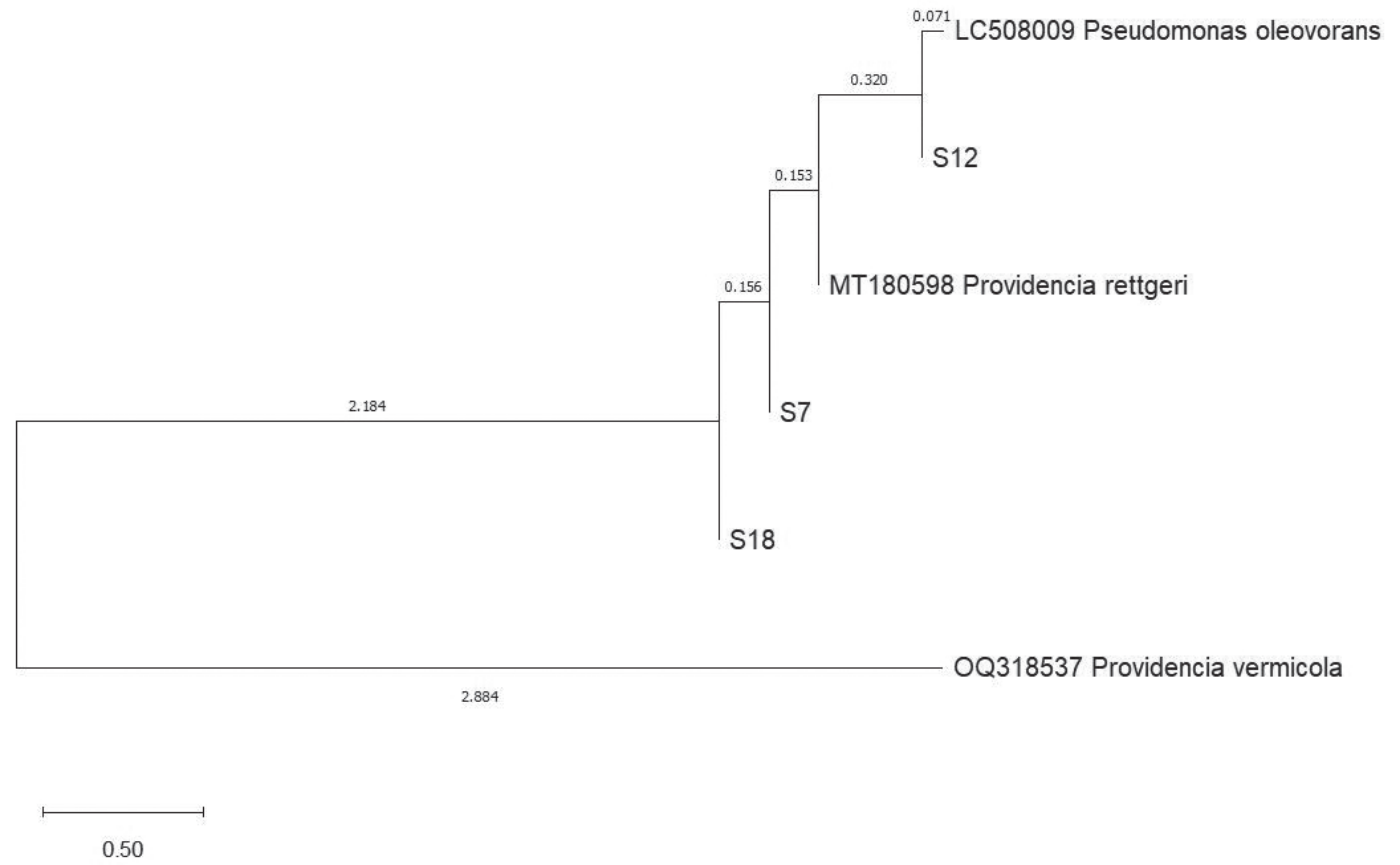
Regarding the Gram-negative isolates, MG7 and MG18 demonstrated negative results with the oxidase test, while MG12 recorded a positive result. The data listed in Table 4 demonstrated the biochemical characters of the Gram-negative isolates. Based on the molecular identification technique (Table 3), the Gram-negative isolates MG7, MG12, and MG18 were identified as Providencia rettgeri, Pseudomonas oleovorans, and Providencia vermicola, respectively. At the same time, a phylogenetic tree based on 16S rRNA gene sequences of the Gram-negative strains clarified that isolates MG7 and MG18 are closely related to the Providencia genus, while isolate MG12 is closely related to the Pseudomonas genus (Fig. 3). In accordance with that, Samanic et al. [25] isolated colistin-tolerant Providencia and Pseudomonas spp., in addition to other human pathogenic bacteria from the costal marine environment in the Croatian Public. In fact, Providencia spp. has been reported as a normal flora of the human intestinal tract and are the most common causes of infections in hospitalized patients [26, 27]. However, some Providencia species were isolated from wastewater and contaminated soil [28, 29].
Antibiotic Resistance Profile of the Bacterial Strains
Antimicrobial resistance represents a major public health concern around the world. Less attention is paid to commensal and environmental microorganisms, which may carry antibiotic resistance genes. The antibiotic resistance profile of the Gram-positive strains (Table 5) showed a clear multidrug resistance of the strains Staphylococcus epidermidis MG13 and Staphylococcus haemolyticus MG14 against wide arrays of antibiotics, including ampicillin (MIC>8), cefoxitin (MIC>4), ciprofloxacin (MIC>2), clarithromycin (MIC>4), erythromycin (MIC>4), levofloxacin (MIC>4), moxifloxacin (MIC>1), oxacillin (MIC>2), penicillin (MIC>8), and tetracycline (MIC>8). Meanwhile, Staphylococcus haemolyticus MG1 showed resistance against clarithromycin (MIC>4), erythromycin (MIC>4), fosfomycin (MIC>32), and penicillin (MIC>8). Staphylococcus hominis MG15 showed resistance against clarithromycin (MIC>4), erythromycin (MIC>4), and penicillin (MIC>8). On the contrary, Staphylococcus equorum MG3 demonstrated sensitivity against the tested antibiotics. These results are in harmony with those of Manoharan et al. [30], who determined antibiotic resistance patterns in clinical isolates of Staphylococcus haemolyticus against cefoxitin, erythromycin, trimoxazole, clindamycin, tetracycline, and linezolid. In 2021, Alahmadi and his colleagues [31] reported the isolation of multi-drug resistant Staphylococcus haemolyticus in nosocomial infections in North Western Saudi Arabia. At the same time, antimicrobial resistance rates were detected in coagulase-negative staphylococci isolates from environmental or clinical samples against a wide range of antibiotics such as ampicillin, amoxicillin/ clavulanic acid, linezolid, tetracycline, oxacillin, and fusidic acid [32, 33]. Data in Table 6 showed the resistance pattern of Gram-negative bacteria against a wide range of antibiotics. Multi-drug resistance patterns have been recorded by Providencia rettgeri MG7 against amoxicillin/clavulanate (MIC>16\8), ampicillin (MIC>16), amp\sulbactam (MIC>16\8), aztreonam (MIC>16), cefotaxime (MIC>16), ceftazidime (MIC>16), and cefuroxime (MIC>16), while Pseudomonas oleovorans MG12 and Providencia vermicola MG18 were sensitive to all the tested antibiotics. These results are in harmony with Li et al. [34], who demonstrated the high-level resistance of clinical Providencia rettgeri against a wide array of antibiotics. Similarly, Wang et al. [35] clarified the presence of abundant antimicrobial resistance genes and high resistance ratios against multiple classes of drugs in various Providencia species, including P. rettgeri, P. stuartii, P. alcalifaciens, P.
Table 5.
Antibiotic resistance profile and antibiotic minimum inhibitory concentration of the Gram-positive bacteria isolated from coastal marine water in Jazan, Saudi Arabia.
rustigianii, P. heimbachae, P. vermicola, P. huaxiensis, P. sneebi, P. burhodogranaeriae, P. thailandensis,
and P. friedericiana. The current study revealed the incidence of different opportunistic pathogenic bacteria with multi-drug resistance in the marine coastal water of Jazan. In fact, the occurrence of multi-drug resistant pathogenic bacteria is growing to hazardous levels in various geographical areas around the world [36]. Moreover, the presence of clinically relevant antibiotic-resistant bacteria in the natural environment has been reported [37, 38]. The environment can serve as a reservoir of already-resistant pathogens or may acquire antibiotic-resistant genes from other pathogenic or environmental bacteria. Horizontal gene transfer via plasmids, transposons, and integrons may facilitate the gene exchange between environmental and pathogenic bacteria, which leads to an increase in the risk of the co-selection of multiple resistances [39]. Wastewater treatment plants represent hotspots for antibiotic resistance emergence and dissemination where they receive a continuous discharge of antibiotic-resistant pathogens, antibiotic-resistant genes, and antibiotics in addition to the commensal microbiota [40-43]. The pathogenic bacteria may survive and pass through the wastewater system, reaching the environmental reservoirs [44, 45].
Table 6.
Antibiotic resistance profile and antibiotic minimum inhibitory concentration of the Gram-negative bacterial isolates obtained from coastal marine water in Jazan, Saudi Arabia.
Conclusions
The results of the current study revealed the presence of different opportunistic pathogenic bacteria with multidrug resistance against a wide spectrum of antibiotics in the marine coastal water of Jazan that may pose a serious environmental and health hazard. To the best of our knowledge, this is the first report to indicate the isolation of multi-drug resistant Providencia rettgeri from the marine environment in Saudi Arabia until now. Although the infection of the bacteria depends on the bacterial species, virulence and resistance mechanisms, and ecological niche, the current study highlighted the need for regular monitoring of marine-borne pathogens. Moreover, the development of more effective disinfection and treatment methods for wastewater treatment plant effluents to reduce the release of antibiotics, antibiotic-resistant bacteria, and antibiotic-resistant genes into the natural environment is highly recommended. Further studies are required to seasonally investigate the density of the pathogenic bacteria and their virulence factors and resistance genes in coastal marine water.

