

Introduction
Cadmium (Cd) is one of the most toxic heavy metals, with its short half-life preventing degradation by microorganisms and allowing it to persist in soil for extended periods [1]. As the economy develops, the area of Cd-contaminated soil is increasing, posing a threat to crop production safety [2]. Cd does not have a specific transporter in crops and is typically absorbed by crop tissues through competition for divalent metal ion transporters [3]. Previous studies have shown that Cd reduces biomass, antioxidant enzyme activity, and soluble protein in crops, leading to inhibited growth [4, 5]. Cd found in soil can be absorbed by roots, transported to aerial parts of crops through the xylem, and eventually enter the human body through the food chain, posing a health risk [6, 7]. Therefore, it is necessary to take measures to reduce the uptake and accumulation of Cd in crops.
Gamma-aminobutyric acid (GABA) is a nonproteinogenic four-carbon amino acid that plays a role in synthesizing primary and secondary metabolites, particularly carbon and nitrogen metabolites [8]. In various physiological and biochemical processes, GABA acts as a signal transporter in plants and participates in the tricarboxylic acid (TCA) cycle [9]. Previous studies have shown that exogenous GABA can effectively alleviate abiotic stress by increasing antioxidant enzyme activity and reducing membrane damage [10, 11]. Under aluminum stress, exogenous GABA improved tolerance in plants like Agrostis stolonifera [12]. Exogenous GABA has also been found to promote crop growth and chlorophyll synthesis under Cd stress and alleviate physiological toxicity in plants [13, 14]. Additionally, exogenous GABA has been shown to reduce Cd accumulation in apple seedlings and oilseed rape (Brassica napus) under Cd stress [11, 15] and enhance Cd accumulation in hyperaccumulator plants Galinsoga parviflora and Solanum nigrum var. humile to improve their phytoremediation ability [13, 16]. However, exogenous GABA reduces the Cd accumulation in the roots of wild peach seedlings under Cd stress while increasing it in the shoots [17]. Thus, exogenous GABA can help alleviate Cd stress in crops and has varying effects on Cd accumulation in different plant species.
Maize (Zea mays) is an important grain crop that can take up and transport heavy metals such as Cd2+, making it potentially useful for bioremediation of Cd-contaminated soil [18]. However, maize seedlings are sensitive to Cd2+ and respond rapidly to Cd-contaminated soil through changes in biomass and photosynthetic efficiency [19]. The increasing prevalence of Cd-contaminated agricultural soils threatens maize production [20]. Application of GABA to maize seedlings under Cd stress may help reduce Cd uptake. In this study, we applied GABA to maize seedlings under Cd stress to investigate its effects on their physiology and Cd uptake. The study aimed to determine whether GABA promotes growth and reduces the Cd uptake in maize, providing insights for safe maize production.
Materials and Methods
Materials
The maize material used in this experiment is “NC6”, a glutinous maize inbred line developed by the Institute of Biotechnology and Nuclear Technology Research, Sichuan Academy of Agricultural Sciences. In March 2024, maize seeds were germinated and sown in 50-hole trays (54 cm length × 28 cm width) filled with moist perlite. The trays were then placed in a greenhouse, with cultivation conditions of 14 h at 25ºC, 70% relative humidity, and 10,000 Lux for daytime; and 10 h, 20ºC, 90% relative humidity, and 0 Lux for nighttime [21]. The trays were irrigated with distilled water to keep the perlite moist before seed germination. After seed germination, the trays were irrigated with Hoagland solution every three days.
GABA was obtained from Beijing Solarbio Science & Technology Co., Ltd. (Beijing, China).
Experimental Design
The experiment was conducted in a greenhouse from March to April 2024. In March 2024, uniform maize seedlings (about 5 cm in height) were transplanted into trays (54 cm length × 28 cm width) with 24 holes filled with perlite, each containing one plant. Four treatments were applied: (1) control (CK); (2) GABA treatment (GABA): 0.5 mmol L−1 GABA application;
(4) combination of GABA and Cd treatments (Cd+GABA): 1.0 mg L−1 Cd and 0.5 mmol L−1 GABA application [11]. Each treatment was replicated three times (three trays), and the Hoagland nutrient solution was watered every three days. Cd was applied as CdCl2•2.5H2O and added directly into the Hoagland nutrient solution. GABA was also added directly into the Hoagland nutrient solution. All plants were harvested one month after treatment (transplanting).
Determination of Parameters
One month after transplanting maize seedlings, the middle mature leaf of the maize plants was collected to measure the contents of photosynthetic pigments (chlorophyll a, chlorophyll b, and carotenoids) and the activities of antioxidant enzymes, including peroxidase (POD), superoxide dismutase (SOD), and catalase (CAT). To determine the contents of photosynthetic pigments, the ethanol and acetone (1:1, v/v) mixture solution was used to extract, and the extraction solution was determined at 663, 645, and 470 nm wavelengths using a spectrophotometer (Summit, Shanghai, China) for the contents of chlorophyll a, chlorophyll b, and carotenoids [19]. To determine the activities of antioxidant enzymes, the leaves were ground and homogenized in 0.05 M potassium phosphate extraction buffer (pH 7.0, containing 1 mM EDTA) to extract the enzyme at 4ºC [21]. After the homogenate was centrifuged (11,000×g for 20 min), the supernatant was used for determining the SOD activity by the nitroblue tetrazole method, POD activity by the guaiacol colorimetric method, and catalase (CAT) activity by the potassium permanganate titration method [22]. Subsequently, the entire maize seedlings were harvested, separated into root and shoot sections, washed, and dried in an oven at 80ºC to constant weight to measure the biomass (dry weight) using an electronic balance. The ground dried samples were digested in the nitrate acid and perchloric acid (4:1, v/v) solution at 200ºC, and the digestive solution was used for Cd content analysis using an iCAP 6300 ICP spectrometer (Thermo Scientific, Waltham, MA, USA) [23]. Cd’s translocation factor (TF) was calculated as the shoot Cd content divided by the root Cd content [24].
Statistical Analysis
The software SPSS 20.0.0 (IBM, Inc., Armonk, NY, USA) was utilized for all statistical analyses. The data was analyzed using the one-way analysis of variance and Duncan’s Multiple Range Test (P<0.05). Pearson’s correlation and grey relational analysis were employed to analyze the correlations among all parameters and the different parameters with the shoot Cd content under Cd stress [25].
Results and Discussion
Biomass of Maize Seedlings
Cd has a severely toxic effect on plants and inhibits plant growth [1]. GABA is a functional substance and an important signaling molecule [8, 9]. GABA acts as a primary metabolite and signaling molecule in plants, playing vital roles in plant growth, development, energy supply, and maintaining carbon/nitrogen balance [26]. Under Cd stress, exogenous GABA promoted the growth of G. parviflora and Festuca elata [13, 14]. In this study, compared to CK, both the root and shoot biomass of maize seedlings treated with GABA were decreased (Fig. 1a) and 1b)). Additionally, both root and shoot biomass in the Cd treatment were lower than in CK, indicating that Cd treatment inhibited the growth of maize seedlings. There were no significant differences in root and shoot biomass between the GABA and Cd treatments. When compared with the Cd treatment, the root biomass in the Cd+GABA treatment was lower, whereas the shoot biomass remained the same. The Cd+GABA treatment decreased the root and shoot biomass by 5.85% and 3.85%, respectively, compared to the Cd treatment alone. These results contradict previous studies [13, 14], indicating that GABA in this experiment inhibited the growth of maize seedlings. This could be due to the higher concentration of exogenous GABA inhibiting plant growth and the varying sensitivities of different plants to the application method and concentration of GABA [11, 27]. Under drought stress, spray application of different concentrations of GABA showed varying effects on the growth of maize seedlings, with lower concentrations promoting growth and higher concentrations inhibiting growth [27]. In this experiment, exogenous GABA was directly added to the Hoagland nutrient solution at a higher concentration, suggesting that the irrigated concentration (0.5 mmol L−1) of GABA may be too high for maize seedlings.
Photosynthetic Pigment Content in Maize Seedlings
The application of exogenous GABA is considered to improve plant tolerance by replenishing the TCA cycle and inhibiting photo-induced stomatal opening and dark-induced stomatal closing [28, 29]. Under Cd stress, exogenous GABA increased the contents of photosynthetic pigments in G. parviflora and F. elata [13, 14]. In this study, the treatment of GABA decreased the contents of photosynthetic pigments in maize seedlings compared to CK (Table 1). The contents of photosynthetic pigments treated with Cd showed no significant effect compared to CK and had no significant effect compared to the GABA treatment. Compared to the Cd treatment, the Cd+GABA treatment decreased the contents of chlorophyll a and carotenoids by 6.11% and 14.20%, respectively, while showing no significant effect on the content of chlorophyll b. These results contradict previous studies [13, 14], indicating that GABA in this experiment inhibited the photosynthetic pigment biosynthesis of maize seedlings, which may be related to the application concentration of GABA [27].
Antioxidant Enzyme Activity
Cd is known to result in the excessive accumulation of reactive oxygen species (ROS), which disrupts the plant defense system and causes severe damage to the membrane system [4]. To defend against oxidative damage, the antioxidant enzyme activities of plants increase, including POD, SOD, and CAT [1]. GABA participates in the tolerance to abiotic stress environments, such as drought, heat, and heavy metals, by activating antioxidant enzyme activities and decreasing the accumulation of ROS [30-32]. Under salinity stress, exogenous GABA increased the activities of SOD, CAT, and POD in Elymus nutans seedlings [33]. Similarly, under high-temperature stress, exogenous GABA application increased antioxidant enzyme activities in perennial ryegrass [34]. In this study, compared to CK, GABA treatment increased the POD activity of maize seedlings, while it did not affect the activity of SOD (Table 2). Cd treatment increased the activities of POD and SOD compared to CK. In comparison to the Cd treatment, the Cd+GABA treatment increased the activities of POD and SOD by 33.69% and 9.77%, respectively. These results are consistent with previous studies [30, 31], which indicate that exogenous GABA mitigated the oxidative damage caused by Cd stress and improved the tolerance of maize seedlings to Cd stress. However, exogenous GABA did not affect the CAT activity of maize seedlings under both non-Cd stress and Cd stress in this experiment, likely because CAT is the most sensitive antioxidant enzyme to abiotic stress [35]. Its activity is easily inhibited, leading to a buildup of H2O2 removed by POD, resulting in increased POD activity [35, 36].
Table 1.
Photosynthetic pigment content.
Cd Content and TF
Cd found in soil can be absorbed through plant roots and transferred to the aboveground part [37]. Under Cd stress, exogenous GABA reduced Cd uptake in apple seedlings and oilseed rape [11, 15] while promoting Cd accumulation in the hyperaccumulator plants G. parviflora and S. nigrum var. humile [13, 16]. For wild peach seedlings, exogenous GABA reduces their root Cd content while increasing their shoot Cd content [17]. So, exogenous GABA has varied effects on Cd uptake in different plant species. In this study, the root Cd content of maize seedlings was found to be higher than the shoot Cd content in all treatments (Table 3). The addition of GABA did not affect the contents of root Cd and shoot Cd when compared to CK. However, when the Cd+GABA treatment was applied, the contents of root Cd and shoot Cd were higher than in the Cd-only treatment. Specifically, the Cd+GABA treatment increased the contents of root Cd and shoot Cd by 11.93% and 23.22%, respectively, compared to the Cd treatment alone. In terms of the TF, GABA did not impact it when compared to CK. The treatment of Cd alone decreased the TF compared to CK. Interestingly, the treatment of Cd+GABA also did not change TF compared to the Cd treatment alone. These results are consistent with the study of hyperaccumulator plants G. parviflora and S. nigrum var. humile [13, 16] but not consistent with the study of apple seedlings and oilseed rape [11, 15]. This may be due to maize’s ability to uptake Cd2+ [18]. When exogenous GABA was applied to maize seedlings, the plant’s tolerance to Cd stress improved, potentially enhancing the Cd absorption capacity of maize seedlings.
Correlation and Grey Relational Analyses
Correlation analysis revealed that root biomass was positively correlated with chlorophyll a content, chlorophyll b content, and carotenoid content and negatively correlated with POD activity and SOD activity (Table 4). Shoot biomass was only negatively correlated with CAT activity. Both root Cd and shoot Cd contents were negatively correlated with carotenoid content and positively correlated with POD activity and SOD activity. Additionally, root Cd content was positively correlated with shoot Cd content.
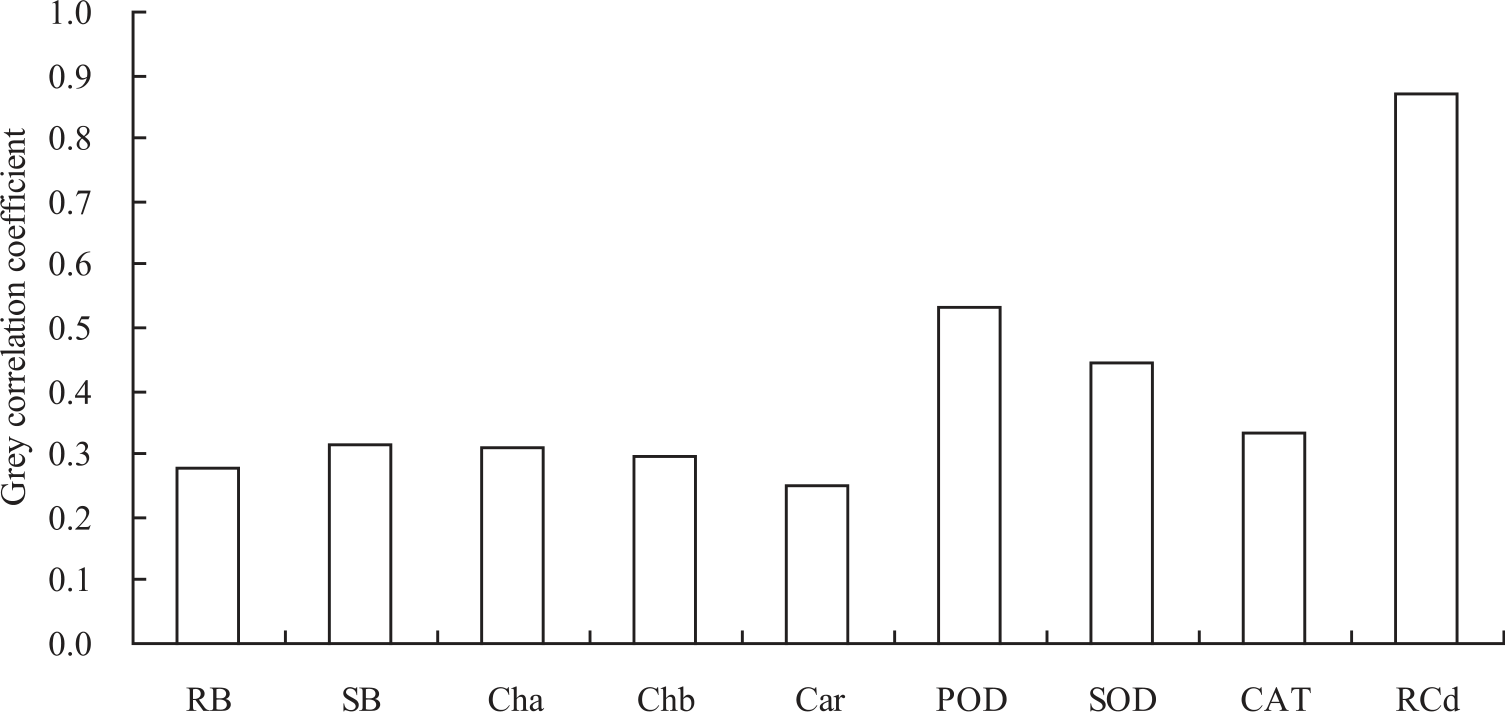
Grey relational analysis showed that the grey correlation coefficients of different parameters with shoot Cd content ranged from 0.252 to 0.872, indicating a correlation between shoot Cd content and these parameters (Fig. 2). The top three grey correlation coefficients were for root Cd content, POD activity, and SOD activity, all of which were above 0.446, indicating their significant roles in promoting Cd accumulation in maize shoots under Cd stress. Further studies are needed to explore the mechanisms behind these results.
Fig. 1.
Biomass. a) root biomass; b) shoot biomass. Values are means (±SD) of three replicates. Different lowercase letters indicate significant differences among the treatments (Duncan’s Multiple Range Test, P<0.05).
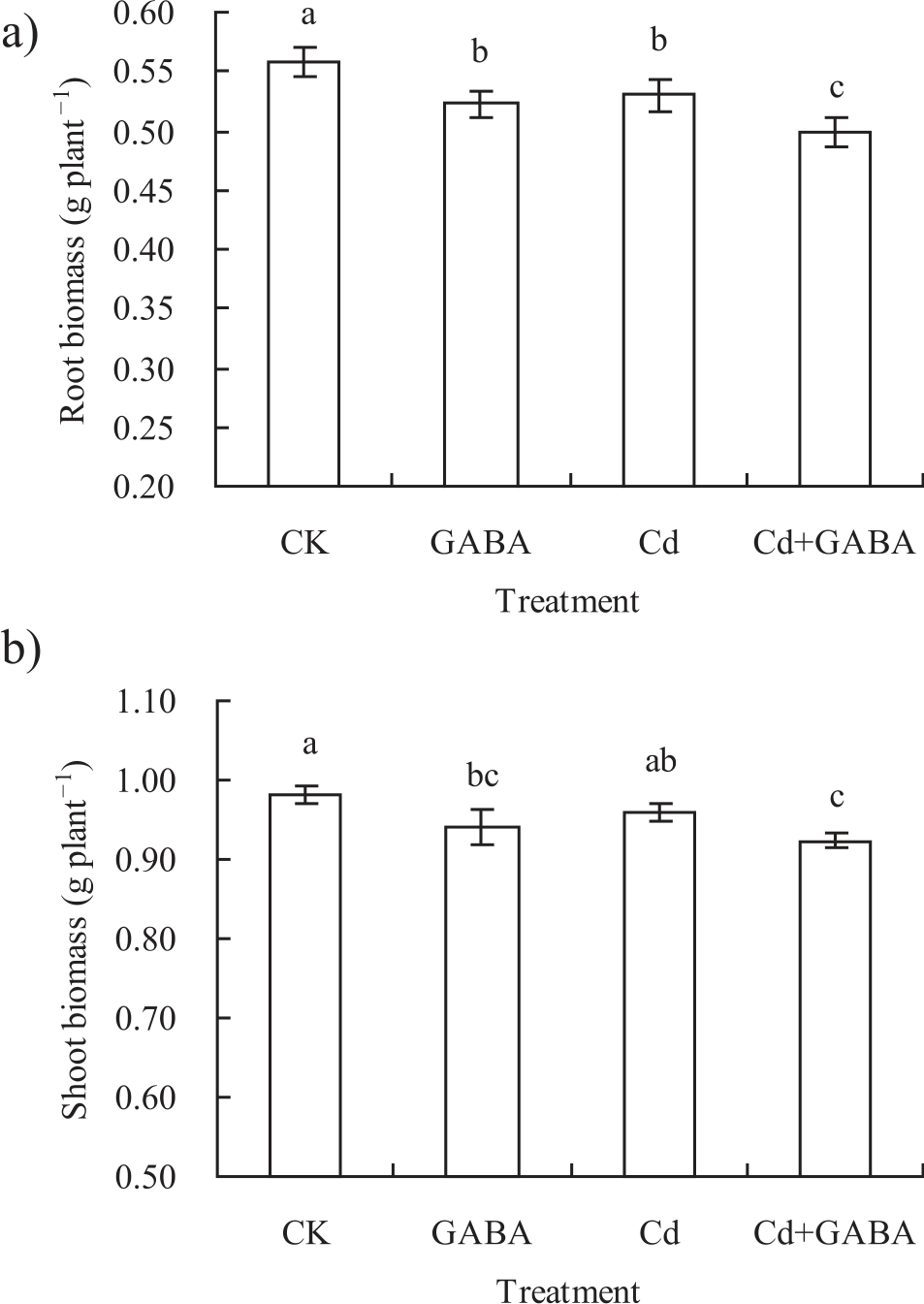
Table 4.
Correlations among the different parameters.
Conclusions
Under Cd stress, exogenous GABA inhibited the growth of maize seedlings by decreasing biomass and photosynthetic pigment content. Exogenous GABA also improved the tolerance of maize seedlings to Cd stress by increasing antioxidant enzyme activity. Furthermore, exogenous GABA increased the contents of root Cd and shoot Cd in maize seedlings under Cd stress. Therefore, it is not recommended to apply 0.5 mmol L−1 GABA on maize in Cd-contaminated areas, while the lower concentrations of GABA need further study.