

Introduction
In recent years, China has made significant progress in addressing environmental challenges [1, 2]. However, corporate environmental behavior remains a significant factor in achieving long-term sustainable development goals [3]. Enterprises, which are key drivers of economic development and major contributors to environmental degradation, face mounting expectations to align their strategies with sustainability objectives [4]. While considerable research has explored external pressures, such as government regulations and market incentives, there is a critical gap in understanding the internal drivers of corporate environmental investment [5]. In particular, the role of top executives’ environmental experience in shaping firms’ strategic decisions remains underexplored despite its potential to bridge the divide between environmental responsibility and long-term business performance.
This study seeks to address this gap by examining how executive environmental experience, i.e., the personal environmental expertise and background of top management, shapes corporate environmental investment strategies [6]. Drawing on upper echelon theory, which posits that the experiences and values of top executives significantly influence firm-level strategic decisions, we argue that executives with strong environmental expertise are more likely to integrate sustainability into their firms’ core strategies [7]. These leaders not only bring technical knowledge to guide environmental investments but also embed sustainability into the broader business trajectory, enabling firms to transition from reactive compliance to proactive investment in environmental innovation [8, 9]. By positioning environmental initiatives as strategic imperatives, executives with environmental experience enhance both corporate sustainability practices and long-term competitive advantage [10].
Our research extends upper echelon theory into the domain of corporate environmental sustainability by exploring the critical role of leadership in shaping environmental outcomes. It also sheds light on the micro-level mechanisms, such as heightened environmental attention and enhanced green innovation. This contributes to a deeper understanding of how leadership decisions at the top management level can drive more sustainable and strategic business practices, an area that has received insufficient attention in the existing literature. Despite significant regulatory advancements in China, the current policy landscape often emphasizes compliance mechanisms, such as emissions standards and penalties, while neglecting the pivotal role of corporate leadership in fostering sustainability. While these regulations undoubtedly put pressure on firms to meet minimum environmental standards, firms are often passive in their compliance with environmental regulations [11, 12]. This study highlights the importance of recognizing executive leadership as a crucial driver of corporate environmental performance. By identifying the mechanisms through which executive environmental experience shapes corporate environmental investments, this research provides valuable insights for both policymakers and business leaders. Our paper underscores the need for policy frameworks and corporate strategies that leverage leadership expertise to align environmental sustainability with strategic business goals, thereby ensuring firms contribute meaningfully to long-term sustainability while maintaining competitive performance.
This study holds potential value in several key areas. First, previous research has predominantly focused on the impact of executives’ demographic features, such as marketing experience and hometown identity, on corporate behavior [13-15], while insufficient focus has been given to executive environmental experience. This study uses text mining to measure executive environmental experience and to explore how it affects firms’ environmental investments. Consequently, this study extends the upper echelon theory from the environmental economic perspective. Second, prior studies on the drivers of environmental investment have often centered on macro-level environmental regulations [16-19], but such macro-level influences inevitably overlook heterogeneity at the micro-firm level. Our research broadens the understanding of the factors influencing corporate environmental investment, thereby contributing to integrating environmental economics and management. The findings provide reliable evidence for firms to formulate appropriate sustainable development strategies. Furthermore, executive environmental experience not only directly impacts corporate environmental decisions but also indirectly promotes investment in sustainable development projects by increasing firms’ attention to environmental issues. This finding offers a new perspective on the complex relationship between executive environmental experience and environmental performance. Thus, this study elucidates additional channels through which executive environmental experience affects corporate environmental investment.
Theoretical Foundations
Contemporary investors’ increasing emphasis on corporate environmental performance places heightened demands on top management teams, whose decisions are central to firms’ strategic trajectories. The upper echelon theory provides a robust framework for exploring how executives’ environmental experience shapes corporate environmental investments [20]. This theory posits that the characteristics, values, and experiences of top executives significantly influence firm behavior and strategy [21, 22]. In the environmental domain, executive environmental experience, defined as the environmental expertise, knowledge, or background possessed by top management, emerges as a critical driver. Executives with such backgrounds not only understand the complexities of environmental challenges but also demonstrate a stronger commitment to sustainability, making them more likely to prioritize and allocate resources toward environmental initiatives [23]1. Moreover, executives with environmental expertise serve as valuable internal resources, offering specialized knowledge that enhances organizational awareness and responsiveness to environmental issues. Empirical studies have demonstrated that firms led by environmentally experienced executives are more likely to pursue green innovations and adopt sustainable supply chain practices, further substantiating this link [24]. When confronted with environmental challenges, executives possessing environmental expertise are more likely to prioritize sustainability efforts and promote greater investment in corporate environmental initiatives.
Upper echelon theory also emphasizes the role of information transmission and cognitive imitation within organizations. Executives with environmental backgrounds actively disseminate environmental information across the organization through formal communication channels, such as sustainability training programs or workshops, and informal interactions, such as discussions in executive meetings [25]2. This process fosters a culture of environmental awareness and influences the attitudes of other employees, encouraging them to align their actions with the firm’s sustainability goals. Additionally, cognitive imitation plays a pivotal role, as employees observe and emulate the environmentally responsible behaviors and values exhibited by their leaders. Empirical evidence supports that such imitation can lead to a cascading effect, amplifying the impact of executive environmental priorities throughout the organization [26]. Executives with environmental expertise also profoundly shape corporate culture. They embed environmental values into the core of the organization, ensuring that sustainability becomes a guiding principle for decision-making3. 1 For example, leaders with formal education in environmen-
tal sciences or prior experience in environmental organiza-
tions tend to view environmental investments as integral to
long-term strategic goals rather than mere compliance co-
sts. One notable instance is Paul Polman, former CEO of
Unilever, whose commitment to sustainable development
reshaped Unilever’s business strategy, leading to significant
investments in eco-friendly product lines and operational
sustainability. Such examples illustrate the direct influence
of executive environmental experience on strategic deci-
sion-making and corporate behavior. 2 For instance, an executive might use company-wide emails
to highlight the strategic importance of reducing carbon
emissions, linking it to both corporate social responsibility
(CSR) objectives and competitive advantages. 3 For example, companies like Patagonia, led by environmen-
tally conscious leaders, have successfully cultivated a cultu-
re where environmental protection is a shared responsibility
among all employees. Empirical studies further validate this phenomenon, showing that firms with environmentally focused leadership tend to exhibit stronger CSR performance, higher green innovation outputs, and improved environmental compliance. These findings underscore the vital role of executive environmental experience in embedding sustainability within organizational practices [27, 28]. This alignment of corporate culture with environmental goals not only supports sustainable business practices but also contributes to the firm’s broader social and environmental responsibilities.
This study builds on upper echelon theory by exploring the mechanisms through which executive environmental experience shapes corporate environmental investment. By integrating insights from empirical research, we provide a nuanced understanding of how leadership characteristics influence environmental strategy. Specifically, our work highlights the pathways of knowledge transfer, employee engagement, and cultural transformation as key mechanisms. These findings contribute to the broader literature on corporate governance and environmental management, offering both theoretical advancements and practical implications.
Literature Review
How to effectively incentivize enterprises, particularly heavily polluting ones, to improve environmental protection investment remains a crucial issue in the field of environmental economics. The factors influencing corporate environmental investment are typically categorized into internal and external factors. While internal factors such as firm size, state ownership, and corporate governance have been widely discussed, the role of the executive, specifically in terms of their attributes and leadership styles, requires further emphasis. Executives play a key role in shaping corporate environmental strategies, as their decisions often guide the firm’s overall approach to sustainability and environmental responsibility. The executives’ leadership style, values, and expertise can directly influence the company’s commitment to environmental investment beyond organizational factors like firm size or ownership structure.
Internal factors influencing corporate environmental investment include attributes such as the type of enterprise, its scale, and corporate governance. For instance, state-owned enterprises, due to government influence and higher levels of accountability, are often more proactive in addressing environmental obligations and are inclined to increase the scope of their environmental investments [29]. Similarly, with their substantial resources and capabilities, large firms are more likely to adopt aggressive environmental strategies to enhance market competitiveness and brand image [30]. Additionally, several factors influence corporate environmental investment, including the gender diversity of top management [31, 32], digital transformation [24], management experience [33], labor unions [34], political connections [35], and robust corporate governance structures [36]. However, a deeper examination of executive leadership is essential. Executives with specific environmental expertise or a strong environmental focus tend to integrate sustainability into their corporate strategies more effectively, guiding their firms to not only meet regulatory standards but also innovate in environmental technologies. For example, studies suggest that executives with prior experience in environmental management or a background in sustainability often push their firms to adopt proactive environmental investments, especially when such expertise aligns with the firm’s strategic goals. Executives with this type of expertise are often key drivers in setting ambitious environmental goals, implementing green technologies, and fostering a culture of sustainability within the organization.
The external factors driving corporate environmental investment mainly consist of pressures from stakeholders, heightened public scrutiny, and government-led environmental regulations and policies. Through their influence on stakeholders, public environmental concern and media attention often push companies to enhance their environmental transparency and investments [17, 37]. Through information dissemination and increased public oversight, the media can pressure companies to focus more on environmental concerns and improve the transparency and reliability of their environmental disclosures [38]. In recent years, the growth of the digital economy has created new opportunities for enhancing corporate environmental practices. It provides firms with more flexible and efficient tools to meet their environmental objectives, allowing them to adapt more effectively to the dynamic market landscape [39]. Moreover, as an emerging field, digital finance is gradually gaining attention for its impact on corporate environmental investments [40]. Furthermore, digital finance offers new ways to fund environmental investments, and executives who understand these tools are better equipped to access and utilize these financial channels to support green projects [41].
As key participants in the market economy, firms’ environmental investments are shaped not only by the “invisible hand” of the market but also by the “visible hand” of government macro-regulation [5, 16]. Recent empirical studies have indicated that interest rate liberalization generally fosters corporate environmental governance [42], while economic growth pressures often crowd out environmental investments [43]. As principal agents of environmental governance, governments play a pivotal role in environmental governance. In the case of China, the government has implemented a multifaceted regulatory framework designed to enhance environmental compliance and encourage corporate environmental responsibility [44]. These measures include both mandatory environmental regulations, such as environmental courts and the new Environmental Protection Law, alongside market-oriented mechanisms like the carbon emission trading system, low-carbon city pilot programs, and the Environmental Protection Tax Law. Together, these regulatory and incentive-based approaches underscore the complementary importance of both compulsion and market incentives in driving improvements in corporate environmental performance.
On the one hand, stringent environmental regulations compel firms to address their long-term sustainability [45]. In China, local governments exert significant control over resource allocation. Firms that engage in environmentally oriented activities are more likely to gain recognition from both government and society, which helps them to obtain more resources, such as government procurement and environmental protection subsidies [46]. Additionally, increased environmental investment helps firms cultivate a green image, and the market and investors prefer enterprises with better environmental performance [47]. Environmental investments frequently provide greater long-term advantages, creating a synergistic outcome that benefits both environmental governance and economic performance [48, 49]. On the other hand, the Porter Hypothesis posits that environmental regulations can spur firms to innovate in environmental technologies [50]. Under the pressure of external stakeholders and environmental legitimacy, firms are likely to implement proactive environmental strategies [51]. The “innovation compensation effect” created by government environmental regulations can either partially or entirely alleviate the environmental costs that firms encounter. This, in turn, enhances their competitive advantage and promotes greater investment in environmental initiatives [11].
In conclusion, while the literature highlights the importance of various internal and external factors, a more focused examination of executive experience, particularly in relation to environmental expertise, leadership styles, and the integration of digital technologies, offers valuable insights into how firms can enhance their environmental investment strategies. By understanding the interplay between executive leadership, regulatory frameworks, and emerging digital opportunities, policymakers and corporate leaders can better incentivize environmentally responsible practices and investments.
Materials and Methods
Samples and Data
The scope of our study begins in 2012, a pivotal year when China formally incorporated ecological civilization into its broader socio-economic agenda, marking a significant shift in the country’s approach to environmental governance. This policy shift was a response to growing concerns over environmental degradation and aimed to align economic development with sustainable environmental practices. By prioritizing ecological civilization, the Chinese government set higher expectations for both local governments and corporations in terms of environmental responsibility. This shift is central to our study, as it introduced new regulatory and policy frameworks that directly influenced corporate behavior, particularly regarding environmental investments and practices. We excluded listed companies with special treatment, financial investment firms, companies with gearing ratios above 100%, cross-listed companies, newly listed firms, those with missing data for key variables, and firms with only one observation from 2012 to 2020. In total, we retain 8,991 observations from 1,742 listed companies for our analysis. The sample is drawn from a variety of industries, encompassing both private and state-owned enterprises. While the sample includes firms from different sectors, the majority of companies are in the manufacturing, energy, and service industries, which are most affected by environmental regulations and, thus, more likely to have made significant investments in environmental initiatives.
For the non-balanced panel data used in this study, firm environmental investment is derived from corporate annual reports. Corporate environmental attention is calculated based on corporate annual reports’ Management Discussion and Analysis (MD&A) text. Executive environmental experience is created from executive biographies. Environmental penalties are sourced from the legal information network of Peking University. Data on corporate green innovation is obtained from the CNRDS database, whereas additional data are sourced from the CSMAR database. All continuous variables were trimmed at the 1% level.
Variable Definitions
Dependent Variable
Corporate environmental investment (Cei). Drawing inspiration from the methodologies employed by Zhang et al. (2019) [52] and Qian et al. (2023) [18], this study involves a manual extraction of corporate environmental investment data from the “construction in progress” segments of annual reports issued by publicly listed companies. Corporate environmental investment is defined as the financial expenditures reported under the “construction in progress” sections of annual reports issued by publicly listed companies. These expenditures are associated with initiatives that aim to enhance environmental sustainability and reduce ecological impacts. Examples of “green projects” included in this measure are renewable energy initiatives such as solar or wind power installations; pollution control projects like the deployment of desulfurization systems or advanced dust suppression technologies; waste management systems including wastewater treatment plants and recycling facilities; and energy efficiency upgrades through retrofitting equipment or optimizing industrial processes. These examples help to clarify the scope and nature of the investments categorized as Cei.
To calculate Cei, a manual data extraction process was employed. Financial data related to these green projects was identified within each company’s annual reports and aggregated to form a comprehensive measure of their environmental investments. The aggregation process involved summing all expenditures categorized under environmental initiatives, ensuring consistency, and capturing the full extent of firms’ financial commitment to sustainability. This transparent approach ensures the reliability and comparability of the data across firms and industries. Cei was selected as the dependent variable for this study because it provides a direct and quantifiable measure of firms’ financial commitment to addressing environmental concerns. Unlike indirect metrics such as sustainability scores or qualitative disclosures, Cei reflects the tangible actions companies take in response to environmental regulations, market demands for sustainability, and internal strategic priorities.
Independent Variable
Executive environmental experience (Expe). Executive environmental experience is constructed by identifying the environmental background of corporate executives using a text-mining approach. Similar to Chen et al. (2018) [53] and Luo and Zhang (2024) [54], we compute executives’ environmental backgrounds in the following way. Initially, we sourced executive biographies from the CSMAR database. Subsequently, we applied text analysis techniques alongside targeted keywords, including “environmental science”, “environmental engineering”, “ecology”, “low carbon”, “sustainable development”, and “green”, to filter these biographies. These keywords have been carefully chosen to capture the diverse facets of environmental expertise relevant to sustainability initiatives. An executive is deemed to possess an environmental background if any of these keywords appear in their resume. In the final step, we aggregate the total number of executives with environmental backgrounds for each respective company.
The decision to utilize text-mining techniques to measure executive environmental experience was driven by several considerations. First, traditional methods of assessing executive expertise, such as manual coding or relying solely on educational qualifications, are often time-intensive and limited in scope. Text mining, in contrast, enables the efficient processing of large datasets, allowing for the systematic identification of relevant expertise across a wide range of firms and industries. Second, this approach captures both formal qualifications and implicit environmental expertise, such as experience reflected in job titles or project involvement, which may not be evident from conventional data sources. Third, using keywords grounded in the literature ensures that the measure aligns with the multi-dimensional nature of environmental expertise, encompassing technical, managerial, and strategic competencies. By leveraging text-analysis techniques, our study contributes a novel, replicable, and scalable approach to quantifying executive characteristics that influence corporate behavior in the context of environmental sustainability.
Mechanism Variables
Firm environmental attention (Att). In this research, we operationalize firm environmental attention by meticulously analyzing the aggregate count of environmental terminology featured in the MD&A section of corporate annual reports [55]. This approach serves as a robust mechanism for assessing the degree of emphasis that firms allocate to environmental considerations in their communications with stakeholders. The MD&A section is particularly significant as it provides management’s perspective on the company’s operational results and future prospects, thereby offering a platform for articulating environmental priorities and initiatives.
Corporate green innovation (Gi). This study measures corporate green innovation using the natural logarithm of the number of green patent applications, consistent with established methodologies in the existing literature [56, 57]. Using green patents as a metric reflects a firm’s commitment to environmental preservation, resource efficiency, and proactive efforts in addressing global environmental challenges. Green patents represent intellectual property rights granted to firms for inventions with direct environmental benefits, such as reducing pollution, conserving energy, minimizing waste, improving water and air quality, and fostering sustainable resource use. Developing such technologies is critical to mitigating the environmental impacts of industrial activities and transitioning to a more sustainable and circular economy. By investing in green innovation, firms not only contribute to environmental protection but also enhance their competitive advantage as sustainability becomes a growing focus for regulators, investors, and consumers alike.
Moderating Variables
Environmental penalties strength (Penal). Environmental penalties strength denotes the level and intensity of punitive measures implemented by regulatory authorities to enforce environmental laws and standards within a specific jurisdiction. This variable is quantitatively assessed using the number of environmental penalty cases that occur at the provincial level, reflecting the degree to which local governments and regulatory bodies enforce environmental regulations and hold violators accountable. In this study, the strength of environmental penalties is operationalized using data on the number of environmental penalty cases from the Legal Information Network of Peking University4, a comprehensive legal database that records various legal actions across China. The data captures the frequency of penalties imposed for violations of environmental laws, which can include fines, sanctions, and other legal consequences aimed at deterring harmful environmental practices. A higher number of cases in a province may suggest a stronger regulatory environment where violations are more likely to be penalized. Conversely, fewer cases might indicate weaker enforcement, potentially due to limited regulatory capacity, lenient local policies, or lower prioritization of environmental protection.
Corporate pollution levels (Poll). Poll is a categorical variable used to classify firms based on the intensity of their environmental impact, specifically dividing them into two groups: heavily polluting and non-heavily polluting polluters. Heavily polluting firms operate in industries identified as significant contributors to environmental degradation due to high emissions and waste generated during their production processes. These industries are defined according to the 2010 “Guidelines for Environmental Information Disclosure of Listed Companies”. The guidelines cover 16 major industries that are recognized for their high environmental risk due to the large-scale emissions and waste associated with their production processes.
Media attention (Media). Media attention refers to the degree of public and investor awareness of a company or an event as reflected in the volume and intensity of news coverage in the media [58]. This variable measures the extent to which a firm or specific economic event is being reported by various media outlets, including both online and print sources. It is commonly used in corporate and financial research to capture the external visibility of firms, corporate actions, market trends, or regulatory changes. The frequency and intensity of media reports often influence stakeholder perceptions, market reactions, and regulatory responses. A higher volume of media coverage indicates greater visibility, which can affect a firm’s reputation, investor sentiment, stock price volatility, and regulatory oversight. Conversely, lower media coverage may reflect limited visibility or lower public scrutiny, which could influence how stakeholders engage with the firm.
Control Variables
To account for various factors that may influence environmental investment, this study incorporates several variables, following Zhang et al. (2019) [52] and Liu et al. (2022) [16]. Financial indicators include firm asset size (Size1), debt-to-asset ratio (Lev), earnings on total assets (Roa1), the proportion of cash and cash 4 Official website for: https://pkulaw.com/ equivalents to total assets (Cash1), management expense ratio (Mana), and the ratio of research and development investment to total assets (Rd). More profitable firms are likely to implement more effective sustainability strategies. Additionally, corporate governance characteristics include ownership structure (Soe), CEO duality (Dual), board size (Board), equity concentration (Top1), percentage of independent directors (Indir), firm age (Age), and the proportion of female executives (Fem). Since companies with robust corporate governance mechanisms tend to exhibit superior environmental performance.
Model Construction
The two-way fixed effects model provides several key advantages, particularly in terms of controlling for unobserved heterogeneity and improving the accuracy of estimations in panel data analysis [59]. This model accounts for both firm-specific and time-specific factors that may affect the dependent variable, reducing the risk of omitted variable bias. By including firm fixed effects, we control for time-invariant characteristics of firms (such as corporate culture, management style, and industry-specific factors) that could influence their environmental investment decisions. Simultaneously, by incorporating time-fixed effects, we account for broader external factors that might change over time but remain constant across firms, such as macroeconomic conditions or shifts in national policy [60].
The two-way fixed effects model has the ability to mitigate potential biases that arise from omitted variables [61]. Since both firm-level and time-level fixed effects are included, the model effectively isolates the effect of the independent variable (in this case, executive environmental experience) on the dependent variable (corporate environmental investment), controlling for a wide range of potential confounders. This is especially important in studies with panel data, where failing to account for such factors could lead to misleading results. By reducing unobserved heterogeneity and allowing for a clearer understanding of causal relationships, the two-way fixed effects model improves the robustness and credibility of the findings, ensuring that the results reflect true associations rather than spurious correlations. To evaluate the effect of executive environmental experience on environmental investment, we develop a two-way fixed effects model as follows:
In the model outlined above, Ceiit represents the environmental investment of firm i in year t. α is the constant, while Expeit serves as the independent variable. β1 captures the effect of executive environmental experience. Additionally, Xit includes various control variables, with λ denoting their coefficients. μi and υt account for fixed effects related to the firm and year, respectively, and εit represents the error term.
We adopt a two-step approach to test the mediating effect, which has significant advantages in mitigating the endogeneity problem compared with the traditional three-step approach. By directly modeling the relationship between the dependent variable and the mediating variable, the two-step approach can avoid the estimation bias that may be triggered by the stepwise regression process in the three-step approach. For example, the three-step approach assumes that the mediator variable fully explains the effect of the independent variable on the dependent variable, which is prone to endogeneity problems due to the omission of key variables or modeling bias, whereas the two-step approach effectively circumvents this defect by integrating the analytical path. Similar to Baron (2022) [62], we design the following model:
In Equation (2), Mechit refers to mechanism variables.
Meanwhile, this paper constructs the following interaction fixed effects model to test the robustness of the benchmark regression results [53].
In Equation (3), δpt is the province and year interaction fixed effect.
Results and Discussion
Descriptive Statistics
Table 1 displays the descriptive statistical results. For corporate environmental investment (Cei), the extreme difference is large, implying that there are great differences in different companies’ attitudes towards environmental protection. The mean value of executive environmental experience (Expe) is 0.970, indicating that, on average, each firm has one executive with an environmental background.
Baseline Results
Table 2 illustrates the results of the benchmark regression analysis. In the absence of control variables in the model, executive environmental experience significantly improves corporate environmental investment at the 1% level. When we incorporate all control variables, executive environmental experience significantly improves corporate environmental investment at the 5% level. In the full model, the estimated value of the independent variable becomes smaller. In other words, the effect of executive environmental experience is weakened when all control variables are included. Overall, executive environmental experience helps to improve corporate environmental investment, thereby providing practical guidance on corporate environmental practices.
Table 1.
Descriptive statistics.
Robustness Tests
Placebo Test
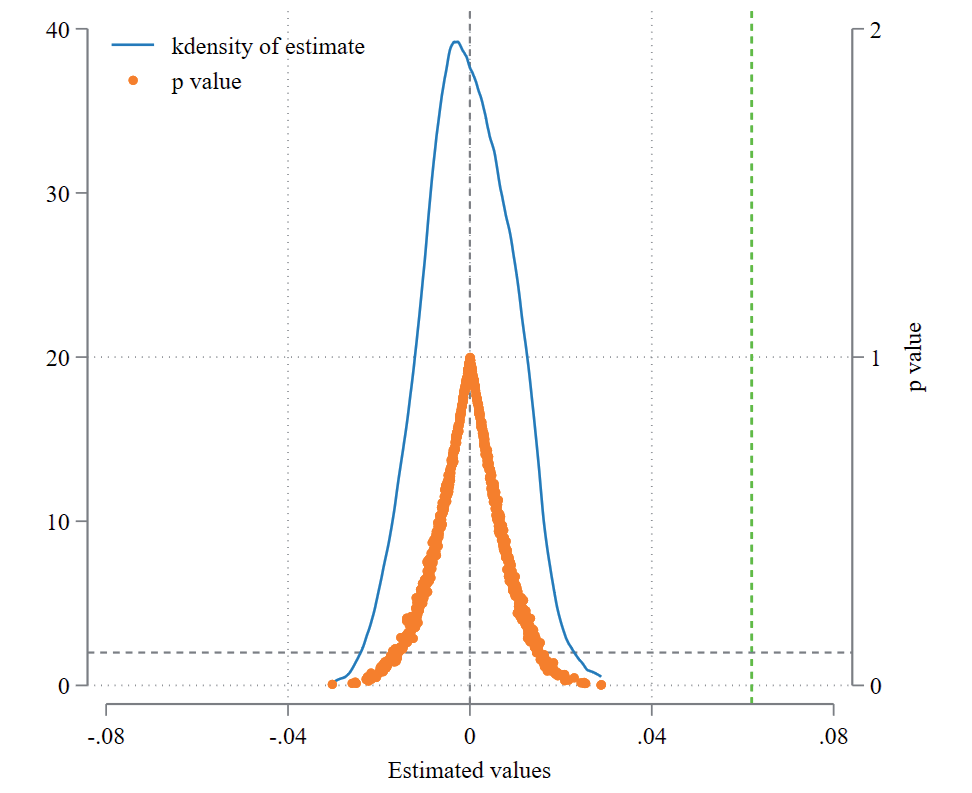
Following Zhou and Zhang (2023) [63], we perform a placebo test to mitigate the potential impact of unobserved variables on the baseline results. We randomly assign the independent variable to the dependent variable, thereby generating a counterfactual dataset. Subsequently, we conduct regression analyses on this counterfactual dataset using the benchmark regression equation. To validate the robustness of our findings, we repeated this random assignment process 1,000 times. The probability density distribution of the coefficients obtained from these 1,000 regressions is depicted in Fig. 1. Most of the estimated coefficients are concentrated around zero, with the majority of p-values exceeding 0.1. Furthermore, the actual estimated value (as indicated in Column (2) of Table 2 and illustrated by the green vertical line in Fig. 1) stands out as a significant outlier in the placebo test.
Other Robustness Tests
Furthermore, we have undertaken other robustness measures. First, we use the proportion of executives with environmental backgrounds as the independent variable. The result is shown in Column (1) of Table 3. Second, we employ the natural logarithm of the number of executives with environmental backgrounds as a new independent variable. The result is displayed in Column (2). Thirdly, in the initial regression analysis, we utilize the natural logarithm of corporate environmental investment as the dependent variable, neglecting the impact of firm size variations. To rectify this oversight, we introduce an alternative dependent variable that takes into account the ratio of corporate environmental investment to firm size, with the findings presented in Column (3).
Fourthly, following Tang et al. (2022) [64], Column (4) presents the result, controlling for province and year interaction fixed effects. Subsequently, acknowledging that the manufacturing sector and heavily polluting industries are the main contributors to industrial pollution and thus bear significant environmental responsibilities, we limit our regression analysis to only manufacturing and heavily polluting enterprises, as reflected in Column (5). Lastly, considering the possible nonlinear relationship between executive environmental experience and environmental investment, we include the squared term of the independent variable in the model. The coefficient of Expe*Expe is not significant. The findings are presented in Column (6).
Table 3.
Other robustness test results.
Mechanism Analysis
Raising Firm Environmental Awareness
As shown in Column (1) of Table 4, executive environmental experience significantly enhances firm environmental attention, which implies that executives with environmental backgrounds effectively contribute to firms’ attention to environmental issues. Therefore, raising firm environmental attention constitutes one of the channels through which executive environmental experience increases corporate environmental investment. In other words, executive environmental experience can effectively promote corporate environmental investment by raising firm environmental attention.
The rationale stems from executives with environmental backgrounds possessing extensive experience in environmental protection and sustainable development, thereby being more likely to regard environmental protection as a vital strategic objective for corporate growth. Executives with an environmental background are more inclined to take environmental factors into account when developing company strategies and decisions. These executives foster an environmentally-oriented corporate culture by disseminating environmental awareness throughout the entire organization. For instance, they are predisposed to opting for eco-friendly technologies and processes, instituting stringent environmental policies, and internally promoting green office practices and energy-saving measures [65]. This top-down environmental strategic orientation guides firms to prioritize environmental concerns across various facets such as product development, production, and sales, thus effectively enhancing corporate environmental consciousness.
Improving Corporate Green Innovation
Corporate green innovation is employed as the dependent variable, as depicted in Column (2) of Table 4. Notably, executive environmental experience significantly fosters corporate green innovation. This observation suggests that executive environmental experience can influence corporate environmental investment by enhancing green innovation. Consequently, improving green innovation is one of the channels through which executive environmental experience impacts corporate environmental investment.
It is not difficult to comprehend that amidst the increasingly fierce market competition, green innovation has emerged as a crucial avenue for firms to enhance their competitiveness and brand value. Executives with environmental backgrounds recognize that green innovation not only signifies a manifestation of corporate environmental responsibility but also stands as a key driver for achieving sustainable development. Green innovation not only meets the market demand for eco-friendly products and services but also enhances corporate brand image and social responsibility [66]. Consequently, they are more likely to take green innovation as a vital component of their corporate strategy and push companies to increase their investment in green technology research and development to enhance green innovation levels. The environmental awareness of executives can guide enterprises to pay more attention to environmental issues in their business decisions, thus promoting the implementation of green innovation strategies.
Heterogeneity Analysis
Heterogeneity Based on the Strength of Environmental Penalties
In this section, we categorize the sample into two segments according to the strength of provincial environmental penalties. The moderating effect of environmental penalty strength is shown in Columns (1) - (2) of Table 5. In Column (1), when firms’ headquarters are located in regions with less environmental penalties, the effect of executive environmental experience on firms’ environmental investment is insignificant. On the contrary, in Column (2), when corporate headquarters are located in regions with stronger environmental penalties, executive environmental experience significantly increases corporate environmental investment.
The likely reason for this is that in regions with higher environmental penalties, the government usually implements stricter environmental laws and regulations and takes more stringent environmental regulatory measures. Executives with an environmental background are generally more attuned to shifts in environmental regulations and requirements, prioritizing corporate adherence to environmental standards. Moreover, executives with an environmental background usually have a deeper understanding and knowledge of environmental policies and standards, and they are more sensitive to and cognizant of environmental issues. In such an environment, companies face greater environmental pressure and risk. In order to reduce the cost of non-compliance and avoid environmental penalties, firms need to pay more attention to environmental protection to meet environmental requirements [67]. As a result, environmental penalties amplify the positive effects of executive environmental experience.
Heterogeneity Based on Corporate Pollution Levels
Heavily polluting industries are the major source of industrial pollution, and they are under increasing pressure from environmental regulation. To achieve the environmental performance required by the higher government, the local governments will allocate most of the emission reduction tasks to heavily polluting polluters. As the focus of environmental governance, under the background of the central government’s strong pollution control, the heavily polluting polluters have to actively fulfill their environmental responsibilities to meet the local government’s environmental preference. Therefore, compared with ordinary enterprises, the environmental performance of heavily polluting polluters may be higher.
As shown in Table 5, Columns (3) and (4) represent non-heavily polluting polluters and heavily polluting polluters, respectively. Executive environmental experience significantly enhances the environmental investment of heavily polluting polluters, but it is not significant for non-heavily polluting polluters. The possible reason for this is that the heavily polluting polluters are given more attention by government environmental protection departments, so executive environmental experience may have a greater impact on heavily polluting polluters. Many studies have confirmed that the environmental performance of heavily polluting polluters is better than ordinary enterprises [4, 68].
Heterogeneity Based on Media Coverage
Media coverage is deemed a key form of informal environmental regulation, which can provide effective supervision on the implementation of formal environmental regulation [69]. As a medium for corporate information disclosure, the media continues to transmit a lot of environmental information to stakeholders, thus reducing the degree of information asymmetry among stakeholders [58]. In addition, media coverage can effectively encourage enterprises to conduct environmental protection investment activities, develop active and effective supervision of the firms’ environmental protection behavior, and become an indispensable part of environmental governance. Therefore, we expect that media coverage will help to improve environmental investment. To test this point, using the mean value of media coverage as the cut-off point, we divided the sample into a high media coverage group and a low media coverage group.
Table 5.
Heterogeneity analysis results.
To complement formal environmental regulations, the media can compensate for regulatory failure to a certain extent. In consideration of their own reputation and ongoing operations, enterprises must be cautious about the voice of the media. As shown in Table 5, Columns (5) and (6) represent low and high media attention, respectively. For companies with low media attention, the effect of executive environmental experience is not significant. For firms with high media attention, executive environmental experience significantly enhances firms’ environmental investment. To demonstrate a good corporate image to the outside world, under the pressure of external stakeholders, enterprises will better comply with environmental regulations and enhance the motivation to fulfill their environmental responsibilities.
Conclusions
This study explores the impact of executives’ environmental experience on corporate environmental investment, contributing to the growing body of literature on corporate sustainability and governance. Using a two-way fixed effects model, we find a significant positive relationship between executive environmental experience and corporate environmental investment. Our analysis reveals that executives with environmental backgrounds not only steer companies toward more proactive environmental measures but also enhance corporate attention to environmental issues and foster green innovation. Furthermore, we observe that the effect of executive environmental experience is amplified by environmental penalties and media coverage, particularly in heavily polluting industries. These findings underscore the critical role of top management in shaping corporate environmental behavior, adding new insights to the attention-based view of corporate governance.
Our findings contribute to the attention-based view by highlighting how executives with environmental expertise bring heightened focus to sustainability-related issues, directing organizational attention and resources toward green initiatives. Unlike studies that primarily focus on external pressures such as regulations or market forces, this research emphasizes the critical role of top management in shaping corporate environmental strategies. For example, executives with environmental expertise amplify corporate attention to environmental concerns and actively facilitate environmental investment, offering a nuanced understanding of how individual-level attributes can impact organizational outcomes. Compared to existing studies, our research provides empirical evidence on the mechanisms through which executive attention is converted into actionable corporate practices, expanding the scope of the attention-based view in the context of environmental governance [55, 70, 71].
The practical implications of our study are far-reaching. Companies should prioritize recruiting executives with strong environmental expertise and invest in continuous environmental education for their leadership teams to foster a culture of sustainability and innovation. Governments, on the other hand, should consider implementing more stringent regulations on environmental disclosure, encouraging companies to be more transparent about their environmental practices. Additionally, policies supporting green innovation, such as financial incentives for environmentally friendly projects, could further drive sustainable practices within firms. As environmental penalties play a significant role in influencing corporate behavior, governments should ensure the enforcement of stringent environmental laws with penalties that effectively deter non-compliance. Our study also highlights the role of media in shaping corporate environmental behavior, suggesting that increased public scrutiny could further encourage firms to adopt sustainable practices.
Despite the valuable contributions of this study, several avenues for future research remain. First, while our study measures executive environmental experience using text mining, future research could refine this measurement by incorporating contextual semantics or using advanced machine-learning techniques to accurately capture the depth and specificity of executive experience. Additionally, our study is limited to firms in mainland China with a distinct regulatory environment. Future research could extend this analysis to cross-country comparisons, examining how different levels of environmental regulation influence the relationship between executive experience and corporate environmental investment. It would also be useful to explore how this relationship varies across different industry sectors, as sector-specific factors such as regulatory pressure and technological feasibility may impact the role of executive experience in driving environmental investments. Furthermore, while our study focuses on the immediate drivers of environmental investment, future research could investigate the long-term outcomes of corporate environmental investments, including their effects on financial performance, brand reputation, and competitive advantage. Third, future studies could incorporate a contextual analysis of executive environmental experience, examining how industry-specific or regional factors shape the effectiveness of environmental expertise in driving corporate sustainability. To enhance the global relevance of this research, future studies should include data from other developing countries. Cross-country comparisons could shed light on how differences in regulatory environments, cultural attitudes toward sustainability, and economic conditions influence the dynamics of executive environmental experience and corporate environmental investment.

