

Introduction
With the promotion of the strategy of “Civil Aviation Power” and “Intelligent Airport” in the new era, the construction of airports is gradually expanding from the plain and hilly areas to the high plateau and mountainous areas, especially in the high mountainous and extremely high mountainous areas mainly in the Qinghai-Tibetan Plateau and the Yunnan-Guizhou Plateau [1]. At the same time, with the continuous improvement of flight technology and flight safety standards, the indexes for building airports in plateaus are becoming more and more refined, especially the settlement and deformation requirements for the foundation soil of high plateau airports are getting higher and higher. Distinguished from other geological environments, foundation soils in plateau areas are often formed by the Quaternary Pleistocene period, experiencing multiple ice ages and interglacial turnover, the end of the interglacial period glacial meltwater volume is reduced, the carrying capacity of the transport is weakened, and the formation of fine-grained clayey soils, subject to the reduction in the amount of rainfall, and the formation of locally thick layers of unsaturated clayey soils [2-5].
In actual airport engineering, unsaturated clayey soil foundation often belongs to bad foundation , easy to cause foundation settlement, airport high slope instability and other engineering problems : Ganzi Kangding Airport, Sichuan, belongs to the high plateau airport, in the investigation and design stage, due to the airport field road area foundation soil contains part of the unsaturated clayey foundation soil, due to the time of the drainage characteristics of this type of soil in bearing the wheel loads of the aircraft and the lack of knowledge of the geological parameters, resulting in the multiple patching of foundations during the operation and maintenance stage [6]. Therefore, in actual airport projects, corresponding treatment measures are often taken for unsaturated viscous foundation soils, and it is common to add rigid piles such as CFG piles in the foundation soils, so that the piles and the soil base can bear the upper load together, and then reduce the settlement deformation of the foundation [7-10]. However, the current research on CFG pile reinforcement of unsaturated foundation soil in airport engineering is still relatively small, and a large number of studies focus on considering the soil between piles as saturated soil, without really considering the unsaturated nature of the soil between piles [11-16]. With the continuous improvement of flight safety requirements in civil aviation industry, the requirement of settlement and deformation of airport foundation soil will be more and more accurate, so it is especially important to consider the unsaturated nature of inter-pile soil [17-20].
In view of this, based on the perspective of flight technology and flight safety, this paper takes the unsaturated clayey foundation soil of a high plateau airport in the mountainous area of southwest China as the research object, and establishes the method of calculating the composite modulus of CFG pile composite foundation in which the soil between the piles is an unsaturated soil according to the relevant characteristics of unsaturated soils, and carries out the calculation of the settlement of composite foundation based on this method. At the same time, Plaxis finite element analysis software is used to model the actual project and numerically analyze the settlement characteristics of the composite foundation. Finally, the calculation results of the two methods are compared and studied with the actual settlement monitoring values on site.
Material and Methods
A high plateau airport in the southwest mountainous area is an important hub connecting the east and west transportation of China. The airport is located in Ganzi County of Sichuan Province, with an average elevation of 4238 m, which is a typical high plateau airport, and at the same time, unsaturated clayey soils are widely distributed in the foundation soils. In order to ensure the safety and smoothness of airport operation, CFG piles are added to reinforce the foundation soil of the airport to form a composite foundation, and the section of composite foundation of the airport is shown in Fig. 1. In practical engineering, the subgrade of the airport is often designed and constructed in accordance with the slope of 1:1.5, which is representative in practical engineering. Therefore, when carrying out the theoretical analysis in this paper, the slope of 1:1.5 is selected to establish the analysis model.
Each parameter of CFG pile composite foundation, see Table 1.
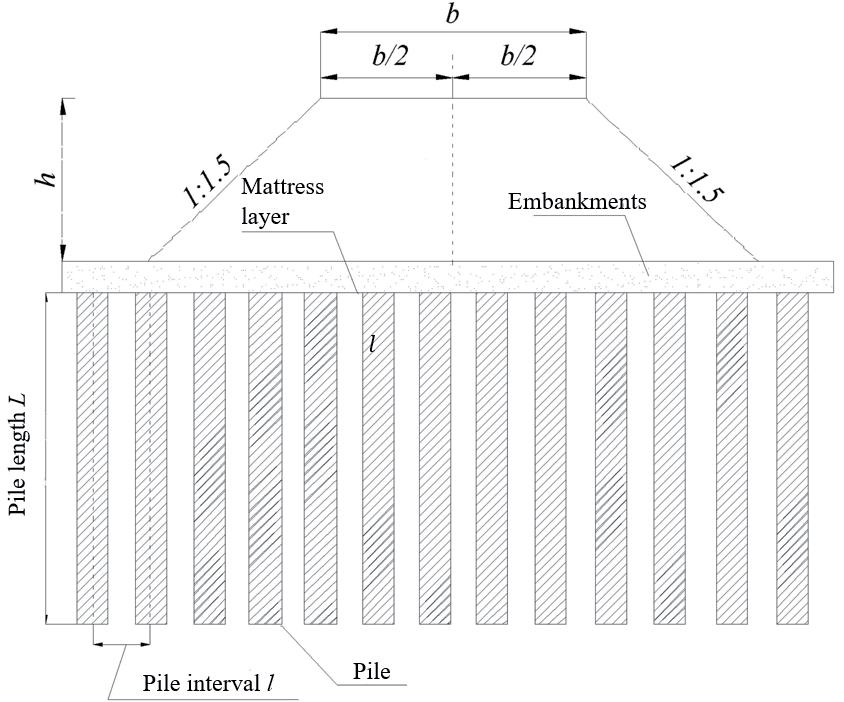
Table 1.
Parameters of composite foundation layers.
Theoretical Analysis
In actual engineering, in the settlement calculation of CFG pile reinforced foundation soil to form a composite foundation, the composite modulus of the composite foundation is often obtained first, and then the theoretical formula method of the composite modulus is used for calculation [21-23].
This paper follows the theoretical analysis method of composite modulus in the industry specification, meanwhile, in order to coordinate the deformation of pile and soil, the bedding layer is generally set on the composite foundation. It is assumed that the bedding layer satisfies Hooke’s law:
Where: Sr is the bedding layer compression, σr is the average stress on the bedding layer, Hr is the thickness of the bedding layer, and Er is the modulus of the bedding layer. Assuming that the bearing platform is very rigid and does not tilt under load, the deformation at each point under the bearing platform is the same, with:
Where: S, Sp, Ss are the settlement values of composite foundation, rigid pile, and soil between piles under load, respectively; Srp, Srs are the compression amount of bedding layer for rigid pile location and soil location bedding layer, respectively. By assuming that the foundation soil reinforced by (2) is homogeneous and only its one-dimensional settlement is considered, there are:
Where: σ is the average stress of composite foundation, Ec is the composite modulus, and H is the pile length. The subscript “unsat” stands for the relevant parameters of unsaturated soil. According to the principle of area weighting, the average stress of composite foundation is calculated as:
Where: σp is the stress at the top of the rigid pile, σs–unsat is the stress in the soil between the piles. The subscript “unsat” stands for the relevant parameters of unsaturated soil, and m is the replacement ratio of the pile-soil area.
Bringing (8) and (11) into (10) can be obtained:
For homogeneous inter-pile soils there are:
The displacement of soil around the pile is related to the loading with the Equation [24]:
Where: τ0 is pile lateral resistance, r0 is pile diameter,
The differential Equation for pile load transfer is:
Where: Ep is the compression modulus of the pile, A is the cross sectional area of the pile, and U is the length of the pile.
can be obtained from Equations (14) and (15):
Let
can be obtained from Equations (10) and (11):
The boundary conditions are:
Where: n can be determined according to the Boussinesq theory,
The values of c1, c2 can be obtained from Equations (12), (13) and hence:
of which: λ = μH,
From Equation (21):
can be obtained from Equations (5) and (15):
From Equation (16), it is found that this method takes into account the effects of the pile length of the rigid pile, the nature of the soil between the piles, the nature of the soil at the end of the pile, and the shape coefficient of the end of the pile (for the expanded-bottom pile). In the actual engineering calculations, the actual compression modulus of unsaturated clayey soil can be obtained through field testing and other methods, which can be brought into (16) to find the composite modulus of the composite foundation when the soil between the piles is unsaturated, and then carry out settlement calculations.
Numerical Analysis
In order to compare with the improved composite modulus theoretical analysis method, Plaxis software was also used to model the foundation soil in the study area and numerical simulation analysis of the settlement characteristics of the composite foundation after CFG pile reinforcement was carried out.
Basic Assumptions
Combined with the actual engineering situation of unsaturated clayey foundation soil and CFG pile reinforcement in high plateau airports, the following basic assumptions are made when constructing the finite element numerical analysis model according to the adaptability of the finite element analysis software PLAXIS:
1) The Mohr-coulomb (Mohr-coulomb) constitutive model is selected for the constitutive model of unsaturated clayey soils in the model; the yielding criterion of the soil conforms to the Mohr-coulomb strength criterion;
2) The soil material is not subjected to tensile forces;
3) Introduce the contact unit (Interface Element) to simulate the contact problems between the pile and the soil layer, the bedding layer and the soil, and the grillage and the bedding layer;
4) A standard setup of boundary conditions is used, i.e., the model is fixed horizontally around the perimeter and both horizontally and vertically at the bottom;
5) Assume the stratigraphic level of the High Plains Airport study area analyzed;
Parameter Selection
The parameters of each soil layer of the CFG pile composite foundation were entered during the simulation, as shown in Table 1.
Numerical Analysis Modeling and Meshing
In the analysis of airport geotechnical engineering, plaxis software can well model the interaction between soil and water when constructing the finite element analysis model. At the same time, the selection of parameter constitutive model of soil and water is also close to the engineering practice. Therefore, plaxis software is selected for modeling and analysis in this paper.
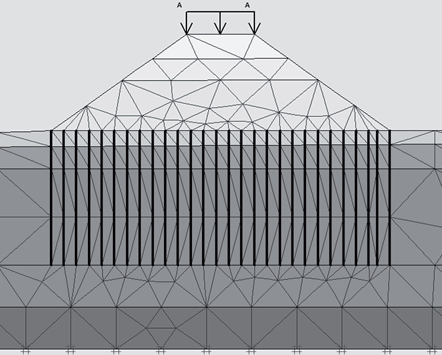
The reason that the 2D meshing in the PLAXIS-3D finite element model uses 6-node triangular cells (Fig. 2) instead of 15-node triangular cells as in the PLAXIS-2D finite element model is that once the 2D meshing in the 3D finite element model is done with 15-node triangular cells, the 3D meshing will have to be done with higher-node wedge cells. This would take up a large amount of memory and incur unacceptable computation time. The process of mesh generation is the conversion of a geometric model into a finite element model. The 2D meshing is performed before the 3D meshing of the PLAXIS-3D geometric model, i.e., the PLAXIS-2D finite element model is generated first.
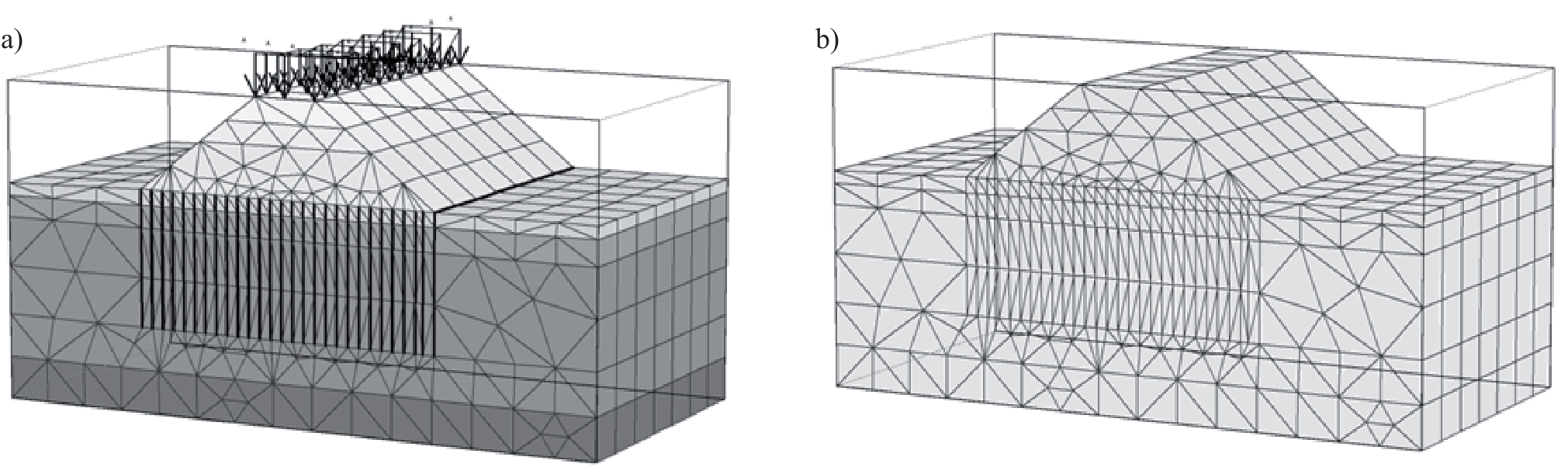
According to Fig. 2, the PLAXIS-3D finite element analysis model is constructed, see Fig. 3. The number of cells is divided into 3134, the number of nodes is 9265, and the total number of stress points is 18825 in the whole 3D model.
Simulation of Initial State of Foundation Soil Layers
The initial stress field is generated by simulating the initial environment of the site according to the initial actual situation of the site, see Fig. 4.
Simulation of the state of CFG piles in soil layers
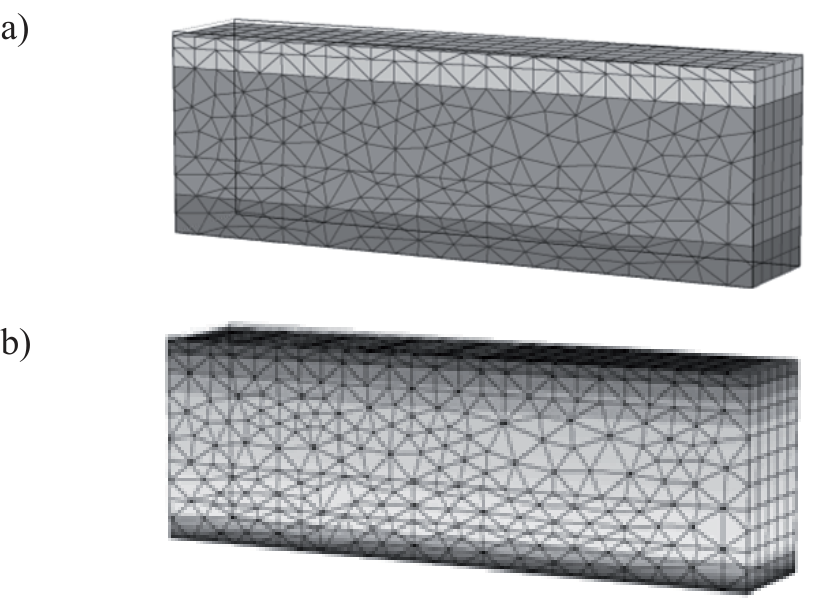
Simulation of CFG piles in the soil layer: the CFG piles were left in place for 60 days after construction to eliminate the effects of superporous water pressure generated during the construction of CFG piles and nets (Fig. 5).
Simulation of Gravel Bedding on Top of Piles
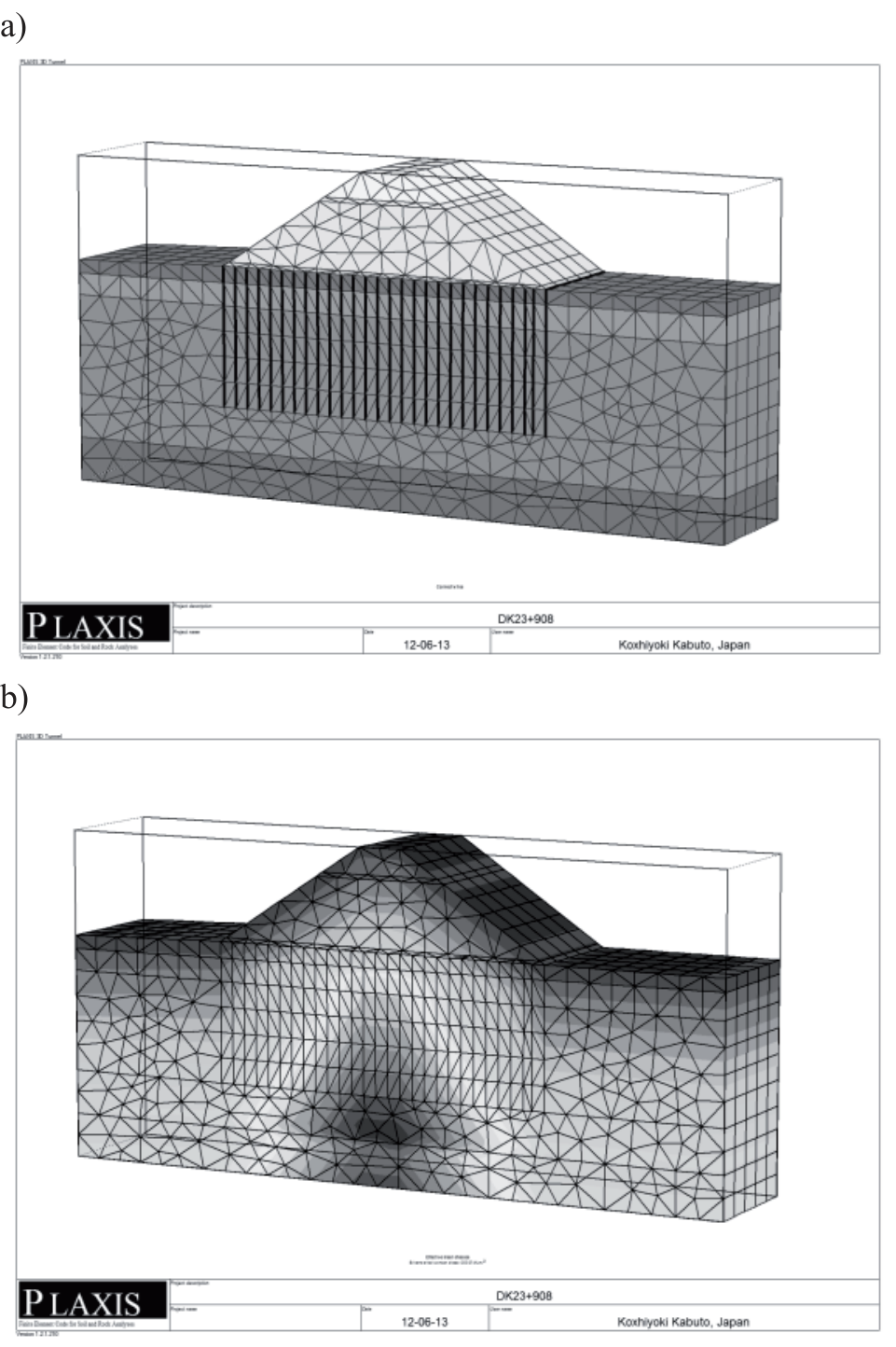
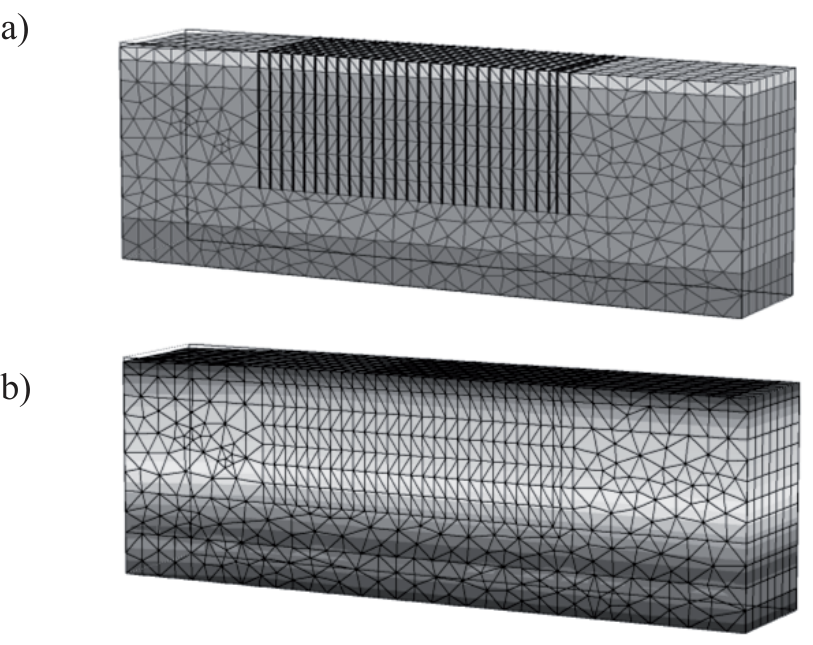
Combined with the actual project, 0.60m thick gravel bedding is laid on top of CFG piles, and the numerical analysis model is shown in Fig. 6.
Simulation of Embankment Fill Pre-Compaction Completion State
The simulated condition of the embankment after filling and pre-compaction is completed is shown in Fig. 7.
Fig. 6.
State and stress diagram of bedding laid on top of CFG piles. a) Simulation of laying bedding on top of CFG piles, b) Stress diagram of laying bedding on top of CFG piles.
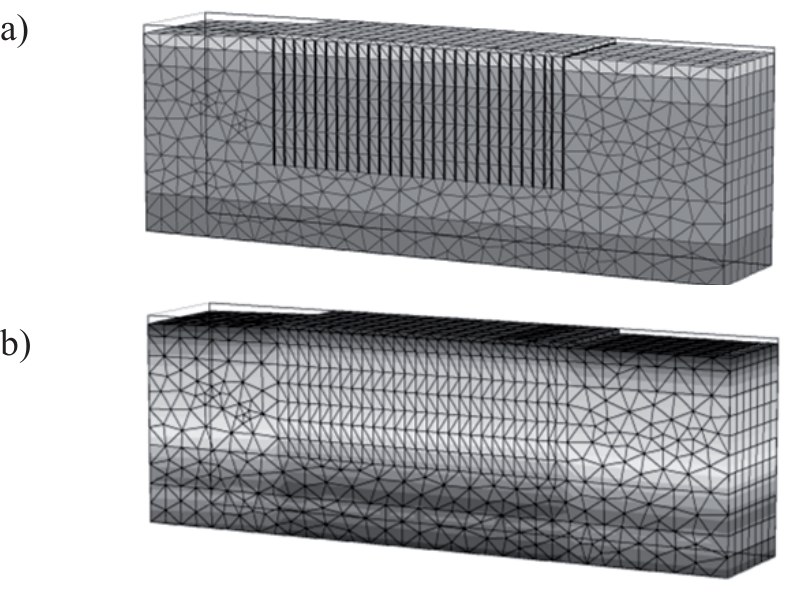
Fig. 7.
State of pre-compaction completion of embankment fill and stress map. a) Simulation of the pre-compacted state of the embankment fill, b) Stress diagram of the pre-compacted state of the embankment fill.
Analysis of Results
According to the actual engineering situation, the settlement calculation results of CFG pile reinforced unsaturated clayey foundation soil composite foundation are shown in Fig. 8.
As can be seen in Fig. 8, the maximum settlement of the composite foundation in the calculated section is at the center of the foundation, which is 5.3 mm.
Results and Discussion
For both theoretical analysis method and numerical analysis method, the maximum settlement value of CFG pile composite foundation can be obtained, and it can be found that the settlement value is the largest in the center of the analysis model (i.e., the center of the composite foundation). Comparing the maximum settlement values of the two analysis methods with the actual monitoring values on site, the most suitable method for analyzing the settlement characteristics of CFG pile composite foundation for this actual project can be obtained. The comparison results are shown in Table 2.
As can be seen from Table 2, the theoretical analysis method and numerical analysis method calculated the results of the value are smaller than the field measured value, but the numerical analysis method is closer to the field measured value. The reason for this can be understood as the field measurement will be affected by the actual engineering environment, construction and other factors, which will make the field measured value is larger. However, it can also be seen that, for this project, the difference between the theoretical analysis method and numerical analysis method recommended in this paper and the field measured values are within 10%, therefore, in the actual high plateau airports can be selected in this paper to recommend the two methods of analysis for the relevant research.
Conclusions
In this paper, by considering the unsaturated nature of the soil between the piles, the insufficiency of considering the soil between the piles as saturated soil in the conventional composite modulus method is improved, and based on the theory of the shear displacement method, the theoretical method for the calculation of the composite modulus and settlement of rigid pile composite foundations with the soil between the piles as unsaturated soil is deduced. The settlement of CFG pile reinforced unsaturated clayey foundation soil composite foundation in a high plateau airport in Southwest China was analyzed by using this theoretical analysis method and Plaxis finite element analysis method, and the following conclusions were obtained:
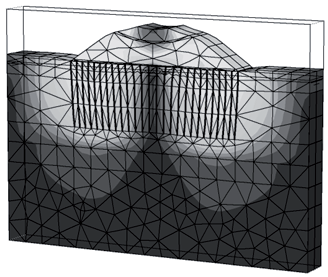
Table 2.
Comparison of Settlement of Unsaturated Cohesive Foundation Soil Reinforced by CFG Piles in Different Methods for High Plateau Airports.
(1) This theoretical analysis method is able to consider the effects of pile length, pile modulus, and matrix suction in unsaturated soil of rigid piles on the composite modulus, which is more in line with the reality than the conventional composite modulus method that does not consider the unsaturated nature of the soil between the piles.
(2) The theoretical analysis method and numerical analysis method suggested in this paper both calculated the result value is smaller than the field measured value, but the difference is within 10%, therefore, in the actual high plateau airports can choose the two analysis methods recommended in this paper to carry out the related research.

