

Introduction
During port construction and the establishment of navigable waterways, a substantial quantity of sludge is generated on the seabed. The utilization of discarded seabed sludge for land construction not only proves to be economically viable but also addresses the deficiency of land resources. The engineering characteristics of filled soil are determined not only by the material composition but also by the fundamental treatment techniques applied to the filled foundation. The former significantly influences, and at times dictates, the methods used for foundation treatment. This article is dedicated to investigating the unfavorable engineering characteristics of reclamation soft soil with high water content in the Binhai area of Tianjin. The fundamental resolution to this issue encompasses not only augmenting the soil’s strength but also mitigating its deformability. The solidification of lightweight soil serves to boost the soil’s strength and, due to its low density, decelerates overall site deformation. Hence, advancing lightweight solidifying agents suitable for high-water-content reclamation sites, refining solidification techniques, and delving into strength variations in solidified lightweight soil under extensive shear deformation are significantly practical for engineering applications.
In recent years, scholars both domestically and internationally have achieved significant advancements in the research pertaining to solidified soil, lightweight soil, shear mechanical properties, and the bearing characteristics of double-layer foundations. Shinsha et al. [1] employed a solidifying agent to treat dredged soil, examining the particle characteristics of the treated soil samples and assessing their performance over the long term in the presence of seawater. Shen et al. [2] utilized a solidifying agent derived from gypsum and industrial waste to address soft soil. They observed that while the long-term strength was comparable to cement-treated soil, the early strength exhibited a notable reduction compared to the latter. Hu et al. [3] employed ion-based solidifying agents innovatively to augment the durability of the protective layer surrounding the foundation piles. Do et al. [4] utilized cut and ground old fishing nets as additives for solidification agents, combined with the primary agent to treat dredged soil, and evaluated the performance using normalization factors. Wako et al. [5] incorporated density and temperature difference as key indicators in the assessment criteria for solidifying agents, illustrating a strong correlation between the stability of bubble-mixed lightweight soil and these parameters. The research conducted by Oh et al. [6] demonstrates that the optimal coordination among bubbles, cement, and water in lightweight soil bubbles occurs within the temperature range of 5-25°C. Zhao et al. [7] introduced an innovative approach by integrating construction waste particles as lightweight materials into soft soil. They observed that this incorporation of construction waste particles positively influences the long-term strength of solidified soft soil. Mackay et al. [8] conducted a comprehensive review of soil solidification treatments involving diverse materials and combinations, including cement, dust, and kiln ash. They also made refinements to the treatment process. Jones et al. [9] substituted sand with fly ash in the original formula during the development of lightweight foam soil materials, resulting in significant strength improvement and cost reduction. Yun et al. [10] reinforced the aged fishing net for treating dredged soil and incorporated rubber crumbs to augment the ductility of the dredged soil. Huan et al. [11] introduced bubbles into silt soil and examined permeability and long-term performance under the combined effect of curing materials, focusing on Qingpao and the curing agent. Wang et al. [12] employed ring shear tests to investigate the behavior of landslide soil under environmental factors like rainfall. Zhu et al. [13] investigated the impact of moisture content on the comprehensive strength in ring shear experiments of loess. They also analyzed the particle movement mechanism of the soil using scanning electron microscopy. He et al. [14] illustrated that the particle size of the material has the most immediate impact on strength in ring shear experiments. Chen et al. [15] from the perspective of particle size displacement, investigated the parameters and engineering stability of shear band soil through ring shear tests. Duong et al. [16] investigated cemented soils with varying consolidation effects using ring shear tests and compared the outcomes employing both single-stage and multi-stage procedures. Xu et al. [17] investigated the interface effect between soft soil and rock through ring shear tests. Bai et al. [18] explored the interlocking interaction between soil particles and fibers in reinforced soil and conducted a comparative analysis using two shear methods. Ma et al. [19] examined the strain softening and hardening behavior of soft soil layers and confirmed their stability using ring shear tests. Yuan et al. [20] acquired in-situ loess samples from the northwestern region of China and investigated the relationship between shear bands, failure surfaces, and strength. The above results underscore the practical viability of employing both solidified soil and lightweight soil in engineering applications. However, existing studies predominantly concentrate on traditional solidified soil or lightweight soil for general embankments, and there’s a dearth of research concerning high water-content solidified lightweight soil in embankments. Both domestic and international scholars commonly employ a direct shear apparatus to investigate plasticity indices and stress history concerning silty soil, saturated clay, and undisturbed soil. They explore roughness and deformation characteristics on various contact surfaces. However, limited attention has been given to research on solidified lightweight soil in this context. Conducting a direct shear test on solidified lightweight soil under static loading can provide crucial insights into how shear deformation affects the soil’s shear strength, holding practical implications for engineering applications.
Experimental
In this study, soft reclaimed soil sourced from Tianjin Binhai New Area is employed as the foundational material for creating solidified lightweight soil. The initial physical and mechanical properties of the soft reclaimed soil from Binhai New Area are outlined in Table 1 below.
In the preparation of the solidified lightweight soil for this study, two types of agents were utilized: the primary agent and the auxiliary agent. A self-made foaming agent was used and incorporated into the soft reclaimed soil to reduce soil density, effectively decreasing the overall weight of the soil. The ring shear tests were carried out using an SRS-150 ring shear apparatus manufactured in the United States. In this study, a single-stage shear test methodology is employed. This involves conducting tests under undrained and unconsolidated conditions, employing four distinct shear rates: 0.05, 1, 10 and 30 mm/min. These rates are selected to encompass a spectrum of slow, medium, and fast shear velocities. Moreover, a range of normal stresses and shear rates are deliberately chosen to thoroughly examine both peak strength and residual strength of the reclamation solidified lightweight soil. Detailed test parameters can be found in Table 2.
Results and Discussion
Effect of Different Normal Stresses on the Shear Strength of Solidified Lightweight Soil
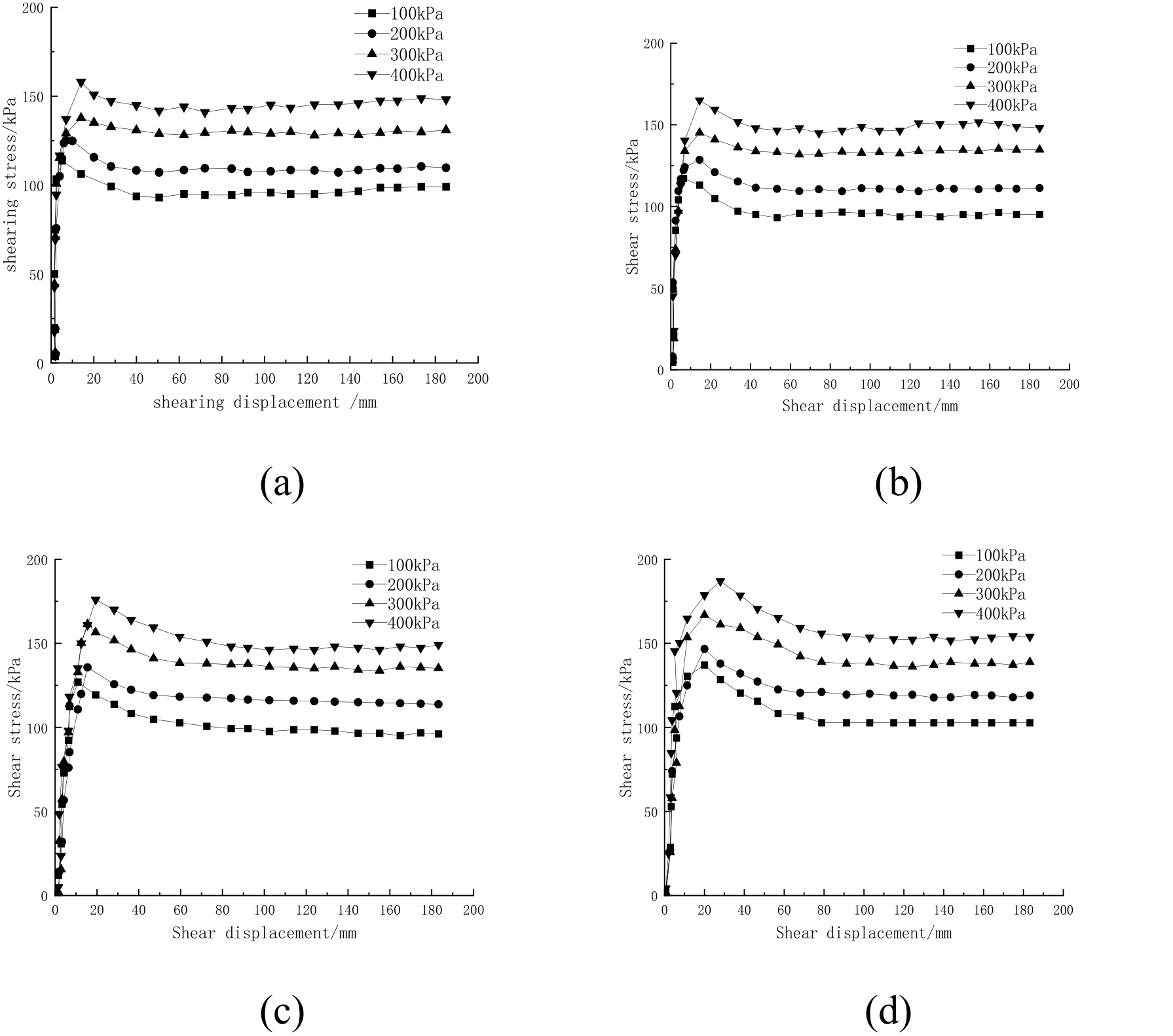
Based on the observations depicted in Fig. 1, the shear stress-shear displacement relationships manifest similarities across various normal stress conditions. The trends in shear strength for the solidified lightweight soil remain constant. At the initiation of the direct shear test, the shear stress undergoes a sharp increase, peaking at a relatively small displacement. Following this, a distinct inflection point emerges where the shear stress notably decreases, indicating a phase of shear softening. This transition is brief, and with the progression of the shear process, the displacement continues to ascend while the shear stress gradually stabilizes, reflecting no significant further alterations. The initial rapid increase in shear stress is attributed to significant friction and compression among soil particles at the onset of shear, causing a swift rise in shear stress. Following the attainment of peak strength, the shear stress starts to decline due to structural damage within the soil and the subsequent reorganization of internal particles. At equivalent shear rates, higher normal stresses correspond to elevated peak and residual strengths, with less prominent shear softening. This is because increased normal stress imposes greater overburden pressure on the soil, resulting in densification and heightened shear strength. In cases of relatively low normal stress, the soil’s cemented structure experiences minor damage, and this structure retains a crucial role in resisting shear in the cured lightweight soil. However, as the normal stress surpasses the soil structure’s yield stress, extensive damage occurs to the cemented structure of the cured lightweight soil. At this juncture, only a minor shear stress is necessary to achieve the residual strength. Analysis of Table 3 indicates a direct correlation between peak strength and both normal stress and shear rate, augmenting with higher normal stress and shear rate. Although there is no significant alteration in residual strength with increased shear rate, it escalates with higher normal stress.
Effect of Different Normal Stresses on the Shear Strength of Solidified Lightweight Soil
Fig. 2 illustrates that, at the same normal stress level, higher shear rates lead to increased peak strength. Peak strength shows a direct proportionality to shear rate, and this increase is relatively uniform. Despite variations in shear rates during the direct shear process, the final strengths remain generally consistent. This implies that the shear rate does not significantly affect residual strength. The most prominent softening phenomenon occurs in samples exposed to the maximum shear rate, demonstrating the largest numerical difference between peak and residual strengths. Shear strength comprises cohesion and the internal friction angle. The latter signifies sliding friction between particles and interlocking within irregularities, while the former represents bonding between clay particles. As shear rate increases, the friction between particles intensifies, causing a more rapid rise in shear stress. Conversely, at lower shear rates, the soil achieves both peak and residual strengths more rapidly, requiring less shear displacement. This is because, during shear, soil particles need to reorient within a smaller shear displacement range. At higher shear rates, the particles lack adequate time to reposition themselves directionally, resulting in a need for larger shear displacements to reach residual strength. Analyzing the distinct normal stress curves in Fig. 2 reveals that an increase in normal stress leads to higher peak and residual strengths at equivalent shear rate conditions. However, the degree of softening diminishes. For instance, considering the shear stress-shear displacement curve at a normal stress of 100 kPa from Fig. 2a) as an example, the corresponding shear displacements for peak strength at shear rates of 0.05, 1, 10, and 30 mm/min are 5.107 mm, 6.429 mm, 10.898 mm, and 20.017 mm, respectively. The corresponding shear displacements for residual strength are 39.945 mm, 42.590 mm, 72.503 mm, and 91.245 mm, respectively.
Fig. 1.
Shear stress Shear Displacement Curve under Different Normal Stresses. a) Shear rate is 0.05 mm/min; b) Shear rate is 1 mm/min; c) Shear rate is 10 mm/min; d) The shear rate is 30 mm/min.
In Fig. 3, the peak strength envelopes for varying shear rates depict upward-trending lines, and those associated with higher shear rates exhibit more pronounced curvature. For the same shear rate conditions, lines corresponding to higher normal stresses display steeper slopes. An examination of Table 4 shows that altering the shear rate influences the peak strength to some extent. Higher shear rates lead to stronger instantaneous shear resistance, resulting in larger cohesion values (c1, c2). However, the difference in internal friction angles (φ1, φ2) is not significant. At lower normal stresses, where the cohesive structure of the sample remains intact, cohesion plays a pivotal role, resulting in higher cohesion values. Conversely, at higher normal stresses, the cohesive structure of the sample undergoes substantial damage, leading to reduced cohesion values. Peak strength primarily arises from interparticle friction in this scenario, resulting in a noticeable increase in the internal friction angle (φ1, φ2). Fig. 4 illustrates the residual strength fitting for various shear rates, showcasing similar residual strength envelopes under varying shear rate conditions. This indicates that shear rate has minimal influence on residual strength. Additionally, the graph demonstrates a linear relationship between residual strength and normal stress.
Table 3.
Shear strength of different normal stresses.
Fig. 2.
Shear stress Shear Displacement Curve under Different Shear Rates. a) Normal stress is 100 kPa ; b) Normal stress is 200 kPa; c) Normal stress is 300 kPa; d) Normal stress is 400 kPa.
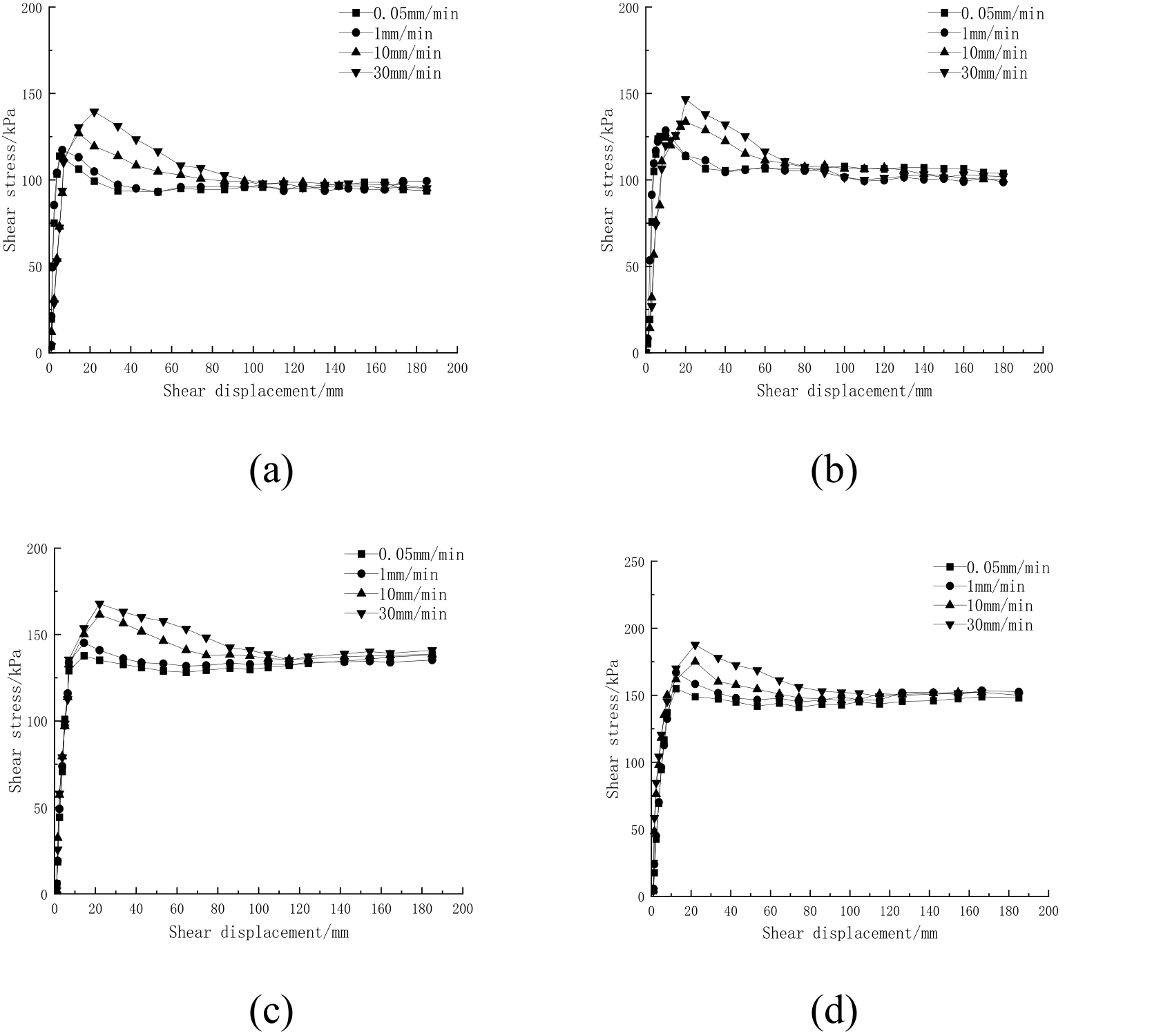
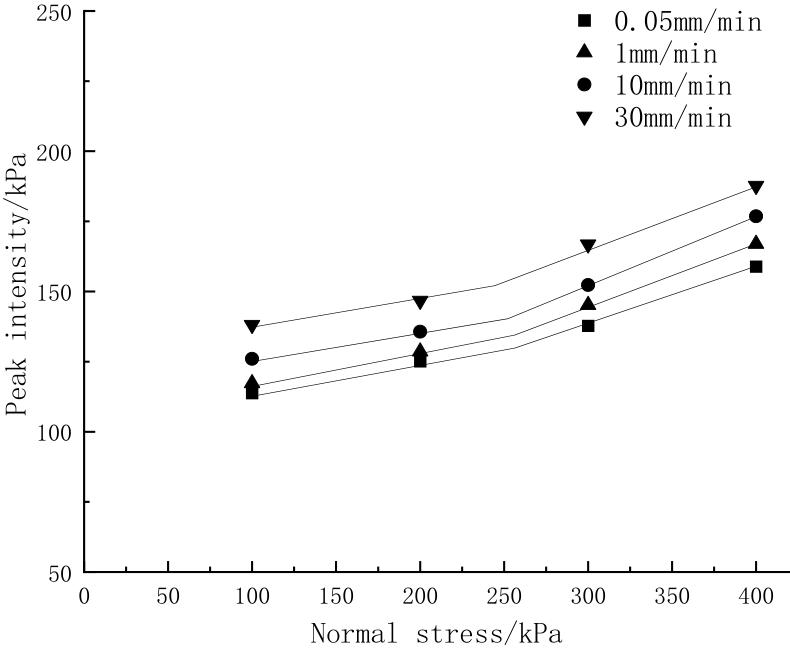
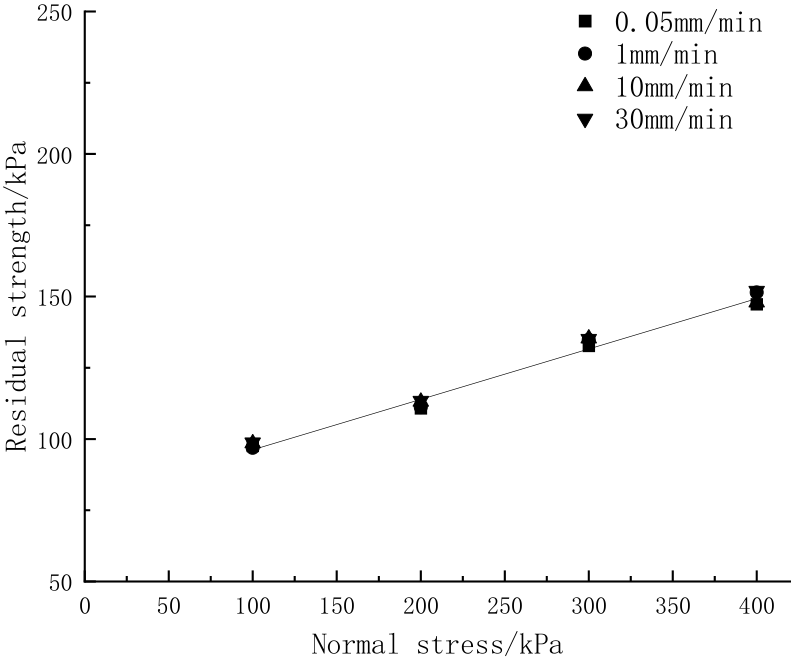
Table 4.
Peak intensity parameters.
Table 4 clearly shows that an increase in shear rate corresponds to higher cohesion values (c1 and c2) and no significant variation in the internal friction angles (φ1, φ2). Additionally, an increase in normal stress leads to smaller cohesion values and larger internal friction angles in the shear strength parameters. Analyzing the residual strength parameters derived from different shear rate residual strength envelopes (Table 4), it is evident that there is no noticeable trend in residual strength parameters with varying shear rate. Shear rate appears to exert minimal influence on residual strength.
Conclusions
This article conducts experiments to study the mechanical characteristics of solidified lightweight soil under extensive shear deformation conditions. The main conclusions obtained are as follows:
(1) Based on the shear stress-shear displacement curve, it is inferred that the curve of solidified lightweight soil tends to exhibit strain softening under extensive shear conditions. As the normal stress increases, both the peak strength and residual strength augment, albeit with a lesser degree of softening. With an identical normal stress, elevating the shear rate amplifies the peak strength; the residual strength, however, remains constant. Furthermore, as the shear rate increases, the requisite shear displacement to attain the peak and residual values also rises.
(2) The peak strength envelopes at varying shear rates exhibit an upward curvature, with the degree of curvature increasing as the rate escalates. Conversely, the residual strength envelopes at different shear rates are linear and remain unaffected by the shear rate.
(3) Analyzing the peak strength and residual strength parameters reveals that an increase in shear rate leads to an augmentation of cohesion in the peak strength parameters, while the internal friction angle remains relatively constant. Notably, the residual strength parameters remain consistent regardless of changes in the shear rate.

