

Introduction
In recent years, with the rapid development in industrialization and modernization, the world has seen impressive growth the in economy. However, this growth has also caused severe damage to the ecological environment. [1] For example, the release of greenhouse gases such as carbon dioxide has led to global warming, which has also brought a series of environmental problems like melting glaciers, rising sea levels, and extreme weather. [2] In response, a series of international conventions and agreements have been established to address climate change.
Carbon emissions and carbon sequestration accounting were the earliest topics in carbon accounting research. Energy consumption leads to CO2 emissions, while actions such as afforestation and changes in land use can sequester CO2 [3]. With the development of the low-carbon economy, the accounting field has conducted in-depth research on carbon accounting, achieving some stage breakthroughs [4]. However, no unified international corporate accounting standards have been established so far, and scholars hold different opinions on this issue. In terms of the study of corporate carbon emissions materiality accounting, most scholars prefer input-output methods [5, 6], life cycle assessment methods which in short LCA [7, 8], and carbon emission coefficient methods [9-11]. Carbon accounting reflects and embodies carbon emission rights as a new type of economic business which is a supplement and update to traditional accounting theory. Most scholars regard carbon emission rights as assets, mainly focusing on “inventory” [12, 13], “intangible assets”[14], and “financial assets” [15, 16]. When it comes to the selection of carbon emission rights measurement methods, in the short term, the current carbon emission rights trading market does not meet the conditions for fair value measurement. In the long term, the historical cost method cannot accurately and reliably measure the value of carbon emission rights, while fair value measurement can more effectively promote the prosperity of the carbon emission rights trading market [17]. Some scholars also suggest combining the historical cost method and fair value method for net amount and total amount accounting scopes [18]. In the early stage of the carbon emission rights market establishment, there were no specific limitations on carbon emission rights information disclosure content, which could include emission volume, carbon emission rights accounting treatment methods, energy-saving, and emission reduction technologies. After conducting a questionnaire survey on carbon emission rights information disclosure, the results showed that most respondents believed that the current disclosure methods were incomplete, inadequate, and not prominent enough [19]. With the development of the carbon trading market, information disclosure has become increasingly important. After understanding the role of climate change and the Green Climate Fund, corporate carbon information disclosure may affect corporate financing. Researchers subsequently used the fixed-effects regression method to establish models [20], the Analytic Hierarchy Process (AHP), and the Entropy-Weight Method [21], finding that the more carbon information disclosed, the lower the financing cost, indicating that creditors are paying more attention to carbon information disclosure when lending.
The paper industry is an essential part of the secondary industry and is closely related to the national economy. Its development is firmly connected to the overall development of the national industry. From a global perspective, the paper industry accounts for approximately 6% of global industrial energy use and 2% of direct CO2 emissions [22]. China is the largest producer and consumer of paper products in the world [23]. what is more, China is also a country with the greatest carbon emission potential in the paper industry. So, addressing the high carbon emissions problem in the paper industry is an urgent issue [24, 25].
Current research on carbon accounting still has the following problems: (1) the definition and connotation of “carbon accounting” have not yet reached a consensus;
(2) regarding the recognition of carbon emissions accounting, most scholars believe it is an asset, but there is no common conclusion on which specific asset it should be recognized as; (3) there is still debate on whether carbon emission accounting measurement should be based on historical cost or fair value; (4) there are no unified disclosure standards for information disclosure, making it difficult to compare between enterprises through disclosure. At present carbon trading has not been widely implemented on a large scale, and the number of enterprises related to carbon emissions is huge. It is difficult for enterprises to join carbon trading as soon as possible, based on this, the research of carbon accounting at this stage should concentrate more on the carbon emissions generated by the production and operation of enterprises. Under the new situation of China’s “dual carbon” goals and the practical needs of corporate carbon emissions supervision, it is necessary to strengthen supervision of the production process [26]. Therefore, this study combines the characteristics of accounting subjects in the paper industry to determine the accounting elements, analyzes activities involving carbon business, and sets financial accounting subjects and disclosure standards considering the actual situation of the paper industry’s production process, to construct a prototype of a carbon emission accounting system for paper enterprises oriented towards the production process, addressing the shortcomings of missing carbon factors in traditional accounting, also, promoting the development of global carbon financial accountings.
Material and Methods
In this paper, long-term research has been carried out on domestic and foreign forest-pulp-paper integration enterprises. It has investigated Stora Enso’s headquarters in Finland and the company in China (Guangxi), UPM in Finland, and other domestic forest-pulp-paper enterprises as well as the raw material forest bases of the companies, at the same time it investigated the operation mode of forest-pulp-paper integration and obtained abundant information on the production and operation of the enterprises. This paper takes Stora Enso (Guangxi) Company as a specific case and accounts for the carbon emissions generated in its production and operation process from the accounting perspective.
Stora Enso (Guangxi) Pulp and Paper Co., Ltd. is a Sino-foreign joint venture formed by Stora Enso Pulp and Paper Asia Ltd. and Guangxi GaoFeng Forest Pulp and Paper (Group) Co., Ltd. The company’s business scope includes wood products, pulp products, and paper products.
This study is based on the “900,000 tons of pulp, 900,000 tons of paper, and paperboard” project of Stora Enso (Guangxi) Pulp and Paper Co., Ltd. The specific product plan for the project is an annual production of 900,000 tons of eucalyptus chemical pulp, of which 450,000 tons are for self-use and 450,000 tons are for commercial pulp; an annual production of 900,000 tons of paper, including 450,000 tons of high-end packaging cardboard and 450,000 tons of high-end cultural paper (200,000 tons of high-end writing and printing paper, and 250,000 tons of coated paper). The main raw materials required for the production are eucalyptus produced from the raw material forest base, bleached hardwood chemical pulp and bleached softwood pulp purchased from external markets, as well as required ingredients such as limestone, calcium sulfate, caustic soda, sodium sulfate, starch, film, latex, and various chemical pharmaceuticals. The main energy sources required for the project are liquefied gas, raw coal, bark, heavy oil, water, and electricity.
Table 1.
100-year Global Warming Potential of Greenhouse Gases.
| Greenhouse gas | GWP value in 100 years |
|---|---|
| CO2 | 1 |
| CH4 | 21 |
| N2O | 310 |
Carbon Emission Measurement Model Oriented to Enterprise Production Process
In this paper, carbon emission coefficient method is used to establish a carbon emission equivalent accounting model to determine the carbon emissions from the production process of a paper manufacturer, referring to the methods in the “PAS2050 Standardized Assessment of Greenhouse Gas Emissions in Product and Service Lifecycle”, carbon dioxide is used as the benchmark and converted into carbon dioxide equivalents according to the Global Warming Potential (GWP), account for the material flow of carbon emissions, and then measure the value flow of the paper company’s production process based on the value of the material flow. The Kyoto Protocol stipulates six major greenhouse gases, this paper selects the three most emitted greenhouse gases, carbon dioxide, methane, and nitrous oxide, as the accounting objects, and their GWP values within 100 years are shown in Table 1.
The production process of paper manufacturers includes steps such as material preparation, pulping, pulpboard production, papermaking, and alkali recovery [28]. According to the main energy consumption in the production process, a carbon emission accounting indicator system for the paper manufacturers’ production process is established [29-31] (e.g., Table 2).
Carbon Emission Accounting System for Enterprise Production Process
The carbon emission accounting system integrates the relevant economic matters of the enterprise’s carbon footprint into traditional accounting. And it combines them into a whole that can reflect universality and specificity through the construction of accounting recognition, accounting measurement and information disclosure (e.g., Fig. 1). This paper establishes a carbon emission accounting system and studies the system construction in the production process of papermaking enterprises. Specifically, it includes setting accounting goals and information quality characteristics according to the actual situation of the papermaking enterprise’s production process, recognizing carbon emission rights as assets, measuring them at fair value, setting up separate “carbon emission rights assets” accounts, formulating specialized carbon financial statements, and disclosing the enterprise’s production process carbon emissions in a combined form of on-balance sheet and off-balance sheet.
Table 2.
Carbon Emission Accounting Index System in the Production Process of Papermaking Enterprises.
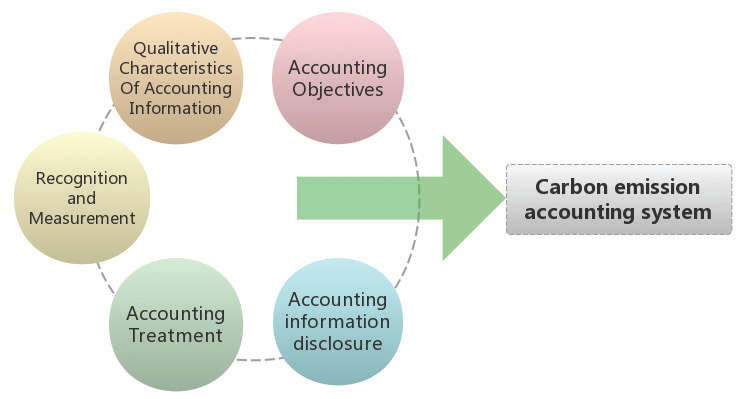
Accounting Objectives
Determining scientific accounting objectives can guide the construction of the accounting system. By publicly disclosing their financial information, paper manufacturer enterprises can provide references for their information decision-makers. Currently, the carbon market trading is progressing smoothly, and construction work is flourishing [32]. At the same time, public awareness of ecological civilization and energy conservation is increasing, and the attention and requirements for carbon accounting information from various information users, such as enterprise investors, creditors, state entities, and individuals concerned about enterprises, are gradually strengthening. They understand the performance of enterprises in related aspects by understanding this information to facilitate their decision-making based on this information [33]. Therefore, the basic objective of carbon emission accounting is a fundamental key objective or the minimum requirement that the system should achieve.
Furthermore, carbon emission accounting benefits the accounting subject itself, including economic, social, and ecological aspects, while being valued and enhanced to achieve a win-win situation for economic development and environmental protection. [34] Based on practical considerations and exploring from a broader perspective, we clearly understand the interests of economic development and ecological protection. Then it is highly demanded that social development should be alarmed, that is developing the economy alone without considering the protection of the ecological environment is unsustainable. The two must be combined for joint development [35]. Therefore, the highest goal of carbon accounting for papermaking enterprises is to simultaneously improve their economic and environmental benefits, which depends on the realization of the basic objectives.
Information Quality Characteristics
Carbon emission accounting is complementary to traditional accounting. Therefore, the information quality characteristics of papermaking enterprises should be based on traditional accounting with further requirements for carbon emission accounting characteristics.
First, carbon emission accounting should follow the principle of reasonableness. Reasonableness requires enterprises to report accurate carbon emissions. If the real data is difficult to obtain, they can refer to the data of relevant enterprises in the same industry or other relevant materials to reasonably estimate their carbon emissions.
Second, carbon emission accounting should follow the principle of comprehensiveness. Comprehensiveness requires papermaking enterprises provide carbon emission accounting information Which includes the entire process of the paper company’s production chain [36].
Finally, carbon emission accounting should follow the principle of specialization. The main objects of carbon emission accounting for papermaking enterprises are carbon emissions, carbon sinks, product carbon footprints, and emission reduction technologies [37], which are also the main aspects that affect the carbon-related businesses of papermaking enterprises. The carbon accounting system does not account for business activities that do not affect the carbon business of the papermaking enterprises.
Accounting Recognition
The changes in carbon emission rights generated by enterprises in production and operation, carbon market transactions, and other activities need to be recognized in accounting. Therefore, it is necessary to classify the objects of carbon emission accounting. The accounting elements of carbon emission accounting should be consistent with traditional accounting called the “six elements of carbon accounting”, which allows carbon accounting to be coordinated with traditional accounting and better meets accounting requirements.
Carbon assets are carbon emission rights that can be traded in the carbon trading market or directly offset the enterprise’s carbon emissions in subsequent production. They are obtained by papermaking enterprises during past economic activities, which are under the control of the enterprise, expected to increase the economic benefits of the enterprise. Carbon liabilities are events generated by papermaking enterprises during past economic activities that negatively impact enterprise benefits, causing economic benefits to flow out of the enterprise. Carbon owners’ equity is the residual equity enjoyed by carbon owners after subtracting carbon liabilities from carbon assets. Carbon income is the total inflow of economic benefits unrelated to the input of carbon owners, which increases carbon equity during past economic activities of papermaking enterprises. Carbon costs are the total outflow of economic benefits unrelated to the input of carbon owners, which reduce carbon equity during past economic activities of papermaking enterprises. Carbon profit is the balance of income minus for the accounting period and reflects the operating results of the paper company for that accounting period.
With reference to the current accounting elements, the six elements of carbon accounting need to satisfy the following three balance equations:
Based on the recognition criteria for assets, firstly, free carbon emission allowance is issued by the government based on the nature of the enterprise and its past carbon emissions, meeting the historical requirements of past trading activities. Secondly, the carbon emission rights obtained by enterprises through government allowances can be used for trading or self-use, with the right to allocate them autonomously, which meet the requirement of being under enterprise control. Finally, the carbon emission rights acquired by enterprises can obtain certain returns when traded in the carbon trading market, meeting the requirement of expected increases in economic benefits. Moreover, the government’s free carbon emission allowance has a reliable valuation basis. Therefore, this study believes that the government’s free carbon emission allowance should be recognized as an asset. Papermaking enterprises are high carbon-emitting enterprises; compared to other enterprises, their production process needs to account for more carbon emissions. The “carbon emission rights asset” should be set as a Level 1 account for more straightforward accounting and to better reflect the carbon emissions and emission reduction effects in the production process of papermaking enterprises.
Accounting Measurement
The historical cost method is difficult to reflect the price fluctuations of carbon emission rights in the carbon trading market promptly [38]. With the implementation of the “Measures for the Administration of Carbon Emission Trading (for Trial Implementation)”, China’s carbon trading market is becoming increasingly mature, and the market quotations for carbon emission rights are relatively easy to obtain. The fair value approach should be adopted for the carbon emission rights of paper enterprises, with the specific implementation plan as follows:
On the day of acquiring the government’s free carbon emission allowance, the fair value of the carbon trading market should be recorded. The value of carbon emission rights will fluctuate with the market price during the holding period, and the price needs to be promptly reflected in the market value changes [39]. Therefore, the fair value measurement should be adopted. For allowances obtained through auctions or transactions, the acquisition cost should be recorded at acquisition cost and are measured in the same way as free government allowances over the holding period.
For projects such as CCER, from project design to the issuance of emission reduction records, the process is complex, and many expenses will occur [40]. The expenses incurred during the project stages should be measured using the historical cost method and when the carbon emission reduction is issued, these expenses can be capitalized and included in the project’s initial cost. The carbon emission reduction should be recorded at the market value at the time of issuance and measured using the fair value method for subsequent measurements. Moreover, for the carbon emission reductions obtained through trading are recorded at acquisition cost and are measured in the same way as self-developed projects over the holding period.
Accounting Treatment
In the carbon emission accounting system for papermaking enterprises, to meet the daily accounting needs and reflect the new requirements of carbon accounting, this study reflects the carbon emissions during the production process of papermaking enterprises through the accounts and promptly judge the environmental obligation of relevant production departments. This enables enterprises to adjust their strategic measures in a timely manner to achieve energy conservation and emission reduction. The specific accounting treatment is as follows:
a) Carbon emission allowances that have been granted free from the government are measured at fair value on the acquisition date. They are debited to “Carbon Emission Rights Assets-Allowance” and credited to “Carbon Capital Reserve”, depending on their use. Dr: Carbon emission rights assets - allowance Cr: Carbon capital reserve
b) Carbon emission allowances obtained through auctions or trading are recorded at the acquisition cost. They are debited to “Carbon Emission Rights Assets-Allowance” . Trading expenses are debited to “Carbon Income” and credited to “Cash In Banks”. Dr: Carbon emission rights assets - allowance Carbon income Cr: Cash in banks
c) During the holding period, the appreciation of carbon emission allowances is debited to “Carbon Emission Rights Assets-Allowance-Fair Value Changes” and credited to “Carbon Gain or Loss form Changes In Fair Values,” while depreciation is the opposite. At the year-end, the “Carbon Gain or Loss form Changes In Fair Values” are transferred to “Undistributed Carbon Profit.”
Dr: Carbon emission rights assets - allowance - fair value change Cr: Carbon gain or loss from changes in fair values Dr: Carbon gain or loss from changes in fair values Cr: Undistributed carbon profit d) Carbon emissions generated during the production process of papermaking enterprises should be debited to “Carbon General and Administrative Expenses” and credited to “Payable Carbon Emission Rights.” When neutralizing the actual carbon emissions, “Payable Carbon Emission Rights” are debited, and “Carbon Emission Rights Assets—Allowance” are credited. At the end of the month, the expenses are transferred; “Undistributed Carbon Profits” are debited, and “Carbon General and Administrative Expenses” are credited. Dr: Carbon general and administrative expenses - carbon emission - XX workshop Cr: Payable carbon emission rights Dr: Payable carbon emission rights Cr: Carbon emission rights assets - allowance Dr: Undistributed carbon profits Cr: Carbon general and administrative expenses - carbon emission - XX workshop e) When selling carbon emission rights, the sale amount is determined based on the actual number of carbon emission rights sold. “Cash In Banks” and “Carbon Gain Or Loss From Changes In Fair Values” are debited, while “Carbon Emission Rights Assets-Allowance” is credited, and “Carbon Gain Or Loss From Changes In Fair Values” are transferred to “Carbon Income.” Dr: Cash in banks Carbon gain or loss from changes in fair values Cr: Carbon emission rights assets - allowance Dr: Carbon income Cr: Carbon gain or loss from changes in fair values f) During project development, expenditures are recorded according to their purpose, such as “Carbon Construction in Progress” and “Carbon Development Costs.” Upon project success, the amounts are transferred to “Carbon Fixed Assets-Project Equipment.” Dr: Carbon construction in progress (or Carbon development costs et al.) Cr: Cash in banks Dr: Carbon fixed assets - project equipment Cr: Carbon construction in progress g) After project completion, when carbon emission allowances are issued, they are measured at fair value on the issuance date, debited to “Carbon Emission Rights Assets-Project,” and credited to “Carbon Capital Reserve.” Dr: Carbon emission rights assets - project Cr: Carbon capital reserve Subsequent treatments are the same as those for allowances. When allowances are insufficient, the issued carbon emission rights for the project are deducted.
h) Most or all papermaking enterprises will use low-carbon equipment to achieve emission reductions. This will result in a series of changes in “Carbon Assets” and “Carbon Costs.” When purchasing low-carbon equipment that meets capitalization conditions, they are recorded as “Carbon Fixed Assets-Low-Carbon Equipment.”
Dr: Carbon fixed assets - low-carbon equipment - XX workshop
Cr: Cash in banks i) During the production process, depreciation for
low-carbon equipment is charged to “Carbon
Manufacturing Overhead” and credited to “Carbon
Accumulated Depreciation.”
Dr: Carbon manufacturing overhead-low-carbon equipment depreciation - XX workshop
Cr: Carbon accumulated depreciation j) Operating costs and maintenance costs for low-
carbon equipment during the production process
are charged to “Carbon Manufacturing Overhead,”
and at the end of the month, they are transferred to
“Carbon Emission Costs.”
Dr: Carbon manufacturing overhead - low-carbon equipment operation - XX workshop
Cr: Other carbon payable
Dr: Carbon manufacturing overhead - low-carbon equipment maintenance - XX workshop
Cr: Other carbon payable
Dr: Carbon emission costs - low-carbon equipment operation - XX workshop
Cr: Carbon manufacturing overhead - low-carbon equipment operation - XX workshop
Dr: Carbon emission costs - low-carbon equipment maintenance - XX workshop
Cr: Carbon manufacturing overhead - low-carbon equipment maintenance - XX workshop k) After product production is completed, excess
emission fines, pollution fees, etc., are charged to
“Carbon Governance Costs” and transferred to
“Carbon Non-business Expenditures” at the end of
the month.
Dr: Carbon governance costs - fines
Cr: Cash in banks
Dr: Carbon non-business expenditure
Cr: Carbon governance costs - fines l) Employee salaries involved in carbon emission
management and measurement during the production
process are charged to “Carbon Emission Costs.”
Dr: Carbon emission costs - staff salaries
Cr: Staff Salaries payable
Accounting Information Disclosure
The information disclosure methods and contents are different in different markets, making it difficult for information users to compare information [41]. Therefore, it is necessary to unify carbon emission information disclosure methods, combining on-balance-sheet and off-balance-sheet methods [42, 43], and combining with the actual situation of the enterprise to disclose the carbon emission rights during the production process. The service targets of the carbon emission accounting system are the enterprises themselves, investors, and creditors, etc. [44]. To reflect the carbon emissions comprehensively and intuitively during the production process, enterprises should follow these principles when disclosing carbon emission rights:
Table 3.
Electricity and Heat Emission Coefficient Table of Guangxi.
a) Comprehensibility principle. When providing carbon emission rights disclosure information, enterprises must consider the information users’ understanding ability. The provided accounting information must be clear, concise, and easy for users to understand and apply.
b) Reliability principle. It should be guaranteed that Information must be free from errors and bias, reflecting the intended phenomenon. This can be further measured by truthfulness, neutrality, and verifiability.
c) Comparability principle. The disclosed information’s comparability should include both vertical comparability with data from previous years and horizontal comparability with other peer enterprises or relevant institutions.
d) Relevance principle. Papermaking enterprises should regularly disclose matters related to carbon emission rights that occur during the production process. For certain unexpected events that require temporary disclosure, disclosure should be completed within one day of the event.
The purpose of financial statements is to concisely present the operating results of an enterprise over a certain period in a tabular form [45]. For high-carbon-emitting papermaking enterprises, carbon emission rights should also be disclosed at the same time. Therefore, in addition to traditional financial statements, the changes in value of carbon emission rights during the production process need to be disclosed in specific financial statements (Table A1, A2, and A3).
Moreover, carbon financial statements disclose to some extent the carbon emission situation during the production process but are not accurately comprehensive and complete. Therefore, other methods are demanded for the disclosure of the carbon emission rights-related information that are omitted from the financial statements [46], including but not limited to the characteristics of participating in emission reduction mechanisms, carbon emission strategies, energy conservation and emission reduction measures; specific sources of carbon emission rights, including the ways of obtaining allowances, the acquisition year, the use of carbon emission right, and carryover reasons; energy conservation and emission reduction or excess emission situations, including a comparison of data related to free allocation of carbon emission allowances and actual emissions in the same period, reasons for energy conservation and emission reduction or excess emissions; carbon emission rights change situations (Table A4); and carbon emission rights usage situations in various workshops (Table A5).
Results and Discussion
Most papermaking enterprises currently do not account for carbon emissions during the production process. Stora Enso is a representative papermaking enterprise in the industry and a key emission unit in China’s carbon emission trading quota management. Based on survey data, this study analyzes the carbon emission business in its production process and provides illustration.
The project location of Stora Enso is Guangxi Zhuang Autonomous Region. According to the Guidelines for the Preparation of Provincial Greenhouse Gas Inventories, [47] the greenhouse gas emission coefficient table is drawn (Table 3), and the steam enthalpy value table (Table 4) is drawn based on the literature. The following carbon emission trading price is formulated as the average price of RMB 45.61/t traded in the Chinese carbon market in 2022.
Raw Material Preparation Process
According to the Project Report, the final sales products of the project are 450,000 tons of commercial pulp board and 900,000 tons of paper and paperboard. The consumption of eucalyptus chemical pulp per ton of paper in the 900,000-ton paper and paperboard production line is shown in Table 5. And it is calculated that the production of 900,000 tons of paper requires 45*0.34931 + 20*0.83464 + 25*0.4736≈442,500 tons of eucalyptus chemical pulp; the carbon content of eucalyptus chemical pulp required for 450,000 tons of commodity pulp board is 218,700 tons, and the carbon content rate of air-dried pulp is 0.45, then it is calculated that eucalyptus chemical pulp 21.87/0.45 = 486,000 tons is required to produce 450,000 tons of commercial pulp board. Therefore, the pulping plant will need to produce a total of 442500 + 48.6 = 928500 tons of eucalyptus chemical pulp.
Table 4.
Table of Steam Enthalpy Values.
| Pressure (MPa) | Enthalpy value (kJ/kg) |
|---|---|
| 0.45 | 2,744 |
| 0.5 | 2,749 |
| 1.0 | 2,777 |
| 1.1 | 2,781 |
Table 5.
Consumption of Eucalyptus Chemical Pulp in 900,000 tons Paper and Board Production Line.
The main energy consumption in the raw material preparation workshop is shown in Table 6. The total electricity consumption in the raw material preparation workshop is calculated to be 32,497,500 kWh. According to Formula 1, Table 1, and Table 3, the carbon dioxide equivalent emissions caused by electricity consumption are 24,300 tons.
Dr: Carbon general and administrative expenses - carbon emission - material reparation workshop 1,108,323
Cr: Payable carbon emission rights 1,108,323
Dr: Payable carbon emission rights 1,108,323
Cr: Carbon emission rights assets - allowance 1,108,323
Dr: Undistributed carbon profit 1,108,323
Cr: Carbon general and administrative expenses - carbon emission - material reparation workshop 1,108,323
Pulping Process
The main energy consumption in the pulping workshop is shown in Table 7. Combining the calculation results of the raw material preparation process, the total electricity consumption in the pulping workshop is 213,555,000 kWh. According to Formula 1, Table 1, and Table 3, the carbon dioxide equivalent emissions caused by electricity consumption are 159,950 tons; according to Table 7 data, 1.1 MPa steam consumption is 603,500 tons, and 0.45 MPa steam consumption is 417,800 tons. According to Formula 2, Table 1, Table 3, and Table 4, the carbon dioxide equivalent emissions caused by the consumption of 1.1 MPa steam are 185,500 tons, and the carbon dioxide equivalent emissions caused by the consumption of 0.45 MPa steam are 126,700 tons. Thus, the pulping process emits a total of 472,150 tons of carbon dioxide equivalent.
Dr: Carbon general and administrative expenses - carbon emission - pulping workshop 21,534,761.5
Cr: Payable carbon emission rights 21,534,761.5
Dr: Payable carbon emission rights 21,534,761.5
Cr: Carbon emission rights assets - allowance 21,534,761.5
Dr: Undistributed carbon profit 21,534,761.5
Cr: Carbon general and administrative expenses - carbon emission - pulping workshop 21,534,761.5
Pulp Board Production Process
The main energy consumption in the commercial pulp production workshop is shown in Table 8. It is calculated that the workshop consumes a total of 58.5 million kWh of electricity. According to Formula 1, Table 1, and Table 3, the CO2 equivalent emissions caused by electricity consumption amount to 43,800 tons. Based on the data in Table 8, the production of commercial pulp consumes 495,000 tons of 0.45 MPa steam. According to Formula 2, Table 1, Table 3, and Table 4, the CO2 equivalent emissions caused by the consumption of 0.45 MPa steam amount to 150,100 tons. Therefore, the total CO2 equivalent emissions in the pulping process are 193,900 tons.
Dr: Carbon general and administrative expenses - carbon emission - commercial pulp production workshop 8,843,779
Cr: Payable carbon emission rights 8,843,779
Dr: Payable carbon emission rights 8,843,779
Cr: Carbon emission rights assets - allowance 8,843,779
Table 7.
Main Unit Energy Consumption of Pulping Workshop.
| Name | Unit | Quantity | Remarks |
|---|---|---|---|
| Water | m3 | 29.45 | |
| Electricity | kW·h | 230 | |
| Steam | t | 0.65 | 1.1MPa |
| t | 0.45 | 0.45MPa |
Table 6.
Main Unit Energy Consumption of material Preparation Workshop.
| Name | Unit | Quantity |
|---|---|---|
| Water | m3 | 1 |
| Electricity | kW·h | 35 |
Table 8.
Main Unit Energy Consumption of Commercial Pulp Production Workshop.
| Name | Unit | Quantity | Remarks |
|---|---|---|---|
| Water | m3 | 4.0 | |
| Electricity | kW·h | 130 | |
| Steam | t | 1.1 | 0.45MPa |
Dr: Undistributed carbon profit 8,843,779
Cr: Carbon general and administrative expenses - carbon emission - commercial pulp production workshop 8,843,779
Papermaking Process
The main energy consumption in the high-end packaging cardboard papermaking workshop is shown in Table 9. It is calculated that the workshop consumes a total of 351 million kWh of electricity. According to Formula 1, Table 1, and Table 3, the CO2 equivalent emissions caused by electricity consumption amount to 262,900 tons. Based on the data in Table 9, the production of 450,000 tons of high-end packaging cardboard consumes 25.38 tons of 1 MPa steam and 916,200 tons of 0.5 MPa steam in the pulping process. According to Formula 2, Table 1, Table 3, and Table 4, the CO2 equivalent emissions caused by the consumption of 1 MPa steam amount to 77,900 tons, and the CO2 equivalent emissions caused by the consumption of 0.5 MPa steam amount to 278,300 tons. Therefore, the total CO2 equivalent emissions in the pulping process are 619,100 tons.
Dr: Carbon general and administrative expenses - carbon emission - high-end packaging cardboard papermaking workshop 28,237,151
Cr: Payable carbon emission rights 28,237,151
Dr: Payable carbon emission rights 28,237,151
Cr: Carbon emission rights assets - allowance 28,237,151
Dr: Undistributed carbon profit 28,237,151
Cr: Carbon general and administrative expenses - carbon emission - high-end packaging cardboard papermaking workshop 28,237,151
The main energy consumption in the high-end writing and printing papermaking workshop is shown in Table 10. It is calculated that the workshop consumes a total of 156 million kWh of electricity. According to Formula 1, Table 1, and Table 3, the CO2 equivalent emissions caused by electricity consumption amount to 116,800 tons.
Dr: Carbon general and administrative expenses - carbon emission - high-end writing and printing papermaking workshop 5,327,248
Cr: Payable carbon emission rights 5,327,248
Dr: Payable carbon emission rights 5,327,248
Cr: Carbon emission rights assets - allowance 5,327,248
Dr: Undistributed carbon profit 5,327,248
Cr: Carbon general and administrative expenses - carbon emission - high-end writing and printing papermaking workshop 5,327,248
The main energy consumption in the coated paper papermaking workshop is shown in Table 11. It is calculated that the workshop consumes a total of 225 million kWh of electricity. According to Formula 1, Table 1, and Table 3, the CO2 equivalent emissions caused by electricity consumption amount to 168,500 tons.
Dr: Carbon general and administrative expenses - carbon emission - coated paper papermaking workshop 7,685,285
Cr: Payable carbon emission rights 7,685,285
Dr: Payable carbon emission rights 7,685,285
Cr: Carbon emission rights assets - allowance 7,685,285
Dr: Undistributed carbon profit 7,685,285
Cr: Carbon general and administrative expenses - carbon emission - coated paper papermaking workshop 7,685,285
Alkali Recovery Process
The main energy consumption in the alkali recovery workshop is shown in Table 12. It is calculated that the workshop consumes a total of 148.56 million kWh of electricity. According to Formula 1, Table 1, and Table 3, the CO2 equivalent emissions caused by electricity consumption amount to 106,600 tons. Based on the data in Table 12, the alkali recovery consumes 2,507,000 tons of 0.45 MPa steam. According to Formula 2, Table 1, Table 3, and Table 4, the CO2 equivalent emissions caused by the consumption of 0.45 MPa steam amount to 762,000 tons. The consumption of heavy oil is 41,800 tons. According to Formula 3.3, Table 3-1, and Table 4-1, the CO2 equivalent emissions caused by heavy oil combustion amount to 135,600 tons. The data in the table shows that the calcination of white mud requires 16,700 tons of limestone. Since the causticization rate of the alkali recovery workshop is 82%, the CO2 equivalent emissions caused by combustion, according to carbon element conservation, amount to 337,800 tons. Therefore, the total CO2 equivalent emissions in the alkali recovery process are 580,000 tons.
Table 9.
Main Unit Energy Consumption of High-end Packaging Cardboard Papermaking Workshop.
| Name | Unit | Quantity | Remarks |
|---|---|---|---|
| Water | m3 | 18 | |
| Electricity | kW·h | 780 | |
| Steam | t | 2.036 | 0.5MPa |
| t | 0.564 | 1MPa |
Table 10.
Main Unit Energy Consumption of High-end Writing and Printing Papermaking Workshop.
| Name | Unit | Quantity |
|---|---|---|
| Water | m3 | 20 |
| Electricity | kW·h | 780 |
Table 11.
Main Unit Energy Consumption of Coated Papermaking Workshop.
| Name | Unit | Quantity |
|---|---|---|
| Water | m3 | 22 |
| Electricity | kW·h | 900 |
Table 12.
Main Unit Energy Consumption of Alkali Recovery Workshop.
| Name | Unit | Quantity | Remarks |
|---|---|---|---|
| Limestone (95% purity) | kg | 18 | |
| #200 bunker oil | kg | 45 | |
| Water | m3 | 7.55 | |
| Electricity | kW·h | 160 | |
| Steam | t | 2.7 | 0.45MPa |
Dr: Carbon general and administrative expenses - carbon emission - alkali recovery workshop 26,453,800
Cr: Payable carbon emission rights 26,453,800
Dr: Payable carbon emission rights 26,453,800
Cr: Carbon emission rights assets - allowance 26,453,800
Dr: Undistributed carbon profit 26,453,800
Cr: Carbon general and administrative expenses - carbon emission - alkali recovery workshop 26,453,800
On-balance Sheet Disclosure
The following carbon financial statements, in all material respects, reflect Stora Enso’s carbon operating results and carbon cash flow by the carbon emissions accounting system (Tables 13, 14, 15).
Off-balance Sheet Disclosure
(1) This year, the company did not participate in any nationally certified voluntary emission reduction projects.
(2) The carbon market in which the company operates adopts the “emission first, quota later” approach. The specific allocation of this year’s carbon emission allowances has not yet been announced, and the allowances will be used to fulfill carbon market obligations, with no external sales for the time being.
Unit: yuan
Table 13.
Carbon Balance Sheet.
Unit: yuan
Table 14.
Carbon Income Statement.
Unit: yuan
Table 15.
The Statement of Carbon Cash Flows.
(3) Changes in carbon emission rights. (Table 16).
(4) The application of carbon credits in each workshop (Table 17).
So far, China’s carbon market has only completed two compliance cycles, both adopting the ”emissions first, then allowances“ approach, which makes no contributions to the prosperity and development of the carbon trading market. The carbon emission accounting system established in this paper determines the accounting elements based on the characteristics of the accounting subjects in the papermaking industry and analyzes the activities involving carbon businesses from the production processes of stock preparation, pulping, papermaking, pulp and paperboard production, and alkali recovery. A carbon emission coefficient accounting model is established, a separate asset category “carbon emission rights assets” is set up in the accounts and measured at fair value, specialized carbon financial statements are prepared, and the carbon emissions of the enterprise’s production process are disclosed both on and off the balance sheet. This builds a prototype of a carbon emission accounting system for the papermaking industry, addressing the shortcomings of the traditional accounting system where carbon factors are missing. However, carbon emissions not only involve value accounting but also need to consider their negative externalities. To promote emission reduction and achieve relative environmental improvement, workshop managers and operators should be well-trained on emission reduction awareness. Based on national quotas, enterprises should redistribute quotas among various production workshops, allocate the proceeds from the sale of surplus carbon emission rights back to the workshops, and set up separate departments to monitor and manage carbon emissions when technology matures, and the carbon trading market is perfected. The carbon emission accounting system also needs further improvement, updating carbon emission-related businesses that have not yet occurred, and presenting a complete picture of carbon emissions in the production process of papermaking enterprises.
Table 16.
Changes in Carbon Emission Rights.
Table 17.
The Application of Carbon Credits in Each Workshop.
Conclusions
This paper establishes a comprehensive corporate carbon emissions accounting system based on enterprise production processes, which specifically includes accounting objectives, information quality features, accounting recognition, accounting measurement, accounting treatments, and information disclosure. A carbon emissions equivalent accounting model, combined with a case company is utilized to calculate the carbon emissions during the production process of paper-making companies. The results show that the pulping workshop and the high-end packaging cardboard paper-making workshop account for a major part of the carbon emissions in the production process of the case company. A detailed disclosure of carbon emissions in each production process contributes to realizing corporate carbon emissions responsibilities. Companies are required to establish management systems, set up departments related to carbon emission rights management and accounting, implement performance evaluations, and, in cases of exceeding emissions standards, responsibility at the workshop level is necessary, holding accountable those responsible promptly. Periodic summaries should be made of issues that arise in work, continuously improving the system. Relevant government departments need to expedite the perfection of carbon emission rights allocation methods. By considering the scale of enterprise equipment and emissions in previous years, quotas should be completed at the beginning of the compliance period to stimulate the development of the carbon trading market. In addition, the concept of “workshop” in this paper is divided at the macro level, which is a combination of several interconnected processes. In future studies, the department can be further refined, from the perspective of specific equipment or work sections, to aid in the enhancement of the system construction.

