


Introduction
The worldwide trajectory of carbon emissions is directly impacted by the magnitude of carbon emissions originating from China. Hence, for the purpose of accelerating the global shift towards achieving net-zero emissions, it is imperative that China undertakes urgent decarbonization. The primary cause of global temperature increase and fast climate change on a global scale is the release of carbon dioxide and other greenhouse gasses by human activities [1]. Approximately 75% of worldwide greenhouse gas emissions are attributed to carbon discharge, with the majority resulting from energy generation [2]. Global carbon emissions continue to rise, with China accounting for a relatively large share of those emissions [3]. Evidently, China’s per capita carbon dioxide emissions have constituted half of the global total in recent years [4]. China has the most substantial carbon footprint globally, and the need to diminish emissions surpasses that of other nations [5]. In response to the global environmental crisis, China actively promoted green development and low-carbon transformation. China has adopted several climate change initiatives and is actively involved in a range of regulations regarding climate change and measures [6]. China aims to reduce carbon discharge by constructing a particularly rigorous sustainable development route [7].
The construction industry is a high-carbon emitting sector that is a critical component of the “carbon peaking and carbon neutrality” objective. Therefore, the industry’s environmental sustainability direction is to promote greening and low-carbonation. With accelerating urbanization and population growth, the construction industry’s demand for energy is increasing, and so is its carbon footprint. In addition to exacerbating the severity of global environmental degradation, this trend also presents a significant threat to the long-term sustainability of human society. The building sector significantly contributes to both global energy use and emissions of carbon [8]. Furthermore, the carbon emission issue of construction enterprises has been further exacerbated by the significant waste of natural resources and the substantial energy expenditure associated with the traditional construction mode. Green building measures have been implemented in many aspects of building design, building materials, and building construction. However, they have not yet fundamentally promoted carbon reduction processes in the construction industry because they have not been fully popularized [9]. Green building measures have been implemented in numerous aspects of building design, building materials, and building construction. However, they have not yet significantly facilitated carbon reduction in the construction industry due to their partial popularization.
Technological innovation plays a vital role in the shift towards a carbon-neutral economy [10]. This is a significant means of achieving lower emissions in the building sector. Green technological innovation refers to realizing the efficient use of resources, reducing environmental pollution, and diminishing carbon dioxide discharge through technological innovation and management innovation. As the primary players in the construction industry, construction firms use innovative green technology to implement emission reduction measures [11]. This is particularly essential to attaining the sector’s carbon reduction objective. On the one hand, when implemented via energy innovation, zero-carbon technologies may decrease reliance on fundamental energy sources, such as traditional fossil fuels, substantially reducing pollution [12]. On the other hand, green growth and objectives for achieving a low-emissions society can be achieved through policy development that encourages technological innovation. This is because technical progress contributes to the ongoing progress of environmentally friendly energy. There are positive effects on certain economies by optimizing the consumption of green energy sources [13]. Therefore, advancements in technology are seen as beneficial in mitigating carbon dioxide emissions.
Government environmental considerations may contribute to maintaining a harmonious equilibrium between various levels of technological progress and carbon dioxide discharge. The growing environmental awareness of the government will force companies and society to acknowledge the significance of the green technology revolution as a novel catalyst for economic expansion. Specifically, the government can strengthen its environmental concerns by formulating policies and providing financial support. Public sector financial allocations for energy technology-related research and development (R&D) may generate favorable market circumstances. It can encourage the private sector to invest in environmentally friendly technologies, thereby facilitating the adoption of renewable energy [14]. Furthermore, achieving carbon neutrality requires significant efforts, one of which is the development of improved low-carbon technologies [15]. Firms will only undertake technological research and development if green technological innovation enables them to gain a competitive advantage [16]. The government can reduce the complexity and uncertainty of technological innovation by signaling green and low-carbon development to a wide range of enterprises. This perception will motivate enterprises to make a concerted effort to invest in environmentally friendly technology in order to gain a competitive edge. Therefore, it can foster the evolution of an economic system in a low-carbon, sustainable direction.
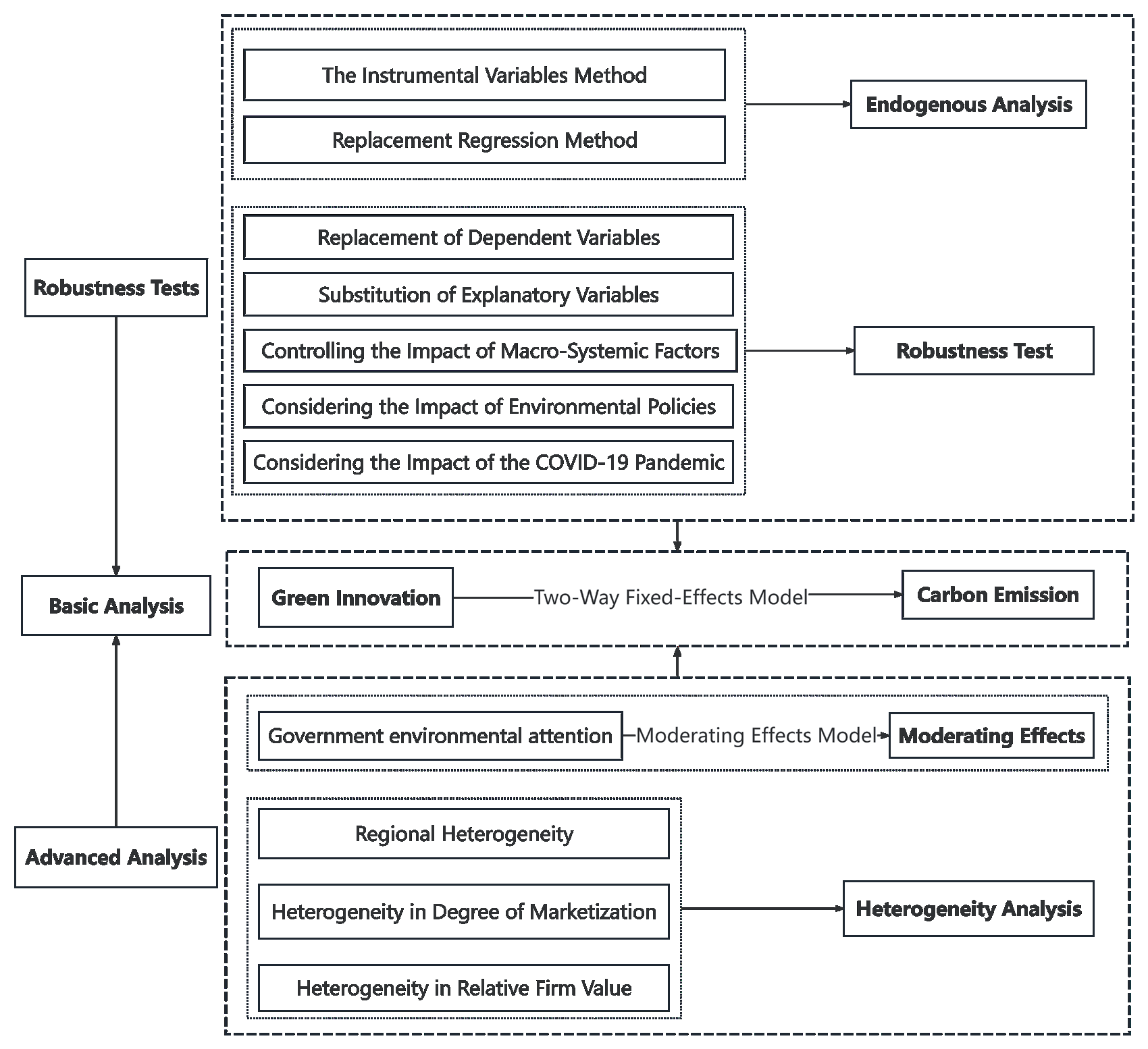
The major purpose of this work is to confirm the impact of emission reduction and the emission reduction mechanism of the green technology revolution on carbon emissions based on the provided background information. The main research contents of this article are listed as follows. Firstly, this paper employs a two-way fixed effects model to investigate the causal connection between the green technology revolution and carbon dioxide discharge. We adopt the data of all A-share-listed enterprises in China’s construction industry from 2003 to 2021 by examining endogeneity and undertaking robustness tests for further analysis. Secondly, this paper employs the moderating effect model to examine the moderating influence of government environmental concern on the innovation of green technologies. Lastly, this paper investigates the heterogeneity of the green technology revolution in terms of emissions, taking into account the degree of marketization, enterprise scale, and region.
The following innovations exist in this paper. Firstly, this research incorporates green technology evolution, government environmental concerns, and carbon dioxide emissions into the same framework for research, breaking through the limitations of previous single-dimension analyses. In this paper, we examined in-depth its moderating effect on the abatement effect of green technology evolution from the government’s perspective. It innovatively revealed the government’s important role in promoting the transformation of the green technology revolution into an actual carbon abatement effect. Secondly, the multi-dimensional heterogeneity analysis reveals the complexity of the carbon abatement effect. We further conduct heterogeneity analysis from multiple dimensions, such as the degree of marketization, enterprise scale, and regional characteristics. This multi-dimensional heterogeneity analysis reveals the differences in the carbon abatement effects of green technology evolution across diverse contexts.
The rest of the article follows this structure. Section II reviews the literature. The third phase of the study focuses on the theoretical examination and formulation of research hypotheses. The fourth part outlines the research methods and data used in the study. Section five provides the empirical findings. Section six provides further analysis. Part VII presents the study findings and provides policy recommendations. Fig. 1 shows the research framework of the thesis.
Literature Review
Study on Carbon Emissions
Research on carbon emissions has mostly centered on measuring techniques and the variables that influence them.
The measurement of carbon emissions is mainly divided into two categories: directly and indirectly measurable. On the one hand, directly measurable carbon dioxide emissions are mainly related to the national [17], industry [18], provincial and municipal [19- 20], and other macro-levels. A large amount of energy consumption data can be provided to match the emission factors for calculation [21]. On the other hand, carbon emissions that are indirectly measurable mainly involve the micro level, such as enterprise [22] and county [23]. Existing energy consumption data in this category are less available, and the data samples are inadequate. The following approaches are typically used: Firstly, indirect and direct emissions are computed using an input-output methodology [24]. Secondly, industry carbon emissions are used to estimate enterprise discharge [25]. Thirdly, construct models to predict. For example, Sun et al. [26] developed a model to forecast carbon discharge intensity using factor analysis and an extreme learning machine. Fourth, a full life cycle approach is used. For example, Resch et al. [27] used a comprehensive life-cycle approach (LCA) to evaluate and illustrate the implicit emission statistics associated with the manufacturing and transporting of building materials. In fact, there are no strict boundaries for the use of the above categorization of measurement methods; e.g., micro-level studies also use LCA [28], and macro-level studies use input-output analysis [7].
The study of the variables influencing carbon dioxide discharge is mostly conducted from several viewpoints. On the one hand, from the energy itself. The closest and most direct factor affecting discharge is the energy consumption situation, which mainly involves the energy structure, energy efficiency, energy intensity, and so on. For example, Chastas et al. [29] stated in their study that the operational and total environmental impacts are correlated with the energy mix, which can be quantified in terms of energy or discharge. Kirikkaleli et al. [30] used the NARDL, Fourier ADL, and frequency domain causality techniques to examine the asymmetry and long-term impacts of energy production on the sustainability of the environment (carbon dioxide emissions) in Finland. Khezri et al. [31] discovered that higher energy usage intensity, trade openness, and urbanization lead to a rise in carbon dioxide emissions. On the other hand, starting from exogenous factors, i.e., other factors unrelated to energy. These mainly involve digital transformation [32], level of economic development [33], green finance [34], and environmental policies [35-36]. In addition, some scholars use factor decomposition models to incorporate numerous carbon emission-driving influences into the same analytical framework. For example, Li et al. [3] developed an expanded STIRPAT model to examine the influence of energy market parameters on the conventional STIRPAT human ecology model.
Research on Green Technology Innovation and Carbon Emissions
Additional conclusive information about the influence of green technology innovations on carbon dioxide emissions needs to be included. On the one hand, most scholars consider eco-innovation as the most critical life-saver for addressing the adverse effects of increasing environmental degradation. For example, Erdogan [37] determined that adopting technical advancements in the BRICS nations has the potential to cut down carbon dioxide release in the building industry between 1992 and 2018. On the other hand, many studies have emphasized the negligible or even enhanced impact of green technological innovation on the diffusion of greenhouse gas release. For example, Chen et al. [38] used a spatial econometric model to investigate the influence of technical innovation on carbon dioxide release in 96 nations. The findings of the research indicate that technological innovation does not have a substantial mitigating impact on the worldwide emissions of carbon dioxide. Furthermore, several studies have examined the function of green innovative technology, exploring its role as a mediator in lowering emissions. This includes its mediating role [39] and moderating function [40]. However, it has garnered relatively little attention as a central explanatory variable.
Research on green technology innovation and carbon emissions in the construction sector primarily focuses on the following topics. Firstly, there are relatively few studies involving micro-areas, such as enterprises, which mainly focus on national or sectoral scopes, such as industry [41], manufacturing [42], services [43], and agriculture [44]. Secondly, focusing on the carbon reduction effects of construction companies is based on the variability of industry characteristics. Each sector has its own carbon emission trends [45]. The influence of technical advancements on carbon dioxide emissions varies greatly across different industries [46]. Thirdly, there is a paucity of concrete evidence in studies about the impact of building companies on carbon reduction. Prior studies primarily focus on the variables that influence construction companies’ inclination to diminish emissions [47] and the direct influence of digital construction advancements on carbon dioxide release [48]. Furthermore, several researchers have developed simulation models to analyze carbon dioxide emissions mitigation and investigate the low-carbon growth strategies of building companies [49]. Generally, most similar studies focus on the macro level, rarely include micro samples of enterprises, and lack direct analyses of construction enterprises. However, studying how construction enterprises use technological innovation to achieve carbon dioxide abatement is essential.
Analysis of Green Technology Innovation, Government Environmental Attentions, and Carbon Emissions
Government environmental attention has been widely studied, mainly including indicator measures and influencing factors. Distributing decision-maker’s attention may result in varying organizational strategies and resource allocation, subsequently influencing organizational behavioral decisions [50]. The government’s focus is constrained within a certain time frame, but a growth in the government’s environmental attention indicates a greater allocation of resources towards environmental protection. This shift transforms the conventional rivalry based on GDP into a competition based on environmental performance [51]. It is challenging to assess the environmental governance of local governments fully by relying only on metrics such as carbon tax rate, environmental protection staff, and total investment in pollution, which are used to indicate government environmental concern [52]. Consequently, the approach to measuring government environmental concern has evolved from the “indicator substitution method” to the “text analysis method” [50]. Scholars use text analysis to examine the frequency of words in government reports, plans, programs, and decrees. This technique helps create comprehensive environmental care indicators within local governments [53]. Several studies have examined the influence of government environmental concern on several aspects, including company ESG performance [54], urban energy efficiency [55], and air pollution [56], using the approach of textual analysis.
The relationship between government environmental concern, green technological innovation, and carbon dioxide emissions is highly correlated. However, there is a scarcity of literature that integrates these three factors into a cohesive study framework. On the one hand, some experts claim that government environmental governance has a substantial and direct impact on promoting enterprises’ innovation in green technologies [57]. Additionally, some experts contend that a non-linear correlation exists between the two [58]. On the other hand, the government’s environmental concern significantly influences firms’ carbon dioxide release mitigation, mostly by implementing effective emission reduction measures and mechanisms [59]. Public engagement in environmental matters can enhance pollution management by heightening the government’s environmental focus [53]. The more prominent the government’s emphasis on environmental protection, the more effective green financial policies become in promoting ecologically sustainable development [60]. However, fewer studies have explored the specific mechanism through which government environmental concerns influence innovative green technology and the release of carbon dioxide.
Theoretical Analysis and Research Hypothesis
The Impact of Green Technology Innovation on Carbon Emissions
Diffusion of innovations is a concept that aims to explain how new goods, behaviors, or ideas get accepted by individuals within a social system. The Diffusion of Innovations theory was first introduced by Everett Rogers in his work titled Diffusion of Innovations [61]. The Diffusion of Innovations theory illustrates the gradual progression that takes place when novel concepts, items, or technology are introduced into a social framework [62]. It explores the mechanisms via which creative ideas, products, or practices disseminate within a social system, tracing their path over time through distinct channels [63]. The theory encompasses many crucial components, including the invention itself, the process of dissemination and the channels through which it occurs, the factor of time, the possible adopters, and the social structure [64]. These aspects determine whether or not a given group will accept an innovation.
The dissemination process of green technological innovation, being a distinct type of innovation, is likewise influenced by the elements outlined in the diffusion of innovation theory. Based on the innovation diffusion theory, some environmental improvements need more time to be accepted due to their dissemination rate and diffusion route [65]. The inherent characteristics of technological innovation, such as risk, uncertainty, and long lead times, constitute barriers to green technological innovation. For conservative construction companies, these obstacles become detrimental factors that impede their active participation in green technological innovation, thereby influencing their continued endorsement of green technological innovation. To “disrupt” an incumbent, an invention must bridge the gap between an early specialized market and the mainstream market [66]. The diffusion channel of green technological innovation facilitates the acceptance of low-carbon technological innovation results by innovation adopters. This promotes and applies low-carbon technology and the realization of economic value through producing low-carbon products. Consequently, construction enterprises are encouraged to transition from high-use energy and high contamination to low energy usage and low pollutants, thereby achieving the objectives of carbon emission reduction and industrial upgrading. This research hypothesizes the following from the information:
H1: The higher the level of green technology innovation, the stronger the carbon emission reduction effect in construction enterprises.
Mechanisms of Green Technology Innovation Affecting Carbon Emissions
A low-carbon economy is centered on minimizing energy usage and reducing pollution levels. The idea of low-carbon economics centers on diminishing the use of high-carbon energy sources and the emission of greenhouse gasses. This is achieved through technical advancements, institutional reforms, industrial restructuring, and the promotion of renewable energy sources. The objective is to attain novel economic growth distinguished by minimal energy use, pollution, and emissions [67]. It aims to address the inherent conflict between the economic system and the ecology. As such, it places significant emphasis on economic, technical, and institutional matters.
Within this theoretical framework, government environmental attention is seen as a key factor in driving the development of green technology and reducing carbon dioxide release. The government can promote urban low-carbon transitions through effective policy formulation and governance practices [68]. On the one hand, the government encourages businesses to engage in innovations in green technology activities to enhance energy efficiency and minimize carbon dioxide emissions by developing and enforcing appropriate legislation. Local governments’ environmental incentives may encourage enterprises to embrace cleaner manufacturing techniques and use green management strategies to reduce carbon dioxide release [69]. On the other hand, governments follow governance practices that motivate firms to comply with environmental regulations and reduce environmental pollution. Urban development may facilitate the shift towards a circular economy by implementing sustainable practices and fostering possibilities for resource and commodity reuse and recycling [70]. The government’s environmental concerns are essential in fostering innovation in green technology and mitigating business carbon dioxide emissions. With the facts supplied, this research hypothesizes:
H2: Higher government environmental attention makes green technology innovation and carbon emissions more negatively correlated.
Material and Methods
Model Construction
Two-Way Fixed-Effects Model
The subsequent regression equation was devised to evaluate the influence of green technology innovation on construction firms’ carbon emissions.
Where individuals and years are represented by the symbols i and t, respectively; CEIit represents the logarithm of carbon emissions intensity from construction firms for individual i in period t; Techit represents the logarithm of the number of green technology innovation patents obtained by construction firms for individual i in period t, indicating the level of green innovative technology; Xit is a set of control variables that influence the carbon dioxide release of construction firms; αi represents an individual fixed effect, accounting for factors that remain constant over time for all construction firms; γt represents time-fixed effects, accounting for factors that remain constant over time for construction firms at the time level; and εit is the residual term. In the above equation, the symbol β1 represents this research’s estimated coefficient of interest. If the coefficient β1 is negative and statistically significant, it indicates that adopting green technological innovation may considerably decrease the carbon emission intensity of construction enterprises.
Moderating Effects Model
This research examines the influence of government environmental attention on the relationship between green innovative technology and carbon dioxide emissions. The equation (2) is developed based on equation (1). Furthermore, to avoid any bias caused by multicollinearity, the independent variable of green technological innovation and the moderating variable of government environmental concern are both centered prior to generating the turnover multiplier term. There is a significant link between these two variables.
Where, GEAit denotes government environmental attention and acts as a moderating variable for firm i in period t. In the above equation, β1, β2, β3 are the estimated coefficients of interest in this paper. If β3 is significant, it means that government environmental attention has a moderating effect on the invention of green technology in construction enterprises, namely in lowering carbon dioxide emissions. When the main effect is negative, the interaction term is negative, and government environmental attention acts as an enhanced moderating role.
Variable Selection
Dependent Variable
Carbon Emission Intensity (CEI). Carbon emission data at the level of listed companies is challenging to obtain. Taking Bolton and Kacperczyk [71] as a reference, we measure enterprises’ carbon emissions using their disclosed emission data, such as their social responsibility reports and energy consumption data. This article classifies the provided data in the report into three categories: direct, indirect, and overall carbon dioxide emissions. The dependent variable used in our analysis was carbon emission intensity, which was determined by dividing carbon discharge by company revenue plus one and then taking the natural logarithm. This research uses the logarithms of total carbon emission intensity (GCEI), direct carbon emission intensity (DCEI), and indirect carbon emission intensity (ICEI) for regression analysis. Furthermore, the carbon emission intensity is used to conduct a robustness test of the method’s strength and reliability.
Explanatory Variables
Green Technology Innovation (Tech). Taking into account the gradual improvement in the availability and accuracy of patent data, this paper uses the logarithm of green invention patent acquisition (Tech) as a measure of green technology evolution [72-73]. It is calculated by adding 1 to the number of green invention patents acquired and then taking the natural logarithm. In addition, we use the logarithm of green patent applications [74] and the logarithm of green utility model patent applications [75] for robustness testing.
Moderating Variable
Government Environmental Attention (GEA). The variable GEA is seen as a mediator in relation to government attention to the environment. In accordance with Chen et al.’s study technique [76], we quantify local government environmental concerns by comparing the frequency of environment-related phrases to the overall word count of the reports. The government’s increasing use of environmental terminology in its work report implicitly suggests a heightened focus on environmental protection. Therefore, it amplifies the government’s attention to environmental matters. The variables GEA and Tech are centered on mitigating the issue of multicollinearity. The interaction term between government environmental attention and green technology evolution is computed.
Control Variables
Various intricate aspects impact the carbon dioxide discharge of construction enterprises. This study examines many factors that include firm size, gearing ratio, net profit ratio of total assets, fixed asset ratio, percentage of shares owned by the biggest shareholder, cash flow ratio, proportion of independent directors, executive team’s focus on the environment, and whether the company is experiencing a loss. The value of the omitted variable controls the possible influence of other factors and alleviates the endogenous problems that may result from the omitted variable bias. For the stability of the data, we take the natural logarithm for the quantity category and keep the original data for the ratio category (the definitions of this study’s primary variables can be seen in Supplementary Notes).
Data Sources
The paper utilizes A-share data from construction-listed businesses from 2003-2021 as a research sample, taking into account the accessibility and dependability of the data. The emissions data is sourced from annual reports, social responsibility reports, sustainable development reports, company websites, environmental department websites, and environmental reports of listed firms. The CSMAR database includes information on advancements in green technology. The CSMAR database, annual reports of listed firms, and social responsibility reports of listed corporations serve as the primary sources for the data on control factors. The mechanism variable information is derived from the work reports of municipal governments in each province. The following processing processes ensure data accuracy. (1) Remove data from companies with the labels ST, *ST, and PT, as well as the data from companies that are no longer listed. Only keep data from listed construction industry companies that are traded on the A-share market. (2) Eliminate the samples of variables with missing data. (3) Remove the parts of businesses with a gearing ratio of 0 or 1. (4) To prevent extreme values from influencing empirical results, the article applies two-sided 1% and 99% truncation to continuous variables. Finally, 88 listed companies and 1030 unbalanced panel data are obtained through screening in this study. This section also assessed the mean-variance inflation factor (VIF), revealing that the average VIF value was 1.83, and the VIF for each variable was below 4. This indicates that the explanatory variables did not exhibit multicollinearity. Table 1 shows the variable descriptive statistics.
Table 1.
Descriptive statistics of variables.
Table 2.
Estimation results for the two-way fixed-effects model.
[i] Note: (1) Values included in brackets represent robust standard errors. (2) The symbols *, **, and *** represent the significance thresholds of 10%, 5%, and 1%, respectively. (3) The table displays the regression results of a two-way fixed effects model with robust standard errors, denoted as FE. It also shows the regression results of an interaction fixed effects model, denoted as FE_DT, which accounts for individuals and years.
Results and Discussion
Two-Way Fixed-Effects Model Regression Results
Baseline regression results are in Table 2. The table shows two-way fixed-effect model regression results in columns (1) to (3). Robust standard errors are taken into account. The table displays the regression outcomes using the interaction fixed-effect model, adjusting for individuals and years. Columns 4 to 6 include the specific data. The correlation coefficients for the variables are -0.035, -0.028, and -0.007, as shown in columns (1) to (3). It can be demonstrated that companies implementing green technologies may decrease total, direct, and indirect carbon dioxide emissions. After controlling for interaction fixed effects, the variable Tech’s regression coefficients in columns (4) to (6) are all statistically negative. The results indicate that enhancing the development of ecologically conscious technologies may reduce emissions by construction companies. The findings corroborate H1.
Carbon emission intensity reduces as green technological innovation grows, as shown by the interpretive analysis done using the estimates in columns (1) and (3). Construction companies’ carbon dioxide discharges are clearly affected by innovative green technology. Carbon levels mostly stem from the energy utilization of building firms’ manufacturing and operation processes. The advancement of technical innovation levels promotes improving the production process and transforming the industrial structure, leading to increased production efficiency and decreased investment costs for pollution management. As a result, the evolution of green technology can potentially optimize industrial structure, eliminate polluting technologies, and achieve energy-saving goals. These variables will ultimately influence the emission levels of corporations. The findings of this study align with the consensus of the prevailing body of research.
Table 3.
Regression results for the instrumental variable.
[i] Note: (1) Values included in brackets represent robust standard errors. (2) The symbols ** and *** represent the significance thresholds of 5% and 1%, respectively. (3) The Kleibergen-Paap rk LM statistic represents the under-identification test; the Cragg-Donald Wald F statistic and Stock-Yogo weak ID test critical values represent the weak instrumental variable test.
Endogenous Test
Carbon emissions and innovative green technology may be reversely causal. This means that higher emissions levels in the construction industry may lead to increased engagement in green technology evolution. Alternatively, measurement errors or omitted variables could also be contributing factors. This study reevaluates equation (1) using the instrumental variable approach instead of the regression technique. Additionally, all variables are delayed by one period to reduce endogeneity, which might skew model estimates.
Building Instrumental Variables
We estimate equation (1) using Arellano and Bond’s (1991) two-step generalized method of moment estimation (GMM). Using an instrumental variables approach, this procedure permits us to correct for endogeneity. This article employs the average value of technological innovations related to environmentally friendly practices in other companies within the same industry during the present year as an instrumental variable (IV) [77]. The actions of individual enterprises do not influence the whole sample’s characteristic parameters. However, they are linked to the explanatory variables, specifically the green technology revolutionization status of other companies in the same industry. Note that the green technology evolution status of other enterprises in the current year does not directly impact the carbon emission situation of a particular enterprise. Still, it directly affects its green technology revolutionization level, which meets the criteria. Thus, this study retests its assumptions using the instrumental variable approach and runs a two-step GMM regression on the original model.
Upon considering endogeneity, Table 3’s columns (2) and (4) show that implementing green technology evolution leads to reduced emission levels. The results show a significant detrimental impact at the 5%, 5%, and 1% levels, with an even worse deterioration effect. It implies that equation (1) underestimates green technology innovation’s reducing influence on carbon dioxide emissions due to endogeneity. Furthermore, the F-statistic for the first-stage regression exceeds 10, suggesting that the chosen IVs are suitable. The p-value of the under-identification test is below 0.01. It rejects the initial hypothesis that IVs are not identifiable and establishes a connection between IVs and endogenous variables. The weak identification test rejects the initial hypothesis of “weak IV” since the critical value exceeds all other critical values. This indicates that there are no weak IVs in the equation, which would have helped address the endogeneity issue of the model. In summary, the aforementioned experiments confirm the validity of the instrumental variable.
Changing the Estimation Model
Descriptive statistics of explanatory factors (GCEI, DCEI, ICEI) showed that over 10% of the carbon emission intensity logarithm was 0. The Tobit model can take into account both truncated data and endogeneity issues. It is based on the maximum likelihood estimation method, incorporating observed, truncated, and potentially unobserved data. The study was conducted using a linear Tobit model. Table 4 shows the Tobit regression findings. All the regression coefficients are statistically significant at the 5% level, and the connections between the variables remain unchanged. The robustness test findings match the preceding conclusions after substituting the regression approach.
Robustness Checks
We further performed the following robustness tests (see Supplementary Notes). The findings demonstrate that the empirical conclusions presented remain solid. First, the paper’s conclusions were reinforced using regression models that included measures of total, direct, and indirect carbon emission intensities. Second, we used two different metrics to assess corporate green revolutionary technology: Tech1 and Tech2. The value of Tech1 represents the natural logarithm plus 1 of the total number of green patent applications. Similarly, Tech2 represents the natural logarithm plus 1 of the number of green utility model patent applications. Third, our regression model incorporates controls for the enterprise-province-year and enterprise-city-year effects within a multi-dimensional fixed-effects framework. Fourth, in this analysis, the interaction terms of the sulfur carbon dioxide levels fee increase policy, the emissions trading pilot policy, the first low-carbon provincial and municipal pilot policy, the sewage rights trading pilot policy, the One Belt, One Road Initiative, and the energy use right trading pilot policy are included in equation (1). Fifth, we considered the effect of the New Crown Pneumonia pandemic by excluding data from 2019 and 2020 and creating interaction variables for both years.
Further Analysis
The Moderating Effects of Government Environmental Attention
The preceding section specifically analyzed the influence of innovative green technologies on carbon dioxide levels. A model (2) is created to examine whether the connection between government attention to environmental issues and innovation in green technologies influences the transmission process. Table 5 illustrates the extent to which government environmental concerns influence or regulate. Columns (1), (2), and (3) have negative and statistically significant green technological innovation coefficients at the 10% level. Although not statistically significant, government environmental attention coefficients are negative, suggesting a decline. Negative coefficients in columns (1) and (3) indicate statistically significant interaction terms. Government environmental efforts may boost green revolutionary technology’s carbon reduction effects. As the government and society place more importance on the environment, heightened government focus on environmental issues might lead to higher costs for enterprises in terms of discharges. In this instance, construction companies believe that the penalties for pollution levels are excessively severe, resulting in the price of emissions vastly eclipsing the cost of abatement. Therefore, construction companies increase their willingness to mitigate carbon dioxide. Companies are willing to allocate more to research and development or implement new green technology to enhance construction industry sanitation. They can reduce environmental pollution and internalize expenses. This conclusion supports H2.
Table 4.
Regression results for the Tobit model.
Table 5.
Regression results for the moderating effect model.
Heterogeneity Analysis
The influence of green innovative technology on levels of carbon may vary depending on the macroeconomic environment, including factors such as regional economic growth, population size, and degree of industrialization. The size of a business also directly impacts its capacity to engage in technical research and development. Furthermore, marketization is crucial to industrial carbon emission reduction and revolutionary green technology. According to innovation diffusion theory, marketization development differs across regions and industries in China. The degree of marketization can severely limit R&D fund financing efficiency and technological innovation diffusion benefits, which affects green technology revolutionization optimization and spillover effects [78]. Therefore, we need to explore the potential heterogeneity of the carbon abatement effects of green revolutionary technologies across regions, firm sizes, and degrees of marketization. Heterogeneity results indicate that green innovative technology in enterprises located in the eastern region, with large enterprise scale and a high degree of marketization, exhibits a significant carbon reduction effect (see Supplementary Notes).
Conclusions
Green technology innovation is crucial for mitigating emission levels during peak carbon periods and achieving carbon neutrality. Prior research has placed less emphasis on the construction firms’ carbon dioxide emissions than on industry and manufacturing concentration. Given the global push to minimize carbon dioxide emissions, prioritizing research on carbon emission problems in nations with a significant number of construction companies, such as China, is crucial. Green technology innovation is critical in cutting down emission levels within the “carbon peak” and “carbon neutrality” framework. Technological innovation positively impacts the development of low-carbon initiatives. This study used a two-way fixed-effects model to examine the influence of innovative green technology on carbon dioxide emissions, using data from listed businesses in China’s construction sector spanning from 2003 to 2021. In addition, we examine how government environmental attentions influence the impact of innovative green technology on emission reduction, and we investigate the variations across different regions. The primary research findings are as follows. Firstly, green technology improvements have decreased the carbon emission intensity of Chinese construction companies. Secondly, government environmental attention enhances the construction industry’s green revolutionary technology’s ability to diminish emission levels. Finally, the heterogeneity research demonstrates that green innovative technology significantly reduces emissions in the eastern region while having a less pronounced effect in the central and western areas. Moreover, lowering carbon dioxide emissions is especially noticeable in companies with substantial scale and a high degree of market orientation.
This research proposes the following policy suggestions in response to the aforementioned results. First, the building sector and companies need to cooperate to lower carbon dioxide emission levels. Construction companies may use green building technology and materials such as energy-efficient materials, solar energy equipment, and rainwater collection systems to cut down carbon discharge during construction and usage. The second item to explore is the government’s regulatory role in environmental oversight. They can promote the engagement of construction enterprises and research institutes in researching, developing, and implementing environmentally friendly and sustainable technologies by providing policy guidance and financial assistance. Additionally, the research, development, and dissemination of technologies can enhance government support. Finally, strategies for carbon reduction should be developed in accordance with the specific circumstances of the region. The findings of the comprehensive study indicate that it is crucial to place greater emphasis on the leading role of businesses in the eastern region in fulfilling their environmental obligations. Efforts should be made to strengthen technological advancements’ spillover and radiation effects on the central and western regions to provide guidance. Implementing a hierarchical technology and industry access mechanism is beneficial in promoting cleaner technologies and encouraging the transition to low-carbon practices. This mechanism will result in higher manufacturing costs for highly polluting enterprises while increasing companies’ revenues that focus on developing clean technologies. Furthermore, it will incentivize energy-saving technological advancements and encourage businesses to embrace low-carbon transformation.
This work contains several constraints, which may indicate potential areas for further exploration. Firstly, this study of carbon emission reduction has only considered the construction industry’s perspective. Carbon emissions are influenced not only by the manufacturing and building stages but also by the upstream and downstream sectors. Further research should examine the effects of carbon dioxide discharge from both upstream (such as steel and cement production) and downstream (such as real estate) industries on the construction industry. Moreover, it should investigate whether green revolutionary technology has any spillover or radiation effects on carbon emission reduction throughout the entire industrial chain. Secondly, green revolutionary technology in firms is multifaceted. While patents are an excellent indicator of green innovative technology, they are still too homogeneous to measure comprehensively. Future research needs more hands to support the findings.

