

Introduction
An increasing level of environmental deterioration is present at a global scale [1]. For example, more than 95% of the global citizens face unsafe air. Approximately 6.1 million premature deaths worldwide occurred due to air pollution in 2016 [2]. Firm pollution, a firm’s emissions and discharges exceeding the limit of the pollution quota that is allowed by the government, is an important factor leading to such results [3]. However, those unethical events causing a great deal of environmental pollution still frequently occur [4], such as Volkswagen’s diesel-emissions scandal in 2015 [5].
Political connections, a type of government-business relationship [6-8], are on one side a significant means for the government to intervene in enterprises [9]; on the other side, they are critical for the access of government resources by firms [10, 11]. While much research has probed into how political connections affect the economic decision-making of a firm [12], robust studies on their influence on environmental decision-making is limited. For instance, Zhang (2017) pointed out that political connections can aid firms in accessing government subsidies in order to improve environmental performance [13]. However, Xiao and Shen (2022) found that political connections can lead to the deterioration of environmental performance [14]. Failure to fully consider boundary conditions, particularly institutional characteristics, including environmental regulation, state ownership and market competition, may lead to inconsistencies, as previous research has shown that firm pollution varies under different institutional logics.
Therefore, our research attempts to address two issues: (1) Do political connections buffer or foster corporate pollution in particular? (2) How does the institutional logic of environmental regulation, state ownership and market competition affect this relationship? China presents a unique context for addressing these problems. In the four decades of reform and opening up, Chinese enterprises have experienced unprecedented growth. However, the development process has been accompanied by issues such as energy consumption, resource waste, and environmental pollution, posing constraints on the economy’s sustainable development. Consequently, the Chinese government has introduced a series of environmental regulation policies aimed at monitoring corporate environmental misconduct and mitigating pollution levels. It is noteworthy that the effectiveness of these environmental regulation policies relies on the approval system involving government officials at various levels. This system bestows substantial influence upon government officials, providing them with the power to shape the operations of enterprises [14]. Companies frequently establish close ties with officials, strategically forming alliances to circumvent regulatory oversight. Consequently, within this specific context, it becomes imperative to evaluate the impact of political linkages on corporate pollution.
Using data from the most polluting Chinese listed companies based on a real-time monitoring system, this study finds that political connections can buffer firm pollution. Moreover, we determine that market competition and state ownership significantly negatively moderate the focal relationship, while environmental regulation has an insignificant moderating effect.
The study has made the following contributions. First, the study extends the research of political connections to the natural environmental context. Most prior studies consider how political connections affect economic decisions of enterprises, instead of the environmental decisions [15]. With the increasing importance of climate change and pollution problems, it has gradually become a trend for enterprises to consider environmental issues as an important component of their strategic layout. However, little effort has been done to clarify how political relations affect this topic. Moreover, inconsistent conclusions are presented in the limited studies. Several scholars argue that political connections help the government to supervise corporate unethical environmental behaviors and award positive initiatives [13], while others demonstrate that political connections act as an umbrella for environmentally wrong doers to escape punishment [16, 17]. Therefore, this study elucidates how political connections play a role in the ecological context by evaluating their impact on pollution.
Second, this paper enriches the research on the antecedents of firm pollution. Previous literature mainly explores the impact of formal external environmental regulation or the internal managerial characteristics on corporate environmental behavior [18], but seldom focus on the influence of the informal mechanisms for the prevention of pollution [19]. Concerning formal external environmental regulations, they have been demonstrated to effectively lower the level of pollution emissions from enterprises and enhance their economic and environmental performance [20, 21]. For example, environmental regulations, exemplified as a typical representation, compel companies to confront pressures that may lead to shutdowns and market exits. However, companies equipped with adequate innovation capabilities and capital have the ability to transform this pressure into an incentive. This incentive drives them to actively participate in environmental innovation behaviors, effectively controlling corporate pollution levels [22] and better fulfilling corporate social responsibility [23]. Nevertheless, environmental regulations may also impose cost pressures on companies for pollution control, leading them to explore alternative strategies to ensure survival and maximize profits. Notably, scholars have indicated that companies with robust regulatory ties possess increased bargaining power in the realm of environmental compliance [24]. In response to environmental regulations, companies may strategically establish regulatory ties as a means of navigating and adapting [25]. Hence, the government’s reliance on formal regulation to mitigate corporate pollution is significantly diminished. Diverging from the perspective mentioned earlier, Zhang et al. (2020), focusing on internal managerial characteristics, argue that the propensity for corporate environmental pollution behavior is largely influenced by CEO characteristics [26]. According to their findings, the higher the level of hubris in a CEO, the greater the pollution level exhibited by their company. To sum up, the current body of research regarding the influence of formal external environmental regulation or internal managerial characteristics on corporate environmental behavior is well-established and mature. In contrast, the exploration of informal regulation remains in its early stages and is relatively underdeveloped. Recently, scholars have proposed investigating how informal mechanisms play a role in corporate sustainability [27]. We address this call by exploring how political connections affect corporate environmental irresponsibility in the context of China, where political connections have a critical, yet informal, role in business.
Third, this study also provides novel insights into institutional theory. We investigate the mitigating effects of market competition, state ownership, and environmental regulation on the focal relationship from an institutional logics perspective, since institutional factors of both market and state logics play critical roles in transitional China [26]. This is conducive to understanding the institutional boundaries, as well as acting as an extension of this research field.
Theoretical Framework and Hypothesis Development
Political Connections and Firm Pollution
Political connections are external social connections of enterprises that relate to the government [28]. Companies with political backgrounds are more concerned with the society and government than those without any form of political connection [13]. Most research has begun to attach importance to whether and how political connections affect corporate economic decision-making [29]. Recent literature explores its influence on non-market strategies, such as corporate social and environmental responsibility, yet with inconclusive findings [17, 30]. For instance, Du et al. (2019) found that the intersection between corporate social responsibility and central political relations has a positive impact on corporate financial performance, which becomes stronger when the level of government participation is high [31]. On the contrary, Zhang et al. (2020) show that corporate pollution emissions are encouraged by political connections [26]. Firms require cost-benefit analysis in order to make decisions on unethical behaviors such as over-pollution [13]. Since the natural environment is regarded as a “public good”, firms are generally reluctant to invest resources in environmentally-friendly activities. The government, particularly those in emerging economies, has great power in policy setting, as well as resource allocation [32]. An intimate government-business relationship can aid firms in acquiring scarce resources that are conducive to their green development from the government [33]. For example, bank loans [34], tax reduction [13], opportunities to enter barrier industries [35], the provision of property rights protection [36], and the reduction of financial constraints on environmental investment [13]. Obtaining such resources allows firms to have more slack or discretion in taking on environmentally friendly behaviors [37].
Admittedly, firms may utilize their political connections to buffer the regulatory pressure and thus increase pollution [38]. However, we believe that politically connected firms will in all likelihood receive more government attention and supervision in comparison with their peers without political connections. For the government, political connections may be used as a significant means to guide firms in lowering their pollution levels [13]. Thus, pressure from the government may foster politically connected firms to respond to environmental initiatives.
Moreover, in China, the recent anti-corruption initiative [39], initiated with the inauguration of President Xi Jin ping, has allowed the government to emphasize a pro-ecological standpoint, thus inhibiting the adverse effect which political connections exert on firm pollution. The launch of this initiative discourages firms from taking political connections as protection for environmental pollution [40]. Once a pollution event such as extreme air pollution occurs and is exposed, the government will distance themselves from the firm, thus affecting future opportunities for information and resource acquisition from the government. Thus, we propose the following assumption:
H1: Political connections are negatively correlated with firm pollution in China.
Contingencies from an Institutional Perspective
The institutional environment in which enterprises operate may affect the relationship between political connections and enterprise pollution. According to the institutional logics perspective [31], the market logic and government logic are both important institutional factors for enterprises in countries experiencing economic transition [41]. Considering that market logic is mainly manifested in market competition, and government logic is manifested in government environmental regulation and state ownership, this paper investigates how the impact of political connections on corporate pollution is regulated by market competition, state ownership, and environmental regulation based on institutional logics perspective [42].
The Moderating Effect of Market Competition
The market logic states that market power is an important factor for corporate decision-making. Firms will become more dependent on stakeholders with the intensification of market competition, and typically face more complexity when they are in highly competitive industries [43].
Environmentally friendly firms can gain trust from consumers, which is of vital importance in markets with fierce competition [26]. Highly competitive markets result in firms more dependent on resources from various stakeholders, in order to, for example, maintain close contact with the government when there is competition for scarce resources. This restricts firms from using political connections to evade environmental control, thus improving environmental management and further reducing environmental pollution [13]. Meanwhile, research based on contract theory and incentive theory has demonstrated that improving the intensity of market competition is effective in solving information asymmetry and agency problems between owners and executives [44]. Giroud and Mueller (2011) indicated that when facing pressure from competitors, firms will be less likely to hide information, and tend to reduce environmental pollution and disclose environmental information [45].
Nevertheless, in a market lacking competition, enterprises may deal with environmental problems at their own will. On the one hand, politically connected firms in less competitive industries may believe that they can thrive without heavily relying on resources from stakeholders, and can easily deal with environmental problems without considering their competitors and customers. On the other hand, their intimate governmental relationships can shield them from the blame of their peers or customers for their pollution. On the occurrence of a pollution event, firms with political backgrounds will in all likelihood reduce negative market reactions by concealing the truth and delaying the disclosure of information. For example, Florackis, Fu (2023) found that when a negative event occurs, the corresponding companies will not be effectively punished due to the protection of the local government [46], resulting in a significantly reduced market response. Thus, we propose the following assumption:
H2: Market competition strengthens the negative relationship between political connections and firm pollution.
The Moderating Effect of State Ownership
Political connections for state-owned enterprises (SOEs) differ from those of private firms [47]. Private firms aim at maximizing economic benefits, while SOEs have broader economic, political and social goals [48], and easier access to government support [49]. Apart from profit objectives, SOEs hold a larger amount of social objectives, including social stability and environmental protection, whereby senior management with connections in politics are more concerned with “political products” than economic benefits. Therefore, SOEs tend to assume more environmental responsibilities, thereby establishing a “green image” to cater to the performance objectives and individual promotions of local officials.
SOEs endow firms with both resources and pressure to prevent them from polluting. The reasons are as follows: first, SOEs provide financial, human resource and political support [26]. For instance, research has shown that SOEs can help companies acquire improved governmental support plans, allowing enterprises to engage in environmental protection activities in spite of high cost [50]. Second, SOEs are equipped with more government-related power, allowing their executives to engage in environmentally-friendly activities such as green innovations [51]. Enterprises are usually unwilling to invest in green technologies since they are often regarded as a burden [52], thus they need both the stimulation and pressure from government, which are particularly suitable for SOEs.
Higher state-ownership generates governments with more power, as well as pressure on enterprises; weakening the adverse impact of political connections on firm pollution. With respect to power, both state-ownership and political connections orient to public welfare, which forces enterprises to undertake social responsibility and reduce pollution [53]. In terms of pressure, enterprises with a higher proportion of state-ownership endure greater control by the government, and political connections will encourage enterprises to obey the law or face punishment [54]. On the contrary, enterprises with a low or no proportion of state-ownership, government control is weak, and political connections may then become a tool for enterprises to indulge self-interest, increasing pollution. Thereby, we propose the following assumption:
H3: State ownership strengthens the negative relationship between political connections and firm pollution.
The Moderating Effect of Environmental Regulation
External policies and regulations are important driving forces for enterprises to take on activities that protect the environment. Strict environmental regulation forces enterprises to engage in responsible initiatives, such as investing in pollution control facilities [55]. Politically connected companies that break regulations face severe penalties and, under government policy, take on fines and taxes that may exceed the environmental costs [56]. This pushes companies to engage in environmentally responsible activities. Moreover, the stricter the regulation, the more enterprises need to resort to political connections to obtain regulatory information, such as the intensity of punishment and resources including subsidies. Research demonstrates that for polluting firms that are politically connected, regulatory authorities may face more intervention in the investigation and punishment process, and the punishment cycle is relatively longer than for firms without connections.
By contrast, under weak environmental regulations, enterprises with political backgrounds tend to not comply with this regulation more often, adopting the “free rider” strategy instead. Therefore, without a restraint mechanism, companies will not pay much attention to regulatory pressure and will not use political connections to reduce pollution. For weak regulations, enterprises may be trapped into the “prisoner’s dilemma”, where neither side chooses to obey the regulation. For example, Teeter and Sandberg (2017) found that the uncertainty of environmental policy makes enterprises prefer short-term investments, thereby leading to deviations in their green capabilities and environmental regulatory development from expected outcomes [57]. Therefore, with the current increasingly strict regulations in China, enterprises with political backgrounds become more cautious about environmental issues and actively taking on environmental responsibilities. On the contrary, once a serious pollution accident occurs, enterprises with few or no political connections may be highly concerned and punished by the government, hindering the development of enterprises and affecting their environmental reputation. Accordingly, we propose the following assumption:
H4: Environmental regulation strengthens the negative relationship between political connections and firm pollution.
Data and Methodology
Sample
In China, though pollution problem is extremely severe, there is seldom any authoritative database at the firm level. To our knowledge, the Pollution List originates from the real-time monitoring of pollution sources developed by the Institute of Public and Environmental Affairs (IPE), whose data is quite relevant and magisterial. Although as a non-governmental institution, the IPE is committed to establishing an environmental database, the data of which has been frequently employed by recent research [58]. The IPE database discloses approximately 300,000 records of environmental pollution during 2004-2017, based on corporate self-report and real-time monitoring system of the Ministry of Environment Protection (MEP) of China. The IPE has compiled the Pollution List since 2015, announcing the top 20 excessively polluting Chinese listed enterprises every week, and the 10 most over-polluting firms semi-monthly since September 2016. The most polluting firms are selected according to the pollution index, which calculates both exceeding rate and exceeding days a week, as detailed in the next section.
We obtained an initial sample of 450 annual observations of companies during 2015-2017. After excluding special treated (ST) firms for their abnormal financial status (7 observations), firms listed in Hong Kong (51 observations) and Taiwan (23 observations), firms suspended (19 observations) or delisted (1 observation), we obtained a sample containing 349 observations corresponding to 242 unique firms. Additional data comes from the CSMAR database, offering economic and financial data of enterprises listed in China. The sampling results show that the sampled companies belong to 44 industries, as detailed in Table 1.
Table 1.
Industry composition of sampled firms.
Measurements
Dependent Variable
Firm pollution is estimated by the frequency of an enterprise appearing in the top over-polluting list compiled by the IPE. Based on a real-time monitoring system, the IPE ranks the most over-polluting publicly listed companies by compiling a pollution index [26]. The index investigates the severity and frequency of enterprise emissions exceeding standard, computed as “exceeding rate per week *50% + exceeding days of the week* 50%”. The exceeding rate is computed as the ratio of the portion of pollutant emissions exceeding regulatory standards to regulatory standards. The index adopts the hundred-mark system, with the higher the index, the more severe the polluting situation of the firm for the given period. Note that the value of firm pollution was log-transformed.
Independent Variable
Political connections is a 0-1 variable, the value of which is assigned to 1 when an executive worked or is working as a government official, a representative of the National People’s Congress, or a member of the political consultative conferences [59], and 0 otherwise. This variable is denoted as PC.
Moderating Variables
Market competition. Following prior literature, market competition is calculated as the natural logarithm of CR4t/ CR4t −1, where CR4 is the industry concentration ratio of the four largest firms, which is the ratio of their total sales to the industry sales [60]. It is denoted as Competition.
State ownership. The government in emerging economies always resorts to state ownership to fulfill its goals [61]. It is a 0-1 variable, with a value of 1 when the firm is state-owned, otherwise 0 [62], denoted as State.
Environmental regulation. There are several measures of environmental regulation [63]. According to prior literature, Environmental regulation is estimated as the Pollution Information Transparency Index, noted as PITI. It was jointly developed by the Natural Resources Defense Council and IPE, while the latter is an influential international environmental NGO with three million members and online activists. The PITI aims to assess the environmental regulation status and performance of 120 large cities in China. High rank in PITI indicates transparency and regulatory pressure in pollution [64].
Control Variables
Most variables which may influence corporate environmental behavior are controlled. These variables include contextual and corporate variables. In the following, we describe the controlled contextual variables.
(1) Provincial Marketization: On the part of market development, the situation varies from province to province [65]. We use the widely accepted “Marketization Index” for Chinese provinces as our measure [26]. It is compiled by the National Economic Research Institute (NERI), using statistical and survey data. The index reflects the regional marketization levels of various provinces and is used extensively in economics, finance, management, and international business to determine the extent of institutional development in various regions of China [66]. We denote this variable as MI.
(2) Region: There is a substantial amount of variation between the economic, social and cultural characteristics in eastern and western China. To take this into account, we assign a value of 1 to the variable of region if the company belongs to the eastern region of China (Beijing, Shanghai, Guangdong, Shenzhen and Tianjin), and 0 otherwise.
In addition, some corporate level variables are also controlled:
(1) Firm age: The older the company, the less likely it is to adopt environmental compliance requirements [67]. This article estimates this variable by subtracting the year of establishment from the current year of the company and adding 1.
(2) Firm size: Firms that operate on a larger scale are faced with more regulatory pressure from the government, media and the public [68]. Thus, it is more difficult for such firms to adopt environmental misconduct, resulting in them paying more attention to environmental pollution [26]. As for the estimation of firm size, this article takes the logarithm of its total assets.
(3) Organization slack: Firms with an abundant level of organizational slack have more resources in preventing pollution [69]. We measure organizational slack by dividing circulating assets by current liabilities. This variable is denoted as Slack.
(4) Shareholder concentration: Shareholders with a large ownership concentration can better supervise and influence executives’ environmental behavior [70]. This variable is estimated by the sum of the first three major shareholders of the company, and denoted as TOP3.
(5) Management shareholding: Managers with a shareholding have more discretion in environmental decision-making [71]. This variable is calculated by the ratio of the number of shares held by managers compared to the total number of shares, and is denoted as Manager.
(6) Independent directors: The self-serving behavior of executives can be monitored by independent outside directors [72]. This variable is estimated by the percentage of board members over total directors [73], and denoted as INDIR.
Results
Descriptive Statistical Analysis
The mean values and correlations of all variables are listed in Table 2. The average value of firm pollution is 1.26, which indicates that there exist serious pollution problems for the sampled firms. The mean level of political connections is 0.46, which reflects that almost half of the Chinese listed companies possess some sort of governmental relation. Moreover, all VIF values are less than 3, suggesting an acceptable level of multicollinearity among these variables.
Hypothesis Testing
We examine the proposed assumptions utilizing multiple regression models. Table 3 presents their regression outcomes. Model1 reflects the impact of control variables on the dependent variable, while Model2 introduces the independent variable, political connections. Moderating variables, i.e., market competition, state ownership and environmental regulation, are added in Model 3. Then, Model 4 of Table 3 introduces the cross term between the moderators and the independent variable. All the interactions were centralized to avoid any problems associated with.
Hypothesis 1 predicts that political connections can buffer pollution among firms in China. The outcome of Model 3 in Table 3 demonstrates that political connections have remarkably and negatively affected firm pollution (β = -0.564, p<0.05), revealing that politically connected enterprises are less likely to engage in over-pollution. Therefore, hypothesis H1 is supported.
Hypothesis 2 believes that the effects of political connections on firm pollution is stronger in highly competitive markets than in less competitive markets. The cross coefficient between political connections and the level of market competition is remarkably negative (β = -0.508, p = 0.064), meaning that political connections have a stronger buffering effect in fierce market competition, so H2 is supported.
As to hypothesis 3, results show that state ownership strengthens the reverse effect of political connections on firm pollution (β = -1.126, p = 0.047), indicating that state ownership helps politically connected firms engage in more environmentally-friendly behavior. Thus H3 is supported.
Table 2.
Descriptive statistics and correlations.
Table 3.
Results of regression tests.
Hypothesis 4 assumes that environmental regulation strengthens the reverse effect of political connections on firm pollution. However, the outcome of Model4 shows that the interaction of environmental regulation on political connections is insignificant (β = -0.021, p = 0.211), meaning that H4 is not supported.
Fig. 1 more intuitively and clearly depicts the regulatory effect of market competition. We use the mean of the moderating variables plus and minus one standard deviation to reflect its level for drawing the moderating effect graph [74]. At the high level of market competition, the slope between political connections and firm pollution is flatter, while at lower levels of market competition, the slope is steeper [75]. This is in line with the previous market logic, that is, the higher the level of market competition, the stronger the buffer effect of political connections on firm pollution.
Similarly, the moderating effect of SOEs is depicted in Fig. 2. In Fig. 2, we can see that for SOEs, political connections have a reverse impact on pollution, whereas for non-SOEs, the impact is positive. This is consistent with government logic, that is, politically-connected SOEs engage in less pollution.
Robustness Test and Endogeneity Issues
The proportion of executives with political backgrounds is used for the robustness test as another measure of political connections. As shown in Table 4, the results for Models 5-8 are generally consistent with the previous results. This demonstrates that the outcomes are in accord with the previous outcomes.
This study only includes companies that occupied the top of the over-polluting list. The exclusion of those firms that did not appear on the list may have resulted in sample selection bias and endogeneity [76]. Hence, the research introduced the Heckman two-stage statistics method to address this problem [77]. The first step incorporated some control variables associated with dependent variables for selection with a probit model. The second step introduced the outcome variable (the inverse mills ratio) into all regression models of Table 3. The results of the above two steps are listed in Table 5. For the first-step regression in Panel A of Table 5, the article employed the “Probit Model” for the sample of all listed companies during 2015-2017, and the “Firm Pollution Dummy” as a dichotomous dependent variable (1 if firm occupied the top over-polluting list, and 0 otherwise) as the dependent variable. The control variables were the proportion of independent directors, region, slack, firm age and size.
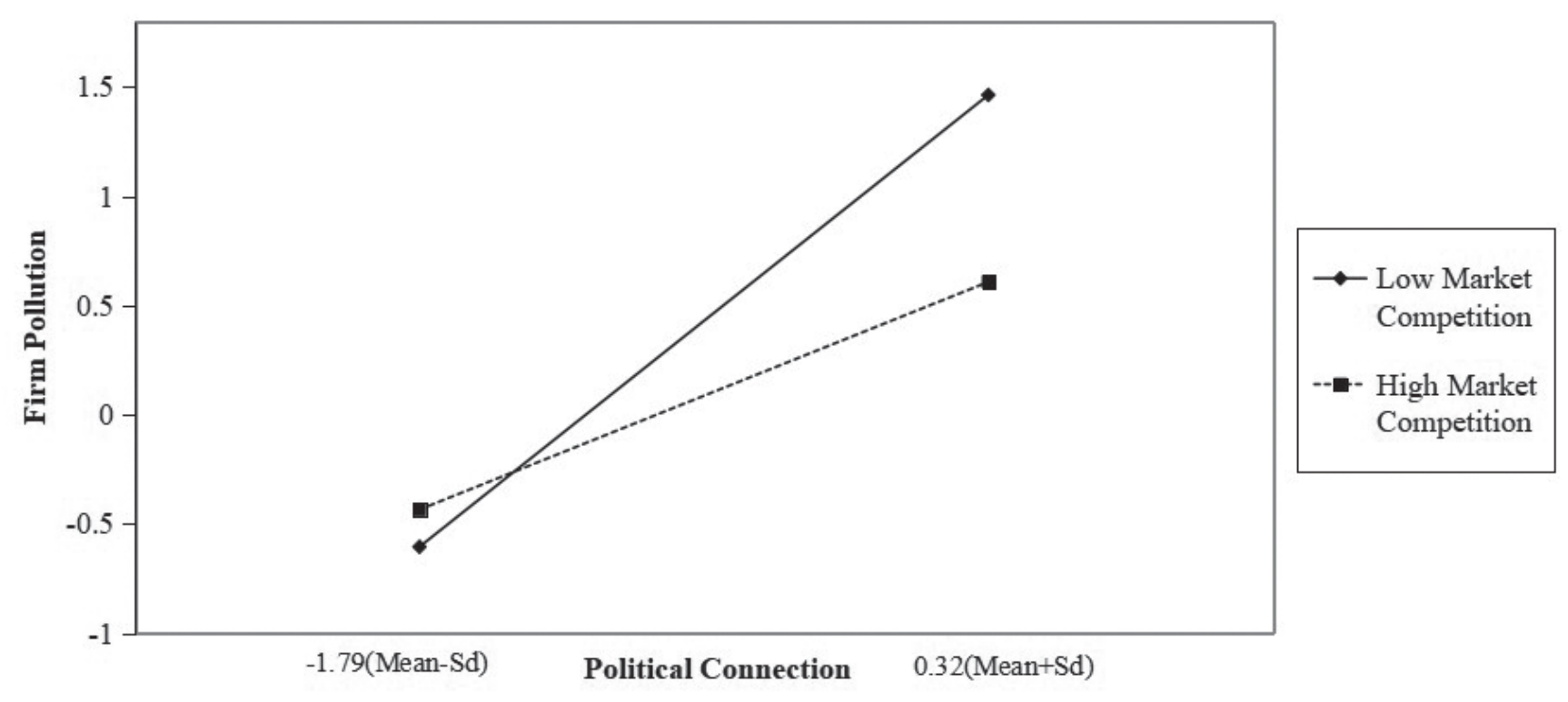
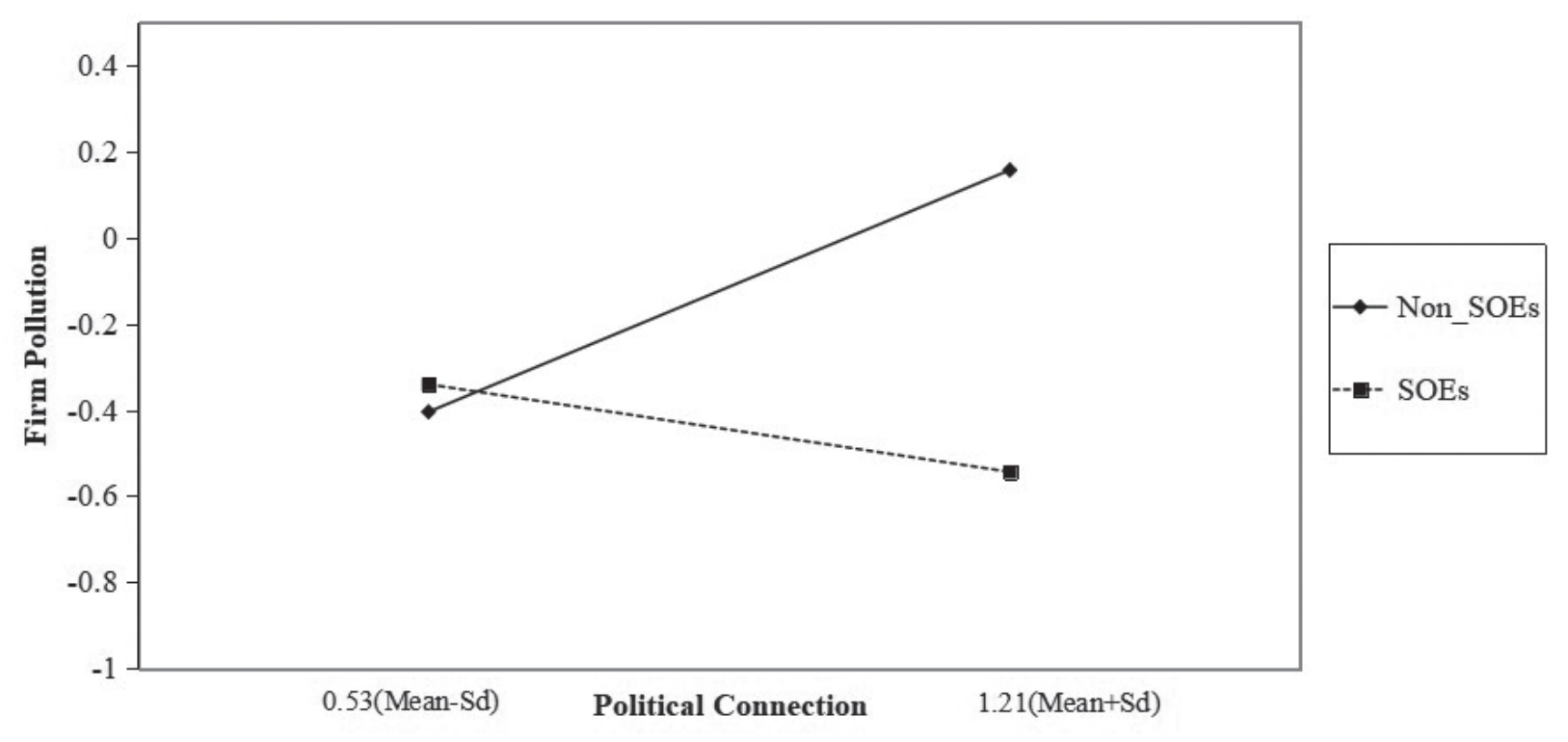
Table 4.
Robustness tests of alternative measure of PC.
The Panel B of Table 5 displays that the coefficient of IMR is not significant, indicating that sample selection bias is not present in our model. Moreover, the regression outcomes of Models 10, 11, and 12 with IMR added in panel B coincide with the outcomes in Table 3 above.
Discussions and Conclusions
General Discussion
The study investigates how the impact of political connections on corporate pollution is regulated by market competition, state ownership and environmental regulation from the perspective of institutional logics [41]. Taking the listed companies in China with the most severe pollution during 2015-2017 as a sample, our research results are as follows:
Firstly, the research has shown that political connections have a negative impact on corporate pollution, indicating that political connections will buffer rather than promote corporate pollution. This contradicts existing views, which have mainly explored the negative impact of political connections on the environment [78]. For example, Xiao and Shen (2022) empirically proved that political connections are not conducive to the improvement of corporate environmental performance and have negative externalities on the environment [14]; Deng et al. (2020) argue that political connections are institutional means for enterprises to engage in strategic pollution control, leading to unreasonable resource allocation, squeezing investment in environmental protection, weakening the enforcement of environmental regulations, and ultimately resulting in higher levels of pollution [16]. The study takes a new perspective and reveals the positive side of political connection. The main reason may be that compared to non-political affiliated enterprises, political affiliated enterprises have access to more scarce resources and are willing to engage in more environmental technology research and development; On the other hand, they accept more attention and supervision and are unwilling to take risks in engaging in environmental pollution behavior.
Secondly, From the perspective of institutional logic,the results suggest diverse moderating effects of the variables that were evaluated. For market competition, it strengthens the negative effect of political connections on corporate pollution, consistent with existing logic. The more intense the market competition, the more reliant enterprises are on the resources of stakeholders, and the more vigilant they are to avoid illegal environmental behavior; Otherwise, it may raise and strengthen the vigilance of the government, competitors, and consumers. This is consistent with the existing logic. For state ownership, it strengthens the negative correlation between political relations and corporate pollution, consistent with existing logic [78]. Politically linked state-owned enterprises have the ability to access government resources and the pressure to achieve their social goals, and are more willing to put effort into combating pollution. For environmental regulations, its moderating effect is insignificant, which is different from existing research. Existing research suggests that environmental regulations will weaken the political rent-seeking activities of politically related enterprises, reduce distortion of resource allocation and privileges, and weaken the positive relationship between political connections and corporate carbon emissions [79, 80]; This study argues that the failure of environmental regulation to strengthen political relations has a negative impact on corporate pollution, which can be attributed to the failure of the Chinese government in legislation and implementation of environmental regulation, leading to the failure of environmental regulation to play its due role [81]. Kathuria (2007) also found that formal environmental regulation in developing countries has inevitable limitations in pollution control [82].
Practical Implications
First, political connections in China can buffer firm pollution. Therefore, they can be used as an important informal mechanism to reduce firm pollution. Accordingly, both the government and firms should encourage and monitor political connections to act strongly in prevention of pollution. For one thing, both firms and the government should encourage politically-connected corporate leaders to put forward suggestions to the government to reduce pollution and take proactive environmental ethical initiatives inside firms. For another, the government should strictly monitor political connections to discourage them from shielding firms from the effects of their pollution.
Table 5.
Results of Heckman two-stage procedure.
Second, institutional logics should be strengthened in order to help political connections further reduce firm pollution. A more fair, open and competitive market is required to ensure the effectiveness of political connections and to encourage firms to undertake a greater amount of environmental responsibilities. In addition, state-owned enterprises should be the pioneers in pollution control, improving their efficiency in environmentally friendly activities. In terms of environmental regulation, the government should be aware of any ineffectiveness and implement serious reforms to fight against pollution.
Limitations and Future Prospects
There are several shortcomings in this paper. First, we did not thoroughly investigate the mechanisms through which political connections affect firm pollution, thus subsequent research should examine the possible mediating effects and other moderating variables. Second, based on data availability, the study just used most polluting listed companies in China during 2015- 2017. Further research should expand the dataset for getting more reliable and insightful outcomes. Third, the empirical results are applicable to the enterprises with a large scale in emerging economies and not necessarily applicable to small and medium scale enterprises or other economies. Subsequent research can expand the sample in order to cover different sized firms from different countries to improve the persuasiveness of the conclusions.

