

Introduction
China's extensive economic growth model, heavily reliant on resource consumption and environmental degradation, has had significant negative impacts on the country’s pursuit of low-carbon economic development [1-3]. Consequently, the Chinese government has devoted considerable attention to reducing pollution emissions [4, 5], particularly by urging heavily polluting firms, the primary emitters of pollutants, to fulfill corporate environmental responsibility (CER) [6]. Unlike developed countries, where CER is driven by non-governmental stakeholders [7, 8], the key driving force of CER in emerging market countries such as China is government via formal environmental regulation [9]. Nevertheless, previous empirical studies found that stricter formal environmental regulation does not always lead to the expected enhancement of CER [10, 11]. The surprising empirical results are rooted in China's environmental decentralization and cadre evaluation systems. Under these institutional arrangements, local government officials responsible for environmental protection in their respective regions often prioritize rapid economic growth to increase their chances of promotion [12]. As a consequence, China's environmental regulation is characterized by campaign-style governance [13],1 ineffective execution [14, 15], and limited public input [16, 17].
In response to the deficiencies in environmental regulation, China enacted the New Environmental Protection Law (NEPL) in 2015, aiming to establish a more rigorous, adaptable, and incentivized system of environmental governance with the active participation of multiple stakeholders [18, 19]. Compared to its predecessor, the old Environmental Protection Law, the NEPL further strengthens the environmental supervision responsibilities of local government and provides incentive measures for enterprises with outstanding performance in pollution control [20]. Meanwhile, it introduces the public participation system. Nevertheless, as highlighted by Zhang and Cao (2015) [21], the NEPL will not result in nationwide improvement of China's environment in the short run. Thus far, there is a lack of reliable evidence regarding the NEPL's effectiveness, and the existing anecdotal evidence has led to conflicting conclusions, underscoring the need for further investigation. On the one hand, the NEPL has significantly improved government prioritization of environmental protection and strengthened the enforcement of environmental laws. In 2015, environmental protection departments at all levels issued more than 97,000 environmental infringement notices, and the public security bureaus resolved a total of 6,035 environmental pollution crimes, an increase of 17% and 16%, respectively, over 2014.2 However, on the other hand, corporate environmental violations still occur frequently, and the strengthened government environmental enforcement may not bring enough pressure to shift an enterprise's attention from economic growth to environmental protection. For example, in early 2017, Baotou Xinjin Magnesium Industry Co. Ltd. was ordered to suspend production for rectification due to the shutdown of environmental protection facilities. Nonetheless, the firm continued its 1 A typical example of "campaign-style" governance is "APEC
Blue", in order to ensure Beijing's air quality during the 2014
APEC meeting, the Ministry of Environmental Protection is-
sued emission reduction targets to Beijing and its surround-
ing provinces and cities. Through the implementation of a
series of mandatory means, such as vehicle restriction, con-
struction site shutdown, etc. 2 The detailed news can be accessed at: http://www.xinhuanet.
com//politics/2016-11/02/c_1119838168.htm. production operations until the intervention of the public security department, which imposed a substantial fine.3
Against this background, it is significant and timely to undertake empirical studies on the effectiveness of the NEPL. Herein, we focus on whether and when the NEPL could enhance CER. This research utilizes a sample of 3,525 firm-year observations in China spanning 2011 to 2019. The aim of our study is to investigate the causal impact of the NEPL on CER by implementing the difference-in-differences (DID) model. In addition, we further explore the moderating role of environmental regulation intensity, corporate ownership structure, and public participation in the causal effect. Our study finds that the NEPL can significantly improve the CER of heavily polluting enterprises; this basic conclusion still holds after a series of robustness tests, such as the triple differences (DDD) method. Meanwhile, the effect of NEPL is more pronounced for heavily polluting firms under the following conditions: 1) weaker local government environmental regulation; 2) non-state-owned enterprises; and 3) higher public participation.
This study makes valuable contributions in several aspects. First, our research directly responds to the controversy on the actual effect of NEPL. The empirical results from the whole sample confirmed its positive effect on CER, thus challenging the statement concerning the ineffectiveness of China's NEPL [21]. Meanwhile, this paper echoes the recent academic focus on the effectiveness of China's NEPL and can be regarded as a favorable complement to the NEPL [22, 23]. Second, our empirical analysis using the sub-sample explores the boundary when the NEPL works, helping reconcile the opposing arguments from the anecdotal evidence. We delve into the moderating effects of formal and informal environmental regulations, which can offer practical guidance for the government to establish a more robust environmental governance system. Thus, our paper reveals the specific conditions under which the NEPL can improve corporate environmental practices in China. Besides, comparing with previous studies concerning the impact of environmental regulation on quasi-CER, such as green productivity, environmental governance efficiency, and green innovation [10, 16], we directly focus on CER since it could reflect corporate environmental activities in a comprehensive way [24]. By doing so, we shed light on some of the mysteries surrounding the role of macro-environmental legislation in shaping micro-environmental behavior.
Research Hypotheses
Environmental regulation plays a pivotal role in firms' fulfillment of CER, particularly in heavily polluting industries. A substantial body of research 3 Further information can be accessed on the website: https://
www.sohu.com/a/129214706_645100. underscores that stringent environmental regulations compel firms to adopt more proactive environmental practices, responding to both legitimacy pressures and societal expectations [20]. As one of the most stringent environmental laws in China's history, the NEPL represents a significant shift from lenient oversight to a more rigorous and systematic regulatory framework [25].4 This shift, especially targeting heavily polluting firms, imposes clearer and stricter requirements. Specifically, the NEPL impacts heavily polluting firms' CER through three primary mechanisms: legitimacy pressure, policy incentives, and regulatory flexibility.
First, legitimacy theory suggests that firms whose actions diverge from societal norms or regulatory requirements face pressure from stakeholders, including the public, government, and markets, compelling them to restore legitimacy. The NEPL mandates that heavily polluting firms disclose key environmental information-such as firm names, types of pollutants, and emission levels- to the public. This requirement significantly enhances transparency, increasing firms' environmental accountability to both government authorities and the broader society. By making such disclosures, firms face greater compliance risks, as failure to meet their environmental responsibilities could result in severe penalties from local environmental authorities and, in some cases, legal liability [26, 27]. Prior research has shown that stringent disclosure requirements can improve firms' environmental accountability and reduce violations [28]. Thus, the NEPL intensifies legitimacy pressures on heavily polluting firms, driving them to fulfill CER more actively.
Second, while strict environmental regulations may raise compliance costs and promote environmental behavior, relying solely on compliance pressure can lead to resistance, particularly among firms that fear CER might undermine their economic performance [29, 30]. To address this concern, the NEPL provides a range of incentives, including financial support, tax benefits, pricing policies, and government procurement opportunities, to encourage firms to fulfill CER while continuing to create economic value. For heavily polluting firms, such incentives lead to increased environmental investment and green innovation. Consequently, the NEPL not only strengthens heavily polluting firms' CER engagement through stringent regulation, but also offers economic support through diverse policy incentives, enabling firms to balance environmental responsibility with profitability [31].
Third, in contrast to its predecessor, the NEPL not only enhances regulatory stringency, but also grants local governments greater enforcement flexibility, allowing for better adaptation to regional environmental 4 According to Article 4 of the NEPL, environmental protec-
tion constitutes a fundamental national policy of the state.
As such, the central government should implement measures
to synchronize economic development with environmental
protection. needs. This flexibility permits local authorities to tailor enforcement strategies based on specific circumstances, improving the overall effectiveness of environmental policies. Studies have found that environmental regulations combining strictness with flexibility are more effective at ensuring firms meet their environmental responsibilities [32]. Flexible policy designs help reduce the negative impact of excessive administrative intervention on firms' daily operations. Accordingly, the NEPL, by fostering a regulatory environment that balances stringent enforcement with flexibility, promotes more sustainable CER engagement by heavily polluting firms [9, 33].5
In light of the arguments mentioned above, we put forward our first hypothesis:
Hypothesis 1: The NEPL notably improves the fulfillment of CER for heavily polluting firms.
Since the local government is responsible for detailed environmental protection matters [34], one of the highlights of the NEPL is to strengthen the local governments' environmental monitoring systems by establishing legal liability, thus transferring pressure on jurisdictional firms for CER enhancement. However, due to the existing cadre evaluation system, local governments' environmental monitoring systems are by no means homogeneous. Previous empirical research has indicated that the impact of environmental performance on the promotion process of local officials is considerably lower than that of economic performance [35, 36]. Under such circumstances, local governments with poor environmental performance would exert more pressure on the heavily polluting firms within their jurisdiction to enhance CER, thereby avoiding bearing legal liability. On the contrary, local governments, without the pressure of their environmental performance, would motivate firms to be more involved in economic activities to maximize their promotion probability since there is a trade-off between economic development and environmental protection in the short run [37]. In a nutshell, the local governments’ differentiating preferences between environmental performance and economic development shape the degree of enforcement of the NEPL. Given the arguments mentioned in this section, we propose the second hypothesis:
Hypothesis 2: There would be a more pronounced effect of the NEPL on the CER for heavily polluting firms when headquartered in regions with weaker environmental regulation intensity.
Another highlight of the NEPL is the design of incentive mechanisms for firms to enhance CER, but the incentive effect would vary based on the ownership structure for the following two reasons. First, for state-owned firms, the local government has a greater 5 As an instance, article 16 of the NEPL specifies that local
governments possess the authority to establish local pollut-
ant discharge standards for projects that are not covered in
the national pollutant discharge standards. This reflects the
flexibility of the NEPL. motivation and preference to supply more resources and provide sufficient protection for these firms [38]. In general, state-owned enterprises enjoy advantages in fiscal subsidies, tax preference, financial support, land appropriation, market access, and contract enforcement [39]. Therefore, state-owned heavily polluting firms would be less motivated to enhance CER for the sake of pursuing preferential policies of the NEPL compared with their non-stated-owned counterparts. Meanwhile, state-owned firms are generally more involved in socially and environmentally responsible activities, owing to their dual economic and social objectives. That is to say, state-owned heavily polluting firms behave better in CER, making it easier to meet the essential environmental performance requirement of the NEPL. Conversely, non-state-owned heavily polluting firms have stronger motivation to adopt more CER activities to seek preferential policies and avoid legal liabilities. Based on these arguments, we propose the third hypothesis:
Hypothesis 3: There would be a more pronounced effect of NEPL on the CER for non-state-owned heavily polluting firms.
The NEPL establishes the right of all citizens to participate in and oversee environmental protection activities, thereby providing legitimacy for public engagement in such initiatives. Although the local government may reduce the environmental protection commitments when facing political promotion incentives and economic growth competition, the public demand for environmental protection can affect the government's environmental protection behavior [40-42]. Specifically, the current system for evaluating cadres in China places primary emphasis on economic-related indicators, whereas some social-related indicators (e.g., social stability) have veto power. Put another way, the local government would obey the NEPL in a stricter manner if high public participation in environmental issues may lead to potential social instability (e.g., environmental protests). Given this, our paper argues that public participation in environmental issues can effectively motivate enterprises to comply with the NEPL.
Hypothesis 4: The higher the public participation, the more significant the impact of the NEPL on the CER for heavily polluting enterprises will be.
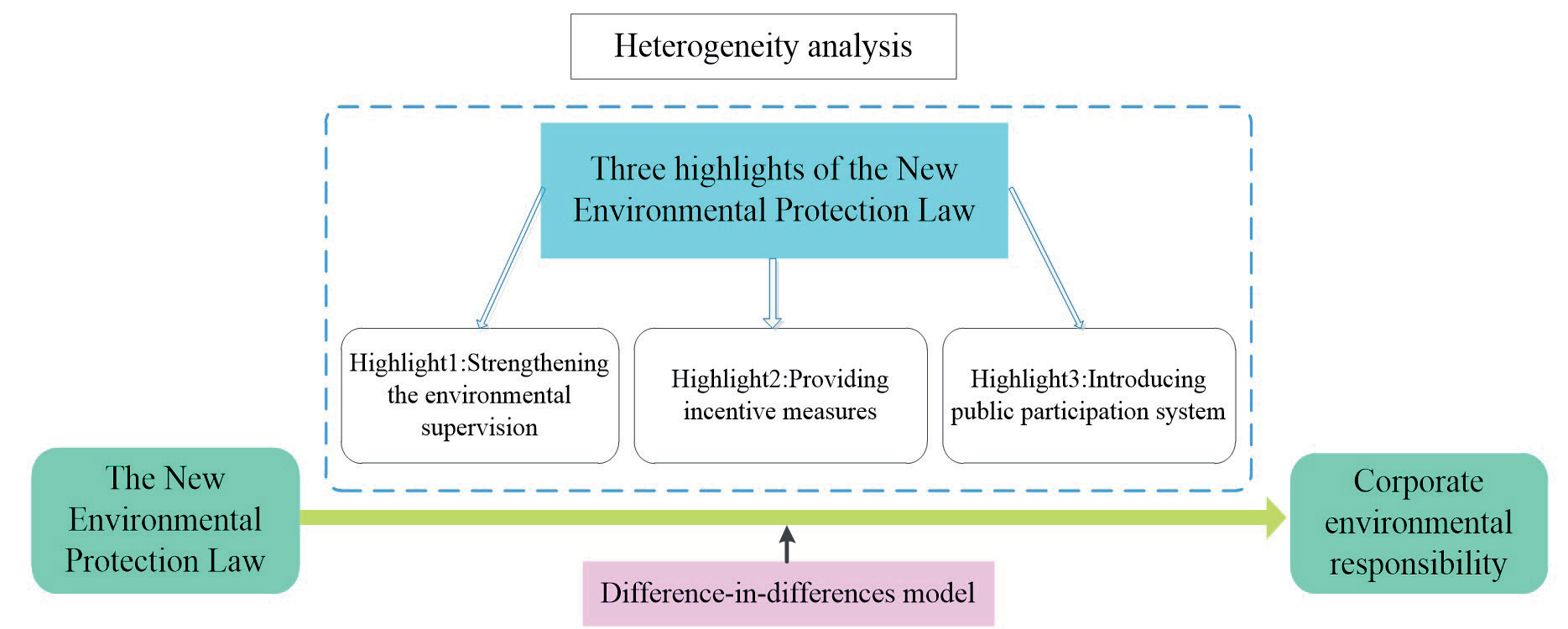
Fig. 1 depicts the conceptual framework based on the above arguments. We focus primarily on the causal effect of the NEPL on CER. Based on the three major highlights of the NEPL, this paper further explores the moderating effects of environmental regulation intensity, corporate ownership structure, and public participation on the main effect.
Research Design
Data and Sample
This article has selected the period between 2011 and 2019 as the research interval. There are two primary reasons for this. Firstly, to ensure symmetry of time before and after policy implementation (the NEPL was officially promulgated in 2015). Secondly, to avoid the impact of the COVID-19 pandemic on corporate environmental activities [43], this paper selects 2019 as the endpoint of the sample. The heavily polluting firms are selected as the experimental group. It is defined based on the Guidelines for Environmental Information Disclosure of Listed Companies issued by the Ministry of Environmental Protection in 2010. The main reason for choosing heavily polluting firms as the experimental group is that the NEPL has strengthened the supervision of key polluting units. Heavily polluting firms are the major source of industrial pollution and are under increasing pressure from environmental regulation [44]. The analysis of changes in CER for heavily polluting enterprises before and after the enforcement of NEPL would allow testing of the NEPL's effectiveness. Meanwhile, given that the effect of the manufacturing industry on the environment is much higher than that of other industries [42], we select other manufacturing enterprises as the control group to make our results comparable.
Also, this paper screens the sample according to the following standards: (1) Excluding the sample with special circumstances such as ST and PT. (2) Excluding cross-listed companies. (3) Eliminating companies with an asset-liability ratio greater than 100%. (4) Excluding firms listed in the current year. Finally, 3,525 observations were obtained involving 598 unique listed companies, including 385 in the experimental group and 213 in the control group. The CER data employed in this paper is derived from the Chinese Corporate Social Responsibilities (CCSR) Database, which is widely used in previous empirical studies [42, 45]. Other firm-level data comes from the CSMAR Database. The environmental regulation indicator is constructed based on city-level government work reports. Public environmental participation comes from official Baidu Index data. Media attention is from the CNRDS database.
Variable Definitions
Dependent Variables
Corporate environmental responsibility (CER). Due to the subjectivity and randomness of the data collected from firms' annual reports and questionnaire surveys and the objective data from professional evaluation agencies. This can enhance the transparency and replicability of the study [46]. To guarantee the comparability and objectivity of the results and avoid self-defined CSR measurements, we rely on the CSR outcomes generated by professional institutions, such as the CCSR Database. The CCSR Database utilizes the prevalent Kinder, Lydenberg, and Domini (KLD) CSR evaluation system, which has been adjusted to better suit the particular CSR context in China. As shown in Table A1 of Appendix A, CCSR measures CER in environmental terms. Like content analysis, the focal firm scored 1 point for meeting the specified indicator's requirements and 0 otherwise. Based on Tang et al. [45], the final CER is the natural logarithm of the environmental item score.
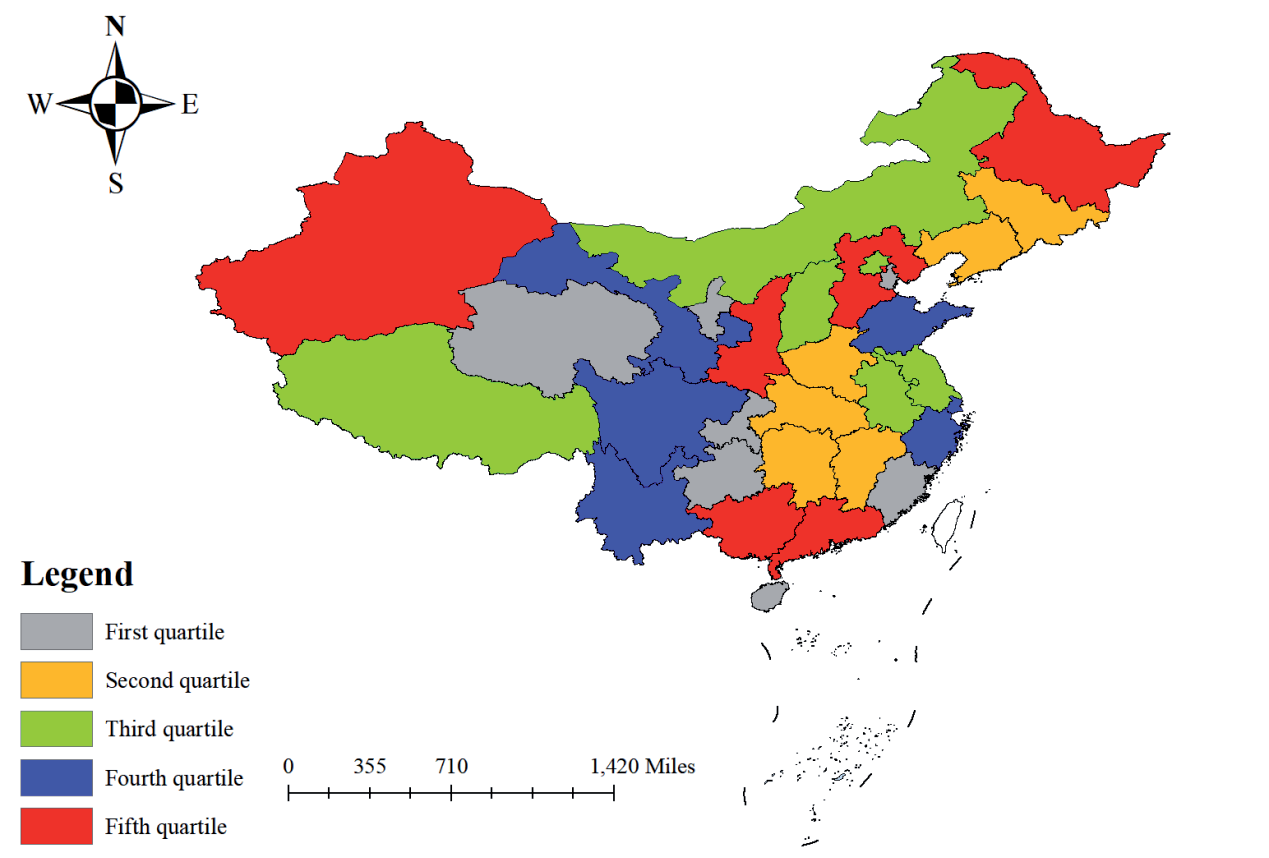
Fig. 2 illustrates the distribution of CER means at the provincial level over the sample period (The foundational map originates from the Standard Map Service System administered by the Ministry of Natural Resources, with an assigned audit number of GS(2019)1822). From the first to the fifth quartile, the mean value of CER gradually increases. Overall, provinces with lower levels of CER fulfillment are mainly located in western China, such as Qinghai and Guizhou. Areas with higher levels of CER fulfillment include Guangdong, Hebei, Shaanxi, and so on, while the distribution is more dispersed.
There are several possible reasons for this phenomenon. First, the varying stages of economic development across different provinces play a significant role. Provinces in the western regions, such as Qinghai and Guizhou, are generally at earlier stages of economic development, where industrial growth is primarily resource-driven, with limited financial and technological capacity to prioritize environmental concerns. This contrasts with more developed regions, particularly in the eastern provinces like Guangdong, where the transition towards advanced manufacturing and service sectors has facilitated greater investments in corporate environmental responsibility. Second, the strength of environmental governance and regulatory enforcement also differs considerably between provinces. In provinces with more established environmental policies and stronger regulatory oversight, such as Hebei and Shaanxi, there is greater pressure on firms to comply with environmental standards, which has led to higher CER averages. In contrast, weaker regulatory frameworks and oversight in less developed regions have contributed to lower levels of CER. Lastly, public environmental awareness and social oversight mechanisms vary across regions. In wealthier, more urbanized areas, there is a higher degree of public scrutiny and pressure on firms to adopt environmentally responsible practices. In contrast, regions with less active civil society and lower public engagement in environmental issues may experience less pressure on corporations, resulting in weaker CER performance.
Independent Variable
Did indicate the NEPL. If the focal firm-year observation is a heavily polluting firm in and after 2015, Did equals 1, and 0 otherwise. Specifically, Did equals 1 if the firm-year observation belongs to a heavily polluting firm and occurs in 2015 or later. If the firm is not classified as a heavily polluting enterprise or the observation falls in the pre-2015 period (before the NEPL was enforced), Did equals 0. Heavily polluting firms are defined according to the 2010 "Guidelines for Environmental Information Disclosure of Listed Companies" published by China’s Ministry of Environmental Protection6. These guidelines cover 16 major industries, including thermal power, steel, cement, electrolytic aluminum, coal, metallurgy, chemicals, petrochemicals, building materials, paper, brewing, pharmaceuticals, fermentation, textiles, leather, and mining. Firms in these sectors are subject to increased environmental scrutiny and are required to disclose 6 The official source can be found at the following link:
https://www.mee.gov.cn/gkml/sthjbgw/qt/201009/
t20100914_194484.htm more detailed environmental information, making them a focal point of our study.
Moderating Variables
Environmental regulation intensity (Er). The measurements of environmental regulation in existing research studies are usually based on pollution intensity [47], environmental levies [48], shadow cost [49], comprehensive energy price [50], or pollution governance costs [51]. However, these indicators could only reflect one aspect of the government's environmental governance and suffer from high subjectivity [52]. Therefore, Chen et al. selected the proportion of the number of words in the paragraphs devoted to describing the ecological environment to the total number of words in the government work report to measure environmental regulation [53]. The government work report usually divides the government's work into several major categories (i.e., environment, economy, employment, etc.) and elaborates on work initiatives and plans to be implemented in detail. Adhering to the extant literature, the public usually uses the proportion of environment-related vocabulary in government work reports to measure the government's attention to environmental issues [50]. Our research employs the median of the environmental regulation intensity as the cut-off point; the higher group is assigned a value of 1, and the lower group is assigned a value of 0.7 7 This study's environmental regulation intensity construction
process includes the following specific steps: first, manually
collecting government work reports from Chinese prefec-
ture-level and above cities spanning 2011-2019. Second, re-
Corporate ownership structure (Soe): 1 indicates state-owned firms, 0 otherwise.
Public environmental participation (Public). Similar to Ma et al. [54], this paper uses a province-level Baidu search index to measure public environmental participation. We divide the sample into two groups using the median of the Baidu search index. The group with a higher Baidu search index is assigned a value of 1, while the other group is assigned a value of 0.
Control Variables
Referring to Lau et al. [55] and Abeysekera and Fernando [56], the control variables selected mainly include corporate financial features and governance features. Financial features include: Firm size (Size) and the natural logarithm of the total assets. Asset liability ratio (Lev) is the proportion of total liabilities to total assets. Management cost ratio (Man) is measured by the proportion of management cost to total assets. Total asset turnover (Ato). Firm growth (Growth) is measured by the growth rate of operating revenue. Free cash flow (Cash) is measured as the ratio of net cash flow from operating activities to total assets. Governance features include: Duality (Dual), 1 for the duality of the CEO and chair of the board, 0 otherwise. Firm age (Est) is the natural logarithm of the firm's establishment age. The proportion of independent directors (Indir). Equity concentration (Top1) is the shareholding ratio of the largest shareholder. Board size (Board), i.e., the number
viewing each government work report to identify paragraphs
focused on the ecological environment. Third, calculating
the environmental regulation intensity through Python 3.8. of all directors on the board. Media attention (Media), as media exposure, motivates companies to fulfill CER. The number of executives with environmental backgrounds (Gtmt).
Table 1.
Summary statistics.
Model Specification and Model Approach
The DID model is able to compare the differences between the treatment group (the group subject to policy intervention) and the control group (the group not subject to policy intervention) before and after the implementation of the policy, thus providing a more accurate assessment of the impact of the policy on CER. Controlling for industry fixed effects helps to eliminate the potential impact of structural differences across industries on the results; controlling for year fixed effects eliminates the interference of time trends on the results; and controlling for province fixed effects eliminates the impact of local factors on the results, allowing us to more accurately capture the actual impact of the NEPL on CER. To examine the causal influence of the NEPL on CER, following Hao et al. [57], we design the following model:
In equation (1), CERit represents the CER score of enterprise i in year t; Did is the independent variable; Xit is a set of control variables; Industryi, Yeart, and Provincej represent the industry, year, and province fixed effects, respectively; and εit is the error term.
For equation (1), controlling for industry fixed effects allows us to capture sector-specific factors that remain constant over time, such as industry-level environmental regulations or technological constraints. Year-fixed effects control for macroeconomic trends and nationwide policy changes, while province-fixed effects account for regional differences in economic development and environmental enforcement. We use city-level clustered robust standard errors for statistical inference. This approach accounts for the intra-city correlation of residuals across different firms, thereby relaxing the classical regression assumption of independent disturbances and enhancing the efficiency of our estimates.
Table 2.
Benchmark regression results.
Empirical Results
Descriptive Statistics
The definition of variables and descriptive statistics are exhibited in Table 1. The mean value of CER without natural log transformation (CER2) is 3.148, which is 44.971% of its maximum value (7), highlighting the need to study the drivers of CER.
Benchmark Regression
Table 2 displays the policy impact of the NEPL. Regardless of whether the financial or governance features have been controlled, the independent variable remains positively significant, and its value and significance have decreased along with the incorporation of more control variables. For instance, in the full model, the NEPL increases the median CER for heavily polluting enterprises by 8.5%, thereby supporting Hypothesis 1. However, the increase is relatively small, leaving ample room for improvement, especially considering the relatively low level of CER in China.
Robust Tests
Parallel Trend Test
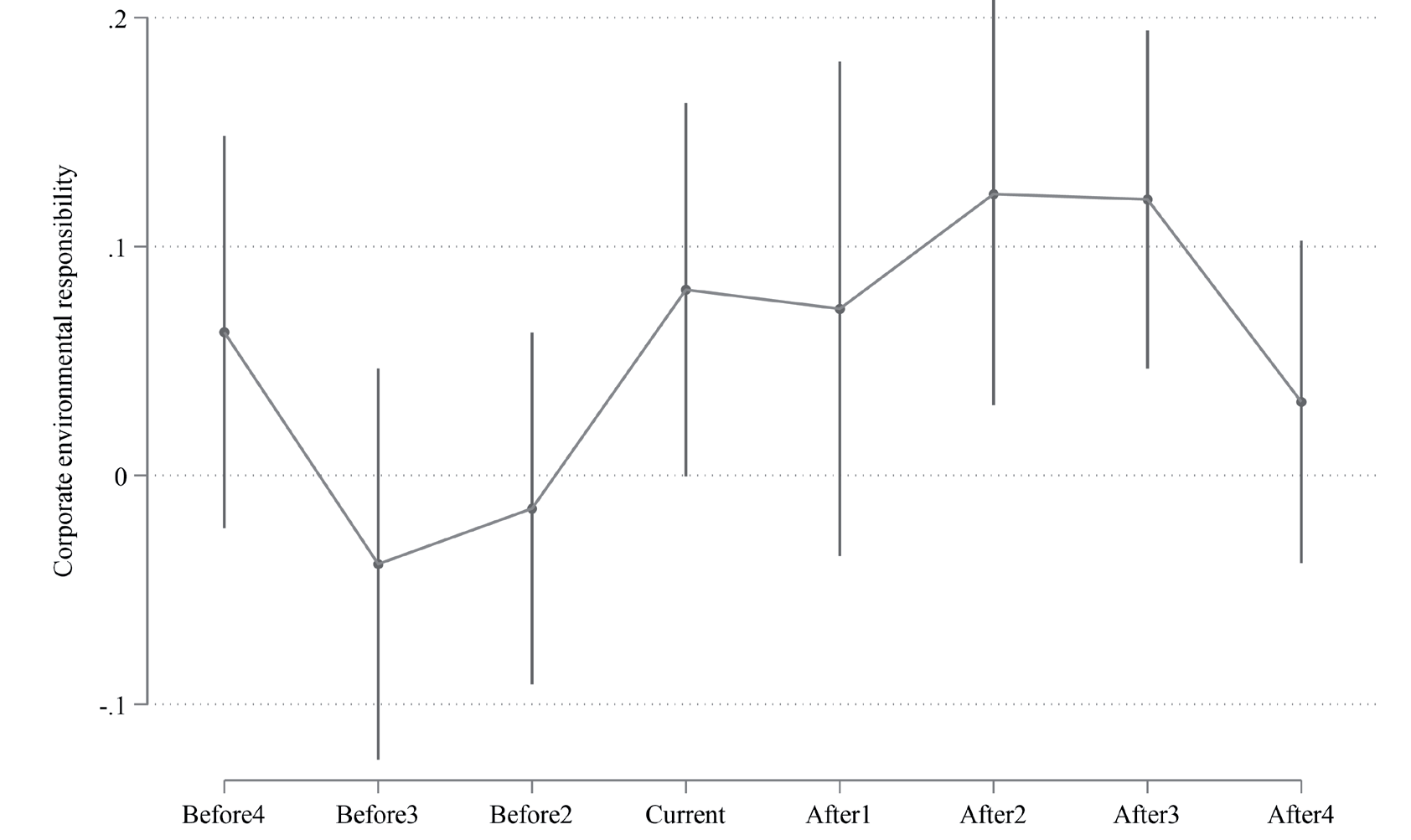
The premise of applying a DID model is to meet the parallel trend test [58]. For this study, the DID model requires a parallel trend of CER fulfillment in the experimental and control groups before implementing the policy. To test the parallel trend hypothesis, referring to Beck et al. [59], a more rigorous empirical test is conducted by employing an event study. Fig. 3 illustrates the parallel trend graph based on the empirical test. Where Before4-Before2 denotes 2011-2013, Current-After4 denotes 2015-2019, and Before1 (2014) serves as the reference group. Before the implementation of the NEPL, the Did in each year was not significant, indicating that there was no significant difference between the experimental and control groups, consistent with the parallel trend test. After the implementation of the NEPL, there is a tendency for the policy effect to increase but then disappear immediately. The parallel trend test exhibits that the impact of the NEPL lacks continuity, which echoes the phenomenon that China still "attaches importance to legislation but overlooks the enforcement".
Placebo Test
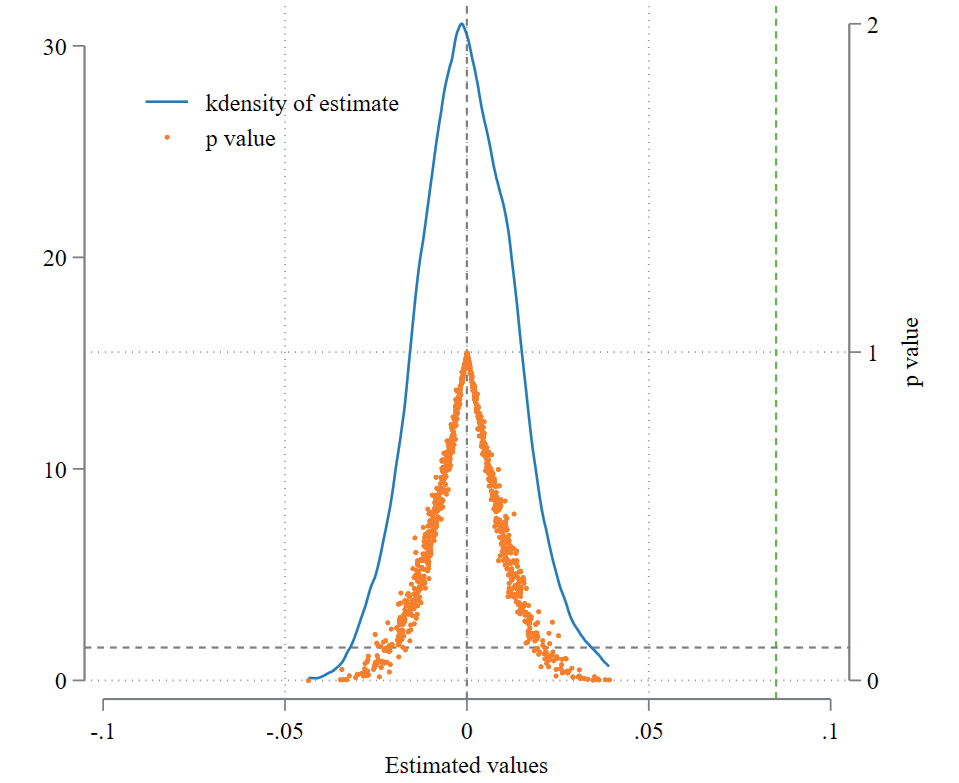
To further exclude the influence of other environmental policies in the same period on the baseline results. Following Hao et al. [57], we obtain the kernel density graph of 1000 self-sampling regression. Fig. 3 reports the kernel density distribution of coefficients from the 1000 self-sampling regressions.8 We find that the mean of all the estimated coefficients of Did is almost 0. Most of the estimated coefficients are concentrated around the 0 point, and most of the estimated coefficients have p-values greater than 0.1. Also, the actual estimated coefficient of this study (from Column (4) of Table 2, as shown by the green vertical line in Fig. 4) is significant outliers in the placebo test. Therefore, the benchmark regression results are able to pass the placebo test, and other unknown factors would not bias results.
Other Robustness Tests
In order to ensure the benchmark regression results are more robust and convincing, this paper also performs other robustness tests to demonstrate the robustness of the baseline regression results. In Column (1) of Table 3, we employ CER2 as the dependent variable. Similar to Chen et al. [53], we have considered the interaction fixed effects of provinces and years to control for temporal characteristics at the regional level. The result is exhibited in Column (2). Furthermore, we excluded other industries and only used manufacturing samples for regression analysis. The result is shown in Column (3). According to Abadie et al. [60], we apply "k-nearest neighbor matching" as the matching method (k=1) and adopt a logit model to estimate the propensity score. 8 As this paper uses unbalanced panel data, we randomly se-
lect the experimental group from the whole sample, and keep
the proportion of the experimental group and the implemen-
tation time of the NEPL unchanged. Then carry out regres-
sion test according to the benchmark regression model to
obtain the regression p value and kernel density estimation. To overcome the problem of sample selection bias, we employ the sample after propensity score matching (PSM) to conduct the regression test again. The result is exhibited in Column (4).
Immediately after that, we redefine heavily polluting firms. Based on the industrial three waste emissions before the NEPL (2011-2014), we synthesize the industry pollution index using the entropy method. We consider an industry to be heavily polluting when its industrial pollution index is above the median. The corresponding result is shown in Column (5). Then, referring to Chen et al. [53], this paper uses the DDD model to verify the robustness of the result. Specifically, based on the city's three waste emissions before the NEPL (2011- 2014), we synthesize the city's pollution index using the entropy method. When the pollution index of a city is above the median, the corresponding city is assigned a value of 1, and the remaining cities are assigned a value of 0. We use this dummy variable to multiply with the independent variable Did to generate a new independent variable, Ddd, and the result is shown in Column (6).
Lastly, recent studies suggest that other related environmental policies may bias our results, such as the Green Finance Reform and Innovation Pilot Zone (Did2) implemented in 2017 [61] and the Environmental Protection Tax Law (Did3) implemented in 2018 [62]. To exclude the effects of the above environmental policies, we include Did2 and Did3 as control variables in the model. The result is shown in Column (7). After controlling the relevant policies, the NEPL still significantly improves CER. The full robust results denote that the benchmark regression still holds.
Table 3.
Other robustness tests.
Heterogeneity Analysis
Although our study has confirmed the causal effect of the NEPL, is there heterogeneity among different regions and enterprises in response to policy shocks? Accordingly, based on the three major highlights of the NEPL, this paper further incorporates environmental regulation intensity, corporate ownership structure, and public participation into the relationship between the NEPL and CER.
Heterogeneity Analysis Based on Environmental Regulation Intensity
Table 4 demonstrates the moderating effect of the environmental regulation intensity. The NEPL significantly increases CER when firms are located in areas with weaker environmental regulation intensity (Column (2) of Table 4). When firms are located in regions with stronger environmental regulation intensity, the effect of the NEPL is not significant (Column (1) of Table 4). Also, the test for difference in coefficients between groups (Diff) is significant at the 5% level, indicating that the two groups are indeed significantly different. The result indicates that to avoid penalties by the NEPL, the fulfillment of CER for heavily polluting enterprises in regions with weaker intensity of environmental regulation is improved. When enterprises are located in areas with weaker environmental regulation intensity, the NEPL significantly promotes CER. Therefore, Hypothesis 2 is verified.
Heterogeneity Analysis Based on Ownership Structure
Table 4 demonstrates the heterogeneity effect of the firm's ownership structure. The grouped regression result indicates that, compared with state-owned heavily polluting firms (Column (3) of Table 4), the NEPL significantly improves the CER of non-state-owned heavily polluting firms (Column (4) of Table 4). Also, the test for difference in coefficients between groups (Diff) is significant at the 5% level, indicating that the two groups are indeed significantly different. This may be due to the political connection between state-owned heavily polluting enterprises and local government. State-owned heavily polluting enterprises are less motivated to pursue the preferential policies of the NEPL, while non-state-owned heavily polluting enterprises are more motivated to carry out CER activities to seek favorable policies and avoid legal liabilities. Therefore, Hypothesis 3 is verified.
Heterogeneity Analysis Based on Public Environmental Participation
The NEPL provides legal support for public environmental participation in environmental protection. As a complement to formal environmental regulation, the public can compensate for regulatory failure to a certain extent. In consideration of their reputation and ongoing operations, enterprises must be cautious about the public’s voice. As exhibited in Table 4, CER is poorly fulfilled by heavily polluting enterprises in regions with lower public participation (Column (6) of Table 4). However, implementing the NEPL has led to obvious improvements in CER for heavily polluting enterprises in regions with higher public participation (Column (5) of Table 4). Also, the test for difference in coefficients between groups (Diff) is significant at the 1% level, indicating that the two groups are indeed significantly different. Our results suggest that public participation enhances the public's right to know about the ecological environment. To demonstrate a good corporate image to the outside world, under the pressure of external stakeholders, enterprises will better comply with environmental regulations and enhance the motivation to fulfill their environmental responsibilities [63]. Therefore, Hypothesis 4 is confirmed.
Table 4.
Heterogeneity analysis results.
Conclusions and Policy Implications
Drawing from a sample of 3,525 firm-year observations in China spanning from 2011 to 2019, our DID model reveals the following findings: 1) The NEPL has significantly improved the fulfillment level of CER for heavily polluting enterprises. This conclusion remains valid even after conducting a series of robustness tests; 2) for heavily polluting firms in regions with lower environmental regulation intensity and non-state-owned heavily polluting enterprises, the policy effect is more pronounced. The higher the public participation, the greater the impact of the NEPL on CER for heavily polluting enterprises.
Our study enhances the comprehension of the prerequisites for heavily polluting firms to achieve CER through the lens of environmental legal governance. First, given the current debate on the actual effect of NEPL, this paper systematically tests the impact of NEPL on CER, and our results effectively alleviate the concern about the uncertainty of the policy effect of the NEPL. In addition, the existing literature has focused on command-and-control and market-based environmental regulation when examining the impact of formal environmental regulation on quasi-CER [16, 19, 64, 65], while fewer studies have addressed the role of environmental law. Therefore, this paper enriches the impact of macro-environmental legislation on CER.
Aside from its theoretical contributions, our research also offers practical guidance for not only China but also other emerging economies. Firstly, considering that the policy effect of the NEPL does not last, the central government should further strengthen the enforcement of the NEPL, especially for holding local government accountable for environmental protection. Secondly, the heterogeneous results indicate that the environmental policy of the central government should refrain from implementing a uniform environmental regulation, and the enforcement of the NEPL should be accompanied by other measures. Specifically, the weaker effect of the NEPL in regions with high intensity of environmental regulation implies increasing the weight of environmental quality indicators in the performance appraisal of local government officials in these regions. Similarly, a high standard of environmental performance should be set for state-owned heavily polluting firms. Besides, the pronounced moderating effect of public participation denotes that the government should endeavor to build a sound informal environmental regulation system to cover the institutional void in the formal environmental regulation system.
Like every study, our findings have certain limitations. Firstly, since our sample covers heavily polluting and other manufacturing firms, more attention should be paid when generalizing our results to other industries. Secondly, we analyzed the three predominant traits of NEPL, but our study could not depict the NEPL in its entirety. In addition to controlling enterprises' activities, the NEPL encourages and guides public participation in environmental protection. Future research can be conducted along with more features of the NEPL, such as the public's environmental protection behavior. Lastly, there is no consensus on how to measure CER. The CER data used in this paper were obtained from the CCSR Database. The CCSR Database uses the same standards as the well-known KLD's evaluation system and adjusts accordingly to China's context. It is a reasonable approach for our study. However, future studies may consider other measurements that suit the research context.

