


Introduction
Mosquitoes are being controlled by a large number of chemical insecticides. Since the introduction of organic insecticides in the 1940s, chemical control has been a commonly used method in mosquito control [1] (pp. 197- 210). Mosquitocides are diverse and include pesticides from classes like organophosphates (OP), insect growth regulators (IGRs), and pyrethroids [2, 3]. The use of larvicides is the ultimate approach to reducing mosquito breeding; therefore, the majority of mosquito control programs aim at the larval stage in their breeding sites with larvicides because the adulticides may only decrease the adult population for the time being [4, 5].
Organophosphates (OP’s) and insect growth regulators (IGRs) are used for larval control.[6] Temephos (an OP) is the most extensively used larvicide worldwide because of its reasonable residual effect, easy handling, low mammalian toxicity, low cost, and safety in application to drinking water [7, 8]. Temephos is among a small number of organophosphates registered and produced commercially for the control of Aedes mosquito larvae [9]. Insect growth regulators are relatively safer than non-targeted organisms [10] and have been suggested for mosquito control. For example, pyriproxyfen, diflubenzuron, and methoprene are some important insect growth regulators registered as mosquito larvicides [6]. Pyriproxyfen is safe for non-target organisms like mammals and fish, along with mosquito predators like dragonflies [10]. Pyriproxyfen is a juvenile hormone pesticide to which various larval instars of a variety of mosquito species differ in sensitivity [11]. According to the World Health Organization (WHO), pyriproxyfen is judged a ‘reduced-risk pesticide’ or ‘unlikely to present acute hazard’ which means it is almost harmless to animals or birds and is neither genotoxic nor carcinogenic and can be safely added at a concentration of 0.01 ppm to drinking water for mosquito control [7, 12].
Thus, the present study is of substantial status as it focused on the knowledge of common mosquito species from different ecological zones of Punjab (Pakistan) formed because of dengue prevalence along with evaluation of the efficacy of larvicides and IGR currently being used in dengue control programs.
Experimental
Mosquito Collections and Rearing
Collection of mosquitoes was done from the areas that have been exposed to heavy mosquitocides during the past few years to minimize dengue outbreaks, i.e., Lahore (31°32’58.992”N, 74°20’36.996”E), Rawalpindi (33°36’2.52”N, 73°04’4.44”E), and Faisalabad (31°25′33.60”N, 73°05′56.40”E). The populations of Culex quinquefasciatus, Aedes aegypti, and Aedes albopictus collected from respective localities were maintained under laboratory conditions for bioassay. From all the three districts, the Culex quinquefasciatus population was found and collected, though, regarding Aedes species, Aedes aegypti was found and collected from districts of Faisalabad and Lahore, while Aedes albopictus was found and collected from district Rawalpindi. The population was reared at 27±2ºC with a relative humidity of 65±5% at L/D 12:12 h photoperiod at Dengue Vector Research Laboratory, Department of Entomology, University of Agriculture Faisalabad, Pakistan. Adults were kept in culture cages provided with 10% sugar solution. Larvae were fed on fishmeal, while pupae were collected daily and transferred to the adult cages. The female mosquitoes were fed on the blood of live white rats twice a week [13].
Bioassay Procedure
Larval bioassay was done against the larval population of mosquitoes collected from respective localities to check the efficacy of different insecticides under laboratory conditions. WHO-recommended larvicides for mosquito control were used, i.e., Temephos (1G and 50EC) from organophosphates and pyriproxyfen from IGRs. Insecticidal activities were tested using standard WHO protocols. Recommended dose, high dose, and low dose were used. For Temephos (1G and 50EC), low dose (D1), recommended dose (D2), and high dose (D3) were used at 0.5 ppm, 1 ppm, and 2 ppm, respectively. In the case of pyriproxyfen 0.5 WDG, low dose (D1), recommended dose (D2), and high dose (D3) were used at 0.005 ppm, 0.01 ppm, and 0.02 ppm, respectively. Each dose was tested in three replicates and a control. For bioassay, twenty-five larvae were placed in the glass beaker in each replication, and the total number of larvae tested per concentration was 100.
Data Collection
Mortality due to temephos 1G and temephos 50EC was observed after 24 hours, and the treatments were exposed for 4-5 months at weekly intervals. For pyriproxyfen (IGR), adult emergence inhibition was observed, and treatments were exposed to larvae fortnightly for 4-5 months. The threshold bioefficacy was 80% mortality/emergence inhibition.
Statistical Analysis
Mortality data, where necessary, was corrected by Abbott’s formula [14]. Data so collected was analyzed using three factors CRD for drawing inferences.
Results
The results indicated in the early weeks of the study that mortality induced by all the tested larvicides at all doses was quite similar between the species. Over time, there was observed a significant difference among the tested doses in causing mortality.
Response of the chemicals varied, i.e., temephos 1G showed marginally higher residual efficacy than temephos 50EC i.e. for Culex quinquefasciatus, it was about 3 weeks at a lower dose (0.5 ppm), 1.25-1.75 months at the recommended dose (1 ppm), and 1.5-2 months at the higher dose (2 ppm); and for Aedes aegypti/albopictus, it was about 1-1.5 months at the lower dose (0.5 ppm), 3-3.5 months at the recommended dose (1 ppm), and 3-4 months at the higher dose (2 ppm), as shown in Fig. 1.
Temephos 50EC showed the least residual efficacy, i.e., for Culex quinquefasciatus, it was about 3 weeks at a lower dose (0.5 ppm), 1-1.25 months at the recommended dose (1 ppm), and 1-1.5 months at a higher dose (2 ppm); and for Aedes aegypti/albopictus, it was about 1-2 months at a lower dose (0.5 ppm), 2.5-3.5 months at the recommended dose (1 ppm), and 3-3.5 months at the higher dose (2 ppm) (Fig. 2).
Pyriproxyfen induces inhibition emergence in adults for longer periods. So, when it is compared with that of temephos 1G and temephos 50EC in terms of controlling the larva, it showed a significant difference and greater residual efficacy, i.e. for Culex quinquefasciatus, it was about 1.5-2 months at the lower dose (0.005 ppm), 2-2.5 months at the recommended dose (0.01 ppm), and about 2.5 months at the higher dose (0.02 ppm); and for Aedes aegypti/albopictus, it was about 2.5-3 months at the lower dose (0.005 ppm), 3.5-4 months at the recommended dose (0.01 ppm), and 3.5-4.5 months at the higher dose (0.02 ppm), as shown in Fig. 3.
The marginal difference between temephos 1G and temephos 50EC in causing the mortalities of Culex quinquefasciatus and Aedes aegypti/albopictus in terms of both residual efficacy (i.e., 80% mortality) and percent mortality, but there was observed a significant difference between pyriproxyfen 0.5WDG with that of temephos 1G and temephos 50EC in controlling Culex quinquefasciatus and Aedes aegypti/albopictus (Table 1).
However, marginal variation was observed between the recommended doses (D2) and the higher doses (D3), but a significant difference was observed between the lower doses (D1) of the recommended and higher doses (D2 and D3). Table 2 shows Species × District interaction, while Table 3 shows Dose × District interaction. Overall Species × Dose × District interaction has been indicated in Table 4. According to Fig. 1, 2, and 3, the number of days at which 80% mortality/emergence inhibition (LT 80) remained at different doses of chemicals in respective districts. Aedes aegypti/albopictus showed more susceptibility in terms of percent mortality as compared to Culex quinquefasciatus. The population of Culex quinquefasciatus and Aedes aegypti from Lahore was found less responsive to the chemicals tested as compared to the population from Faisalabad and Rawalpindi.
Fig. 1.
LT 80 of Culex quinquefasciatus and Aedes aegypti/albopictus population of Faisalabad, Lahore, and Rawalpindi at different doses (D1 = 0.5 ppm; D2 = 1 ppm; D3 = 2 ppm) of Temephos 1G.
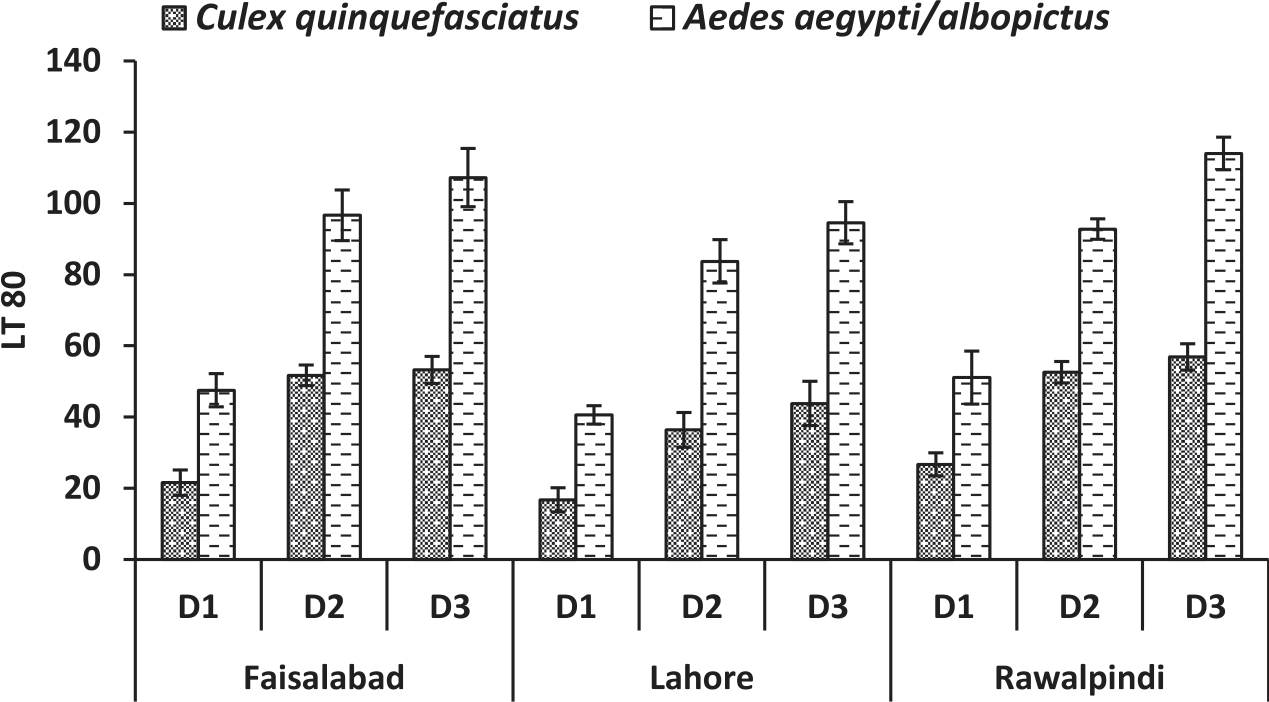
Fig. 2.
LT 80 of Culex quinquefasciatus and Aedes aegypti/albopictus population of Faisalabad, Lahore, and Rawalpindi at different doses (D1 = 0.5 ppm; D2 = 1 ppm; D3 = 2 ppm) of Temephos 50EC.
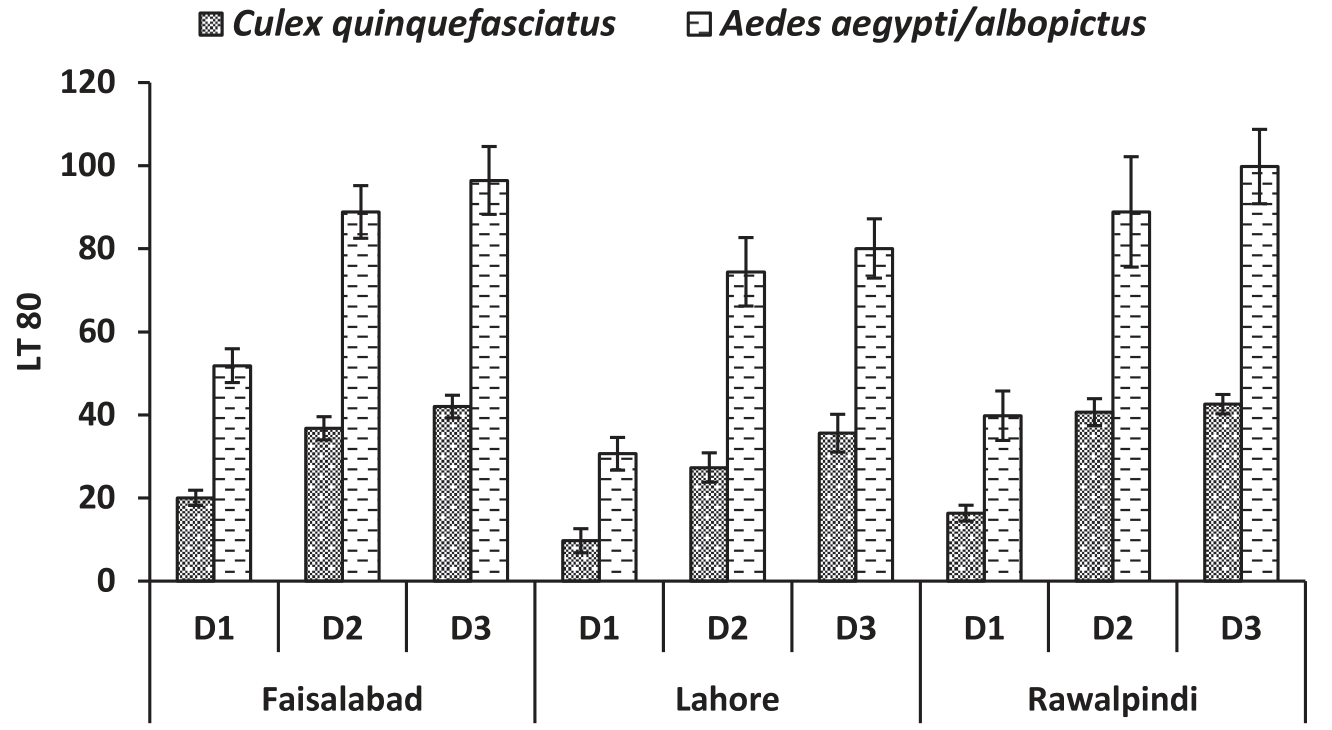
Fig. 3.
LT 80 of Culex quinquefasciatus and Aedes aegypti/albopictus population of Faisalabad, Lahore, and Rawalpindi at different doses (D1 = 0.005 ppm; D2 = 0.01 ppm; D3 = 0.02 ppm) of Pyriproxyfen 0.5WDG.
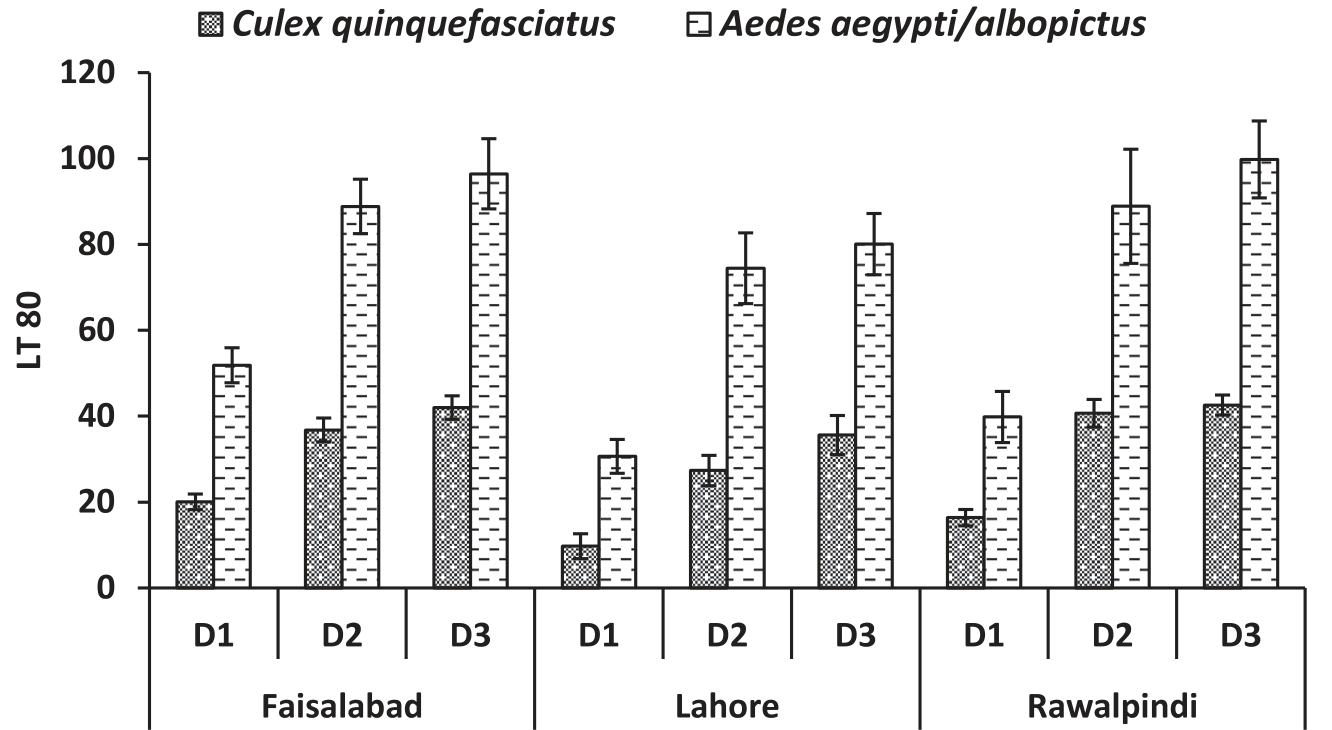
Table 1.
Analysis of variance (mean squares) table for mortality/emergence inhibition at different larvicide/IGR.
Discussion
Temephos (granular formulation) at the rate of 1 ppm (1 mg/L) provided 3 months of effective control against Aedes aegypti as reported by various scientists [15-18], and against Aedes aegypti/albopictus and Culex quinquefasciatus as reported by Garza-Robledo et al. [19], which is similar to our results of Aedes aegypti/ albopictus and close to that of Culex quinquefasciatus.
The residual efficacy of temephos 1G (1 mg/L) lasted for 15 weeks (105 days) under laboratory conditions against Aedes aegypti, as reported by Chen and Lee [20], which is very close to our results. Temephos (sand granules) at the concentration of 1 mg/L was found highly effective for breeding places of Aedes aegypti and Aedes albopictus for 3-3.5 months reported earlier by Brown et al. [21], which is very close to our results about Aedes aegypti and Aedes albopictus. Temephos granular formulation provided between 4-10 weeks of absolute control of Aedes spp. and Culex spp., as reported by Pérez et al. [22], is similar to our results. Different concentrations of temephos produced 100% control of Aedes albopictus ranging from 7-8 weeks to 5 months as suggested by Morris et al. [23], which is close to our results. The efficacy of temephos was reported to be 7-9 weeks against Aedes aegypti and Aedes albopictus in a study conducted in Malaysia by the World Health Organization [24], which resembles our findings. The validity period of temephos reported by Liu et al. [25] against Aedes albopictus and Cx. pipiens pallens was only 10-14 days at 0.4-0.8 mg/L and 21 days at 1.2 mg/L and the effective control time of 0.25 mg/L of 1% temephos was about 28 days to larvae of Culex pipiens pallens and Ae albopictus, both results in favor of our observations about Culex but significantly less than that of Aedes albopictus. The granular formulation of 1.0% temephos at rates of 2.0 and 5.0 mg/L in the selected septic tanks provided 22 days of effective larval control against Culex pipiens, as reported by KANG et al. [26], which is also like our results about Culex spp.
Table 2.
Mean mortality/emergence inhibition±SE for Temephos 1G, Temephos 50EC, and Pyriproxyfen 0.5WDG (Species × District interaction) a.
Table 3.
Mean mortality/emergence inhibition±SE for Temephos 1G, Temephos 50EC, and Pyriproxyfen 0.5WDG (Dose × District interaction).
Table 4.
Mean mortality/emergence inhibition ± SE for Temephos 1G, Temephos 50EC, and Pyriproxyfen 0.5WDG (Species × Dose × District interaction) a.
Temephos provided effective control against Aedes aegypti ranging from 130-140 days as reported by Marcombe et al. [27] and 120 days as reported by Boewono and Widyastuti [28], which is higher than our results. Shorter residuality was reported by Gürtler et al. [29] and Grisales et al. [30], in which temephos at the rate of 1 ppm provided approximately 6-9 weeks of effective control against Aedes aegypti, which is significantly lower than our findings. Treatment of temephos 50EC (100 ml/ha) in the field trials provided 4-5 weeks of absolute control and an additional 2-3 weeks of partial control against Culex spp. as described by Marina et al. [31] that resembles our observations under the laboratory conditions. Temephos 50EC at 0.5 ppm and 1 ppm resulted in 100% control of Culex spp. up to 7 days and 18 days of post-treatment reported by Ahmed and Adam [32], which is significantly lower than our results.
The results of larval bioassays conducted by Karunaratne et al. [33] in the laboratory against Aedes aegypti and Aedes albopictus at 1 ppm showed that temephos produced 100% mortality for ten months, significantly higher results than our findings. Temephos, when used in controlled release capsules, showed high efficacy against the Culex pipiens larvae, resulting in 100% mortality up to 120 and 92 days in stagnant and running water, respectively, reported by Badawy et al. [34], which is also significantly higher than our results because of the capsule formulation.
Temephos (5% granules) applied at 1 mg/L in simulated field studies showed effectiveness for 14 weeks against Aedes albopictus and 10 weeks against Cx. Quinquefasciatus, respectively, as reported by WHO [35], which resembles our results as temephos showed more efficacy against Aedes spp. as compared to Cx. quinquefasciatus. The larval population of Aedes aegypti is still susceptible to temephos reported by Thongwat and Bunchu [36] and endorses our results. The less responsive behavior and low mortality of Cx. quinquefasciatus against temephos in our findings is due to the possible development of resistance as described by Thomas et al. [37], as they found a significant difference in the larval mortality of Cx. quinquefasciatus in urban zones (ranging between 2.8 and 56.5%) and rural zones (ranging from 45.0 to 71.0%).
Pyriproxyfen was found highly effective at a dose of 0.01 mg/L (recommended dose) and 0.02 mg/L (high dose) against Aedes aegypti for 16 weeks under a laboratory trial and simulated field trial [38]. Also, 0.1 mg/L granular sand formulations of pyriproxyfen remained active for over 4 months (>16 weeks), as reported by Seccacini et al. [39]. Both results are in favor of our findings in terms of the residual efficacy of pyriproxyfen. Pyriproxyfen resulted in total inhibition of adult emergence of Aedes aegypti for 90 days at a 0.05 ppm dose, which is concurrent with our results, and 45 days at a 0.01 ppm dose is dissimilar to our findings as reported by Resende and Gama [40]. The results of Nayar et al. [41] are parallel to our findings in which they used a granular formulation of pyriproxyfen 0.5G at 0.02-0.05 ppm against Aedes aegypti and Cx. quinquefasciatus and found effectiveness for the entire 6-week test period in both laboratory conditions and outdoors.
Emergence of Cx. quinquefasciatus adults was inhibited for 4-11 weeks when treated with 0.1 mg/L of pyriproxyfen under field conditions reported by Chavasse et al. [42], which is close to our results in terms of residual efficacy of pyriproxyfen. A single treatment of pyriproxyfen provided up to 2 months of control against Culex quinquefasciatus, as reported by Mulligan and Schaefer [43], which is close to our results in terms of efficacy. About 60-70% inhibition of emergence was seen by Ansari et al. [44] for 3 months in disused wells against C. quinquefasciatus when pyriproxyfen 0.5% GR formulation was applied at the rate of 0.1 mg/L, which followed our results in which 60-70% emergence inhibition (EI) was seen up to 3 months. The results of various studies [45-47] follow our results in which the larvicidal efficacy of pyriproxyfen (IGR) was found to be greater than that of temephos (organophosphates). Ammar et al. [47] reported that even the lower doses of IGRs gave effective control against Aedes albopictus compared to organophosphate.
Complete inhibition of adult emergence of Culex pipiens pallens and Cx. tritaeniorhynchus was observed for 3 weeks only under field conditions when pyriproxyfen 0.5% granules were applied at different dosages of 0.01, 0.05, and 0.1 ppm, as reported by Kamimura and Arakawa [48], also when pyriproxyfen (Sumilarv 0.5G) applied at concentrations of 1.0 and 5.0 mg/L showed complete inhibition of adult emergence of Aedes aegypti for 22-28 and 36-42 days, respectively [49]. The granular formulation of 0.5% pyriproxyfen at 0.05-0.1 mg/L inhibited the emergence of Aedes togoi in brackish water in rock pools from 5 to 40 days, as reported by Lee [50]. Field trials of pyriproxyfen conducted by Okazawa et al. [51] against immature stages of Anopheles punctulatus at 4 different dosages resulted in inhibition of adult emergence for 2 months at a dosage of 0.1 ppm, for one month at 0.05 ppm and 0.01 ppm, and for 20 days at 0.02 ppm. Inhibition of adult emergence of Aedes aegypti and Aedes albopictus was observed up to 40, 57, and 56 days when treated with 0.001 ppm, 0.1 ppm of pyriproxyfen, and 1 ppm temephos 1% granules, respectively [52]. Studies by WHO [53] reported complete EI against Aedes aegypti for 6 weeks in plastic tubs placed outdoors. All these results are significantly lower than our results because of the field conditions.
The residual activity of pyriproxyfen reported by Marcombe et al. [27] in permanent breeding containers against Aedes aegypti was up to 28 weeks. The EI of pyriproxyfen GR decreased to < 80% after 160 and 260 days for 0.02 mg/L and 0.05 mg/L, respectively. Mortality of Aedes aegypti was reported to be greater than 80% for 5 months by Sihuincha et al. [54] in field trials in water tanks treated with pyriproxyfen. Complete inhibition of adult emergence of Aedes aegypti was observed by Andrighetti et al. [55] for 160 days in shaded areas and 46 days at sunlight exposure when treated with pyriproxyfen at 0.05 ppm. Residual activity of pyriproxyfen was reported at 43 weeks (indoor) and 26 weeks (outdoor) against Aedes aegypti [44]. All these results are significantly higher than our findings. Results of Romeo et al. [56] indicate that pyriproxyfen (SUMILARV® 0.5G) is somewhat less effective on Aedes albopictus as compared to Cx. Pipiens, which contrasts with our results, revealed that Aedes aegypti/ albopictus are more susceptible to pyriproxyfen as compared to Culex quinquefasciatus.
Conclusions
As a conclusion of our studies, a marginal difference was observed between temephos 1G and temephos 50EC in causing the mortalities of Culex quinquefasciatus, Aedes aegypti, and Aedes albopictus in terms of both residual efficacy (80% mortality) and percent mortality but there was observed a significant difference of results between pyriproxyfen 0.5WDG compared to that of temephos 1G and temephos 50EC. In the early weeks of the study, mortality induced by all the tested larvicides at all doses was quite similar between the species, but over time, there was a significant difference among the tested doses in causing mortality, i.e., a marginal difference was observed between the recommended doses (D2) and the higher doses (D3), but a significant difference was observed between the lower doses (D1) with that of the recommended and higher doses (D2 and D3).

