

Introduction
With climate change and severe pollution, environmental problems have become a crucial topic in the world. Pollution control in the production of enterprises is also an essential way to improve the environment. The existing literature on affecting factors of enterprises’ environmental performance mainly focuses on government policy and law [1-4], cultural norms [5], and corporate governance mechanisms [6, 7]. Nevertheless, few have considered how political connections affect a firm’s environmental performance. This paper will explore the firm environmental effects of political connection disruptions to fill a research gap.
Theoretically, the relationship between political connections and firm environmental performance is under debate. Based on the government intervention hypothesis [8] and the political resources hypothesis [9], this paper develops two opposing hypotheses. On the one hand, the political intervention hypothesis holds that the government will interfere with the firms’ environmental decision-making. With an increase in consciousness for environmental protection, particularly in China, environmental issues have been included in the assessment indicators for local government managers’ promotion, not only for the GDP [10]. Therefore, dealing with environmental issues is the government’s political objective, which would affect the firms’ objectivesto focus more on social responsibility, like environmental performance. And they believe that political connection disruptions (less political connections) may make firms pay less attention to environmental performance.
On the other hand, the political resources theory [9, 11] considers a political connection as an essential resource for enterprises. The scarcity of resources will bring various benefits to enterprises [9]. For example, the political connections will bring tax incentives [12], equity financing [13], easier access to bank loans [14, 15], and the labor costs of enterprises [16]. It will also make enterprises avoid environmental responsibility and reduce investment in environmental protection [17]. Therefore, the political resource hypothesis holds that political connection disruptions (less political connections) may make firms pay more attention to environmental performance.
A significant challenge facing the empirical literature about the relationship between political connection and firms’ environmental performance is that political connection is likely endogenous. First, there are different ways to construct political connection indicators, such as measures based on the features of senior executives [8, 18] or other characteristics of the enterprises [11, 12]. Secondly, previous literature that studied the political connection generally would miss or could not control the factors that affect environmental performance but could not be measured, such as the environmental beliefs of enterprise managers. Finally, the literature that examines the relationship between political connection and environmental performance may have potential reverse causation. That is, the more companies invest in environmental protection, the better they can connect with the local government.
To mitigate the above potential endogenous problems, we use an exogenous quasi-natural experiment, Rule No. 18 of the China Communist Party for Independent Directors in 2014, to identify the causal effect between political connection disruptions and environmental performance. On October 19, 2013, the organization department of the Communist Party of China Central Committee (CPCCC) issued document Rule No. 18- “Opinions on Further Standardizing the Issue of Party and Government Officials’ Part-time Jobs in Enterprises”. Rule No. 18 stipulates that party and government officials above certain levels should not serve as independent directors for companies. Rule No. 18 brought a wave of departures of independent directors, most of whom were government officials.
In this paper, we manually collect environmental investment data of Chinese heavily polluting A-share listed firms during 2011-2018, and manually collect enterprise sample data of independent directors who resigned due to Rule No. 18. Adopting a DiD (difference-in-differences) methodology, this paper finds that political connection disruptions will cut down on environmental investments, indicating the prospect of political connection disruptions decreasing corporate environmental responsibility and reducing investment in environmental protection, which supports the government intervention hypothesis. In terms of economic significance, the estimated effect corresponds to a 37.65% increase in an average firm’s mean value of environmental investment. Further analysis shows that this effect supports the government intervention hypothesis rather than the government resource hypothesis. The effects of political connection disruptions on firm environmental performance are especially prominent for firms that are in low market pressure, small-scale, or high environmental regulation locations.
This paper has three contributions. Firstly, this paper explores the effect of political connections on firm environmental performance from firm external political connections, in particular, from the perspective of independent directors. Most of the previous literature investigates the environmental effects of firm internal political connections, like those of firm executives [2, 19-23]. Although Xiao and Shen (2022) also explored the effects of political connections on corporate environmental performance from the perspective of independent directors, there are some differences between their paper and this paper. Firstly, there are contrary findings [24]. They find that political connections would have a negative effect on the firm’s environmental performance, while there is a positive environmental effect of political connections in our paper. Secondly, this paper explores environmental performance based on firm environmental investment activities and corporate CSR ratings. Firm environmental investment activities are related to the firm’s specific investment amount; the CSR rating is a relatively abstract synthetic number that cannot specifically represent the firm\s environmental performance intensity. Finally, the samples were different. They focus on environmental performance in non-state enterprises. Our paper examines the highly polluting enterprises’ environmental performance. Therefore, this paper explores the corporate environmental effect of political connections from external independent directors.
Secondly, this paper extends the research related to the impact of government intervention on firms from environmental performance. Previous scholars have investigated the effect of government intervention on firm non-environmental performance, like firm performance [25-27], firm innovation [28-30], firm financing [31, 32], firm labor investment efficiency [33]. Therefore, this paper enriches the research about the effect of government intervention on firms from environmental performance.
Finally, this paper has strong policy implications for the government, whether in developing countries like China or in developed countries like the USA. This paper finds that political connections can reduce firms’ environmental investments in China. Therefore, for developing countries, it is possible to improve firm environmental performance by strengthening government intervention with enterprises. Additionally, for developing countries, a firm’s political connection needs to be taken into account when improving firm environmental performance.
Literature Review
Institutional Background
To meet the needs of internationalization and the requirements of establishing a modern enterprise system, China gradually introduced the independent director system in 1997. In 1997, the China Securities Regulatory Commission (CSRC) stipulated that overseas-listed enterprises set up two more independent directors in the Guidelines on the Regulations of Association of Listed Firms. And then it begins to be taken on trial in the A and B-share markets. In 2001, the CSRC formally issued the Guidance on the Establishment of Independent Director System in Listed Firms, claiming that the number of independent directors of a listed company should be no less than 1/3 of the board of directors. The introduction of the independent director system is a beneficial attempt to solve the agency problem in China, which causes the major shareholders to infringe on the interests of the minority shareholders. Nevertheless, the system has been controversial since it was created, especially when companies hired independent directors. There is no doubt that enterprises employ officials as independent directors in the hope of obtaining benefits through political connections, which also violates the supervision function of independent directors.
In 2012, the organization department of the CPCCC issued document Rule No. 18 – “Opinions on Further Standardizing the Issue of Party and Government Officials “Part-time Jobs in Enterprises” on October 19, 2013. Rule No. 18 is mainly aimed at officials of the party and government who are incumbent, not incumbent but unretired, resigned from office, or already retired. It makes strict regulations on whether the party and government leaders can take a part-time job in an enterprise, their term limit of office, the age limit, and remuneration. Rule No. 18 stipulates that party and government officials above certain levels should not serve as independent directors for companies. Rule No. 18 brought a wave of departures of independent directors, most of whom were government officials. Once the document was published, a large-scale tide of independent directors serving in the government or party resigned. Table 1 is a manual collection of the resignation notices of independent directors of China A-share listed companies from October 19, 2013 (Rule No. 18 issued) to December 31, 2014, through Juchao Information Network (the website discloses the announcements issued by listed companies). By matching the CSMAR database of personal resumes of senior executives and supplementing and cross-checking the missing data through Baidu, Wencaibaike, and Wind, we obtain a total of 1109 resignation notices from independent directors from 832 listed companies. Although some resignations of independent directors as officials are not disclosed according to document Rule No. 18, we have reasons to believe that most independent directors resigned because of it (as shown in Table 1). Therefore, according to the resumes of independent directors, we manually judge whether it is affected by Rule No. 18 and resign. The phenomenon that the political policy shock is leading to a large number of resignations of independent directors as officials provides the possibility to study the environmental behavior of enterprises from the perspective of political connection.
Table 1.
Reasons for the resignations of independent directors.
Hypothesis Development
How political connection disruptions affect firms’ environmental performance is getting more and more attention from scholars and governments. Based on the government intervention hypothesis [8] and the political resources hypothesis [9], this paper develops two opposing hypotheses. On the one hand, the government intervention hypothesis holds that the government will interfere in business decisions, including, of course, companies’ environmental decision-making. Particularly in China, this intervention is more evident in firms with political connections, like state-owned enterprises whose CEO is appointed by the local government. As environmental problems have become more and more severe in China in recent years, the central government is paying more attention to environmental protection, not just using GDP indicators for local government managers’ promotion (called “GDP Championship” [10]). In 2007, China confirmedly introduced the “One-Vote Veto System” of environmental protection into the official assessment system. For political promotion, the local government will shift the pressure of environmental responsibility to local enterprises, especially firms with more political connections. government intervention hypothesis believes that firms with fewer political connections will not interfere with the government, which would not push them to contribute to environmental performance. Therefore, we hypothesize the following.
H1a: All else equal, political connection disruptions will make firms pay less attention to environmental performance.
The political resources hypothesis is also an opposite theory about how the political connection affects firms’ environmental performance [9, 11], which considers political connections as an essential resource for enterprises. Due to the scarcity of resources, politically connected firms will be aided by the government. [9]. For example, the political connection will bring tax incentives [12], equity financing [13], easier access to bank loans [14, 15], and lower the labor costs of enterprises [16]. As a manifestation of corporate social responsibility, environmental investment will cause unnecessary cash expenditures for enterprises. Firms with political connections can avoid environmental responsibility and would not afford investment expenses in environmental protection [17]. And the political resources hypothesis believes that firms that have fewer political connections will not benefit from the government, which would push them to contribute to environmental performance. Therefore, we hypothesize the following:
H1b: All else equal, political connection disruptions will make firms pay more attention to environmental performance.
Based on the above theoretical discussion, we draw a theoretical framework diagram of the relationship between political connection disruptions and firms’ environmental performance, as shown in Fig. 1.
Materials and Methods
Sample and Data
The research consisted of 379 Chinese A-share listed firms in heavily polluting industries during 2011-2018. We chose firms in heavily polluting industries as the research object because only heavily polluting industry firms disclosed the environmental investment (dependent variable) in Chinese listed firms. Corporate environmental expenditure data is extracted manually from corporate social responsibility reports, environmental responsibility reports, and sustainable development reports. Other firm variable data is from the CSMAR database. The final sample has 2148 firm-year observations. This paper winsorizes all continuous variables at the top and below 1% to exclude interference from extreme values.
Research Model
To explore the effect of the political connection disruptions on environmental performance, we adopt the DiD model:
EPIi,t is the dependent variable, which is the measure of the environmental investment of firm i in year t. The firms’ environmental investments are the sum of environmental investments in infrastructure, upgrading, scientific research, etc. Because environmental investment is an absolute quantity, we take the logarithm of the environmental investment to avoid the problem of heteroskedasticity. Treati×Postt is an independent variable that measures the firm political connection disruptions. Where Treat is a dummy variable that equals one when a firm is a treatment group whose independent directors resigned due to Rule No. 18 and zero otherwise. Post is a dummy variable that equals one when the year is greater than or equal to 2014 and zero otherwise.
Following prior research [2, 17], we selected the following control variables from firm characteristics (firm size, Asset; firm leverage, Lev; firm age, Age), corporate governance (independent director ratio, Idp), and executive characteristics (executives’ government background, Expoli), firm operating status (return on assets, Roa). In addition, we control the year-fixed effect (δt) to control the impact of some shocks in a fixed year on corporate environmental performance across the country. We control the firm fixed effect (γi) to control all firms’ characteristics that may influence the extent of environmental performance without changing over time. All variable definitions are reported in Appendix Table A.1.
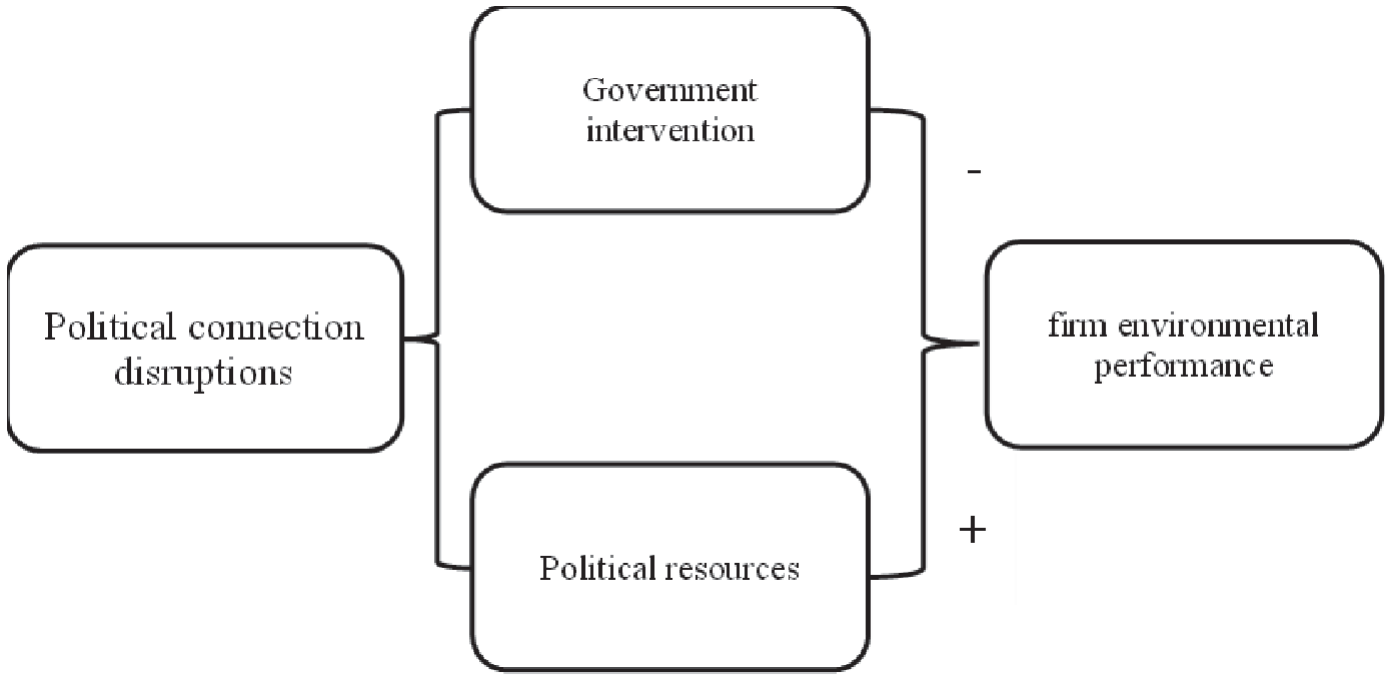
Table A.1.
Variable definitions.
Summary Statistics
The descriptive statistics of the main variables are presented in this section. In Table 2, the mean of Treat is 0.155, indicating that in the study sample, 15.5% of the enterprises whose independent directors resigned. The mean of environmental performance is 0.255%, indicating that Chinese companies pay less for environmental protection. The standard deviation of environmental performance is 0.488, indicating that each firms’ environmental performance is different.
Results and Discussion
Basic Results
Based on model (1), this paper explores how political connection disruptions affect environmental performance. In Column (1) of Table 3, we control the firm and year-fixed effects without firm control variables. In Column (2), we further control the firm control variables. And both results show that Treat×Post is significantly and negatively correlated with EPI, indicating that political connection disruptions will cause a reduction in environmental investment. On average, political connection disruptions decrease firms’ environmental investment by 37.65% (0.096/0.255%). The basic results show that political connection disruptions will worsen firms’ environmental performance, which supports the government intervention hypothesis [8]. This finding is consistent with Deng et al. (2020), who found that political connections increase firms’ environmental performance [34].
Table 2.
Summary statistics.
The Parallel Trend Assumption
An identification for the DiD model is the parallel trend assumption, which means that there should be no difference in the dependent variable (environmental investment) trend between the treatment group firms and control group firms before the policy. Following Du et al. (2022) [35], we use the event study model to investigate the dynamic effects of political connection disruptions on firm environmental investment. The event study model is as follows
Where EPI, Treat, Control is the same as the model (1). Here, D(k) is the dummy variable, which equals 1 when k = year-2014. Therefore, the coefficient of Treat×D(k), αk, estimates the impact of political connection disruptions on firm environmental investment in k. The results are shown in Fig. 2. From Fig. 1, we could find that the effect of political connection disruptions before Rule No. 18 is not significant, indicating that our model satisfies the parallel trend assumption. What’s more, the policy’s effect is significant when Rule No. 18 is implemented two years later.
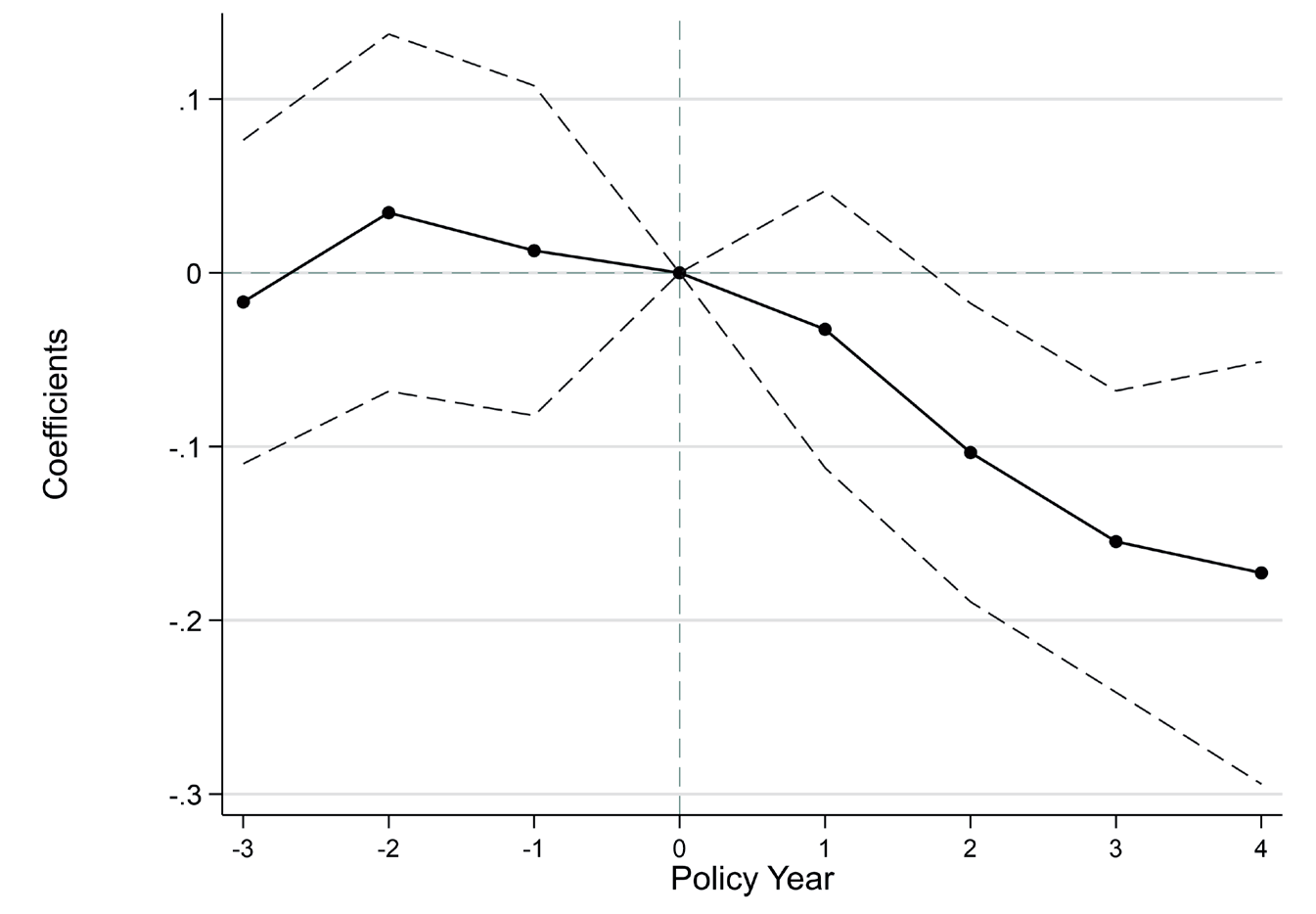
Table 3.
Political connection disruptions and environmental performance.
Further Analysis
Exclude Political Resources Hypothesis
In the theoretical hypothesis section, we analyze that the political resources theory [9, 11] considers a political connection as an essential resource for enterprises. Firms with political ties will therefore have a better chance of gaining the resource advantage of eliminating non-productive costs such as environmental expenditures. Thus, if the political resources theory exists, we would expect that for firms that are not inherently politically connected [36], such as non-state-owned enterprises (NSOE), their environmental expenditures should increase significantly when they lose their politically connected directors. We first divide the sample into SOE and NSOE according to the nature of their ownership. In Columns (1) and (2) of Table 4, Treat×Post is negatively and only significantly correlated with EPI in the SOE sample. Therefore, the empirical results do not support our expected results based on the political resource hypothesis, which also excludes the competing hypotheses of the political resource hypothesis.
To further test whether the political resources hypothesis exists, we collected firms’ government subsidies. The empirical results are shown in Column (3). We can find that political connection disruptions do not significantly reduce firm government subsidies, which also excludes the political resource hypothesis.
Cross-Sectional Analysis
High Market Pressure and Low Market Pressure
Our basic results suggest that after a firm’s political disconnect, the firm is less exposed to government interference, which in turn reduces its environmental investment. As green development has also become a way to improve firm performance, firm investors are now increasingly concerned about firm green behavior [37, 38]. Thus, when firms make environmental spending decisions, they may need to make trade-offs between government intervention and market intervention. Especially when market pressures are high, firms would not significantly reduce their environmental expenses, even though they suffer from political connection disruptions. Therefore, we expect that political connection disruptions will not be insignificant for firms’ environmental expenses for those with higher market pressure. We use firm institutional ownership as an indicator of market pressure [39, 40]. And when the firm’s institutional ownership is greater than its median, the firm is under high market pressure. In Columns (1) and (2) of Table 5, the Treat×Post is not significantly correlated with the EPI in the high market pressure sample, which supports our expectation.
Large-Scale and Small-Scale Firms
Large-scale enterprises are better at lobbying and policymaking, which protects them from government interference [41, 42]. Therefore, government interference is more likely for small businesses than large-scale enterprises, leading to a greater reduction in environmental investment in small-scale enterprise samples. Based on the median of firms’ assets, we divide the sample into small-scale and large-scale firms. In Columns (3) and (4) of Table 5, Treat×Post is negative and only significant in small-scale enterprises’ samples, suggesting that political connection disruptions are associated with higher deviations in environmental performance only in small-scale enterprises.
Firms Located in the High Regulation Region and Low Regulation Region
In this section, we divide the firms into those located in the high regulation area and those located in the low regulation area. Following Lanoie et al. (2008) and Wang and Shen (2016) [43, 44], we use the median of the regional environmental regulation index to divide the sample. The firm is located in a high environmental regulation area when its environmental regulation index is greater than its median, and vice versa. In regions with high environmental regulation, firms are subject to high pressure on environmental governance. Therefore, firms located in the high-regulation region are more likely to be subject to government interference than firms located in the low-regulation region, leading to a more significant reduction in environmental investment in the high-regulation region enterprises sample. In Columns (5) and (6) of Table 5, Treat×Post is only significantly and negatively correlated with EPI in higher environmental regulation samples, suggesting that political connection disruptions are associated with higher deviations in environmental performance in the high environmental regulation region.
Table 4.
Political resources hypothesis.
| Environmental performance EPI | LnSubsidies | ||
|---|---|---|---|
| (1) | (2) | (3) | |
| NSOE | SOE | ||
| Treat×Post | -0.008 | -0.132*** | -0.254 |
| (-0.152) | (-3.473) | (-1.455) | |
| Control_Var | YES | YES | YES |
| Year/Firm FE | YES | YES | YES |
| Observations | 1128 | 1020 | 1875 |
| Adj.R2 | 0.699 | 0.709 | 0.599 |
Table 5.
Heterogeneity analysis.
Robustness Checks
In that section, we also make some robustness checks and the results are reported in Tables 6 and 7.
Propensity-Score Matching (PSM)
There may be some self-selection process for the resignation of sole directors in this paper, which leads to the incomparability between the experimental groups and control groups. Therefore, to ease the concern about self-selection, we use the propensity-score matching (PSM) method. Following Du and Wang (2022) [45], we adopt PSM-DiD by using all control variables in the model (1) as covariables and choosing the 1:2 neighbor matching method. In Column (1), the Treat×Post is significantly and negatively correlated with EPI, suggesting that political connection disruptions are associated with higher deviations in environmental performance even when we consider the interference of sample self-selection.
Placebo Test
In this section, we constructed a placebo experimental group, i.e., the sole directors with government backgrounds who resigned not due to the non-No. 18 regulation, as the experimental group and constructed the variable TreatPlacebo×Post. It is expected that the normal resignation does not change the connection between the enterprise and the government; therefore, even if the sole director with a government background resigns, it will not affect the firm’s environmental expense decisions. The empirical results are shown in Column (2). The TreatPlacebo×Post is not significantly correlated with the EPI, which corroborates our core conclusion of this paper that the firms’ environmental expense decreases after the political connection disruptions caused by No. 18.
Table 6.
Robust test 1.
Exclude the Eight Regulations
We have noted that the Chinese government issued a similar regulation in the early months of Rule No. 18, which may lead us to doubt whether confounding factors might have influenced our main results. In December 2012, the Chinese government issued the Eight Regulation to require companies to reduce their business entertainment expenses [46, 47]. Following Cai et al. (2011) [48], we control business entertainment expenses (BEE) to exclude the impact of the Eight Regulation. In Column (3), political connection disruptions are still associated with higher deviations from environmental performance, even when we consider the interference of the Eight Regulation.
Exclude the Reverse Causality Issues
In the field of corporate finance, the use of financial indicators may lead to reverse causality issues. In this part, we lag all control variables. In Column (4), the results show that political connection disruptions are associated with higher deviations in environmental performance even when we consider the interference of reverse causality issues in financial indicators.
Alternative Measures of Environmental Investment
In this section, we will adopt other indicators to replace the dependent variables. We use EPI2 to measure environmental performance and the ratio of environmental investment to the firm’s total assets. In Column (5), the Treat×Post is negatively and significantly correlated with EPI2, suggesting that political connection disruptions are associated with higher deviations in environmental performance even when we take alternative measures of environmental performance.
Including Industry-Year Fixed Effects
To exclude the effects of industry cycles on our conclusions, we control the industry-year fixed effects in the model (1). In Column (1), political connection disruptions will still reduce firm environmental performance, even when we exclude the effects of industry cycles from our conclusion.
Narrow the Samples
In this section, we first narrow the samples from 2011 to 2016, which can exclude the impact of some events in 2011, 2017, or 2018. The results still hold in Column (2). Then, to exclude the impact of some events in 2013 and 2014, we also tried to delete the data from 2013 and 2014. The results are shown in Column (3), and our basic results still hold.
Two-Periods DiD
To alleviate the potential serial correlation problem in the model (1), we follow Bertrand et al., (2004) [49] and use the two-period DiD method to re-estimate the model (1). In Column (4), Treat×Post is still significantly and negatively correlated with EPI.
Table 7.
Robust test 2.
Conclusions and Policy Implications
Conclusions
In this paper, we manually collect environmental investment data of Chinese heavily polluting A-share listed firms during 2011–2018 and manually collect firms’ data of independent directors who resigned due to Rule No. 18. Then we exploit this exogenous natural experiment to identify the causal effect of political connection disruptions on environmental performance by using the DiD method. We find that political connection disruptions will worsen firms’ environmental performance, which reduces firms’ environmental investment by 37.65%. Further analysis shows that this effect supports the government intervention hypothesis rather than the government resource hypothesis. The effects of political connection disruptions on firm environmental performance are especially prominent for firms that are in low market pressure, small-scale, or high environmental regulation locations. Overall, our paper provides new insights into the environmental effects of political connection disruptions.
Policy Implications
Based on the main empirical results, this paper also makes the following two policy recommendations: First, we know that political disconnects can reduce corporate environmental performance. Therefore, the government should strengthen supervision and intervention with companies, especially in their environmental performance. Since firms are seeking to maximize profits, they are less willing to spend on the environment. Therefore, the government needs to monitor and intervene with companies to make firm environmental spending a constraint in their decision-making.
Second, the effects of political connection disruptions on firm environmental performance are heterogeneous. Therefore, local governments can reduce firm market pressure or increase environmental regulation intensity, which promotes the effect of political connections on corporate environmental performance.
Research Limitations
However, there are two research limitations in our paper. Firstly, this paper adopts China’s firm data to examine the effect of political connection disruptions on firm environmental performance. Therefore, we could re-examine the research question based on international samples for future research. Secondly, our paper could not distinguish exactly where environmental investments are going, so in the future, we can dig deeper into this data to explore which types of environmental investments are affected by political connection disruptions.