

Introduction
Momordica charantia L. belongs to the Cucurbitaceae family and is also known as bitter melon or bitter gourd [1, 2]. Its origin is tropical Asia, east India, and south India, and it is widely grown in tropical and sub-tropical regions of the world [3]. Bitter gourd plants contain a variety of bioactive compounds, including vitamins, minerals, alkaloids, polypeptides, steroidal saponins, and aromatic volatile oil [4]. These plants also have a high amount of nutrients like copper, magnesium, calcium, iron, zinc, phosphorus, and nitrogen [5, 6]. In previous studies, bitter gourd was used for different diseases in the human race, e.g., blood illness, diabetes, breathing issues, and rheumatism. So these benefits increase the demand for bitter gourd all over the globe [7].
Bitter gourd fruits, flowers, and young shoots are used as flavoring agents in various Asian dishes [8]. Fruits can also be canned, pickled, or dehydrated in addition to cooking or deep frying. It is widely used as a folk medicine against diabetes [9]. Bitter gourd tea, known as gohyah or herbal tea, is popular as herbal medicine [10]. Fruit peels are utilized as fertilizers to enhance soil fertility and soil microbiota, regulate the pH of soil, kill insect pests, and fulfill plant nutrient requirements [11]. Fruit peels of oranges, pomegranates, bananas, and tomatoes are generated to a larger extent all over the world (Fa) [12] that contain macro and micronutrients (K, N, Ca, P, Mg, Na, B, Fe, Zn, Cu, and Mn) for plant growth and development [13, 14]. The banana peel is used for soil fertility and growth-promoting substances, which also lower the harmful effects of water stress [15, 16].
On the other hand, inorganic fertilizers damage soil fertility and structure, leading to nutritional imbalances [17]. Conventional practices can be improved by using biodegradable waste; limited inputs can improve the harvest [18]. Therefore, organic fertilizers are used to stabilize soil structures [19]. So, the main objective of this study was to evaluate the effect of different fruit peels (banana, tomato, orange, and pomegranate) on the growth, morphological, and anatomical characteristics of the bitter gourd.
Experimental Method
A pot experiment was conducted in the UE Botanical Garden, Division of Science and Technology, University of Education, Township Lahore. The seeds of bitter gourd varieties, i.e., Aswad and Long Fsd, were taken from Ayub Agriculture Research Institute (AARI) Faisalabad. These are cultivated locally due to their nutritional value, phytochemicals, and bioactive properties [20].
Seeds were sown in plastic pots (25 cm diameter and 30 cm height) filled with garden soil on 2 March 2022 with a light water spray. There were a total of 36 pots for the experiment (3 pots for each treatment) containing 4 kg of soil. Seeds started their germination after 8-10 days of sowing and completed in almost 14-16 days. After 10-12 days of germination, seedlings were thinned to keep 3-4 seedlings of the same size in each pot [21].
Preparation of Fruit Peel Extract
Fruit peels of pomegranate, orange, tomato, and banana were collected from fruit juice vendors in the township market separately. Collected fruit peels were washed thoroughly with tap water to remove the unwanted material, including seeds. The washed peels were cut into small pieces (3-4 cm) and then dried in an oven at 65ºC for 24 hours. The dried fruit peels were powdered separately, sieved, and stored at room temperature [22].
Fruit peel powder in different formulations was mixed with water to prepare their extract to evaluate the plant growth. For this, 6 g of powder from each fruit peel (banana, tomato, pomegranate, and orange) was added to 100 ml of distilled water separately and then mixed thoroughly to prepare their extract. This mixture was stirred for 3 days (the optimum time for proper dilution because fruit peel powder can’t dilute simply in water) by using a magnetic stirrer [23]. After 30 days, the treatments were applied to growing seedlings with an interval of two weeks. Formulation of treatment was used by following concentrations that were described in Table 1.
Morphological Characters
After 125 days of plant germination, one plant from each pot was harvested for the measurements of the plant height, leaf area, shoot fresh and dry weight, root fresh and dry weight, and root and shoot length. A plastic ruler was used for measuring the plant length. The root and shoot fresh weight of each plant was weighed by the electronic analytical balance (TM-STE3002S) immediately after harvesting. After weighing, the fresh sample of the root and shoot of each plant was placed in the oven and dried at 65ºC for 72 h to measure the root and shoot dry weight [24].
Anatomical Characters
The material was preserved in formalin acetic alcohol (FAA) solution for 48 h for anatomical studies. The preservative contained 5% formalin (v/v), 10% acetic acid, 50% ethyl alcohol, and 35% distilled water. Then, plant material was transported in an acetic alcohol solution (acetic acid 25% and ethyl alcohol 75%) for long-term storage. Permanent free-hand sectioning slides were prepared by serial dehydrations in ethanol (30%, 50%, 70%, 90%, and 100%) using the standard double-stained technique of safranine and fast green stains [25]. Photographs were taken by a camera fitted with a light microscope (Nikon 104, Japan) using an ocular micrometer. Anatomical characteristics related to parenchymatous, mechanical, and vascular tissues were recorded with computerized software (Motic Images plus 2.0).
Table 1.
Quantity of fruit peel powder for the preparation of Fruit Peel formulations.
Statistical Analysis
The experimental treatments were arranged in a Completely Randomized Design (CRD) with six replications of each variety. Analysis of variance of all parameters was performed by the factorial design procedure of Statistix version 8 (Statistix 8, Analytical, and Tallahassee, FL, USA) [26]. Comparisons of means among different treatments were made according to the least significant difference (LSD) test at the 5% probability level.
Results
Growth Parameters
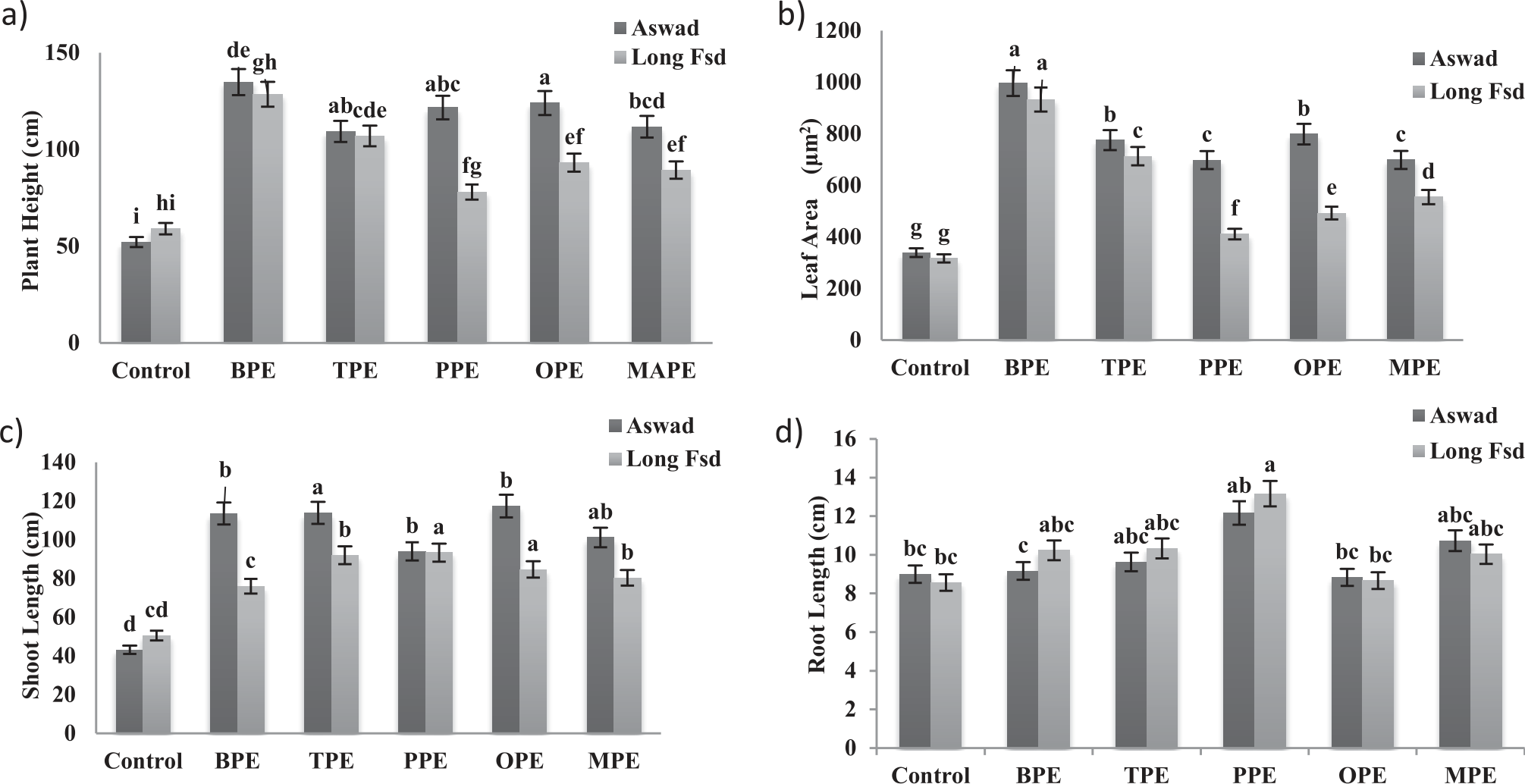
The application of Banana Peel Extract (BPE) showed the highest plant height, 61.31% in Aswad and 54.94% in Long-Fsd, as compared to other treatments (Fig. 1a). The Orange Peel Extract (OPE) application significantly increased the shoot length by 63.23% in Aswad and 45.89% by Pomegranate Peel Extract (PPE) application in Long-Fsd as compared to other treatments (Fig. 1c). The PPE application enhanced the root length by 26.02% and 34.97% in Aswad and Long-Fsd, respectively (Figure 1d). The Banana Peel Extract (BPE) application showed the highest shoot fresh weight by 80.67% and 68.4% in Aswad and Long-Fsd, respectively, compared to other treatments (Fig. 2a).
The application of Tomato Peel Extract (TPE) showed maximum shoot dry weight in Aswad at 85.71% and the Mixture of All Peel Extract (MAPE) at 72.92% in Long-Fsd (Fig. 2b). The Banana Peel Extract (BPE) application significantly increased the leaf area by 65.98% in Aswad and by 66.04% in Long-Fsd (Fig. 1b). The Banana Peel Extract (BPE) and Orange Peel Extract (OPE) applications significantly enhanced the root fresh weight by 23.33% as compared to Tomato Peel Extract (TPE) and Pomegranate Peel Extract (PPE), which decreased the root fresh weight, while the application of Mixture of All Peel Extract (MAPE) increased by 33.33% (Fig. 2c). The OPE application enhanced root dry weight by 39.39% in Aswad and 32.5% in Long Fsd, but the MAPE application decreased root dry weight in both varieties (Fig. 2d).
Stem Anatomical Characters
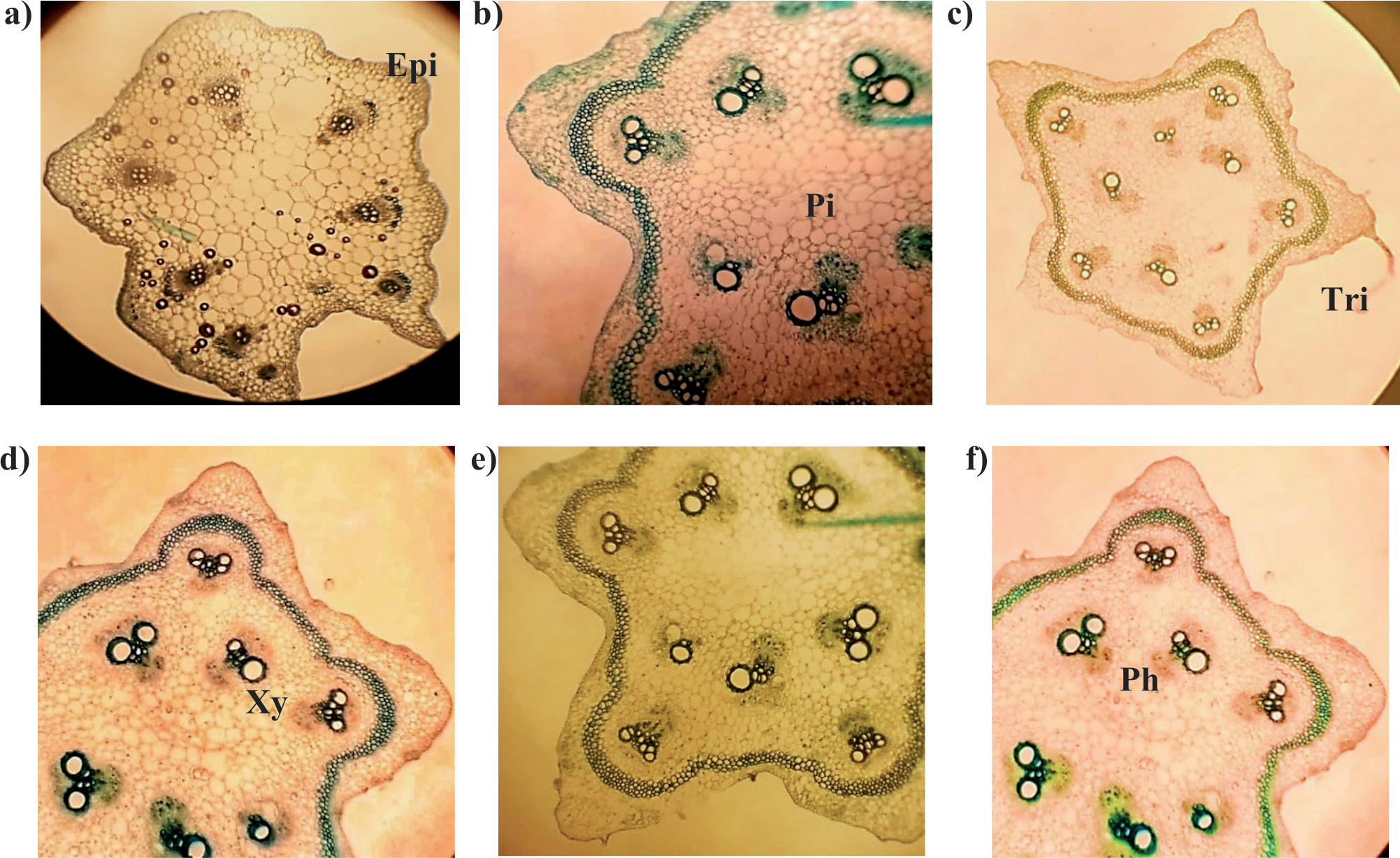
The application of Tomato Peel Extract (TPE), Pomegranate Peel Extract (PPE), Orange Peel Extract (OPE), and Mixture of All Peel Extract (MAPE) significantly increased the stem radius by 12.57%, 17.61%, 5.95%, and 5.13% in Aswad as compared to control plants. The application of Banana Peel Extract (BPE) showed significantly enhanced epidermal thickness of 36.37% in Aswad and Tomato Peel Extract (TPE) in Long-Fsd by 94.52% as compared to other treatments. In Aswad, application of Banana Peel Extract (BPE) and Orange Peel Extract (OPE) significantly improved the epidermal cell area by 84.44% and 88.51% and the pith cell area by 99.71% and 99.17%, respectively. On the other hand, in Long-Fsd, the application of BPE, TPE, PPE, OPE, and MAPE significantly improved the epidermal and pith cell area by up to 99.5% (Table 2).
The Orange Peel Extract (OPE) application significantly enhanced the xylem cell area by 99.61% and phloem cell area by 95.27% in Aswad. The application of TPE, PPE, and OPE enhanced the xylem cell area by 99.81%, 99.57%, and 99.48%, while the phloem cell area increased by 99.92%, 99.62%, and 99.4%, respectively, in Long-Fsd. The BPE and OPE applications significantly improved cortical cell area by 99.78% and 99.89% in Aswad, whereas TPE improved it by 99.51% in Long-Fsd (Table 2).
Root Anatomical Characters
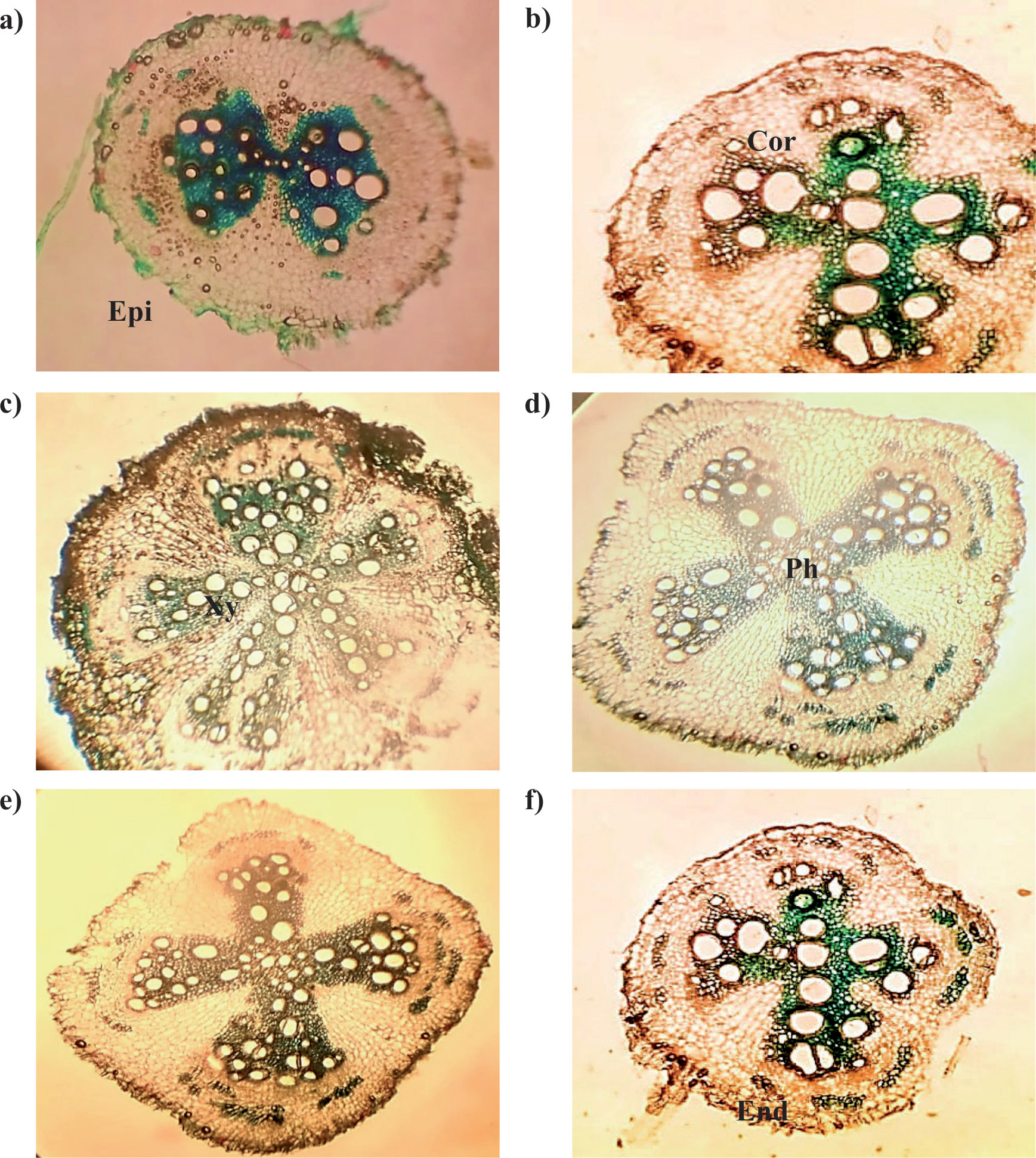
The application of Banana Peel Extract (BPE), Pomegranate Peel Extract (PPE), and Orange Peel Extract (OPE) significantly increased the root radius by 17.22%, 16.33%, and 6.30%, respectively, in Aswad, whereas the application of Mixture of All Peel Extract (MAPE) enhanced the root radius by 21.87% in Long-Fsd (Fig 3). The Tomato Peel Extract (TPE) and MAPE application significantly enhanced the epidermal thickness by 9.71% and 12.29% in Aswad, while BPE, TPE, and MAPE application increased by 28.61%, 4.63%, and 20.74% in Long-Fsd. The OPE and MAPE applications significantly improved the epidermal cell area by 31.68% and 38.83% in Aswad, while all treatments decreased the epidermal cell area in Long-Fsd. The BPE and MAPE applications significantly improved cortical thickness by 14.37% and 10.23% in Aswad, while the MAPE application improved by 23.22% in Long-Fsd as compared to other treatments (Table 3).
The application of Banana Peel Extract (BPE), Tomato Peel Extract (TPE), Pomegranate Peel Extract (PPE), and Orange Peel Extract (OPE) significantly enhanced cortical cell area by 76.65%, 60.16%, 73.65%, and 11.42% in Aswad, whereas PPE, OPE, and MAPE application increased by 60.16%, 57.97%, and 24.52%, respectively, in Long-Fsd. The MAPE application significantly increased the phloem cell area by 46.16% in Aswad, while other treatments decreased the phloem cell area. On the other hand, all treatments improved the phloem cell area in Long-Fsd beings, with the highest being 95.62% by MAPE application (Table 3).
Fig. 2.
Effect of different peel extracts on a) shoot fresh weight, b) shoot dry weight, c) root fresh weight, and d) root dry weight of two bitter gourd varieties. Vertical bars with different lowercase letters above are significantly different at P<0.05 by LSD Tests.
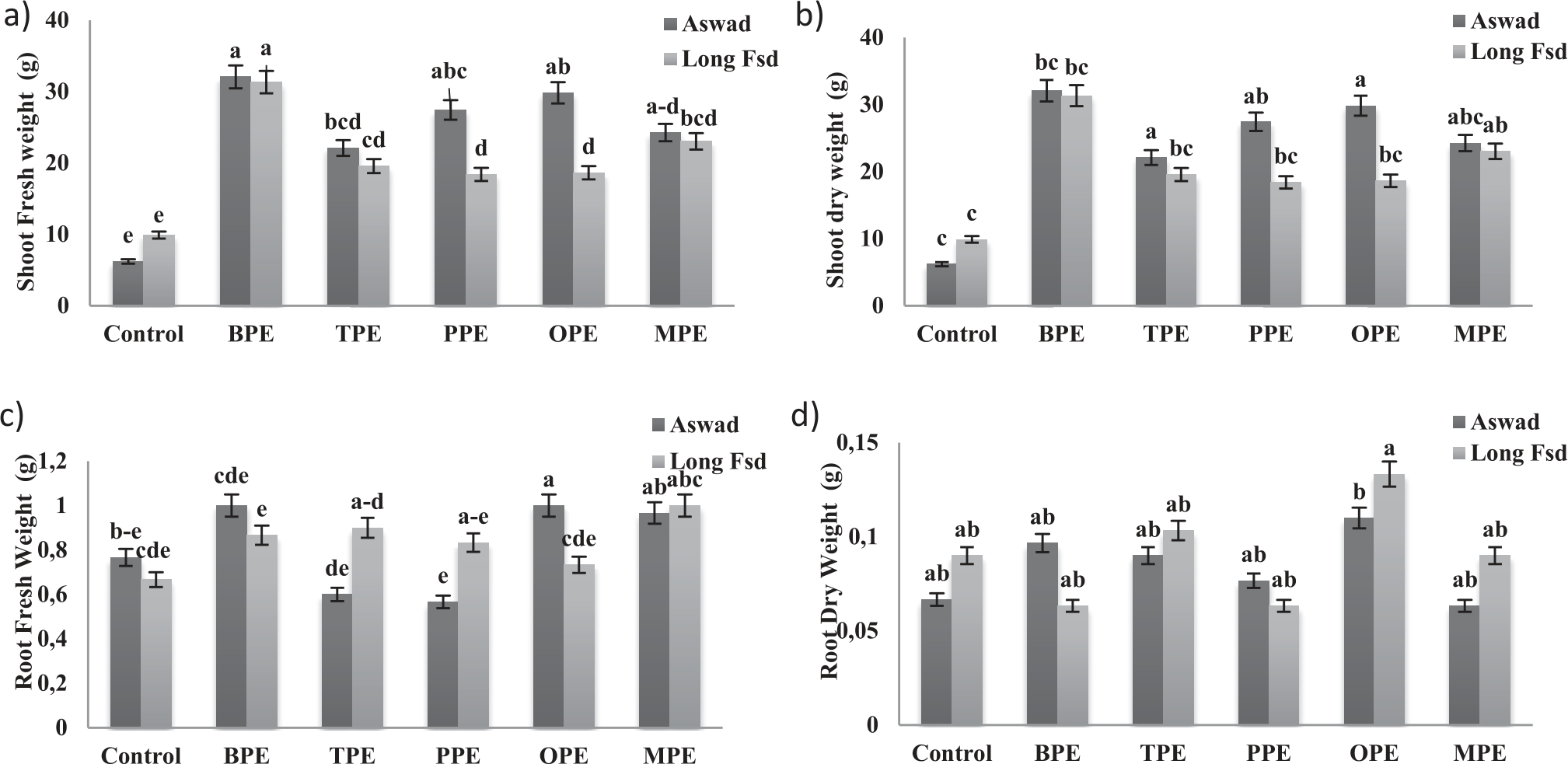
Table 2.
Effect of different fruit peel extract on stem anatomical parameters of Bitter Gourd varieties.
[i] Values represent means ± standard error of three replicates. Means followed by different superscript letters are significantly different (P<0.05) according to LSD test at 5% level. BPE: Banana Peel Extract, TPE: Tomato Peel Extract, PPE: Pomegranate Peel Extract, OPE: Orange Peel Extract, MAPE: Mixture of All Peel Extract.
Table 3.
Effect of different fruit peel extract on root anatomical parameters of Bitter Gourd varieties.
[i] Values represent means ± standard error of three replicates. Means followed by different superscript letters are significantly different (P<0.05) according to LSD test at 5% level. BPE: Banana Peel Extract, TPE: Tomato Peel Extract, PPE: Pomegranate Peel Extract, OPE: Orange Peel Extract, MAPE: Mixture of All Peel Extract
Fig. 3.
T. S of Bitter Gourd Root (Aswad) under Different Fruit Peels a) Control b) Banana Peel Extract, c) Tomato Peel Extract, d) Pomegranate Peel Extract, e) Orange Peel Extract, f) Mixture of All Peel Extract Epi: Epidermis, Cor: Cortex, Ph: Phloem, Xy: Xylem.
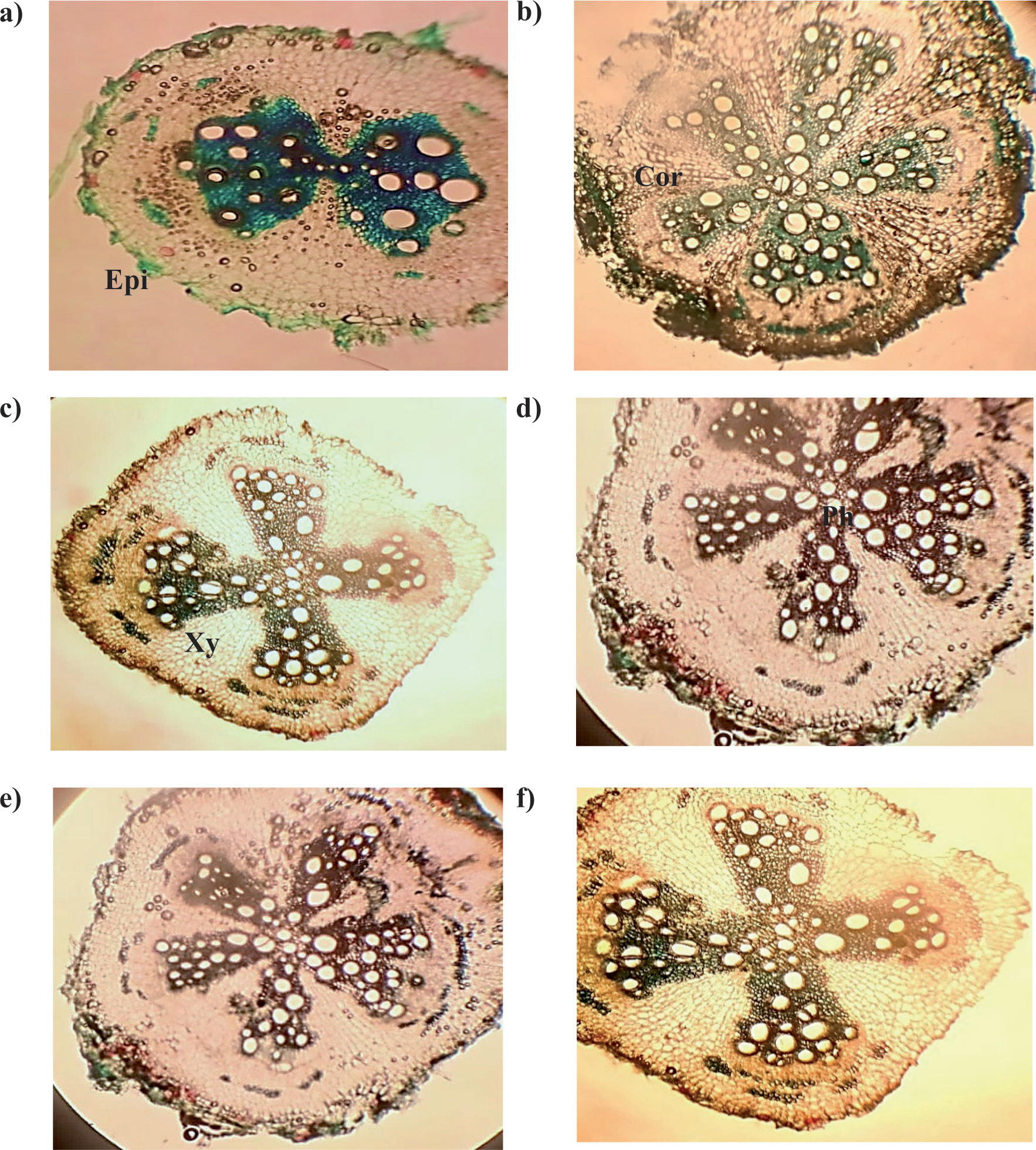
The Mixture of All Peel Extract (MAPE) application significantly showed the highest endodermal cell area by 93.72% in Aswad, while the application of all treatments decreased the endodermal cell area in Long-Fsd. The MAPE application in Aswad and OPE application in Long-Fsd decreased the xylem cell area, while TPE application showed the highest xylem area by 23.39% and BPE by 74.41% in Long-Fsd (Table 3).
Discussion
Fruit scraps are utilized as fertilizers to enhance soil fertility and enrich soil microbiota for plant growth [27]. These are rich in natural phenolic and flavonoid compounds, antioxidants, and nutritional components [28]. Previous studies showed that the pomegranate peel application enhanced the growth of fenugreek, okra, and sage plants [29] due to prominent levels of macro and micronutrients [30].
Fig. 4.
T. S of Bitter Gourd Root (Long Fsd) under Different Fruit Peels a) Control b) Banana Peel Extract, c) Tomato Peel Extract, d) Pomegranate Peel Extract, e) Orange Peel Extract, f) Mixture of All Peel Extract.
In our study, the Banana Peel Extract (BPE) application showed the highest plant height in Aswad and Long Fsd (Fig. 1a). Previous studies showed that fruit peel treatment increased the soil nutrient level, leading to the highest plant height in fenugreek plants [31]. Application of banana peel powder showed the highest plant height in holy basil [32], in okra [33], and in moong [34]. In the present study, the Orange Peel Extract (OPE) application in Aswad and the PPE application in Long Fsd showed maximum shoot length (Fig. 1c). Previous studies showed that the application of orange and pomegranate peel powder improved plant growth due to the presence of calcium, zinc, and iron, and regulated the soil pH [35]. Banana peel extract showed the highest shoot length in moong [36], while orange and banana peels significantly enhanced the shoot length of Solanum scabrum [37].
In the present study, the Pomegranate Peel Extract (PPE) application showed the highest root length in Aswad and Long Fsd (Fig. 1d). In previous studies, fruit peel application increased total phenols, flavonoids, and antioxidant activity that significantly improved the root length in Schefera plants [38], while sweet lime peel extract increased the root length in moong [36]. In this study, Orange Peel Extract (OPE) application enhanced root dry weight in Aswad as well as Long Fsd (Fig. 2d). BPE and OPE applications in Aswad and MPE applications in Long Fsd enhanced the root fresh weight (Fig. 2c). In previous studies, suitable fruit peel was shown to act as a chelating agent for soil, which improved root growth [39]. In field experiments, it was confirmed that organic manure showed improved growth in all parameters, e.g., plant total height, root and shoot biomass, leaf number, and leaf area [40].
Fig. 5.
T. S of Bitter Gourd Stem (Aswad) Under Different Fruit Peels a) Control b) Banana Peel Extract, c) Tomato Peel Extract, d) Pomegranate Peel Extract, e) Orange Peel Extract, f) Mixture of All Peel Extract. Epi: Epidermis, Xy: Xylem, Pi: Pith Tri: Trichome, Ph: Phloem
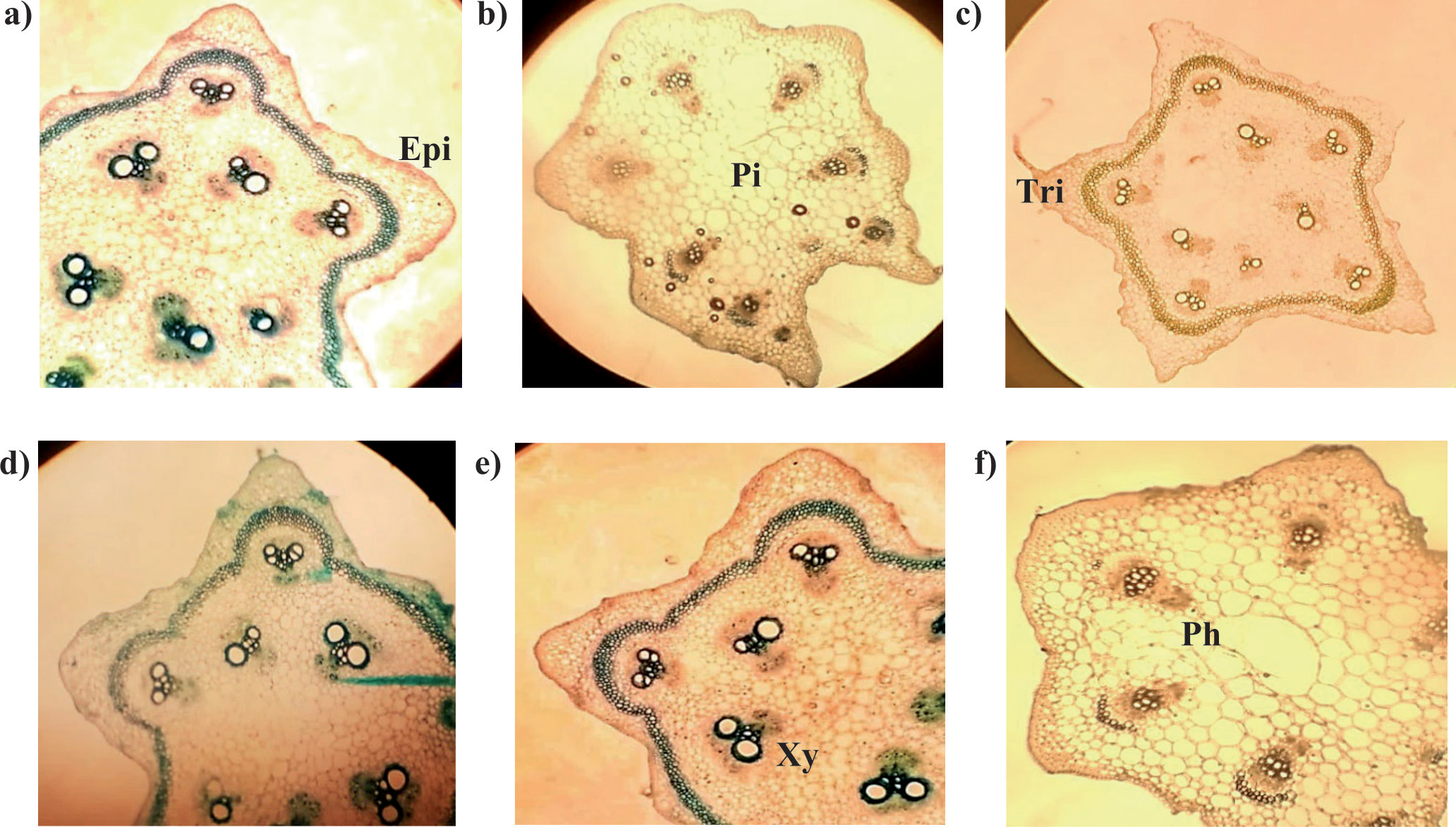
Fig. 6.
T. S of Bitter Gourd Stem (Long Fsd) under Different Fruit Peels a) Control b) Banana Peel Extract, c) Tomato Peel Extract, d) Pomegranate Peel Extract, e) Orange Peel Extract, f) Mixture of All Peel Extract. Epi: Epidermis, Xy: Xylem, Pi: Pith Tri: Trichome, Ph: Phloem
Previous studies showed that orange and banana peel powder applications showed the highest root dry weight in okra due to the presence of growth-promoting factors and nutrients [33]. BPE treatment increased the root fresh and dry weight of quinoa plants [30], C. sesamoides, and J. tenella due to the availability of nitrogen [41]. Different formulations of fruit peels significantly enhanced the anatomical characters of both bitter gourd varieties, Aswad and Long Fsd. Stem anatomical parameters, including epidermal thickness and epidermal cell area, cortical and pith cell area, and metaxylem and phloem cell area, were significantly improved (Table 2). By using fruit peel, biodegradable manure maintains the stem cell division, xylem, and phloem cell area [42, 43]. Root anatomical characters were significantly enhanced in terms of root radius, epidermal thickness, epidermal cell area, cortical thickness and cortical cell area, metaxylem, and phloem cell area (Table 3). Anatomical measurement precisely examines the cell dimensions and provides valuable information about the cellular patterns [44].
The work related to the fruit peel application induced modifications in the bitter gourd anatomy that remained less focused, and no specific information was found. In this study, BPE application showed the highest root radius, root cortical thickness, and cortical cell area in Aswad, while root epidermal thickness and xylem cell area were improved in Long Fsd (Table 3). Tryptophan is found in banana peels and increases the endogenous hormone levels while promoting cell division [45]. Pomegranate Peel Extract application enhanced the stem radius in the Aswad while it was decreased in Long Fsd (Table 2). Previous studies showed that fruit peels enhanced the stem radius of vines by increasing the bioavailability of total nitrogen and phosphorus in the soil [46].
Conclusion
In conclusion, the application of Banana Peel Extract (BPE) improved the growth in terms of plant height and root and shoot fresh weight in both varieties. Application of Orange Peel Extract (OPE) and Tomato Peel Extract (TPE) enhanced the stem epidermal thickness and its cell area, xylem and phloem cell area, and cortical cell area in Aswad and Long Fsd. Banana Peel Extract (BPE) and Mixture of All Peel Extract (MAPE) applications increased the root radius, epidermal, and cortical thickness in Aswad and Long Fsd. Furthermore, Aswad performs better than Long Fsd. In summary, the application of fruit peel improved the morphological and anatomical features of bitter gourd varieties. So, these fruit peels can be used as inorganic fertilizers, and further research is needed to show their involvement in growth and associated anatomical mechanisms to achieve better results.

