

Introduction
With the increasingly fierce competition in science and technology (S&T), international research collaboration (IRC) has proven to be an effective way to promote innovation, which is often accompanied by the generation of high-quality output (e.g., papers, patents, and others) and coming up with solutions to deal with global challenges. Thus, countries have developed policies for international S&T collaboration. Meanwhile, a large amount of current literature has proven the positive influence of IRC on the quality of output [1–3]. Thus, IRC has become a hot topic in academic research.
In the literature, the research topic of IRC has typically been covered from diverse angles, including the evaluation [1, 4], measures [5], patterns [6, 7], effects [8], collaboration networks [9, 10], and influencing factors [11–13] relat-ing to IRC. However, compared with other related topics, the topic “the factors that influence IRC” has received much more attention from scholars. Because IRC is defined as the behaviors involved in launching a project or an article completed by authors from two or more countries [14, 15], IRC is inevitably influenced by policy [16], economic [1], cognitive [17, 18], geography [19, 20], and social differ-ences [21]. In this way, scholars have focused on the external environmental factors of the IRC.
According to Katz and Martin [22], collaboration is the communication and exchange of new knowledge among actors, which refers to exchange behavior in the context of social exchange theory [23]. From a sociological viewpoint, this theory points out the factors that actors are willing to embrace to adopt exchange behavior, i.e., rewards, costs, alternative exchange relationships, dependencies, and equilibria. These factors are also intrinsic motivations that drive IRC, which involves collaborative activities beyond national boundaries. For instance, Chen, Zhang, and Fu [1] summarized the motivating factors behind IRC, including accessing scarce or unique resources, seeking complementary capabilities, and sharing the high costs of large-scale equipment or long-term research.
To compare the literature written from the viewpoint of the external environmental factors or the exchange factors that influence IRC, a systematic study is needed to examine the issue from an integrated perspective, for the reason that external environmental factors may influence IRC through the mediation of exchange factors. For example, international S&T decoupling refers to the current trend toward the dismantling of international S&T relationships. The S&T decoupling policy of the U.S. with regard to China has reduced the exchange of S&T equipment and led to the termination of collaboration.
To address this gap in the research, we focus on China’s State Key Laboratories (SKLs), which are an essential part of the Chinese national innovation system to promote com-petitive advantage in the fields of basic research and applied basic research. The ratio of publications accomplished by SKLs and overseas institutions was going to reach 27% in 2020, indicating that IRC is indispensable to SKLs’ production of scientific outputs. Based on the external environment oriented toward resource dependence theory and social exchange theory, we designed and implemented a questionnaire to investigate the factors that influenced the IRC of SKLs. Unlike prior studies’ findings, which indicated that a single factor influenced the IRC of SKLs, our study finds that, in examining the IRC of SKLs, several factors appear to combine to create a force that reflects the paths and mechanisms underlying them.
Material and Methods
Theoretical Basis
According to resource dependence theory, external environmental factors play critical roles in determining the functioning of actors [24]. Due to the policy orientation characteristics of the IRC, the behavior is indispensably impacted by countries’ international collaboration development strategies in determining an open attitude toward S&T innovation. According to public economics theory, scientific research is a typical public good with significant positive externalities. Openness can promote the visibility of scientific research on a large scale [22]. Therefore, an open attitude toward S&T innovation positively corre-lates with participation in the IRC [13]. Another reflection of the policy orientation relates to geopolitics [25, 26]. Thus, domestic and international policy orientation cannot be ignored when examining the factors that influence IRC. For SKLs, Chinese S&T management departments have im-posed regulations to encourage the IRC. For instance, SKLs were encouraged to participate in major international S&T collaboration programs in the document “Several opinions on strengthening the construction and development of State key laboratories” in 2018. Besides domestic policy, SKLs’ IRC is completed by SKLs and overseas institutions; thus, it is inevitably influenced by international policy.
Further, COVID-19 spread globally in 2020, profoundly impacting the IRC. First, countries faced a danger to public health across national borders, which facilitated the work-ing together of medical institutions and scientists. The main reasons for strengthening IRC were summarized, which were to improve the ability to withstand risks, determine the spreading trend of the pandemic, and share knowledge and experiences [27]. In this vein, COVID-19 accelerated IRC in the field of medicine. Second, the projects of the international graduate scheme, grants, and conferences were forced to be canceled. To a certain extent, COVID-19 inhibited international collaboration activities. For SKLs, the epidemic has impacted their IRC’s environment, which refers to closed collaboration channels and a reduction in the number of collaborators.
Aside from external environmental factors, factors related to interaction should also be considered when SKLs collaborate internationally. Social exchange theory refers to the exchange behavior among actors in social interaction [28]. According to Molm [29], the critical assumptions that influence exchange behavior include the following principles: First, behavior is driven by the motivation to increase outputs or decrease losses, which is summarized as the effects. Second, behavior is established based on the mutual obtaining of valuable resources, which is called “reciprocity.” Third, exchange behavior continues for a period of time, which is called “ties.” Fourth, the outputs obey the economic law of diminishing marginal utility.
According to Sonnenwald [30], “scientific collaboration” is defined as “interactions taking place within a social context among two or more scientists that facilitate the sharing of meaning and completion of tasks with respect to a mutually shared, super-ordinated goal,” which is one exchange behavior in social interaction. Thus, collaboration behavior corresponds to the assumptions in social exchange theory. In the process of SKLs’ IRC, it is inevitable for SKLs and overseas institutions to exchange information, related to these factors. Collaboration effects are demonstrated by publications in famous journals, patents with highly cited times, and solutions to deal with global challenges [1]. Collaboration reciprocity is demonstrated by the sharing of information, technology, and equipment by the collaborators to reach the goal of S&T breakthroughs, which help to make up for the shortfall in S&T research. Collaboration ties are displayed by the strength of linkages among collaborators, which are also closely related to IRC [31]. The diminishing marginal utility of collaboration means that the benefit decreases as the scale increases. In the course of the survey conducted for this study, we found it difficult to reflect on the marginal utility of collaboration; therefore, only the first three assumptions were addressed.
Hypotheses
In social exchange theory, the collaboration effect is a reflection of the results of collaboration. In the previous literature, researchers showed the positive effects of IRC on output and performance [32]. For instance, research quality was improved by collaborating [3], which was more likely to attract the attention and citations of peers [33]. Other scholars have argued that co-authored outputs accomplished by domestic and overseas partners improve visibility in the dissemination of literature, thereby improving the prestige of the science community [34].
In the context of global S&T development, international “big-science” programs and projects are emerging. The term “big-science” refers to “large-scale research projects jointly invested by several countries that are oper-ated for a long period to provide supportive conditions for S&T development on a global scale.” Characterized by the high costs of inputs, complexity, risk, and public nature of outputs, implementing international big-science programs and projects requires using global S&T resources to improve the chances of success. Furthermore, in several global challenges (e.g., climate warming, public health, food security, the energy crisis, and others), the IRC has played a critical role in improving the ability to resist risks. In the process of IRC, the collaborators can not only access unique data, information, and research from other countries but also search for defective equipment and software [35]. As observed by Beaver and Rosen [36], strengthening the impact and providing professional guidance are factors that drive IRC. For SKLs, which aim to explore cutting-edge discoveries, IRC’s high-quality and creative outputs will promote such behavior. Therefore, we hypothesized the following:
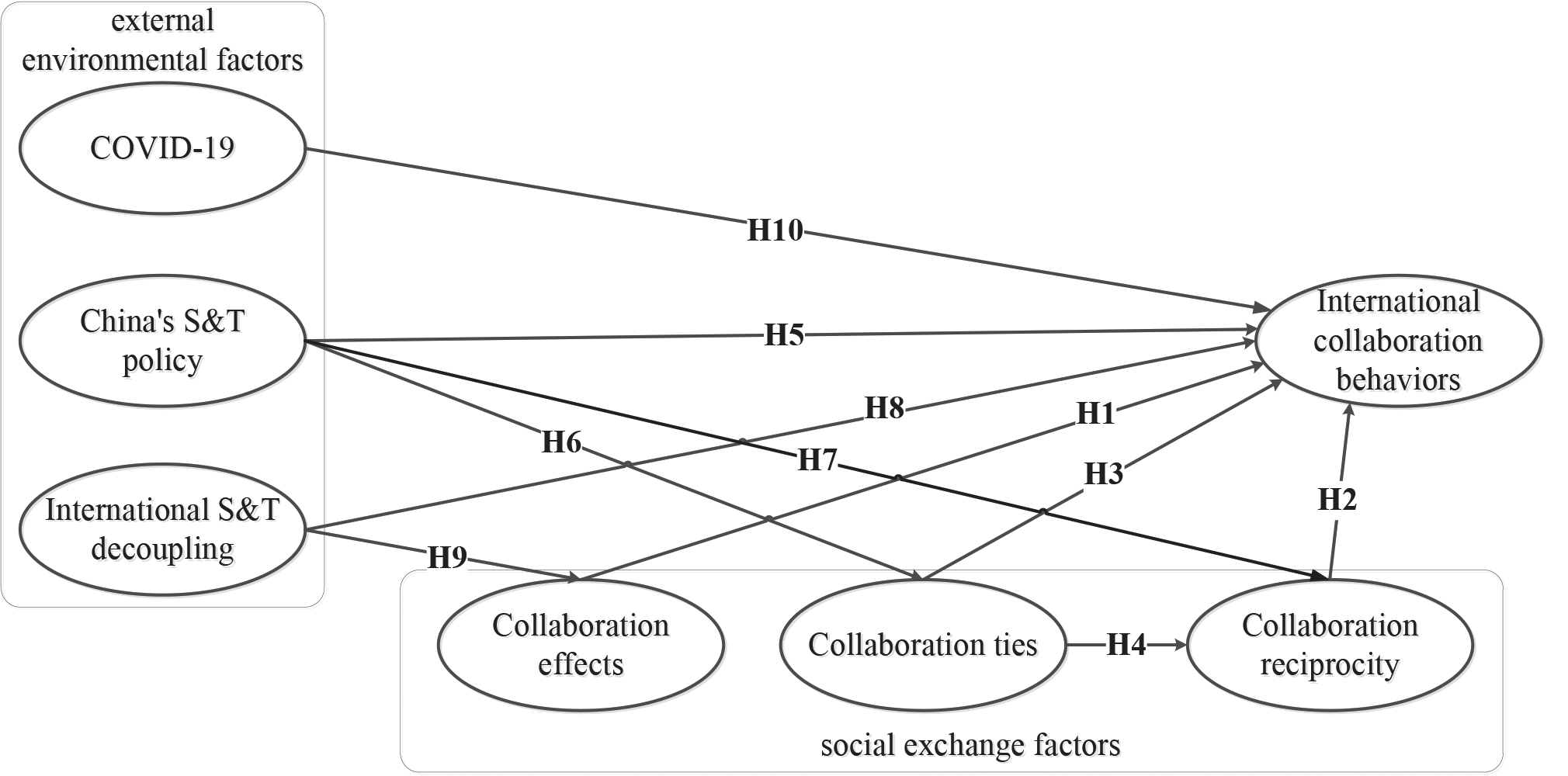
Hypothesis 1 (H1): Collaboration effects positively impact the IRC of SKLs.
In the context of social exchange theory, reciprocity reveals the relationships among actors [37]. According to the definition by Ben-Ari and Enosh [38], reciprocity is “a process whereby each research party believes that he or she contributes not necessarily to the other parties, but to a matter of common interest, an issue of concern, a social phenomenon, or a personal matter.” In the process, information, knowledge, and other valued materials are exchanged, which are mutually influenced by the actors to improve outputs [39]. The norm of reciprocity guar-antees a smooth social exchange, which usually refers to a series of rules regarding the transaction wherein an actor contributing resources to another is obligated to provide feedback [40]. However, under the rational economic man’s assumption, each actor has his or her particular interests and goals in mind when searching for collaborators to build relationships, which may conflict with the common goals. Under the constraints of the norm of reciprocity, if one actor makes an effort toward achieving total utility, the other will offer a response. If another actor neglects these efforts, which amounts to opportunistic and free-riding behavior that destroys reciprocity, the active actor will choose new collaborators, thereby terminating the interaction. Thus, reciprocity serves as a factor that drives collaboration [41].
In terms of social exchange theory, collaboration ties reveal the features of the linkages among actors. Collaboration ties are related to trust, intimacy, contact, and re-sponsibility within interaction behavior among collaborators [42], which are built on past interactions to develop future relationships [43]. By building trust and intimacy, an atmosphere of sharing is created wherein the actors are willing to interact [44], thereby maintaining exchange behavior [45]. In particular, the study by Liu et al. [46] demonstrated that strong ties are indispensable to reinforcing interactive relationships. Chen and Hung [41] concluded that trust is a predictor of building long-term collaborative relationships.
Collaboration ties also impact actors’ intentions to give and get information [47]. Trust provides assurance to actors that their thoughts and opinions will be sufficiently understood and absorbed. Meanwhile, trust encourages actors to make joint efforts toward common goals by sharing knowledge [48]. It also reduces the chance of opportunistic and free-riding behavior. Hence, collaboration ties boost the reciprocity of actors in collaboration.
In sharing and exchanging in SKLs’ IRC, reciprocity represents an agreement to achieve goals through domestic and foreign efforts. The essence is possessing the required knowledge by relying on linkage to each other. The tie is representative of the degree to which SKLs and overseas institutions trust each other across the border. A high level of trust shows the extent of the voluntary exchange of S&T information, which is closely related to collaboration behavior. Meanwhile, trust is also associated with reciprocal collaboration, influencing SKLs’ IRC. Thus, we hypothesized the following:
Hypothesis 2 (H2): Collaboration reciprocity positively impacts the IRC of SKLs.
Hypothesis 3 (H3): Collaboration ties positively impact the IRC of SKLs.
Hypothesis 4 (H4): Collaboration ties positively impact collaboration reciprocity.
In addition to social exchange factors, external environmental factors also play critical roles. Most importantly, IRC inevitably depends on national and regional political interests [49]. For example, BRICS countries have established a collaboration framework to reinforce S&T capabilities [50]. In developing the IRC of SKLs, China‘s policy continues to enrich it, which contains multiple components to facilitate collaboration. At the early stage, Chinese S&T management departments advocated the opening of foreign research institutions and funded overseas exchanges for researchers. In the in-depth development stage, international collaboration became one of the crucial indicators for evaluating the op-eration of SKLs. To support the needs of national strategic development, S&T management departments encouraged SKLs to participate in or initiate major international S&T programs. Thus, the IRC of SKLs cannot be separated from the active guidance of China’s S&T policy.
Facing global challenges such as food, energy, safety, and others, the common interests of countries compel them to enhance communication to deal with these issues [25]. By signing collaboration agreements, ties are built that are associated with SKL’s IRC, such as under the intergov-ernmental collaboration project on international science, technology, and innovation, the State Key Laboratory of Information Engineering in Surveying, Mapping and Remote Sensing (State Key Lab Informat Engn Surveying Mapping & R), the United Nations Institute for Training and Research (UNITAR), and the Hebrew University of Jerusalem, which collaborate to deal with sustainable development goals. Thus, IRC policy boosts collaboration ties connect-ing SKLs with overseas institutions.
In such a situation, based on national interests and policy orientations, reciprocal collaboration between SKLs and overseas institutions becomes one of the most critical ways to address global threats through the sharing of available information and knowledge. Under the terms of an agreement framework, SKLs and overseas institutions share their current research results with partners to obtain the collaborators’ scientific research. Actors displaying opportunistic and self-interested behavior inevitably lose credibility, leading to a significant decrease in international collaboration with others. Thus, such a policy would have the effect of boosting collaboration and reciprocity. In this vein, we hypothesized as follows:
Hypothesis 5 (H5): China’s S&T policy positively impacts the IRC of SKLs.
Hypothesis 6 (H6): China’s S&T policy positively impacts collaboration ties.
Hypothesis 7 (H7): China’s S&T policy positively impacts collaboration reciprocity.
According to the externality theory in public economics, S&T research is a typical public good with positive externalities. The IRC relies on the open and stale environment of international politics [22]. In particular, international S&T decoupling significantly impacts countries by causing them to reformulate their collaboration activities. On the one hand, S&T decoupling among countries undermines the process of globalization, forcing the termination of some existing international collaboration projects, which is a direct deterrent to the IRC. On the other hand, under the influence of the national will, the willingness of actors to collaborate is significantly reduced [50]. The partici-pants’ reluctance to continue exporting their unique S&T resources against the national will leads to a significant reduction in the effectiveness of collaboration, which further affects IRC.
The current trend toward the dismantling of international S&T relationships is not conducive to developing S&T in China. In particular, the withdrawal of the U.S. from collaboration with Chinese S&T research activities has harmed China’s overall innovation environment in the form of restrictions on talent exchange, equipment purchases, and high-tech products. For SKLs, S&T decoupling has reduced exchanges and interactions between China and the U.S. Meanwhile, under the national policies and strategies, foreign scientists’ willingness to collaborate is diminished, leading to a decrease in the collaboration effects of SKLs’ IRC. Thus, we hypothesized as follows:
Hypothesis 8 (H8): International S&T decoupling with China negatively impacts the IRC of SKLs.
Hypothesis 9 (H9): International S&T decoupling with China negatively impacts collaboration effects.
As COVID-19 threatens human health worldwide, collaboration among medical institutions has increased across national borders, while medical practitioners continue to strengthen joint efforts to combat the crisis posed by this disease. However, given border closures, lockdown measures, and air travel curtailment, we also need to be fully aware that the infectious nature of COVID-19 has dramati-cally reduced the frequency of face-to-face communication, which serves a vital information transfer function in SKLs’ IRC [1]. Such restrictions have caused the termination of some international collaborative projects, the suspen-sion of international conferences, and the interruption of talent exchange activities, thus inhibiting SKLs’ IRC in areas outside of the medical field. Bearing in mind that the laboratories investigated in this study did not include SKLs in the medical field, we hypothesized the following:
Hypothesis 10 (H10): COVID-19 negatively impacts the IRC of SKLs.
The framework and structural model of this study are shown in Fig. 1.
Data Collection
To complete this study, we designed a questionnaire that was implemented to investigate China’s State Key Laboratories. According to the dictionary of the annual report of SKLs, 256 SKLs were divided into the categories of material, earth, chemical, biology, information, medical, engineering, mathematics, and physics science, which were used as the sampling pool. Eight SKLs were randomly cho-sen as the research subjects for this study. Scientists work-ing on the eight SKLs became the targets of questionnaire distribution. A total of 626 questionnaires were sent via email. After collection and coding, the number of validated questionnaires was 253, which meant the effective response rate was 40.42%. The distribution of questionnaires among the eight SKLs is shown in Table 1.
Questionnaire Design
The questionnaire aimed to measure the factors that influence the IRC of China’s SKLs and reveal the mechanisms that operate behind them. When designing the measurement indicators, we reviewed relevant literature based on an external environment oriented toward resource dependence theory and social exchange theory. The questionnaire in-cluded three parts: Part 1 was designed to indicate the field that each SKL belonged to, Part 2 concerned the indicators relative to the external environmental factors and social exchange factors of IRC, and Part 3 focused on the IRC of the SKLs. Before the formal survey, the authors shared the questionnaire with experts in long-term S&T policy to improve its reliability and validity. After the expert review and modification, the questionnaire’s measurement indicators were finalized. Finally, 29 questions were developed. A 5-point Likert scale was adopted to measure the indicators: 1 = strongly disagree, 2 = disagree, 3 = neutral, 4 = agree, and 5 = strongly agree. A reverse scoring method was used to measure the indicators relative to international S&T decoupling and COVID-19.
Table 1.
The distribution of questionnaires.
Cronbach’s alpha was used to assess the reliability of the questionnaire. According to Nubally and Bernstein [51], Cronbach’s alpha is 0.7 or greater, which is acceptable. The value of the questionnaire is 0.940, suggesting that its reliability is satisfactory. The Kaiser-Meyer-Olkin (KMO) test was employed to measure the structure validation of the questionnaire. Based on Bendat and Piersol [52], if the KMO is 0.5 or greater, it suggests that the structure validation is considerable. In this study, the KMO value is 0.941, which suggests that the structure validation of the questionnaire is acceptable. These tests were accomplished using SPSS 23.0 software.
Method
This study employed the structural equation model (SEM) to analyze the influence of external environmental and social exchange factors on the IRC of China’s SKLs. SEM contains two sections: Factor analysis aims to extract the common content to form latent variables, which are not observed directly, whereas route analysis is used to explore the relationships among the latent variables. Three steps were implemented: first, exploratory factor analysis (EFA) was used to extract the common factors, which was completed using SPSS 23.0 software. Using the principal components and maximum variance method, we identified seven latent variables: China’s S&T policy, COVID-19, international S&T decoupling, collaboration effects, collaboration reciprocity, collaboration ties, and SKLs’ IRC. One question was removed from the questionnaire due to its crossing factor loading being higher than 0.45 (Question: International research collaboration has promoted the training of high-level scientific and technological talents). Next, common method bias (CMB) was tested using Harman’s single-factor test. The results showed that the single factor to explain variation was no more than 50%; thus, the CMB was acceptable [53]. Second, confirmatory factor analysis (CFA) was used to modify the latent variables and corre-sponding measurement indicators, which was conducted in Amos 23.0 software. One question in the latent variable of China’s S&T policy and four questions in the latent variable of collaboration ties were removed for their high modification index, (Question in the latent variable of China’s S&T policy: China’s S&T policy encourages SKLs to strengthen their connection with overseas institutions by collaborating internationally, and Question in the latent variable of collaboration ties: SKLs carry out long-term international scientific and technological cooperation projects with other overseas institutions; the long-term international partners have increased the influence of SKLs’ output; SKLs tackle major scientific problems with long-term international partners; SKLs have long col-laborated with world-class scientific research institutions and famous universities. Ultimately, 23 questions remained designed to explore the seven latent variables in Table 2. The factor loadings range from 0.664 to 0.944, which are high and acceptable [54]. The construct reliability (CR) is in the range of 0.738 to 0.956, which is satisfactory. The average variance extracted (AVE) is above 0.5, indicating that most variance is explained well [55]. Finally, SEM was run to explore the relationships among the latent variables. The parameter estimation method adopted maximum likelihood. Fit, saturation, and independence models were used to compute fit measures.
Results and Discussion
The results of the SEM are shown in Fig. 2. The model’s fitness is acceptable: χ2/df is 3.352, GFI is 0.826, NFI is 0.854, IFI is 0.893, CFI is 0.854, and RMSEA is 0.097. These results show that the model fit analyzes data well. Standardized regression coefficients are used to analyze whether relationships exist among the variables and to test the hypotheses. The standardized regression coefficients and hypothesis test results are shown in Table 3. The standardized total effects are shown in Table 4.
Collaboration effects and the IRC of SKLs. The standardized coefficient of collaboration effects presented in Table 3 is 0.113 with a significance of 5%, suggesting that the collaboration effects positively impact the IRC of SKLs. This result supports H1.
Collaboration reciprocity and the IRC of SKLs. The standardized coefficient of collaboration reciprocity is 0.357 with a significance of 1%, which means that mutual benefits positively impact the IRC of SKLs. This result supports H2, as shown in Table 3.
Collaboration ties and the IRC of SKLs. There are two routes to analyze the relationship between collaboration ties and the IRC of SKLs. From the viewpoint of direct effects, the standardized coefficient from collaboration ties to IRC is 0.389 with a significance of 0.1% (Table 3), indicating that strengthening international collaboration relationships would boost SKLs’ willingness to collaborate. This result supports H3. From the perspective of indirect effects, the standardized coefficient from collaboration ties to collaboration reciprocity is 0.614 with a significance of 0.1%, demonstrating that a positive influence exists and that H4 is supported. The results of the testing of H2 show a positive relationship between collaboration reciprocity and the IRC of SKLs. By multiplying the coefficients 0.614 and 0.357, the indirect effect is calculated as 0.219. The total effect is then calculated as having a value of 0.608 (Table 4).
China’s S&T policy and the IRC of SKLs. In terms of direct effects, the standardized coefficient of China’s S&T policy is 0.017 with no significance (Table 3). Thus, China’s S&T policy is shown to have no effect on the IRC of SKLs, which indicates that H5 is rejected.
However, the indirect effects shed additional light on this conclusion. First, relative to the relationship between China’s S&T policy and collaboration ties, the standardized coefficient is 0.701 with a significance of 0.1%, which shows that China’s S&T policy is a positive factor in terms of building relationships between SKLs and other international institutions. The results show that H6 is supported. H2 demonstrates a positive relationship between collaboration ties and the IRC of SKLs. Therefore, China’s S&T policy is shown to have an indirect positive influence on the IRC of SKLs. This indirect effect is calculated as 0.273 by multiplying the coefficients 0.701 and 0.389.
Table 2.
Factors and measure design.
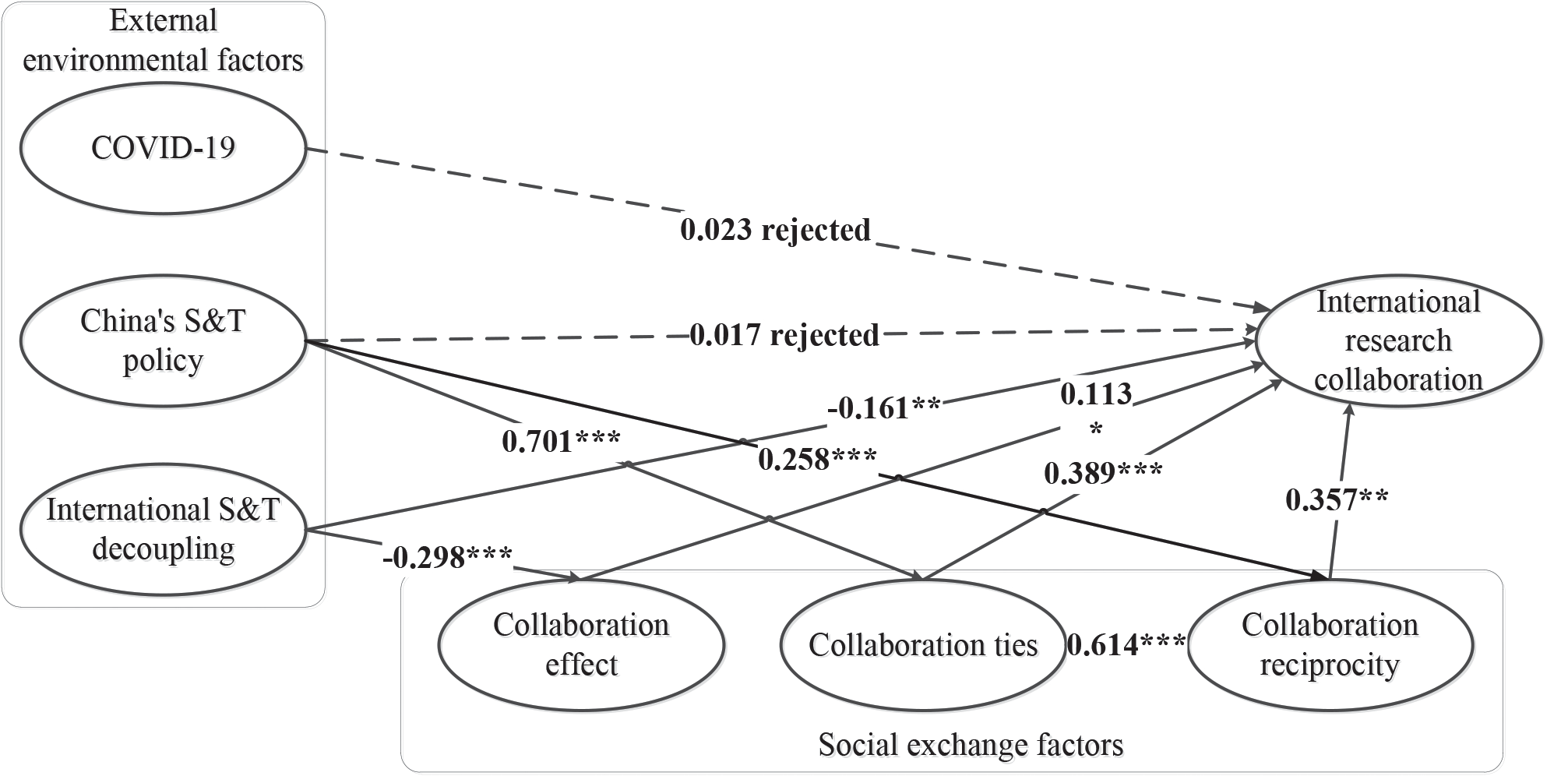
Second, regarding the relationship between China’s S&T policy and collaboration reciprocity, the standardized coefficient is 0.258 with a significance of 0.1%, indicating that China’s current S&T policy is a positive factor in strengthening the mutual benefits for collaborators. The result shows that H7 is supported. Moreover, the test of H3 shows a positive relationship between collaboration reciprocity and the IRC of SKLs. Hence, collaboration reciprocity can also serve as a “bridge” in the relationship between China’s S&T policy and the IRC of SKLs. The indirect effect is calculated as 0.092 by multiplying the coefficients 0.258 and 0.357.
Third, by first influencing collaboration ties and reciprocity, China’s S&T policy impacts the IRC of SKLs. In this context, the indirect effect is measured as 0.154 by multiplying the coefficients 0.701, 0.614, and 0.357. Thus, the total effect is calculated by summing up the three routes of indirect effect as 0.519, as presented in Table 4.
International S&T decoupling and the IRC of SKLs. As a result of calculating the direct effects of the dismantling of international S&T relationships, the standardized coefficient is -0.161 with a significance of 1% (Table 3), which implies that the termination of S&T relationships with the U.S. adversely and directly impacts international collaboration. The result supports H8. Moreover, when evaluating the indirect effects, the standardized coefficient of international S&T decoupling is -0.298 with a significance of 0.1% when it influences collaboration effects, indicating support for H9. When considering H1, the method used to calculate the indirect effect is to multiply the coefficients -0.298 and 0.113, which equals -0.034. Finally, the total effect is calculated as -0.195 (Table 4).
Table 3.
Standardized coefficients and testing of the hypotheses.
Table 4.
Total effects.
COVID-19 and the IRC of SKLs. As shown in Table 3, when considering COVID-19’s influence on IRC, the standardized coefficient is 0.023 but without significance, which indicates that the IRC of SKLs is unrelated to the effects of COVID-19. The result rejects H10. The reason lies in the fact that, as a result of pandemic prevention and control policies, SKLs have to reduce face-to-face communication. However, the alternative communication methods (e.g., the internet, email, and others) provided the necessary conditions for researchers to establish collaborative links, which ensures the gradual advancement and smooth im-plementation of international collaboration [63].
Conclusions
This study proposes a framework of influencing factors to analyze the IRC of China’s State Key Laboratories using the structural equation model. We investigated eight laboratories and collected 253 questionnaires for this purpose. By studying how external environmental and social exchange factors affected the IRC of SKLs, we discovered the following results: Both external environmental factors (China’s S&T policy and international S&T decoupling) and social exchange factors (collaboration effects, collaboration reciprocity, and collaboration ties) have a profound impact on the IRC of SKLs. Except for international S&T decoupling, which has a negative effect, all of China’s S&T policies, collaboration effects, collaboration reciprocity, and collaboration ties positively affect the IRC of SKLs. Furthermore, external environmental factors are also shown to have an impact on behavior through their linkages with social exchange factors. Via collaboration effects, international S&T decoupling exerts a negative effect. Via collaboration ties and reciprocity, China’s S&T policy positively influences the IRC of SKLs.
Theoretical Implications
First, this study introduces China’s S&T policy, international S&T decoupling, and COVID-19 as external environmental factors that could potentially have an effect on the IRC. We tested the positive relationship between China’s S&T policy and the IRC of SKLs, thereby demonstrating that the national supportive S&T policies of China would boost the IRC, which is in accordance with the conclusion of Chen, Zhang, and Fu [1], El-Ouahi, Robinson-Garcia, and Costas [11], and Rousseau [49]. We also find that the current international S&T decoupling initiated by the U.S. has had a negative effect on the IRC of SKLs, which showed that an unfavorable international environment undermines the atmosphere for IRC a conclusion supported by Katz and Martin [22], and Vieir, Cerdeira, and Teixeira [64]. However, the result that indicates no significant correlation between COVID-19 and the IRC of SKLs demonstrates that alternative communication methods can transmit S&T-related information efficiently, which contradicts Davids and Frenken [65] but confirms Gui, Liu, and Du [12], and Schreiber and Jansz [66].
Second, this study shows that the exchange factors of collaboration effects, collaboration ties, and collaboration reciprocity should not be neglected when considering the driving factors of the IRC of SKLs. We tested the positive relationship between collaboration effects and the IRC of SKLs in line with the existing literature, e.g., Chang and Huang [67]. Moreover, we also introduce collaboration ties and collaboration reciprocity, which the previous research did not consider. The result shows that the ties built among international collaborators boost long-term interactions to encourage the IRC of SKLs. By avoiding opportunistic and free-riding behavior, reciprocity among international collaborators can not only lead to the sharing of unique S&T resources to facilitate the IRC of SKLs but also create a favorable atmosphere for collaboration to strengthen collaboration ties and the IRC of SKLs.
Third, compared to the literature that considered the influence of single factors on IRC, this study also indicates that the interconnection between external environmental factors and social exchange factors should be focused on in an integrated manner. That is, when considering the IRC of SKLs, favorable external environmental factors may not be enough. Instead, social exchange factors should also be considered. For example, in terms of the relationship between China’s S&T policy and the IRC, China’s S&T policy can impact the IRC through the intermediary of collaboration ties, which have the effect of strengthening the influence of China’s S&T policy. Moreover, for exchange factors to function, it is essential to consider the external environment where SKLs are located. By doing so, it is possible to promote the IRC of SKLs. Thus, this study innovatively puts for-ward a systematic theoretical framework to understand the formation of the IRC of SKLs.
Practical Implications
This study also offers practical implications for policy design. It is vital to face up to the influence of these factors when the Chinese government develops policies to encourage SKLs to collaborate internationally. First, the government should build an S&T open strategy system, which can create a favorable collaboration environment and policy guidance to support SKLs in participating in collaboration activities through projects and funding. In this way, collaboration ties and reciprocity between SKLs and overseas institutions can be established to promote IRC. Second, in the face of the current severe international decoupling, which damages both collaboration effects and the IRC, the Chinese government should actively negotiate to open up new paths of international collaboration by signing agreements and making frameworks. Lastly, SKLs should strengthen their effect, reciprocity, and ties with international partners. It is helpful to establish long and stable strategic relationships, which can facilitate policy imple-mentation and create an international environment that produces more satisfying results.
Limitations
This study makes contributions to demonstrate the influence of external environmental factors and social exchange factors on the IRC, which will be helpful in exploring the mechanisms that influence the IRC of China’s State Key Laboratories. The results provide a suitable reference for policies to strengthen the international collaboration of SKLs. However, our study has several limitations that need to be dealt with in future studies. First, due to data collection limitations, we collected questionnaires from a limited number of SKLs. Thus, the final sample did not represent the entirety of China’s SKLs, which should be considered in future research. Second, because SKLs are categorized into eight different fields, classification studies can be introduced into future research to explore the mechanisms that influence different fields. Because it targeted SKLs in the biological, material, engineering, and chemical science fields, the influence of COVID-19 was not observed in this study. It may, however, be observed in SKLs in the medical field.

