

Introduction
Since 2020, the world has been both economically and socially affected by multiple types of crises. The crisis of the third decade of this century has been characterized by multiple events that have had a negative effect on a global scale.
The first event was the emergence of the Covid-19 pandemic. This pandemic has negatively affected economies around the world. Lockdowns, global shortages on consumer goods, and closures of businesses lead to worldwide economic stagnation. Petroleum prices reached record-breaking minimums in April 2020 and further put pressure on the economies of petroleum exporting countries.
The second event happened in 2021, after the Davos economic forum topic “Global Reset 2021”. Due to the negative effects of the pandemic on the global economy, countries and international organizations began to introduce more money into markets in order to combat economic stagnation and thus revive economic activities. This procedure, however, led to a surge in global inflation. Countries with vulnerable economies suffered again due to high inflation rates.
The last event happened on the 24th February, 2022, when Russia invaded Ukraine and “ignited” a global geopolitical crisis. Invasion and its economic consequences mainly hit food, petroleum, and fertilized sectors, and there was a global price increase on these products. Implementation of sanctions against Russia, the leaving of global businesses from Russian markets, and continuous economic and military support from western allies to Ukraine maintain stress for not only the national economies of these countries, but also the global economy too.
Global geopolitical and socio-economic turmoil has raised interest in terms like sustainable development and green economy. Due to this, many economists and institutions are confident that after the end of the current crisis, the world will need a new economic model to recover, and green economy is the option that is preferable. Green economy and sustainable development are considered the most favorable ways to combat both relatively older problems like climate change, pollution, and overpopulation, as well as newer ones like those listed above. Issues like these continue to threaten the Earth. Because a green economy is synonymous with renewable energy and carbon-free economic activities. The term sustainable development is intrinsically equal to green economy.
Green economy in Azerbaijan is a new topic of discussion. As a petroleum based economy, the Azerbaijani economy suffered during the global oil price decrease in 2014. Continuously low petroleum prices hit the main income of the country, and due to this, there was a devaluation of the national currency, which happened twice in 2015. The impact of these events led the government to prepare roadmaps for the diversification of the national economy. The terms of the transfer of the Azerbaijani economy to a “green” one are first mentioned in this roadmap [1].
However, the main step for green economic transfer in the Azerbaijani economy happened in 2021, when the President of Azerbaijan, Ilham Aliyev, declared the Eastern Zangezur and Karabakh economic regions of Azerbaijan as “green energy zones”. [2] These two economic regions were under military occupation by the Armenian Armed Forces for about 30 years, and the continued military situation led to the destruction of the area and pollution in the environment. After the liberation of these areas in 2020, the Azerbaijani government started to rebuild them by implementing the “green way”, as mentioned in the decree of the President. Various renewable energy plants and “Smart villages” were built in these areas and future activities will be implemented [3].
As the green economic introduction became fruitful, the President of Azerbaijan declared the year 2024 as the “Green World Solidarity Year”. Emphasizing one of Azerbaijan’s five national priorities for socio-economic development until 2030, articulated as the “Country of Clean Environment and Green Growth,” the declaration outlines ongoing initiatives to enhance environmental conditions, rehabilitate, and expand green spaces with a guarantee for the efficient operation of water resources and sustainable energy alternatives.
The introduction of a green economy in Azerbaijan can ignite a “green revolution” in other areas of Azerbaijan. Successful implementation of a green economy in areas that had no infrastructure due to destruction from war and were contaminated with landmines and unexploded munitions creates ideas for its implementation in the Baku and Absheron-Khizi economic regions of Azerbaijan. These areas of Azerbaijan are some of the most polluted ones, due to the petroleum industry and overpopulation. Green economy can transform these areas into more environmentally friendly ones, and thus maintain sustainable development.
Materials and Methods
General Definition and Factors of Green Economy
Green economy is part of an overall economic concept that intends to minimize or completely remove environmental damage and pollution during and after economic activities. [4] As mentioned earlier, this type of economy is closely associated with environmentally friendly activities and sustainable development.
Green economy can be defined as the union of six main factors, as listed below [5]. – Renewable energy – Green buildings – Sustainable transport – Water management – Waste management – Land management
Renewable energy is considered a main part of green economy, as the remaining 5 factors are highly dependent on energy consumption. Without the former, they are considered non-functional.
Environmental Analysis of the Economic Regions of Baku and Absheron-Khizi
Baku and Absheron-Khizi are two economic regions of Azerbaijan that were targeted by the decree of the President of Azerbaijan in 2021. [6] These two regions cover the areas of Baku and Sumgait, and the districts of Khizi and Absheron.
The climate of these areas, according to the Köppen climate classification, is considered an arid, cold desert. [7] Due to this, soil is not suitable for agriculture, lakes are either saltwater or brine, and freshwater springs and rivers are very few or non-existent. [8] These environmental factors are the main reason why, historically, these areas were sparsely populated, and the main economic activity came from the fishing industry.
However, due to the “petroleum boom” during the second half of the XIX century, the Baku and Absheron peninsula became an economic center, with the former being the capital of the country. Heavy industrial concentration and overpopulation due to the rapid urbanization of the area negatively affected ecology. Soil erosion and pollution due to petroleum and household waste, the pollution of lakes, groundwater, and seawater with oil products, and air pollution are the main environmental issues of the region.
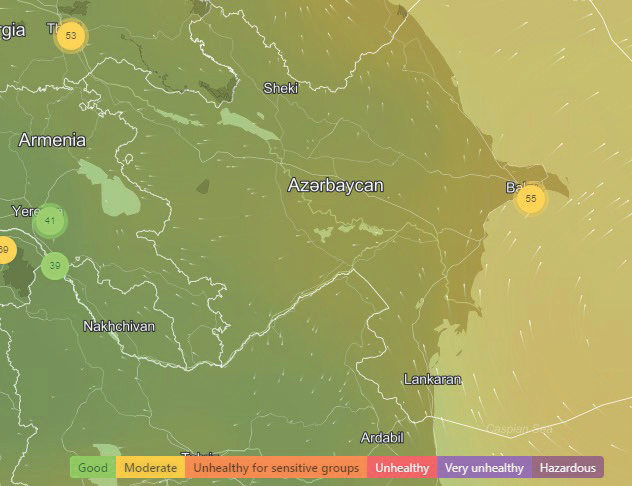
Air pollution is higher in the Baku and Absheron peninsula, as seen in the map below, due to the concentration of industrial plants and factories and heavy traffic in this area as shown on Fig. 1. Also, the main energy source for the region is from thermal power plants that use oil products as fuel. This factor also contributes negatively to air pollution levels in the Absheron peninsula and Baku city.
Another major factor for low air quality is the construction boom that occurred at the beginning of the XX century. The reason for this is high urbanization and internal immigration to the region.
Finally, minor pollution is due to naturally occurring sandstorms from Central Asia and the Middle East, due to very high wind speeds [9].
Soil erosion and pollution some of of the main environmental problems. Before industrialization, arid lands were subjected to only natural erosion factors such as wind erosion and “salt storms”, as brine lakes evaporate during summer seasons.
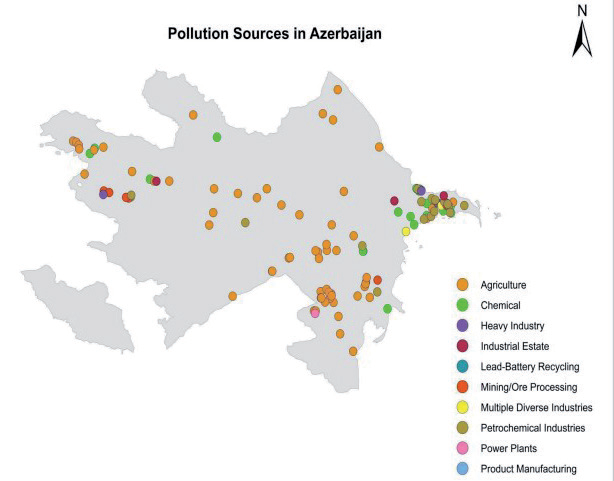
However, after industrialization, these areas suffered from artificial pollution, too. According to Fig. 2, on the Baku and Absheron peninsula, the main soil pollutants are petroleum and industrial chemicals. It can be seen in the map below that there is a high concentration of polluted areas in the peninsula and capital city, in contrast with other areas of the Republic. Besides already being an arid landscape, industrial and household pollution are serious in this area.
“False urbanization”, increasing slum areas, and chaotic construction further put stress on already low-quality lands and also pollute remaining freshwater artesian wells and springs.
Other factors that put soil at risk in these regions are fluctuations in sea levels in the Caspian Sea. From 1979- 2015, sea levels have been steadily decreasing. However, from 2015 onward, sea levels increased dramatically. This caused an increase in salt storms and further pollution of the soil with petroleum and chemical waste.
Another problem in this area is the very limited freshwater sources. There is only one freshwater reservoir for almost 3-4 million people. Petroleum drilling and household pollution from high population density increase the risk of contamination for the few fresh groundwater wells [10].
As mentioned earlier, fluctuations in Caspian Sea levels also create risks for environmental and economic issues for regions in the hydrosphere, too. Shrinking sea levels will increase the risk of salt storms, a complete loss of biodiversity, and the decline of the fishing economy in Azerbaijan [11].
In order to overcome these issues and potential risks, the green economic model can be applied to these areas. As mentioned earlier, during the 3 years of application, the green economic model was “fruitful” for areas of Azerbaijan without proper infrastructure.
Results and Discussion
Green Energy Potential
After the collapse of the Soviet Union, newly independent Azerbaijan had problems with energy security. War, economic and political turmoil, and the absence of modern infrastructure negatively affected the energy production sector of the country.
Shortly after independence, Azerbaijan signed oil contracts and started to develop its energy infrastructure. Being economically dependent on petroleum products, Azerbaijani energy production comes mainly from this sector via thermal power plants, especially gas-fired power plants in the Azerbaijani energy production sector [12].
Due to this, nowadays, shown on Table 1, almost all of the energy generated in the Baku and Absheron-Khizi economic regions is from thermal power plants.
There is only one instance of non-thermal electricity generation; the Surakhany Photovoltaic Power Station. However, this power station has a tiny share of 0.1% of the total energy output for two regions.
When analyzing green energy potential for these two regions, there must be a clear definition of what is considered true green energy. In this case, green energy consists of the energy sources listed below: – Solar energy – Wind energy – Hydropower – Bioenergy – Geothermal energy – Wave and tide energy
Due to environmental factors, hydropower and geothermal energy are not available in the Baku and Absheron-Khizi economic regions. This is because these two regions lack any major rivers or geothermal springs that can produce electric energy. Being industrial areas, bioenergy is also absent, due to its source being agriculture products and waste. However, other renewable and green energy resources have great potential for the development of the green economy in these areas.
Table 1.
Energy production sources and power in the Baku and Absheron-Khizi economic regions.
| Region | Thermal Power (MW) | Solar Power (MW) |
|---|---|---|
| Baku | 709.00 | 0.00 |
| Absheron-Khizi | 525.00 | 1.20 |
Solar Energy Potential
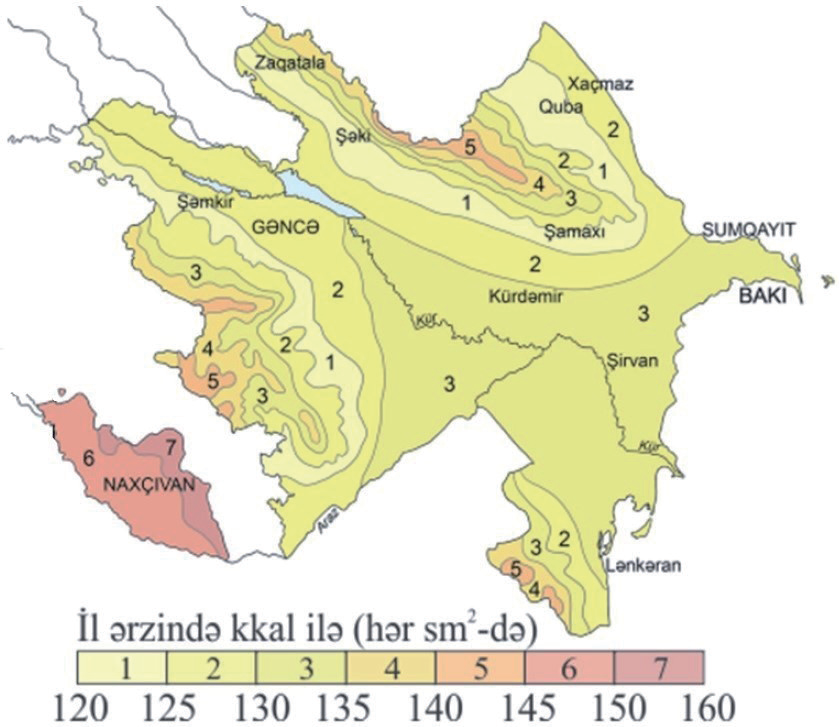
Arid and subtropical climates in major parts of Azerbaijan make solar energy widely suitable. According to graph (Fig. 3), Absheron Peninsula and central regions of Azerbaijan are considered the second sunniest regions after Nakhcivan. Late spring, summer, and early autumn weather on the Absehron peninsula is generally characterized as cloudless and sunny [8].
As a result of the climate, annual solar energy per cm2 in the Baku and Absheron-Khizi economic regions is between 130 to 135 kcal. This quantity is considered slightly below average for Azerbaijan, and these regions are classified as having solar energy efficiency within the range of 28.57% to 42.85% [14].
Despite having average potential, there is only one solar energy plant in the region, located on the Surakhani settlement, with a capacity of just 1.2 megawatts. There are also some minor photovoltaic energy stations located in Alat, Haji, Zeynalabdin, and other settlements, however, their energy output is either low or not functioning.
In 2022, as per the decree of the President about “green energy”, the Azerbaijani government announced the construction of a solar power plant in the Absheron district with a capacity of 240 megawatts. This power plant is part of the “Khizi-Absheron Power Plant” and will be completed at the end of 2024 [15].
Photovoltaic energy is the main area of interest for further implementation of solar power energy plants in these areas, because of the high population concentration and the industrialization of the area. Concentrated solar power (CSP) stations are also considered, but a below average solar power index makes them useful only during hot seasons. Also, the danger to biodiversity due to CSP is one of the main reasons why this sort of solar power is not suitable for this region. Due to this, photovoltaic energy is considered the main solar power source for these regions.
However, unclaimed land in the corresponding two regions, especially sparsely populated areas on the western part of the peninsula and highland areas between the Khizi and Yashma settlements, can be used as a place for the construction of all types of solar power plants. Limited biodiversity and climate enable the construction of both CSP and photovoltaic power plants in these regions.
Wind Energy Potential
The Absheron Peninsula and Khizi district are considered the windiest areas of Azerbaijan. As mentioned on the Fig. 4, average wind speeds for Azerbaijan are considered to be 5.4 m/s to 5.8 m/s. However, on the Absheron Peninsula, the annual average wind speed exceeds 8 m/s. [16] This is due to high gale force winds from the Caspian Sea as a result of the windbreaker effect of the Caucasus mountain range. Due to this, the majority of wind farms are located in these regions [17].
Currently, Azerbaijan possesses 3 functioning wind farms, 2 of which are located in the area between the Khizi and Abhseron districts, where wind speed reaches its maximum. Accoring to Table 2, the total output of wind farms is a little higher than 50 megawatts annually [19].
The output of wind energy is very low, so it has great potential. In order to combat this, the Azerbaijani government started to work with the Saudi company “ACWA Power” to construct the most powerful wind farm in Azerbaijan and the Transcaucasia region. This wind farm will be called “Khizi-Absheron” Wind Power Plant and will cover the areas of the Pirakashkul wind farm (a non-functioning wind farm) and the Sitalchay settlement. Power from this wind farm is calculated to be 240 megawatts, nearly 5 times larger than today’s wind power output of region. This power station will help to save 220 million m3 of natural gas, thus decreasing carbon emissions by around 400,000 tons. The annual power output is calculated to be around 1 billion kVt/h, and can provide enough electricity for 300,000 houses [20].
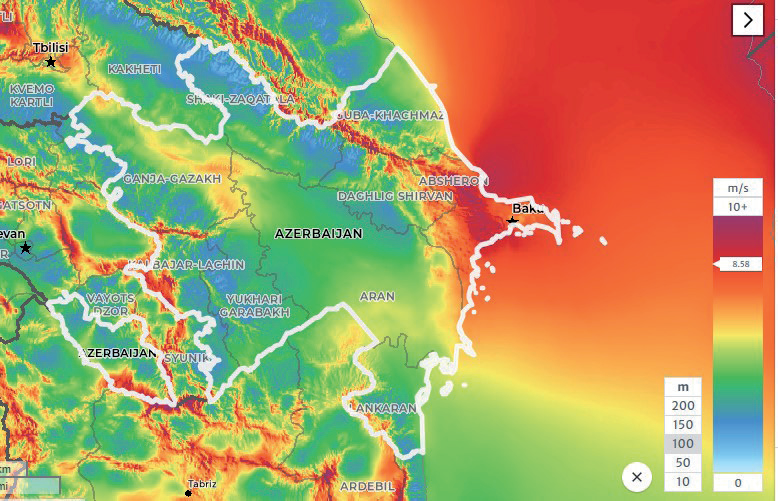
Table 2.
Windfarms in regions and their power.
| Wind farms | Power (MW) |
|---|---|
| Pirakashkul (non-functioning) | 0 |
| Yeni Yashma | 50 |
| Shuraabad | 1.7 |
| TOTAL | 51.7 |
Sea based wind farms are also included in the green energy plan for Azerbaijan, and there were once initiatives to construct this type of power plant on the inhabited islands of Pirallahy and Chilov [21]. However, a high concentration of oil wells both onshore and offshore, pipelines, and heavy marine traffic remains a major issue for the construction of wind farms in these areas.
However, this type of power plant can still be constructed in the relative north-western area of Pirallahi Island, where marine traffic is completely absent and water depth is, on average, 10 meters. Also, this area is free from oil drilling equipment and galeforce winds are strong year-round.
Wave and Tide Energy Potential
Tides and tidal forces are very minimal in the Caspian Sea, due to its enclosed basin and not being part of the world ocean. The maximum extent of tides is 0.7-0.8 cm, measured on the Turkmenistan side of the sea. On the Azerbaijani side, especially around the Absheron peninsula, the maximum extent of tides is 0.2 cm. [22] Due to this factor, energy production from tides is non-efficient.
Wave energy, however, has great potential in these regions, especially on the northern shores and the easternmost islands of the Absheron peninsula. Gale force winds, especially the northern ones, are creating waves with a height of approximately 5-10 meters in the central part of the sea [23].
High waves in central parts of the Caspian Sea within the Azerbaijani maritime sector make the potential establishment of wave power stations on the Pirallahi and Chilov islands and on oil platforms situated on the Neft Dashlary and Azeri-Chirag-Gunashly oil fields, as well as at Shahdeniz gas field, possible. [24] These types of areas are suitable for the establishment of the “Oscillating water column” wave power generator. This instrument generates power by compressing air within a tube as waves rise and fall. Due to this, this wave turbine is suitable for the mentioned areas [25].
The shore areas of northern Absheron, on the other hand, have a low wave height, however, their overall power is high due to rapid depth change. These devices typically have one end fixed to a structure or the seabed, while the other is free to move around. Energy is collected from the relative motion of the body compared to the fixed point. [26] Due to this, the “Oscillating wave surge converter” is the best choice for near-shore power generators that are located on the Absheron peninsula. However, due to high leisure and tourism concentrations on the northern shores, these types of generators can be non-efficient during tourism seasons due to their proximity to the shoreline. The solution for this is the installation of these generators during the windier and wavier cold seasons, when tourism and leisure activities are minimal, and uninstallation during the summer seasons.
“Smart Village” Application
Smart villages are a new concept in Azerbaijan and emerged in 2021 after the second Karabakh War. A smart village is a rural settlement or community that uses innovative solutions like AI, renewable energy, and other types of innovations to improve their flexibility, building on local strengths and opportunities [27]. Smart villages are a conceptual part of the green economy, because all activities in smart villages are environmentally friendly and have a minimal carbon footprint. These types of villages use renewable sources to generate energy and sustain social life in settlement areas [28].
The self-sustaining ability of these types of villages has made the Azerbaijani government implement smart village initiatives for de-occupied territories after the war. The 30 year-long military occupation led to the destruction of all villages and settlements in the Karabakh and Eastern Zangezur economic regions of Azerbaijan. Also, the Presidential decree for the restoration of these areas using the “green economic way” paved the road for the first smart villages in these areas [29].
As a result of the successful implementation of the smart village concept, the Azerbaijani government announced new smart village concepts for various regions in currently liberated areas. These projects are an essential part of development for former war-torn territories without any infrastructure.
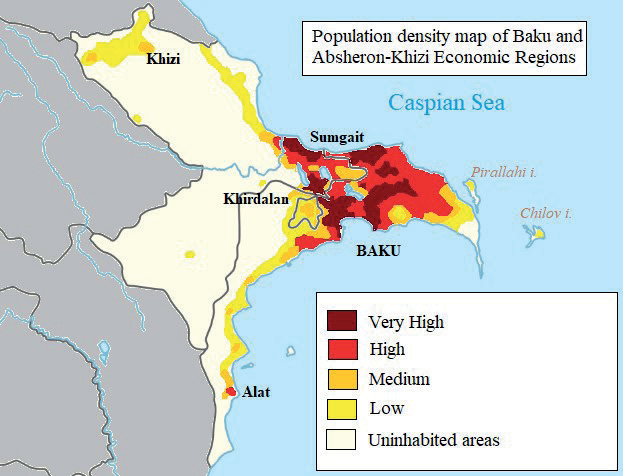
Currently, the smart village concept is concentrated only on liberated areas. However, this phenomenon can be applied to other parts of Azerbaijan as well. As shown on Fig. 5, high urbanization, population density and industrialization, the Baku and Absheron-Khizi economic regions seem unsuitable for smart village initiatives. However, there are certain areas and settlements that are “dying”, and smart village concepts can be key to their development.
Several settlements in these regions are remote and dependent on external aid from well developed areas. Examples are island communities like Pirallahi and Chilov, with the latter being accessible only by air and naval transport, as well as the remote village of Cheyldagh in Baku [30].
Pirallahy
As mentioned earlier, the Pirallahi settlement already has some infrastructure to achieve smart village levels. There are solar power stations with an annual power capacity of 2.8 MW [31]. However, this is not enough to achieve full coverage for the settlement, as annual consumption is 16.12 MW. [32] As mentioned earlier, wind and wave power stations can be installed in these areas in order to sustain island electricity.
Due to an arid climate, agriculture is not possible for self-sustainability. However, due to being an island community, fishing and marine-agriculture can be improved in this area. This type of activity will lead to the establishment of the first “marine smart village”. Certain activities for improvement in fishing are already present on the island, like the establishment of the “Nerekend” fish farm [33].
Chilov
The Chilov island settlement, on the other hand, is considered the remotest settlement in Azerbaijan, situated about 55 km east from the shores of the Absheron peninsula. This settlement was established as part of the petroleum industry, and the main inhabitants are oil-gas sector workers [34].
The landscape of the island is inhospitable, and agriculture is not possible due to areas covered with nothing but sand dunes. Also, unlike Pirallahi Island, high levels of pollution in sea water due to petroleum products makes it impossible for the establishment of fish farms on the island. As mentioned earlier, the inhabitants of the island are oil-gas sector workers with limited agricultural capabilities, so it is unlikely that in the future any agricultural activities will be present on this island.
The top aspect of establishing a smart village is maintaining self-sustainability for island energy. Like Pirallahi Island, solar, wind, and wave energy are considered the main green power sources for this remote community.
Cheyildagh
Cheyildagh village is a remote mainland village in Baku, located on an exclave within the Abhseron district. This settlement was established in 1951 due to its proximity to onshore oil deposits. The first inhabitants were oil-gas sector workers. [35] Due to the decline of the petroleum industry and a lack of infrastructure in this area, people began to leave the settlement. However, there is still a considerable population of 895 people who currently live in this area.
As for energy consumption, the settlement is dependent on transportation from other areas. However, the smart village initiative can be applied in this area, too.
Solar energy is potentially the main green power resource for this area, due to the 130-135 kcal/cm2 annual solar saturation rate. [14] The arid climate of this area is suitable for the establishment of both photovoltaic and concentrated solar power stations [37].
Wind energy, on the other hand, is not as efficient as it is in other parts of the peninsula due to the proximity of the area to the Aran region, where wind speed is on average 5-6 m/s. [18] However, this type of energy can be used as a secondary approach and can still provide the village with a normal amount of energy, due to the small population size.
One of the potential energy sources is limited geothermal energy. There are many mud volcanoes in this area that are active year-round. [35] This kind of “exotic” thermal energy is produced from mud volcanoes and can be used to obtain energy. Heat from mud volcanoes in this area is typically between 30-40 Celsius. [36] However, their efficiency will be lower than that of conventional steam-based geothermal power plants, whose temperature is higher than 80 degrees Celsius. On the other hand, their heat capacity index is high and is suitable to maintain energy for this settlement only.
Agricultural aspects of the smart village concept in Cheyildagh on the other hand, are more achievable than in the Pirallahi and Chilov settlements, due to its proximity to the fertile lands of Aran. The only problem for agriculture is an arid climate with little precipitation and rugged terrain. This makes agricultural development on this area difficult. However, during the cold months, the area surrounding the settlement becomes a pasture area. Due to this, animal husbandry and broiler farms can be built in this area.
There are many broiler farms in similar climate areas in Azerbaijan, like Gilazi, Siyazan, etc. By initiating smart village concepts with modern tools in this settlement, the broiler industry can thrive and the overall economic situation of the village can be improved.
Conclusions
Green economy is the future of mankind for sustainable development and ecological issues. Azerbaijan, being part of this, has to move its economy from a conventional one to a green one in order to combat current issues and economic hardships.
Environmental pressures and social pressures in the Baku and Abhseron-Khizi economic regions, make them better candidates for the future adoption of green economic activities in Azerbaijan. By initiating these activities, Azerbaijan can “ignite” a green revolution for the whole country.
The renewable energy potential in these two regions can transform the energy dependency of multiple regions from fossil fuels to a green approach very quickly, but only if a sophisticated infrastructure is established soon. As for today, the “Khizi-Absheron” green Energy Park is considered the first serious step towards the green development of the region. These will lead to a reduced carbon footprint, better air quality, and better energy security for the region.
Smart villages are becoming an essential part of the green economy in Azerbaijan, and their conceptual implementation on these two regions will maintain steady population growth and sustainable energy security for remote settlements. It will also help to transform polluted areas into more agriculturally useful ones.
In the end, the implementation of a green economy in the two corresponding regions will further help Azerbaijan overcome economic, social, and ecological hardships, as “fruitful” results will “spark” green economic revolution in the wider Republic.
The Azerbaijani example of green economic development can make countries with similar hardships located in Sub-Saharan areas of Africa, the Middle East, and Ukraine sustain their own development. In the future, when military operations cease in Ukraine, Syria, and Yemen, to attract investors to these regions for the development of these war-thorn areas, green economic growth will be key. As the same scenario played out in Azerbaijan, which suffered from 30 years of military occupation and destruction, the Azerbaijani example can be especially attractive. Also, the implementation of green economic growth in industrial areas by Azerbaijan and corresponding regions can pave the road for the de-industrialized and polluted regions of the world toward transformation in green areas.

