

Introduction
With the push for global climate change and carbon-neutral targets, the ESG investment concept is rapidly becoming a mainstream investment philosophy. Major asset management organizations and investment funds around the world have integrated ESG criteria into their investment decisions and risk management systems. Investors generally believe that companies with excellent ESG performance have better management and more sustainable development prospects [1, 2]. Therefore, the quality of the ESG disclosures of listed companies directly affects investors’ judgment. Meanwhile, high-quality ESG disclosure is also one of the important factors for listed companies to participate in international competition [3].
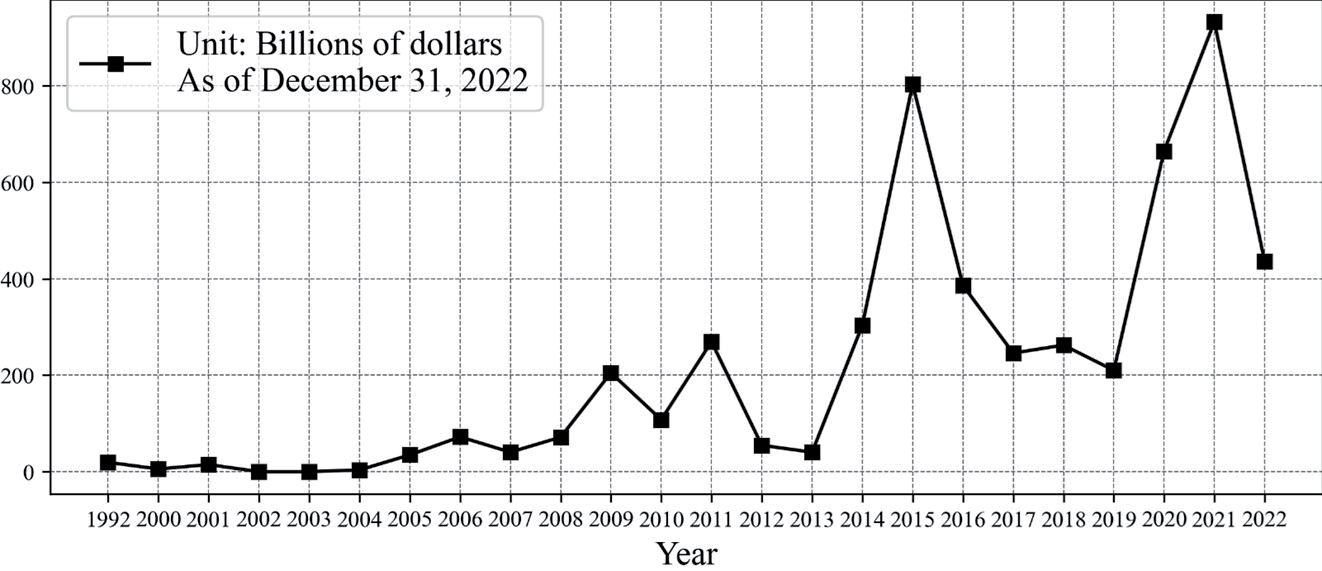
In China, ESG investment has also gradually heated up in recent years, with financial products, mainly ESG public funds, continuously raising capital for issuance in the secondary market. As of December 31, 2022, there are 624 ESG public funds in China, with a total combined size of about 518.2 billion yuan. In terms of scale, there has been a clear upward trend in the establishment scale of ESG public funds since 2004. Among them, the establishment scale of ESG public funds in 2015 was about 80.360 billion yuan, the largest scale in the past 20 years. However, from 2015 to 2019, the total scale showed a downward trend. From 2020 to 2021, the total scale bottomed out and rebounded, showing multiplier growth, and in 2021, the annual establishment scale of ESG public funds reached about 93.224 billion yuan, a year-on-year increase of 40.2%, which is a new record high. In 2022, the total scale of newly established ESG public funds reached 43.555 billion yuan. Specifically, as shown in Fig. 1, the data is from the International Institute of Green Finance of Central University of Finance and Economics and Wind database.
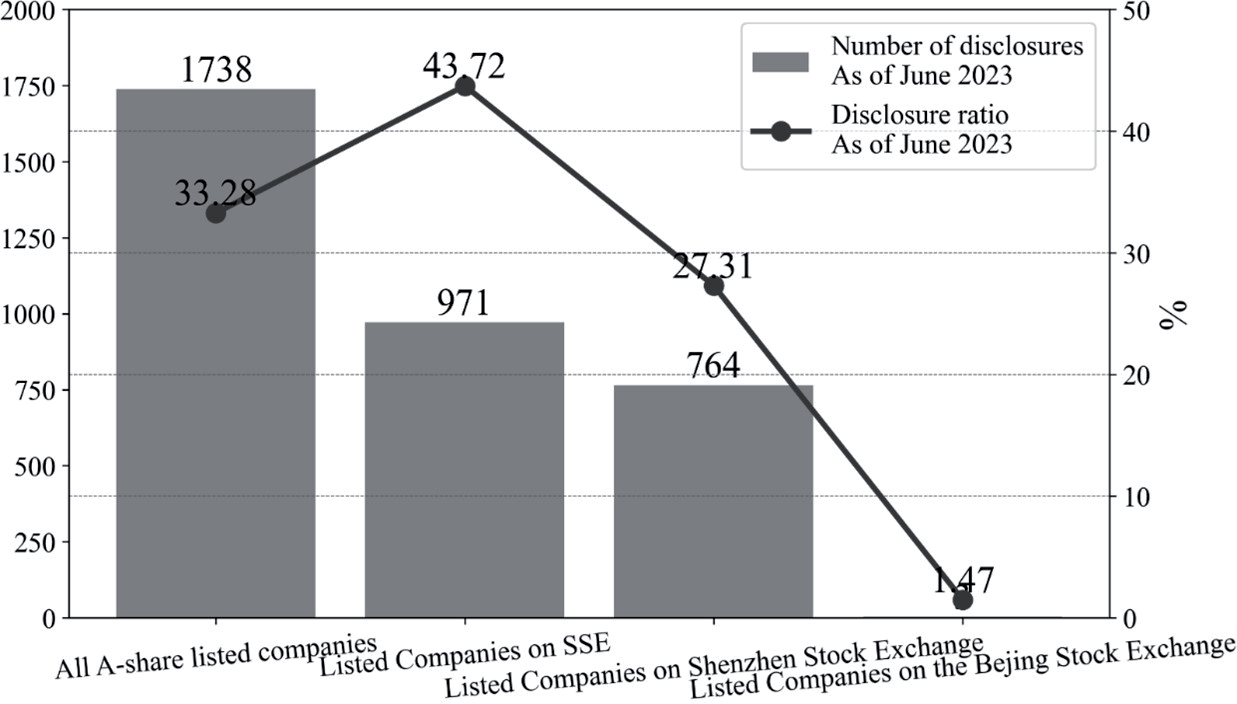
At this stage, China’s A-share market has not yet implemented a mandatory ESG reporting system, but as the concept of ESG has become a consensus at home and abroad, more and more listed companies in the A-share market have taken the initiative to disclose their ESG-related reports, which include major types such as CSR, ESG, Sustainability, Environmental Report, and Environmental Report. These include CSR reports, Environmental, Social, and Governance (ESG) reports, Sustainability reports, Environmental reports, and other major types. The Action Report shows that as of the end of June 2023, a total of 1,738 A-share listed companies had independently disclosed ESG/social responsibility reports, an increase of 22.14% year-on-year, including 971 listed companies on the SSE and 764 listed companies on the SZSE, an increase of 14.78% and 32.41% year-on-year, respectively. Meanwhile, three listed companies on the NSE independently disclosed ESG/social responsibility reports, and the disclosure of ESG information is in the beginning stages. Specifically, as shown in Fig. 2, the data comes from the Green Finance International Research Institute of Central University of Finance and Economics and Wind database.
However, some listed companies engage in selective reporting or data whitewashing in ESG disclosure out of the need to obtain more investment capital. For example, they exaggerate their environmental performance and conceal or embellish their environmental protection problems. These selective disclosures and exaggerated publicity are “greenwashing” behaviors, which not only harm investors’ rights and interests, but also damage the healthy development of the whole capital market [4- 6]. Therefore, in-depth study of greenwashing behavior in ESG disclosure of listed companies, analysis of its root causes, and proposal of effective preventive and governance countermeasures are of great practical significance for the protection of investors’ rights and interests, standardization of the capital market, and promotion of the sustainable development of listed companies.
This research makes a substantive contribution by significantly progressing the dialogue on ESG disclosure, specifically tackling the widespread problem of greenwashing within listed companies. Through the identification of crucial research gaps, the proposal of a nuanced approach for the prevention and governance of ESG disclosure, and the advocacy for collaborative initiatives, this paper enriches our understanding of the intricate challenges and potential solutions associated with deceptive corporate reporting practices. By underlining the imperative for heightened empirical research and offering a framework for standardization, the study seeks to cultivate transparency, integrity, and stability in financial markets.
Literature Review
In the examination of corporate Environmental, Social, and Governance (ESG) performance, ESG disclosure, and ESG investment within the WEB OF SCIENCE database, existing literature consistently asserts the positive impact of ESG disclosure on both listed companies and investors. Notably, studies by Ling et al. (2023) and Li et al. (2023) highlight the portfolio performance improvement associated with ESG [7]. Sheehan et al. (2023) underscore the positive correlation between ESG and corporate performance [8], while Liu et al. (2023) and Bilyay-Erdogan et al. (2023) identify ESG’s potential in reducing non-performing loans and increasing dividend payouts [9, 10]. These findings underscore the substantial value of high-quality ESG disclosure for firms and investors alike [11, 12]. The literature encompasses examinations of various factors such as gender, digitalization, and institutional investors, exploring their influence on ESG. For instance, Meng and Zhu (2023) highlight the positive impact of female managers on ESG [13], while Mo et al. (2023) and Lu et al. (2023) examine the augmentation of ESG performance through digital finance [14, 15]. McCahery et al. (2022) emphasize the attention institutional investors give to ESG due to its correlation with performance, providing insights for promoting ESG [16]. Scholars investigate the multifaceted role of ESG in information transfer and risk management. Wang et al. (2023) reveal ESG’s role in reducing stock price vulnerability [17], Cepni et al. (2023) emphasize ESG assets’ ability to diversify climate risk [18], and Jin et al. (2023) confirm ESG disclosure’s contribution to hedging against risks such as the new crown epidemic [19]. These findings underscore the vital role of ESG in information dissemination and risk mitigation. Certain studies delve into issues impacting the quality of ESG, such as disparities in ESG rating results among data providers highlighted by Aabo and Giorici (2023) [20] and a size bias in data providers’ ESG ratings revealed by Dobrick et al. (2023) [21-23].
Despite the extensive research on corporate ESG performance and ESG disclosure quality, a significant gap persists in directly addressing the phenomenon of ‘drifting green’ in the ESG disclosure of listed companies. This issue is characterized by several deficiencies: a lack of systematic research on identifying and manifesting greenwashing, the absence of a unified standard or judgment method, and no classification or summary of specific greenwashing manifestations. Additionally, there is inadequate exploration of motives and influencing factors behind ESG disclosure bleaching, with insufficient systematic analyses of internal and external driving forces, along with a dearth of examinations regarding variations in ESG disclosure among different types of listed companies and countries.
To bridge these gaps, future research efforts should prioritize empirical analysis. This review focuses on addressing the first three deficiencies, aiming to enhance the understanding of listed companies’ ESG disclosure bleaching and proposing robust coping strategies. These endeavors are crucial for maintaining the stability of the capital market and safeguarding the interests of investors.
Bleaching Green in Listed Companies’ ESG Disclosure
Decoding Bleaching Green in Listed Companies’ ESG Disclosure
Greenwashing refers to the behavior of firms that portray a positive environmental image through exaggerated and misleading environmental disclosure to conceal the firm’s real environmental problems. Greenwashing reflects the disconnect between corporate ESG disclosure and actual ESG performance. Enterprises engage in greenwashing for the purpose of gaining consumer trust, improving reputation, obtaining government support, or gaining investor favor, among other benefits.
Greenwashing behavior shows the “double standard” of enterprises in fulfilling environmental protection and social responsibility, claiming that they attach great importance to environmental protection and social responsibility on the one hand, but have serious environmental pollution or social problems on the other. This kind of inconsistency will eventually damage the credibility and reputation of enterprises [24]. Greenwashing may stem from the opportunistic behavior of enterprises using ESG disclosure to send false signals to stakeholders, or it may be due to the deceptive disclosure of enterprises in order to reduce ESG management costs. Regardless of the motivation, greenwashing reflects corporate irresponsibility on ESG issues, which may lead to greater ESG risks and weaken the effectiveness of ESG investments.
Specific Forms of Greenwashing
The academic literature summarizes the specific ways in which companies engage in greenwashing from different perspectives.
(1) Selective disclosure. Enterprises selectively disclose part of the favorable ESG information, conceal or dilute the negative information, and exaggerate the ESG image of the enterprise [25]. For example, they emphasize only a few environmentally friendly products or projects without mentioning the environmental impact of the whole business; they choose to disclose ESG objectives that are easy to achieve and avoid those that are difficult to achieve.
(2) Reporting the news but not the worries. Enterprises only publicize their achievements in environmental protection and intentionally avoid disclosing negative information such as ESG accidents and pollution records [26]. Companies’ ESG reports are full of exaggerated descriptions of ESG contributions and performance, avoiding the actual problems.
(3) False promises. Enterprises make some empty or unrealistic ESG protection commitments, but the actual actions do not match the commitments [27]. For example, they promise to realize net-zero emissions without a specific roadmap.
(4) Fabricated data. Enterprises fabricate and exaggerate their carbon emission reduction data and resource utilization efficiency data, which are difficult to verify by a third party [3]. The data are not true, which embellishes the ESG performance of the company.
(5) Halo effect. Enterprises may rely on the green image of individual products or businesses to cover up ESG problems in the overall business [4]. For example, companies in highly polluting industries boast a few environmentally friendly products to downplay overall pollution.
(6) Non-disclosure of negative information. Firms deliberately avoid disclosing negative information, such as ESG accidents and pollution records [28]. Problems that exist in reality are attempting to be hidden.
(7) Green packaging. Companies portray an environmentally friendly image through packaging and branding, while the actual product or business is not environmentally friendly [29]. Consumers are confused by green packaging.
To summarize, listed companies engage in greenwashing in a variety of ways, and investors and regulators need to be alert to various means of greenwashing in order to improve the authenticity and reliability of ESG disclosure. The greenwashing of enterprises may stem from the indifference to ESG management and the lack of ethical standards, which need to be curbed by strengthening supervision and enhancing the ESG awareness of enterprises.
Unpacking ESG Disclosure Bleaching in Listed Companies
The reason listed companies engage in greenwashing of ESG disclosure is due to both internal motives and external environmental inducements. This section analyzes the deep-seated reasons for the greenwashing of listed companies from both internal and external levels.
Analysis of Internal Factors
The internal motivation of listed companies’ ESG disclosure drift mainly comes from the deficiencies of corporate governance mechanisms, corporate culture deviation, and inefficiency in the information disclosure system.
First, there are deficiencies in corporate governance. In the boards of directors of many listed companies, the proportion of professional directors focusing on CSR and environmental governance is too low, which makes it difficult to effectively supervise the fulfillment of corporate social responsibility [3], and the establishment of ESG professional committees is not popular, which leads to the ineffective supervision of the boards of directors on the disclosure of ESG information. In addition, there are few cases where executive compensation is linked to ESG performance, thus failing to create strong internal incentives [30]. These factors have led some listed companies to stick to the traditional business philosophy of profitability and investor appeal, and in the pursuit of short-term earnings growth and share price appreciation, they may do whatever they can to achieve quarterly forecasts and keep their share prices high through various maneuvers. Decision-makers at these companies view ESG as a dispensable tool and can play the numbers game to meet investors’ and the public’s expectations of ESG. While this kind of short-term manipulation may have a misleading effect, in the long run, it will definitely damage the reputation of the company.
Secondly, there is a deviation in corporate culture. The corporate culture of listed companies emphasizes short-term performance rather than long-term development, resulting in selective disclosure of favorable information to satisfy investors [31]. In addition, over-emphasis on profit maximization may also induce a lack of ethical values and lead to exaggerated publicity in order to save costs. The corporate culture that lacks responsibility and integrity is the cultural soil for listed companies to bleach green. This culture not only affects internal communication and collaboration on ESG issues and the division of responsibilities, but also weakens the importance of external monitoring and feedback.
Third, the information disclosure system is not perfect. Many listed companies do not have adequate ESG data collection and disclosure systems, environmental impact assessment is subjective, accounting caliber is inconsistent with international standards, and verification is not independent enough [3]. These problems make it impossible to verify the accuracy and completeness of information and create room for greenwashing. Ineffective information systems directly lead to problems such as selective data disclosure and exaggerated reporting, and the irrationality of the performance appraisal system may also induce greenwash behavior. Over-emphasis on ESG ratings rather than the true reflection of performance promotes the practice of playing the numbers game and creating a green impression through superficial articles, thus bringing greenwashing into the daily production and operation management of enterprises.
To summarize, improving internal governance, establishing a scientific performance appraisal system, and strengthening the responsibility of employees are the internal cornerstones for managing the bleaching behavior of the ESG disclosure of listed companies. Enterprises need to fundamentally establish ESG concepts and create a culture of consistency in language and action.
Analysis of External Factors
The external factors of listed companies’ ESG disclosure bleaching behavior mainly come from the comprehensive influence of national policy orientation, industry development, market environment, and social public opinion.
First, the national policy orientation is not clear enough. Currently, China’s positive stance and vigorous promotion of sustainable development and carbon neutrality policy orientation have sent a strong signal to listed companies to make ESG disclosures. However, the specific policies and regulations are still not perfect, and the evaluation standards are not uniform, resulting in selective disclosure by enterprises taking advantage of the loopholes in the system. Some local governments have also adopted local protectionism to attract projects and capital, tacitly recognizing the environmental violations of enterprises and providing space for greenwashing. These factors have led to the lack of unified regulatory constraints on listed companies and reduced their motivation to consciously fulfill their social responsibilities.
Secondly, there are differences in the development status of industries. Some highly polluting industries are overly reliant on traditional models and lag behind in environmental technology and management, which prompts companies to disguise the difficulties they face in the decarbonization transition through information disclosure. Industries and leading companies with ESG advantages may also distort information to maintain their leading position based on industry barriers. These factors lead to different degrees of bias or distortion in information disclosure by listed companies.
Third, the market environment is distorted. The short-term speculative nature of the capital market causes listed companies to face great pressure on quarterly results. In order to meet investors’ expectations, companies make selective disclosures, fabricate data, and use other greenwashing tactics to maintain stock prices. Retail investors, who lack professional judgment, are also easily confused by green packaging, further condoning the phenomenon of greenwashing. In addition, listed companies have incentives to exaggerate their environmental performance for the purpose of obtaining green financing or securing contracts [3]. These market pressures may lead to inaccurate disclosure.
Fourth, public opinion is misleading. Public opinion has a negative impact on ESG. In the media, there is a tendency to focus on the glitter of superficial green behaviors and not enough on substantive performance. Green league tables also stimulate listed companies to make formalized disclosures in order to gain public exposure. These public opinion orientations not only affect listed companies’ real understanding of and attention to ESG, but also interfere with investors’ objective evaluation of ESG.
To summarize, improving the top-level policy design, promoting the synergistic development of the industry, rationally guiding market expectations, and testing the public opinion orientation are the external paths to govern the ESG disclosure behavior of listed companies. The government and society need to work together to create an institutional environment that encourages sincere practice and penalizes false propaganda.
Preventing Bleaching Green in Listed Companies’ ESG Disclosures
In order to effectively curb the behavior of ESG disclosure bleaching green in listed companies, it is necessary to carry out comprehensive governance from both internal and external environment perspectives. Specific countermeasures are as follows:
Strengthening Supervision and Improving Regulations
Improving regulation and guiding listed companies to standardize ESG information disclosure are practical measures to prevent greenwashing behavior. Specific suggestions are as follows.
Firstly, government authorities should speed up the formulation of uniform and binding ESG disclosure standards to prevent enterprises from taking advantage of the confusion of standards to make selective disclosures. The standards should be formulated by absorbing the best international examples, based on the actual national situation, and setting up industry guidelines to promote the wide adoption of the standards in the whole market.
Secondly, regulators should establish an ESG information quality evaluation system and improve the supervision and inspection mechanisms for corporate ESG reports. They should strictly assess the completeness, accuracy, and timeliness of report disclosure, differentiate between sincere performance and fraud, and notify, criticize, or even penalize enterprises that have violated the rules of “greenwashing”.
Again, the legal responsibility of ESG information disclosure by listed companies should be further clarified, and failure to disclose truthfully as required constitutes a violation of the law. Improve the regulatory system, increase the penalty for providing false environmental information, and enhance the self-awareness of corporate disclosure compliance.
Finally, advocate for and guide social organizations and the public to participate in the supervision of ESG information disclosure. Encourage the public to report false publicity, give full play to the role of public opinion supervision, and form a strong external pressure to urge enterprises to improve their environmental and social performance.
Establish a Unified ESG Evaluation Standard
At present, various institutions and organizations have formulated various ESG evaluation standards, and enterprises can make selective information disclosures according to different standards. Therefore, establishing a unified and authoritative ESG evaluation system and disclosure standards is an important measure to curb greenwashing.
First of all, the formulation of ESG evaluation standards should be led by competent government departments, and all parties’ opinions should be widely solicited, so as to form a unified national evaluation index system and disclosure standards. The evaluation indexes should cover the three dimensions of environment, society, and corporate governance and emphasize both quantitative and qualitative indexes.
Secondly, the evaluation standards should take into account international universality and local applicability. They should reflect the stage-specific characteristics of China’s sustainable development and the characteristics of the industry and, at the same time, absorb and learn from international mature evaluation experiences and methods. The evaluation should focus on the real effectiveness of corporate ESG practices, not just on forms and processes.
Thirdly, an independent third-party organization should be appointed to carry out regular evaluations. The third-party organization should be objective and fair and select a scientific scoring method to distinguish the real ESG performance of enterprises. The third-party organization should also establish a complaint mechanism to ensure that the evaluation is fair and impartial.
Finally, the evaluation results should be widely publicized and transparent for society to accept public supervision. The results should be linked with regulatory measures to provide policy support to enterprises with outstanding performance and implement interviews and penalties for enterprises that fail to meet the standards.
Strengthen the Verifiability of Information Disclosure
Listed companies should strengthen the measurability, traceability, and verifiability of ESG information disclosure and improve information transparency. Specific measures include:
First, the ESG indicators disclosed should have quantifiable characteristics. As far as possible, widely recognized quantitative indicators should be used, and vague and difficult-to-quantify qualitative descriptions should be reduced. For certain indicators that are difficult to quantify, clear calculation methods and statistical calibers should be provided to ensure the comparability of data over different periods.
Secondly, establish an ESG data collection and sharing mechanism and an information disclosure system. ESG data source and flow should be traceable and ensure that the core data comes from the company’s authoritative channels, so as to avoid hasty fabrication by grass-roots employees to fulfill the tasks.
Third, establish a scientific internal ESG information review mechanism. Set up an independent ESG working group to review the content of information disclosure, focusing on the accuracy of core data and the disclosure of news-sensitive information. It also conducts internal data cross-validation to check the consistency of given information.
Finally, we actively adopt third-party verification to enhance the credibility of information disclosure. An independent third party is hired to certify corporate ESG reports and conduct audit trails on key data to assess the authenticity and completeness of the reports.
To sum up, comprehensive governance from both internal and external environment perspectives is an effective countermeasure to prevent listed companies’ ESG disclosures from bleaching green behavior. Only by establishing a perfect institutional environment can listed companies be prompted to sincerely fulfill their social responsibilities and enhance their ESG level.
Governance Strategies for ESG Disclosure Bleaching in Listed Companies
In order to effectively govern listed companies’ ESG disclosure bleaching green behavior, it is necessary to carry out comprehensive governance from both internal and external environment perspectives. Specific countermeasures are as follows:
Increase the Strength of Punishment, Improve the Cost of Violations
For the bleaching green behavior that has occurred, it is necessary to establish a perfect penalty mechanism to effectively improve the cost of corporate violations. Specific recommendations are as follows.
First of all, the regulatory authorities should seriously investigate and deal with enterprises’ false and exaggerated ESG information disclosure and notify and criticize them, publicly condemn them, or even give them administrative penalties according to the regulations. For example, restrictions on corporate financing, suspension of project approval, and other administrative penalties.
Secondly, improve the laws and regulations on the punishment of securities fraud, explicitly recognize the intentional false disclosure of ESG information as illegal information disclosure, and investigate and punish the enterprise and the person directly in charge according to a certain percentage.
Once again, establish strict industry access and exit mechanisms. Enterprises that have repeatedly committed major acts of greenwashing can be restricted from entering ESG financial products such as green bonds and green funds or be forced to withdraw from them.
Finally, give full play to the role of public opinion supervision, organize industry experts to test the authenticity of corporate ESG reports, and actively use the media exposure platform to expose the greenwash behavior of problematic enterprises.
Introduce Third-Party Independent Authentication
Introducing a third party to independently certify the ESG reports is an important means to verify the authenticity of ESG information. The specific methods are as follows.
First of all, the regulatory authorities should clarify the legal status of independent forensics for ESG information disclosure and prioritize the promotion of independent forensics for key industries and listed companies. Gradually expanding the coverage of the assurance and ultimately realizing the standardization of the whole market.
Secondly, establish a professional ESG information assurance system and auditing standards. Designate a list of authoritative third-party forensic institutions, strengthen the management of the selection and recruitment of institutions, and ensure the professionalism and independence of forensics. Clarify the assurance standards and standardize the format and content of the assurance report.
Again, the authenticity of core indicators should be emphasized. Focus on greenhouse gas emissions data, environmental penalties, and other key content of the audit tests and spot checks to prevent false information through simple “pass” forensics.
Finally, the regulator will pay attention to the unsatisfactory assurance opinions; for repeated material misstatements, it should be instructed to replace the assurance organization or suspend the qualification of assurance.
Enhance Corporate Self-Discipline and Create a Compliance Culture
Enterprises are the first responsible body for ESG disclosure, and they need to start with themselves to enhance the sense of standardization and moral bottom line. Specific measures include.
First of all, the board of directors and senior management must establish the concept of ESG development and incorporate it into the company’s development strategy and operation management. They should also take the lead in implementing green and low-carbon policies and influence the values of their employees through their personal behavior.
Secondly, establish an internal control system and process system for ESG information disclosure, with each department taking its own responsibility and supervising each other in information collection, organization, and approval flow. We also carry out regular risk control and compliance checks to plug possible loopholes.
Once again, we strengthen the business training and moral education of the staff and enhance the sense of standardization and social responsibility. It also links employees’ personal ethical behavior with performance appraisal to form a self-restraint and supervision mechanism for employees.
Finally, take the initiative to accept third-party supervision, such as regularly hiring professional organizations to certify the ESG report of the enterprise. And keep the transparent disclosure channels open to accept media supervision and public opinion feedback.
Guiding ESG Governance Transformation in Listed Companies
Listed companies should formulate their own ESG governance strategies according to their own industry characteristics and development stages and realize the “endogenous embedding” of environmental and social responsibility in the governance of listed companies. Specific measures include:
Firstly, strengthening the supply of an ESG governance system and enhancing the ESG governance level of listed companies with a guideline-oriented approach. On the basis of the world’s first Green Governance Guidelines (2017), it is recommended to accelerate the introduction of basic ESG governance rules such as ESG Governance Guidelines for Listed Companies and ESG Governance Disclosure Guidelines for Listed Companies. On this basis, according to the characteristics of different industries, the Guidelines on ESG Governance Disclosure for Listed Companies by Sub-Industry will be issued to provide more specific and feasible operational standards for listed companies in different industries to practice ESG governance. These rules and guidelines will help harmonize and standardize the ESG governance of listed companies in different industries. These rules and guidelines will help to unify and standardize the ESG governance requirements and information disclosure standards of listed companies and improve the transparency and comparability of ESG governance.
Secondly, they will guide listed companies to improve their ESG governance structure and mechanisms and realize the “endogenous embedding” of environmental and social responsibility. Under the external pressure of environmental regulations and stakeholder expectations, the ESG governance behavior of “passive response” has brought about the enhancement of ESG governance effectiveness and ESG governance responsibility to a certain extent, but it is difficult to realize the “endogenous embeddedness” of environmental and social responsibility in the governance of listed companies. However, it is difficult to realize the “endogenous embedding” of environmental and social responsibility in the governance of listed companies. It is necessary to further improve the ESG governance structure and ESG governance mechanism, truly implement the concept of ESG governance in the aspects of organization and operation, administration, and evaluation, strengthen the ESG governance responsibility of the board of directors and the managerial layer, and improve the incentive, constraints, and penalties mechanisms. These measures will help integrate environmental and social responsibility into all levels of listed companies’ strategic decision-making, operation and management, performance evaluation, etc., and form an intrinsic motivation mechanism.
Once again, play the role of ESG governance benchmarking for state-owned enterprises and integrate ESG concepts into development strategies. Compared with privately held listed companies, state-controlled listed companies face stronger regulatory constraints on environmental regulations and have a higher level of disclosure of social responsibility reports. State-controlled listed companies should be facilitated and promoted to continuously play a benchmarking role in ESG governance and advocate the standardized practices of the best ESG governance practice companies, especially in the areas of ESG philosophy and strategy. State-owned enterprises should make the fulfillment of social responsibility one of their purposes and closely integrate it with national strategy, national economy, social development, etc., so as to realize the consistency between ESG development and national interests.
Finally, promote the transformation of the ESG governance of GEM listed companies and enhance the ESG synergy effect of the supply chain. Growing entrepreneurial enterprises face greater pressure in the process of carbon reduction due to resource constraints, and they should take advantage of the technological advantages of GEM emerging industry companies to help ESG low-carbon transformation through the effective application of digitalization and other means to achieve innovation and upgrading in the use of ESG equipment, the implementation of ESG purchasing, packaging, warehousing, and transportation, etc., to enhance the efficiency of corporate energy and resource use, and to realize the synergistic development of ESG in the supply chain.
In summary, in order to realize ESG governance transformation, listed companies need to carry out systematic reforms and innovations in many aspects, such as strategy, structure, mechanism, and technology, in order to adapt to the new requirements of the environment and social responsibility, improve ESG governance levels, and enhance competitive advantages.
Conclusions and Outlook
Conclusions
This study focuses on the phenomenon of ‘greenwashing’ in ESG information disclosure among listed companies, exploring three key aspects: identification, causes, and governance. The following conclusions are drawn:
Firstly, greenwashing in ESG disclosure represents malpractice that runs counter to the principles of sustainable development and national policy objectives. It manifests through the selective disclosure of accurate information and the fabrication of false data. Such behaviors not only undermine the credibility and reliability of ESG reports, leading to misguided investor judgments, but also impact the long-term value creation capabilities of listed companies. The root causes of greenwashing involve a company’s short-term performance focus, internal control deficiencies, lax regulatory environments, and incomplete legal frameworks. Greenwashing is not an isolated case but a widespread issue requiring considerable attention.
Secondly, enhancing top-level design and institutional systems to improve the transparency and standardization of ESG disclosure is crucial for managing greenwashing. Government authorities should expedite the formulation of unified disclosure standards and guidelines, specifying requirements for content, form, and frequency, to enhance the comparability and traceability of disclosure quality. Regulators need to enhance the quality evaluation and penalty mechanisms, intensify monitoring, and impose disciplinary actions on greenwashing, thereby reinforcing self-discipline and constraints on listed companies.
Thirdly, enterprises bear the primary responsibility for ESG disclosure and should fundamentally embrace the concept of sustainable development without resorting to short-term gains through unethical means. Establishing robust internal control processes, strengthening information collection and review procedures, and conscientiously fulfilling the obligation to disclose accurate information are imperative. Recognizing ESG information disclosure as both a social responsibility and a strategic choice, enterprises can enhance their corporate image, fortify competitive advantages, reduce financing costs, and attract top talent.
Fourth, collective efforts from government regulators, industry organizations, third-party institutions, and public opinion are essential to promoting the standardization and truthfulness of ESG disclosure. Industry organizations should develop self-regulation norms and enhance the guidance and supervision of their members. Third-party institutions should deliver specialized ESG disclosure services with accountability for service quality. Public opinion should play a crucial role in supervising and exposing greenwashing behavior.
Outlook
To enhance the global standardization of ESG disclosure and ensure market stability, there is an urgent call to accelerate the development of a distinctive ESG disclosure and evaluation system that aligns with diverse national characteristics. As each country grapples with unique challenges, a tailored ESG governance framework should be explored globally. This necessitates a collaborative effort to integrate international consensus while accommodating specific national circumstances. Emphasizing the importance of ESG as both ‘soft power’ in shaping corporate image and a ‘hard standard’ for promoting long-term sustainability, a tailored governance system can be instrumental in fostering high-quality enterprise development on a global scale.
Research Limitations
While offering an insightful overview of the issue of greenwashing in ESG disclosure among listed companies, this study acknowledges several limitations. The absence of sufficient empirical data support and reliance on theoretical inference necessitate future research to enhance credibility through quantitative analysis. The study’s failure to consider variations in the greenwashing phenomenon across countries and industries, coupled with sample selection limitations, prompts the need for subsequent investigations to analyze influencing factors and extent through cross-sectoral comparisons. Furthermore, the discussion of countermeasures lacks comprehensiveness, urging future research to delve deeper into the role of technological means like blockchain and artificial intelligence. Finally, the absence of an econometric model to empirically test the impact of greenwashing on firm performance and the capital market underscores the importance of future research in quantifying these impacts for robust governance. These limitations offer valuable insights for future research directions, acknowledging the preliminary analytical framework provided by this paper and anticipating richer results with further in-depth exploration.

