

Introduction
With the advance of industrialization, an increase in environmental pollution has been observed worldwide [1]. Despite the satisfactory economic benefits, soil is the main reservoir of chemical pollutants, especially trace elements, and the main route of contamination in the soil-plant-animal-human chain [2]. Thus, soil pollution with such elements represents a threat to the functioning and balance of ecosystems.
Isolated and protected, forest fragments present in large cities are exposed to pollution. For example, the city of Manaus, the capital of the state of Amazonas (Brazil), stands out for being a large urban center differentiated, with characteristics of a large urban island, in the middle of the Amazon rainforest, ideal for studying the behavior of the effects of urbanization and industrialization in forest fragments.
In Manaus, there are industrial activities present that exhibit considerable levels of gas emissions and solid waste production, and the city had a great increase in the emission of vehicle gases and the combustion of fossil fuels during the industrialization process of the city [3], which has the largest number of thermoelectric plants in Brazil. Such factors may have harmful effects on urban forest fragments and human health [4] due to the direct emission of trace elements, such as heavy metals in the environment, and it is important to identify the presence and concentrations of these elements in the environment.
Plant species that establish themselves in hostile environments and somehow stabilize or remove trace elements from the soil have motivated research on phytoremediation or phytostabilization of these areas [5]. Several studies were conducted discussing phytoremediation techniques, that is phytoextraction, phytostabilization, phytoevaporation, and rhizogradation [6-8], influence factors [9, 10], acceptance mechanisms and tolerance [11, 12], as well as a compilation of all aspects of phytoremediation, including techniques, influencing factors, uptake, translocation, toxicity, and tolerance mechanisms [13]. The use of endemic species from one site contributes to the success of phytoremediation due to the potential for edaphoclimatic adaptation [14] since these species can survive in local environmental conditions when compared to other non-adapted plant species [15]. In this context, the use of plants is one of the strategies in the management of soils, water, and sediments contaminated by potentially toxic elements [16, 17].
X-ray fluorescence (XRF) spectrometry has wide applications because it is fast and simultaneous, covering most chemical elements at concentrations below part per million (ppm) [18] used to analyze environmental pollution. The versatility and complementarity of analytical methods based on X-rays are useful tools for scientists in different fields, both in agriculture (plants and soils) and environmental research [19]. XRF spectroscopy depends on how the fluorescent signal is detected, and when moving the angle below the critical, the incident beam can be fully reflected, giving rise to full reflection X-ray fluorescence spectroscopy (TXRF) [19], making it more advantageous compared to other methods due to its geometry [20].
TXRF has been applied in plant science [18], soils, and plants with quantification of chemical elements at the level of part per billion (ppb) [19]. The analytical capacity of the method was considered for the analysis of beverages such as tea [21], biomonitoring of Cr, Ni, Cu, Zn, and Pb in different aquatic plants [20], direct elemental analysis in ores [22], multi-elemental analysis in cosmetics [23], direct analysis of solids [24], elemental analysis of teas and herbs [25], plant foods [26], evaluation of bark as bioindicators of environmental pollution [27], and analysis of essential and toxic elements in crops, medicinal plants, and trees [28, 29]. TXRF has proven to be efficient in the characterization of chemical elements simultaneously present in the tissues (root, leaf, raw, and roasted grains) of Coffea canephora clones [30].
The species Stryphnodendron pulcherrimum (Willd.) Hochr. has a large tree habit, reaching approximately 20 m high with disjunction between areas of tropical rainforest and states of northeastern Brazil, with the center of occurrence in the Amazon and Atlantic Forest [31]. The species is indicated for the restoration of the vegetation cover [32] and is among the species with the greatest potential for environmental rehabilitation after strong degradation, for example, mining areas [33]. Additionally, S. pulcherrimum has a high tannin content and is widely used in folk medicine due to its anti-inflammatory and antimicrobial properties [34]. New findings on the use of S. pulcherrimum shells highlight the tannins present as promising for phytotherapy nutrition [31].
S. pulcherrimum is a species of broad plasticity and adaptability since it is adapted both to the conditions of wetter biomes, such as the Amazon and the Atlantic Forest, and the driest, such as the Cerrado and Caatinga [35]. The rusticity and adaptability of the species favor its use in restoration programs of disturbed or contaminated areas by trace elements. Given the context, the following questions arose: Do anthropic areas have any contamination by trace elements? And if they do, is S. pulcherrimum able to absorb and/or accumulate these elements in its tissues? To answer these questions, this study aimed to analyze the levels of inorganic components present in the rhizosphere soil, since it is the region that surrounds the roots and influences the concentration and availability of nutrients for the plants, plant tissues (roots and leaves) of S. pulcherrimum were also analyzed in two urban areas of the metropolitan region of Manaus, Brazil; an area of preserved primary forest fragments and another of secondary forest formations, whose soils are exposed to environmental pollution.
Material and Methods
The study areas are in the metropolitan region of Manaus, in urban areas in Manaus and Novo Airão, state of Amazonas (AM), Brazil. Both are inserted in the Amazon biome [36]. The areas were selected based on the contrasts between the type of vegetation and pollution present at the site, as well as the presence of the species S. pulcherrimum in both environments.
The area of the municipality of Manaus is called the forest fragment of Open Ombrophilous Forest, located in the Senator Arthur Virgílio Filho University campus of the Federal University of Amazonas (UFAM), located between the geographic coordinates 59° 59’ 00’’ and 59°57’07’’W and 03°06’30’ to 03°05’00’’S, in the Municipality of Manaus, AM, Brazil. The campus soil is yellow-dystrophic latosol [37]. The area is characterized by having soil with textures ranging from sandy clay to very clayey, with average percentages of sand (27.85%), silt (9.15%), and clay (58.80%) [38].
The second area is in the municipality of Novo Airão, characterized as an anthropic area in a wasteland with a secondary forest in formation, with irregular disposal of domestic waste directly in the soil, and that permeates the city, with between coordinates 2°37′33″S and 60°56′37″W. The history of the area contains information indicating that the soil was used for agriculture and previously received additional fertilizer (NPK). The soil in the area is classified as Oxisol, with a clayey texture composed of kaolinite, quartz, gibbsite, and hematite associated with well-drained areas and formations in ancient sediments [39]. The two areas are 115 km away from each other and have straight forests.
Rhizosphere Soil and Plant Material Sampling for Phytoremediation Study
Samples of rhizospheric soils, young leaves, and fine roots of S. pulcherrimum plants were collected in both areas. In each area, samples of eight plants were randomly collected, comprising 24 samples in each study area. To collect roots and rhizospheric soils, the undergrowth around the plant was cleared, and the samples were taken using a Dutch auger. The samples were collected from 0 to 20 cm deep, near the neck of the plant [40, 41]. The samples were stored, conserved, and processed for analysis following the method described by Bezerra et al. [30].
Dry Mass and Accumulation of Nutrients in Plants
Leaf and root samples were washed with water plus a neutral detergent solution (1 mL.1L-1), running water, distilled water, and deionized water. The roots were washed in a sieve with a mesh of 1 mm in running water for one minute, then subjected to washing with distilled water and finished with ultrapure water.
The leaf and root samples were dried in an oven with forced air circulation at a constant temperature of 65°C until they reached a constant weight. The dry mass of the leaves (LDM), root dry mass (RDM), and total dry mass (TDM), where TDM = LDM + RDM, were then determined using a Mettler PM 30-K balance (Mettler Toledo, Columbus, OH, USA). Using the dry mass data, the root dry mass ratio (RDMR) and the dry mass ratio (DMR) were calculated [42].
Analysis by Analytical Method of X-ray Fluorescence by Total Reflection (TXRF)
The preparation of rhizospheric soil samples, leaves, and roots of S. pulcherrimum and analysis in TXRF were performed in the scientific technical laboratory of chemical analysis (SETEC) of the Regional Superintendence of the Federal Police of Amazonas.
The dry samples of soil, roots, and leaves were manually crushed and placed in 2.0 mL microtubes identified according to their origin. In the microtubes with the samples, two magnetic spheres were added for crushing and homogenization in a vibratory grinder (model MM400/Retsch GmbH, Haan, Germany) for 40 minutes. Portions of about 20 to 50 mg were then weighed and placed in 2.5 mL microtubes, in accordance with the protocols delineated by Bezerra et al. [30].
After weighing the soil samples and plant tissues, 1.5 mL of the aqueous solution Triton X100 (e.g., 1%) was added to each microtube and then stirred in a vortex for homogenization. After homogenization, 10 µl samples of an internal standard of gallium were added to the microtube. The quartz carriers were applied as sample holders and reflectors, where they were pipetted in the center of the discs [30].
Analytical Method of Total Reflection X-ray Fluorescence (TXRF)
To analyze the samples, a benchtop spectrometer model S4 T-STAR/Bruker (Bruker, Billerica, MA, USA) was utilized. The spectrometer was equipped with two X-ray tubes: a Molybdenum Mo anode tube at 17.5 Kev and a cathode consisting of a tungsten filament (W). This allowed for excitation at 35 kV. To ensure accuracy, blank and duplicate samples of each rhizospheric soil and tissue were analyzed. For the determination of the relative sensitivities of the elements, gallium (Ga) was used as a reference element for presenting known concentrations, followed by a sensitivity calculation [30].
Statistical Analysis of Data
The results were previously submitted to the detection test for outlier removal and then to the assumptions of analysis of variance (ANOVA): normality of residuals [43] and homoscedasticity of variances [44]. The data that did not meet the assumptions of ANOVA were submitted to the Mann-Whitney test [45]. Principal component analysis (PCA) was performed by the program R (RStudio Team, Boston, USA) and its complement, RStudio Team (RStudio Team, Boston, USA) [46]. Pearson correlation analysis between the variables studied was performed with the Genes program (Viçosa, Brazil) [47].
Results and Discussion
Inorganic Elements in the Rhizospheric Soil of S. Pulcherrimum
Except for the elements As, Mg, P, Se, and Zn, for all the others, the medians for the contents of the elements in the soil were significantly different between the two sampled areas. In the Forest Fragment (FF), the values were higher than those found in Anthropic area (AA) for 13 of the elements analyzed (Al, Ba, Br, Cl, Cr, Cu, K, Ni, Rb, S, Si, Ti and Yb), while the elements (Co, Fe, Hf, I, Nb, P, Pb, Sc, Sr and Y) were higher in AA (Table 1).
Among the elements analyzed, the descending order, based on the content of essential elements for plant growth, in the FF was Mg>S>P>K for macronutrients and Fe>Cl>Cu>Zn>Ni for micronutrients, while in AA, the order was Mg>P>S>K for macronutrients and Fe>Cl>Zn>Cu>Ni for micronutrients (Table 1).
Regarding the non-essential elements, in both areas, the four elements found in the highest levels in the soil were in the following order of values Al>Si>Ti>Ba, all of them in statistically higher values in the FF (Table 1). In the FF, the non-essential elements Yb, Cr, Br, and Rb were also found in higher contents than in the soil of the AA, while in the AA, the contents of Co, I, Nb, Pb, Sc, Sr, and Y were higher than those found in the FF (Table 1).
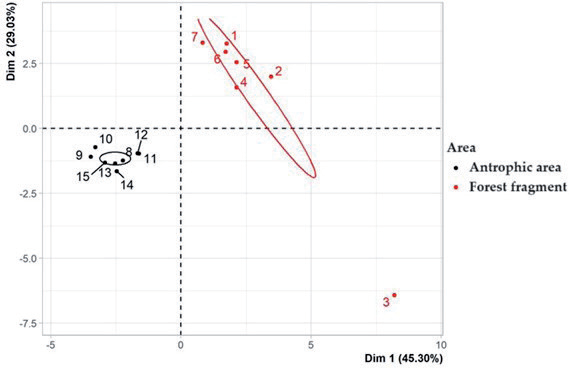
In the PCA, the first two components explained 74.3% of the total variation between the samples, indicating that the graphic dispersion obtained had a good representation of the original distance between the samples. By visual analysis of the graphical dispersion, the formation of two distinct groups of samples, each group corresponding to an area of origin, except for sample 3, from the FF, which was positioned distant from both groups (Fig. 1).
Content of Inorganic Elements in the Roots of S. Pulcherrimum
In the root analysis of S. pulcherrimum, 15 inorganic elements were detected. Each had significant differences (p<0.05) for contents in samples from FF and AA (Table 2). Of the elements detected, three were macroelements (P, Mg, and S), two were essential microelements (Fe and Ni), and the other ten were non-essential elements (As, Ba, Co, Cr, I, Pb, Se, Ti, Y, and Yb). Part of the elements detected in the rhizosphere soil were not detected in the roots, including macro and essential microelements and non-essential elements. The essential macroelements P and Mg differed in content in the roots of the samples from different areas. As for the non-essential elements, except for Yb, all the others were quantified with contents in the roots of the AA samples superior to those of the FF.
Table 1.
Inorganic elements in soils with the occurrence of S. pulcherrimum in an urban forest fragment in the municipality of Manaus and an anthropic urban area in the municipality of Novo Airão, Amazonas, Brazil.
The first two components of the PCA explained 85.37% of the total variation of the samples, indicating that the distortion of the coordinates of the samples in the dispersion plot was low and that with these components, the original variation between the samples was well represented. As verified in the rhizospheric soil analysis, the samples were separated into groups according to their origin, that is, with separation between samples from FF and AA (Fig. 2).
Fig. 1.
Principal Component Analysis with a graphical distribution of 16 individuals of S. pulcherrimum from Manaus Forest Fragment and Novo Airão Anthropic Area, Amazonas (Brazil), for inorganic elements in the rhizosphere soil. The ellipses indicated in the graph represent the regions of confidence for the characterization of the analyzed areas.
Content of Inorganic Elements in the Leaves of Stryphnodendron Pulcherrimum
In the analysis of the leaves of S. pulcherrimum nine elements were identified: three macro elements (P, Mg, and S), two essential microelements (Fe and Ni), and four non-essential elements (Yb, Cr, Se, and Y), all with statistical differences between the medians of the samples from FF and AA (Table 3). The macroelements and essential microelements identified in the leaves were the same as those identified in the roots. For nonessential elements, six identified in the roots were not found in the leaves (As, Ba, Co, I, Pb, and Ti). As observed in roots, the Yb content in leaves was significantly higher in FF samples and for Se and Y higher in AA. For Cr, unlike the roots, the content in the leaves was higher in FF.
The four elements found in the highest concentration in the leaves were in the following order of values S>Yb>Ni>Cr, all of them were identified in statistically higher values for the FF area (Table 3), while in the AA the order was Mg>Y>Se (Table 3).
The dispersion plot created with the first two PCA components accounted for 74.0% of the total variation in the samples, suggesting that the distance between the sampled individuals was adequately represented and with low distortion (Fig. 3). As observed in the analysis of the elements identified in the rhizospheric soil and roots, the graphical dispersion in the PCA from the elements in the leaves also indicated the separation of individuals sampled in two groups, the areas of origin of the individuals.
Table 2.
Contents of inorganic components determined in the roots of S. pulcherrimum in an urban forest fragment in the municipality of Manaus and an anthropic urban area in the municipality of Novo Airão, Amazonas, Brazil.
Fig. 2.
Principal Component Analysis with graphical distribution of 16 individuals of S. pulcherrimum from Manaus Forest Fragment and Novo Airão Anthropic Area, Amazonas (Brazil), of inorganic elements in the roots. The ellipses indicated in the graph represent the regions of confidence for the characterization of the analyzed areas.
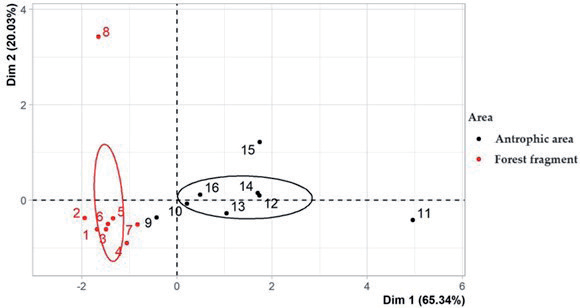
Table 3.
Contents of inorganic components determined in leaves of S. pulcherrimum in an urban forest fragment in the city of Manaus. Urban area in the municipality of Novo Airão, Amazonas, Brazil.
S. Pulcherrimum Dry Mass Components
The type of area analyzed significantly influenced (p<0.05) the variables LDM, RDM, LMR, and RDMR (Table 4). In general, in the forest fragment area, there was greater LDM (6.47 g·kg−1) and LMF (0.84 g·kg−1). In the anthropized area, it was verified that there were higher values for RDM (2.68 g·kg−1) and RDMR (0.39 g·kg−1). In the forest fragment area, the lowest values for RDM (1.28 g.·kg−1) and RDMR (0.16 g·kg−1 ±0·02) were observed (Table 4).
The first two components of the PCA explained 99.2% of the total variation of the samples, demonstrating low distortion of the coordinates in the graphic distribution of the individuals and adequate representation of the distance between them. As in the PCA analyses performed with inorganic element contents in the rhizospheric soil, roots, and leaves of plants, in the analysis with dry matter, values of the graphic distribution obtained indicate the separation of individuals into two groups, each group corresponding to an area of origin (Fig. 4).
Correlations Between Inorganic Elements and Dry Mass Analyzed in S. Pulcherrimum
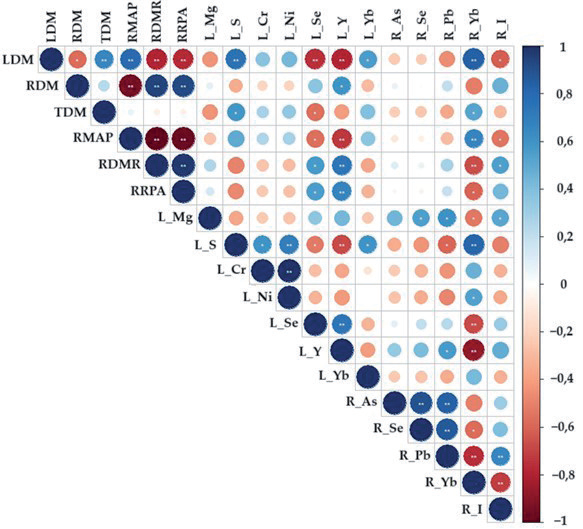
In Fig. 5, the correlations between inorganic components, leaf dry mass (LDM), root dry mass (RDM), leaf dry mass ratio (LMR), and root dry mass ratio (RDMR) of Stryphnodendron pulcherrimum were represented.
Significant, strong (0.7>0.9) and positive correlations were observed between LDM x R_Yb (0.84), LDM x L_S (0.76) and RDMR x L_Y (0.73) and negative between LDM x L_Y (−0.80), LDM x L_Se (−0.75) and RMAP x L_Y (−0.73). Significant, moderate (0.5>0.7) and positive correlations were observed between LDM x L_Yb (0.55), RDM x L_Y (0.59), TDM x L_S (0.58), TDM x R_Yb (0.52), RMAP x R_Yb (0.67), RDMR x L_Se (0.57), RDMR x R_I (0.56), RRPA x L_Se (0.55), and RRPA x L_Y (0.67), and negative correlations were observed between RDM x R_Yb (−0.51), TDM x L_Se (−0.56), RMAP x L_Se (−0.57), RRPA x R_Yb (−0.60), LDM x R_I (−0.61), RMR x R_Yb (−0.67).
The soils of the forest fragment area of preserved primary forest and anthropized forest area, secondary in recomposition, showed pH in H2O of 4.0 and 3.0, respectively, remaining below the range considered adequate (5.5 to 6.2) for the satisfactory growth of most plants [48]. In research involving the concentration of trace elements in urban soils in Manaus, the soils were classified as soils of high or medium acidity with a pH in H2O water of 4.30 [49].
Fig. 3.
Principal Component Analysis with graphical distribution of the 16 individuals of S. pulcherrimum from Manaus Forest Fragment and Novo Airão Anthropic Area, Amazonas (Brazil), evaluated for levels of inorganic elements in the leaves. The ellipses indicated in the graph represent the regions of confidence for the characterization of the analyzed areas.
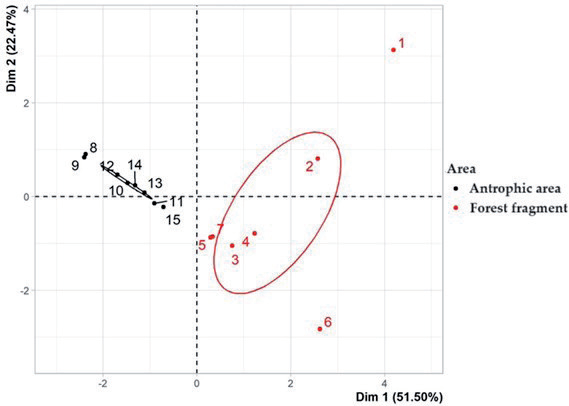
Table 4.
Leaf dry mass (LDM), root dry mass (RDM), leaf mass ratio (LMR), and root mass ratio (RDMR) of preserved forest fragment (FF) plants of primary forest (PF) and anthropized area (AA) of S. pulcherrimum.
Of the 14 elements considered essential for plant growth and development [50, 51], seven were present in the soils of the two study areas, in greater or lesser concentration, such as K, S, Fe, Cu, Cl, Co, and Ni. However, some of these essential elements are also metalloids, that in concentrations above adequate levels, have toxic effects on plants, such as Cu, Fe, Ni, and Co [52].
Most trace elements that occur naturally in soil are not in a bioavailable form for absorption by plants [53]. Unlike the trace elements added to the soil by anthropogenic sources that normally present a high bioavailability [54, 55]. However, its phytoavailability is related to factors associated with soil (pH, redox potential, cation exchange capacity (CEC), soil type and texture, and organic matter content) and factors associated with plants (such as root exudates and the association of microorganisms and the rhizosphere). Thus, the use of technologies that can efficiently quantify the concentration of trace elements in the soil-plant system is of paramount importance.
In the anthropized area, it was observed that the concentration of K in the soil was lower than in the forest fragment area, due to the ease of the element being leached and the fact that K was unavailable to the plant more quickly [56] due to the degree of soil weathering. The contents of the elements Co, Si, and Ba in the forest fragment area and anthropized area, respectively, remained above the reference values (17.6, 2243.9, and 11 mg·kg−1) of quality proposed for soils of natural areas in the Central Amazon. The availability of nutrients in forest ecosystems has been attributed to the decomposition of organic matter and the efficient cycling of litter nutrients [57, 58].
Fig. 4.
Principal Component Analysis with a graphical distribution of 16 individuals of S. pulcherrimum, from Manaus Forest Fragment and New Airão Anthropic Area, Amazonas (Brazil), evaluated for leaf dry matter (LDM) root dry mass (RDM), leaf dry mass ratio (LMR) and root dry mass ratio (RDMR). The ellipses indicated in the graph represent the regions of confidence for the characterization of the analyzed areas.
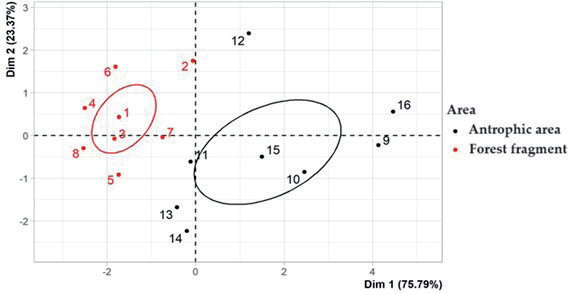
Fig. 5.
Pearson correlation between inorganic components, leaf dry mass (LDM), root dry mass (RDM), leaf dry mass ratio (LMR), and root dry mass ratio (RDMR) of S. pulcherrimum. Leaf dry mass (LDM), root dry mass (RDM), leaf dry mass ratio (LMR), root dry mass ratio (RDMR), total dry mass (TDM), reason mass aerial part (RMAP), reason root part aerial (RRPA), leaf (L) and root (R). The colors refer to negative (red) and positive (blue) correlations, respectively, the more intense the color, the greater the correlation. Asterisks indicate the level of significance (* p≤0.05 and ** p≤0.01).
The predominance of metals Ni, Fe, Ti, and Cr in the forest fragment area, except for Fe, indicates a higher concentration of these elements in clayey soils and with the accumulation of organic matter. The forest fragment area provided higher Cr concentration in the leaves, remaining above (10 mg·kg−1) of the values considered for plant tissues [59]. The concentration of the element in the leaves was higher than the root absorption, indicating that there was leaf absorption of Cr in the forest fragment [60].
Industrial activities are responsible for significant emissions of trace elements into the atmosphere and can be transported over long distances [61, 62]. These metals accumulate in the leaves of plants by foliar transfer after the deposition of atmospheric particles on the leaf surface [63]. Plants that grow close to industrial areas, as was the case of S. pulcherrimum in the urban forest fragment, present high leaf contents of heavy metals, such as Cr. Thus, S. pulcherrimum is a potential species for biomonitoring studies because it is close to the industrial area and has accessible roads to evaluate Cr contamination via atmospheric deposition.
Considering that the concentration of Co in soils is low, it varies between 15 and 25 mg·kg−1 [64] and according to the CONAMA resolution [65], the prevention value for Co in soils is 25 mg·kg−1, that is, the limited concentration of the element in the soil. Based on this, the two study areas: forest fragment area and anthropized area, showed high levels of Co, exceeding the limits of prevention for land use in agriculture. Specifically, Quality Reference Values (VRQ), which are the natural concentration of an element in soils that have not been modified by anthropogenic activity but have been determined for soils of the agricultural frontier in the southwest of the Amazon, comprise about 15 to 21,3 mg·kg−1 of the soil element [66].
The results of the present work indicate that the concentration of Co in the two study areas is above the determined levels and needs to be monitored. The areas are characterized by heavy vehicle traffic on the main avenues. Studies show that high concentrations of Pb, Mn, Ni, and Co in soil are related to vehicular emissions [67-69].
The prevention value (PV) for Ba, according to the CONAMA resolution [65], is 150 mg·kg−1, the limit value of the element concentration in the soil. In the present study, the concentration of the element in the two studied areas was higher than the PV, and in the forest fragment area, was approximately 4.9 times higher than the VP. Despite the high concentration of Ba in the soil of the forest fragment area, the element is more absorbed by the roots of the plants in the anthropized area, and its availability is related to the decrease in pH. However, both Co and Ba do not show displacement of the element for the leaves of S. pulcherrimum.
Similarly, the Al content in the two study areas remained above (491.04 mg·kg−1), which was considered adequate. In the forest fragment, the concentration of Al in the soil was higher when compared to the anthropized area. Despite its high concentration in the soil, there was no content or accumulation of the element in S. pulcherrimum plants.
With acidic pH and high Al concentrations, there is a restriction in root growth because this element compromises cell elongation and division [70], impairs nutrient absorption, and inhibits plant growth [71].
The elements Cu and Yb in the forest fragment area presented levels above, 3.5 and 0.77 mg·kg−1, respectively, of the reference values for soils of natural areas in the Central Amazon and natural values for rare earth elements in soils of the Brazilian Amazon [72]. It was observed that for Yb, the trees of S. pulcherrimum presented expressive content in the soil, root, and leaves, and that practically what the plant absorbed by the roots was translocated to the leaves, with the leaf content being higher than the content in the roots. High levels of heavy elements in the leaves may also be related to leaf absorption.
It was observed that the Cu content in the rhizospheric soil in the forest fragment area remained above the limits considered ideal, while the anthropized area remained within the appropriate limits. This behavior can be explained due to the anthropic pressure that the forest fragment (Manaus) suffers, especially with the installation of the industrial pole of Manaus and the increase of vehicular traffic near the fragment. The concentration of Cu observed in this study for the forest fragment area remained above the reference values (9.55 mg·kg−1) determined for urban soils in the city of Manaus.
In AA, the elements Sc and Nb were detected only in the rhizospheric soil of AA, while in FF, their presence was not identified either in the soil or in the roots and leaves of plants. The Y was also observed only in the anthropic area; however, its presence was observed in the rhizosphere soil and the roots and leaves of the plants. For these elements, there are no reference values for soils. The occurrence of Sc, Y, and Nb indicates that the soil formation of the municipality of Novo Airão, formed from old sediments [73], influenced the occurrence of these elements since they did not occur in the forest fragment area.
Y is considered a rare earth element, which, unlike its name, is widely distributed in soils and plants; however, little is known about its effects on plant growth and development [74]. For Y levels in the roots and leaves of S. pulcherrimum, there are no reference values. It was observed that there was a higher concentration of the element in the root compared to the leaves, indicating that the absorption of Y by the root system is more intense than its translocation to the leaves. Concentrations of the elements in the leaves and stems should be investigated since they are used for medicinal purposes and can have negative effects on human health.
For the Nb element, so far, there are no established quality reference values for soils from the Central Amazon and Brazil. It is not possible to conclude if the concentration of Nb in the rhizospheric soil of the anthropic area is related to the material of the soil or anthropic activities. Even so, high concentrations of the element were observed in latosol soil types [75].
The levels of Sr and Pb in the anthropized area, respectively, 14.9 and 16.6 mg·kg−1, were above the proposed reference value for soils in natural areas in the Central Amazon. The identified presence of Pb only in the rhizosphere soil and in the roots of the plant is indicative that the element available in the soil is absorbed by the roots; however, it is not translocated to the leaves.
Studies have revealed that the toxic effects of trace elements in plants are the most adverse and that this, in addition to limiting growth, directly affects the photosynthetic apparatus and pigments due to metal toxicity in the plant. The presence of these elements in the soil can, in extreme cases, restrict the growth of all plants, except the most tolerant ones. However, for trace elements in the soil to be absorbed and accumulated in plants, they must be in phytoavailable formats, which depend on organic and inorganic soil constituents such as well as Fe and Al oxide, silicates, phosphates, and carbonates, as pH, cation exchange capacity (CTC), organic matter content, oxides and hydroxide content of Fe, Al, and Mn, and biological activity [76].
Conclusions
Heavy metals are present in the soils of urban forest fragment areas in Manaus (Amazonas, Brazil) and in the altered area in the municipality of Novo Airão (Amazonas, Brazil), in some cases in concentrations higher than the reference values for soils of natural areas, indicating that anthropogenic action may be responsible for the presence or increase of these elements in soils.
In the species S. pulcherrimum, the largest number of heavy metals is identified in the roots when compared to the leaves, suggesting that part of the absorbed elements is not translocated.
The variability in heavy metal contents in S. pulcherrimum plants in preserved forest fragments and anthropic areas infers that there may be genetic variability in the absorption and bioaccumulation capacity of these elements.
Individuals of S. pulcherrimum in the forest fragment of the city of Manaus have high leaf contents of Cr and Yb, inferring the effect of the species on phytoremediation or bioindication of these elements. Individuals of S. pulcherrimum in the anthropized area of Novo Airão (Amazonas) have high leaf concentrations of Cr, Ni, and Y. These data suggest the use of leaf tissues of the species for phytoremediation, bioindication, or bioaccumulation for these elements.

