

Introduction
In today’s global society, people’s urgent demand for sustainable development and environmental protection awareness is increasing, and supply chain finance, as an important pillar for SMEs to solve the problems of difficult and expensive financing, is likewise facing a moment of transformation and upgrading. Green supply chain finance is an emerging mode of supply chain finance, which not only helps to solve the financing problems of SMEs by integrating financial tools and environmental protection concepts, but also facilitates the sustainable operation of enterprises. Green supply chain finance is not only the pursuit of corporate social responsibility, but also the pragmatic embodiment of efficient resource utilization and environmental friendliness. In the context of the current global pursuit of green and sustainable development, the development of green supply chain finance has become one of the key paths to promoting the sustainable economic development of SMEs.
As an emerging credit method, the development of green supply chain finance relies on the active participation of relevant market players and the influence of the scientific and technological environment. In green supply chain finance, the most important financial business transaction among SMEs, core enterprises, and financial institutions is credit business. From a micro perspective, the strategic choice of green supply chain finance participants is the basis for reaching credit business, and from a macro perspective, the stable development of the green supply chain credit market is the basis for the prosperous development of green supply chain finance market. At present, green supply chain finance is still in the stage of exploration and development, and the scientific and technological environment will play an important role in guiding the evolution and development of green supply chain finance.
With the rise of the new round of technological revolutions, new technologies such as blockchain, big data, cloud computing, internet of things, artificial intelligence, and so on are constantly emerging. Blockchain is a digitally distributed, decentralized public ledger that exists across a network. The ledger records specific transactions as a “block” of digitized information that flows through internet-linked devices. These transactions are executed via smart contracts, which is another name for algorithms that automate processes once certain conditions are met. As the transaction blocks are linked together to form an identical ledger stored across a distributed network of participating computers, hence the term “blockchain”, the process of creating and executing transactions becomes immediate, irreversible, and unchangeable [1]. Blockchain, with its technical characteristics such as data tamperability and data traceability, has the potential for innovative breakthroughs in the convenience and cost of financing, so there is a natural match between blockchain and the integration and development of green supply chain finance, and based on blockchain technology, green supply chain finance will be driven by a new empowerment. So, can the development of green supply chain finance be Pareto-improved with the empowerment of blockchain? And in what way does blockchain empowerment work? In the existing literature related to green supply chain finance, there are fewer studies that consider the development of green supply chain finance under blockchain empowerment, and there are fewer studies that analyze the strategic behaviors of green supply chain finance subjects from the perspective of cost, and there is insufficient theoretical support related to blockchain empowerment of green supply chain finance. The development of green supply chain finance is a long-term and dynamic process, and exploring the green supply chain finance market under blockchain empowerment through the evolutionary game method is more in line with the dynamic characteristics of real economic development, and it has a certain reference significance in guiding the development of green supply chain finance.
This paper intends to adopt the evolutionary game method, put the three participants of green SMEs, core enterprises, and financial institutions under the same analytical framework, introduce the cost perspective under the information asymmetry into the evolutionary game model, study the behavioral strategies of the participating subjects of green supply chain finance from the cost perspective, explore how blockchain technology empowers the green supply chain finance from the microscopic point of view, excavate the influence of the cost factors on the evolutionary state, and further numerical simulation using Matlab tools to verify the accuracy of the model, in-depth analysis of the impact of blockchain empowerment and other factors on the results of the three-party game of green supply chain finance, to explore how to promote the stable development of the green supply chain finance market, and to provide suggestions for reference to the decision-making of the relevant departments.
Literature Review
Green Supply Chain Finance
Green supply chain is the concept of sustainable development throughout the whole process of traditional supply chain management; that is, the concept of environmental protection and resource conservation is integrated in the whole process of raw material procurement, production, transportation, storage, sales, recycling, and disposal of products, and the nodes of each chain are centered around the core enterprise, relying on the supply relationship between the upstream and downstream, to carry out green supply chain management, green procurement, and so on, with a view to the pursuit of economic interests while undertaking the environmental protection responsibility [2, 3]. Currently, there are relatively more studies on green supply chain in academia. For example, Yang et al [4] investigated the optimal strategies of the members and the supply chain performance under different cooperation modes between two green supply chains in the context of carbon allowance trading. Vanalle [5] et al. investigated the relationship between the drivers, economic performance and environmental performance of green supply chain management and showed that the economic and environmental performance of supply chains is positively related to the adoption of green supply chain management practices. Song and Gao [6] established a green supply chain game model under two different revenue-sharing contracts, and found that the revenue-sharing contract can effectively improve the greening level of the supply chain as well as the revenue level.
In order to promote the green transformation of enterprises in the industrial chain, realize the maximum effectiveness of energy saving and emission reduction, and make up for the financial gap of green development, green supply chain finance has emerged as a new financing method to support the sustainable development of enterprises. Green supply chain finance is a new type of financing method developed through the integration of existing supply chain finance, green finance, and green supply chain, which emphasizes the green investment of funds [7, 8]. At present, the definition of green supply chain finance is not unified in academia. Zhao [9] argues that green supply chain finance is a new type of financing that focuses on enterprise restructuring and promotes the development of enterprise capital flow and environmental protection. Wang et al. [10] believe that green supply chain finance is the organic integration of the concepts of green supply chain, supply chain finance, and green finance. Feng et al. [11], on the basis of summarizing previous studies, argues that green supply chain finance requires SMEs to not only meet the conditions of supply chain finance, but also submit pollutant discharge permit and sewage right pledge loan applications to commercial banks on this basis, and commercial banks will provide financial services to them only after they have examined and approved the applications. In general, green supply chain finance is conducive to accelerating the efficiency of green investment of funds and optimizing the allocation of financial resources in the green field through the collaboration of various nodes in the supply chain in investment and financing in the green field.
Most of the theoretical studies on green supply chain finance have explored the game theory approach. Panja and Mondal [12] constructed a green supply chain game model containing retailers and manufacturers under three decision scenarios, namely, the integration model, the Stackelberg model, and the profit proportional sharing model. Yang et al. [13] considered retailers facing financial constraints in the scenario. They studied a green supply chain consisting of a manufacturer and two retailers and explored different credit strategies, such as internal and external financing of the green supply chain, with a special focus on the retailer’s financial constraints. Fang and Xu [14] considered the bank factor in their study and constructed a green supply chain finance game model among banks, retailers, and manufacturers. It is found that when manufacturers face weak financial constraints or when consumers are less aware of environmental protection, manufacturers are more inclined to give up hybrid financing methods, i.e., a combination of green credit and retailer advances. Wu and Kung [15] study the impact of financial risk on equilibrium output and equilibrium price of green supply chains from the point of view of financial risk under both complete information and incomplete information scenarios. They argued that the government should encourage financial institutions to provide preferential loans for green supply chains in order to promote the development of green supply chains. Forcella et al. [16] studied the environmental performance of 58 microfinancial institutions in Europe. The results of the empirical study show that the loan size of MFIs is closely related to their environmental performance. This suggests that the impact of non-bank financial institutions cannot be ignored when considering the lasting development of green supply chain finance.
Green Supply Chain Finance Empowered by Blockchain
Under the premise that issues such as trust continue to emerge in the practice of supply chain finance, the introduction of blockchain technology or the construction of a platform based on blockchain technology can improve the transparency, information traceability and security of the supply chain [17–19]. The new features of blockchain, such as decentralization, consensus mechanism, and collective supervision, have a natural fit with the characteristics of supply chain finance with multiple participants and upstream and downstream collaboration, which can save transaction costs on supply chain finance to a certain extent, so the integration of blockchain and supply chain finance has gained a lot of attention from scholars. For example, Zheng et al. [20] study the order quantity decision and risk decision problems in spacecraft supply chain, under the perspective of blockchain-facilitated information sharing. Choi [21] investigates the impact of blockchain-supported platform sales model on the profit, consumer surplus, and social welfare of members of a luxury goods supply chain. Liu et al. [22] consider a three-level supply chain, consisting of a manufacturer, distributor, and capital-constrained retailers, a three-tier supply chain consisting of manufacturers, distributors, and retailers, and explore the operational strategies of a blockchain technology-enabled supply chain finance model (Blockchain Platform Finance, BPF). Xu et al. [23] find that the degree of information sharing in supply chain finance based on blockchain technology is much higher than that in traditional supply chain finance, and that the use of blockchain technology can contribute to the development of supply chains in a more sustainable manner. However, very few studies have been seen in which blockchain is combined with green supply chain finance.
Some scholars have likewise attempted to use the analytical tools of game theory to study the development of supply chain finance under the empowerment of blockchain. Zheng et al. [24] conduct a three-party game analysis of the supply chain factor financing process, obtain an equilibrium solution based on the principle of utility maximization, and give a chain of optimization roles of the smart contract technology on the decision-making behaviors of individual entities in the supply. Dong and Qiu [25] developed a three-tier supply chain model and used a game theoretic approach to compare how blockchain-enabled financing schemes affect the optimal risk mitigation strategies and financing strategies of a supply chain with financing constraints. The results of the game show that while increased visibility through blockchain adoption can help firms make more informed supply chain financing decisions, whether it benefits all supply chain members depends on the financing scheme used, and the effect of the game is not unique. Deng et al. [26] explored the impact of blockchain technology maturity on supply chain finance participants, using principal-agent modeling and incentive theory and designing an incentive mechanism between platforms, banks, and central banks, so as to find the optimal incentive contract in the blockchain technology-enabled online supply chain. Yan et al. [27] proved the usability of the receivables pledge financing model based on supply chain finance through simulation analysis and evolutionary game theory. Lou et al. [28] introduced a theoretical framework of blockchain-enabled supply chain finance through a bank-enterprise financing efficiency optimization two-way perspective and studied the impact of the introduction of blockchain technology on the supply chain financial system by using a three-way game and a dynamic evolutionary game model.
In summary, there are relatively more studies on the application of blockchain to supply chain finance, but very few studies on the development of green supply chain finance empowered by blockchain; there have been some results on the development of supply chain finance empowered by blockchain by using the analytical tools of game theory, however, there are relatively few literatures on the development of green supply chain finance financing empowered by blockchain by using the tools of evolutionary game, and there are no studies on the development of green supply chain finance empowered by blockchain by specifically focusing on the perspective of transaction cost under information asymmetry. The semantics of the underlined part are repeated, so please delete the underlined part. This paper tries to study the behavioral strategies of green supply chain finance from the cost perspective, explore how blockchain technology empowers green supply chain finance from the micro perspective, and explore the impact of cost factors on the evolutionary state, and deeply analyze the impact of blockchain empowerment and other factors on the results of the three-party game of green supply chain finance.
Research Model
Analysis of Strategic Behavior of Participating Subjects
in Three-Party Games
In green supply chain finance, green SMEs, core enterprises, and financial institutions are important participants. SMEs in green supply chain finance apply for pollutant discharge permit from environmental protection department, and if they pass the recognition and get the green recognition certificate issued by environmental protection department, they submit the application for sewage right pledge loan to financial institutions, and such SMEs are called green SMEs; core enterprises refer to larger enterprises in green supply chain finance, which evaluate the qualification of SMEs and review the environmental recognition certificate, and decide whether to guarantee the green SMEs with their credit and apply for loans from financial institutions; financial institutions are responsible for providing funds in green supply chain finance.
The green supply chain finance business process framework is shown in Fig.1. Green SMEs, core enterprises, and financial institutions have different interests, and all kinds of subjects in the green supply chain financial market choose different action strategies and play with each other. Green SMEs have a relatively unstable capital chain, and energy saving and emission reduction transformation of the funds generated by a larger demand often tends to ease the pressure of insufficient capital operations through financing. If green SMEs choose the strategy of “financing”, they have to spend search costs and pledge costs in the financing process, as well as pledge accounts receivable, orders, warehouse receipts, etc. under the premise of providing a green recognition certificate to apply for financing. They will have to pay the principal and interest after the maturity of the loan. Green SMEs can also choose the “no financing” strategy and maintain the original transaction. If the core enterprise chooses the “guaranteeing” strategy, it has to assess the green qualification and development credit status of the green SMEs, pay a certain evaluation cost, and bear a certain credit default risk. The income comes from interest. The core enterprise can also choose the “no guaranteeing” strategy and keep the original income. If a financial institution chooses the “serving” strategy, it has to commission the core enterprise it cooperates with to evaluate the feasibility of the loan and pay evaluation and supervision costs in the process of opening and operating green supply chain finance business. The revenue comes from interest. Financial institutions can also choose the “no serving” strategy and keep the original income.
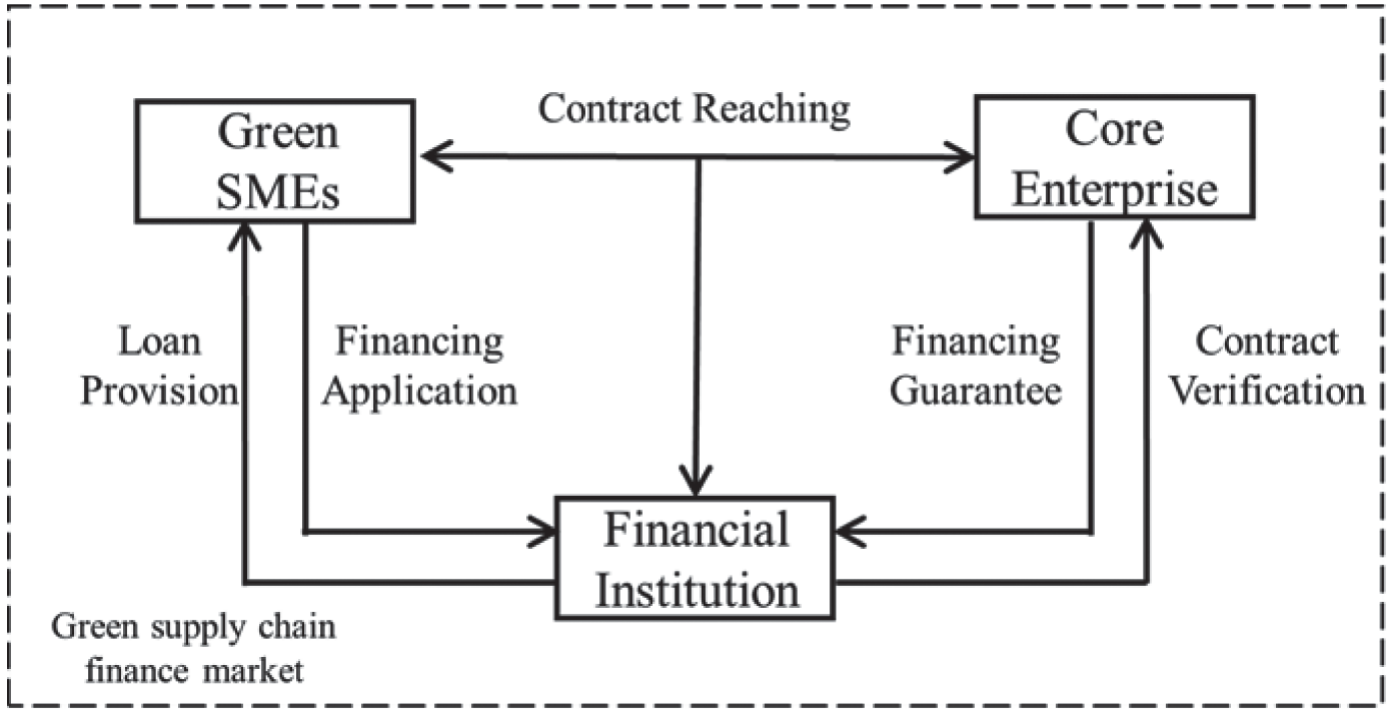
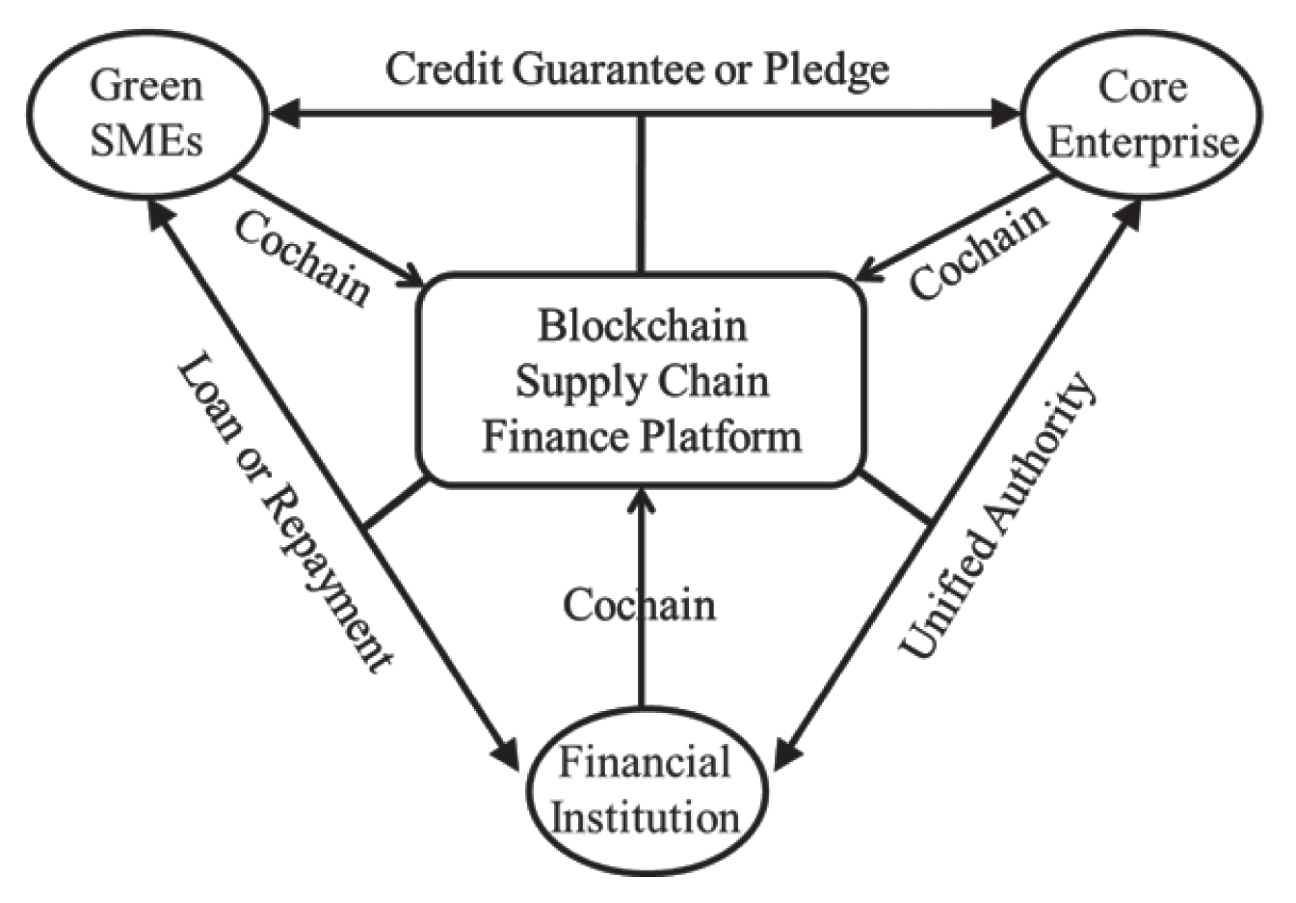
However, the green supply chain finance market is characterized by information asymmetry, and transaction friction often exists in the transaction process. In the operation of green supply chain finance, due to the need to submit a loan application for sewage right pledge and provide pledges, the financing cost of green SMEs is relatively high; at the same time, due to the impossibility of obtaining real-time information on the real transactions of each link in the supply chain, the assessment cost of core enterprises and the supervision cost of financial institutions are also relatively high, which is not conducive to the development of green supply chain finance. Blockchain technology has the characteristics of “permanent traceability and non-tampering”, and the application of blockchain technology can form a blockchain-enabled supply chain finance platform. Green SMEs, core enterprises, financial institutions, logistics enterprises, and other green supply chain finance participants will register as members of the blockchain supply chain finance platform, and the information flow, data flow, business flow, and logistics of these participants will be fully and completely recorded on the blockchain. Since blockchain is characterized by information transparency and can realize credible uploading of each link, all participants on the platform can truly understand the information of other participants.
Fig.2 shows the operation mode of green supply chain finance empowered by blockchain. When green SMEs apply for loans, the original traditional manual sewage right pledge loan application financing is transformed into more efficient and secure on-chain digital financing, which effectively reduces the financing costs of green SMEs. Core enterprises assess the qualification and credit of green SMEs through the blockchain supply chain finance platform, and due to the transparency of information, they do not have to pay for the cost of understanding the emission rights permits and credit records of green SMEs, and they can achieve the purpose by reading the information directly on the platform, which saves a lot of manual and complicated operations, simplifies the loan process, and effectively reduces the assessment cost of core enterprises. Financial institutions assess the credit of core enterprises through the blockchain supply chain finance platform, while verifying the authenticity of debts and vouchers, and decide whether to lend money after judging the authenticity of the transaction. They can also monitor the development of green SMEs and core enterprises in real time during the lending process, which effectively reduces the cost of manual assessment and the cost of manual supervision.
Premises and Payoff Matrix of the Evolutionary Game Model
It is assumed that the participants in the green supply chain finance game empowered by blockchain are green SMEs A, core enterprise B, and financial institution C. The model also assumes the following premises:
Premise 1: All participants are of bounded rationality. The strategy set for green SMEs includes “financing” and “no financing”. The strategy set for core enterprises includes “guaranteeing” and “no guaranteeing”. The strategy set for financial institutions includes “serving” and “no serving”. This paper categorizes “financing”, “guaranteeing”, and “serving” as positive strategies. On the other hand, “no financing”, “no guaranteeing”, and “no serving” are considered negative strategies.
Premise 2: The proportions of choosing positive strategies among green SMEs, core enterprises, and financial institutions are respectively x, y, and z (0≤x,y,z≤1). Hence, the proportion choosing negative strategies are respectively 1-x, 1-y, and 1-z.
Premise 3: After blockchain-enabled green supply chain finance, the overall financing cost of green supply chain finance is greatly reduced. It is assumed that the amount of reduced financing cost for green SMEs is T1 (T1<C1), the amount of reduced appraisal cost for core enterprises is T2 (T2<C2), and the amount of reduced appraisal and supervision cost for financial institutions is T3 (T3<C3).
According to the parameter settings in the premises above, the payoff matrix of the game model is determined as shown in Table 1.
Definitions of parameters in the payment benefit matrix: R1 denotes the original benefit when the green SME does not engage in financing credit transactions. R2 denotes the original benefit when the core enterprise does not guarantee the green SME. R3 denotes the original benefit when the financial institution does not participate in green supply chain finance. r denotes the new benefit after the green SME finances the green SME. m denotes the amount of the green SME’s loan. i1 denotes the interest paid by the green SME as it pays interest to the core enterprise. i2 denotes the interest paid by the core enterprise to the financial institution. θ is the probability that the green SME pays back the loan on its own, and 1-θ is the probability of the core enterprise’s risky loss. k denotes the gain that the core enterprise obtains from disposing of the pledge in the event of the green SME’s default. C1 denotes the sum of the various types of costs paid by the green SME to seek financing. C2 denotes the cost of the various types of costs paid by the core enterprise to participate in the green supply chain finance. C3 is the sum of various types of costs paid by the financial institutions to participate in green supply chain finance.
Game Equilibrium Analysis
This paper uses the replicator dynamics method for game analysis. According to the payoff matrix in Table 1, the replicator dynamics equations for the tripartite game of green supply chain finance empowered by blockchain are listed as follows:
(1)
With dt = 0 , dt = 0 , and dt = 0 in equation group (1), the local equilibrium points of the game system are E1(0,0,0), E2(1,0,0), E3(0,1,0), E4(0,0,1), E5(0,1,1), E6(1,0,1), E7(1,1,0), E8(1,1,1), and E9(x*,y*,z*), where(x*,y*,z*) is the solution of equation group (2).
Since the stable solution in a multi-population evolutionary game must be a strict Nash equilibrium solution [29], this paper focuses on the equilibrium points. According to the method proposed by Friedman [30], the local stability of the equilibrium point can be determined by the characteristics of the system Jacobian matrix. The Jacobian matrix of the game system is in the form of:
Table 1.
Payoff matrix of the tripartite game model.
Where the core part for mathematical judgement is
If there is a possibility of increasing the welfare of some people in the process of resource allocation without lowering the welfare of others, then this state is called Pareto dominance or Pareto improvement; otherwise, it is called Pareto optimality [31]. The Pareto optimal state corresponds to a frictionless and ideal economic environment, and the market converges to this state under the premise of free exchange and distribution among all individuals. There is no room for Pareto improvement in this state [32]. Conversely, the Pareto worst state is diametrically opposed to the Pareto optimal state and denotes the least favorable condition of resource allocation.
The local stability of equilibrium points in the multi-party game system can be determined using Lyapunov’s criterion. By applying this method, the local stability of E1~ E8 can be analyzed, resulting in Propositions 1 to 3.
Proposition 1. The E1 (0,0,0) is the ESS (Evolutionarily Stable Strategy) of the game system, which is a stable state and a Pareto worst state. This state is highly unfavorable for the development of green supply chain finance empowered by blockchain.
Proof of Proposition 1. Substituting (0,0,0) into equation group (3), the Jacobian matrix of E1 is obtained as:
By definition, -C1<0, -C2<0, -C3<0, and since the transaction cost cannot be completely eliminated, there are t1<C1, t2<C2, t3<C3, then -C1+t1<0, -C2+t2<0, -C3+t3<0. The Jacobian matrix of E1 has all negative eigenvalues, indicating that E1 (0,0,0) is the ESS of the system, as determined by the Lyapunov criterion. However, this stable state is highly unfavorable for the development of green supply chain finance empowered by blockchain, as it leads to green SMEs choosing “no financing,” core enterprises choosing “no guaranteeing,” and financial institutions choosing “no serving”.
Proposition 2. Regardless of parameter values, E2, E3, E4, E5, E6, and E7 are either unstable or saddle points; their stability is all unstable.
Proof of Proposition 2. The Jacobian matrix of E2 is:
According to Lyapunov criterion, an equilibrium point is an ESS only if all values on the diagonal of its Jacobian matrix are negative. Given that C1-t1>0, E2 is unstable or saddle point. Similarly, E3, E4, E5, E6, and E7 are all either unstable or a saddle points.
Proposition 3. When r+T1>θ(m+i1)+C1, i1+k+T2>C2 +(1-θ)(m+i1)+i2, and i2+T3>C3 are met simultaneously, E8 (1,1,1) becomes the ESS for the game system, leading to the optimal development of green supply chain finance empowered by blockchain.
Proof of Proposition 3. The Jacobian matrix of E8 is:
When conditions r+T1>θ(m+i1)+C1 , i1+k+T2>C2+(1-θ) (m+i1)+i2 , and i2+T3>C3 are met simultaneously, all eigenvalues of the Jacobian matrix are less than 0, thus E8 becomes the ESS of the game system. In this stable state, green SMEs tend to opt for the “financing” strategy, core enterprises for the “guaranteeing” strategy, and financial institutions for the “serving” strategy. All three parties in the game choose positive credit strategies and green supply chain finance empowered by blockchain evolves towards Pareto optimal state. When the above conditions are not met simultaneously, E8 is an unstable point or a saddle point of the three-party game system, and the stability is all unstable.
Table 2.
Equilibrium point analysis of the game system.
Table 2 summarizes the local stability of equilibrium points in the game system, as inferred from the propositions above. E1(0,0,0) is always the ESS of the game system, leading the game system towards the Pareto worst state with all entities opting for negative strategies. Only when conditions r+T1>θ(m+i1)+C1 , i1+k+T2>C2+(1-θ)(m+i1)+i2 , and i2+T3>C3 are met simultaneously, E8(1,1,1) becomes the ESS, leading the game system towards the Pareto optimal state with all entities opting for positive strategies. While E8(1,1,1) is either a saddle point or an unstable point in all other cases. E2, E3, E4, E5, E6, and E7 can only be unstable or saddle points, regardless of the parameter values.
Results and Discussion
Based on the theoretical analysis in the previous section, this section uses Matlab to numerically simulate the behavioral evolution of the participating subjects in the three-party game system. According to the benchmark commercial loan interest rate issued by the People’s Bank of China on December 20, 2023, the annualized interest rate for loans with a maturity of more than 5 years is 4.2%, so if a green SME takes out a loan of 250 thousand yuan with a maturity of 10 years, the interest due is about 50 thousand yuan, and from this, the initial values of the simulation parameters are defined as a benchmark. In order to facilitate the analysis, the parameter values were set, with m = 25, i1 = 5, r = 50, i2 = 4, θ = 50%, k = 20, C1 = 5, C2 = 3, and C3 = 3. In addition, it is assumed that, after the application of the blockchain, the green SMEs lower the cost T1 is 2, the cost T2 reduced by core enterprises is 1, and the cost T3 reduced by financial institutions is 1. The above initial conditions simultaneously satisfy the parameter conditions in Propositions 1 and 3. Except for studying the effect of the initial proportion of positive strategy on the evolutionary path, the initial proportion of positive strategy of the game participants is set to 0.5. The Influence of Initial Positive Strategies Proportion
on Evolutionary Trajectories
The evolution path of the tripartite game system of green supply chain finance under blockchain empowerment is shown in Fig. 3, where the horizontal axis represents the time (t), which takes the value range of [0,30], and the vertical axis represents the probability p that the green SMEs (x), the core enterprises (y), and the financial institutions (z) choose their respective positive strategies, which takes the value range of 0 to 1. Fig.3 is divided into three subfigures representing the evolutionary paths of each game participant when the initial positive strategy (x0, y0, z0) is (0.25,0.25,0.25), (0.75,0.75,0.75), and (0.5,0.5,0.5) respectively.
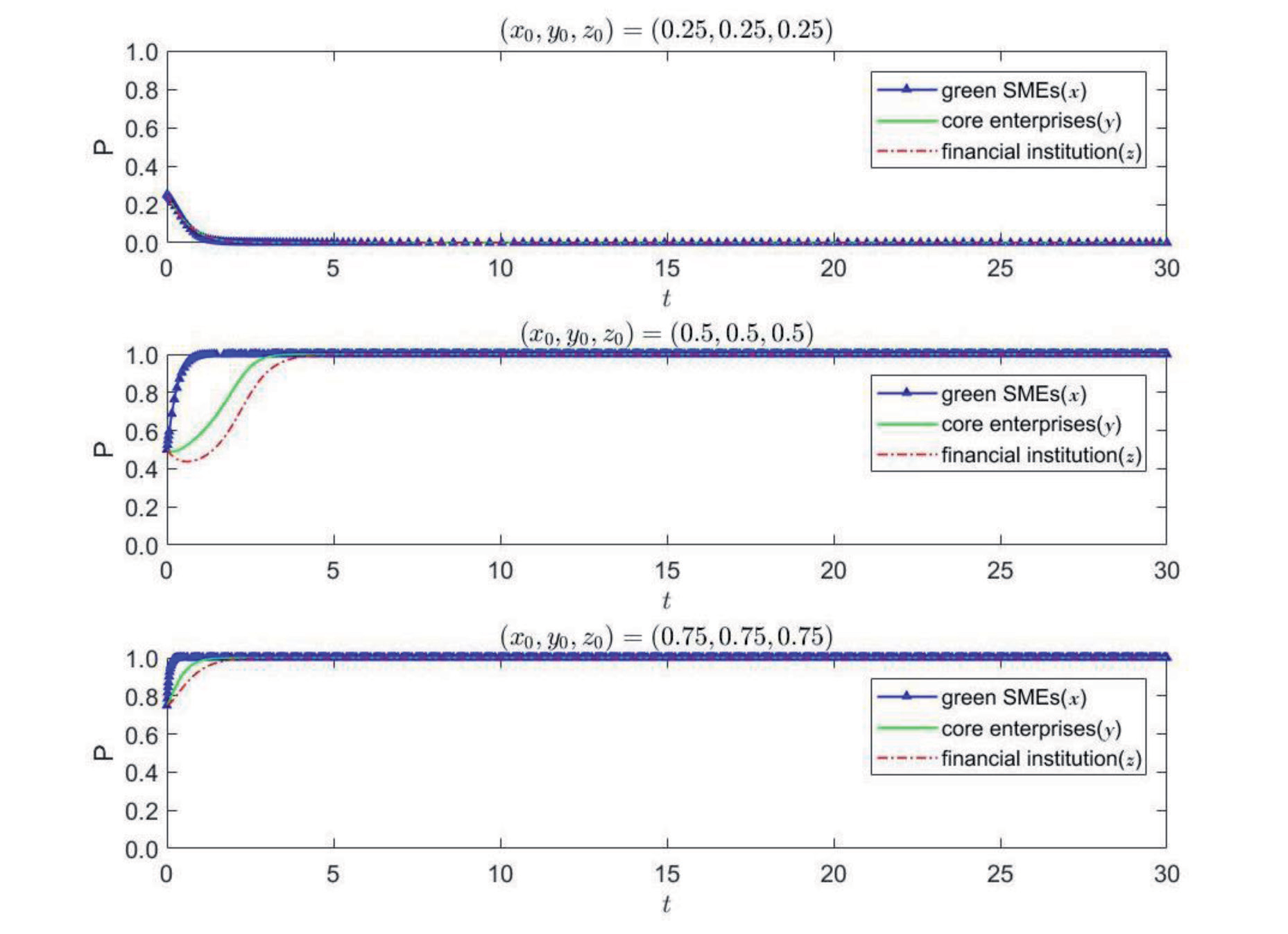
It can be found that when the proportion of initial positive strategies is relatively low, i.e. (x0, y0, z0) is (0.25,0.25,0.25), the probability of green SMEs, core enterprises, and financial institutions choosing (financing, guaranteeing, serving) strategies, respectively, tends to be close to 0, and the game system is evolving towards the Pareto worst state of (0,0,0) at this time. In the case of a relatively high proportion of initial strategies, the probability of the three parties choosing (financing, guaranteeing, serving) strategies tends to be close to 1, and the game system evolves towards the Pareto optimal state of (1,1,1). That is, under the above initial value conditions, there exist two evolutionary stable strategies of (0,0,0) and (1,1,1) for game systems. This verifies the analysis of propositions 1 and 3 and proves the accuracy of the model derivation. Meanwhile, the path of game system evolution is related to the size of the initial strategy proportion of the subjects. The higher the proportion of each subject’s initial positive strategy, the higher the probability that the game system converges to the equilibrium stable point (1,1,1), and vice versa, the higher the probability that the game system converges to the equilibrium stable point (0,0,0), which indicates that the higher the proportion of initial positive strategy of each subject participating in the game, the more the game system evolves towards the Pareto optimal state.
The Influence of Cost Reduction on Evolutionary Trajectories
With the empowerment of blockchain, the financing costs of green SMEs and the assessment cost and supervision costs of core enterprises and financial institutions are greatly reduced. In order to understand the specific influence mechanism in the reduction amount of costs, such as financing cost, assessment cost, and supervision cost on the evolution path of the three-party game system, we conducted numerical simulation. The simulation results are shown in Fig.4. Fig.4 shows four sub-figures, representing the evolution paths and directions of each game subject in the low-to-high case for financing cost reduction T1, assessment cost reduction T2, and assessment and supervision cost reduction T3, respectively.
Fig.4.
The evolutionary trajectories with variation of cost reduction: (a) T1=0, T2=0, T3=0; (b) T1=1, T2=0.5, T3=0.5; (c) T1=2, T2=1, T3=1; (d) T1=3, T2=2, T3=2.
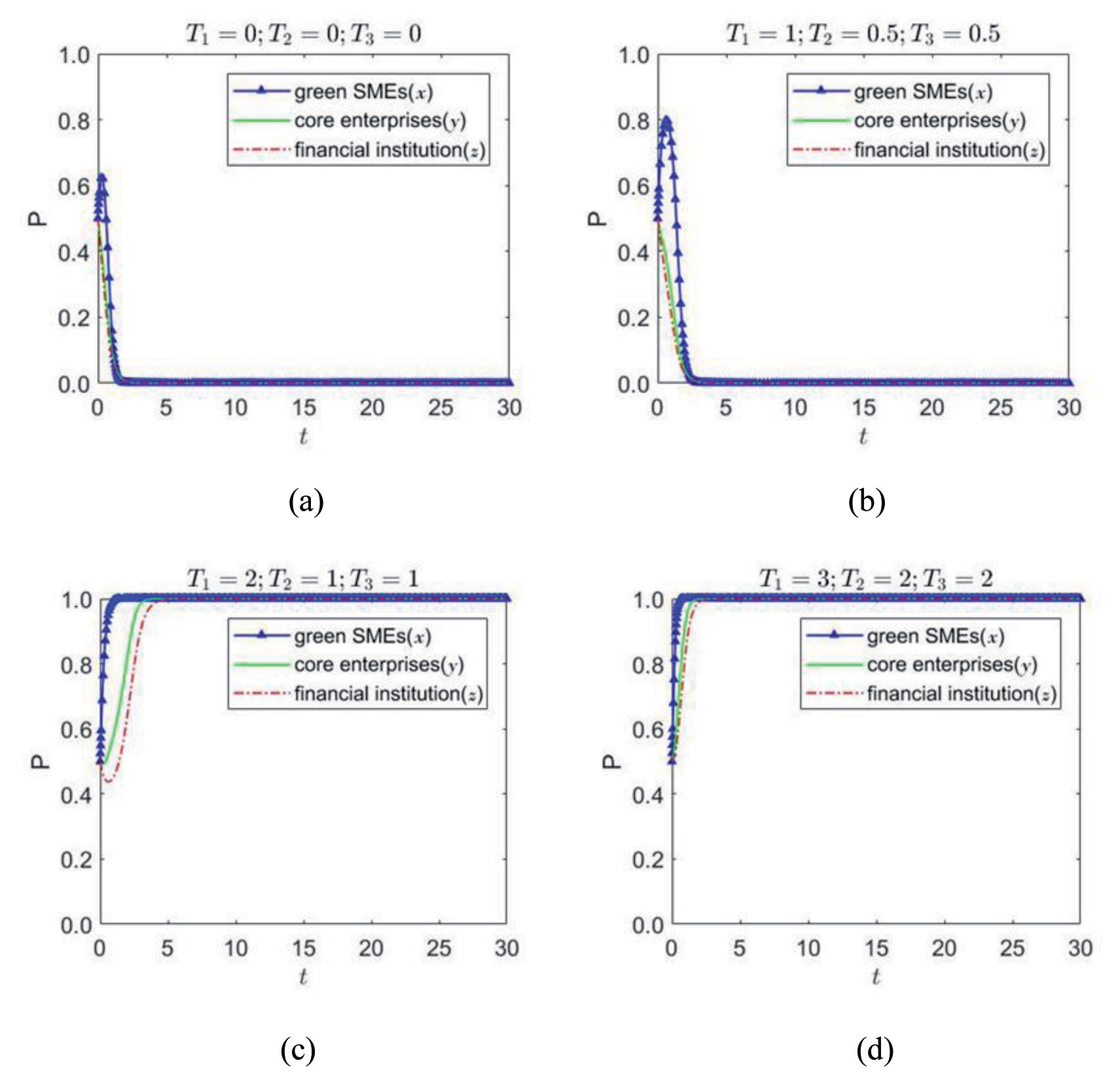
As shown in Fig.4(a), when the reduction of financing cost T1, the reduction of assessment cost T2, and the reduction of assessment and supervision cost T3 are all 0, the probability of green SMEs, core enterprises, and financial institutions choosing positive strategies all converge to 0, and all of them are already 0 when t=2 or so, and the gaming system is evolving towards the Pareto worst state of (0,0,0). As shown in Fig.4(b), when T1=1, T2=0.5, T3=0.5, the probability of green SMEs, core enterprises, and financial institutions choosing positive strategies also converges to 0. However, the time for all of them to converge to 0 is delayed compared with that of T1=0, T2=0, T3=0, which shows that with the increase in the amount of cost reduction, the rate of the main body of the game to converge to 0 decreases. As shown in Fig.4(c), when the cost reduction amount is larger, i.e., T1=2, T2=1, T3=1, the probability of the three-party game subjects choosing positive strategies gradually converges to 1, and all of them are already 1 when t=5, and the three-party game system of the green supply chain finance is evolving towards the Pareto optimal state of (1,1,1). Finally, as shown in Fig.4(d), when T1=3, T2=2, T3=2, the probability of the three-party game subjects choosing positive strategies also gradually converges to 1, and the time of all converging to 1 is earlier than that of T1=2, T2=1, T3=1, which indicates that with the increase in the amount of cost reduction, the rate of the game subjects’ convergence to 1 increases.
In summary, it can be found that the cost reduction amount has an important role in promoting the development of green supply chain finance under the empowerment of blockchain, which can prompt the evolution direction of the game system to shift from the Pareto worst state to the Pareto optimal state, and the rate of convergence of game subjects to the Pareto optimal stable state increases with the continuous increase of the cost reduction amount. The Influence of Green SMEs Autonomous Repayment
Rate on Evolutionary Trajectories
As a borrower, the high or low repayment rate of green SMEs is one of the key factors in determining whether green supply chain finance under the empowerment of blockchain can operate stably. In order to understand the specific influence mechanism of green SMEs’ credit default behavior on the evolution path of the three-party game system, we carried out numerical simulation, and the simulation results are shown in Fig.5. Fig.5 also shows four sub-figures representing the evolution paths and directions of each game subject in the case of low to high autonomous repayment rates.
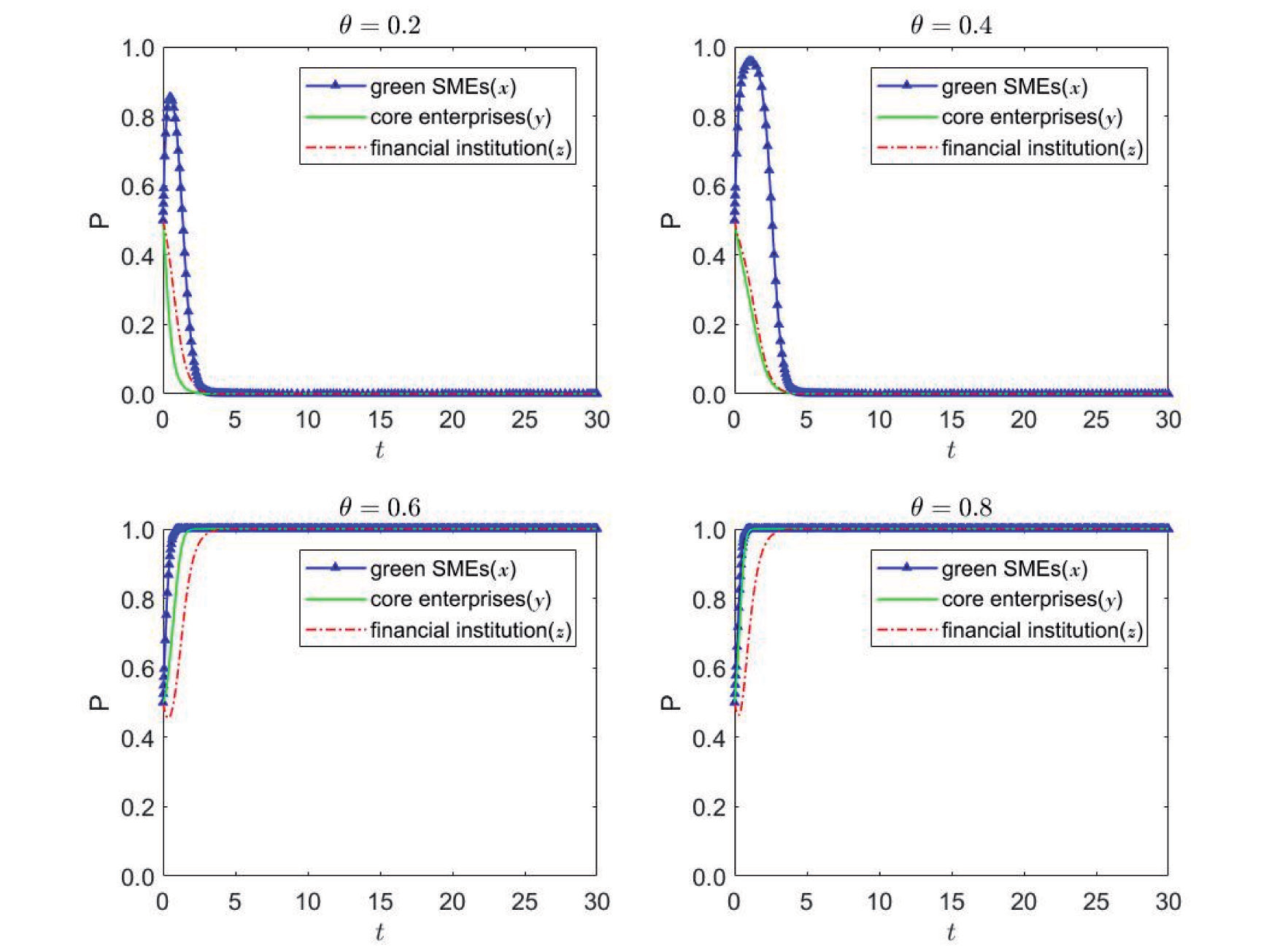
As can be seen from Fig.5, when the autonomous repayment rate θ is low, i.e., when θ is 0.2 or 0.4, the probabilities of green SMEs, core enterprises, and financial institutions choosing positive strategies all converge to 0, and the three-party game system of green supply chain finance under the empowerment of blockchain evolves towards the Pareto worst state of (0,0,0), and the rate of convergence of the main body of the game towards 0 decreases with the increase in autonomous repayment rate. When the autonomous repayment rate θ is high. That is, when θ is 0.6 or 0.8, the probability of the three-party game subjects choosing positive strategies tends to be close to 1, and almost all of them reach 1 when t=5, and the game system evolves towards the Pareto optimal state of (1,1,1), and the rate of convergence of the game subjects to 1 increases with the increase of the autonomous repayment rate. In summary, the improvement of the autonomous repayment rate of green SMEs has a better role in promoting the achievement of green supply chain finance credit business under the empowerment of blockchain.
Conclusions
Based on the theory of green supply chain finance, transaction cost theory and evolutionary game theory, this paper constructs a three-party evolutionary game model of green supply chain finance under the empowerment of blockchain by taking green SMEs, core enterprises, and financial institutions as the main game bodies from the perspective of cost, solves eight equilibrium points through the method of differential equations, and analyzes the stability of the equilibrium points through the Lyapunov criterion, and carries out a numerical simulation of the effects of the changes of the parameters of the proportion of the initial positive strategy, the amount of the cost reduction, and the autonomous repayment rate of green SMEs on the evolution path of the game system by using Matlab, and draws the following main conclusions.
There are eight equilibrium points in the three-party game system of green supply chain finance under blockchain empowerment, in which E1(0,0,0) is always the ESS of the game system, i.e., (no financing, no guaranteeing, no serving) is always the evolutionary stabilization strategy of the game system, and the game system evolves towards the Pareto worst state. When r+T1>θ(m+i1)+C1, i1+k+T2>C2+(1-θ)(m+i1)+i2, and i2+T3>C3 are met simultaneously, E8(1,1,1) is the ESS of the game system, and at this time, each of the participating subjects chooses (financing, guaranteeing, serving), and the game system evolves toward the Pareto optimal state. In the remaining cases, the pure strategy equilibrium points of the game system are unstable points or saddle points, and the stability is unstable.
Under the numerical simulation, when the initial values of the parameters satisfy the parameter conditions in Propositions 1 and 3, there exist two evolutionary stable strategies: (no financing, no guaranteeing, no serving) and (financing, guaranteeing, serving) in the game system. The higher the proportion of the initial positive strategies of the three-party participants in the green supply chain finance under the empowerment of the blockchain, the higher the probability of the game system to converge to the equilibrium stabilizing point (financing, guaranteeing, serving); the lower the proportion of the initial positive strategies, the higher the evolution of the game system towards the direction of (no financing, no guaranteeing, no serving).
With blockchain empowerment, the financing costs of green SMEs and the evaluation cost and supervision costs of core enterprises and financial institutions are greatly reduced. The cost reduction amount has an important role in promoting the development of green supply chain finance, which can prompt the evolution direction of the game system from the Pareto worst state (no financing, no guaranteeing, no serving) to the Pareto optimal state (financing, guaranteeing, serving), and the rate of convergence of the game system to the Pareto optimal stable state increases with the increasing cost reduction amount.
The improvement of the autonomous repayment rate of green SMEs has a better role in promoting the credit business of green supply chain finance under the empowerment of blockchain and the stable development of related green supply chain finance. Under the appropriate credit market environment, the higher the autonomous repayment rate of green SMEs, the more willing the core enterprises are to guarantee, the more willing the financial institutions are to cooperate, and the three-party gaming system will converge to the Pareto optimal stable state.

