

Introduction
The manufacturing industry is the pillar of national economy and provides indispensable power for economic sustainable development in China. However, the problem of large but not strong manufacturing industry in China is increasingly prominent, with the intensification of market competition, the western developed countries took the lead in a new round of technology innovation and fusion application, our country became a veritable OEM country. To avoid the shock effect of industrial transfer in developed countries on manufacturing industry in China, the manufacturing industry needs to carry on transformation and upgrading, constantly improve their own advantages, and get rid of the low-end position in the global value chain.
Against the background of a new round of industrial upgrading, the development of the manufacturing industry in China ushered in a new vitality. The integration and application of intelligent technology has become the key field of manufacturing industry development. Intelligent manufacturing were the development trend of global manufacturing, also is the main attack direction in the transformation and upgrading of manufacturing in China [1], and for the sustainable mechanism of Chinese manufacturing enterprises to point the way. However, the effective sustainable mechanism of intelligent manufacturing is closely related to intelligent technological innovation and diffusion, and it is necessary to improve the intelligent innovation ability and innovation diffusion consciousness of manufacturing enterprises. The promotion of intelligent manufacturing technology follows the basic path as a technology latecomer in China [2], and since reform and opening up, technical innovation has been widely regarded as the main source of manufacturing enterprises competitiveness in China [3]. Innovation diffusion was more important than innovation itself [4]. In a sense, as the subsequent process of technological innovation, the degree of technological innovation diffusion will affect the development, transformation, and upgrading of enterprises to a large extent. For manufacturing enterprises, technological innovation is the lifeblood of survival and development and is also an effective means of high competition [5]. Therefore, in the current situation, the sustainable mechanism in innovation and diffusion of intelligent technology in China’s manufacturing enterprises is very important, and it is an important way for China’s manufacturing industry to become intelligent.
At present, there are abundant research achievements in technological innovation, value chain climbing, and intelligent transformation of enterprises at home and abroad. However, the sustainable mechanism between technological innovation diffusion and intelligent transformation of manufacturing enterprises is still unknown, and domestic and foreign scholars have mostly studied the establishment of theoretical models and a lack of empirical validation. In this paper, starting from the perspective of the value chain to climb, combined with the smile curve and competitive advantage theory, the specific sustainable mechanism and path of technological innovation diffusion in the process of intelligent transformation were explained for manufacturing enterprises in China. This study provides a theoretical framework and reference path for the intelligent transformation of Chinese manufacturing enterprises.
Model Building and Research Hypothesis
Technological Innovation Diffusion and Intelligent Transformation
Technological innovation and diffusion are indispensable to the transformation and development of manufacturing enterprises. The development of the manufacturing industry is inseparable from technological innovation in terms of cost reduction and risk prevention and control [6]. In addition, the intelligent transformation development of manufacturing enterprises requires innovation and the extension of core and key technologies [7]. Technological innovation is a necessary condition for the transformation and upgrading from traditional manufacturing to intelligent manufacturing and is the core of intelligent manufacturing. Technology is an important factor in the challenges faced by the manufacturing industry in the development of industry 4.0 [8]; Tzu-Chieh Lin proposed conceptual framework for the intelligent transformation of manufacturing industry driven by dynamic capabilities was proposed, and the results indicate that enterprises need to continuously innovate to promote their development towards intelligent transformation [9]; The core technology of intelligent manufacturing in China relies on imports and lacks some important technologies, resulting in high costs for enterprises and affecting China’s intelligent process [10]. With the advent of the era of intelligent transformation, the integration of new information technologies such as 5G, big data and cloud computing, AI, edge calculation, etc., then build and promote the improvement and evolution of the intelligent infrastructure, and promote enterprise intelligent transformation has become a hot topic that the industry has been exploring. The emergence of these emerging technologies has provided the infrastructure and laid the intelligent foundation for the intelligent transformation of enterprises. Technological innovation has become a decisive factor in enterprise survival and development, and the enterprise, through the use of technology innovation and secondary innovation, continuously reduces production costs in order to better meet the needs of the current market changes and speed up the development of intelligent processes. Based on the above analysis, this study proposes the following hypothesis:
H1: technology innovation diffusion plays a positive role in the intelligent transformation of manufacturing enterprises.
Technological Innovation Diffusion and Value Chain Climbing
Scholars have conducted abundant discussions on the relationship between technological innovation diffusion and enterprise value chain climbing. Yongzhang Peng believes that innovation is the fundamental motivation to achieve value chain climb [11]; Bo Yang believes that the current manufacturing industry in China can enhance its position in the global value chain through technological innovation [12]; Shuhong Wang believes that for developing countries, technological innovation is an important way to promote their value chain climb [13]; By analyzing the influencing factors and climbing modes of the value chain climbing system of manufacturing enterprises under the conditions of intelligent transformation, it is concluded that technological progress is the source of value chain climbing [14]. Through analyzing case data, Chenyao Qu concluded that the level of technological innovation is the determining factor for Chinese enterprises to achieve industrial value chain climb [15]; Ivan Savin found through literature review that technological innovation can effectively impact the value chain climb of China’s high-tech industry [16]. Based on the research of domestic and foreign scholars, it can be found that technological innovation has a direct impact on the value chain climbing, and as an effective way to realize technological innovation, technological innovation diffusion is very important. Technological innovation diffusion has an equally important effect on value chain climbing. Based on the above analysis, this study proposed the following hypothesis:
H2: Technological innovation diffusion has a positive role in value chain climbing.
Value Chain Climbing and Intelligent Transformation
In terms of the relationship between the climb of the value chain and the intelligent transformation of enterprises, scholars have not conducted a systematic demonstration and analysis, but existing studies have reflected the inseparable relationship between the two from different levels. Value chain climbing is mainly due to the high value-added link of the value chain, which can also be understood as the transformation of each enterprise in the value chain or about to enter the value chain from low value-added to high value-added to continuously improve their comparative advantages. Through the review of the development of manufacturing, continually promoting an intelligent level of manufacturing is a common pursuit of the world. The intelligent transformation of manufacturing has become the only way of global industrialization development, intelligent equipment, intelligent services, new materials and intelligent systems have become the key development areas of the current manufacturing industry. All these require enterprises to continuously climb towards the middle and high ends of the value chain, and actively promote the transfer of the value chain to high-end links such as R&D design and brand service, so as to provide favorable guarantee conditions for the intelligent transformation of enterprises. By vigorously promoting the independent research and development and industrialization of core software and key equipment of intelligent manufacturing, cultivating independent brands and backbone enterprises, and expanding the global market, enterprises can effectively enhance their control over the key links of the value chain. With the continuous improvement of intelligent manufacturing, independent research and development ability, and brand influence, the industrialization level of comprehensive promotion of intelligent manufacturing can be realized and contribute to the continuous development of traditional manufacturing in an intelligent direction. For manufacturing enterprises, continuous development and progress cannot be separated from a continuous climbing of the value chain. Therefore, this study proposes the following hypothesis:
H3: value chain climbing positive role in the intelligent transformation of manufacturing enterprise.
The Mediating Role of Value Chain Climbing
Value chain climbing is crucial for the intelligent transformation of enterprises. However, how value chain climbing plays a role in the diffusion of technological innovation and the intelligent transformation of enterprises is still unknown in the existing research, and the existing literature is rarely involved. Based on this, combined with the value chain theory, smile curve, and other theories, and the above research hypothesis, this study believes that value chain climbing plays an intermediary role between the diffusion of technological innovation and the intelligent transformation of enterprises. That is, technological innovation diffusion affects enterprises’ intelligent transformation by influencing value chain climbing. Further research is required to determine the role of value chain climbing. Based on the above analysis and previous research assumptions, the following hypothesis is proposed:
H4: In the relationship between technological innovation diffusion and intelligent transformation of manufacturing enterprises, value chain climbing plays a mediating role.
The Regulating Effect of Competitive Advantage
The diffusion of technological innovation in the value chain climbing process is inseparable from enterprise competitiveness. Enterprises can realize the diffusion of technological innovation by constantly improving their competitive advantages, which is a way to realize value chain climbing. Enterprises’ competitive advantage has always been a classic research topic in management science. Porter, a master of strategic management, divides enterprise competitive advantage into cost leading advantage, differentiation advantage and centralization advantage [17]. The cost leadership strategy aims to reduce the cost of R&D, production, sales, service, and advertising by strengthening internal controls to form a price advantage. Differentiation strategy aims to provide different products and services to meet customers’ special needs in product performance, service, appearance, and other aspects to form differentiation advantages. Centralization strategy aims to form competitive advantages in its own market segments for specific target customers by concentrating limited resources on a certain market segment [18]. Enterprises win competitive advantages by providing products or services at lower cost or better completion of value activities, including technological innovation, production operation, development design, marketing, brand service, and so on. It can be seen that no matter what kind of competitive advantage, it is aimed at promoting the value chain to ascend towards high-end links such as product research and development, design and brand marketing, and service. Furthermore, in addition to technological innovation and its diffusion, continuously improving competitive advantage is an important way to realize value chain climbing. Therefore, the following hypothesis is proposed in this study:
H5: Competitive advantage plays a moderating role in the process of technological innovation diffusion affecting the climb of value chain, considering that the effect of technological innovation diffusion on the climb of value chain decreases gradually with the continuous improvement in enterprises’ competitive advantage.
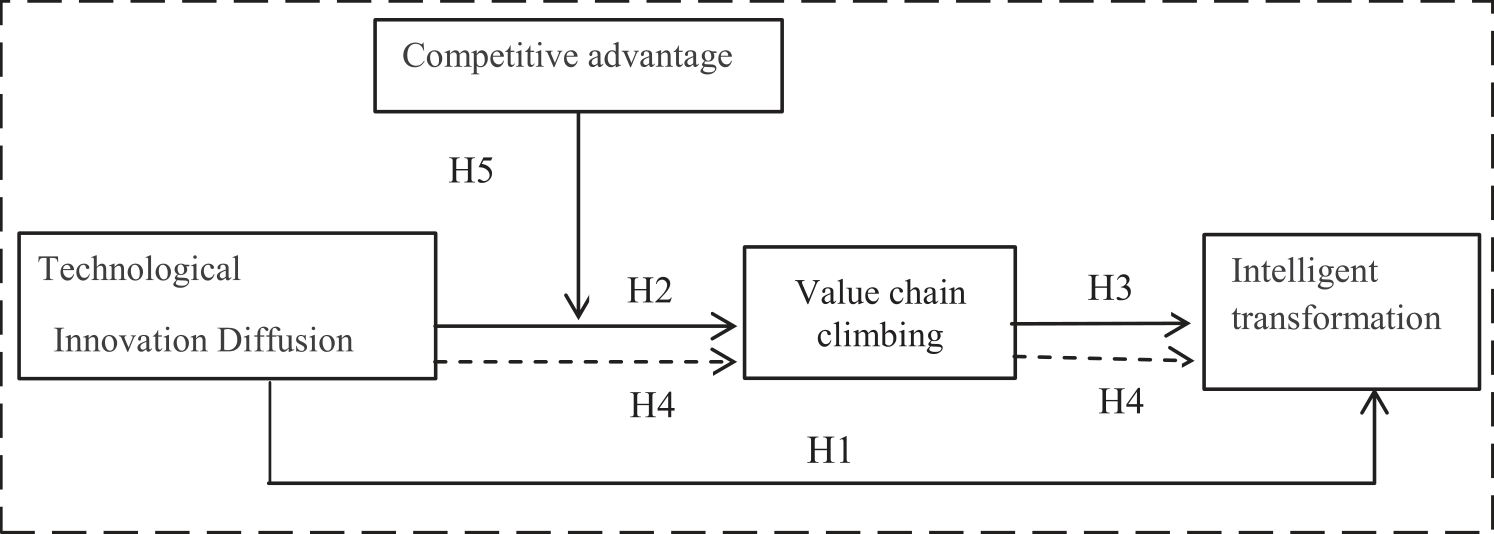
Based on the literature analysis and the research hypothesis, this research constructs the related sustainable mechanism of technological innovation diffusion, intelligent transformation, value chain climbing, and competitive advantage theory model, as shown in Fig. 1.
Materials and Method
This study explores the sustainable mechanism between technological innovation diffusion and intelligent transformation of manufacturing enterprises. Therefore, the principle of the sample sampling in this study is that the sample enterprises belong to China’s manufacturing industry. Data were collected according to the c-class manufacturing enterprises under China’s Industry Classification and Code of National Economy (2017 edition). Based on geographical advantages, Northeast China has abundant school-enterprise cooperation resources. Therefore, the sampling area of this study is mainly concentrated in northeast China and involves manufacturing enterprises in Beijing, Jiangsu, Shanghai, Henan, and other regions. To ensure the effectiveness and universality of the survey, the objects of the questionnaire distributed in this study involved different types and scales, and the filling personnel involved different positions and tenures.
Investigation Method
This research adopts the research methods of questionnaire survey, measurement method choose Likert scale level 5, through the use of third-party questionnaire survey questionnaire survey platform, editor of the issue and recovery, mainly adopt the method of online survey, using QQ, WeChat, questionnaire community publishing platform such as promotion, to be the final data for this collection. In terms of sample size, because the sample size is associated with variable item numbers, general requirements respondents, and examining the ratio between the variable control in more than 5 to 1, and if we want to get more ideal results, should be controlled more than 10 times, by the scale of this research item number shows that the sample size in theory should guarantee more than 240 copies. A total of 300 questionnaires were sent out and 257 were effectively recovered, with an effective rate of 85.67%.
Research Tools and Reliability and Validity Test
(1) The measure scale
Technology innovation diffusion. By reviewing the literature on technology innovation diffusion, this study mainly refers to the definitions of Rogers [19], Fu Jiaji [20], Ma Zuitao [21], and other scholars, from the speed and performance of the two levels of investigation. There are 6 items in this scale and the score is 5 points. The higher the score, the higher the degree of diffusion of the technological innovation.
The value chain climbing. By referring to the industrial upgrading theory of Humphrey and Schnit [22], process flow upgrades, product upgrades, function upgrades, and chain upgrades are used to measure value chain climbing. The scale involves 6 items and adopts a 5-point scoring method. The higher the score, the stronger the enterprise’s ability to climb up the value chain.
The intelligent transformation. In terms of the measurement scale of intelligent transformation, the study by Meng Fansheng mentioned is mainly referred to, and minor adjustments are made based on the actual research problems in this study. The scale involves 6 items in total and adopts 5-point scoring method. The higher the score, the stronger the enterprise’s intelligent transformation ability.
The competitive advantage. In terms of competitive advantage, we mainly referred to the research of Vogel [23] and Dong Baoguo [24] to investigate the perspectives of efficiency, function, and sustainability. The scale involves 6 items in total and adopts 5-point scoring method. The higher the score, the greater the competitive advantage of the enterprise.
(2) The reliability test
For the reliability analysis of the data collected from the questionnaire, Cronbach’s Alpha consistency coefficient method and CITC values of the scale (i.e. Corrected Item-total Correlation) are generally used for verification. According to the reliability analysis results in Table 1, the Cronbach’s α coefficients of technological innovation diffusion, intelligent transformation, value chain climbing, and competitive advantage are 0.949, 0.973, 0.962, and 0.955, respectively, all of which meet the acceptable value range of above 0.7. Their values are all high, showing a high degree of reliability. The CITC values of the 18 items in the four scales all met the requirements of an acceptable value range [0.7-1]. By analyzing Cronbach’s Alpha values after deleting all items, it was found that none of the values were greater than the Cronbach’s Alpha values of the original scales. Thus, the correlation of each item was verified to meet the requirements, and the overall reliability was reliable, indicating that the data had validity, stability, and representativeness.
(3) The validity test
The validity of the scale was analyzed mainly using exploratory factor analysis (EFA) to carry out KMO measure and Bartlett tests on the predicted samples. The standard values of these two indicators are defined as follows: It is generally believed that the closer KMO is to 1, the more suitable it is for factor analysis. It is generally believed that the reasonable value range of KMO statistics is [0.7, 1]. For Bartlett test, its test statistics should meet the requirement of non-negative value, and its corresponding probability value should be less than the given significance level (SIG <0.05). The scale validity of this study is shown in Table 2. According to the analysis results, both the KMO index value of the scale and the Bartlett test value are within a reasonable range.
In summary, the scales selected for technological innovation diffusion, value chain climbing, intelligent transformation, and competitive advantage meet the reliability and validity requirements.
Statistical Analysis of Sample Normality Test
In hypothesis testing or path analysis, the premise is that the sample data can obey the normal distribution. In terms of measuring whether the data conform to the normal distribution, skewness coefficient (S) and kurtosis coefficient (K) can be used to test the integrity (K-S test). For the evaluation criteria of S and K statistics, Kline (1998) thought that if the absolute value of the kurtosis coefficient of the statistical analysis results of the sample data was greater than 8 and the absolute value of the skewness coefficient was greater than 3, it could be considered that the sample data did not conform to the hypothesis of normal distribution. If the kurtosis coefficient is greater than 20, the situation would be more serious. Through descriptive statistical analysis of 257 sample data collected and sorted, the skewness and kurtosis coefficients of each item are shown in Table 3. According to the output results, the maximum absolute value of skewness statistics for each item is 1.021, which is far less than the evaluation standard value of 3, and the maximum absolute value of the kurtosis statistics of each item is 0.600, which is far less than the evaluation standard value of 8. Therefore, the data collected in this study conform to the premise of a normal distribution and can effectively carry out the following hypothesis testing.
Table 1.
Internal consistency reliability analysis of the scale.
Discriminant Validity Test of Each Variable
The main purpose of discriminant validity is to test the correlation coefficient between potential variables. The test results are shown in Table 4, where the value on the diagonal is the AVE value (extraction value of mean variation) of each potential variable. It is generally believed that the scale has good discriminant validity when the coefficient values between potential variables are significant, there is no collinearity, and the value is less than the square root of the corresponding potential variable AVE.
Table 3.
Descriptive statistical analysis of each item.
Table 4.
Discriminant validity analysis of each variable.
From the analysis of the above results, it can be concluded that the diffusion of variable technological innovation, intelligent transformation, value chain climbing, and competitive advantage are significantly correlated. In addition, because the absolute values of the correlation coefficients between various variables are all less than 0.5, the collinearity problem does not exist. The values of the correlation coefficients between various variables are all less than the square root of the AVE value of each latent variable, indicating that each variable has a certain distinction.
In conclusion, the sample scale data extracted in this study had good discriminant validity. However, the results of this analysis cannot determine whether there is a causal logic relationship between potential variables, and further discussion is needed in the following research.
Testing the Mediating Effect of Value Chain Climbing
Referring to the studies on intermediary utility in the existing literature, it can be seen that the commonly used test method is to test the regression coefficient step by step. Compared with the stepwise regression test, the Bootstrap test, an emerging verification method for mediation effects, has been gradually used by scholars. This method can skip the test of the total effect coefficient and test the direct and indirect effects directly to judge the mechanism of the model’s intermediary utility more accurately. In addition, the innovation of test methods also brings about a difference in the expression of results. For the original verification method of “partial mediation” and “complete mediation” also changed into a more intuitive “mediation effect” ratio. In this study, the Bootstrap validation method was used to test the intermediary utility.
With value chain climbing as the intermediate variable, technological innovation diffusion as the independent variable, and intelligent transformation as the dependent variable.
By comparing and analyzing the fitting index values in Table 5, it can be found that the index values of the intermediary utility model are all within a reasonable range, indicating that the intermediary utility model has a good fit with the collected data and can meet the requirements of this study.
Fig. 2 shows the standardized path coefficient value of the relationship between variables in the intermediary utility model of value chain climbing, where A represents the diffusion of technological innovation of variable, B represents variable value chain climbing, and C represents the intelligent transformation of variables.
Table 6 presents the path test results of the intermediary utility model. It can be seen that the test results of technological innovation diffusion on intelligent transformation, technological innovation diffusion on value chain climbing, and value chain climbing on intelligent transformation are statistically significant. That is, H1, H2 and H3 are assumed to be true.
Table 7 lists the intermediary utility test results for this model. The interpretation of the analysis results is based on the upper and lower limits of the path results of the intermediary utility model. If the upper and lower limits do not include 0, it indicates that the intermediary utility is significant. As can be seen from Table 7, the upper and lower limits of Bootstrap test of the two intermediary utility of Bias-corrected and Percentile do not include 0, indicating that the index values verified by Bootstrap 95%confidence interval test are supported. That is, value chain climbing plays a mediating role in the impact of technological innovation diffusion on the relationship between intelligent transformation, and H4 is verified.
Table 5.
Index results of mediation utility model fitting.
| χ2 | df | χ2/df | GFI | RMR | RMSEA | NFI | CFI | TLI | IFI |
|---|---|---|---|---|---|---|---|---|---|
| 297.841 | 114 | 2.613 | 0.901 | 0.028 | 0.070 | 0.930 | 0.956 | 0.947 | 0.956 |
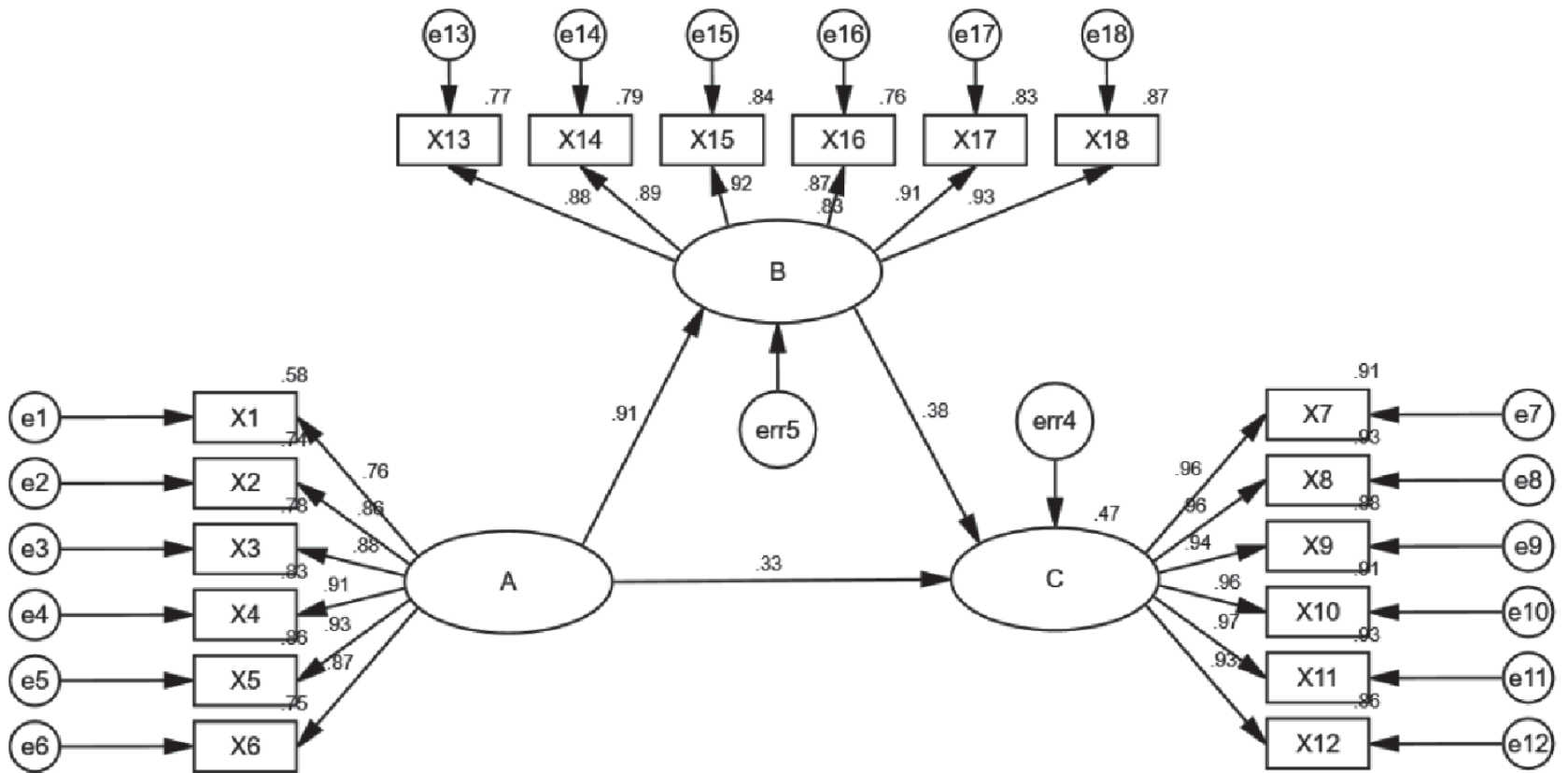
Table 6.
Path coefficient test of mediation effect of value chain climbing.
Table 7.
Test of mediating effect of value chain climbing based on Bootstrap.
| Standardized Bootstrap mediating effect test | ||||||||
|---|---|---|---|---|---|---|---|---|
| Path | Effect value | SE | Bias-corrected | Percentile | ||||
| Lower limit | Upper limit | P | Lower limit | Upper limit | P | |||
| stdindM1 | 0.342 | 0.095 | 0.171 | 0.543 | *** | 0.163 | 0.531 | *** |
Table 8.
Proportion of effect values.
| Effect | BootSE | BootLLCI | BootULCI | Effect of | |
|---|---|---|---|---|---|
| Mediating effect | 0.4438 | 0.1071 | 0.2544 | 0.6832 | 54.04% |
| Direct effect | 0.3776 | 0.111 | 0.1368 | 0.5798 | 45.98% |
| Total effect | 0.8213 | 0.043 | 0.727 | 0.897 | 100.00% |
With technological innovation diffusion as the independent variable, value chain climbing as the intermediate variable, and intelligent transformation as the dependent variable, Bootstrap Process analysis based on Process operation is continued. The results shown in Table 8 were obtained by sorting and analyzing the output results
By comparing its effect value, the ratio of the direct effect (0.3776) and intermediate effect (0.4438) to the total effect (0.8213) can be obtained. That is, the direct effect accounted for 45.98% and the mediation effect of value chain climbing accounted for 54.04%.
Testing of Regulated Intermediary Model
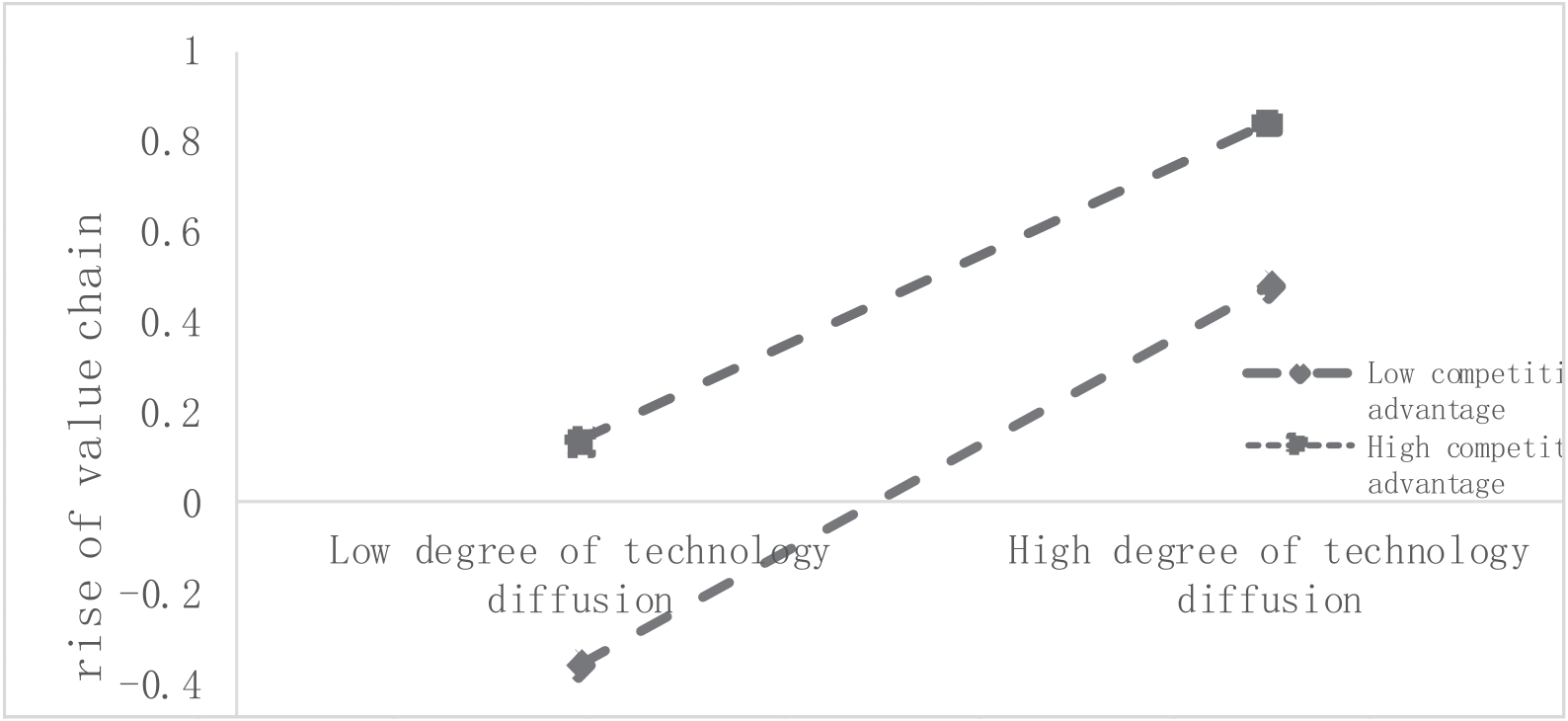
This study constructed a regulating intermediary effect theory model with the following variables: the independent variable, technological innovation diffusion; the dependent variable, intelligent transformation and value chain climbing; and the regulated variable, competitive advantage. The regulating effect of competitive advantage was tested using SPSS software, and Model 7 compiled by Hayes was used to test the intermediary model. The test results are listed in Tables 9 and 10. The results show that, by comparing the model results, interaction terms have a significant impact on intelligent transformation after the addition of variable competitive advantage (value chain climb: B = -0.0664, t = -2.2852, P<0.05), indicating that competitive advantage can adjust the impact of technological innovation diffusion on the value chain climb. Further simple slope analysis results are shown in Fig. 3, according to the results of Fig. 3 shows that technological innovation diffusion has a positive impact on the value chain climbing (t = 5.8522, ps0. 0001) under the competitive advantage level(M-1SD)of the low grouping; technological innovation diffusion also has a positive impact on value chain climbing under the competitive advantage level(M + 1SD)of the high grouping. In contrast, its degree of effect was smaller than that under low grouping (t = 3.7883, P<0. 0001), indicating that with continuous improvement in the level of competitive advantage of enterprises, the effect of technological innovation diffusion on the climb of the value chain gradually decreases, which is verified by H5. Combined with the results in Table 10, the corresponding effect values at the three levels of low (M-1SD), normal (M), and high (M + 1SD) competitive advantage are 0.3479, 0.2305, and 0.1351, respectively, indicating that the intermediary effect of competitive advantage on the relationship between technological innovation diffusion and intelligent transformation also shows a decreasing trend. In other words, with the improvement in competitive advantage, the intermediary effect of value chain climbing on the relationship between technological innovation diffusion and intelligent transformation gradually decreases.
Table 9.
Test analysis of moderated mediation model.
Table 10.
Effect value analysis at different levels of competitive advantage.
Results and Discussion
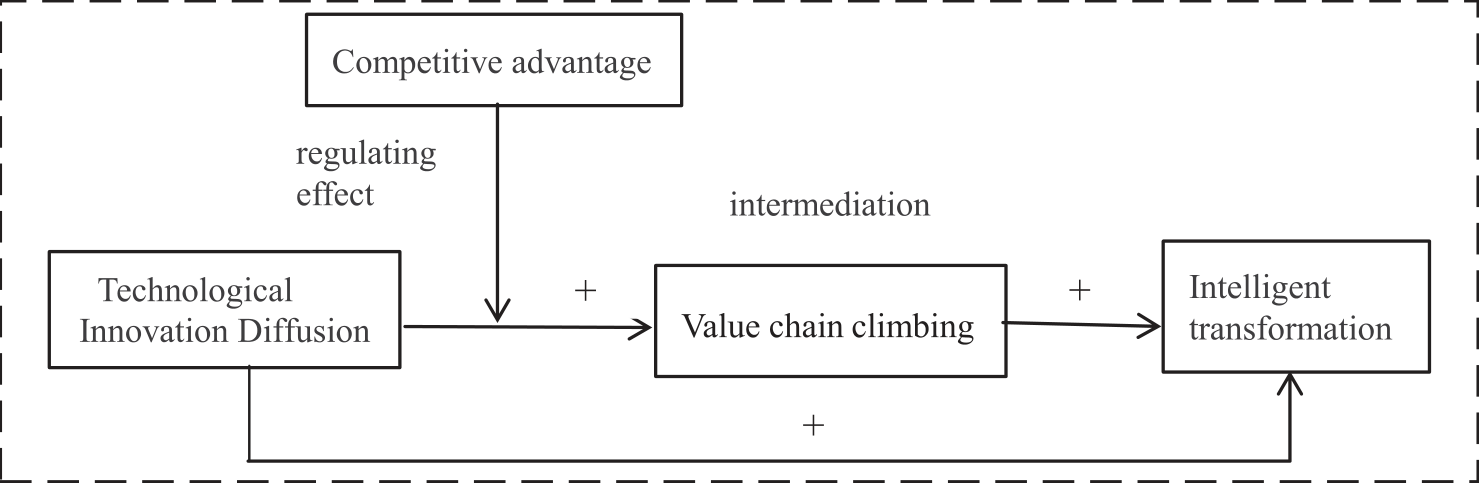
Through the significance verification of the hypotheses in this study, the validity of the proposed hypotheses is confirmed. It has been proven that the diffusion of technological innovation affects the intelligent transformation process of manufacturing enterprises, and the paths of individuals and interactions between variables are determined. Then, a systematic analysis is conducted to obtain the subject content of this paper, that is, the sustainable influence mechanism of technological innovation diffusion on the intelligent transformation of manufacturing, as shown in Fig. 4.
The influencing mechanism shown in Fig. 4 was determined through the verification of the theoretical models and empirical studies. In order to open the “black box” of the influence relationship of technological innovation diffusion on intelligent transformation of manufacturing enterprises, each path in the sustainable influence mechanism is analyzed step by step. The path relationship shows:
First, technological innovation diffusion and the intelligent transformation of manufacturing enterprises between the effects were significant. The spread of technological innovation promotes the intelligent transformation of manufacturing enterprises; the continuous diffusion of technological innovation is conducive to manufacturing enterprises’ mastery of emerging technologies, their own research and development, the improvement of innovation ability, and the promotion of innovation achievements, by combining with the actual situation of the enterprise to carry on innovation integration and extension, and then continuously promote the intelligent transformation of manufacturing enterprises.
Second, technological innovation diffusion and value chain climbing between the effects were significant. The spread of technological innovation promotes the value chain climbing of manufacturing enterprises: the stronger the diffusion ability of technological innovation, the more beneficial it is for enterprise value chain climbing. With the improvement of technological innovation diffusion ability of manufacturing enterprises, the production and manufacturing of manufacturing enterprises bring new process and technology, so that the process of manufacturing enterprises can be upgraded. The new products produced by technological innovation and its diffusion bring new markets and sales services to enterprises and make product upgrading and function upgrading in the mode of manufacturing enterprises’ value chain climbing. The continuous deepening of the upgrading of each link will promote the value chain of manufacturing enterprises, that is, from the traditional low-level industry to the new industry with high added value, the high-tech industry.
Third, the increasing value chain of manufacturing enterprises promotes intelligent transformation. The stronger the ability of enterprises to the value chain climbing, the more conducive it is to the intelligent transformation of enterprises. As the value chain of manufacturing enterprises continues to climb towards high-end links such as research and development, design, brand, and service, it provides a favorable guarantee for the research and development of core technologies and key fields required for intelligent transformation of manufacturing enterprises and accelerates the process of intelligent transformation of manufacturing enterprises.
Fourth, value chain climbing plays a partial mediating role in the influence of technological innovation diffusion on the intelligent transformation of enterprises; that is, technological innovation diffusion positively promotes the intelligent transformation of manufacturing enterprises by promoting the continuous climb of the value chain of manufacturing enterprises. With the strengthening of technological innovation diffusion ability of manufacturing enterprises, it actively promotes the improvement of high-end capabilities such as research and development and design, which helps to improve the ability of enterprises’ products to meet market needs with advantages, thus enabling enterprises to more actively meet the personalized needs and services of the market.
Fifth, the positive promoting effect of technological innovation diffusion on value chain climbing is moderated by competitive advantage, and the effect of technological innovation diffusion on value chain climbing decreases gradually with the continuous improvement in the competitive advantage of enterprises. Technological innovation diffusion influences the value chain climbing of manufacturing enterprises by adjusting their competitive advantage in the transformation process.
Conclusions
In this study, a theoretical model of technological innovation diffusion and intelligent transformation was constructed based on an analysis of relevant literature. The data required for this study were obtained through the design, collection, and processing of the questionnaire. Descriptive statistical analysis, reliability and validity analysis and hypothesis testing analysis were used to test the relationship of the action paths involved in the theoretical model of this study, and the conclusions about technological innovation diffusion and intelligent transformation of manufacturing enterprises were drawn as follows.
(1) The sustainable mechanism theoretical models of technological innovation diffusion, competitive advantage, value chain climbing, and intelligent transformation are constructed, and the influence path of technological innovation diffusion on intelligent transformation is clarified. Through the study of literature as a starting point, and then on the collected data processing, correlation analysis, and test, it is concluded that the intermediary role of the value chain rising path, competitive advantage, and technological innovation diffusion interaction climbed the process of the enterprise value chain, identified in this study, the author studies the diffusion of technological innovation to promote manufacturing enterprises’ influence on the intelligent transformation mechanism.
(2) Value chain climbing plays a partially intermediary role in the diffusion of technological innovation in the intelligent transformation of manufacturing enterprises. Technological innovation diffusion has a positive effect on the intelligent transformation of manufacturing enterprises, which can be realized through the value chain climbing of intermediary variables. The diffusion of enterprise technology innovation, which is beneficial to promote enterprise development to improve its design ability, in turn, helps to improve the ability of enterprise products to meet market needs. In the process, it constantly promotes the enterprise from low to high end, making enterprises more active in meeting the personalized demand and service of the market.
(3) Competitive advantage plays a moderating role in technological innovation diffusion, promoting enterprise value chain climbing. Based on the adoption, absorption, continuous penetration, and improvement of innovative technologies, enterprises can gradually promote the value creation process of enterprises from the low-end link to the middle and high-end links by improving their competitiveness and advantages. Technological innovation and diffusion promote enterprise value chain climbing with the help of competitive advantage; competitive advantage provides another specific form, that is, technological innovation diffusion acts on value chain climbing by means of competitive advantage. With the improvement in competitive advantage, the effects of technological innovation diffusion gradually decrease.
Inspiration
(1) Manufacturing enterprises in the value chain should fully understand the importance of technological innovation diffusion to accelerate their intelligent transformation. Technological innovation is key to the survival and development of manufacturing enterprises, and as a follow-up process of technological innovation, technology innovation diffusion is a necessary way to improve and develop technological innovation. This is an effective means of improving self-competition, greatly affecting the development, transformation, and upgrading of enterprises. Thus, it is necessary to accelerate the diffusion and development of intelligent technology innovation in China’s manufacturing enterprises, which is an important step towards intelligent manufacturing enterprises in China.
(2) The intelligent transformation process of manufacturing enterprises in value chain climbing as a guide, enterprise dedicated to the rise in value chain is to continuously stretch on both ends of the smiling curve, promote the enterprise’s value creation process, and promote the enterprise’s high-end upgrades, move to meet the personalized needs of improvement and service, so as to accelerate the process of intelligence. The process of technological innovation diffusion promotes the intelligent transformation of enterprises through the value chain climbing. Therefore, the intelligent transformation and development of enterprises cannot be separated from improvement in value creation. For Chinese manufacturing enterprises, it is necessary to promote intelligent transformation by increasing the degree of diffusion of technological innovation guided by value chain climbing.
(3) The research on value chain climbing is regulated by competitive advantage in the process of intelligent transformation of manufacturing enterprises, and the results show that technological innovation diffusion should take advantage of competitive advantage in the process of promoting enterprise value chain climbing. Through the adoption, absorption, diffusion, and secondary innovation of existing innovative technologies, enterprises can continuously improve their competitive advantages and enhance their research and development, design, marketing, brand service, and other capabilities, which can effectively promote the value chain climbing of enterprises. That is, technological innovation and diffusion promote the value chain climbing of enterprises with the help of competitive advantage, which provides another form for it. This requires enterprises to form their own competitive advantages in the process of intelligent transformation to promote the enterprise value chain toward the high end.

