

Introduction
Yangzhou is an ancient city with a long history. The Sui Emperor opened the Beijing-Hangzhou Grand Canal, making it a north-south water transport hub, which promoted the development of commerce and handicraft industry and laid the foundation for future economic prosperity [2]. At the same time, Yangzhou, as a distribution center of salt and water transportation, has a solid material foundation. The vast wealth accumulated in commerce was used for the construction of gardens and houses on a large scale in addition to the luxurious lifestyle. Salt traders showed off and competed with each other, making Yangzhou a land of big gardens [3].
Private gardens in Yangzhou in the Ming Dynasty paid more attention to planning, architecture, garden layout and flowers and trees allocation than ever before. Especially in the late Ming Dynasty, the shadow garden and Xiu garden were built successively, making the level of Yangzhou gardens reach an unprecedented height. This paper chooses Zheng Yuanxia's garden, a typical merchant garden in Yangzhou, as the research object [4].
Yuanxia Zheng, styled ShiJie, known as Yi 'An, was a literary talent, was born in a wealthy salt merchant's family in Yangzhou in the late Ming Dynasty. He built his own special business, the Garden of Xiu, near the Yangzhou Water Bridge. The Zheng family had a high reputation among the salt merchants in Yangzhou and was very wealthy. The Zheng brothers' extensive construction of famous gardens was a success in Yangzhou. Among them, Zheng Yuanxun's Ying Garden and Zheng Yuanxia's Xiu Garden can be considered as fine masterpieces of Yangzhou gardens in the late Ming and early Qing dynasties. The name of the garden was derived from Fang Sun in the Tang Dynasty, who named the garden "Xiu Garden" because of his words: "Rest when you are full of coarse food and rice, rest when you are full of cold and warm, rest when you are full of three levels and two times, and rest when you are not greedy or jealous of the old". This reflects Zheng Yuanxia's life feelings of being open-minded and content [5].
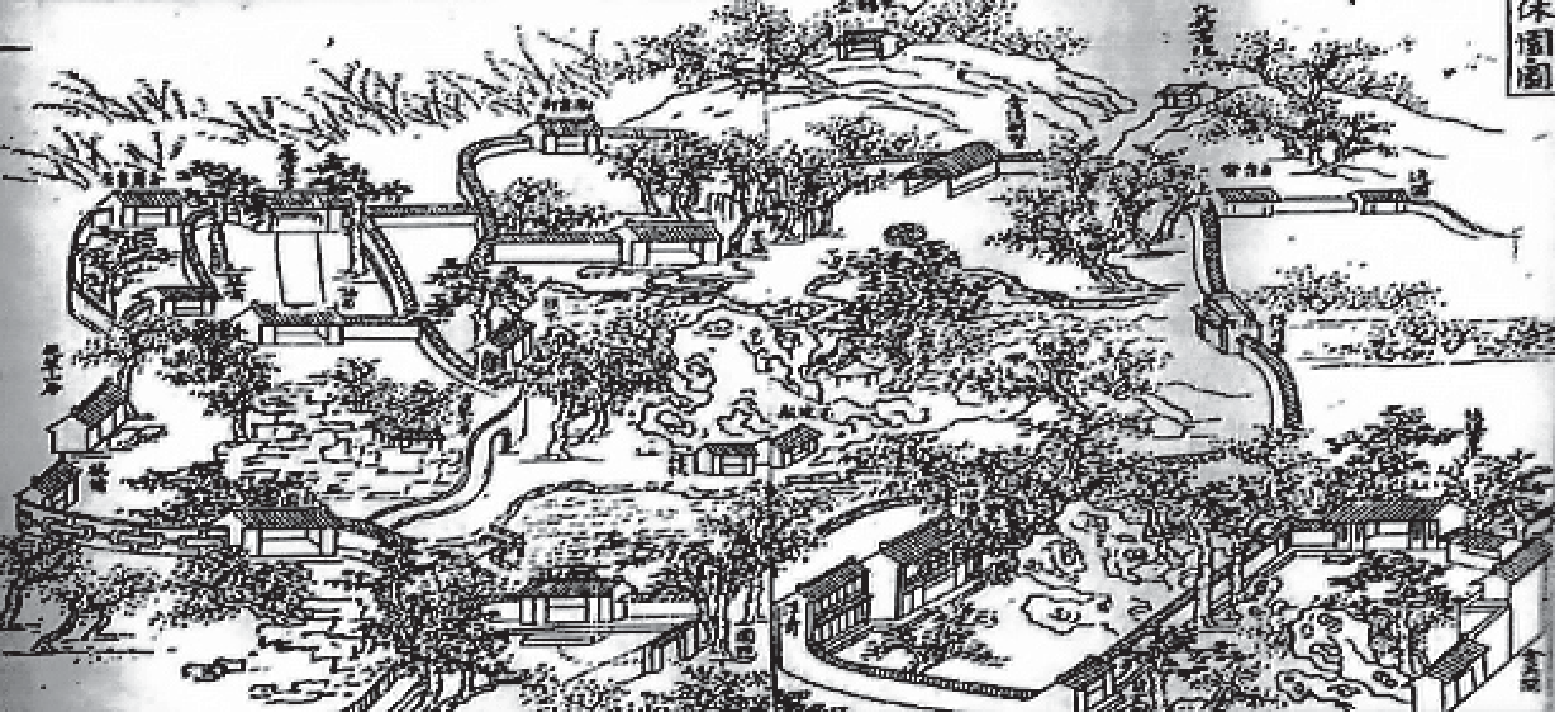
After the closure and destruction of the camp building, which endured the changes of dynasties and the withering of mulberry trees, it fell into a state of disrepair, Yuan Xia's grandson Maojia Zheng repair on the shabby basis, and after more than 20 years, Yuan Xia's great-grandson Yuheng Zheng focused on the garden pavilion and the hall repair, after repeated repair, after more than one hundred years, the park stood firm in Jiangnan, become one of the longest experience in the southern area of the garden. A picture of the garden is recorded in the Annals of Yangzhou Garden (As shown in Fig. 1).
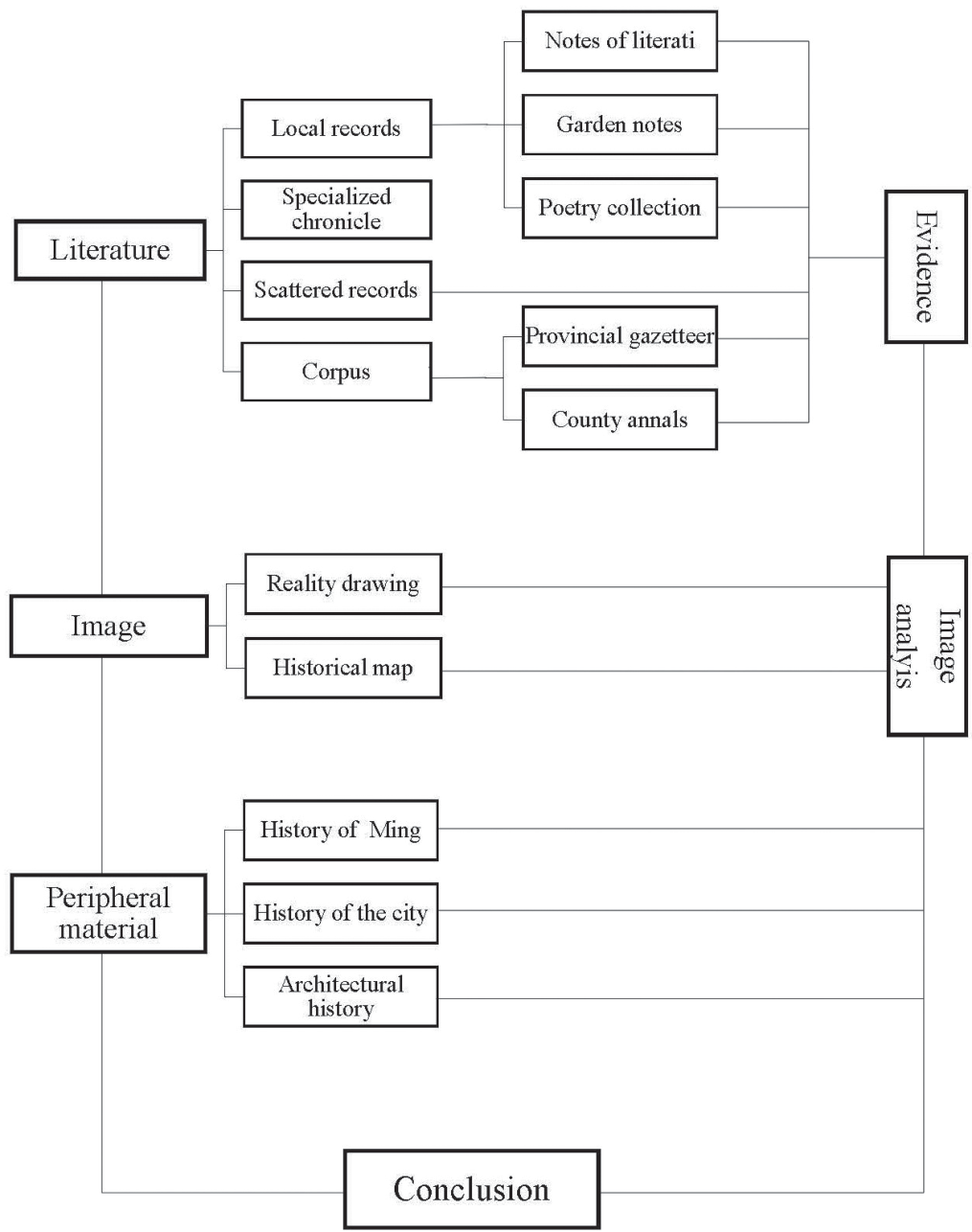
Study Methods, Data Sources and Research Routes
Methods
Literature Theory Research
Hao Li said in the introduction of the Tang Dynasty Garden Industry Survey: "The study of gardens in the Tang Dynasty, especially private gardens, is mainly not a physical archaeological study, but a documentary archaeological study." Since the private gardens in the south of the Ming Dynasty were destroyed by historical changes and wars, most of them have no physical objects for reference, so this paper also uses Li Hao's literature and archaeological research methods for reference.
Anthology Study
Through a large number of local Chronicles, literati collection and folk historical materials, mutual research of literary history, to understand the Ming Dynasty Jiangnan merchant garden real situation. While fully reproducing the history, it can explore the unique cultural connotation of the garden. Through the investigation of cultural practice activities in gardens, we can explore the social functions of merchant gardens in the unique social environment of Ming Dynasty, and reveal the influence and inheritance of their unique urban culture on merchant gardens
Field Research
Based on the existing theoretical research, combined with field investigation, we can more intuitively understand the protection status and existing problems of Jiangnan merchant gardens. In addition, we can further understand the historical characteristics and development process of Jiangnan merchant gardens by visiting local native residents or relevant experts and scholars, so as to provide a solid reference for the study of the development and characteristics of Jiangnan merchant gardens since the Ming Dynasty.
Data Sources
Yuanxia Zheng published a number of collections of poems, including Xiu Yuan Poems and Xiu Yuan Province Record. With his fame, there was an endless stream of scholars and writers visiting Xiu Yuan for dinner. They left precious poems and calligraphic treasures for the garden. Among them, Ji Dong's Guangling Garden Resting Record, Fang Xiangying's, Wu Qi's and Xu Chengjia's Heavy Repair Xiu Garden Record. Li Guangdi's, Zhang Yunzhang's and Song He's Three Repairs Xiu Garden Record. Yun Wang was an indispensable guest in the numerous poetry and prose meetings held in the garden. He not only kept close contact with the Zhengs, but also was familiar with the scenery in the garden. The investigation of the twelve landscapes Yun Wang drew for the rest garden is consistent with the twelve landscapes recorded by Xiangying Fang. It can be inferred that Yun Wang carefully read the garden records of various families before drawing the rest garden map, and finally chose Fang Xiangying's rerepair the Xiu Garden Record as the creative blueprint for drawing. These documents and materials elaborated the layout of the garden in detail. Among them, the most realistic records of the spatial layout and landscape design of the garden are Fang Xiangying's Record of Heavy Repair of the Garden and Wang Yun's Garden Map, so they are taken as the main reference materials.
Results
Garden Purpose
For Yuanxia Zheng, the garden was a place where he built relationships with social elites and an effective means to elevate his reputation among the upper class. So, what was Zheng Yuanxia's original purpose in building the garden? What personal insights and thoughts did he incorporate into the garden?
In Fang Xiangying's Rerepair the Xiu Garden wrote: "With elder brother Ji Chang, Zong Chao, ke Zan, emphasis on the southeast, each for the garden pavilion to serve the mother." He bought the site of Zhu's family to entertain his mother, and called it "Xiu Garden". It can be seen that Yuanxia Zheng initially built the garden for the very important purpose of serving as a secluded space for foster mothers and learning [6].
However, Xiangying Fang did not mention any records about Zheng Yuanxia's adoptive mother in the garden record, and there is no place in the space design of the garden for his mother. Since Yuanxia Zheng was born into a wealthy family and was the youngest among his brothers, the argument that he built a garden to support his old mother is a bit far-fetched. However, we can also understand that the purpose of building a garden for caring for one's mother is the best way to show one's filial piety. Especially in the traditional Confucian society, it is necessary to gain more recognition from the upper class. Just like the later Qianlong Emperor built the Qingyi Garden under the banner of celebrating the Empress Dowmother's birthday, but this is not the real purpose of the garden [7].
Since being a foster mother is not the most real purpose, can it be a secluded space for learning and entertainment alone? As mentioned above, the name of the Xiu garden comes from Sun Fang's words in the Tang Dynasty, "Rest when you are full of plain food, rest when you are full of cold and warm, rest when you are full of three levels, and rest when you are not greedy or jealous of the old". Yuanxia Zheng therefore named the garden "Xiu Garden". This not only reflects Zheng Yuanxia's feelings of being open-minded and happy with enough, but also reveals his secluded garden building thoughts [8].
Although he belonged to a merchant family, Yuanxia Zheng was an accomplished literati at the beginning of building the garden. Forced by the great changes in the social environmental, he had no choice but to resign and return to his hometown, so he built his own garden, indicating that his garden is actually more hidden in the mountains and forests, but because of the change of identity between businessmen and scholars, he is not an absolute scholar seclusion. It can be seen that the garden is indeed a secluded space for Yuanxia Zheng to study and entertain alone, and also a means and shortcut to make friends with celebrities. More importantly, it may imply the utilitarian implication of getting rid of the identity prejudice of the merchant family and obtaining the recognition of the upper class [9].
Environmental Space Sturcture
According to Fang Xiangying's Heavy Repair of the Xiu Garden, we can probably infer the environmental space structure of the garden. The scenic spot on the left of the park is mainly a mountain, and the central landscape is centered on the ink pool, which occupies one third of the central scenic spot, surrounded by three or four groups of buildings with rhythmic distribution, echoing the main building pavilions, and artificial rockery on both sides of the building vestibule. So designed and arranged, like music, with a clear rhythm; Such as painting, spot dyeing into interest, scattered into the scene [10].
It is evident that the garden focused on the combination of mountains and water, with water being the central element. Surrounding the water feature, there were artificial hills, pavilions, stone bridges, pools, as well as precious flowers and plants, creating a distinctly designed landscape garden. It attracted many social elites of that time to appreciate the garden scenery, gather for poetry composition, and appreciate calligraphy and painting. Now, let's explore the detailed analysis of the garden record to investigate the specific landscape design of the garden.
Environmentalal Design
First of all, let's look at the text describing garden environmental design:
Among them said: "Yu Shi Hall", said: "Shu Fang Porch", said: "Yun Shan Pavilion", its right said: "Rui Qi", said: "Hua Yu". There is a mountain on the left, there is a pavilion on the mountainside, said: "Kong Cui Mountain Pavilion".
From this, we can know that there are Yu Shi Hall, Shu Fang Porch and YunShan Pavilion in the central area of the whole garden. Ruiqi, Flower Island and other scenic spots in the right area, the main rockery in the left area, and a pavilion in the middle of the mountain, named Kong Cui Mountain Pavilion. The overall landscape layout of the garden is mainly divided into three scenic spots: left, middle and right. From the name of each scenic spot, it includes hall, porch, pavilion, etc., including the basic types of buildings in private gardens. The relevant scenic spot research is as follows:
Jun Du explained the origin of the stone hall in the Biography of Mr.Shi: "The family has a spirit wall strange stone diameter, color as clear jade, the sound of the palace merchant, the public for the stone hall." Xiji Zheng Write a poem: "Hanshan a stone, the language can be poor years."
It can be clearly seen from the above two points that Yuanxia Zheng built the YuShi Hall with a strange stone and placed expensive rockery stone in or in front of the hall for enjoyment. He often entertained guests here to appreciate the strange stone, which reflected from the side that Yuanxia Zheng needed certain financial support to build the garden [11].
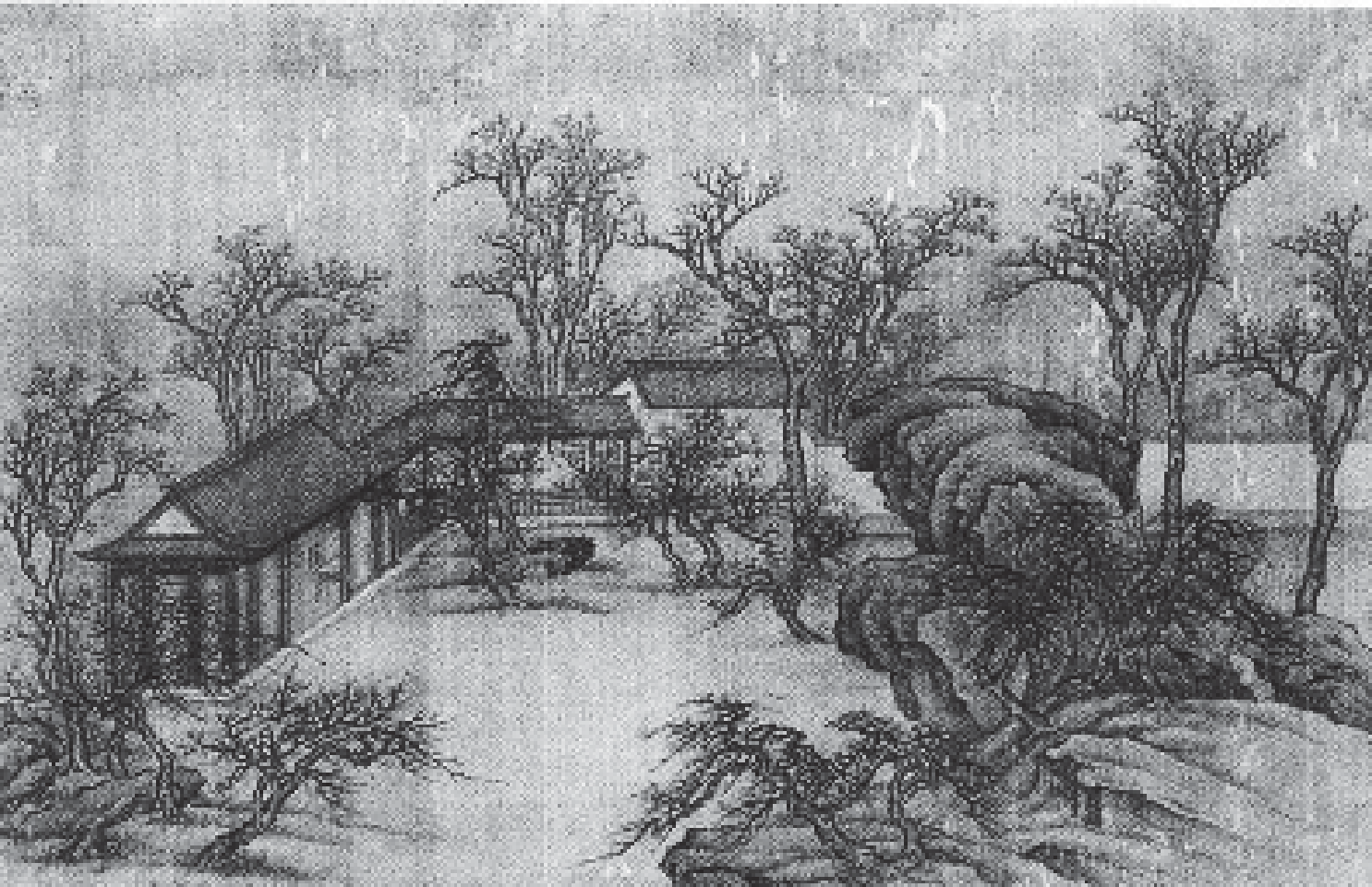
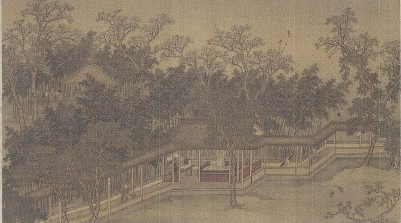
In addition, the description of the YuShi Hall can also be found in the first paragraph of the garden diagram (as shown in Fig. 3). The picture shows the autumn scenery. In the picture, the leaves of all kinds of trees fall down, and their trunks grow erect beside the stone in front of the house, along the fence, through the corridor and into a corridor house. In front of the house, the boulder lies horizontally, opposite the door. The whole color is mainly cold and green, and the picture creates a feeling of bleak autumn wind and chilling air. Visible, the garden a large number of strange stone landscape in the garden occupies an important position. Stone in a small space to increase the interest, create a level, and even to increase the role of space, which is different from the Jiangnan private garden with stone ornament in essence. Now let's move on:
After the hill, Guihua column, said: "JinE Library". After the house repair bamboo thousand pole, there is a porch said: "Qin Xiao". By "Qin Xiao" and left, through the bamboo forest, corridor dozens of, twists and turns, day: "Wei Shu Porch". the porch pond, plant are several acres, open fragrance attack train, said: "Han Qing Villa". villa side, called: "De Yue".
From above, you can see that there is a small hillside behind the CuiShan Pavilion, and a large number of plants are planted halfway up the hill, among which osmanthus is mainly planted. In the osmanthus trees, a building is faintly emerging and embellish, named JinE Library [12]. There are many bamboo trees planted behind the Library, and it is equipped with an architectural porch. It is probably named Qin Xiao because the wind whistles across the hillside, driving the large bamboo forest to make a sound like the sound of qin. Marching to the left by Qin Xiao, after dozens of corridor buildings, winding around along the hillside, found a spacious place in the middle of the porch, named WeiShu Porch. There is a pond next to the WeiShu Porch, pond planting a few acres of lotus, wait until the lotus opens, the subtle fragrance of the face,, the shore also built a villa, named with HanQing villa. Next to the villa there is a high platform, named as the platform, meaning the meaning of climbing the left by Qin Xiao, after dozens of corridor buildings, winding around along the hillside, found a spacious place in the middle of the porch, named WeiShu Porch [13]. There is a pond next to the WeiShu Porch, pond planting a few acres of lotus, wait until the lotus opens, the subtle fragrance of the face,, the shore also built a villa, named with HanQing Villa. Next to the villa there is a high platform, named as the platform, meaning the meaning of climbing the moon, imagine in the summer night, with the moonlight shrouded in the lotus pond flowers, a lotus pond moonlight picture leisurely and rise, give people infinite reverie.
It can be seen from the above quotation description that the scenic spot on the left part of the garden is mainly a mountain, and the design of buildings and water below the mountain is embellished with the mountain, and then flowers and plants are configured to create a mountain and water garden with obvious artificial atmosphere [14]. The research on the scenic spots is as follows: the poem of the JinE library writes: "Cluster Guihuan bookstore, slanted corridor grass vine seal." Xiji Zheng wrote in a poem about the noise of the harp: "Barefoot cooking tea and barefoot singing in the bamboo forest."
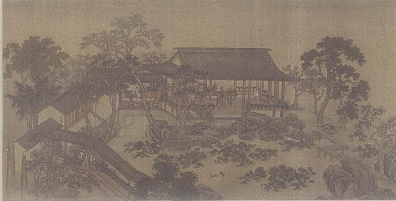
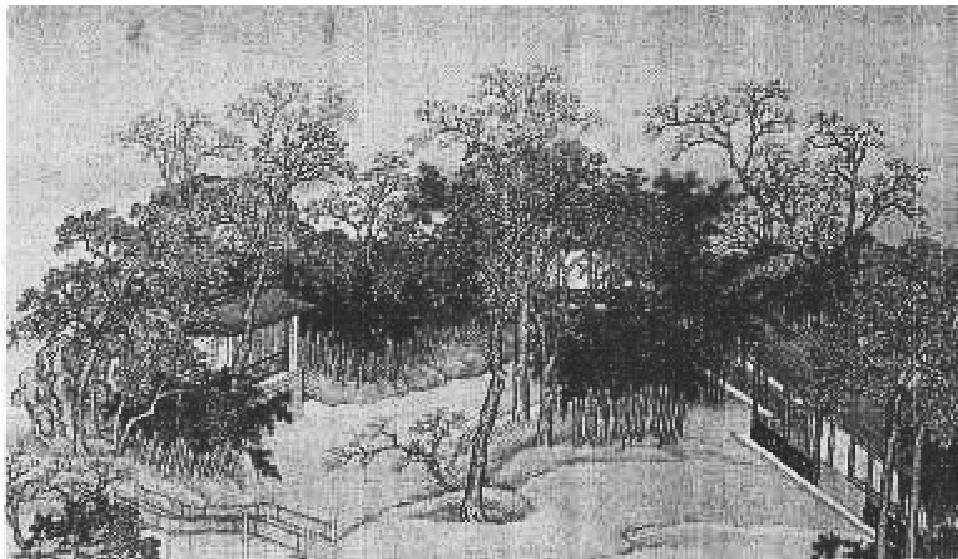
From the above verses, it can be seen that the JinE Library is indeed on a hillside, and the inclined corridor connected with it undulates and twists and turns along the terrain. There are groves of osmanthus flowers around the library [15]. Also mentioned more is the bamboo forest, Qin Xiao an important feature of the scene is also bamboo. Yun Wang gave a vivid description of Qin Xiao in the fourth paragraph of the Garden Picture (as shown in Figs 4-5). It can be seen from the picture that behind the house, bamboo is built with thousands of poles, trees are clumping together, and there is a hill with a grassy pavilion looming. By passing the bamboo forest, see the ruler corridor connecting a porch, sitting in the house of the elderly scroll meditation, eyes are very different, sitting on the bed tread. On both side of the corridor, the servant or holding the piano or tea, is coming to the master. In the fifth paragraph, it can be seen that the horizontal platform faces the winding bridge of the lotus pool and the tall trees are shaded. In the hall, the master of the garden and the guests were overlooking the fence. There is a lotus pond beside the porch, the lotus fragrance hit, re-freshing the heart and the heart. People were moved by this beautiful scene, gazing out of the window at the lotus pond, secretly appreciate. This is almost the same as Fang Xiangying's description, but the sense of imagination pre-sented in the scroll will make the scene more vivid [16].
Then look at the central landscape design:
In the middle is the "MoChi Pavilion". In front of the stone for the peak, under the pool, the stone bridge, after the peak, there are pavilions, said: "Yuzhao", ":" BuBoHang", said:" ZhenLiu", said": "JiuYing Library", the structure unique, the victory of the garden, especially to the interior, visitors can not to, more than a day of elegant, boarding and through .
From the upper side we can see, the central pavilion named Mochi Pavilion, in front of the Mochi Pavilion useful block stone built steep peaks, the lower edge of the pool, known as Mochi, is the main water system of the whole park, water carries twists and turns, set up stone bridge on the water surface, unicom pool at both ends. There are pavilions in front and behind the peaks. These pavilions are named YuZhao, BuBoHang, ZhenLiu, and JiuYing Library. Among them, BuBoHang is a walking built in the shape of a ship near the water for people to play, hold banquets and enjoy the water scene. The architectural structure of pavilions is quiet, leisurely and natural, which is the most prominent and unique in private gardens. Especially, stones are piled on the ground to form rockery stone caves like indoor space. Whenever visitors visit here, they can't go in to experience and play due to crowding. It can be seen that the description is the surrounding landscape of MoChi Pavilion. The water area of the MoChi Pool occupies about one third of the central scenic area of the garden, forming the main landscape of the garden with artificial rockery, and surrounding architectural pavilions, stone Bridges and pools, forming a landscape of integrated landscape.
Here, Xiangying Fang describes the pavilions around the MoChi Pavilion in great detail. First, he explains the specific names of the pavilions, and then saying that the structure of the pavilions is clean and leisurely, natural and natural. Among the buildings of many private gardens, it is the most prominent and unique one. The design of this pavilion also extends the interaction between the space under which the fake rocks are piled and the space on the water, so that the garden people can still taste the interesting landscape in the pool although they are in the rockery cave. The tenth paragraph of Wang Yun's Garden of Xiu shows a stream landscape in the garden (as shown in Fig. 6), which is probably the ink pool here.
The stone bridge is built on the winding water, the end of the bridge with the shelter of plants, making the bridge if hidden if visible, virtually increasing the fun of the garden. Several buildings on the banks of the stream are also clearly seen in the picture. Zhang Chen also has a description here: "ink pool a mountain root, count the fish to see the bottom." The mountain in the "mountain root" is probably a steep mountain built along the edge of the pool water, which can be said that "stone for the peak, under the pool".
Now let's move on:
About the scene of the garden, outside the marsh, there are ancient trees, bamboo, high willow , and the stone mountain is the most. Stone potential abrupt ups and downs, about its big, there are three peaks how. The highest view, calendar scales, the south of the Jiangnan mountains, misty smoke, more than the said: "the first peak", not different " Wushan... left River right lake, fireworks also.
It is written that there are ancient trees, slender bamboo, tall willows and plane trees around the whole garden, among which the most prominent are several stone mountains. Piling stone mountain stone abrupt changes, ups and downs, heavy rock [17].
Overlapping peaks, exquisitely carved, one of the largest peak body has three. Climb one of the highest peaks, look around and look at the distance, the nearby city of Yangzhou can be clearly seen, as if neatly arranged there, vivid, even in the distance can be seen through the misty mountains south of the Yangtze River.
From this, we can guess how the landscape around the garden is configured. First of all, there are many tall and ancient trees planted around the whole garden. Plants cooperate with each other to evolve the scenery and hue of different seasons. As well as the rockery piled up with rare stones, the rockery built up is tall and upright, uneven and exquisitely carved. According to research, the landscape described here is Yuanxia Zheng to reproduce the outstanding style of his brother Zheng Yuanxun's Ying Garden, which is very similar to the landscape design described by the Ying Garden (as shown in Fig. 7).
The garden is rich in vegetation, unique rockery stone. A large number of ancient trees and rockery stones are also required for the economic strength of the garden owner. If there is no certain assets, how to bear the external transportation costs and maintenance costs? Therefore, these configurations not only create the beauty of the garden, but also imply the wealth of the garden owner Zheng Yuanxia. And finally:
In the garden, it is suitable for spring, autumn and summer, and I arrive in mid-winter. Snow covers the sky. Jackdaws cry for trees, hear the sound of cranes in the bamboo, silence seems not human.
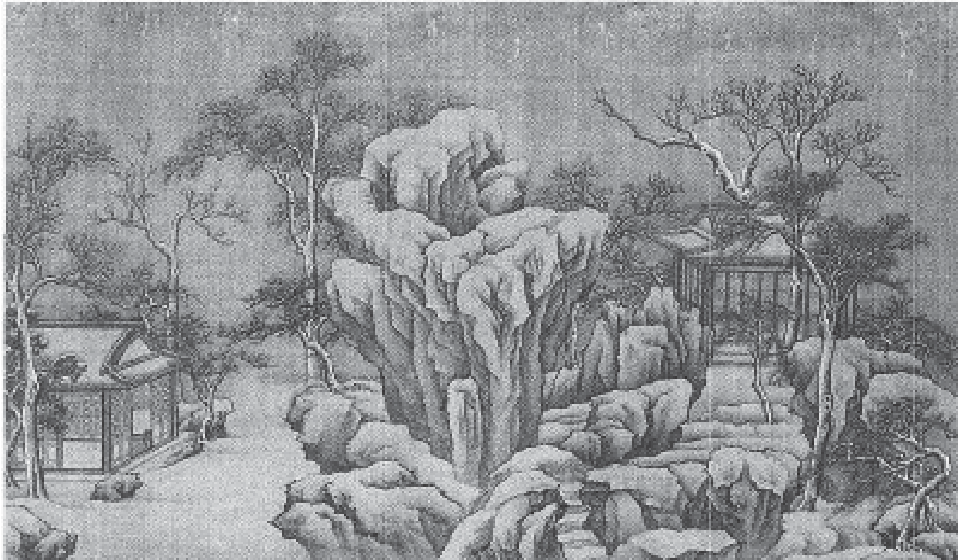
As you can see from above, the best time to visit the garden is spring, autumn and summer, because it seems to me that it often snows after the winter solstice, and the garden is covered with snow. At a glance, there is a vast expanse of white, quiet and airy, crows crowing in the wind-swept dead trees, and from time to time, I can hear fretting and wailing in the bamboo forest. The desolate crowing of the silent garden is not a pleasant scene to visit [18]. The second paragraph of Wang Yun's scroll is also described. Through the part of the rocks, the convex parts are mostly blank, and the trunks and branches are mostly white to show the weather covered with snow, creating a quiet atmosphere of cold white day.
The above description explains that spring, summer and autumn are the best seasons to enjoy the landscape in the garden. It can be inferred that in summer, the high summerhouse is cool and airy on all sides. At dusk, the sunset glow on the distant ridge becomes a useful sight in the garden. In autumn, the golden leaves and flowers become the background of pavilions and rockeries, allowing Yuanxia Zheng to enjoy natural wild fun with his family and friends in his spare time. This is similar to Yuanxun Zheng description of the Ying Garden: "Autumn is old, and the reeds are as white as snow... No one dared to swear. Lying in the pavilion in the heat of summer. "Neither brother mentioned the winter scene, probably because it often snows in Yangzhou after the winter solstice, and the garden is covered with snow [19]. At the first sight, there is nothing but white in the garden. The desolate birds chirping and singing in the quiet garden create this kind of cold white and quiet atmosphere in winter.
Conclusion
Through the analysis of Xiangying Fang "Rerepair of the Garden", the environmental design of the garden can be summarized simply:
(1) Highlight the literati temperament, pay attention to the use of classics. The overall landscape construction of the garden highlights the literati temperament, which has many similar to the literati garden. The overall landscape style is maintained. The left scenic spot of the garden is mainly a mountain, in which the buildings are decorated with flowers, trees and plants. In addition, for the building naming on the emphasis on the use of scripture, like the JinE library, Qin Xiao, including Qing Villa, have the platform is with meaning to give people infinite reverie.
(2) Superior environmental conditions, there are sufficient borrowing resources. The pavilions are built before and after the peaks, and the surrounding areas are matched with plants, flowers and trees, etc. This spatial relationship of up and down, one high and one low is borrowed from each other, showing a rich level of depth of field under the reflection of the pool water and plants. Writing of the northern mountain: "From its highest peak, Left River and Right Lake fireworks also "By climbing mountains and other ways can borrow the garden outside the mountain, water and even lights of the city. It extends the landscape infinitely, breaking through the original sense of boundary limitation. Just as Cheng Ji said in Yuan Ye, Borrowing Scenery: "There is no grid in a garden, and there are reasons for borrowing scenery. The most important thing in a forest garden is to borrow scenery".
(3) The scale is grand and the design is fine and hierarchical. Through the part of the rocks, convex places are mostly blank, and the trunks and branches are mostly white to show the weather covered with snow, creating a quiet atmosphere of cold white days. With a large number of strange stones, so that stone in the garden occupies a very important position [20]. Stone in a small space to increase the interest, create a level, and even to increase the role of space.
(4) There are multiple buildings closely integrated with the environment. For example, in the central part of the garden, there is a main building in the form of a pavilion or tower, with the surrounding buildings arranged in a rhythmic distribution, all centered around the water feature of the garden. This design and arrangement create a sense of harmony and echo between the main building and the surrounding structures. The overall layout resembles the rhythm in music and the brushwork in painting, with distinct intervals and a charming blend of various elements, resulting in a picturesque and captivating setting.
To sum up, Zheng Yuanxia's Xiu garden has the following characteristics: (1) the scale of the garden is not too large. (2) the environmental of the garden is basically built in imitation of nature. The characteristics of the overall landscape are very similar to those of scholar-official gardens. They all learn from nature and have obvious traces of literati gardens [21]. (3) the design of some scenic spots needs the support of wealth, such as the huge amount of materials used in the garden.
(4) the pavilion, stone bridge, and a large number of plant configuration are not very common in most literati gardens, especially in the use of stone. It can be seen that the garden of rest is a merchant garden with the characteristics of literati garden built by Yuanxia Zheng with huge sums of money.

