


Introduction
Global warming, mainly caused by carbon dioxide, is a challenge for humanity. It hurts the environment and human health, contributing to the melting of glaciers, extreme temperatures, and weather events [1- 2]. Besides, environmental pollution causes significant property damage due to high environmental costs [3]. The costs of climate damage are about 1.5% and 0.7% of China’s GDP and global GDP per 1ºC temperature rise on average [4]. As the largest CO2 emitter in the world [5], China’s rapid economic growth is accompanied by environmental problems. The Chinese government has expressed its determination to reduce carbon emissions, pledging to achieve carbon peaking by 2030, and carbon neutrality by 2060 [6].
Global warming can be combated by boosting carbon productivity [7]. Although China’s average carbon productivity growth rate is higher than the USA, France, and other countries, it only accounts for about 20% of developed countries [8]. Therefore, exploring carbon productivity and its growth mechanisms is particularly important.
Auditing affects the environment [9-11]. Most studies discuss the role of environmental auditing in terms of its strict enforcement and monitoring role [12]. Some studies explore specific environmental auditing practices [13], especially the Leading Officials’ Accountability Audit of Natural Resources policy [14-16]. However, few studies have analyzed how auditing affects the environment from the perspective of institutional arrangements and audit independence. Vertical audit reforms have changed institutional arrangements to enhance audit institutions’ independence. This study examines how vertical management auditing reform affects carbon productivity, providing essential insights into the role of audit independence.
There was no consensus reached on whether to centralize or decentralize auditing institutions. Some scholars believe that environmental decentralization is the cause of China’s long-term inability to manage its environmental problems [17]. They have argued that environmental decentralization leads local governments to sacrifice the environment for economic growth [18]. Besides, it generates bottom-up competition [19], transboundary pollution [20], free-riding [21], and other issues. However, other studies have argued that local governments have an information advantage over the central government [22]. Most studies on China’s environmental management system conclude that excessive environmental decentralization would increase carbon emissions [23]. China has experimentally adopted vertical reform measures to solve the distortion of environmental governance caused by decentralization [24-26]. This study examines how auditing centralization impacts carbon productivity, answering whether to centralize or decentralize auditing institutions and extending the research on environmental centralization theory.
This paper has done the following work. We take the vertical management auditing reform conducted in 2015 as a quasi-natural experiment and adopt a DID method to identify the positive effect of auditing centralization on carbon productivity. The heterogeneity tests show that the policy effects only make sense when government officials face low promotion or high public scrutiny pressure. Furthermore, we discuss the mechanisms between vertical management auditing reform and carbon productivity.
Compared with existing studies, the main contributions of this paper are as follows. Firstly, this paper empirically examines the auditing approach to carbon productivity, enriching the existing methods for improving carbon productivity. Secondly, this paper further verifies the mediating role of environmental regulation, industrial structure rationalization, green innovation, and energy efficiency, enriching our understanding of the relationship between auditing centralization and carbon productivity. This paper also validates the heterogeneous effect of auditing reform on carbon productivity when officials face promotion pressure and public scrutiny. Thirdly, to our knowledge, it is the first paper to identify the positive effect of vertical management auditing reform on carbon productivity, arguing the role of auditing centralization on carbon productivity and enriching the literature on allocating audit centralization structures. Vertical management auditing reforms have made grass-roots audit institutions directly accountable to provincial audit institutions, reflecting auditing centralization. Besides, it is an excellent quasi-natural experiment, providing an effective exogenous shock to measure the centralization of auditing institutions. It supports the point that moderate auditing centralization contributes to carbon productivity.
The organization of the paper is as follows. Section 2 reviews the existing relevant literature and formulates research hypotheses. Section 3 describes the model and the data. Section 4 presents the empirical results and robustness checks. Section 5 analyzes heterogeneity and identifies mechanisms. Section 6 presents the main conclusions and policy implications.
Literature Review and Hypothesis
Vertical Management Auditing Reform
Since 1995, China has established an environmental management system of “dual and block-oriented management”. However, this system led to local protectionism and implementation bias among local governments due to information asymmetry [27-28]. Therefore, the Chinese government has initiated vertical reform to solve the problems. In 2015, the General Office of the Central Committee of the Communist Party of China and the General Office of the State Council issued Framework Opinions on several Major Issues Concerning the Improvement of the Audit System and the Implementing Opinions on the Implementation of Full Audit Coverage, and other supporting documents. These documents directed pilot reforms in personnel, property, and asset management of audit institutions in Shandong, Jiangsu, Guangdong, Zhejiang, Chongqing, Guizhou, and Yunnan municipalities.
Vertical management audit reforms achieve the centralization of provincial audit institutions. Previously, China adopted an Executive-dominated government audit system. Local grass-roots audit institutions were responsible for the parent government and higher-level audit institutions, which had a dual-management character. Specifically, the personnel power was dominated by local party governments, and the property power was entirely at the local level. Besides, audit reports are commissioned and reported on by local governments, making it difficult to play an oversight role. Consequently, the willingness of local governments to govern the environment had been weakened, and governance “distortions” had arisen. Vertical management auditing reform transfers local audit institutions under the parent government’s jurisdiction to the provincial audit institutions’ direct jurisdiction. Audit staff, funding budgets, and assets of regional audit offices are centrally managed at the provincial level, forming an independent oversight system. It has restructured the relationship between local governments and audit offices, freed local governments from path dependency [26], and strengthened the independence of audit offices.
Voluntary auditing is a significant form of EMS practice in foreign countries [29]. Hence, the organizational attributes of a company and the composition of the audit committee significantly influence the audit process [30-32]. The United States has a history of employing voluntary environmental audits as a crucial means of enhancing environmental performance [31, 33]. Prior research supports the notion that voluntary audit activities enhance environmental performance in the United States [29]. The voluntary management of Mexico’s National Environmental Audit Program (PNAA) has positively influenced the environment [34]. Environmental management system standards, like ISO 14001 and EMAS, represent another significant category of voluntary audits [35, 36]. Nonetheless, some studies contend that these measures lack binding force [37]. Apart from voluntary audits, more stringent policy instruments for environmental auditing exist, including environmental tax audits and specialized assessments, among others [38-41]. Owing to national institutional and cultural factors, only a handful of countries, such as India and the Philippines, have implemented centralized auditing, with very few empirical studies exploring this phenomenon. Theoretical evidence suggests that vertical audit regulation in India enhances environmental governance.
Vertical Management Auditing Reform and Carbon Productivity
Potential reasons for centralizing audits to improve carbon productivity are as follows. First, it improves audit work efficiency and enhances the audit supervision function [25]. The internal governance structure and its independence affect auditing effect [42-45]. This reform has changed the internal governance structure by strengthening the direct leadership of higher-level audit institutions over lower-level audit institutions, thus facilitating the strategic allocation of audit resources and the consolidation of audit capacity. Second, the management of audits and the provision of information impact the green economy development [46]. Vertical management auditing reform has alleviated information asymmetry and implementation bias. It has minimized the levels of information transfer between audit offices. Consequently, higher-level audit institutions can access more precise information [28]. Besides, environmental audits play an important role in assessing and controlling the environmental impact of information [47]. Third, audit has a supervisory role in economic activities [48]. The verticalization of audit institutions has strengthened their supervisory function, which is conducive to solving the problems of protectionism and government “self-supervision” in local governments [24], thus facilitating local governments’ environmental governance. Therefore, we propose Hypothesis 1:
H1 Vertical management auditing reform can significantly improve carbon productivity.
Influence Mechanism
Vertical management auditing reform contributes to strengthening environmental regulation by local governments [26]. Simultaneously, environmental regulations have a substantial impact on carbon productivity [49]. First, vertical management auditing reform increases the government’s willingness to implement environmental regulation. It has made provincial audit institutions more aware of the audit efficiency of grass-roots audit institutions, which has exerted monitoring pressure on local governments to strengthen environmental regulations [50]. Second, vertical management auditing reform can support the government’s capacity for environmental governance. The auditing verticalization precludes undue interference by local governments in audit reports and strengthens its supervisory role. Local governments can gain insight into system deficiencies and management loopholes through audit reports to eliminate hidden problems and improve management promptly. Meanwhile, enhanced environmental enforcement capacity can significantly improve the environmental performance of enterprises [51]. Therefore, we propose Hypothesis 2:
H2 Vertical management auditing reform improves carbon productivity by strengthening environmental regulation.
Vertical auditing reforms alleviate vicious local government competition, thus enhancing the rationalization of industrial structures. According to the “Pollution Heaven” hypothesis, China’s decentralized environmental governance system involves different environmental regulation enforcement across regions. Consequently, highly polluting industries relocate to less regulated areas to avoid the costs generated by higher environmental standards [52, 53], leading to changes in industrial structure. Moreover, local governments will adopt lower environmental standards to prevent local industries from losing their competitive advantage, ultimately creating a vicious competitive situation of “race to the bottom” [54]. Verticalized audit management fosters regulatory coordination, alleviating the fierce competition among local governments, and thus rationalizing industrial structure. Further, industrial structure significantly impacts carbon intensity [55]. Therefore, we propose Hypothesis 3:
H3 Vertical management auditing reform improves carbon productivity by promoting rationalizing industrial structure.
The relationship between vertical management auditing reform and green innovation reflects Porter’s effect. According to Porter’s hypothesis, firms can meet environmental standards and offset compliance costs through technological innovation when facing strengthened environmental regulations and increased pollution control costs. Vertical management auditing reforms force governments to strengthen environmental regulations [26]. Second, vertical audit reforms have improved the government’s environmental governance model. Previously, local governments often choose low-risk, high-yield, short-payback environmental governance models to achieve accountability [13]. The reform increases the government’s attention to the environment, changing officials’ “GDP-only” promotion model and prompting them to invest in high-risk, low-yield science and technology fields. Besides, green technological innovations can reduce carbon emissions through capture and fixation [56, 57]. Therefore, we propose Hypothesis 4:
H4 Vertical management auditing reform improves carbon productivity by promoting regional green innovation.
Vertical auditing reforms have strengthened environmental regulations, forcing firms to improve energy efficiency to meet the increased energy consumption costs. Vertical auditing reforms have enhanced the audit oversight function and government environmental regulation. Furthermore, strengthened environmental regulations increase firms’ production costs [58], raising the marginal cost of energy consumption and pushing firms to improve energy efficiency [59]. Audits have been demonstrated to enhance energy efficiency [12]. Meanwhile, energy efficiency affects carbon emissions [60]. Therefore, we propose Hypothesis 5:
H5 Vertical management auditing reform improves carbon productivity by increasing energy efficiency.
Materials and Methods
Difference-in-Differences Model (DID)
Taking the Framework Opinions on Several Major Issues Concerning the Improvement of the Audit System promulgated in 2015 as a quasi-natural experimental event, we employ a difference-in-differences method to examine the impact of vertical management auditing reform on carbon productivity. The specific model settings are as follows:
In this formula, CPit is the explanatory variable, which represents the carbon productivity. The subscripts i and t represent the city and the year. didit is the core explanatory variable, when the city is located in Jiangsu, Zhejiang, Shandong, Guangdong, Chongqing, Guizhou, or Yunnan provinces and the time is after the pilot time, the value is assigned to 1. Otherwise, it is 0. control Pitj is a series of control variables that may affect carbon productivity, including gross secondary industry output (lngy), registered population (lnpeople), education expenditure (lnedu), per capita gross domestic product (lnperGDP), general public budget expenditure (lnfis), and the number of operated buses (lnbus). γi denotes individual-fixed effects. δt denotes year-fixed effects. εit represents a random error term.
Measures
We calculate carbon emissions based on energy consumption data of electricity, gas, liquefied petroleum gas, and thermal energy [61] (The specific calculation process can be seen in Supplementary Notes). Carbon productivity is numerically equal to the ratio of GDP to carbon dioxide emissions [62]. Therefore, it is calculated by the following formula [63]:
didit is used as the key explanatory variable, reflecting whether the vertical management auditing reform was piloted or not. When the city is located in a policy pilot area and the time is after the pilot time, the value is assigned to 1. Otherwise, it is 0.
We discuss four potential mechanisms in this study. Regional environmental regulation is represented by the frequency of words related to the environment in local government reports. The redefined Theil index is the basis for measuring the rationalization of industrial structure [64]. The per capita utility model of green invention represents green innovation, and the energy consumption per unit of GDP means energy efficiency.
Referring to the previous literature, we select the GDP of the second industry, the registered population at the end of the year, the education expenditure, the per capita GDP, the general public budget expenditure, and the number of buses operated at the end of the year as the control variables (see Supplementary Notes).
Data Sources and Descriptions
This paper uses the panel data of 281 cities from 2006 to 2019. Because of the impact of the new coronavirus epidemic, we take 2019 as the deadline for research. Data on carbon productivity and word frequency related to environmental protection are obtained by manual calculation. Data on green innovation comes from the China Research Data Service Platform. Other data are from the City Statistical Yearbook. Table 1 shows the descriptive statistical results of the main variables in this paper.
Results and Discussion
Vertical Management Auditing Reform and Carbon Productivity
Table 2 shows the baseline regression results for the impact of vertical management auditing reform on carbon productivity. We cluster standard errors by city level. Column (1) shows the estimation results without the control variables. Considering the two-way fixed effects, the estimated coefficient is positive at the 1% significance level, indicating that vertical management auditing reform significantly contributes to carbon productivity. Furthermore, we add control variables. The coefficient in column (2) increases compared to column (1), implying that the pilot city’s carbon productivity has increased by 13%.
We further use the PSM-DID approach to eliminate self-selection biases in pilot areas. We select control variables in the original model as covariates to estimate the propensity score using Logit regression and then carry out the nearest neighbor matching, kernel matching, and radius matching, respectively. The results show that the coefficients, approximately 0.13, are consistent with the development of the baseline regression. Therefore, Hypothesis 1 is verified. (The results of the balance tests are presented in supplementary notes)
Heterogeneity Analysis
Local governments are the significant executors of environmental policies, and the public is the essential third-party supervisor. Therefore, we further examine the policy effects from the perspective of heterogeneity in promotion pressure and public scrutiny. A high GDP growth rate is the decisive factor affecting the advancement of officials [65]. Studies have found that officials are more motivated to increase economic intervention in search of political advancement when they approach the end of their assignment [66], consequently giving up environmental governance to a certain extent. Secondly, as a third-party informal supervision, public supervision of the ecological environment can improve the rationality and quality of environmental governance decisions [67], enhancing the environment [68-70].
Table 1.
The statistical description of variables.
Table 2.
Results of the PSM and hypothesis testing.
We perform group regressions based on official promotions and public scrutiny pressures. The results display that the effect of vertical management auditing reform on carbon productivity is significant only when government officials face low promotion pressure or high public scrutiny pressure (see Supplementary Notes).
Robustness Tests
Discussion of Endogeneity
First, these policy implementation areas are not selected stochastically. Second, the control variables included in the current data can not represent all factors that affect carbon productivity. Therefore, we use the instrumental variable method to identify the policy effect to prevent the interference of omitted variables and non-randomized choices of policy implementation sites.
We follow existing studies that employ fixed telephones to construct instrumental variables [71]. The number of mobile phone users reflects the telecommunications infrastructure and informatization level and correlates with Internet development [72]. Moreover, information disclosure and decision transmission rely on communication facilities and the Internet. Therefore, the number of mobile phone users can make a difference in implementing the reform and auditing work efficiency. In addition, it is not directly related to carbon productivity. Accordingly, we select the number of urban mobile phone users at the end of the year as one of the instrumental variables.
Real estate investments affect the implementation of audits. First, because of the mutual promotion between real estate investment and urbanization, real estate investment plays a role in absorbing the population [73]. Besides, infrastructure, finance, and people are inherently related to implementing auditing work. Second, real estate development will impact the power operation between governments and audit institutions. The real estate industry will burden environmental protection due to its high energy consumption and heavy pollution [74]. Besides, the government’s insistence on implementing house price containment policies will more serious local fiscal pressure. When local governments are under significant financial pressure, they give up environmental goals to achieve economic goals [75, 76], reducing policy effects. Beyond that, real estate investment has nothing to do with carbon productivity.
Table 3.
Discussion of endogeneity: The instrumental variables method.
To sum up, we choose the logarithm of the number of year-end mobile phone subscribers and the logarithm of the completed amount of real estate development investment as instrumental variables and adopt the two-stage least-squares (2SLS) approach. The statistics of Kleibergen-Paap rk LM, Kleibergen-Paap rk Wald F, and Hansen J show that the instrumental variables have passed the underidentification, weak instruments, and overidentification tests. As shown in column (1), these two instrumental variables significantly correlated with the explanatory variable, meeting the relevance requirement. In column (2), CP still has a significant positive correlation with did after considering the issue of endogeneity. This result validates the robustness of the baseline regression findings. To test the externality of instrumental variables, we exclude the sample data of 2015 and subsequent years and regress instrumental variables on carbon productivity. Column (3) presents that the result is insignificant, indicating that instrumental variables can not affect carbon productivity directly before the auditing reform. Column (4) reports the regression result of the core explanatory variable and instrumental variables on carbon productivity. The results of instrumental variables are not significant. In contrast, the results of core explanatory variables are positively effective, thus proving that instrumental variables do not immediately impact carbon productivity.
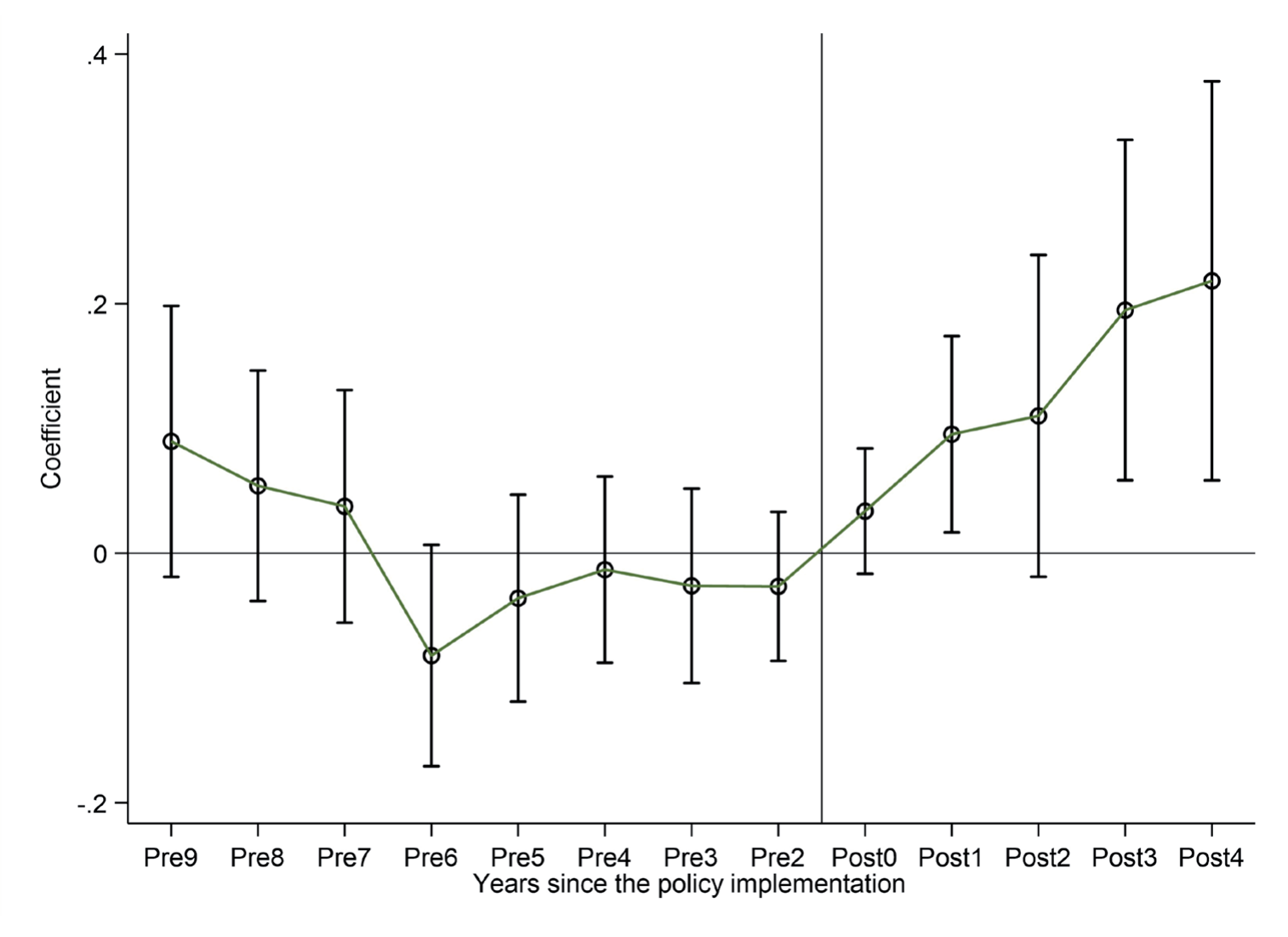
Parallel Trend Test
The parallel trend test is the premise of applying the difference-in-differences model. We utilize an event study to test the dynamic effect of the vertical management auditing reform on carbon productivity. Based on the model (1), we construct window period variables, using pre1-pre9 to denote the year before the start of the reform through the first nine years and post0- post4 to represent the years after the policy. As can be seen from Fig. 1, there was no significant difference in carbon productivity between the treatment and control groups before the reform. However, the differences between the two groups are revealed after the reform, satisfying the parallel trend hypothesis.
Other Robustness Tests
We further performed the following robustness tests (see Supplementary Notes). First, we conducted a placebo test by randomly setting up an experimental group to exclude the effect of the non-random selection of policy pilot areas. Results show robust baseline results. Second, we alter fixed effects and clustered levels to exclude the products of higher dimensional unobservable variables. Third, we further control the effect of other parallel environmental policies by adding dummy variables to eliminate the possible interference. The results show that the policy effects remain significant under contemporaneous policy disruptions. Fourth, we conducted Synthetic difference-in-differences and counterfactual estimation to weaken the estimators’ dependence on the parallel trend and exclude the influence of unobservable time-varying confounders [77, 78]. Fifth, we replace the data on carbon emissions and redefine the independent variable. The results show that vertical management auditing reforms can significantly increase carbon productivity and reduce carbon intensity. Sixth, we further use the RA, IPW, AIPW, and IPWRA estimators to estimate the auditing reform’s average treatment effect, supporting the baseline results’ robustness.
Mediating Effect Analysis
To verify the mechanism between vertical management auditing reform and carbon productivity, we construct model (3). Meditorit is the mediating variable of this paper, including the frequency of environmental protection words (lner), the rationalization index of industrial structure (lntl), the number of green inventions of utility models per capita (perugrma), and the energy efficiency (lnenergyeffi). The meanings of other variables refer to Model (1).
The above regression results indicate that the vertical management auditing reform improves carbon productivity. However, how the reform impacts carbon productivity remains to be determined. Therefore, we further examine whether local governments improve carbon productivity by promoting environmental regulation, industrial structure rationalization, green innovation, and energy efficiency.
The regression results of the mechanism analysis are presented in Table 4. The results show that vertical management auditing reform can significantly promote regional environmental regulation, rationalization of industrial structure, green innovation, and significantly reduce energy consumption per unit of GDP.
Conclusions and Limitations
For a long time, China has implemented the environmental management system of “dual and block-oriented management”. To avoid the problems caused by the traditional environmental management system, China’s government has reformed its environmental management system, including the vertical management auditing reform. This paper uses the difference-in-differences method to verify the positive effect of vertical management auditing reform on carbon productivity. The policy effects only make sense when government officials face low promotion pressure or high public scrutiny pressure. The mechanism analysis shows that the vertical management auditing reform can improve carbon productivity by strengthening environmental regulation, promoting the rationalization of the industrial structure, and improving regional green innovation and energy efficiency.
This paper enriches the research on the relationship between audit centralization and carbon productivity. Existing studies have examined the reform’s impact on major air pollutants. Compared to them, this paper takes a carbon productivity perspective that captures both environmental and economic efficiency. Regarding results, the policy was considered economically and environmentally beneficial, consistent with previous studies. Compared to studies on environmental centralization, this paper verifies the auditing centralization’s positive effects on the environment from the perspective of government auditing. Further, it provides empirical evidence for the application of moderate audit centralization.
This paper may have the following points that can inspire future research. First, this paper explores the role of audit centralization in enhancing carbon productivity, but does not explore the institutional design due to data limitations. It is suggests that more research is needed on how to design the specific powers’ centralization and decentralization to achieve the best carbon productivity gains, while taking into account costs. Second, this paper does not fully explore the environmental performance of audit centralization. We only explored how audit centralization impacts carbon productivity. More research is needed to explore the impact of audit centralization on the other pollutants’ emission efficiency, such as sulphur dioxide emission efficiency.
This study has some limitations: First, due to the lack of data and information, this paper only analyzes the policy effects of the reforms and does not analyze the environmental impacts of specific changes in rights and responsibilities. Therefore, further research is needed on improving the specific policy content and allocating rights among the various subjects. Second, we examine only four potential mechanisms. Future research should explore additional influencing factors to provide a more comprehensive analysis of this relationship.

