

Introduction
Environmental pollution threatens the survival of all mankind [1]. The public plays a crucial role in environmental governance systems [2, 3]. Public environment concern (PEC) and participation are needed in addressing environmental pollution and improving environmental quality [4-6]. However, there is insufficient public environmental awareness and effective participation [7-10]. One explanation for this dilemma is the lack of high-quality environmental information disclosure (EID) and the lack of a legal system that allows for public environmental participation [11, 12]. China is facing tremendous pressure on its governance environment and has set a target to peak its carbon emissions by 2030. Recognizing the importance of PEC and factors limiting PEC, it is imperative to take measures to promote public environmental awareness and effective participation.
Local governments are promoters of public environmental participation and agents of public environmental demands [12]. Hence, the efficacy and fairness of the government departments influence the public’s pro-environmental behavior [13-15]. Local governments promote public environmental participation through the implementation of public environmental policies. However, issues such as local protectionism undermine the effectiveness of public environmental policies [16]. Government audits constitute a crucial component of the national governance system and have an oversight effect on local governments [17]. Consequently, government audits can mitigate problems such as local protectionism. Since the Chinese government’s Auditing Vertical Management Reform in 2015, the independence of audit authorities has greatly increased, and their supervisory role over local governments has strengthened. AVMR is a valuable quasi-natural experiment, offering an exogenous shock for evaluating audit independence and government auditing [18]. We aim to explore the connection between government audits and PEC in China.
Existing research suffers from the following shortcomings: Firstly, while studies have explored the impact of government effectiveness on the public’s pro-environmental behavior, the relationship between the national auditing departments’ independence and PEC has not yet been made clear. Our study provides some insights into the effectiveness of audit departments’ auditing functions and PEC. Secondly, existing research on audit independence focuses more on auditors and audit committees [19, 20]. There has been limited exploration into designing a management model that promotes greater freedom for the national audit authority. Thirdly, there is a lack of investigation into AVMR’s dynamic impact effects. Specifically, studies have predominantly focused on the short-term dynamic impact effects of AVMR. Additionally, policy synergy is an important trend in research on policy design [21, 22]. Building joint participation mechanisms through judicial and administrative means has been found to improve local government accountability [23]. However, there are no empirical studies that validate the environmental impacts of collaborative governance between the judiciary and government agencies from a policy synergy perspective.
We investigate the following aspects: Firstly, based on panel data for 292 cities in China from 2011- 2019, we examine the positive influence of AVMR on PEC using a DID estimation strategy. Secondly, we confirm that government environmental enforcement and corporate EID mediate between AVMR and PEC. Thirdly, we further confirm that AVMR and Public Interest Litigation Reform (PILR) have a synergistic implementation effect for long-term PEC enhancement. Lastly, our heterogeneity analysis discloses that the impact of AVMR on PEC is more pronounced in cities with higher levels of legalization and digitization or lower fiscal pressure.
Compared to existing studies, this paper offers several significant contributions: Firstly, this paper enriches the literature on exploring audit organization management models and audit independence. We validate the positive impact of audit independence on PEC, supporting the idea that government audit departments should be centrally organized. Secondly, this paper advances understanding of the impact of AVMR on government governance and EID. We confirm that government environmental enforcement and EID are pivotal mechanisms through which AVMR influences PEC. Thirdly, this paper contributes to the literature on designing synergistic environmental policies. Our findings support enhancing the complementarity and collaboration between government auditing and litigation policies. Notably, this paper adopts a methodology for examining policy synergy within a quasi-natural experiment framework, thereby enhancing empirical research on synergy in dual policy regimes. Scholars have previously discussed the synergistic effects of different environmental policies using methods such as Bayesian nonparametric [24], interaction terms [25, 26], synergy measures [27], and continuum DID [28, 29]. We introduce an interaction term using the DID estimation strategy.
Institutional Background
Auditing Vertical Management Reform
China initially adopted an environmental management system of “dual and block-oriented management”. Audit institutions are accountable to the superior audit institutions and equivalent government. In this dual management model, auditors lack independence, and the accountability system is merely a formality [30, 31]. The main reason is that the auditing organization considers local interests when issuing government audit reports. In 2015, the Chinese government released the Framework Opinions on Several Major Issues Concerning the Improvement of the Audit System and supporting documents, initiating the AVMR pilot. AVMR has three priorities, the first being to achieve complete audit coverage. Complete audit coverage refers to strengthening the auditing responsibility in supervising public funds, state-owned assets, and state-owned resources and fulfilling economic responsibilities by leading cadres. The second priority is investigating the reform of managing personnel, property, and assets in local audit offices. That is to say, AVMR strengthens the leadership of the higher-level audit institutions over the lower-level audit institutions and enhances the independence of audit supervision in personnel, property, and asset management. Finally, it aims to promote the professionalization of auditing. Specifically, it targets establishing a scientific system for the management, selection, and training of audit staff, thereby enhancing the effectiveness of their work. AVMR represents a crucial initiative in safeguarding the independence of audit institutions (see the Supplementary Notes for more details on the policy background of PILR).
Literature Review and Hypotheses Development
Literature Review
National audits have a positive effect on government governance and environmental governance [32]. Since AVMR is an important reform of audit institutions, many studies have explored the role of national audits from the perspective of AVMR. AVMR strengthens the independence of audit institutions and the oversight function of government audits [18]. Studies have been conducted to assess the impact of AVMR policy on the environment and government behavior. The reform was found to have significantly reduced pollutant emissions and improved energy efficiency [33, 34]. AVMR also has a positive impact on the fiscal management of local governments by reducing their over-indebtedness and improving their fiscal sustainability [35, 36]. Prior research has not fully recognized the influence of AVMR on public environmental behavior. Therefore, this study examines the role of AVMR in enhancing PEC.
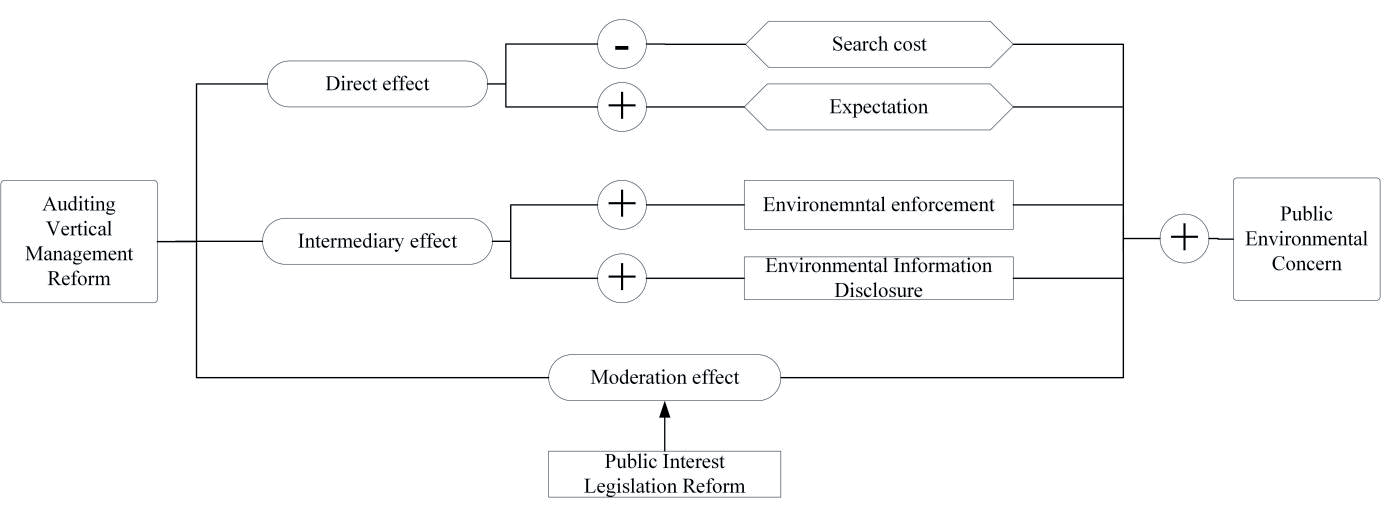
We will formulate hypotheses based on logical relationships, as shown in Fig. 1.
Audit Independence and Public Environmental Concern
Building upon existing studies, we posit a positive impact of AVMR on PEC. Firstly, AVMR reduces the search costs for the public to pay attention to environmental information by facilitating the disclosure of audit information. On the one hand, AVMR has enhanced audit disclosure [35]. More rigorous audits of local governments have revealed more problems. Besides, governments will strengthen personnel and property management in response to audit inspections, thereby enhancing the transparency of government information [35]. On the other hand, AVMR contributes to the quality of audit reports. Audit reports on local governments are no longer the responsibility of local governments, which can effectively avoid government tampering with audit reports. Consequently, the information in the audit reports is more accurate and reliable, which strengthens the public quality of government information. Secondly, AVMR raises the public’s expectation that the environment will be improved. According to the expected value theory, the greater the likelihood that an individual believes a goal will be reached, the greater the individual’s motivation to accomplish the task. With the strengthening of audit supervision, local governments meet the audit requirements by strengthening environmental governance and environmental enforcement, which enhances the government’s environmental enforcement behavioral norms [18]. The government’s environmental enforcement behavioral norms enhance public expectations, which promotes people’s participation in environmental issues [37, 38]. On the one hand, the public cares about government decisions that have social impacts and is willing to take action to support government decisions [39]. On the other hand, the public will regulate and shape their behavior accordingly when they perceive the social pressure brought by the government’s enforcement of behavioral norms [40]. Based on the above analysis, we propose Hypothesis 1.
H1: AVMR has a positive effect on PEC.
Auditing Independence and Environmental Enforcement
AVMR facilitates government environmental enforcement through several key mechanisms. Firstly, AVMR inherently pushes local governments’ environmental enforcement [18, 41]. AVMR has shifted the responsibility of the primary audit department from the local government at the same level to the provincial audit department [18]. This removes local governments’ interference in the auditing process and strengthens local governments’ supervision. Governments will strengthen environmental enforcement, responding to heightened audit accountability pressures. Secondly, AVMR’s contribution to audit quality and efficiency has led to a stronger audit monitoring role for local governments. On the one hand, AVMR focuses on enhancing the professional competence of the audit team. Enhancing auditors’ professionalism significantly contributes to audit quality [42-44], subsequently increasing the accountability of local governments [45, 46]. On the other hand, provincial audit bodies harmonize the management of audit resources, facilitating the consolidation and harmonized management of audit resources and thus promoting audit efficiency [18]. Thirdly, AVMR’s contribution to the fiscal sustainability of local governments provides the necessary resources for local government environmental enforcement [35]. Strengthened capacity for environmental enforcement promotes PEC [47]. Based on the above analysis, we formulate Hypothesis 2.
H2: AVMR strengthens PEC by enhancing environmental enforcement.
Audit Independence and Environmental Information Disclosure
AVMR promotes corporate EID by strengthening the external monitoring pressure. According to stakeholder theory, firms disclose higher-quality environmental information to demonstrate their legitimacy with stakeholders under greater external regulatory pressure [48, 49]. On the one hand, the pressure comes from government departments. Subject to stronger audit scrutiny, government departments will focus more on environmental governance and enforcement [18]. As the main polluters, companies are bound to feel the pressure from the government’s environmental requirements. Enhanced environmental enforcement ensures the effectiveness of EID [50]. Simultaneously, this pressure comes from the audit department. AVMR improves the efficiency of auditing and thus enhances the companies’ environmental auditing by effectively managing audit resources. Environmental auditing can significantly improve the level and quality of corporate EID [51]. EID is acknowledged as an effective tool for fostering public environmental participation [52], primarily due to its role in reducing information asymmetry. Based on the above analysis, we formulate Hypothesis 3.
H3: AVMR strengthens PEC by enhancing corporate environmental disclosure.
Audit Independence, Public Interest Litigation, and Public Environmental Concern
The main reasons AVMR and PILR can realize policy synergies are as follows: Firstly, PILR encourages public environmental litigation and enhances the effectiveness of environmental enforcement by ensuring the accessibility of government information. AVMR promotes information disclosure by local governments and establishes the prerequisite for the public to participate in environmental governance [35]. PILR provides a litigation channel for the public. Based on the implementation of AVMR, the implementation of PILR not only guarantees the public’s right to access environmental information but also helps the public to exercise their oversight authority and participatory rights [53, 54]. Secondly, the synergy between VMAR and PILR brings together the audit institutions, the judiciary, and the public. The joint participation of multiple subjects in environmental governance helps to enhance the enthusiasm of the participating subjects [55]. Thirdly, PILR and AVMR have the same policy effect in that they both strengthen the monitoring by local governments. Local governments will pay more attention to environmental matters and reduce localism in the face of scrutiny by prosecutors, the public, and auditors. Based on the above analysis, we formulate Hypothesis 4.
H4: Synergy between AVMR and PILR can contribute to long-term PEC growth.
Experimental
Methodology
To verify the effect of AVMR on PEC, we employ a DID estimation strategy with two-way fixed effects.
Where subscripts i and t denote city and year, respectively, the dependent variable PECit is public environmental concern. didit is the independent variable indicating whether AVMR is implemented or not. Controlit represents other control variables that may affect the PEC. δi represents the city fixed effect. γt represents year-fixed effects. εit is the stochastic disturbance term.
To further validate the mechanism between AVMR and PEC, we construct Equations (2) and (3).
Where Enforit denotes environmental enforcement, the rest of the settings are the same as Equation (1).
EIDit is for environmental information disclosure. Control_mit represents the firm-level control variables affecting environmental disclosure (see Supplementary Notes). The rest of the settings are the same as Equation (1). We focus on AVMR’s impact on corporate EID in illustrating the relationship between AVMR and corporate environmental behavior. This indicates AVMR’s role in driving pro-environmental behavior among NGOs.
The specific pilots for AVMR and PILR are shown in the Supplementary Notes. We employ a multi-temporal DID estimation strategy with two-way fixed effects to verify the synergistic effect between AVMR and PILR.
did_sit is the independent variable of Equation (4). did_sit equals 1 if a city pilots both AVMR and PILR; otherwise, it equals 0. did_pit is the independent variable of Equation (5). did_pit equals 1 if a city pilots PILR; otherwise, it equals 0. The rest of the settings are the same as Equation (1).
Variable Definition
The dependent variable (PEC) is expressed as the annual average value of the Baidu search index for “environmental pollution”. Owing to the robust information dissemination and collection capabilities of online media, the public primarily articulates environmental concerns through these channels [56, 57]. Existing studies have mostly used search indexes to measure PEC [58-60]. We multiply the explanatory variables by 0.1 to better show the coefficients.
didit is the independent variable. didit equals 1 when the year is greater than 2014 and the city is an AVMR pilot city; otherwise, it is 0.
Referring to previous studies [9, 61], we control for important variables affecting PEC, including industrial structure, economic level, population density, foreign direct investment, level of environmental pollution, fixed investment, level of education, human capital, level of financial development, green behavior, and level of social welfare. The specific variable settings are shown in Table 1.
Table 1.
Main variables and their definitions.
Data Sources
This study relies on panel data for 292 cities from 2011-2019. We use STATA.17 for all data analysis. As there are more than 0 values in the Baidu search index of “environmental pollution” on PC or mobile before 2011 and the influence of the epidemic in 2020, we selected 2011-2019 as our research sample time. Control variable data come from The Statistical Yearbook of Chinese Cities. Data on the number of environmental penalty cases were obtained from the Pkulaw website. Following Yang, Zhang, and Li’s (2023) study [62], environmental disclosure is obtained through a composite indicator score (see Supplementary Notes). The control variables at the enterprise level are extracted from the CSMAR database. (The descriptive statistics of the main variables are shown in the Supplementary Notes).
Results
Benchmark Results
Building upon the earlier model design and variable selection, this section explores the effect of AVMR on PEC. The results of the benchmark regression are presented in Table 2. We have adopted a variety of standard errors to improve the accuracy of our results. Columns (1)-(3) present DID estimation results with clustering robust standard errors, bootstrap sampling standard errors (times = 1000), and Driscoll-Kraay standard errors, respectively. The findings indicate a significant promotion of PEC by AVMR. AVMR pilot cities exhibit approximately 32.2% higher PEC impacts than control group cities. Since the clustering standard errors are more robust, we use the city-level clustering standard errors in the following models. We employ the PSM-DID approach to mitigate the bias due to city characteristics. The PSM-DID estimation results, presented in Columns (4)-(6), also demonstrate a significant promotion of PEC by AVMR. H1 is verified. (The results of the balance test are detailed in the Supplementary Notes).
Parallel Trend Test
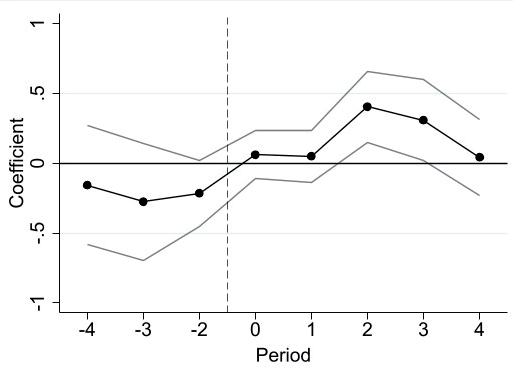
Parallel trends are a prerequisite for DID estimates to hold. Employing the event study method, we perform tests for parallel trends and analyze the dynamic impact of AVMR on PEC. The results are shown in Fig. 2. The pre-treatment coefficient lacks significance at the 95% confidence level, suggesting no notable difference between the treatment and control groups before AVMR implementation. Only the coefficients for the second and third years among the treated coefficients show significant positivity, suggesting that the impact of AVMR on PEC could not be more sustainable in the long run, exhibiting lag effects.
Other Robustness Tests
We further perform the following robustness tests (see Supplementary Notes). First, we use an instrumental variables (IV) approach to explore the effect of AVMR on PEC. Second, we examine the effects of AVMR on pollutants because it may affect public environmental attitudes. Third, we employ placebo tests to address the impact of non-randomized policy pilot selection on the results. Forth, we alter fixed effects and clustered levels to exclude the effects of higher-dimensional unobservable variables. Fifth, we further use the Regression Adjustment (RA), Inverse Probability Weighting (IPW), Augmented Inverse Probability Weighting (AIPW), and Inverse Probability Weighted Regression Adjustment (IPWRA) estimators to estimate the average treatment effect of the auditing reform. Sixth, we replace the independent variable. Seventh, we add dummy variables to eliminate the possible interference of parallel environmental policies. Finally, we conduct sensitivity analysis on parallel trends. All of the above robustness tests prove the robustness of our benchmark results.
Table 2.
Benchmark regression results.
[i] Notes: t/z-values are in parentheses. Significance levels: ***p<0.01, **p<0.05, *p<0.1. Column (4) is the radius matching (1:4), Column (5) is kernel matching, and Column (6) is the caliper matching. The coefficients of control variables are not reported to save space. The feature variables applied to the PSM include lnGDP, lnpeople, lnFDI, lnclr, lnedu, lnfin, and lnbus.
Further Analysis
Environmental Enforcement
AVMR strengthens local governments’ environmental enforcement [18, 41]. The heightened government environmental enforcement promotes PEC [47]. Accordingly, we employ the natural logarithm of the count of environmental penalty cases to represent environmental enforcement.
Column (1) of Table 3 shows that AVMR promotes environmental enforcement. Hence, we posit that environmental enforcement is an effective mechanism for AVMR to enhance PEC. H2 is validated.
Environmental Information Disclosure
Environmental audits can promote corporate EID [51, 63], which supports public participation in environmental governance [52]. We calculated environmental disclosure indicators based on Yang et al.’s (2023) study [62]. Column (2) of Table 3 shows that AVMR promotes corporate environmental disclosure. H3 is validated.
Synergy Analysis
Firstly, we employ a multi-temporal DID approach to test Equation (5). Column (1) in Table 4 indicates that PILR has no significant impact on PEC, implying that implementing PILR alone does not enhance PEC. Then, we test Equation (4) and examine the synergistic effects of AVMR and PILR on PEC. Columns (2)-(4) of Table 4 employ clustering robust standard errors, bootstrap sampling standard errors (times = 1000), and Driscoll-Kraay standard errors, respectively. The results indicate that the synergy between AVMR and PILR significantly enhances PEC, with an impact effect of approximately 33.5%, surpassing AVMR alone on PEC. PILR and AVMR can be in synergy when implemented together.
Table 3.
Results of the mechanism analysis.
| VARIABLES | Enfor | EID |
|---|---|---|
| (1) | (2) | |
| did | 0.748*** | 0.832*** |
| (3.09) | (4.90) | |
| Controls | YES | YES |
| Year FE | YES | YES |
| City FE | YES | NO |
| Firm FE | NO | YES |
| Observations | 2,028 | 24,689 |
| R-squared | 0.694 | 0.212 |
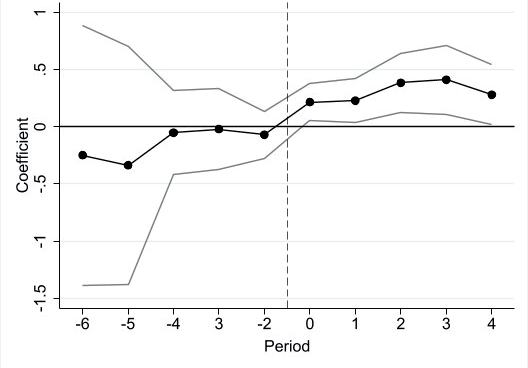
Using an event study approach, we further explore the synergistic effect of AVMR and PILR. Fig. 3. illustrates that the synergy between AVMR and PILR contributes to the sustained growth of PEC, provided that parallel trends are observed. H4 is validated. It has been found that when there is heterogeneity in the treatment effects, the estimates of the two-way fixed effects model are biased even when the parallel trend assumption is satisfied [64]. Based on the estimators proposed by Abraham and Sun (2018) and Cengiz et al. (2019) [65, 66], we re-estimate the synergistic effect and plot the event study graphs to enhance the robustness of the results (see Supplementary Notes).
Fig. 3.
Dynamic effects of Auditing Vertical Management Reform Synergy with Public Interest Litigation Reform.
Heterogeneity Analysis
Legalization Level
The level of regional legalization may influence the impact of AVMR on PEC. A more favorable legal environment correlates with increased government department efficiency and higher quality environmental information [67, 68], enhancing enthusiasm for the public to engage in environmental governance [69]. Hence, the influence of environmental auditing on PEC is more pronounced in regions characterized by a more favorable legalization. The PILR policy is essentially aimed at improving the judicial environment in China and solving the problem of the lack of legal protection of social and environmental public interests [54]. Local procuratorates and the public have the right to file environmental administrative public interest litigation against local governments for ecological protection omissions, which effectively alleviates the problem of no one suing for damage to social and environmental public interests. This further confirms why AVMR and PILR have an excellent synergistic governance effect on PEC.
We employ the marketization index to measure the level of regional legalization. Samples with marketization indexes below the median are allocated to the poor institutional environment group, while those with indexes exceeding the median are assigned to the good institutional environment group. Columns (1)-(2) of Table 5 reveal that AVMR exhibits a positive and significant impact on PEC solely in samples characterized by high levels of legalization.
Financial Pressure
Local government officials tend to focus more on economic development than environmental development for promotion [70]. Besides, the financial development of the local government also determines the investment of the government in environmental development [71]. Therefore, local governments focus more on environmental development in areas that are economically developed and where local governments are in a better financial position.
We use the debt ratio to represent the fiscal pressure on the government. The higher the debt ratio, the greater the fiscal pressure on the government. Columns (3)-(4) of Table 5 reveal that AVMR exhibits a positive and significant impact on PEC solely in cities with lower financial pressure.
Digitization Level
The digital development of the region has an impact on the policy effectiveness of AVMR. On the one hand, the development of digital technology and the Internet enhances the monitoring efficiency of auditing institutions [33]. On the other hand, the Internet improves the government’s responsiveness to the public’s environmental demands [72]. It has been established that the development of digital technology enhances the policy effects of AVMR [73].
We use the cell phone penetration rate to represent the digitization level of a region. The higher the cell phone penetration rate, the higher the digitization level of the region. Columns (5)-(6) of Table 5 reveal that AVMR exhibits a positive and significant impact on PEC solely in cities with higher digitization level.
Table 5.
Results of the heterogeneity analysis.
Conclusions
There is a lack of effective accountability of audit bodies to governments in the dual management system. In 2015, China initiated a pilot to explore the implementation of vertical management for audit institutions. This paper examines the impact of AVMR on PEC based on panel data covering 292 cities from 2011-2019. The study reveals a positive effect of AVMR on PEC. AVMR strengthens PEC by enhancing government environmental enforcement and corporate environmental disclosure. Thirdly, AVMR synergizes with PILR and contributes to long-term PEC enhancement. Fourthly, the AVMR policy has a stronger effect on improving PEC in cities with a higher level of legalization and digitization or lower fiscal pressure.
This study employed city-level data from China between 2011 and 2019 and determined that AVMR policies markedly enhance PEC. Concerning the findings, previous studies have investigated the influence of AVMR on governmental conduct, but the impact of AVMR on public conduct remains underexplored. This research demonstrates that government audit oversight is conducive to green development, consistent with prior studies on energy efficiency and pollutants. Unlike previous studies, this study not only assesses the environmental impacts of AVMR but also explores the mechanisms that enhance the environmental impacts of AVMR from the perspective of policy synergies. The study indicates that the integrated implementation of AVMR and PILR policies may be advantageous for the long-term enhancement of PEC, providing further evidence for previous studies on PILR and green development.
While this paper provides valuable insights, it also has certain limitations. First, due to data limitations, only two possible mechanisms are explored in this paper. Future studies can delve deeper into the potential mechanisms linking AVMR and PEC. Second, this paper examines the synergies between environmental auditing and environmental justice, focusing on national auditing and public litigation. Subsequent research could delve into this topic from social auditing and private litigation angles.