

Introduction
The Fourth Plenary Session of the 19th Central Committee of the Communist Party of China pointed out that the construction of ecological civilization is a millennium long plan related to the sustainable development of the Chinese nation. “The 14th Five Year Plan” outlines the reduction of atmospheric pollutants as the first task of environmental protection and resource conservation projects, demonstrating the importance of air pollution control. There is a consensus on the negative impact of air pollution on the economy and society, and how to achieve effective governance of air pollution has become an important academic topic [1]. As one of the main producers of air pollutants, enterprises mainly rely on external incentive structures to control air pollution, such as policy subsidies and environmental taxes [2-3]. Although the implementation of environmental regulation policies has to some extent curbed the pollution emissions of enterprises, the effectiveness of environmental regulation policies is often compromised for some large enterprises that affect regional economic growth. This is also the main reason why some regions may not have significant air quality improvement effects despite implementing environmental policies. It can be seen that environmental pollution control not only requires seeking feasible solutions at the technical level, but also needs to return to the exploration of government systems and their mechanisms of action [4].
In recent years, governments have also recognized that environmental pollution control not only requires strengthening the implementation of environmental policies, but also the institutional construction of official power. For example, some studies have shown that central environmental inspections and national leaders' visits could reduce environmental pollution to a certain extent, resulting in a significant improvement in air quality [5-6]. Based on the perspective of environmental governance, research on vertical regulatory systems mainly focuses on which system superior governments adopt to promote effective governance of environmental issues by subordinate governments. Therefore, it is still worth studying whether China’s city-county merger has also reduced air pollution.
In this study, we use data from 2008 to 2021 on China’s city-county merger and combine haze pollution published by the Atmospheric Composition Analysis Group at the University of Washington, St. Louis as the dependent variable to explore the impact of China’s city-county merger on air pollution. The results show that China’s city-county merger could reduce air pollution, but this effect is mainly effective in the border areas of administrative regions and western regions. In addition, further analysis shows that the reduce air pollution originating from the reformed areas can be attributed to reduced financial expenditure pressure and reduce the productive expenditure, which also provides direct evidence for China's implementation of vertical regulatory systems to improve air quality.
Our study contributes to three strands of literature. First, this article supplements the literature on vertical regulation from a research perspective. As far as we know, China’s city-county merger is mainly used to study the impact on economic growth [7], urbanization development and public service supply level [8], while there is little literature to investigate the impact on air pollution. Second, this article uses a staggered DID to identify China’s city-county merger on air pollution, which to some extent alleviates the endogeneity of the impact, and the conclusions obtained are more accurate. Finally, this article uses grid data of PM2.5 to measure air pollution, and the research level is refined to the district/county level, providing more accurate evaluation evidence for vertical regulatory reform, which could enrich the strategic interaction research between different levels of local governments in vertical regulatory reform.
The rest of the paper is structured as follows. Section 2 provides background information and theoretical analysis. Section 3 describes the data, variables and empirical specifications. Section 4 presents the baseline results and robustness results. Section 5 presents the mechanism analysis, and Section 6 concludes.
Background and Theoretical Analysis
Background
After the Communist Party of China (CPC) came to power in 1949, the establishment of municipal districts in large and medium-sized cities does not need the approval of the central government, nor does it have specific implementation standards. After the reform and opening up, the planned economic system has gradually transformed into a market economic system. The fiscal decentralization reform has delegated more development power to local governments. The adjustment of Administrative division has been given incentives and economic functions by the central and local governments under the Chinese style decentralized system framework, profoundly changing the incentives and constraints faced by relevant local officials and the scope of power of relevant local governments The spatial structure of factors and even the competitive landscape between local governments [9].
In order to change the government overlap caused by the coexistence of county-level city and prefecture-level city governments and urbanization, the central government began to reform the regional administrative division system in 1982, piloted the “Prefecture-level city governing county-level city"system, and popularized it nationwide in 1983. Various regions have withdrawn their land and established cities (or merged cities), officially establishing a five level government hierarchy of "central province city county township". During this period, in order to encourage the priority development of small and medium-sized cities and towns, the China’s city-county merger emerged. However, due to the strategic actions of local governments and insufficient agglomeration of small cities, this reform has not been well promoted [7].
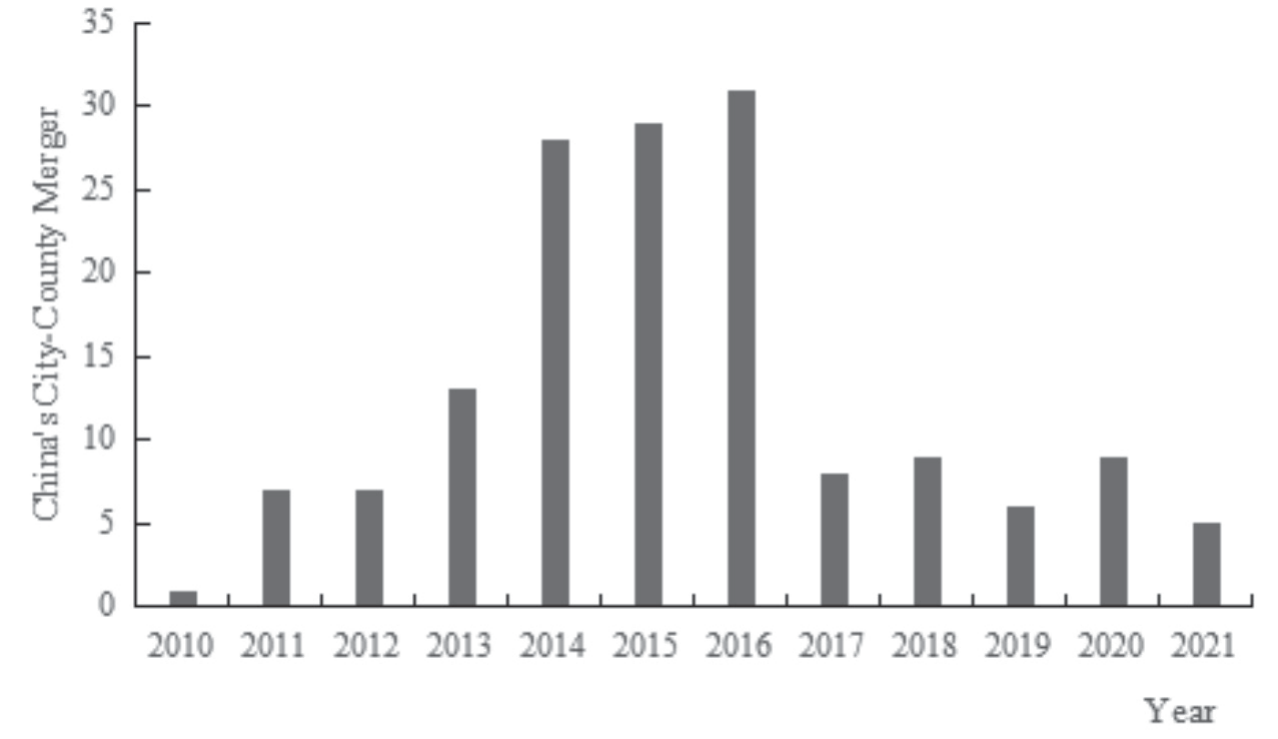
Over reliance on GDP as the assessment index of relative performance has led to the urban oriented economic policies of local governments. As a urbanized economic zone under the direct jurisdiction of Prefecture-level city governments and with highly concentrated secondary and tertiary industries, municipal districts naturally become the focus of policy. However, the county (County-level city) has a high independent right of economic development. Driven by the local government’s “entrepreneurial spirit”, the county-level government actively participates in the competition for regional resource elements and the protection of the local market. According to statistics, from 1983 to 2021, a total of 92 prefecture level cities merged 134 counties or county-level city. There is a clear characteristic of imbalanced progress in the process of withdrawing counties and establishing districts. Before 2000, the number of mergers and acquisitions was relatively small, but after 2000, there were two peaks of mergers and acquisitions: the first wave was from 2000 to 2004. The second wave sprouted in 2011 and completely erupted from 2014 to 2015 (Fig. 1). The reform of withdrawing counties and establishing districts has a wide spatial distribution, with coverage in the eastern and central and western regions during each stage of withdrawal and merger. From the institutional framework of this article, it may be related to the widespread block competition in China, where any prefecture level government cannot afford to wait, slow down, or sit still in the competition for greater development space.
Theoretical Analysis
Based on the background of China’s city-county merger, this study will comprehensively analyze the internal logic of the impact of China’s city-county merger on air pollution from two aspects: fiscal effect and structural effect.
In the fiscal effect, the city-county merger may promote the increase of local air pollution control investment through the path of fiscal pressure and fiscal expenditure structure, thereby improving the local air pollution level. Specifically, the county reform has concentrated the fiscal and tax authority of the newly established municipal districts to Prefecture-level city [7], strengthening the vertical supervision of the municipal government. On the one hand, the reform of the fiscal and tax authority of the county will be consolidated by the municipal government, which will reduce the financial pressure and reduce the possibility of "Race to the bottom" [10]. On the other hand, after the reform of fiscal vertical regulation, the structure of fiscal expenditure also needs to be synchronized with and comply with the overall planning of the municipal government, reducing production expenditure and increasing livelihood expenditure to meet the corresponding demand for public goods supply. After the reform, the county government has corresponding financial and tax resources to improve the efficiency of local environmental governance. It can play a financial leverage role in areas such as the introduction of enterprise pollution discharge equipment, installation of pollution monitoring systems, support for green innovation technology, and improvement of pollution supervision standards, ultimately leading to a decrease in the level of local air pollution.
In the structural effect, the city-county merger may reduce the intensity of air pollution emissions at the enterprise level by affecting the number and output value of polluting enterprises. Specifically, after the city-county merger, the Prefecture-level city government has more leading authority in reforming the county's investment attraction, enterprise supervision, and environmental governance, and tends to reduce the number of polluting enterprises within the city's jurisdiction, change the local industrial structure, and reduce potential air pollution [11]. On the one hand, reforming the economic and social development planning of counties requires obeying the overall arrangement of the municipal government. The original pattern of financial and tax competition between the city and county levels has been changed, while the municipal government tends to rearrange the location of enterprises to meet the development needs of the new city jurisdiction. On the other hand, the original county planning, natural resources, ecological environment and other functional departments have been reformed to become branches of the municipal government [12]. Although restricted by the vertical supervision of the municipal government, the administrative resources of the corresponding departments have also been optimized. After the reform, the county government lacks financial incentives to protect polluting enterprises. At the same time, under the influence of vertical supervision by the higher-level government, polluting enterprises are relocated from their jurisdiction, reducing their output value and overall emissions, resulting in changes in the local industrial structure and ultimately reducing the intensity of air pollution emissions at the enterprise level.
Data and Research Design
Data Source
To maintain data consistency and integrity, this study constructed China’s county panel data from 2010 to 2021, and excluded the sample data: Hong Kong, Macao and Taiwan regions in China; Beijing, Tianjin, Shanghai, and Chongqing, the four municipalities directly under the central government, have lower comparability with other counties.
Dependent Variable
There are various types of air pollution. Considering the objectivity and consistency of data, haze pollution, which is more important in air pollution, is selected as the dependent variable. This data is sourced from the Atmospheric Composition Analysis Group at the University of Washington, St. Louis and is a satellite remote sensing image formed by combining satellite images with ground monitoring station data, with a resolution of 1 km. Currently, this data has been used in many haze studies [13]. Based on the vector map of administrative division of the National Geographic Information Resource Catalog Service System, this paper uses ArcGIS software to extract haze data at the county level. Therefore, the annual average of PM2.5 in this article serves as a proxy variable for air pollution.
Independent Variables
The data of county (city) to district transformation comes from the annual changes announced on the official website of the Ministry of Civil Affairs. If the city-county merger occurs, it is policy = 1, otherwise it is 0.
Control Variables
According to the relevant requirements of the "Standards for the Establishment of Municipal Districts" issued by the Ministry of Civil Affairs (2014), this article uses per capita GDP, per capita fiscal income, secondary and tertiary industry structure, urbanization rate, and education level as control variables to alleviate potential issues of missing variables bias. The relevant data sources are “China County Statistical Yearbook”, “China County and City Social and Economic Statistical Yearbook”, and provincial statistical yearbooks. The non-agricultural population data in the county-level Panel data is seriously missing, so the interpolation method is used to smooth and carry out 1% tail shrinking. The descriptive analysis is shown in Table 1.
Empirical Strategy
We use a staggered difference-in-differences (DID) regression model on the full sample to estimate the effects of city-county merger on air pollution. As an exogenous policy, China’s city-county merger brought exogenous changes to the air pollution of the reformed county, which provides us with a unique quasi-natural experiment. The DID model helps us identify the causal relationship between China’s city-county merger and air pollution. The specific regression equation is set as follows:
Among them, i and t represent the county and year respectively; Yit represents the level of air pollution in the county; policyit represents whether the city-county merger reform occurred in year t, with a value of 1 for the year and thereafter, otherwise 0; X is a set of control variables that may affect both county (city) relocation and air pollution; λt and μi are year fixed effects and county fixed effects, respectively, and εit is the error term.
Table 1.
Summary statistics.
Main Results
Baseline Results
Starting with the staggered DID of the baseline, we estimate Eq. (1) using the PM2.5 from 2010 to 2021 as the dependent variable. To ensure the accuracy of the empirical results, Table 2 presents our baseline results obtained by not adding control variables and adding control variables. Estimates are separately reported in Columns (1) and (2). The estimated coefficients of interest are highly significant. The results in Table 2 show that the China’s city-county merger have a significantly negative effect on air pollution as measured by PM2.5. Specifically, in the results of Column (2), the estimated coefficient is -0.024, which means that after controlling the relevant control variables and fixed effects, the counties reformed have a significantly lower growth in PM2.5 than those counties without reform.
Dynamic Effect and Parallel Trend Test
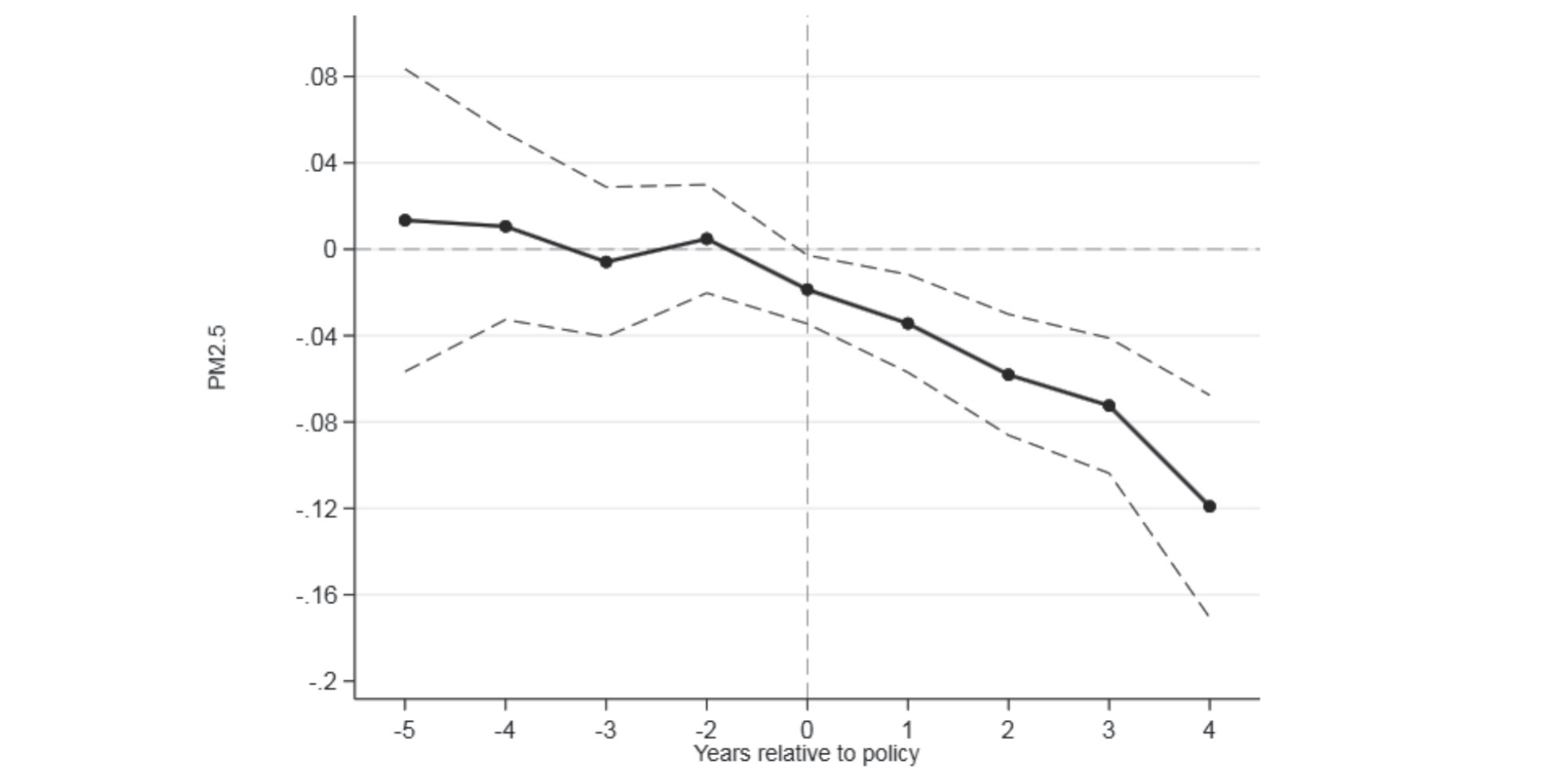
The accuracy of DID estimation results depends on whether the control group and the treatment group meet the parallel trend assumption, that is, before the city-county merger is reformed, the variables in the treatment group and the control group should meet the same trend. Therefore, this article refers to the Event Study method proposed by Jacobson et al. (1993) to test the dynamic effects of county (city) redevelopment [14]. The test equation is established as follows:
In Eq. (2), Dti0+k denotes a series of activities in the process of China’s city-county merger, which is a dummy variable. Specifically, ti0 denotes the time spent by China’s city-county merger in different counties, and k represents the years before and after the county was reformed. If t – ti0 ≤–5, then Dti0 –5 = 1, otherwise, it is 0. If t – ti0 = k (k = -5, -4, -3, -2, 0, 1, 2, 3, 4), Dti0+k = 1; otherwise, it is 0. If t – ti0 ≥4, then Dti0 +5 = 1, otherwise it is 0. This study sets k = –1 as the base period, and the coefficient βk reflects the influence of the China’s city-county merger on air pollution in the k-th year.
Robustness Test
To address concerns about the data assumptions and corroborate the findings, a battery of robustness checks are conducted.
First, we examine the robustness of the PM2.5 variable. Since we used the average value of PM2.5 as the dependent variable in the baseline regression, however, air pollution mainly comes from industrial pollution, and these enterprises exist in the city center. If a county has a large area, it will undoubtedly reduce the measurement of air pollution. Therefore, in the robustness analysis, we used the sum of PM2.5 to represent the air pollution level of a county and re-estimated equation (1). The results are shown in column (1) of Table 3, and the results are very robust.
Second, we tested the robustness of the sample. Compared to all samples, the heterogeneity within the treatment group samples is smaller. Therefore, referring to existing literature [15], we regressed the treatment group samples, and the results shown in column (2) of Table 3, and the results are very robust. In addition, in order to avoid interfering with the regression results due to differences in administrative levels, we excluded county samples from provincial capital cities and planned cities. The results are shown in column (3) of Table 3, and the results are very robust.
Thirdly, based on the county-level characteristics of the control variables, the kernel matching method was used for PSM sample pairing test. The regression results of PSM-DID were relatively consistent with the baseline regression results, and the results are very robust.
Finally, considering the possible impact of natural factors, the county annual precipitation, wind speed, and temperature were included in the control variables based on the daily value dataset of China’s surface climate data. It can be seen that the regression results in column (7) of Table 5 show relatively small changes. In addition, the study also used a random sampling of 500 placebo-based tests to confirm the reliability of the baseline regression.
Further Analysis
Mechanism Analysis
In Section 4, we provide sufficient evidence that China’s city-county merger have a negative effect on air pollution as measured by PM2.5. In this section, we provide evidence on potential mechanisms. Specifically, we examine whether the reform reduce financial expenditure pressure and reduce the productive expenditure.
Table 2.
Baseline regression results.
| Variables | PM2.5 | |
|---|---|---|
| (1) | (2) | |
| Policy | -0.037* (-1.708) | -0.024*** (-2.939) |
| Control variables | NO | YES |
| County fixed effects | YES | YES |
| Year fixed effects | YES | YES |
| Observations | 33108 | 33108 |
| R-squared | 0.645 | 0.678 |
In order to verify the corresponding mechanism, the study set Equation (3) to test the potential mechanism, with Mit as the mechanism variable and the other settings being the same as Equation (1).
(1) China’s city-county merger may reduce the financial pressure on the reform county
On the one hand, the reduction of financial pressure reduces the possibility of “Race to the bottom” for polluting enterprises, making the county government reduce its economic dependence on polluting enterprises. On the other hand, the reduction of financial pressure has given county governments potential financial resources to invest in environmental governance, such as expanding law enforcement teams and subsidizing the installation of pollution control equipment. Therefore, the difference between the expenditure and income of the general Public budgeting divided by GDP is used as the proxy variable of financial pressure. The regression results of column (1) in Table 4 indicate that the county (city) to district reform has relatively significantly reduced the financial pressure on the county level.
(2) China’s city-county merger may reduce the productive expenditure
After the city-county merger strengthens the vertical supervision level of the municipal government, local governments in the reformed county may strengthen corresponding financial investment in the field of environmental governance to meet the governance requirements of the municipal government, thereby reducing the level of air pollution. Due to the lack of data on county-level environmental protection expenditures nationwide, from the perspective of productive expenditures in fiscal expenditures, it is assumed that under certain conditions of total financial resources, a decrease in productive expenditures may increase the increase in livelihood expenditures such as environmental governance. Therefore, this article is based on the county-level financial expenditure subject data of the “National Financial Statistics of Cities and Counties" (2010-2021), and measures the government's productive expenditure by aggregating the basic construction, enterprise potential exploration and transformation, science and technology, and other expenditures within the budget. The regression results of column (2) in Table 4 indicate that the China’s city-county merger has relatively significantly reduced the productive expenditure of the reformed county.
Table 3.
Robustness test.
Heterogeneity Analysis
China has a vast territory, and there is a big gap between resource endowments and economic development. The same reform may change due to differences in geographical location, and there are differences between County-level city and counties. Therefore, the heterogeneity impact of vertical regulatory reform can be analyzed by grouping based on whether to remove counties and districts or cities and districts, as well as being located in the east or west. The results of Column (1) and Column (2) in Table 5 show that compared with the counties within the provincial boundary, the counties near the provincial boundary have almost no reform effect, which may be caused by the more serious externality of provincial boundary pollution [16]. In the analysis of whether it is a neighboring city boundary, it was found that the county located at the city boundary has a more significant effect on air pollution control. Perhaps it is because compared to internal counties, there are more pollution intensive enterprises in the counties near the city boundary, and most of them belong to economically underdeveloped areas, resulting in greater financial pressure. Therefore, in the vertical regulatory reform of China’s city-county merger, the attention allocation of resources to the city boundary reform counties is increased, financial support is provided, and policy requirements for enterprise relocation are proposed. Therefore, the results in column (3) of Table 5 are more significant compared to column (4). Compared to the eastern region, the reform effect in the western region is relatively significant. As shown in columns (5) and (6) of Table 5, the energy source in the western region is in the overall development stage, and the original level of industrialization and urbanization is relatively low. Therefore, the financial support and enterprise relocation in the China’s city-county merger have a more significant effect.
Conclusion and Suggestions
Air pollution control is closely related to government institutional changes, and there is still room for improvement in the research on the impact of vertical regulation on air pollution in existing literature. This study uses the China’s city-county merger as a quasi experiment, and based on the county panel data and satellite image data from 2010 to 2021, uses the staggered DID method to estimate the impact of vertical regulatory reform on air pollution. Research shows that China’s city-county merger could reduce air pollution, but this effect is mainly effective in the border areas of administrative regions and western regions. Further analysis shows that the reduce air pollution originating from the reformed areas can be attributed to reduced financial expenditure pressure and reduce the productive expenditure.
Table 5.
The results of heterogeneity analysis.
Based on the above conclusions, several suggestions are proposed for future air pollution control: Continue to steadily promote vertical regulatory reform in the field of ecological environment. Under the conditions of local economic and social development, the scope of vertical supervision should be appropriately extended from the ecological environment field to other line departments to maximize the efficiency of air pollution prevention and control. In the vertical regulatory reform, financial resources need to be appropriately tilted towards the county level, providing financial support for policy tools to prevent and control air pollution, and improving the environmental governance capacity of local governments vertical regulatory reform needs to start with the pollution emissions of large enterprises, and reshape the incentive function of local government behavior through financial and tax system reform.

