


Introduction
Vegetation is considered an important component of urban ecology. Rightfully known as the lungs of nature, trees are essential in providing us with clean air to breathe in. With the large-scale increase in industrialization, pollution levels have also been increasing in parallel [1]. Air pollution poses one of the most threatening scenarios, as being continuously exposed to contaminants in the air we have no option other than to inhale them [2].
Air pollution is a serious problem, which is increasing with an increase in the population size of the city and the number of transport [3]. These sources are responsible for increasing harmful gases and smoke in the environment [4], which is the leading threat to air quality and public health is airborne particulate matter PM [5]. As a major part of atmospheric aerosols, fine particulate matter, or PM2.5, affects the environment and climate, with its prime sources being agricultural activities, burning of biomass, and soil dust [6]. Smog is a combination of atmospheric pollutants, including PM2.5, and a widespread problem in North America, European countries, and countries like India and China in the 1950s and 1960s [7]. With 90% of anthropogenic particulate matter coming from road traffic that has many health-damaging impacts [8], it is mostly composed of heavy metals, polycyclic aromatic compounds, carbon black, and other particles suspended particles of air [9].
Particulate matter harms human health due to its small diameter, which enables it to easily enter the respiratory system and cause cardiac and lung diseases [10]. It has been found that 3% of cardiopulmonary deaths and 5% of lung cancer deaths are only due to PM2.5 exposure [11]. With these facts at hand, it is a more pressing issue as to how to reduce loads of ambient particulate matter, particularly in urban areas where high traffic density and industrialization are persistent sources of generating particulate matter.
To improve air quality, particulate matter (PM) can be reduced using green infrastructure [12]. Many trees have been reported to be highly effective in trapping and absorbing air pollutants, thereby acting as a sink for various types of air pollutants [13-16].
Processes involved in the deposition process of PM2.5 on the surface of the leaf include sedimentation, diffusion, interception, and impaction. A coarse fraction of Total Suspended Particulate Matter (PM10) is generally deposited by sedimentation, while fine particles (PM2.5) are deposited by interception and impaction [17]. Brownian motion causes the deposition of PM2.5 on the wet surface of the leaf by process of diffusion, but turbulent flow of air and impaction are also involved in greater deposition of PM2.5 on the leaf surface [18]. It is noteworthy here that the deposition velocity of the larger leaf is greater, thereby increasing the impaction of PM [19].
Fig. 1.
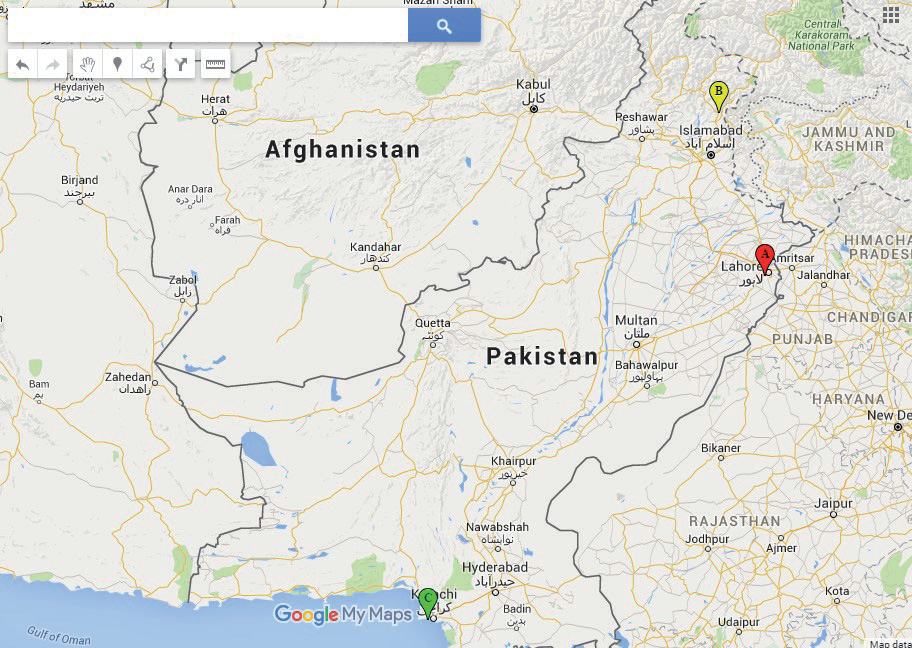
Location of sampling sites (Site A = Lahore, Punjab; Site B = Mansehra, Khyber Pakhtoon Khawa; Site C = Karachi, Sindh.
Pakistan is enlisted as one of the worst countries in terms of air pollution, with an annual mortality rate of more than 22,600 deaths per year in 2005, of which more than 800 were children under five years of age [20]. Ambient levels of particulate matter have been reported by many researchers to be manifolds higher than the WHO recommended limits [3, 5, 21-24], and there has been very little if any work done on improving the air quality of urban areas.
In the absence of any study to determine the PM sequestration potential of the native flora of Pakistan, the current study is an attempt to record the potential of four native trees in reducing pollutant loads from the air.
Experimental
Pakistan lies in a sub-tropical zone located within the latitude of 30°00 N and a longitude of 70º 00E. With nine forest types present in Pakistan, the forest cover is only 4.1%, covering 3.3 million ha of land [25], while the World Conservation and Monitoring Centre (WCMC) reports it to be still less, i.e., 3.7% [26].
To collect a variety of data, four native species from three locations in three provinces were selected (Fig. 1). Before sampling, their morphometric measurements were made, and the height and width of the tree were measured. The canopy volume (CV) of the selected trees was measured by Thorne et al. [27] as follows:
CV = 2/3π × H(A/2 × B/2)
Where,
H = height of the plant
A = diameter (north to south)
B = diameter (east to west)
Jamun Tree (Syzygium cumini)
Jamun (Syzygium cumini) is a fruit-bearing native tree of tropical and subtropical areas, including Pakistan, India, and Indonesia. It is a fast-growing evergreen tree with a large tree cover [28]. The tree selected for sampling was located in Punjab province at the University of the Punjab, Lahore. The height of the tree was 16.8 m, with a 2.1 m stem diameter. The size of the tree canopy was measured to be 4.6 m towards the north, 6.1 m towards the south, 8.5 m towards the east, and 3.9 m towards the west from the stem. The volume of the tree canopy was 1169.60 m³.
Mango Tree (Mangifera indica)
Mangifera indica, or mango tree, is a fruit-bearing tree in the genus Mangifera, with its fruit crowned as the king of fruits. The species is native to tropical and sub-tropical Southeast Asia [29]. A Mango tree located in the University of the Punjab, Lahore, was selected to assess the role of vegetation in reducing PM pollution. With a height of 15.2 m, the size of the tree canopy was 6.1 m towards the north, 5.2 m towards the south, 6.7 m towards the east, and 5.5 m towards the west from the stem. The volume of the tree canopy was 1096.62 m³.
Mangrove Tree (Avicennia marina)
With about 80 known species, mangrove trees are known to inhabit coastal areas of tropical and subtropical regions. Mangrove forests exist along the 1050 km long coastline of Pakistan at five locations, namely the Indus Delta, Sandspit, Sonmiani, Kalmat Khor, and along the Jiwani coast. These forests are the second largest mangrove ecosystem in the sub-tropical regions [26, 30]. The tree selected for this study was located at Hawks Bay, Karachi. The height was 4.6 m with a diameter of 0.6 m at the stem. The size of the tree canopy was also measured and was 4.9 m towards the north, 3 m towards the south, 3.7 m towards the east, and 4.1 m towards the west from the stem. The volume of the tree canopy was calculated to be 150.27 m³.
Pinus Tree (Pinus wallichiana)
Himalayan White Pine (Pinus wallichiana) is a widespread native tree in the Himalayan range [31]. A Pinus tree from Mansehra, Khyber Pakhtunkhwa, was selected for the PM monitoring. The height of the selected tree was 15.2 m with a diameter of 1.5 m at the stem. The size of the tree canopy was measured to be 4.9 m towards the north, 5.2 m towards the south, 4.6 m towards the east, and 4.9 m towards the west from the stem. The volume of the tree canopy was calculated to be 758.5 m³.
Instrumentation and Experimental Setup
Fine particulate matter (PM2.5) was sampled for six hours at each site with a data logging interval of 1 minute. The instruments used for this purpose were real-time aerosol monitors (DustTrak, model 8520, and DustTrak DRX, model 8533, TSI Inc.). One instrument was placed under the tree canopy, while the second one was placed at a distance of 50 m upwind.
The data was transferred to a PC via TrakPro software and exported into Excel sheets. Statistical analysis was carried out using SPSS (ver. 20.0, IBM Inc.). A paired-t test was applied to the collected data to observe if any significant difference existed between PM levels at 50 m upwind and PM levels under the canopy. A one-way ANOVA was run to further analyze the data and compare the data from all four trees.
The temperature, relative humidity, and volatile organic compounds (VOCs) were also monitored by running the Aero Qual Gas Monitor (series 500) in parallel with the PM monitors inside the tree canopy for six hours.
Air Pollution Tolerance Index
The Air Pollution Tolerance Index (APTI) is a measure of the tolerance level of plants towards air pollution and is calculated by analyzing four parameters in the leaf samples, namely pH (P), Chlorophyll (T), Ascorbic Acid (A), and Relative water content (R) [32]. The index is calculated by using the following formula:
APTI = A (T+P) + R/10
The APTI of the species under study was also calculated to compare which species was more tolerant to contaminants in the air. The number of stomata per cm2 was also determined to check the stomatal densities of different species since stomata are known to absorb particulate matter, which in turn can affect the metabolism of the plants along with various characteristics of stomata as well [33].
Results
Levels of PM2.5 in both the upwind position and the canopy were much higher, with mean values ranging between 167.90±2.231 and 108.26±3.472 in the upwind position and 40.32±8.97 and 152.50±32.264 in the canopy (Table 1). However, the levels of PM2.5 were observed to be lower in the canopy than in the upwind position, as observed in the figures (Fig. 2a-d). A paired t-test was applied to the results species, and a significant difference in PM2.5 levels in the canopy and upwind position was observed for each species at a level of significance of 0.05. The difference between mean values of PM2.5 in the canopy and upwind locations was calculated to determine which tree was more effective in PM removal. The largest difference was observed to be for the mangrove tree, followed by pinus, mango, and jamun in the last position (Table 2).
Fig. 2a.
Comparative mass concentration of PM2.5 levels recorded at 50m upwind and under the canopy of Pinus tree. Fig. 2b. Comparative mass concentration of PM2.5 levels recorded at 50m upwind and under the canopy of Jamun tree. Fig. 2c. Comparative mass concentration of PM2.5 levels recorded at 50m upwind and under the canopy of the Mango tree. Fig. 2d. Comparative mass concentration of PM2.5 levels recorded at 50m upwind and under the canopy of the Mangrove tree.
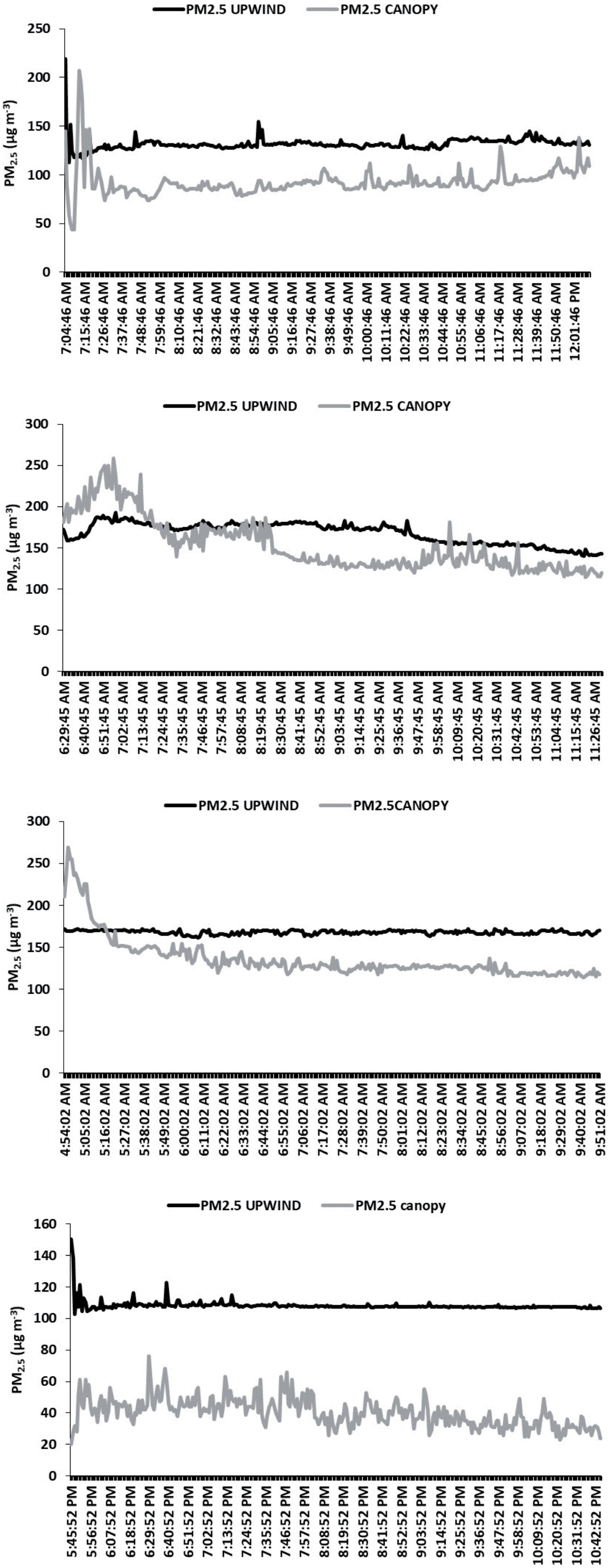
Table 1.
Descriptive statistics of PM2.5 levels recorded at each site.
Discussion
Poor air quality and particulate pollution have a negative impact on human health as the small size of particulate matter makes it easier to penetrate deeper into the alveoli [6, 34]. While the sources of fine particulate matter are numerous, it is essential to reduce their levels for the benefit of humanity. The current study attempted to determine the role of native tree species of Pakistan in reducing PM2.5 levels in the air.
There are numerous factors involved in PM reduction via vegetation; canopy volume being one of them. A study by Nowak et al. [35] reported that tree canopy improved air quality and vegetation played an important role in removing air pollutants and improving health. By increasing the number of trees, particulate matter is deposited on the leaf surface of the canopy, and its amount decreases in the ambient air [36]. Many studies have shown that if tree cover increases, then ultimately the rate of removal of particulate matter also increases. While evergreen plants capture air particles throughout the whole year, trees, shrubs, and herbs are also known to improve air quality and, in turn, improve human health. Smog formation is intensified at high temperatures, but vegetation lowers the temperature, which is thus unsupportive of smog formation [7, 37, 38].
The findings of the current study highlighted this fact, as the levels of fine particulate matter were significantly reduced under the tree canopy as compared to levels present at a distance of 50 m upwind. Trees have been proven a sink for capturing PM2.5. They reduce the amount of PM2.5 in the ambient air by the uptake of air pollutants through their stomata. Tree cover and the amount of PM2.5 are prime factors for determining the filtering capacity of native tree canopy for ambient air containing various pollutants [6, 39]. It is due to the depositing character of canopy leaves that absorb PM2.5 through their stomata, and these particles stick to the surface of the leaf [40].
The amount of PM2.5 deposited varies from species to species as well. In the current study, four native tree species were selected, and the results revealed variable figures. The differences in mean values obtained at the two sampling points at each location were observed to check which species had the highest PM removal rate. Avicennia was thereby concluded to be the most effective, with a difference of 67.95 µg m-3, followed by Pinus (38.99 µg m-3), Mangifera (31.79 µg m-3), and lastly Syzygium (15.39 µg m-3). However, the canopy volume was not found to be significantly associated with PM removal in this case since Syzygium cumini and Mangifera indica had more spread with a canopy volume of 1096.6 m³ and 1169.6 m³. respectively as compared to Pinus wallichiana.
Avicennia marina can be considered an exception since the tree tends to grow in clusters with very little space between each plant. As a result, the shared canopy volume increases manifolds more than that of the single tree. A high proportion of tree cover can lead to greater reduction rates of particulate matter [35] as observed in the case of the Avicennia tree.
On the other hand, it was seen that trees with large canopy volumes, i.e., Syzgium and Mangifera, emitted higher levels of VOCs, while Avicennia and Pinus had lower levels. Numerous factors can be responsible for such variations, such as species type, tree cover, temperature, and relative humidity levels. Lower temperatures are associated with lower emissions of VOCs, which are also associated with the formation of tropospheric ozone, while higher temperatures also assist in the dispersal of particulate matter. Trees are known to lower air temperatures [35], and thereby an increase in tree cover can reduce VOC emissions [35, 41-43]. In our study, since mangrove has the largest tree cover due to the large number of trees growing close to each other, VOC levels as well as PM levels were also reduced.
A recent study by Pandey et al. [44] pointed out the effectiveness of mango and jamun trees in combating air pollution, but the locality of each tree under observation cannot be ignored while interpreting the results. Jamun and mango trees were located in Lahore, a metropolis with ambient levels of PM2.5 to be reported as high as 222±103 and 302±51 µg m-3 by Ali et al. [45] and 181±75.36 µg m-3 by Zona et al. [46]. With these exceedingly high levels of fine particulate matter in the surroundings, both trees were reported to have a higher APTI value (Table 2). The stomatal density per cm2 was also noted to be higher in these two species. On the contrary, the mangroves are located along the coastal area near Karachi city, which is also a metropolis and the largest city of Pakistan. Zona et al. [46] reported the mean ambient levels of PM2.5 at Karachi to be 102±85.56 µg m-3, and the APTI value of Avicennia during the current observations was 7.81. The APTI value of the Pinus tree was still lower at 6.98, while the ambient PM levels of Mansehra were not previously reported. Such an outcome may be due to the thin needle-like leaves of pinus, while mango and jamun trees have large, broad leaves. Moreover, stomatal count per cm2 is also an important factor that can relate to ambient air pollution levels. It has been established that lower stomatal density and decreased pore size may be an effective strategy adopted by plants to control the absorption of pollutants through stomata [35]. In the current study, the stomatal density was recorded to be in the order of Jamun > Mango > Mangrove > Pinus, while a study by Pourkhabbaz et al. [47] observed decreased stomatal density in polluted urban areas as compared to cleaner rural areas. The outcomes of the present study also signified higher PM levels at all sites, as seen in Table 1. The air pollution tolerance index for each species was calculated as well, and the results signified that the jamun tree had the highest APTI, followed by mango and mangrove with pinus in the last place.
Table 2.
Summary of parameters measured at different sites.
Keeping in view the results obtained, it is necessary to conduct more research in this context. By monitoring PM levels of more native trees under control conditions and in natural settings as well, it will be easier to determine which species is by far more efficient in reducing air pollution. These findings will also be helpful for the Parks and Horticulture Authority for future considerations and for devising better strategies to improve environmental and public health. By knowing the traits of the leaves, we can select and grow efficient plant species for urban development, reducing particulate matter pollution. By making new developments for planting trees, we can reduce PM2.5 to a sufficient level to improve air quality.
Conclusions
As per the recorded data, the levels of particulate matter in both the upwind position and the canopy were much higher in the upwind position (167.90 to 108.26) and in the canopy (40.32 to 152.50). However, the levels of fine particulate matter were lower in the canopy than in the upwind direction. Avicennia marina was found to be most effective in PM reduction, while Syzygium cumini was found to be least effective. In conclusion, Avicennia marina was found to be most effective in PM reduction, with fine particulate matter less in the canopy than in the upwind direction.

