

Introduction
Climate change is a core element of debate among researchers and scientists around the globe, as it is a major challenge that humans face, irrespective of where they live on Earth [1]. The major cause of climate change is increased greenhouse gas (GHG) emissions, causing global warming. Among the GHGs, CO2 is primarily responsible for climate change, accounting for 79% of the GHG composition. Moreover, CO2 has the longest atmospheric lifespan of over 300 years [2]. Therefore, the continuous rise in the concentration of CO2 in the atmosphere is a major obstacle to achieving the target of stabilizing global warming at 2 or 1.5o C [3]. Literature has highlighted that a large number of national and international studies have extensively focused on exploring the factors affecting CO2 emissions. Various studies have focused on the role of economic and non-economic factors affecting CO2 emissions, such as GDP, FDI, renewable and non-renewable energy, institutional quality, health expenditures, population, trade, human capital, financial development, technology, and income inequality [4-9]. Therefore, CO2 emissions have become an important research topic in terms of climate change and eco-friendly economic growth. During this period, the link between international trade and the global economy grew extensively. The nexus among CO2 emissions, energy consumption, business climate, trade, and economic growth is crucial for sustainable growth. This nexus is highly complicated by global value chains (GVCs) resulting from vertical specialization and worldwide intra-industry trade [10].
GVCs highlight that the production process is not limited to one region or country and is distributed globally [11], implying that the countries are responsible for only one stage of production rather than the whole production process. According to the most recent SDGs report, GVCs play a crucial role in many of the most important environmental stressors and societal difficulties [12]. In this regard, economies have developed international collaborations to reduce emissions. Moreover, many nations have set emission targets to achieve sustainable economic growth. Distributed production networks across nations lead to the dispersion of the global manufacturing system. Thus, developed economies occupy an upstream position in the globally dispersed manufacturing system of GVCs. These economies transfer high-carbon industries to developing economies to reduce their emissions levels. The environmental issues of the BRICS economies, such as increasing carbon emissions and environmental degradation, have worsened in recent years. Significant economic and geopolitical changes have appeared worldwide, and BRICS economies have attracted the attention of researchers around the world, as these economies have various common features, such as high economic growth, high population, influential government, and continuous efforts toward approaching global markets [13]. Moreover, the GDP of BRICS economies is expected to be larger than that of the seven largest world economies in 2050 [14].
Emerging GVCs in the world economy and their rapid growth in recent decades highlight the interdependence of national economies. Therefore, the growth of the BRICS economies has great potential for GVC development. In 2018, at the 10th anniversary of BRICS economies, they clearly disclosed their commitment to strengthening themselves through mutual innovation and industrial cooperation [15]. This mutual innovation and industrial interconnectedness among BRICS countries leads to their joint science and technology networks, which create their own inter-BRICS GVCs. The high economic growth rate of the BRICS economies demonstrates that they are demanding a high volume of energy consumption, and their emission levels have also increased drastically. These economies have a combined share of 36.7% of primary energy consumption and 41.18% of CO2 emissions [16].
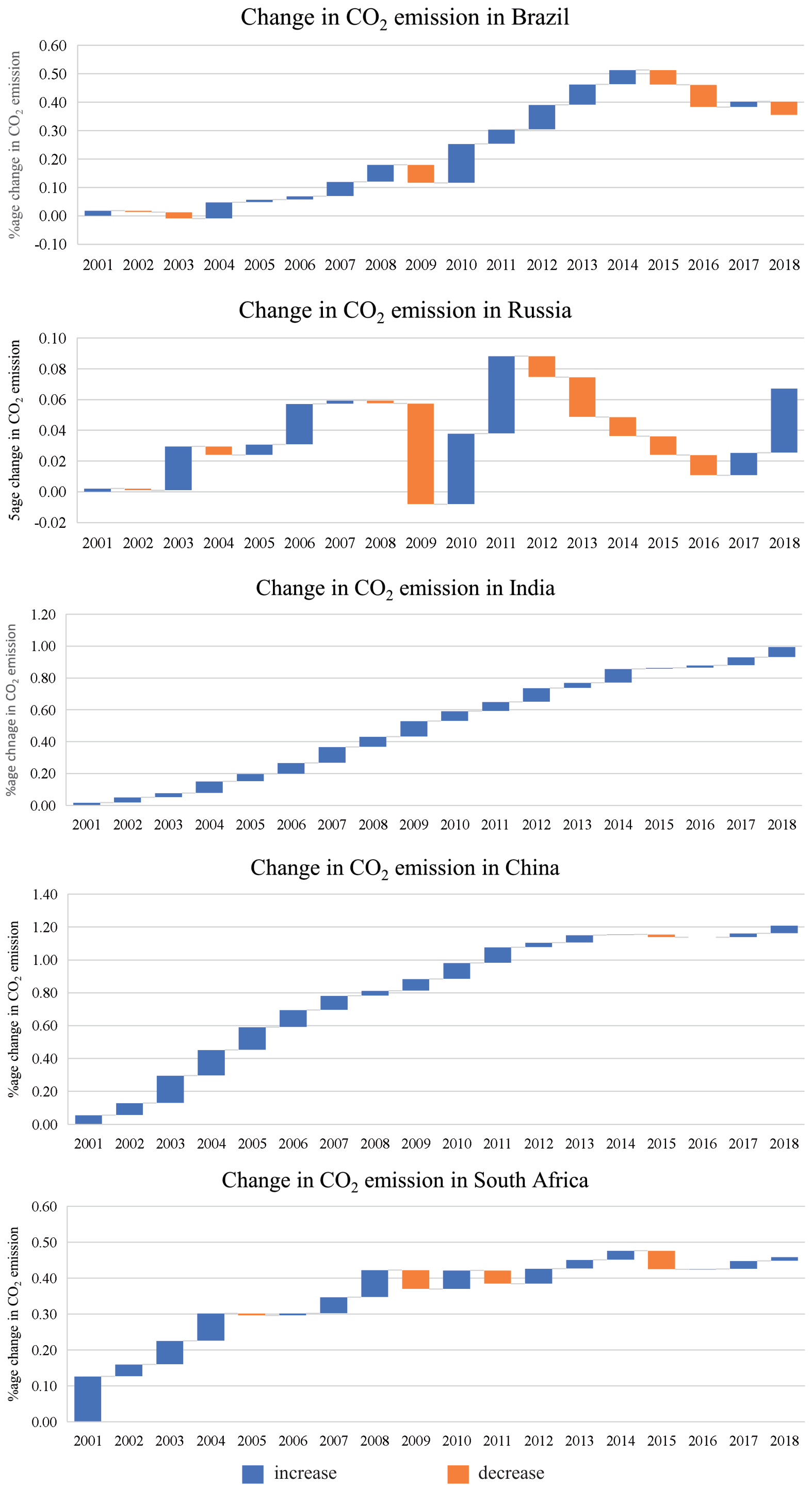
Fig. 1 clearly presents the rate of CO2 emissions in BRICS economies over the time period from 2000-2018 under consideration. Generally, the emission levels of BRICS economies increased continuously from 2000 to 2018. In individual emission levels, India consistently emitted high CO2, as it never experienced a negative change in emissions over a period of 19 years. After that, China is second among the BRICS economies in that it only lowered its emission level in 2015 compared to the previous year. In Russia, the emission level sharply declined by 6.56% and then increased over the next two years. After 2012, it continuously controlled its emissions from 2013-2016, and its CO2 emissions increased by 1.47% in 2017 and 4.17% in 2018. Brazil’s CO2 emissions have continuously declined since 2015, whereas the emission level in South Africa is increasing.
This rapid increase in emissions in the BRICS economies is closely linked to the international trade system characterized by the division of labor in GVCs. This trade system and division of labor fosters transnational production and cooperation, which increases the separation of production. Developed economies have selected only the high value-added production stage because of technological and capital advantages. They mostly produce clean, eco-oriented products, such as brand marketing, research, and development, and import more energy-consuming and pollution-intensive products from developing economies to meet domestic demands [16].
Such cross-border economic activities in terms of dispersed production systems worldwide led to another aspect of the world economy, the so-called 4th industrial revolution. This transforms the world economies’ relationships with the changes brought about by globalization 4.0, which promotes the cross-border flow of goods without limitations. This Globalization 4.0 focuses on developing global production, services, and innovation networks among economies, along with the movement of intangible assets across borders [15].
The modern economic environment demonstrates the crucial role of globalization in fostering creative cooperation among nations to achieve sustainable development. Globalization reduces barriers to the flow of capital, finance, services, goods, and labor across borders [17, 18]. It also assists the development of uniform socioeconomic and political systems across global economies. Therefore, social and economic development is highly linked to globalization. GATT 1948 is commonly believed to be the time when globalization started, and developing and less developed economies have experienced significant economic growth [19].
Along with the GVCs’ participation in economies in the era of globalization, the business climate also matters in achieving sustainable economic development. Business climate depicts the attitudes of financial institutions, government, and labor unions toward the private sector. Moreover, it considers how these institutions develop a framework of business regulations, inflation, lending rates, and tax rates [20]. Therefore, a good business climate is characterized by low tax rates, fair labor regulations, low lending rates, and market-oriented business regulations, which attract new firms and facilitate the expansion of existing firms’ business activities. Thus, business climate is also a crucial factor affecting the emission level of economies [21]. However, how business climate affects the environment depends on domestic environmental policies and socioeconomic and institutional characteristics. Therefore, business climate, participation in GVCs, and globalization trends can influence CO2 emissions in BRICS economies. A favorable business climate is expected to provide an environment for domestic firms to consolidate the international trade process, leading to low CO2 emissions. The BRICS economies improved their business climate during the period 2000-2020. China and Russia have experienced considerable improvements in their business climates compared to other BRICS economies [22].
Based on the EKC hypothesis, this study explores the individual impact of participation in GVCs, renewable energy consumption (REC), and urbanization (URB) on CO2 emissions in BRICS economies. Moreover, the current study also plans to analyze how BCL and GLO moderate the impact of REC and participation in GVCs on CO2 emissions in BRICS economies.
Theoretical Background
The environment provides all the basic elements necessary for life on Earth. It is a major source of many resources, such as clean air and water, and supports biodiversity and adjusts waste for a healthy world. Sustainable development requires the availability of natural resources for both the current and future generations. In the era of globalization, all economies are interconnected, irrespective of whether they belong to developing or developed economies. Moreover, the nation’s changing socioeconomic and political systems have majorly transformed their economic activities because now, all countries cannot remain separate from world markets. This study examines BCL and GLO’s individual and moderating effects on REC and GVC emissions in BRICS economies, along with their economic growth and energy consumption.
BCL expresses the attitude and behavior of domestic institutions and the government regarding providing a favorable environment to attract new firms and support existing firms in expanding their business activities. The provision of low lending rates, low tax burdens, market-oriented business regulations, and a fair labor market leads to positive BCL from local financial and governmental institutions [21]. Therefore, BCL is expected to influence CO2 emissions in BRICS economies. Considering the moderating role of BCL in the effect of GVCs on CO2 emissions, BCL provides fair and effective regulations to firms involved in GVCs that support their adherence to eco-friendly standards. This fosters the adoption of clean production technologies and practices, leading to low CO2 emissions. Moreover, low lending rates, along with the provision of green finance, enable firms to invest in eco-friendly innovations and technologies. Therefore, BCL can control the environmental implications of the increased industrial activities linked to GVCs and GLO. Similarly, the characteristics of positive BCL support eco-friendly business practices, leading to high innovation and domestic and global competitiveness. Thus, BCL can play a critical moderating role in how GVCs and GLOs can transition towards reducing emissions levels in BRICS economies through fair regulations and institutional support.
Considering the impact of GVCs, various studies support their positive impact on CO2 emissions. The participation of BRICS economies may increase carbon emissions due to the various interconnected factors. These nations often manufacture heavy industry products demanding low labor costs and high energy, leading to a high-carbon industry. Similarly, the GVCs involve electronics, textiles, and manufacturing, which are energy-intensive. Moreover, all factors, such as heavy industrial composition, high energy-intensive production, and high logistic activities associated with GVCs, enhance CO2 emissions. López et al. [23] found 29667 Kt of CO2 emissions created in China and Spain trade, 24.1% of which were due to participation in GVCs. Moreover, Meng et al. [24] have found correlations between GVCs and CO2 emissions. Hertwich [25] found that participation in GVCs has an increasing effect on carbon in transit. Dünhaupt and Herr [26] state that most developing economies, like China, export a comparatively large amount of finished goods through GVCs, which contributes to the high emission level. The globalized economic environment generates many beneficial economic activities for developed and developing economies. GLO generates environmental benefits for developing nations by providing easy access to energy-saving and eco-friendly technology from developed economies [27]. These technologies facilitate domestic production with the minimum energy use, which substantially lowers CO2 emissions. GLO Mehboob et al. [28] have demonstrated the favorable impact of trade GLO on emissions, which implies trade GLO reduces consumption-based emissions. To explain the possible effect of GLO on carbon emissions, there are two types of explanations. First is the Pollution Heaven Hypothesis, which demonstrates that developing economies do not have a well-developed environmental regulation framework and would like to achieve more rapid economic development by attracting pollution-intensive industries from developed economies. The second is the Hallo Effects Hypothesis, which states that developing economies can lower their emissions by adopting advanced technologies from developed economies through the globalization process [29].
The Environmental Kuznets Curve (EKC) demonstrates the link between economic growth and the environment. It highlights the inverted U-shaped relationship between economic growth and environmental degradation. Similarly, energy consumption is the major source of environmental degradation [30]. Therefore, renewable energy sources play a crucial role in lowering carbon emissions.
Review of Literature
Krugman [31] proposed the concept of GVC, describing that different economies are involved in certain phases of the same production process and specialize in developing international production networks across different countries. GVCs are different from the concepts of trade openness and trade liberalization because of their emphasis on vertical specialization and intra-industry trade [32, 40]. With the rise of GVCs, substantial transformations have appeared in the nature and structure of trade. Bogmans [33] has stated that vertical specialization may contribute to environmental pollution. Moreover, the rising complexity and sophistication of GVCs have caused difficulties in analyzing the costs and benefits associated with their participation, especially in terms of environmental implications.
Considering that the studies exploring the impact of GVCs on CO2 emissions are very limited compared to those analyzing the validity of the EKC, the literature demonstrates dual viewpoints regarding the impact of GVCs on environmental quality. The first group of studies, including Chiou et al. [34] and Danish and Khattak [35], demonstrate the beneficial impact of GVC participation in reducing CO2 emissions. In terms of forward and backward GVC participation, the studies shed light on the decreasing effect of forward participation while increasing the effect of backward participation of emissions [36, 37]. However, a second group of studies contradicts the negative impact of GVCs on CO2 emissions. Wu et al. [38] found a positive impact of GVCs on CO2 emissions by applying a panel vector autoregressive model based on a panel of 172 economies from the Asia-Pacific region. Assamoi et al. [39] used a panel of ASEAN economies and India to investigate the impact of GVC participation on carbon emissions. They applied fully modified and dynamic OLS and found a negative relationship between GVC participation and carbon emissions. Similarly, a third group of studies has found an inverted U-shaped relationship between GVC participation and CO2 emissions [32, 40].
GLO emphasizes the social, economic, and political integration of economies, which causes rapid change in the world economy [41]. A few studies have analyzed the impact of GLO on the environment. Most have used trade openness as a proxy for GLO [42-44]. Although trade openness impacts carbon emissions, it does not capture all the effects that GLO has on the environment. The KFO GLO index considers three different dimensions: economic, social, and political globalization. This index is now widely used around the globe. You and Lv [45] have used the economic GLO of 83 economies and found its spatial effect on carbon emissions. Similarly, Khan et al. [46], Shujah Ur et al. [47], Zaidi et al. [48], and Farooq et al. [49] have employed the KFO index. GLO is a crucial factor in carbon emissions, through which economies are interconnected and develop their economic, social, and political relations. However, the results regarding the impact of GLO on carbon emissions contradict the literature. Shujah et al. [47], Zaidi et al. [48], Twerefou et al. [50], Tahir et al. [51], Wada et al. [52], and Aluko et al. [53] have found the favorable impact of GLO on the environment. These studies endorse the constructive role of GLO in the environment through the exchange of innovations, advanced green technologies, and environmental knowledge sharing. Tahir et al. [51] also used the panel of South Asian economies from 1990– 2014 and found that the GLO reduced carbon emissions. Zafar et al. [54] used energy consumption as a control variable along with the GLO and found that the GLO mitigates carbon emissions in Asian economies. Aluko et al. [53] analyzed the impact of GLO on the environmental quality of 27 industrialized economies.
On the other hand, Kalayci [55], Le and Ozturk [56], Awan et al. [57], Wen et al. [58], and Leal and Marques [59] highlight the increasing effect of GLO on CO2 emissions. These studies have found that GLO degrades the environment under the EKC hypothesis. Le and Ozturk [56] used the panel of EMDEs over the period 1990–2014 and found that GLO escalated carbon emissions along with energy consumption and financial development. Awan et al. [57] have explored the impact of GLO on CO2 emissions in six MENA economies over the period 1971–2015 under the EKCC hypothesis. They confirmed the existence of the EKC hypothesis and have demonstrated that the GLO adversely affects CO2 emissions.
Only a few studies have focused on the BCL and environment, including Gani and Sharma [60], Rieger [21], and Omri and Afi [61]. They have focused on developing and developed countries. Gani and Shrama [60] used a panel of 87 developing and 20 developed economies and found a negative impact between BCL and CO2 emissions by applying regression. Rieger [21] applied regression to a panel of 104 developing economies over the period of 2005–2014 and found a positive relationship between the variables. Omri and Afi [61] used a panel of 32 developing nations and also found BCL’s positive impact on the environment. The positive impact of BCL demonstrates a favorable business environment for establishing and expanding business operations, leading to environmental degradation. Moreover, considering the panel of BRICS economies, the most recent study found a positive impact of BCL on CO2 emissions.
Methods
Data Sources and Model Specification
Table 1 presents the source of the variables from which the data was collected. The CO2, GDP per capita, and urbanization data are downloaded from the World Development Indicators (WDI). The U.S. Energy Information and Administration provided the data on renewable energy consumption in QBTU. The data about GVCs is available in the Eora MRIO input-output table. The productive capacity index (PCI) was used as a proxy for BCL. PCI has three dimensions: Entrepreneurial capabilities, productive resources, and production linkages. All these dimensions together demonstrate the capacity of a nation to produce goods and services in order to develop and grow itself. Moreover, this index emphasizes different features of the economy, such as ease of trade in terms of cost and time, availability of financial and regulatory support for businesses, speed of contract enforcement, and time required to start a new business [22]. The data regarding GLO is obtained from the KFO site for the globalization index.
The following functional form is developed, including CO2 as the dependent variable, GDP, GDP2, REC, and URB as control variables, and GVC, BCL, and GLO as prime variables.
CO2 = f(GDP, GDP2, REC, URB, GVC, BCL, GLO)
Where GDP indicates economic growth, GDP2 is the square of GDP included to analyze the existence of the EKC hypothesis, REC is the consumption of renewable energy, URB is a proxy variable for urbanization, GVC is the global value chain, BCL is the business climate, and GLO is the globalization index. The empirical form of the model for the panel of BRICS economies over the period from 2000-2018 is given below:
Model-1
Where i indicates the cross-sectional identity, such as sample countries, t depicts the time variable, like time period, and e is the error term. It is hypothesized that the presence of GLO, BCL, REC, and GVCs may have a differential impact on emissions in BRICS economies. Allowing cross-border resource mobilization in terms of GLO enables economies to access advanced and energy-efficient technologies, along with economies’ interpersonal, informational, cultural, and political integration. Through trade and financial integration under the dimension of economic globalization, along with social and political globalization, it is expected that the GLO may play a crucial moderating role in relation to REC and GVC with CO2 emissions in BRICS economies. The exchange of technologies, knowledge, and human and capital resources across borders might enhance the impact of REC and GVC on emissions in a positive direction. Similarly, this augmented impact is expected with BCL, as it provides a secure and favorable environment for new business and fosters the expansion of the existing capacity of firms. The lending is available at low rates, property rights are protected, and fair trade practices and market-oriented regulations, along with low taxes, may enable domestic firms to consume more renewable energy and to follow more international standards of low carbon emissions along GVCs in BRICS economies. Therefore, better BCL and high GLO may play a crucial moderating role in the relation of REC and GVC to CO2 emissions in BRICS economies. Therefore, the empirical model in eq. 2 is further decomposed into models 2 and 3, including the interaction term, to examine the moderating impact of GLO and BCL.
Model-2
Model-3
In model-2, the BCL moderates the impact of REC and GVC, and the moderating impact of GLO is exerted in model-3. Models 2 and 3 are further represented in the form of the elasticities of CO2 emissions, as below:
For REC:
For GVC
Table 1.
Data source.
The movement of these elasticities will demonstrate the possible moderating impact, and a comparison of all models will indicate damping or augmenting the impact of BCL and GLO.
Data Analysis Techniques
At first, we performed the cross-sectional dependency test in order to confirm the cross-sectional dependency among the variables under consideration. This task has been completed by using the CD test, which is presented in the following equation:
To analyze slope heterogeneity, we performed two types of slope homogeneity tests, namely the basic delta slope heterogeneity (eq. 2) and adjusted slope heterogeneity (eq. 3) tests proposed by Pesaran and Yamagata [62].
After confirming the cross-sectional dependency, we performed the panel unit root tests to confirm the variable’s stationarity level in the next step. In order to do this, we use first-generation IPS and second-generation CIPS [63]. The second-generation CIPS test provides reliable results regarding the unit root feature of variables in the presence of cross-sectional dependency and heterogeneity.
After confirming cross-sectional dependency, slope heterogeneity, and stationarity, we applied Westerlund [64] to confirm a long-run relationship equilibrium in the data. The following equation (eq. 4) presents this test.
The results will express a constant trend if Tt = (1) and then Tt = (0) if it lacks a constant trend. If it is equal to (1, t), it indicates both constant and trend (eq.4).
Cross-sectional dependency provides the proxies, which show the factor matrix in eq. 4. These proxies are expected to be consistent to tackle the cross-sectional dependency efficiently. Here, the null hypothesis is no cointegration.
Under the problems of heteroskedasticity, cross-section dependency, autocorrelation, and slope homogeneity, the econometric models are erroneous [65]. In this case, there are many benefits to the common correlated effect mean group (CCEMG) estimator. The mean group, fixed effect, and random effect may provide biased estimates. Similarly, instrumental estimators such as generalized moment (GMM) provide inconsistent results in the case of N<T [66]. Therefore, the CEMG will provide reliable estimates in the current scenario of five nations (N) with 19 years (T). Additionally, CCEMG also provides well-rounded estimates for the problems of slope homogeneity, autocorrelation, cross-sectional dependency, and unit root problems [67]. Moreover, Salim et al. [65] state that CCEMG performs well under the shocks of local and international shocks. Pesaran [68] introduced CCEMG, which was further improved by Kapetanios et al. [69]. The augmented mean group (AMG) was performed to check the robustness.
Results
Table 2 presents the descriptive information of the variables under consideration. Concerning the emissions in BRICS economies, they have a substantial level of CO2 emissions equal to 2293895.6 kt emitted over the period from 2000 to 2018. The minimum value (=284463.3 kt) and maximum value (=10567262 kt) depict that these nations have a large variation in emission levels within the group of 5 economies. Positive economic growth has been observed in BRICS economies, as their GDP per capita equals US$5646.66. The standard deviation value equal to 4013.09 reveals the substantial variation in the economic growth of BRICS economies. The minimum value of GDP per capita (+US $442.035) and maximum value (=US $15941.448) indicate that at least one economy is a small economy relative to the others in the group. BRICS economies, on average, consumed 1.116 QBTU of renewable energy over the period 2000– 2018. The minimum value of -0.002 indicates that the economy has not had a substantial consumption level of renewable energy in previous years. Considering the percentage of the population residing in urban areas, it reveals that the BRICS economies have relatively high urbanization, according to the average value of 59.546%. The data about urbanization shows moderate variability within the group. The range of urbanization rates from 27.66% to 86.56% reflects the ongoing urbanization trend in BRICS economies. The average value of GVC in BRICS economies indicates that these rapidly growing economies significantly participated in GVC. The average score (=47.007) with a standard deviation (=5.80) depicts that BRIC economies have moderate differences in their business environments. The average score of the GLO of BRICS economies, equal to 62.95, reflects that these economies have a moderate to high level of global integration. The range from 46.407 to 72.027 indicates how differently BRICS economies are integrated with global networks.
Table 2.
Descriptive information.
Table 3 presents three important findings regarding the data under consideration that are crucial to analyze before proceeding to further analysis. At first, we confirmed that the variables are cross-sectionally dependent. The findings of the cross-sectional dependency test reveal that a p-value less than 1% rejects the null hypothesis of no cross-sectional dependency. Furthermore, the second-generation CIPS and first-generation IPS unit root tests have also confirmed the stationarity of all variables at their first difference. This indicates that all the variables are integrated into first-order I(1). The delta and adjusted delta’s p-values are less than 1% of significance, which implies that the null hypothesis of slope homogeneity is rejected and confirms that slope heterogeneity exists in the data set under consideration.
Westerlund (2007) has been applied to confirm the long-run relationship among the variables. The findings of the cointegration test in Table 4 indicate that the null hypothesis of no cointegration is rejected, which implies a long-run relationship between the variables under consideration. This directs us to use the appropriate econometric technique, which can provide reliable estimates under the characteristics confirmed by the findings.
Table 5 presents the long-run relationships among the variables estimated by CCEMG. The findings confirm the existence of the EKC hypothesis in BRICS economies. The positive and significant coefficient of lnGDP (=2.848; p<0.01) indicates that a rise in economic growth causes environmental degradation, and after reaching a certain point, the negative value of lnGDP2 (=- 1.172; p<0.00) indicates that after reaching a certain level of economic growth, it starts to contribute positively to environmental quality. The REC (=-0.089; p<0.01) negatively impacts carbon emissions, which implies that the high use of renewable energy consumption leads to low CO2 emissions. The environment is degraded as urbanization (=14.091; p<0.05) increases according to URB’s positive and significant impact. The outcomes of CCEMG indicate that the involvement of BRICS economies in GVC (=-0.466; p<0.01) positively contributes to environmental quality. Considering the BCL (=0.326; p<0.01) and GLO (=-0.402; p<0.01), both have a positive and negative impact, respectively, on CO2 emissions in BRICS economies.
The above-mentioned individual impacts of variables on CO2 emissions are model parameters. However, not all variables are independent; likewise, the impact of BCL and GLO on carbon emissions will generate a moderating effect in the relation of REC and GVC to CO2 emissions in BRICS economies. The moderating roles of BCL and GLO are captured by models 2 and 3, respectively. The combined effect of BCL with REC and GVC is presented in Model 2. The significant negative impact of the interaction term of REC and BCL (=-0.149) indicates that the moderating impact of BCL negatively contributes to CO2 emissions. Similarly, the interaction impact of GVC and BCL on CO2 emissions is also negative, with a magnitude of 0.040%, demonstrating that the moderating impact of BCL and GVC decreases CO2 emissions in BRICS economies.
Model-3 presents the moderation impact of GLO on the relations of REC and GVC with CO2 emissions. The negative and significant interaction impact of REC and GLO (=-0.883) indicates that this combined effect of REC and GLO has a favorable outcome for environmental quality. Moreover, the GLO also plays a significant negative moderation role in the relationship between GVC (=-0.844) and CO2 emissions. This implies that the high integration of BRICS economies with the rest of the world will generate a decreasing impact of GVC on CO2 emissions.
Table 3.
Unit root, cross sectional dependency, and slop heterogeneity.
Elasticity Analysis
The elasticity analysis provides important information about the impact of moderating (interaction term) parameters. Based on the findings of Models 2 and 3, provide the elasticity scores with regard to the change in REC. If BCL = 0 and GLO = 0, the moderating effect will be equal to -0.089 (eq. 5) as predicted in model 1. Suppose BCL = 100; the moderating impact with REC is equal to -14.98. This implies that BCL causes an increase in REC’s positive environmental externalities. Similarly, the parameters in Model 3 explain that if GLO = 100, then its moderating impact with REC is equal to -88.98. It also demonstrates that the GLO also causes a rise in the positive environmental externality of REC.
(5)
Considering the moderating impact of BCL and GLO, the findings reveal that when BCL and GLO are equal to zero, the moderating effect is equal to -0.466 (in eq. 6), according to Model 1. Model-2 shows that if BCL = 100, the moderating effect is equal to -4.466. Moreover, if GLO = 100, then the moderating effect will be equal to -84.86. Both outcomes reveal that the BCL and GLO both cause an increase in the positive environmental externality of GVC in BRICS economies.
Robustness Check
Our CCEMG provides long-run estimates, and it is important to check their robustness. For this purpose, the augmented mean group estimates are presented in Table 6. The findings confirm the robustness of the parameters estimated by CCEMG. Moreover, the small root mean square (RMSE) value of CCEMG as compared to the RMSE value of AMG indicates that CCEMG should be preferred over AMG for interpreting the results.
Table 4.
Westerlund (2007) Co-integration test.
| Statistics | Scores | z-value | p-value | Robust p-value |
|---|---|---|---|---|
| Gt | -1.436 | 4.183 | 1.00 | 0.005 |
| Ga | -2.688 | 4.742 | 1.00 | 0.004 |
| Pt | -3.455 | 5.176 | 1.00 | 0.009 |
| Pa | -1.660 | 3.978 | 1.00 | 0.007 |
Table. 5.
CCEMG estimates.
Discussion
Rising globalization, rapid industrialization, considerable transformation in the domestic financial sector, and changing forms of trade around the globe significantly affect environmental quality along with the expansion of economic activities. Therefore, with the expansion of economic activities, the demand for energy increases, economies are globally integrated, the domestic business environment remains unstable, and vertical specialization takes place quickly. All these global transformations majorly lead to environmental instability and cause climate change. The current study aims to explore the dynamic relationship between REC, GVC, BCL, and GLO in light of the EKC hypothesis in BRICS economies. Moreover, the moderating impact of BCL and GLO in relation to REC and GVC CO2 emissions is also examined.
The findings reveal the existence of EKC in BRICS economies. It explains that the rise in economic growth in BRICS economies degrades their environment, and after reaching a certain level of economic growth, it positively contributes to the environmental quality. It demonstrates that the relationship between CO2 emissions and economic growth is inverted U-shaped. It is clear that during the initial phases of economic growth, industrial activities, urbanization, and energy use increase, which causes dependency on fossil fuels and extensive use of natural resources, leading to high carbon emissions [70]. When the economy achieves a certain level of economic growth, it starts to adopt advanced and energy-efficient technologies and improve its productivity, which lowers carbon emissions. Moreover, with substantial economic development, high education, cultural awareness, and good life quality alongside economic growth, the individual starts to give value to the environment [71]. Our results are in line with Khattak et al. [72].
Findings indicate a significant positive individual impact of URB on CO2 emissions in BRICS economies. This implies that the URB has a strong positive impact on CO2 emissions due to the spillover effects of land urbanization [73]. The high growth of urbanization and population density majorly causes high CO2 emissions, as these factors rapidly increase in developing economies [74]. Moreover, future urban patterns indicate a significant rise in CO2 emissions, which requires understanding and managing urbanization to lower carbon emissions [75]. Our findings regarding the impact of URB are in line with Wang et al. [76]. Anwar et al. [77] and Khoshnevis et al. [78] demonstrate the positive impact of URB and GDP on carbon emissions, and their extent of impact differs across regions and nations.
The outcomes of the study also demonstrate the negative impact of REC on CO2 emissions in BRICS economies. It implies that REC plays a crucial role in mitigating environmental degradation [79]. Including a high proportion of renewable energy sources in the domestic energy mix causes low CO2 emissions, improving environmental quality. Renewable energy is clean energy that does not emit GHGs and provides a clean substitute for fossil fuels in various sectors of an economy [80]. In the case of BRICS economies, our findings are in line with Leitão et al. [81]. Moreover, considering the impact of REC on CO2 emissions in other economies, REC also contributes significantly to environmental quality [82].
The results regarding the impact of GVC reveal that it has a significantly negative effect on CO2 emissions. It implies that the high involvement of BRICS economies in trade through GVC tends to lower carbon emissions. Chiou et al. [34] emphasize that producing environmentally friendly goods is promoted by working closely with supply chain partners. Such close production linkages promote a competitive position and enable the firms to produce good-quality products. Moreover, the GVC’s participation can generate networks that facilitate economies accessing knowledge and information to upgrade production mechanisms [35]. Similarly, the GVCs promote information exchange and sharing among the firms involved, which results in environmental gains [83]. Wang et al. [10] also found that GVC has a favorable long-run impact on environmental quality. They stated that the GVCs lower CO2 emissions in the long run. Yao et al. [84] also demonstrate that economies with high GVCs enable them to produce more energy-efficient products, leading to low carbon emissions.
BCL is an important factor that plays a crucial role in attracting new businesses to the economy. The findings reveal that BCL significantly contributes to CO2 emissions in BRICS economies. Our findings are in line with those who have also found a positive impact of BCL on CO2 emissions. The interaction between BCL and CO2 emissions varies due to differences in environmental policies, and BCL, along with weak environmental policies and regulations, results in high CO2 emissions. Gani and Sharma [60], Rieger [21], and Omri and Afi [61] have also found a positive impact of BCL on CO2 emissions. Reigers [21] states that business indicators significantly increase CO2 emissions. Efobi et al. [85] also found a strong impact of BCL in terms of environmental policies on the environment. Ajide et al. [86] also found a significant positive impact of BCL on environmental degradation.
This study reveals the significant negative impact of GLO on CO2 emissions. Our findings are in line with Haseeb et al. [87] and contradict Pata [88]. GLO generates win-win situations for both developing and developed economies. The developed economies can benefit from the low-wage labor available in developing economies in order to boost their production. On the other side, GLO enables developing economies to access advanced and energy-efficient technologies. Similar results are stated by Shahbaz et al. [89], as they found a negative impact of GLO on CO2 emissions in China over the period of 1970–2012. GLO affects carbon emissions through three types of effects [90] such as income, technique, and composition effects. The income effect indicates the positive impact of GLO on CO2 emissions through the rise in production activities and trade levels, which lead to high carbon emissions. The technique effect describes the negative impact of GLO on carbon emissions through its easy access to advanced energy-efficient technologies. The third effect indicates a sectoral shift, which may cause high carbon emissions.
Considering the moderating impact of BCL on the relations of REC and GVC with CO2 emissions. It may be explained by the possible impact of BCL on increasing the adoption of clean energy sources. Good BCL generates an effective environmental regulatory framework and creates environmental awareness, which enhances the potential impact of REC on CO2 emissions [22]. By providing financial capital at affordable lending rates, adopting clean energy sources may attract firms to adopt clean energy sources, leading to low carbon emissions. Incentivizing clean energy technologies through an effective policy framework can further boost the negative impact of Rec on CO2 emissions [91]. Concerning the moderating impact of BCL on the relation of GVC with CO2 emissions, a good BCL is characterized by an effective domestic institutional framework [92], clear rules and regulations [93], and fair policies, leading to the adoption of greener production practices by firms involved in GVCs. When a business environment is provided with transparency and innovation, firms are more likely to adopt eco-friendly practices and technologies in GVCs.
The findings also reveal GLO’s significant negative moderating impact on the relationship of REC and GVCs with CO2 emissions in BRICS economies. GLO promotes the exchange of knowledge and information sharing [94] and technology and practice transfer across borders, leading to the adoption of advanced digital technologies [95]. Similarly, highly integrated economies extensively collaborate with each other and invest in more eco-friendly technologies, which enhance accessibility and affordability for economies around the world [96]. Additionally, GLO drives the adoption of clean energy in GVCs, leading to sustainable production and low emissions [12]. Moreover, GLO facilitates the exchange of ideas and innovation, creating a competitive environment that motivates the economies to integrate clean energy sources in order to maintain international standards and stable economic competitiveness.
Although this study contributes significantly to the literature, its results must be generalized considering the following limitations. The first limitation of this study is the exclusion of local environmental regulations, which might influence carbon emissions, as indicated by prior studies [97-101]. This study excluded local environmental regulations from the analysis for the following reasons: Environmental regulations differ greatly across the BRICS economies, and the mechanisms by which these economies enforce these regulations vary. Moreover, the data on environmental regulations are inconsistent across nations, making it challenging to determine the potential reliability and validity of the study analysis. The second limitation is that while BRICS countries are significant economies with high carbon emissions, the findings may not be universally applicable to other regions or smaller economies with different energy consumption patterns, industrial structures, or environmental policies. Therefore, future studies should consider local environmental regulations and use global data to examine their implications for global carbon emissions.
Conclusion
Increasing global warming generates serious concern among researchers, governments, and institutions around the globe. CO2 is among the major GHGs that cause climate change. The increasing demand for energy, the transformation of trade patterns, high urbanization, and differences in business climate and economic growth are crucial factors affecting environmental quality. Moreover, BRICS economies are also characterized by rapid economic growth with extensive industrialization activities, a growing urban population, high energy consumption, and rapid economic growth. Therefore, this study is planned to analyze the dynamic impact of GVCs, GLO, BCL, REC, and URB in light of the EKC hypothesis in BRICS economies. Moreover, the moderating effect of BCL and GLO on the relation of REC and GVCC with CO2 emissions was also examined. To obtain robust long-run estimates, we applied the CCEMG and AMG econometric approaches.
Findings confirm the existence of EKC in BRICS economies and reveal the significant negative impact of REC, GVC, and GLO, while the positive impact of URB and BCL on CO2 emissions in BRICS economies. Moreover, the outcomes indicate that the interaction terms of BCL and GVC with REC and GVC play a significantly decreasing role in CO2 emissions. Considering the elasticity analysis, the BCL and GLO strongly cause positive environmental externalities for REC and GVC. It describes that a good BCL and high GLO significantly moderate the relationship between REC and GVC and CO2 emissions and enhance their decreasing effect on carbon emissions. Therefore, it is concluded that the REC and GVCs can play a crucial role in mitigating CO2 in BRICS economies by providing a good business climate and integration with other economies.
As the interaction terms REC*BCL and GVC*BCL have a crucial role in mitigating CO2 emissions, the BRICS economies should develop a good institutional framework characterized by fair regulations, subsidized financial incentives, high transparency, and low bureaucratic hurdles to create a good business climate for promoting green investment. Moreover, tax reduction for green investments, an easy approval process for green projects, and the establishment of green industrial zones are necessary in order to create a good business climate to reduce carbon emissions and promote the adoption of renewable energy technologies. Similarly, the favorable moderating role of GLO in the relation of REC and GVC on CO2 emissions also induces optimization of globalization. For this purpose, the BRICS economies must strengthen international collaboration in order to start green initiatives to enhance sustainable investment and trade. These economies must support the collaboration among domestic and international businesses within GVCs, which enhances the adoption of green technologies and production practices. The government can play a crucial role in creating joint sustainability initiatives by promoting informational and knowledge sharing.

