

Introduction
In recent years, the improvement of social economy has led to a continuous increase in organic waste. As a result, anaerobic fermentation technology [1] has gained widespread attention due to its ability to produce clean energy from organic waste. However, the anaerobic fermentation process can be affected by various factors, including the accumulation of volatile fatty acids, which exacerbates the acidification of the system, inhibits ammonia and nitrogen, and decreases the activity of microorganisms such as methanogens [2]. These issues can result in the instability of the anaerobic fermentation system and a low rate of methanogenesis.
Biochar is a cost-effective and easily obtainable material with a large specific surface area, high pore size, and abundant functional groups [3]. It can be added as an additive to anaerobic fermentation systems to mitigate ammonia-nitrogen inhibition and acidification, thereby improving gas production rates and maintaining system stability [4].
This review paper highlights the crucial role of biochar in anaerobic fermentation systems. It covers the preparation and characteristics of biochar, its main effects on anaerobic fermentation systems, its impact on the fermentation process of different substrate types, and the underlying mechanisms of its effects. Furthermore, this paper explores the potential for further research and in-depth applications of biochar in anaerobic fermentation systems.
Table 1.
Properties and applications of biochar prepared by different matrices and methods.
Preparation and Characterization of Biochar
Biochar Preparation
Biochar is a solid material produced from biomass via thermal conversion under anaerobic conditions, resulting in the carbonization of organic matter [5]. A variety of raw materials, including agricultural and forestry waste, municipal sludge, and livestock waste (Table 1), can be utilized for biochar preparation.
Producing biochar from organic waste through carbonization not only addresses environmental pollution and resource depletion, but also transforms waste into a valuable resource. The diverse types of biochar produced possess unique physical and chemical properties, making them applicable in various fields such as soil and water remediation, energy, catalysis, and construction. Additionally, the production process of biochar promotes material circulation and energy flow in the ecological environment. As biochar gains increasing attention and research, various methods based on slow pyrolysis, fast pyrolysis, gasification, and hydrothermal carbonization have been developed for its preparation [28]. Each method has its own advantages and disadvantages. It has been observed that temperature plays a crucial role in the preparation process of biochar, with both excessively high and low temperatures having a detrimental impact on its performance. Previous studies have demonstrated a positive correlation between the pyrolysis temperature (400-500ºC) and the specific surface area and porosity of biochar [29]. However, it has also been reported that pyrolysis temperatures exceeding 500ºC can lead to the destruction of the pore structure, resulting in a reduction in the specific surface area and porosity of the biochar [30]. At an optimal temperature of 500ºC, biochar exhibits a higher abundance of specific surface area and oxygen-containing functional groups, thereby maximizing its adsorption performance [31].
Conventional biochar has limitations in pollutant adsorption due to its inherent characteristics. As a result, modified biochar has garnered significant attention from scholars. Modification operations not only address deficiencies such as low adsorption efficiency and trace heavy metal pollutants, but also increase biochar yield (Table 2). Enhancing biomass conversion efficiency and biochar yield can effectively address issues arising from organic waste accumulation.
Based on the alkalinity and capacity to react with organic acids, among other characteristics, it has been concluded that biochar application can enhance the buffering effect of anaerobic fermentation systems. The pore structure of biochar can provide a stable carrier for microorganisms, promoting their growth and ultimately improving the efficiency of anaerobic fermentation [49].
Effect of Biochar on Anaerobic Fermentation and its Mechanism
Enhancing the Stability of Anaerobic Fermentation
Anaerobic fermentation is a complex process that involves three stages: hydrolysis, acidogenesis, and methanogenesis [51]. During the acidogenesis stage, the accumulation of volatile fatty acids can lead to acidification of the system, which reduces the pH and inhibits the activity of microorganisms, including methanogenic bacteria, thereby reducing their ability to decompose and consume organic matter [52]. However, the alkaline properties of biochar can buffer the acidification of the system, thereby improving the activity of methanogenic bacteria. Meanwhile, biochar exhibits excellent adsorption capacity and can serve as a substrate for the enrichment of microorganisms, including methanogenic bacteria. This property of biochar can effectively mitigate the inhibition of microbial activity caused by environmental changes within the system.
Enhancing Methane Production in Anaerobic Fermentation Systems
Ammonia nitrogen is a major byproduct of anaerobic hydrolysis of organic matter, such as proteins, urea, and nucleic acids, in anaerobic fermentation systems. Ammonia nitrogen exists mainly in the form of ammonium ions (ANG) and free ammonia (FAN), and their interconversion is pH-dependent. The inhibitory effect of ammonia nitrogen on methane production is primarily attributed to the toxicity of FAN towards methanogenic bacteria [53].
The relationship between FAN and ANG can be described as follows.
NH+4 ←→ NH3 + H+ (1)
Table 2.
Research and application of modified biochar.
When ammonia nitrogen concentration is high, it inhibits the metabolism of microorganisms, including methanogenic bacteria, leading to the accumulation of intermediates such as volatile fatty acids. This accumulation causes acidification of the anaerobic fermentation system, which can ultimately result in the cessation of methane gas production [54]. Conversely, when ammonia nitrogen concentration is low, it can serve as a source of nitrogen, providing nutrients for the growth of microorganisms such as methanogenic bacteria.
Table 3.
Comparing the effects of biochar on bacterial and archaea.
The rich pore structure and numerous functional groups of biochar confer adsorptive and ion-exchange properties, enabling it to reduce ammonia nitrogen concentration in anaerobic fermentation systems and alleviate the inhibitory effects of ammonia nitrogen on the fermentation process [55]. Additionally, biochar can modify the attachment state between microorganisms, such as methanogenic bacteria, and the substrate, thereby enhancing substrate degradation efficiency and gas production rates in anaerobic fermentation systems. Lü [56] demonstrated the efficacy of biochar prepared from fruit wood via pyrolysis in an anaerobic fermentation system, reporting a 25% reduction in maximum volatile fatty acid concentration and a significant decrease in ammonia nitrogen concentration.
The intricate pore structure and high specific surface area of biochar provide an ideal habitat for the growth of microorganisms, including methanogenic bacteria, by shielding them from acidic environments. The adsorption capacity of biochar is enhanced by increasing its specific surface area and reducing its particle size, which in turn provides more attachment sites for microorganisms, such as methanogenic bacteria, thereby improving their activity and positively impacting anaerobic fermentation systems [57]. Biochar is rich in carbon and nitrogen nutrients, which effectively nourish the growth and development of microorganisms, such as methanogenic bacteria, promoting their proliferation [58] and increasing the abundance and diversity of microorganisms in anaerobic fermentation systems. Furthermore, the alkalinity of biochar effectively neutralizes accumulated volatile fatty acids, mitigates the inhibitory effects of ammonia and nitrogen, prevents rapid pH decline, and enhances the resistance of microorganisms, such as methanogenic bacteria, to ammonia and volatile fatty acids (VFAs). Biochar also mediates electron transfer between microorganisms, promotes interspecies mutualistic relationships among microorganisms, such as methanogens, facilitates the process of anaerobic fermentation, shortens the stagnation period of the acid production phase, and increases the rate of gas production. Wang [59] incorporated biochar into anaerobic fermentation and observed a reduction in bacterial and archaeal diversity. The addition of biochar promoted the growth of dominant methanogenic bacteria and other microorganisms, leading to an enrichment of these microorganisms and preventing the inhibition of anaerobic fermentation by environmental factors. This resulted in improved activity of dominant microorganisms such as methanogens. Liao [60] introduced biochar produced from fruitwood via pyrolysis into an anaerobic fermentation system. This led to a significant increase in the number and diversity of microorganisms, particularly methanogenic bacteria, with a 4.25-fold increase in the relative abundance of dominant bacteria (Table 3).
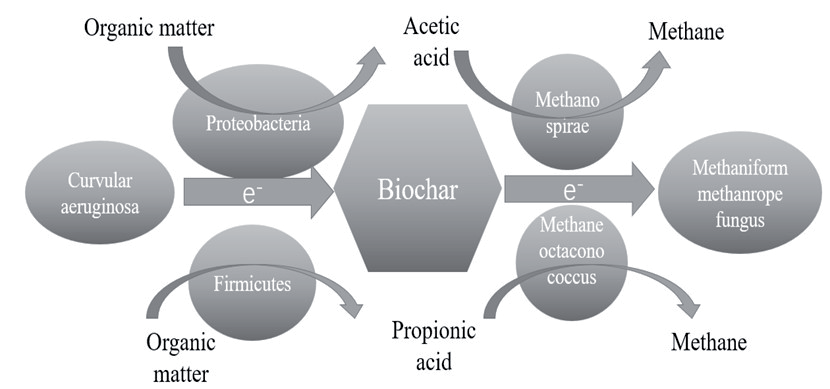
Interspecies electron transfer (DIET) is a process by which anaerobic microorganisms oxidize organic matter and transfer electrons through conducting cells. Biochar, with its abundance of unsaturated carbon and specific functional groups, provides numerous active sites and unsaturated electron pairs that facilitate electron transfer and transference during biochemical reactions, including anaerobic fermentation reactions, thereby enhancing reaction efficiency [61]. Recent studies have demonstrated that biochar can replace bacterial hairs in transferring electrons between acetyl and methanogenic bacteria, thereby establishing a stable electron transfer chain between fermenting bacteria and methanogens. This process promotes the dominance of methanogens and further enhances methane production under the influence of DIET (Fig. 1).
The surface of biochar harbors numerous active functional groups that facilitate electron transfer between anaerobic microorganisms, thereby enhancing their metabolic activity. Additionally, the large specific surface area of biochar promotes the enrichment of anaerobic microorganisms and increases the concentration of anaerobic fermentation microorganisms [59]. By augmenting both the concentration and metabolic activity of microorganisms, the decomposition of substances can be effectively accelerated, thereby promoting the hydrolysis process. Li [62] investigated the physicochemical properties of biochar and demonstrated its potential as a carrier for anaerobic fermentation microorganisms. Biochar can effectively enrich anaerobic fermentation microorganisms and increase their concentration, while the reactive functional groups on its surface can promote electron transfer among microorganisms, including methanotrophic bacteria.
Anaerobic fermentation relies heavily on hydrolytic enzymes during the initial hydrolysis stage, which break down organic macromolecules into water-soluble small molecule compounds [63]. Increasing the activity and enrichment of hydrolytic enzymes can effectively enhance the hydrolysis rate and improve the gas production rate of the anaerobic fermentation system. The addition of biochar with a rich pore structure to the anaerobic fermentation system can serve as a carrier for enriched microorganisms, promoting the enrichment and immobilization of hydrolases and accelerating the rate of the hydrolysis stage [64]. Duan [65] added biochar prepared from algae as a substrate to the anaerobic fermentation system and observed a 2.1-fold increase in the production of short-chain fatty acids. The activities of hydrolytic enzymes, such as protease, glucoamylase, and lipase, increased by 1.6, 1.3, and 1.2 times, respectively, indicating that biochar can promote the activities of hydrolytic enzymes in anaerobic fermentation.
Reduction of Heavy Metal Concentration in Anaerobic Fermentation Systems
To improve breeding efficiency and shorten the slaughtering period of livestock and poultry, excessive trace elements are often added to pig feed, resulting in high concentrations of heavy metals in livestock and poultry feces used as substrates for anaerobic fermentation [66]. Heavy metals are biotoxic and harmful to the environment, and their accumulation in the food chain poses a threat to human health. Moreover, high concentrations of heavy metals can inhibit microbial and enzyme activities in anaerobic fermentation to varying degrees [67].
Biochar has been shown to effectively reduce heavy metal concentrations in anaerobic fermentation systems by forming complexes or co-precipitates with heavy metals in the substrate [68]. Zhang [69] investigated the effect of different passivators (fly ash, diatomaceous earth, and biochar) on heavy metals in swine manure anaerobic fermentation systems. The study found that the addition of 5.0% biochar effectively reduced the concentrations of copper and zinc in the anaerobic fermentation system.
Effect of Biochar on Anaerobic Fermentation Processes with Different Types of Substrates
Effect of Biochar on Anaerobic Fermentation Processes Using Livestock and Poultry Manure as Substrates
The concentration of heavy metals is a critical issue affecting anaerobic fermentation in systems using livestock and poultry manure as substrates [69]. Biochar, with its alkaline pH, can buffer the acidification of the anaerobic fermentation system caused by the accumulation of VFAs, thereby preventing the inhibition of fermentation microorganisms, such as methanogens, and increasing the rate of gas production. Additionally, biochar possesses abundant functional groups that can react with heavy metals in the system to form complexes or precipitate as coprecipitates, thereby reducing the effects of high concentrations of heavy metals [70]. Zeng [71] et al. investigated the effect of adding biochar to an anaerobic fermentation system using chicken manure as the fermentation substrate. They found that the addition of 5% biochar increased the pH value of the system from 6.76 to 8.48, resulting in a 94% increase in cumulative biogas production. Furthermore, the concentration of volatile fatty acids was reduced, and the biogas production rate was increased.
Biochar’s Impact on Anaerobic Fermentation of Agricultural Wastes
The complex structure of crop straw, which consists of tightly bound cellulose, hemicellulose, and lignin, poses a challenge to the degradation of substrates by microorganisms such as methanogenic bacteria [72]. This results in the accumulation of intermediate products, such as volatile fatty acids (VFAs), and the inhibition of microbial activity, leading to low efficiency in biogas production through anaerobic fermentation. However, biochar’s porous structure and rich functional groups enable it to adsorb inhibitory substances and enhance the stability and buffering capacity of the anaerobic fermentation system [73]. Additionally, the alkaline pH of biochar can alleviate acidification caused by VFAs, shorten the delay period of the anaerobic fermentation system, improve the activity of microorganisms, such as methanogenic bacteria, and increase the amount of methane produced by the anaerobic fermentation system.Jing [74] utilized the remaining wood as a substrate for pyrolysis to produce biochar, which was subsequently added to an anaerobic fermentation system with corn stover as the substrate. The aim of this study was to investigate the impact of biochar on the gas production performance of anaerobic fermentation and the stability of the system. The results demonstrated that the addition of 8 g/L biochar not only promoted the growth and reproduction of bacteria and archaea, but also inhibited the growth of CO2-producing microorganisms, leading to a 5.9% decrease in CO2 concentration. Furthermore, the addition of biochar improved the beneficial bioflora’s ability to adapt to the environment, as well as the ability of microorganisms such as methanogenic bacteria to hydrolyze the substrate. This resulted in a 7.4% increase in methane content and an increase in the biogas production rate.
Biochar’s Impact on the Anaerobic Fermentation Process of Sludge
The activated sludge method is a reliable approach for treating wastewater, but the remaining sludge contains a significant amount of harmful pollutants, including pathogenic bacteria, organic matter, and heavy metals [75]. Anaerobic fermentation can reduce and stabilize sludge, as well as promote resource recycling. However, high concentrations of volatile fatty acids can acidify the anaerobic fermentation system [76], inhibit the growth of microorganisms, and reduce the rate of gas production.
Biochar’s porous structure provides attachment sites for hydrolytic enzymes, promoting the reaction between enzymes and substrates. The rich functional groups on the surface of biochar can also enhance the activity of microorganisms, such as methanogenic bacteria, promoting the transfer of electrons and reducing the concentration of organic pollutants. Zhang [77] investigated the effect of biochar on acid production in anaerobic fermentation of residual sludge by adding different types of biochar as a substrate. The study showed that the addition of 10 gL-1 biochar increased the concentration of volatile fatty acid accumulation by 2.26 times. The accumulated volatile fatty acids were utilized by hydrogen-producing acetate-producing bacteria and methanogens as a substrate during the methanogenic stage of anaerobic fermentation, promoting methanogens production and further increasing methane production.
Biochar’s Impact on Anaerobic Fermentation of Food Waste
Food waste has a complex composition, and numerous factors influence anaerobic fermentation. In the anaerobic fermentation system, excessive accumulation of volatile fatty acids can lead to acidification, while high concentrations of ammonia nitrogen can cause inhibition. A significant increase in suspended solids content can also hinder the activity of methanogenic bacteria, resulting in reduced gas production rates and even system failure [78]. Incorporating biochar into the anaerobic fermentation system can increase the system’s pH, promote acetic acid degradation, boost the number of methanogenic bacteria, and alleviate acidification caused by excessive volatile fatty acid accumulation [2,79]. Additionally, biochar can regulate the carbon-to-nitrogen ratio of the anaerobic fermentation system, enhance microorganism activity, such as methanogenic bacteria, improve system stability, and promote gas production rates.Song produced biochar from agricultural waste, including wheat straw and apple branches, to investigate the impact of different biochar on the rate of gas production and the mechanism of anaerobic fermentation of kitchen waste. The study demonstrated that straw biochar increased the activity of coenzyme F420 during the pre-fermentation period to 108.9 molL-1, enhanced the utilization of volatile fatty acids by methanogenic bacteria, mitigated acid inhibition, and increased methane accumulation to 6763.5 mL. Additionally, straw biochar promoted direct interspecies electron transfer between microorganisms and substrates, thereby increasing the rate of gas production in anaerobic fermentation systems.
Conclusions
The use of biochar in anaerobic fermentation engineering has garnered significant attention from scholars. The choice of substrate and preparation method for biochar can have varying effects on anaerobic fermentation systems, and further research on biochar modification is necessary to determine the optimal preparation and addition of biochar to enhance gas production rates in anaerobic fermentation systems. While current studies on the promotion of anaerobic fermentation by biochar are primarily in the laboratory stage, practical applications require consideration of parameter control and environmental benefits.
Although biochar application has been shown to promote stability, safety, and methane production rate in anaerobic fermentation systems, there are still limitations and challenges associated with this technology. Firstly, the high production costs of biochar have resulted in most studies being limited to laboratory settings, making large-scale dissemination difficult. Secondly, the efficiency of anaerobic fermentation is influenced by various factors such as fermentation substrate, temperature, pH, and C/N ratio ,which highlights the need for further upgrades and improvements in the anaerobic fermentation process.

