

Introduction
Sustainability research is an extremely topical issue today. However, sustainability is not just one separate research area that does not affect other aspects of research, but it is an area that is interconnected in almost all areas of life. Sustainability, although perceived mainly in ecological terms, also affects the competitiveness of countries. Alonso-Almedia & Celemin-Pedroche [1] focused on this fact at the research level, dealing mainly with the relationship between the competitiveness and sustainability of a tourist destination. 4 years later, Rodriguez-Diaz & Pulido-Fernandez [2] explored in their paper that sustainability is currently a key factor for assessing the sustainability of tourism competitiveness.
The link between sustainability and competitiveness has also been confirmed in the research of Vašaničová et al. [3], in which the authors focused on the business environment and measured the level of competitiveness through the Business Environmental Pillar of the Travel and Tourism Competitiveness Index (TTCI). All this research has in common and confirms the fact that sustainability does not apply only to one area of research but has an interdisciplinary character, and therefore its investigation applies to several research levels [4].
To achieve an increasing level of sustainability, 17 global Sustainable Development Goals have been created, the fulfillment of which contributes to increasing the level of sustainability of countries and thus to plans to achieve the 2030 Agenda.
Theoretical Background
Sustainable development was first defined as “development that meets the needs of present generations without compromising the ability of future generations to meet their own needs” in the United Nations Environment Commission’s “Our Common Future” document [5].
Economic development, social development, and environmental protection are interdependent and mutually reinforcing components of sustainable development” [6]. Each of these factors has played an important role in recent years in innovation efforts, financing, and global development [7]. In terms of social development, in addition to eradicating poverty and population well-being, quality education is another important factor today, bringing about innovation in teaching methods, particularly digital teaching, but also increased mobility of pupils and students [8].
Economic development mainly concerns business inputs on the ground, innovation, the development of the knowledge economy, and digitalization, such as the introduction of robotic automation processes for business, which has become one of the main variables to increase competitiveness and further develop the market and business [9, 10].
The focus in environmental protection is on sustainable development in the form of renewable energy such as wind, solar, and other forms of green energy, for which sustainable development is also important and must be ensured through various supporting policies, the inclusion of community projects, and funding programs [11, 12]. Moreover, research has shown that at country level, there is a high correlation (and possible relationship) between social sustainability, innovation, and competitiveness [13].
Table 1.
Sustainable Development Goals
In 2015, the United Nations (UN) General Assembly formally adopted the “2030 Agenda” for Sustainable Development, which provides a framework for “peace and prosperity for people and the planet, now and into the future” [14].
As part of this agreement, all Member States of the United Nations, following a participatory process involving several stakeholders, have agreed on sustainable development through the identification of Sustainable Development Goals (SDGs) that can be used to provide an indicator and measure progress towards the SDG [15, 16]. The 17 Sustainable Development Goals (SDGs) found in Table 1 are a way to understand a variety of socially significant topics, from eradicating global poverty to taking urgent action to combat climate change and its impacts by 2030, and are outlined in the UN document entitled Transforming our world: The 2030 Agenda for Sustainable Development [14].
The aim of the listed SDGs is to inspire the operationalization and integration of sustainability into organizations worldwide, address the current and future needs of stakeholders, and contribute to achieving sustainable development for society. Although this global initiative is authoritative and a source of inspiration, divergent interpretations of the SDGs require further efforts through policymaking, as well as the need to improve the understanding and scientific resonance of future initiatives like the SDGs [17-19].
The assessment of the 17 SDGs has focused extensively on the formulation of appropriate targets and indicators for each goal [21]. Moreover, as outlined by Sachs [22], SDGs “aim at combining economic development, environmental sustainability, and social inclusion”, and thus, by definition, must encompass a wide range of targets and indicators. The SDGs are crucial to achieving sustainable development at all levels of society [23]. Just looking at the individual goals, they are multidisciplinary – they relate to key areas that have a decisive impact on raising the level of sustainability in all countries in the world, as also noted by Scherera et al. [24] in their study. It is recognized that some progress has been made towards the SDGs. However, some critics, such as Des Gasper [25], argue that themes in the SDGs such as migration, terrorism, capital flight, and democracy are missing. Fonseca & Carvalho [17] therefore found in their study the impact and links of individual relationships between the different SDGs. Indeed, there are situations where achieving a sustainable development goal makes it impossible to make progress on another goal or where success under the SDG depends on the success of another [26]. For example, as poverty and inequality are reflected in consumption volumes [27], developments in poverty lead to alleviation (SDG 01), and reductions in inequalities (SDG 10) could lead to higher living standards. Therefore, the impact and relationship of individual targets is an important factor when looking at the SDGs listed above [28].
Therefore, the subject of our research became the analysis of the sustainability of selected countries with a link to their competitiveness. In this paper, we evaluated the sustainability of the V4 countries in terms of meeting individual global goals of sustainable development, which are considered a relatively homogeneous territory in Central Europe.
The V4 countries have their justification both in the research sphere and in terms of the historical development of these countries. We decided to compare the sustainability of the V4 countries based on quantified competitiveness indices and the Sustainable Development Goals index. To study countries’ competitiveness in the field of sustainability, a sustainability competitiveness index has been developed that considers the needs of both areas and quantifies the level of competitiveness of countries.
In view of the above, the countries of the V4 Visegrad region, namely the Czech Republic, Hungary, Poland, and Slovakia, have become the subject of our interest, which is also trying to find ways and ways of a common approach to solving the challenges of sustainable development. As an example, we can mention the holding of The Planet Budapest 2021 Summit, which took place in Budapest, Hungary, from November 30 to December 2, 2021. The aim of the event was to raise public awareness of adverse environmental, social, and economic practices and their impacts, and to highlight that these negative changes are reversible. Participants focused on nine areas, namely: sustainability in a post-COVID world, climate change, a circular economy, energy efficiency and security, smart cities, water and food security, transport, financing sustainable development, and waste management.
The issue of assessing the level of sustainable development in the Visegrad region is also dealt with by academics and researchers. In their research, researchers Esses et al. [29] from the Budapest University of Technology and Economics focused on exploring the relationship between the transformation of digitization and sustainability in the V4 member countries. Their results show the extent of digital performance across countries and the relationship between digital performance and sustainability indicators.
Researchers Sobczak et al. [30] from Wroclaw University of Economics and Business in Jelenia Góra, Poland, in turn, addressed issues related to the implementation of SDG 1: No poverty. Their aim was to assess the diversity within the V4 countries in 2005– 2018 in terms of the level of poverty and sustainable development in the area without poverty and to identify the impact of the level of socio-economic development in the studied countries on sustainable development in the area without poverty. According to their findings, the highest level of sustainable development is represented by the Czech Republic, followed by Slovakia. The highest average dynamics of change occur in Poland and Hungary, resulting in the gradual elimination of existing disproportions.
The aim of the research by the authors Čepelová & Douša from Pavol Jozef Šafárik University Košice, Slovak Republic [31] was to identify the results of meeting goal 11 of the 2030 Agenda: Make cities and human settlements inclusive, safe, resilient, and sustainable in the V4 countries. They obtained interesting results in various indicators. As for the resulting average of the V4 countries for all surveyed indicators in terms of the possibility of achieving 100% of goal 11 of the 2030 Agenda by 2030, the authors found that all V4 countries except the Czech Republic have more than 50% chance of succeeding. The Czech Republic has values just under 50%, so it shows the lowest probability of all V4 countries that it will achieve the target values of the studied indicators by 2030. All countries analyzed are taking the necessary steps to develop appropriate strategies and concepts to achieve the final achievement of goal 11.
Material and Methods
The aim of the paper is to present the results of the analysis of the process of meeting the global goals of sustainable development (SDGs) in the V4 countries for 2022 based on selected indices. The process of achieving global sustainable development goals (SDGs) in the Visegrad countries during 2022 is mapped through the Global Sustainable Development Goals Index. The Sustainable Development Goals Index (SDG-I) was selected mainly to overcome the limitations of information found on the website of the Statistical Office of the European Union, where we will look in vain for data on the implementation of individual global sustainable development goals for 2022.
The Sustainable Development Goals Index (SDG-I) was developed by Jeffrey Sachs et al. [32] on behalf of the Bertelsmann Stiftung and the Sustainable Development Solutions Network (SDSN) in 2015. It aims to develop and implement a single indicator to monitor progress towards the SDGs at a global level and to support the identification of priority areas for action, track overall developments, and allow for international comparisons and benchmarking. The objective of the Sustainable Development Index relies on available data from several publicly available sources, covering all 193 member states of the United Nations since 2016. It comes from a scoring system that uses an arithmetic mean for aggregated indicators relating to each of the 17 SDGs sequentially before “averaging” results into a single metric [33]. The equal weight system is deliberately used to express international commitments to “treat each SDG equally and as an integrated and indivisible set of goals” [32]. The Sustainable Development Index does not aim to replace the global scoreboard of indicators for monitoring the SDGs [34]. However, it has enormous potential (like other well-known composite indicators) to identify priority areas for action, track overall progress, and thus make international comparisons.
The data we work with in the paper is secondary in nature and comes from the European Sustainable Development Report 2022. Based on our theoretical background and previous research, we have established the following 3 research hypotheses:
1. The implementation of the Sustainable Development Goals in individual V4 countries for 2022 is the same.
2. The changes in the implementation of the Sustainable Development Goals in the V4 countries for 2022 are the same.
3. The V4 Sustainable Development Goals Index is dependent on the V4 Competitiveness Index.
At the research level of the paper, we verified the established research hypotheses in the statistical program R using appropriate tests. For the first and second hypotheses, where we test for differences in achievement as well as changes in achievement of individual SDGs, we use a t-test. For the third hypothesis, where we test the dependence of the SDG index and the global competitiveness index, we use panel analysis focusing on fixed effects.
When verifying research hypotheses, we consider a significance level of 0.05. The decision rule for these research hypotheses is as follows:
If the p-value is ≤ α, we reject the H0 hypothesis. There are statistically significant differences/associations between variables.
If the p-value is > α, we cannot reject/reject the H0 hypothesis. There are no statistically significant differences/associations between variables.
From the results of analysis and testing of statistical hypotheses, it will be possible to determine which of the V4 countries is the most successful in meeting the SDGs and vice versa, which country does not perform so well in this regard, which is also related to the competitiveness of countries in the field of sustainability. The results of our analysis expand knowledge in the field of sustainable development in the V4 countries through the fulfillment of global sustainable development goals and, at the same time, can serve as a basis for further study and research on sustainability, which are very urgent in view of current global problems.
Results and Discussion
For 2022, all V4 countries will keep their SDG-I score at about 70% [35]. Compared to the European Union average (which is at 72.0%), all V4 countries are significantly successful in achieving the Sustainable Development Goals. In Table 2, we can see that the Czech Republic ranks best in the implementation of the SDGs in this regard, which is in the top ten countries in the Sustainable Development Index and, at the same time, is also 2.2% above the European average. On the contrary, the least successful country in SDGs is Hungary, which ranked last among the V4 countries, and is also 2.1% below the European average.
From the perspective of European Union countries, we can see in figure 1 that the best SDG-I scores for 2022 were achieved by the countries of northern Europe; Finland (81.7%), Sweden (80.6%), Denmark (79.2%), and Norway (77.2%). By contrast, Turkey scored the worst with 56.7%. At the same time, from the point of view of the SDG-I of individual European countries, the SDG-I of the V4 countries is at the level of “good” and “average”.
Table 2.
SDG-I of V4 countries for 2022
| V4 country | SDG-I ranking (2022) | SDG-I score in % (2022) |
|---|---|---|
| Czech Republic | 7 | 74.2 |
| Poland | 13 | 72.4 |
| Slovak Republic | 21 | 70.2 |
| Hungary | 23 | 69.9 |
| EU average | --- | 72.0 |
As far as the fulfillment of individual goals is concerned, the V4 countries adopt different attitudes towards the SDGs. There is also diversity in the implementation of the SDGs across the V4 countries. For the purposes of our research, however, we distinguished them graphically. In the first hypothesis, we verified statistically significant differences, but to determine these differences according to the T-test, we need to recode the data according to the graphical scale into numerical ones.
In the following Table 3, we can see the fulfillment of individual SDGs in the V4 countries differentiated according to this defined graphical and numerical scale as follows:
✔ objective is achieved = 1, like a most significant achievement,
• challenges remain to achieve the goal = 2, like a rather significant implementation,
➢ significant challenges remain to achieve the objective = 3, like a significant implementation,
o major challenges remain to achieve the goal = 4, like an insignificant implementation.
If we look at the fulfillment of individual SDGs in the V4 countries, we can see that for individual countries, the decisive phenomenon is not only whether and what attitude they will take towards each of the SDGs, but also how the fulfillment of the goal has changed compared to the previous year. As with the fulfillment of goals, we can graphically distinguish individual changes in the fulfillment of individual goals as follows. You can see this graphical and numerical scale (for the purpose of the research) in Table 4 below:
⬆ the goal is on the rise = 1, like the most significant changes,
➡ the achievement of the target has seen a slight increase = 2, like a rather significant change,
⬅ goal achievement stagnates = 3, like a rather insignificant change,
⬇ goal achievement is on the decline = 4, like an insignificant change.
From the Tables 3 and 4, we can see diversity between fulfillment and changes in the fulfillment of SDGs in V4 countries. This diversity between the V4 countries helps countries to be mutually competitive [36, 37] and more competitive than other countries [38]. However, in this paper, we focus primarily on comparing the Global Competitiveness Index with the SDG index.
We wrote more about the SDG index in Table 2 and Figure 1. This time we will focus on the competitiveness index of the V4 countries, which we describe in Table 5.
From the encoded data itself (Table 3), there are differences between individual V4 countries in the fulfillment of individual Sustainable Development Goals. However, it is questionable whether these differences are also statistically significant, which in our case is verified by the first research hypothesis: The Implementation of the Sustainable Development Goals is the same in the V4 countries.
Fig. 1.
SDG-I score of individual European Union countries in % (Source: own processing according to Lafortune et al. [35]).
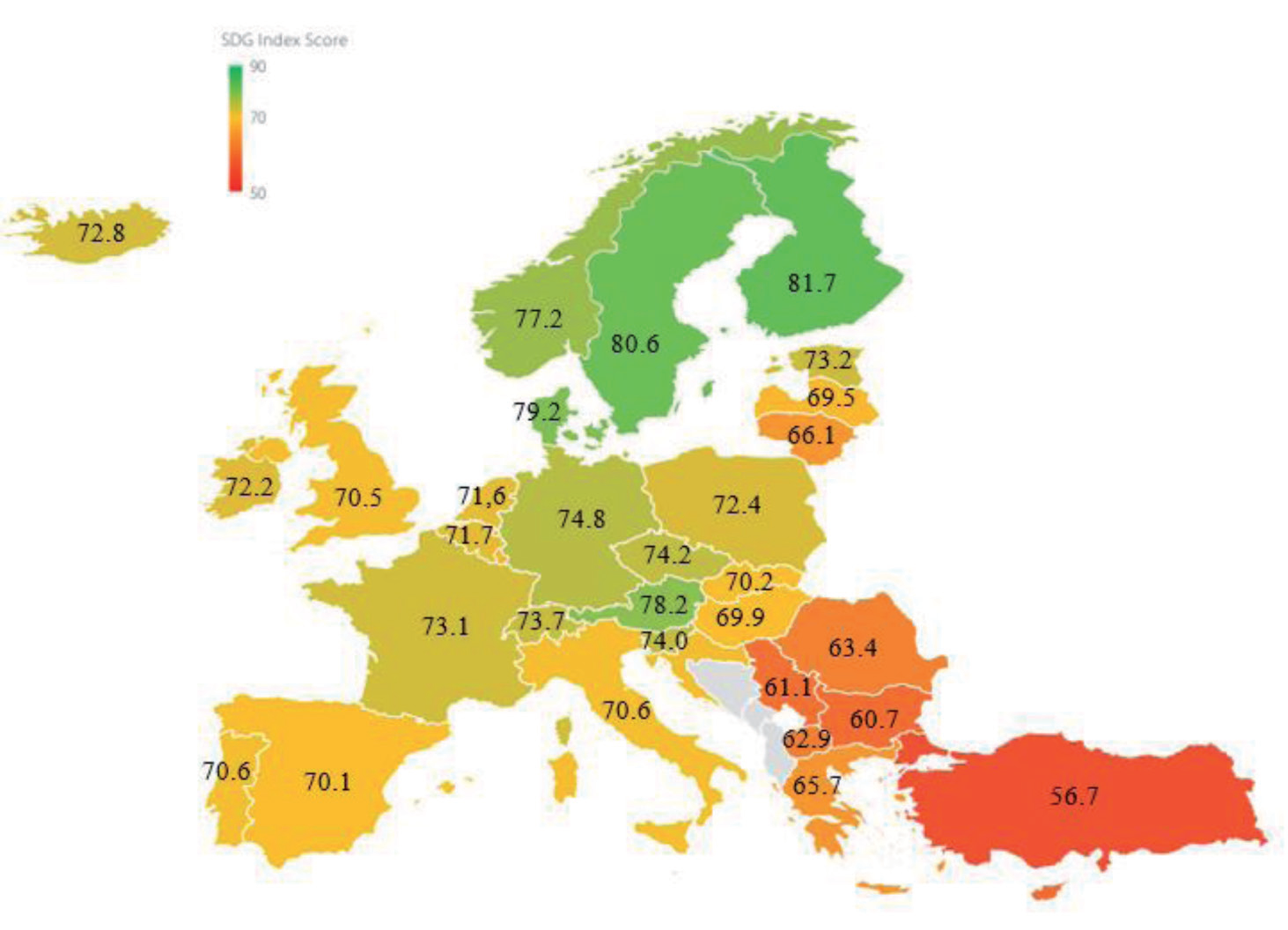
Table 3.
Implementation of SDGs in V4 countries for 2022
Table 4.
Changes in the implementation of individual SDGs in the V4 countries in 2022
For the first research hypothesis, the following applies:
H0: The implementation of the Sustainable Development Goals is the same in the V4 countries.
H1: The implementation of the Sustainable Development Goals is not the same in the V4 countries.
Table 5.
WCI of the V4 countries for 2022
| V4 country | WCI ranking (2022) | WCI score in % (2022) |
|---|---|---|
| Czech Republic | 8 | 75.81 |
| Hungary | 3 | 65.88 |
| Slovak republic | 1 | 53.53 |
| Poland | 3 | 53.37 |
or
Even in this case, we can see from the encoded data itself (Table 4) that there are differences between individual V4 countries within the framework of changes in the fulfillment of individual sustainable development goals, too. However, it is questionable whether these differences are also statistically significant, which in our case is verified by the second research hypothesis: The changes in the implementation of the Sustainable Development Goals for 2022 in the V4 countries are the same.
For the second research hypothesis, the following applies:
H0: Changes in the implementation of the Sustainable Development Goals for 2022 are the same in the V4 countries.
H1: Changes in the implementation of the Sustainable Development Goals for 2022 are not the same in the V4 countries.
or
The results from the verification of the first and second research hypotheses are shown in the following Table 6.
It is clear from Table 6 that our assumptions about statistically significant differences in the fulfillment of individual V4 goals between individual V4 countries have been confirmed. There are statistically significant differences in the implementation of the SDGs between all country pairs. This means that each country implements the 17 SDGs differently.
In the case of the second hypothesis regarding differences in the implementation of individual SDGs in the V4 countries for 2022 (as we can see in Table 6), these differences were confirmed, as the resulting p-value of the t-test was lower than the significance level of α.
Since statistically significant differences have been confirmed in both cases (between the implementation of the SDGs and between the changes in the fulfillment of the SDGs), we can say that each of the V4 countries can prosper in one of the goals and prosper less in one of the goals.
For the verification of the third research hypothesis, we work with the World Competitiveness Index, which we describe in Table 5. Table 5 shows only the data for 2022. For an overview of the dynamics of the implementation of each SDG, in the following Table 7 we show both SDGI and WCI data for the last 10 years (since 2013).
Since data for the SDGI for 2013-2014 does not exist because the SDGI itself has not yet been discovered, we will use data for both indices only from 2015 onwards in testing the third hypothesis. The third hypothesis was: The SDG index is dependent to the V4 competitiveness index. For the third research hypothesis, the following applies:
H0: The SDG index is not dependant on the V4 competitiveness index.
H1: The SDG index is dependant on the V4 competitiveness index.
or
To determine the relationships between indices, we used the panel analysis, focusing on fixed effects. The panel analysis achieved a p-value of 0.0289, which is lower than the significance level of α, and therefore we cannot reject/reject the H0 hypothesis. This means that the SDG Index is a significant variable. In this model we have only one variable, so the p-value is the same.
Therefore, it follows that SDGI, as a dependent variable, can influence the WCI. The relationship is linear - that is, if the amount of SDGI in a country increases, so does the WCI. Conversely, if a country’s SDGI score decreases, the WCI also decreases.
Currently, there is an index that considers both the competitiveness index and the sustainability index. It is the Global Competitiveness in Sustainability Index (GSCI), which is determined based on a country’s measure of natural, social, intellectual capital, economic sustainability, government establishment, and resource efficiency and intensity [42]. This index can be used to determine which country is the most competitive in terms of sustainability.
Table 6.
Verification of the first and second research hypothesis
Table 7.
Comparison of SDGI and WCI in 10 years
Table 8.
Comparison of V4 indices for 2022
| V4 country | SDGI score in % (2022) | WCI score in % (2022) | GSCI score in % (2022) |
|---|---|---|---|
| Czech Republic | 74.2 | 75.81 | 52.4 |
| Poland | 72.4 | 53.37 | 51.2 |
| Slovak Republic | 70.2 | 53.53 | 52.7 |
| Hungary | 69.9 | 65.88 | 47.7 |
Since the association between the Competitiveness Index and the Sustainable Development Index was not confirmed in the analysis, the research goal was to find out which of the V4 countries is the most competitive in terms of indices. We therefore decided to consider the country’s sustainability competitiveness index, which we present in Table 8.
From the Table 8, if we consider only the competitiveness index in terms of sustainability, Slovakia is the most competitive country in V4. In second place among the V4 countries is the Czech Republic, followed by Poland. By contrast, Hungary is the least competitive country.
Conclusions
Based on the study of available literature and results from the analysis, we found that the implementation of the Sustainable Development Goals in the V4 countries is not at the same level, and changes in the fulfillment of these 17 goals in the V4 countries are different. This means that each country is implementing the SDGs differently. For example, Slovakia has the most significant implementation of target 10 (reduction of inequalities), Czechia and Poland have the most significant implementation of targets 01 (no poverty) and 10 (reduction of inequalities), while Hungary does not report significant implementation for either target. As for the least significant implementation, all the V4 countries list targets 13 (climate action) and 14 (life below water), which we have already stated in Table 1. These conclusions are logical as countries such as Slovakia and Czechia are landlocked countries, and therefore the fulfillment of target 14 (life below water) cannot be implemented in the conditions of these countries as in countries that are oriented by the sea, and therefore these countries report the least significant fulfillment of this objective.
When comparing the SDG index and the competitiveness index, it was found that the SDG index score depends on the score of the World´s Competitiveness Index. The higher the SDGI score itself, the more competitive any country (and not just the V4) is against the others. This implies that the country should also focus on sustainability in competitiveness research. Considering the results of the panel analysis, sustainability, and the actual implementation of the goals or countries’ efforts to meet the 17 SDGs also leads to the fact that a country can become more competitive than it would be if the country did not address this area.
Since both indices consider different facts, we also considered the global competitiveness index for sustainability. Based on it, it was found that the Slovak Republic is the most competitive of the V4 countries in terms of sustainability. By contrast, Hungary is the least competitive country. Even though it is the smallest of the V4 countries in terms of area in terms of sustainability, it is more competitive than 3 significantly more developed and larger countries. However, it is necessary to consider the fact that these results of the analysis apply only to the V4 countries, so we cannot draw general conclusions from the analysis, only conclusions that apply to the V4 countries and at the same time reflect only the year 2022.
The fact that the Slovak Republic has the highest score of the sustainability competitiveness index and is therefore the most competitive of the V4 countries in the field of sustainability is also related to the fact that Slovakia has all suitable prerequisites for the development of sustainability, as the territory has sufficient natural potential necessary for the development of sustainability, which has a perspective for the future development of both the V4 countries and other countries [29].
At the same time, the results of the first two hypotheses must be considered, where we found that individual V4 countries meet the SDGs differently - that is, a country can be successful in meeting different goals, but this does not mean that the same country is not competitively competitive. It can also be competitive in sustainability – just not according to the indicators that are part of the SDGI. In this case, the composition of the indices themselves must be considered as predictors of what the index itself “measures”.
The greatest added value of the contribution is the analysis of the competitiveness of the V4 countries, which are perceived as a homogeneous territory, but during a more detailed analysis of the global SDGs, we noted statistically significant differences in the fulfillment of global goals for sustainable development in the territories of individual countries. At the same time, it can be observed that the V4 countries in indices (whether of competitiveness, sustainability, or competitiveness of sustainability) achieved scores like the European average, which is a significant contribution and an incentive for further sustainability research.

