

Introduction
Plants have free radical scavenging systems that fight oxidative senescence. These systems include antioxidant enzymes and antioxidant substances, among which superoxide dismutase (SOD), catalase (CAT), ascorbate peroxidase (APX) and peroxidase (POD) constitute protective enzyme system [1]. Superoxide dismutase (SOD)and other antioxidant enzymes reduce the cellular damage associated with reactive oxygen species by catalyzing the conversion of H+ and O2-· (the superoxide anion radical) to H2O2 (hydrogen peroxide) and O2 (oxygen), followed by the further conversion of H2O2 to O2 and H2O [1]. APX, another important antioxidant enzyme, is an important component of the plant redox pathway, as well as a key enzyme in H2O2 scavenging, especially in chloroplasts [2]. Under normal conditions, the plant antioxidant system precisely regulates free radicals to maintain a dynamic equilibrium between production and scavenging [2]. However, low temperature, low air pressure, strong ultraviolet radiation and other factors can disrupt this equilibrium, leading to the excessive accumulation of free radicals in the plant body and consequent tissue damage [3]. For example, excess free radicals may increase lipid peroxidation, which has several deleterious effects on cells, including changes in the structure and function of biofilm, DNA damage, and protein denaturation [4]. In plants, the harmful effects of excess free radical accumulation directly or indirectly lead to the development of metabolic disorders [5]. Environmental stresses (salinity, drought, heat/ cold, light and other hostile conditions) may trigger in plants oxidative stress, generating the formation of reactive oxygen species (ROS). In order to overcome oxidative stress, plants have developed antioxidants defense mechanisms to ensure normal growth [6]. Therefore, it is important to study plant peroxidase activity to better understand the molecular processes underlying plant growth and development.
Changes in elevation have a variety of effects on plants. As elevation increases, average temperature, CO2 levels, and atmospheric pressure decrease, while light intensity and ultraviolet radiation increase, affecting plant growth and development [7, 8], substance metabolism [9], and tissue structure and function, as well as other physiological characters [10, 11]. In general, plants grown at higher elevations exhibit reduced growth, slower development, and altered morphological structures [12]. Temperature, drought, strong ultraviolet radiation, and other elevation-associated stressors disrupt the dynamic free-radical equilibrium, leading to plant cell damage and metabolic disorders [13]. To adapt to challenging environmental conditions, such as elevation, crops invoke a variety of stress response mechanisms that lead to physiological adjustments. For example, studies have shown that elevation-associated changes in environmental factors significantly affect antioxidant enzyme activity levels in plants [14]. Plant stress resistance mechanisms, which are dependent on antioxidant content and activity levels, effectively remove the reactive oxygen free radicals produced by stress, eliminating or reducing tissue damage [15]. SOD, CAT, APX, and POD resist and remove reactive oxygen species, prevent membrane lipid peroxidation, and maintain the stability of the membrane system in order to mitigate the damage caused by adverse environmental conditions [15]. Under stress, high antioxidant and antioxidant oxidase levels can result in high adaptability to stress conditions [16].
There are a lot of microorganisms in the soil, such as bacteria, fungi and so on. These microorganisms form a symbiotic relationship with plant roots and constitute the rhizosphere microbial community of plants. Rhizosphere microorganisms have important influence on the physiological activities of plants. They can decompose organic matter, convert organic matter into inorganic matter that can be absorbed by plants, and provide nutrients for plant growth [17]. In addition, rhizosphere microorganisms can also promote nutrient uptake, disease resistance and stress adaptability of plants.
Lonicera caerulea is a perennial deciduous shrub that produces edible berries. It produces a rare, green edible berry and grows wild in the Changbai Mountain area [18]. The fruit of this shrub, which is rich in anthocyanins, amino acids, vitamins, and various essential trace elements, has been shown to help manage cardiovascular disease, improve liver detoxification, stabilize blood pressure, treat anemia in the elderly, and increase resistance to some viruses and tumors [19-20]. It has high commercial, medicinal, and nutritional value. It can be made into fruit drinks, wine, jam, medicine, and other products. In Russia, L. caerulea berries have been made into a drink for cosmonauts. The L. caerulea berry has broad and promising prospects for development and utilization [21, 22].
This study evaluated the activity of antioxidant enzymes in Lonicera lonicera to determine the relationship between its growth and habitat. The results of this study will help to characterize the relationship between the environmental conditions of the Changbai Mountains and L. caerulea growth and development. Because increases in antioxidant enzyme activity can promote the growth and physiological performance of L. caerulea, this study aimed to improve the nutritional value of L. caerulea by identifying the altitude corresponding to the optimal antioxidant performance of L. caerulea.
Materials and Methods
Study Site
The Changbai Mountain Nature Reserve (41°42’– 42°25’ N, 127°43’–128°17’ E), located in northeastern China, covers a total area of 196,465 hm2, with its highest peak reaching 2744 m. [23, 24]. The annual average wind speed is 11.7 m/s. The annual precipitation in the reserve ranges from 700 to 1400 mm, 60% of which falls during the summer; winter and spring are dry, while autumn is foggy [25]. Because local average temperatures are low (as low as 2ºC), there is far less evaporation than precipitation, and the Changbai Mountain area is perennially wet, with an average annual relative humidity of 70%. The average annual temperature differential along the mountain slopes is at least 10°C [26], and the vertical landscape is typical of natural mountainous areas. Transition zones between each vegetation type are narrow, the vegetation is divided into five distinct vegetation types along the vertical gradient: broadleaved forest (<500 m), mixed coniferous and broadleaved forest (500-1100 m), conifero us forest (1100-1700 m), birch forest (1700-2100 m), and alpine tundra (>2100 m).
Sampling of Plants and Soil
Based on a preliminary investigation of L. caerulea plants growing on the northern slope of Changbai Mountain, a transect line was set along the road (Altitude gradient range of continuous distribution of L. caerulea shrubs) in July 2018 that spanned an elevation range of 800–1800 m and bisected a continuous distribution of shrubs. Along this transect, a sampling point was set up for every 200 m increase in elevation, for a total of seven sampling sites. At seven elevations (600, 800, 1000, 1200, 1400, 1600, and 1800 m), in each sampling area, 10-year-old plants (n = 30) at least 10 m apart were randomly selected among the Lonicera caerulea population (in the horizontal direction of each population per elevation level). To be included, the plant sampled had to be growing normally, with no signs of disease, insect pest infestations, or obvious structural defects. Three standard branches from each plant were randomly selected along five directions (east, south, west, north, and the top of the shrub), from which the second and third pairs of fully-grown and expanded leaves were collected from each branch tip for a total of 60 – 90 samples taken at each elevation. These leaves were removed and placed into a plastic self-sealed bag, then immediately taken to the laboratory in a portable refrigerator and stored in an ultra-low temperature refrigerator (−70ºC) for later testing. At the same time, a soil layer of 0~20 cm depth was taken from each sample plant, and the soil collected from 10 sample plants at each altitude was mixed to form a soil sample. Three soil samples were taken from each altitude, which were respectively put into cloth bags and brought back to the laboratory for analysis. Finally, at each sampling point location, plant sampling time, surface vegetation status, and meteorological data were recorded. The annual accumulated temperature of a year is calculated by adding up all the values of daily mean temperature ≥10ºC in 365 days of a year (The daily mean temperature is the average temperature for 24 hours a day. The calculation method is as follows: in meteorology, the average temperature of four times a day is usually taken as the average temperature of a day after adding together the temperature of 02, 08, 14 and 20).
Soil and Leaf Variables
The available P was extracted using sulfuric acid and hydrochloric acid and was determined using the molybdenum-antimony colorimetric method. The available K was extracted using ammonium acetate and was determined using a flame photometer, as was the extractable K. The hydrolysis N was determined using the alkali diffusion method. The total P was determined by molybdenum-antimony resistance colorimetric method. The total N was determined by automatic Kjeldahl nitrogen analyzer [26]. The pH of the soil was determined using the potential method. The potassium dichromate oxidation and reheating method was used to assess the soil organic matter. The soil samples were collected using a ring cutter with a volume of 100 cm3 to measure soil bulk density; they were then sealed in cloth bags and transported to the laboratory, where each was weighed to determine its bulk soil density.
Leaf samples (0.5 g) were homogenized in 10 ml HEPES-KOH buffer (pH 7.8) containing 0.1 mM EDTA. The homogenate was centrifuged at 15000 g for 15 min at 4ºC. In the supernatant, superoxide dismutase (SOD) activity was assayed by a photochemical method as described by Cakmak [27]. For catalase, the reaction mixture consisted of 25 mM potassium phosphate buffer (pH 6.8), 10 mM H2O2, and diluted enzyme extract in a total volume of 1 ml. The decomposition of H2O2 was followed by the decline in absorbance at 240 nm. Peroxidase activity was assayed using a reaction mixture containing 25 mM potassium phosphate buffer (pH 6.8), 10 mM H2O2, 0.05% guaiacol, and diluted enzyme extract. The oxidation of guaiacol was measured at 470 nm [27]. To measure ascorbate peroxidase (APX) activity, the decrease in absorbance at 290 nm due to ascorbate oxidation was measured using a reaction mixture based on the method described by Younis [28]. The reaction mixture contained 0.83 cm3 of 0.5 mM AsA in phosphate buffer (pH 7), 0.13 cm3 of 2 mM H2O2, and 0.04 cm3 of enzyme extract in a final volume of 1 cm3 at 25ºC [28].
Statistical Analysis
Data for the five measured leaf traits (SOD, POD, CAT, APX) were analyzed. First, one-way ANOVA was performed for each leaf trait variable. Each leaf trait variable was compared on a pairwise basis using Duncan’s multiple range test in SAS v9.1 software. To determine whether there was multicollinearity among independent variables, SPSS v19 was used, and any non-significant factors were removed. After this step (confirming no multicollinearity), the data had been rendered suitable for multiple stepwise regression analysis, and backward stepwise regression analysis was conducted.
Results and Discussion
Effects of the Altitude Gradient on Antioxidant Enzyme Activity in L. caerulea Leaves
In general, antioxidant enzyme activity in the L. caerulea leaves increased significantly with elevation up to 1600 m, followed by a significant decrease at 1800 m. Specifically, POD activity increased significantly between 800-1000 m and 1600 m, peaking at 1600 m and decreasing significantly at 1800 m (Fig. 1). Compared to POD activity at 1000 m, POD activity at 800 m, 1200 m, 1400 m, 1600 m, and 1800 m increased by 44.3%, 116.3%, 413.2%, 488.8%, and 297.5%, respectively (Fig. 1).
CAT activity increased significantly from 800 m to 1400-1600 m, followed by a significant decrease at 1800 m (Fig. 1). Compared to CAT activity at 800 m, CAT activity at 1000 m, 1200 m, 1400 m, 1600 m, and 1800 m increased by 69.8%, 144.6%, 344.3%, 363.0%, and 241.5%, respectively (Fig. 1).
APX activity levels were more variable, with significant fluctuations at 800-1400 m (Fig. 1). Nonetheless, similar to the other antioxidant enzymes tested, APX activity peaked at 1600 m, an increase of 91% compared to that at 1400 m, and declined significantly between 1600 m and 1800 m (Fig. 1). Compared to the lowest activity level (at 1000 m), activity levels at 800 m, 1200 m, 1400 m, 1600 m, and 1800 m increased by 29.5%, 48.9%, 48.7%, 184.0%, and 63.7%, respectively (Fig. 1).
Finally, SOD activity increased significantly from 800 m to 1600 m and decreased from 1600 m to 1800 m (Fig. 1), although there was no significant difference in SOD activity levels between 1400 m and 1600 m. Compared to SOD activity at 800 m, SOD activity at 1000 m, 1200 m, 1400 m, and 1600 m increased by 12.4%, 11.6%, 35.8%, and 55.2%, respectively.
Several Soil Properties Varied Along the Elevation Gradient
The properties of the soils surrounding L. caerulea plants at elevations from 800-1600 m on the northern slope of Changbai Mountain are shown in Table 1. The value of hydrolyzed N is lower at 800 m. The value of available potassium is lower at 1000~1400 m. Available phosphorus values are lower at 1600 m and 1800 m (Table 1). Lack of soil nutrients may limit plant growth.
Correlations Between Environmental Factors and Antioxidant Enzyme Activity in L. caerulea Leaves
The antioxidant enzyme activity of L. caerulea was affected by average annual temperature, annual precipitation, accumulated temperature >5ºC (The sum of the daily mean temperature over the course of one year when the daily mean temperature >5ºC), precipitation from June to September, average temperature in January, average temperature in July, frost-free period, days with snow cover, dryness index and wetness index (Table 2).
Environmental Factors Significantly Affecting Antioxidant Enzyme Activity in L. Caerulea Leaves at Different Elevations
Regression analysis showed that POD activity in L. caerulea leaves was mainly affected by precipitation from June to September (Table 3). The best-fit regression model was Y = 22.92X − 11055, where Y represented POD activity and X represented the precipitation from June to September. The correlation coefficient of this model was 0.8687.
CAT activity was mainly affected by the number of days with snow cover, soil available P, and soil total P (Table 3). Of these, the number of days with snow cover had the largest effect on CAT activity, followed by available P and total P. The best-fit regression model was Y= 5.00X1 + 3.62X2 + 1258.98X3 − 742.34, where Y represented CAT activity, X1 represented days with snow cover, X2 represented soil effective P, and X3 represented soil total P. The correlation coefficient of this model was 0.9999.
SOD activity was primarily affected by precipitation from June to September, followed by soil total P (Table 3). The best-fit regression model was Y = 0.09X1 + 178.79X2 − 23.32, where Y represented SOD activity, X1 represented precipitation from June to September, and X2 represented soil total P. The correlation coefficient of this model was 0.9881.
APX activity was mainly affected by soil available P (Table 3). The best-fit regression model was Y = 183.40 + 0.45X, where Y represented APX activity and X represented soil available P. The correlation coefficient of this model was 0.9073.
It is well-known that environmental conditions vary along mountain sides. CO2 concentration, and solar ultraviolet radiation intensity. Due to these factors, plants growing at high altitudes are subjected to severe environmental stress. In particular, the low temperatures and high levels of UV-B radiation endemic to high altitudes disrupt free-radical metabolic homeostasis, leading to the production of a large number of reactive oxygen species; reactive oxygen species damage cell membranes and inhibit enzyme activity, possibly leading to cell death in extreme cases [29- 32]. Intracellular antioxidant enzymes, including POD, CAT, SOD, and APX, effectively scavenge superoxide free radicals to maintain the metabolic balance of free radicals in plants [33-34]. SOD is the first line of defense in the plant antioxidant system, scavenging residual O2- and other reactive oxygen free radicals in cells during photosynthesis, while POD, APX, and CAT are the main scavengers of H2O2 in plant chloroplasts [35-36]. Therefore, increases in the activity levels of these enzymes suggest increased scavenging activity as a result of greater production of reactive oxygen free radicals [37-38].
Table 1.
Environmental factors that might influence the leaf traits of Lonicera caerulea at different elevations.
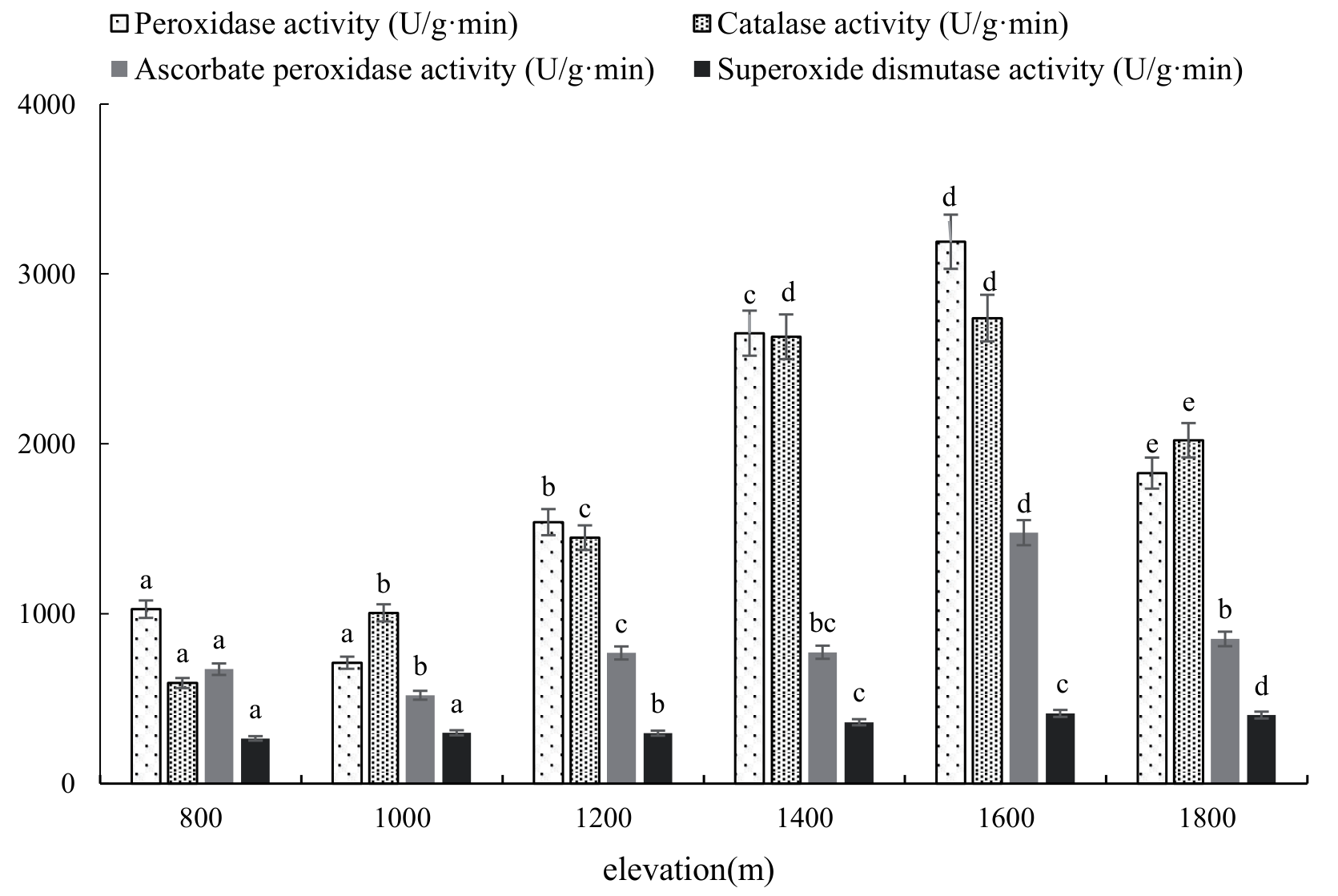
Here, POD and APX activity profiles changed similarly as elevation increased, with significantly decreased levels of activity at 1800 m as compared to 1600 m. This may be because the stronger light, increased UV-B radiation, lower temperatures, larger diurnal temperature fluctuations, and reduced partial pressures of O2 and CO2 found at higher altitudes have adverse effects on oxidase synthesis [39]. SOD, POD, CAT, and APX activity levels peaked at 1400-1600 m in response to changes in various environmental factors (i.e., soil and climatic characters). That is, the accumulation of reactive oxygen species in L. caerulea led to increases in enzyme activity. As POD activity levels were higher than APX or CAT or SOD activity levels, POD might better allow the plant to adapt to the adverse conditions at high altitudes [40].
In L. caerulea leaves, SOD, CAT, POD, and APX activity levels fluctuated with increasing elevation, peaked at 1600 m, and decreased significantly at 1800 m. Low temperatures and other environmental stresses are present at high altitude. These stressors promoted antioxidant enzyme activity in L. caerulea leaves and ensured that the damage associated with reactive oxygen species was minimized. In general, antioxidant enzyme activity levels were relatively high at moderate altitudes and low at lower at higher altitudes. This pattern might reflect a lack of reactive oxygen species in the L. caerulea leaves due to long-term adaptations to the environment. Environmental factors (soil properties and climate parameters) changed with altitude, leading to an excessing accumulation of reactive oxygen species in L. caerulea leaves.
This increase in reactive oxygen species promoted the synthesis of various antioxidant enzymes and increased enzyme activity [41]. Similar changes in the activity levels of antioxidant enzymes were found in the needles of Pinus massoniana growing at high altitudes in China [42]. The decrease in SOD, POD, APX and CAT activity levels at 1800 m as compared to 1600 m may indicate that the excessive accumulation of reactive oxygen species overwhelmed the protective defense capability of L. caerulea, resulting in damage to cell structure and function, leading to disruptions in the synthesis and function of various antioxidant enzymes. These results were consistent with those of a study of hawthorn plants in the Himalayas [43]. Similarly, a study of medicinal plants at different altitudes in Saudi Arabia showed that antioxidant enzyme activity steadily increased with altitude to a certain point, after which antioxidant enzyme activity decreased [44]. Although L. caerulea is found in a harsh environment, it grows and develops well, showing adaptability to adverse environmental conditions, which is inseparable from the effective operation of antioxidant systems within its body. The results of this study indicated that plant antioxidant activity levels are maximized at medium altitudes. The elevation at which L. caerulea exhibited the greatest level of antioxidant enzyme activity was identified. This result may support improvements in the growth and physiological properties of this plant.
Table 2.
Correlations between antioxidant enzyme activity and environmental factors.
Table 3.
Regression analysis of antioxidant enzyme activity and environmental factors.
Conclusions
Levels of antioxidant enzyme activity in L. caerulea leaves significantly changed along the elevation gradient of the northern slope of Changbai Mountain. Antioxidant enzyme activity levels in the leaves were highest at moderate altitudes (1200-1600 m), suggesting that these altitudes are the most conducive to the stable growth of. L. caerulea has high edible and medicinal value, and this plant grows well throughout its wide distribution in the Changbai Mountain area. Therefore, the results of this study suggested that the planting area of L. caerulea can be extended to these altitudes. In addition, these findings provide a basis for improvements of L. caerulea fruit yield and quality. High antioxidant enzyme activity can promote plants growth and enhance stress resistance. In conclusion, the antioxidant enzyme activities of plants in the mountainous region are related to the mountainous environment, and L. caerulea has stronger adaptability and antioxidant activity at the appropriate altitude. Selecting the altitude most suitable for the growth of L. caerulea can improve the antioxidant activity of L. caerulea, thus improving the quality of L. caerulea fruit and allowing production of indigo fruit to be optimized.