

Introduction
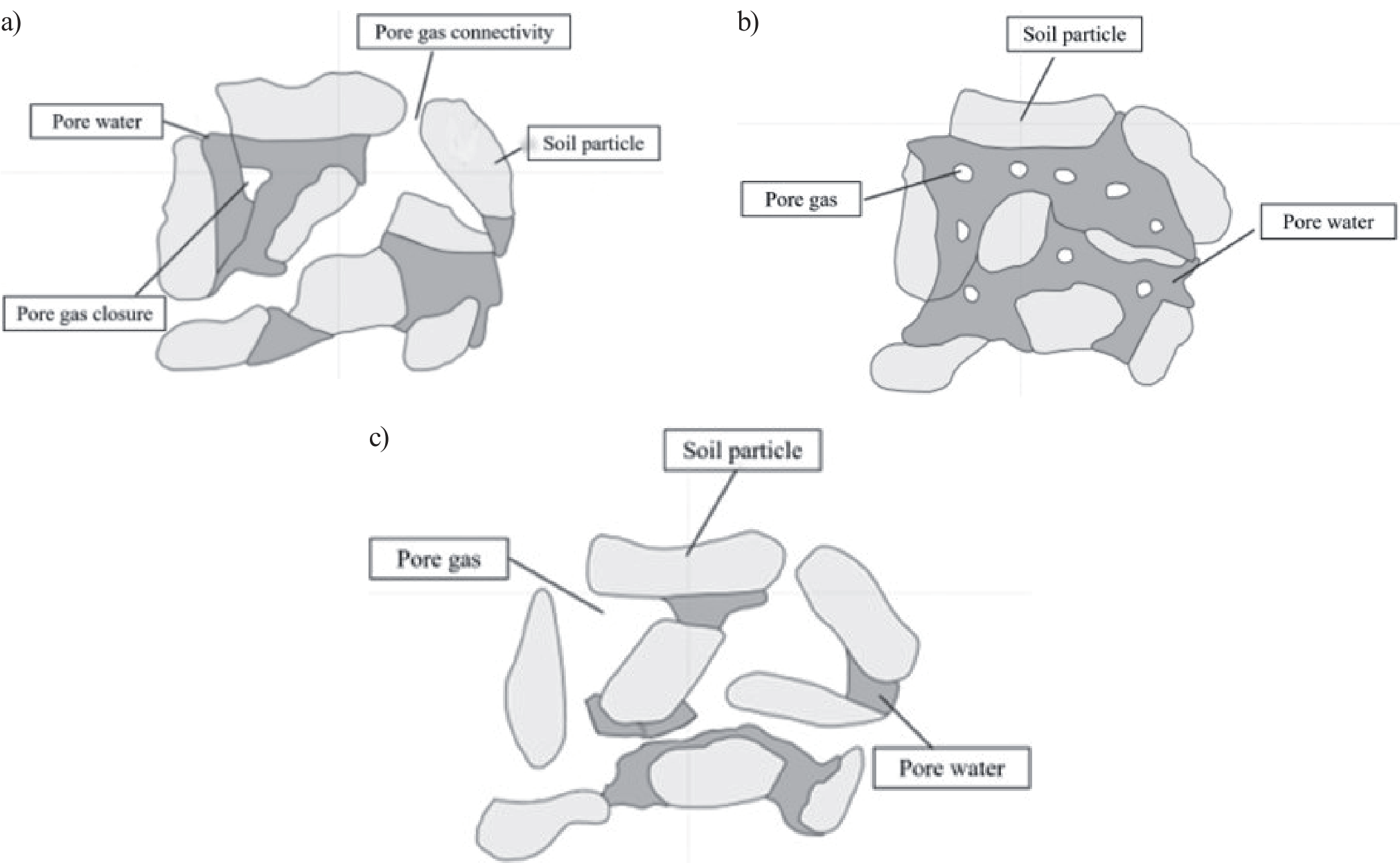
With the promotion of the new era of Western Development and the strategy of “Build China’s Strength in Transportation”, the construction of railways, highways, airports, and other types of projects is gradually expanding from the plains and hills to the highlands and mountainous areas, especially in the high mountainous and extremely high mountainous areas of the Qinghai-Tibet Plateau and the Yunnan-Guizhou Plateau [1-3]. This type of area in the Quaternary Pleistocene period, through several glacial and interglacial period alternations, the end of the interglacial period glacial meltwater amount decreased, carrying capacity is weakened, the formation of fine-grained clay soil layer, and the accumulation of gravelly soils, block gravel soils during the water-abundant period in the form of layers of alternating distribution, by the influence of the dry and warm river valley climate, this type of area is low in rainfall, the soil body is dry, and in a long-term state of non-saturation [4, 5]. When these unsaturated ice-water- deposited clay soils are used as foundation soils, often cause foundation settlement, slope instability, and other engineering problems due to an insufficient foundation-bearing capacity. The Lijiang to Shangri-La Railway, which passes through the snow-covered plateau region in the middle of the Heng-Duan Mountains at the south-east edge of the Qinghai-Tibet Plateau, is built on the upper Pleistocene hard-plasticized ice-water deposited clay soils (Q3fgl) along the line, the unsaturated bearing capacity was not clearly explained during the selection of the parameters at the design stage. In the line design stage, the selection of the roadbed section and the foundation treatment program selection were affected [6]. Leshan-Ya’an Expressway along the distribution of complex engineering properties of ice and water deposition accumulation of soil, accumulation of soil in the lower part of the clay, due to the majority of sections belong to the high-fill roadbed and fill material for local materials, as the filler of the ice and water deposition of clay soil in a long-term non-saturated state, by the distribution of pore space, non-saturated soil in the pore microscopic connectivity characteristics of the different (Fig. 1), resulting in the difference between the pore water, air transport characteristics, and thus causing its bearing capacity is seriously insufficient. This results in a serious lack of bearing capacity, which has an important impact on the settlement of the roadbed and the stability of the high-fill roadbed slopes [7]. KangDing Airport in GanZi, Sichuan Province, is a high plateau-airport. During the investigation and design stage, because the foundation soil of the airport track area contains part of ice-water cohesive clay soil and is unsaturated state, due to the lack of understanding of the drainage characteristics and the bearing capacity parameters of the ice-water deposited cohesive soils when it is unsaturated state at that time, it resulted in several remedial repairs to the foundation during the operation and maintenance stage [8]. Therefore, an accurate interpretation of the bearing capacity of unsaturated ice-water deposited clay soils has important theoretical value for the construction operation and maintenance of actual projects. At the same time, according to the engineering practice, these three methods are often selected to carry out the planning and design of airport engineering in the actual project, but there is still a lack of relevant comparative studies on the suitability of these three methods. Therefore, this paper chooses these three methods to compare, in order to find a reasonable research method for the specific soil research. This research is of great significance to the design and construction of airport engineering, especially the high-altitude airport engineering. The comparative study of the three methods is also very reasonable for practical engineering.
Material and Methods
Related Theories
In all kinds of projects, the bearing capacity and settlement deformation of foundation soil involves the bearing capacity of the foundation soil, which depends on the strength of the soil itself. The fragmentation and multiphase nature of the soil body and the variability formed in the long-term geological history make its strength characteristics show a special nature different from that of other materials [9]. The damage to the soil body is mainly shear damage, and what determines its shear strength is often the cohesion and friction between soil particles. When unsaturated soils are used as foundation soils for various types of projects, matrix suction is generated at the shrinkage film inside the unsaturated soil unit under external loading. The presence of matrix suction makes the bearing characteristics of unsaturated foundation soils quite different from those of conventional saturated soils. A large number of studies have shown that in unsaturated soils, due to the presence of pore gas, which in turn generates the corresponding matrix suction, additional suction friction is generated in the soil, resulting in an unusually complex analysis of the strength characteristics of unsaturated soils [10].
The research in the area of strength characterization of unsaturated soils taking into account matrix suction began in the 1950’s. In 1959, Bishop proposed an effective stress formula for unsaturated soils,
Where, σʹ is the effective stress of the unsaturated soil, σ is the total stress, ua is the pore gas pressure, s is the matrix suction (s = ua–uw), uw is the pore water pressure, and x is the parameter related to the degree of saturation.
In 1961, the effective stress formula was proposed at the Colloquium on Pore Pressure and Suction in Soils held in England:
Where, p* is the pore water pressure difference; φ is the parameter.
Jennings (1961) [11] proposed to utilize the following equation to express the effective stress formula for unsaturated soils:
Where p** is the negative pore water pressure; β is a statistical coefficient reflecting the contact area between grains, which can be determined by test.
The above three formulas are most widely used with Bishop’s effective stress formula, and they have in common the use of a single strain-effective stress to analyze the strength and deformation of unsaturated soils. However, Jennings and Burland (1961) [12] pointed out that Equation (3) could not explain the phenomenon of wetting and deformation of unsaturated soil by water immersion. Fredlund et al. considered the effects of net stress (σ–ua ) and matric suction (s = ua–uw) separately in unsaturated mechanics and proposed the following bivariate strength equations for unsaturated soils:
Fig. 1.
Three states of connectivity within unsaturated soils. a) Completely closed state of the gas phase; b) Partially contact state of the gas phase; c) Fully connected state of the gas phase.
Where c' is the effective cohesion, tan ϕ is the effective internal friction coefficient for net normal stress, and tan ϕb is the effective internal friction coefficient for matrix suction.
According to Fredlund’s double stress variable theory, scholars have proposed related unsaturated soil constitutive models, and Spanish scholars Alonso et al. (1990) first proposed an elastoplastic constitutive model for unsaturated soils to describe the basic mechanical properties of unsaturated soils, and the most important part of this model is that it can predict the wetting deformation of unsaturated soils. Sundan et al. (2000) [13] verified this model through laboratory tests and proposed a three-dimensional elastic-plastic model for unsaturated soils. In recent years, many scholars have obtained many theoretical models on the strength characteristics of unsaturated soils through different laboratory tests and theoretical analyses: Zhao Yuxin et al. [14] studied the laws of cohesion, internal friction angle, and shear expansion angle of unsaturated soils with the saturation degree in the existing literature, and obtained an evolution model considering the shear strength indexes of unsaturated soils in a wide range of saturation degrees. Hu Xiaorong et al. [15] combined the principle of generalized effective stress for unsaturated soils with the three-shear strength criterion and proposed a three-shear strength criterion for generalized effective stress for unsaturated soils.
Although there are many theoretical analysis models, in actual engineering, unsaturated soils are strongly influenced by the actual engineering environment, the same kind of soil in different engineering environments may show different bearing capacity characteristics, and the bearing capacity characteristics of the soil are a comprehensive reflection in the complex engineering environment. Therefore, the theoretical analysis should be combined with the relevant field test and laboratory test results for comparison, and then arrive at the final bearing capacity index of the corresponding unsaturated soil body. At present, a large number of scholars at home and abroad have given their suggestions for the determination method of bearing capacity of unsaturated clay soil. In summary, there are three main determination methods: standard penetration test, laboratory test and static probe test, but the applicability of each method varies for specific soils. For the Neoproterozoic Upper Neogene semimorphic clay soils in Baoji area, especially in the diffuse beach and terrace fabric on the north and south sides of Weihe River, it is suggested to be safe and reliable when the characteristic value of foundation bearing capacity is 500 kPa through the relevant experimental research [16]. Zihao Zhang analyzed the method of taking the characteristic value of bearing capacity of soft clay soil in Hangzhou by studying the relationship between the microstructural characteristics of the soil and the macroscopic mechanical properties [17]. Wang Xiaofeng Using the survey data of Hulushan Bay sea area, Changxing Island, Dalian, the main physical indexes of 742 groups of clay soils were correlated and analyzed with the comparative data of bearing capacity, and the method of evaluating the characteristic value of the bearing capacity in the actual survey work was proposed [18].
Table 1.
Basic physical parameters.
In view of this, this paper takes an unsaturated clay soil of a highland airport in the mountainous area of southwest China as the research object, and for the deep clay soil appearing in this range, three methods of standard penetration test, laboratory test, and static probe test are adopted to determine its bearing capacity, and the bearing capacity determined by the three methods are compared and studied, to select the optimal method suitable for determining the bearing capacity of unsaturated clay soil of a highland airport.
Results and Discussion
Standard Penetration Test
The representative standard penetration test data of this section were selected for analysis, and to compare with the other two methods, the data were selected from soil samples with a depth of about 6~7 m for analysis, and a total of 22 groups were selected. The test data are shown in Table 2.
Referring to the relevant industry standard: When the standard value of foundation bearing capacity is determined according to the standard penetration test hammer blow number N, the field test hammer blow number shall be corrected by the following formula to take the N value to the nearest whole digit,
Where u stands for the average number of hits in the number of holes after correction for rod length; the calculation is corrected for rod length according to the method of the Engineering Geology Manual, and the correction factor is shown in Table 3. The σ stands for the standard deviation, and the interpolation calculations were then performed according to Table 4.
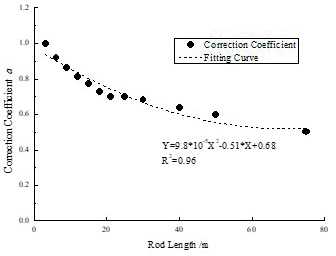
From Table 3, it can be seen that there is a relationship between the rod length correction coefficient and the rod length as shown in Fig. 3.
According to the relationship curve in Fig. 3, the corrected number of strikes at each test point can be obtained. According to the above specification method, according to the requirements of Table 4 (relevant parameters stipulated by national industry standards), the characteristic value of the bearing capacity of the cohesive soil body in this section obtained according to the standard penetration test can be interpolated and calculated as 179.18 kPa, and the results of the calculation are shown in Table 5.
Table 2.
Standard penetration test data.
Table 3.
Standard penetration test rod length correction factor.
| Rod Length (m) | ≤3 | 6 | 9 | 12 | 15 | 18 | 21 | 25 | 30 | 40 | 50 | 75 |
|---|---|---|---|---|---|---|---|---|---|---|---|---|
| α | 1.00 | 0.92 | 0.86 | 0.81 | 0.77 | 0.73 | 0.70 | 0.70 | 0.68 | 0.64 | 0.60 | 0.50 |
Table 4.
The standard value of bearing capacity for cohesive soil.
| N | 3 | 5 | 7 | 9 | 11 | 13 | 15 | 17 | 19 | 21 | 23 |
|---|---|---|---|---|---|---|---|---|---|---|---|
| fk(kPa) | 105 | 145 | 190 | 235 | 280 | 325 | 370 | 430 | 515 | 600 | 680 |
Laboratory Test
When analyzing according to this method, due to the concentration of the laboratory test data for each parameter, four representative groups of data were selected for analysis, and the raw data are shown in Table 6.
Referring to the relevant industry codes, when determining the standard value of foundation bearing capacity based on the average value of physical and mechanical indexes of the soil obtained from laboratory tests, the basic value of bearing capacity in the codes shall be multiplied by the regression correction factor by the following provisions:
Regression correction factors, as specified in the relevant industry codes, i.e., Equation (6).
Where Ψf: - regression correction coefficient.
n-Number of participating statistics for the soil indicators on which the tables are based.
δ-Coefficient of variation.
The results of the data analysis calculations are shown in Table 7.
According to the calculation results in Table 7, it is possible to analyze the pore ratio and liquidity index as two indicators for the evaluation of the bearing capacity of clay soils (Table 8).
Referring to Table 8, taking the pore ratio e = 1.15 and IL = 0.08, it can be interpolated to obtain that the bearing capacity of the clay soil under study is 187.2 kPa.
Table 6.
Basic physical parameters of cohesive soil.
Table 7.
Experimental data processing calculation results.
Table 8.
Basic value of bearing capacity of cohesive soil (kPa).
Table 9.
Static cone penetration tests data.
Static Cone Penetration Test
By the field static cone penetration tests, the resulting data for the cohesive foundation soils in this section are shown in Table 9.
According to Table 9, it can be concluded that the average value of the bearing capacity of the cohesive foundation soil according to the static cone penetration test is 214.19 kPa.
The results of the three test methods are compared in Table 10.
As can be seen from Table 10, among the three test methods, the bearing capacity value determined by the static cone penetration test method is the largest, the bearing capacity determined by the laboratory test method is the second largest, and the bearing capacity value determined by the standardized penetration test method is the smallest. Among them, the bearing capacity values determined by the standardized penetration test method and the laboratory test method are close to each other, but the values determined by the laboratory test method are slightly larger than those determined by the standardized penetration test method, which is because that the laboratory test is often a process of taking samples from the field and then sending them to the test laboratory, where the moisture content of the soil, dry density, etc., changes, which in turn results in a larger value of the tested bearing capacity, while the standardized penetration test is an instantaneous on-site test. But even so, as can be seen from Table 10, the difference does not exceed 5%, indicating that the values determined by these two methods can be used as the recommended values for foundation bearing capacity of unsaturated cohesive soils for high plateau airports. From Table 10, it can be seen that the difference between the static cone penetration test method over the other two methods is greater than 5%, which indicates that for the soil samples under study, this method is not recommended as a bearing capacity analysis when the test data are analyzed mathematically and statistically.
Conclusions
For the unsaturated clay soils occurring in the high plateau airports in the mountainous areas of southwest China, three methods of standard penetration test, laboratory test and static cone penetration test were used to determine their bearing capacity, and the bearing capacity determined by the three methods were compared and studied, and the following conclusions were obtained:
(1) Among the three test methods, the maximum value of bearing capacity was determined by the static cone penetration test method, followed by the laboratory test method, and the minimum value of bearing capacity was determined by the standard penetration test method. The bearing capacity values determined by the standard penetration test method and the laboratory test method are close to each other, but the value determined by the laboratory test method is slightly larger than that of the standard penetration test method.
(2) For the studied soil, it is recommended that the bearing capacity be determined by the standard penetration test method and the laboratory test method rather than the static cone penetration test method.

