
Introduction
More than 10% of people worldwide suffer from stomach ulcers (GU), a serious health condition that results in a severe lesion of the stomach lining when the thick mucus layer is reduced [1]. Proton pump inhibitors are an important group of drugs used to treat and prevent stomach ulcers. However, these drugs can cause constipation, headache, dizziness, skin rashes and stomach pain from time to time in their short-term use. In addition, other side effects, such as hepatotoxicity and enteric infections, may occur with long-term use of these drugs [2]. Therefore, this research is focused on the aim of discovering an alternative natural product for the treatment of this disease. With natural treatments using different herbs such as pomegranate peel (PP), stomach ulcers can be prevented or treated with fewer or no side effects.
Nowadays, the worldwide availability of pomegranate peel, a by-product of the fruit and vegetable processing industry, encourages its use as a new source of bioactive molecules [3]. Natural antioxidants obtained from agricultural wastes have attracted economic and health attention due to their long-term viability, safer food practices and beneficial components. In addition, the peel and seeds of the pomegranate fruit, which is typically considered a waste by-product, can be processed to create value-added products with industrial, medicinal and cosmetic value [4].
With the addition of increasing new evidence in the literature, pomegranate fruit treats acute and/or chronic wounds such as surgery incision, excision, burn, oral lichen planus, gingival, aphthous stomatitis, diabetic wounds and stomach ulcers as better as compared to existing drugs. The conventional drugs used in the treatment of diseases, e.g., antibiotics and corticosteroids cause serious side effects. In contrast, research on pomegranate reveals that pomegranate can be considered as an alternative, safe, multifunctional, wound-healing by-product [5]. Heber [6] demonstrates that PPE contains more than 100 different compounds, and many of the molecules are involved in the antioxidant activity caused by the extracts. Nonetheless, numerous variables such as harvesting season, soil composition, and used solvent in the extraction step might impact the chemical composition and, thereby, the biological effect of it. The main class of compounds in pomegranate was reported as polyphenols, including flavonoids (anthocyanins, 0.2 to 1.0% of the fruit), condensed tannins (proanthocyanidins), and hydrolyzable tannins (ellagitannins and gallotannins) [7]. The PP contains about 30% of all anthocyanidins that are present. Also, pomegranate by-products have drawn attention since it has been discovered that they contain significant levels of polyphenols such as ellagitannins, ellagic acid, ellagitannins, catechins, gallotannins, anthocyanins, quercetins, ferulic acids, alkaloids, glycosides, punicalagin, and gallic acid [8]. In addition, it has been shown to have antimicrobial, antiviral, antioxidant, anti-inflammatory, apoptosis in leukemia cells, anticancer, antidiabetic, antidiarrheal, antiproliferative, and immunomodulatory properties both in vivo and in vitro [9]. The PPE, which is rich in phenolic derivatives, has recently been demonstrated to be a potent nephroprotective agent that inhibits CCl4-induced nephrotoxicity in rodents [10]. These polyphenols have antioxidant effects that can scavenge free radicals and efficiently prevent the oxidation of lipids. Furthermore, research on animals has demonstrated that PPE is not hazardous [11]. Anti-inflammatory [12] and anti-cancer [13] effects of PPE have also been demonstrated.
Unfortunately, a few studies have focused on in silico and molecular dynamic studies of PPE’s. One of those was reported by Khairujjaman et al. [14], who conducted an in silico examination of the inhibitory potential of the components of pomegranate juice on antioxidant protection mechanisms against neurodegenerative diseases. Furthermore, a recent study demonstrates an in vitro and in silico analysis of Pomegranate fruit extract as pancreatic lipase and α-amylase inhibitor [15]. Most of the research on PP was only reported on their antioxidant and anti-inflammatory components in the extracts of PPE’s. Thus, the present study aims to evaluate the phytochemical composition of PPME using LC/HRMS and to characterize its mineral composition by ICP-AES, evaluate its antioxidant capacity of it, and the potential protective role of methanolic extract of pomegranate peel (PPME) against GU through in silico study.
Material and Methods
Plant Material and Chemicals
Pomegranate fruits were purchased from local markets in Hail, Kingdom of Saudi Arabia, in September 2021. After extracting the pomegranate juices, the pomegranate peels were collected and washed with distilled water. Then they were dried in the shade at room temperature and powdered by using a mill. All chemicals and solvents used in experimental processes are of analytical grade purity.
Table 1.
Phytochemical characterization of methanolic extract of pomegranate (P. granatum L.) peels. BHT: Butylated hydroxytoluene, AA: Ascorbic Acid. BHT and AA were used as positive controls. All analyses were carried out in triplicate.
Phytochemical Profile of PPME
Phytochemical Analysis
The PPME was qualitatively tested for the presence of polyphenols, flavonoids, and tannins using a Cary 60 UV-Vis spectrophotometer (Agilent Technologies, USA). by following the protocol described by Dewanto et al. [16].
Reducing Power Assay
The reducing power was evaluated based on the formerly reported method in the literature [17]. For this, increased concentrations of PP extract (100, 200, 500, 750, and 1000 µg/mL) were mixed with 2.5 mL of sodium phosphate buffer (pH 6.6) and 2.5 mL of potassium ferricyanide at 164.5 mg (200 mmol/L) and 1%, respectively. After shaking, the mixture was incubated at 50ºC for 20 min. Then, 2.5 mL of trichloroacetic acid (10%) was added to the solution. The mixture vortexed for 20 seconds, then centrifuged for 8 min at 1000 rpm. Finally, distilled water (2.5 mL) and 1% ferric chloride (0.5 mL) was added to the vessel. The absorbance of each sample was measured spectrophotometrically at 700 nm and IC 50 value of the extract was determined.
Antiradical Activity Against DPPH
The total radical scavenging capacity of PPME was determined by using 2, 2-diphenyl-1-picrylhydrazyl (DPPH) method [18]. Ascorbic acid was used as a positive control in the assay. The DPPH solution was mixed in the range of 1, 10, 100, and 200 g/mL of the PPME extract. Following the recording of DO values at 515 nm, spectrophotometrically, IC 50 was calculated from the graph.
Inductively Coupled Plasma (ICP) Spectroscopy PPE Analysis
Utilizing an Anton Paar Monowave 50 microwave synthesis reactor, a process for microwave-assisted digestion was performed. 6 mL of pure HNO3 were used to treat aliquots of 0.5 g of each sample in a jar made of borosilicate glass (Reaction Vial G10). The leftover solution was diluted up to 100 g for the solutions tested by ICP atomic emission spectrometry after reactors were opened to remove nitrous gases and cooled to room temperature (ICP-AES). No solid remains were found in any case, and the digestion was complete. Before the sample treatment, glass containers were adequately cleaned with nitric acid to prevent cross-contamination. The ICP-AES data results are expressed in µg per gram (or ppm) dry weight.
Identification of Bioactive by High Resolution-Liquid Chromatography-Mass Spectroscopy
Agilent 324 Technologies®, USA’s UHPLC-PDA-Detector 323 Mass Spectrophotometer (HR-LCMS 1290 Infinity UHPLC System), was used to evaluate the phytochemical analysis. The HiP sampler, binary gradient solvent pump, column compartment, and quadrupole time of flight mass spectrometer (MS Q-TOF) with twin Agilent Jet Stream Electrospray (AJS ES) ion sources made comprised the liquid chromatographic system. The system received 10 µL of material, separated in an SB-C18 column (2.1x50 mm, 1.8-particle size; Agilent Technologies, Santa Clara, CA, USA). Acetonitrile and 1% formic acid in deionized water were utilized as solvents A and B, respectively. A 0.350 mL/min flow rate and MS Q-TOF were used for MS detection. Utilizing mass spectra and distinctive mass fragmentation patterns, compounds were discovered. Compound Discoverer 2.1, ChemSpider, and PubChem were used as primary tools to identify the phytochemical components of the PPME [19]. In accordance with Arunachalam et al. [20], a qualitative phytochemical investigation of the prepared P. granatum L peel methanolic extract was conducted using conventional methods. The outcomes were qualitatively expressed by using either positive (+) or negative ionization mode.
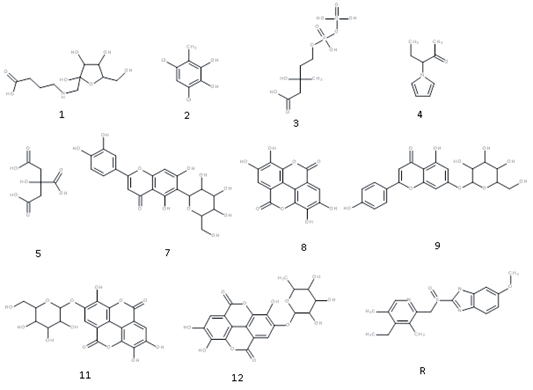
Fig. 1.
Chemical structures of the identified compounds from pomegranate fruit peel (1, 2, 3, 4, 5, 6, 7, 8, 9, 11, 12) and esomeprazole. The numbers are the same as listed in Table 3
In Silico Pharmacokinetic Analyses
The bioavailability of the pomegranate fruit peel-identified compounds was assessed based on their physicochemical structures as described by Badraoui et al. [21]. In addition, the druggability and pharmacokinetics of these phytochemicals were also evaluated based on the ADMET (for absorption, distribution, metabolism, elimination, and toxicity) attributes as previously reported [21].
Results
Total Polyphenol, Flavonoid, and Tannins Contents And Antioxidant Properties
Table 1 summarizes all the obtained results concerning the analysis of total polyphenol, flavonoid, and condensed tannins contents of the PPME. The total phenol, flavonoid, and tannin contents were determined as 211.43±1.25 mg GAE/g extract, 20.7±1.88 mg QE/g extract, and 11.5±1.02 mg TAE/g extract, respectively.
The reducing power and the DPPH methods were used to determine the antioxidant capacity of PPME. The reducing power of ASE increased with the concentration of the extract (IC50 = 0.45±0.02). The reducing power was reported to be concomitant with the antioxidant activity.
Inductively Coupled Plasma (ICP) Spectroscopy PPE Analysis
Sample preparation was carried out by using a microwave-assisted digestion system for the elemental composition analysis. Then concentrations of 20 different elements (Ag, Al, As, Ba, Be, Cd, Co, Cr, Cu, Fe, Mn, Mo, Ni, Pb, Sb, Se, Sr, Ti, V, Zn) were determined using the ICP-AES technique. The results were summarized in Table S1 (Supplementary data). As a result of the measurements, the concentrations of strontium (37.96 ppm) and Iron (10.43 ppm) were the two most prevalent minerals in PPE studied. In addition, trace amounts of Zinc (0.75 ppm) were determined in PPME.
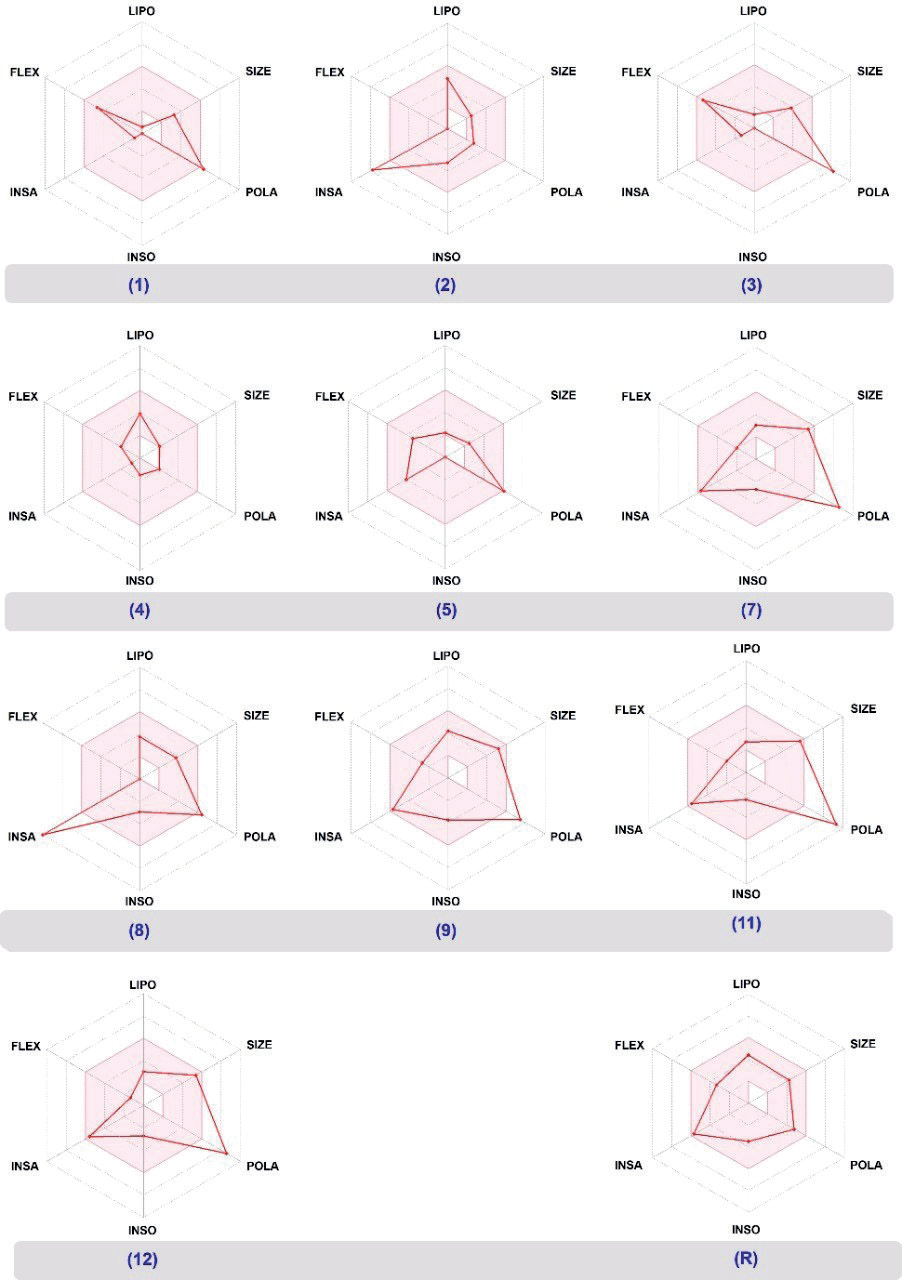
Fig. 2.
Bioavailability hexagons of the major identified phytochemicals in the pomegranate fruit peel and esomeprazole as a reference drug (R). POLA: polarity, SIZE: molecular size, LIPO: lipophilicity, INSO: insolubility, INSA: instauration and FLEX: flexibility. The numbers are the same as listed in Table 3.
PPME Phytochemical Composition by High Resolution-Liquid Chromatography-Mass Spectroscopy HR-LC/MS
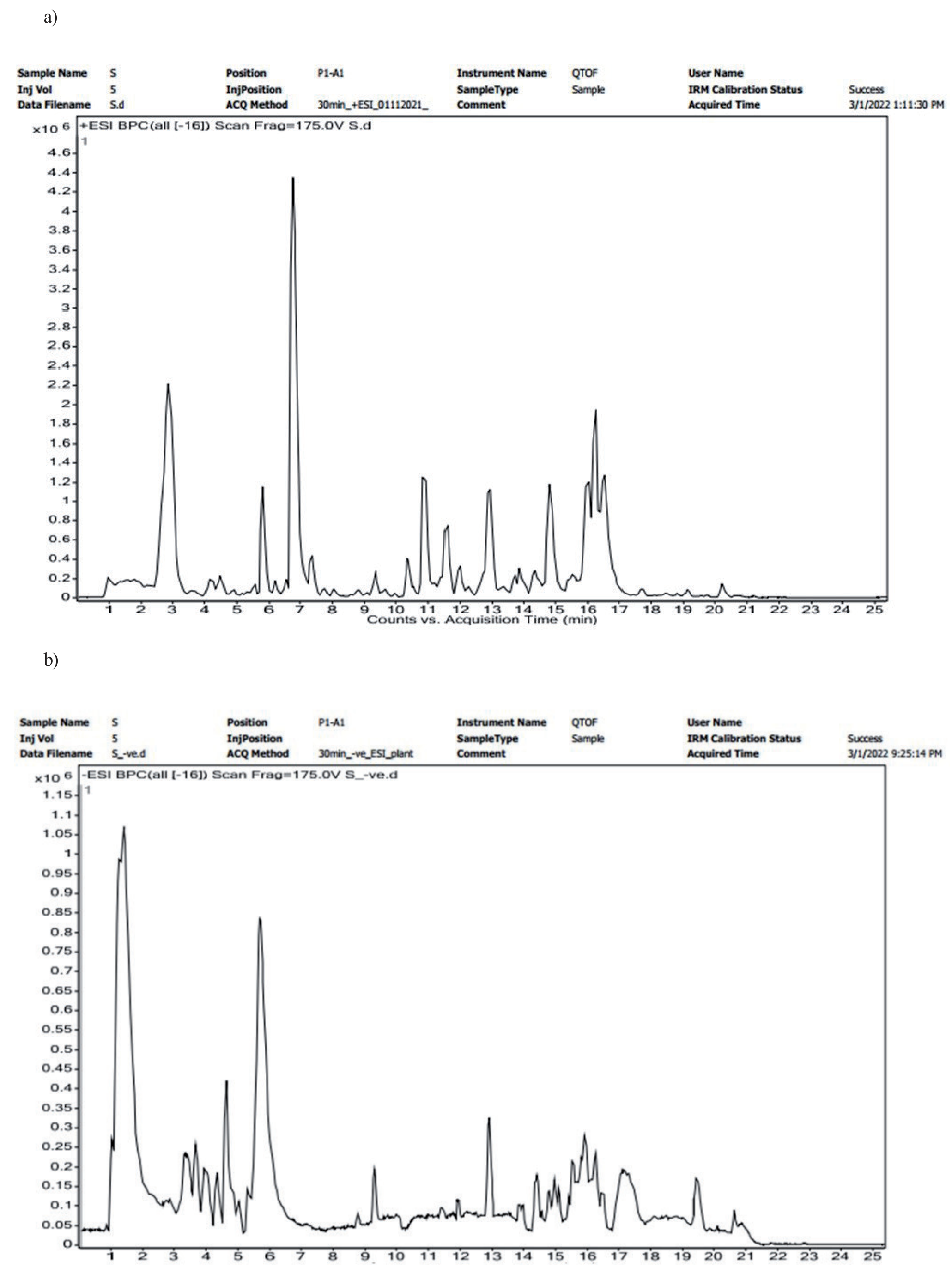
The structural determination of phytochemicals in PPME was carried out using LC/HRMS. This technique allows us to separate and identify the phytochemicals based on their retention time, experimental m/z, MS/MS fragments, metabolite class, and proposed compounds in the database of compound discovery software. In addition, both negative and positive ionization mode MS data were reported. Fig. S1 summarizes the MS chromatograms of the PPME for the positive (A) and negative (B) ion phases (Supplementary data). The total ion chromatogram (TIC) (dark line in Fig. S1) displays how the intensity variation’s cumulative values changed over time. The analyte is typically fragmented to acquire information beyond the molecule mass, and the following step involves using tandem MS data to search the database of molecular structures [22]. This research meticulously annotates features with MS and MS/MS information based on databases and references. Furthermore, comparisons of standards with m/z and retention time were imported for further identification to have a more trustworthy proof for some dominant compounds.
Table 2.
Phytochemical composition of the methanolic extract of PPME using High Resolution-Liquid Chromatography-Mass Spectroscopy HR-LC/MS.
By comparison of the spectral data of the extract with that of well-known substances, 35 phytochemicals in all were identified (Table 2) in PPME. The most commonly observed m/z values were found to be between 190 and 642 in the extract. In addition, 16 compounds were found unknown, and they need further investigation to accomplish their identification. The HP-LC/MS chromatogram obtained in positive ion mode showed the presence of metabolites different from those recorded in the negative ion mode (Fig.s S1A and S1B, Supplementary data). In addition, some compounds were present in both negative and positive modes.
The identified compounds in PPME are as follows: seven terpenoids (Ganoderic acid H, Lucidenic acid M, 7’,8’-Dihydro-8’-hydroxycitraniaxanthin, 12alpha-Hydroxyamoorstatin, cis-p Coumaroylcorosolic acid, Nigakilactone B, Schleicherastatin 6), 3 flavonoids (6-C-Galactosylluteolin, Apigenin 7-glucoside, Poncirin), three steroids (Stenocereol, (3a,5b,7a,12a)-24- [(carboxymethyl)amino]-1,12-dihydroxy-24-oxocholan- 3-yl-b-D Glucopyranosiduronic a, Solanocapsine), one phenol (4,6-Dichloro-3-methyl catechol), one terpene (3’-Hydroxy-T2 Toxin), one Quinone and hydroquinones (2,3-Epoxyphylloquinone), one lactone (Mycinamicin VII), one Vitamin (α2-Tocopherol), one alcohol (23-Acetoxysoladulcidine), one Sugar(D-1-[(3-Carboxypropyl)amino]-1 deoxyglucose), one Carboxylic Acids (Mevalonic acid 5-pyrophosphate), one Amino acid (3-(1-Pyrrolidinyl)-2-pentanone), one glycoside ((1x,2x)-Guaiacylglycerol 2-glucoside), one oxime (3-Oxopregn-4-ene-20beta-carboxaldehyde dioxime). All the above data underlined the presence of a wide variety of compounds in pomegranate peel (Fig. 1).
In Silico Findings: Bioavailability, Druggability, and Pharmacokinetics
The physicochemical properties, druggability, and pharmacokinetic analyses are given in Table 3. While compounds 7, 11, and 12 did not meet the Lipinski rule of five, all the others satisfactorily followed this rule in all respects. The plant compounds also associated acceptable bioavailability scores, ranging between 0.11 and 0.55 (Fig. 2). Furthermore, the bioavailability polygons, which are reported in Table 3, further supported these values. The identified compounds exhibited low to moderate skin permeation, assessed using Log Kp values ranging between –5.47 and –11.08 cm/s. The identified compounds also presented low to high gastrointestinal (GI) absorption. Moreover, only compounds 2 and 4 were predicted to permeate the blood-brain barrier (BBB) (Table 3 and Fig. 3). The possibility of being a substrate of P-glycoprotein (P-gp) was also assessed. It has been found that compound 9 behaved as a P-gp substrate. Our results showed that none of the compounds inhibited the various assessed cytochrome P450 (CYP1A2, CYP2C9, CYP2C19, CYP2D6, and CYP3A4).
Discussion
Currently, the use of natural antioxidants from agricultural residues such as plant origin (resources that are plentiful, affordable, sustainable, and eco-friendly) are considered a substitute, low-cost source of natural by-products mainly when used to treat and prevent some diseases and has been preferred globally by consumers than using synthesized toxic antioxidants with undesirable side effects and health risk [23].
The consumption of pomegranate fruits and/or juice has a significant health benefit and has attracted much scientific attention [24]. According to numerous studies, PEE, manufactured from a waste product of processing companies, has a powerful antioxidant and free radical-scavenging capacity [25]. Therefore, low-cost agri-waste, such as PP derivatives, is considered a rich source of natural polyphenolic and flavonoid molecules (more than in the other parts of pomegranate trees) and is regarded as an encouraging source of natural antioxidants.
Total Polyphenol, Flavonoid, and Tannins Contents and Antioxidant Properties
In order to determine the antioxidant capacities of PPME, DPPH and FRAP, assays were used. In addition, total polyphenols, flavonoids, and tannins content were determined. Several studies used many solvents, such as methanol, acetone, and water, to extract antioxidants from PP and demonstrated that methanol provided the highest yields of antioxidants [26]. According to earlier research [27], ellagic acid, one of the main determined compounds in PPE, is highly soluble in organic solvents like ethanol and methanol. The current study’s findings are consistent with the antioxidant properties of PPs described in the literature from various countries. Similar work using PPME has demonstrated the most potent antioxidant activity across several ranges of polar and nonpolar extracts [28]. In reality, the donation of a hydrogen atom by reductones allows them to stop the chain reaction of free radicals. Its reducing power is a significant predictor of a compound’s potential antioxidant activity. In a redox-linked colorimetric process involving a single electron transfer, the FRAP assay indicates an antioxidant’s capacity to reduce ferric (III) to ferrous (II) [18]. PPME has demonstrated significant antioxidant activity in prior investigations [18, 26].
When polyphenols are used, reactive oxygen species (ROS) can be eliminated or reduced from forming. Superoxide radicals, hydrogen peroxide, and hydroxyl free radicals are examples of ROS that are produced during cellular metabolic processes or as a result of exposure to ionizing radiation. They may have harmful effects by causing damage to the DNA, RNA, and proteins [29]. Pomegranate peels contain polyphenols that can be isolated and used as natural antioxidants in the food industry to prevent food oxidation and maintain the quality of food products [30]. Their phytochemical composition can significantly influence the biological activity of extracts from pomegranates. Stronger antioxidant activity, for instance, was associated with Ellagic Acid and Ellagic Acid derivatives, a type of pomegranate polyphenols.
Mineral Characterization of PPME Using Inductively Coupled Plasma (ICP) Spectroscopy
Characterization of PPE demonstrates that it is a good source of minerals [31]. Table S1 summarizes the mineral analysis of PPE. The strontium concentration was found to be the highest (37.96 ppm) as compared to all the other minerals content, followed by Iron (10.43 ppm) and Zinc (0.75 ppm). Unfortunately, few studies were conducted on strontium analysis and its effect. However, recent research by Dresler et al. [32] revealed that the interaction of strontium and secondary metabolites in soybeans could aid in the development of a natural pharmaceutical product that contains both strontium and phytoestrogens for the treatment of postmenopausal osteoporosis.
A previous study by Ullah et al. [33] showed that potassium was the main mineral detected in PPE, followed by sodium and iron. In addition to the aforementioned elemets, zinc was detected as a trace element in our result. However, in another recent study by Omer et al. [34], zinc, manganese, copper, iron, and selenium were detected in PPE. pomegranate juice is characterized by its richness in minerals [35]. Similarly, PPE and seeds are good sources of minerals [36].
Therefore, it can be concluded from the present findings that in addition to their richness of polyphenols, PPE was distinguished by their richness in strontium, iron, and zinc and that they are considered a good source of micronutrients.
Phytochemical Composition of PPME by Liquid Chromatography - High Resolution Mass Spectroscopy
One of the most studied aspects of pomegranate peels was their phenolic composition, and variations were found in the references used for compound annotation or identification. For example, Man et al. [37] identified 64 phytochemicals using UHPLC-QTOF/MS. The main class of compounds were reported as flavonoids (50 molecules), tannins (10 hydrolyzable), and phenolic acids (4 molecules). In that study, 21 flavonoids were characterized for the first time. Likewise, from Egyptian pomegranate peels, 43 phenolic molecules were characterized by HPLC [25] and, from Chinese PPE 50 phenolic molecules were identified by using an HPLC-QTOF-MS method [38].
Hereof, the last research teams and ours do not find the same number of compounds and the same compositions in PPE. The techniques used definitely influence the determined chemical composition of each extract. Co-elution may be a problem when using HPLC alone for identification due to the lack of molecular weight of the compounds. Additionally, it is challenging to create a library of standards that includes all discovered chemicals. HPLC only improves the separation of the compounds, particularly if the chemicals co-elute; however, LC-MS at the same time can determine the m/z ratio of the ions as well [39].
Many researchers characterized PP and showed that polyphenols, flavonoids, and other compound classes are the most dominant chemicals in it [40]. The main compounds in PP were reported as ellagitannins, punicalin, punicalagin, and ellagic acid [41].
By using LC/HRMS, the phenolic, flavonoid, and condensed tannin concentration of PPME was assessed. Ellagitannins were defined as the predominant class of phenolic compounds in pomegranate peel and marc, a by-product made up of seeds and peels [42]. Additionally, the main ellagitannins present in both pomegranate by-products and pomegranate products (fruit and juice) are punicalagins [43].
The characterized polyphenols from the PPME were reported in Table 2. The main components of it were determined as 4,6-Dichloro-3-methyl catechol, Punicalagin derivative, 6-C-Galactosylluteolin, Ellagic Acid, Apigenin 7-glucoside, Galloyl-HHDP-hex, Ellagic acid hexoside, Ellagic acid rhamnoside, Dehydro-gallolyl-HHDP-hexoide. This component could explain the observed antioxidant capacity [7, 13, 26].
PPME was found as a strong antioxidant in both DPPH and FRAP scavenging experiments due to the phenolic compounds it has as reported in the literature, the antioxidant activity is caused by rich polyphenolic substances in the extract [26]. According to the findings of this study, the presence of a significant amount of polyphenol and flavonoids (211.43±1.25 mg GAE/g extra/g and 20.7±1.88 mg QE/g) was determined. Our data agreed with the formerly reported data [18, 26]. Flavonoid concentration of pomegranate peel extracts (g QE/mg of dry extract) were reported in the range of 11.50.54 to 53.851.95 by Orak et al. [43], in agreement with our results herein. In another report, while the highest tannin content was found by using water and methanol (50:50) solvent systems, the lowest yield was obtained by using an aqueous extract, 6.390.28 mg CE/g, and 2.220.14 mg CE/g, respectively [44]. Similarly, Çam and Hișil reported that the yield of the detected compounds increased 3 times in the methanol extract [45]. A study conducted on Tunisian pomegranate peels also demonstrated that the antioxidant activities of the extracts were correlated with total phenols, tannins, and flavonoids contents of it too [31].
Mounting body of evidence have suggested the phytochemical composition of PPE. Numerous studies have reported different phytochemical components. The possible reasons for this difference is the use of different mass spectrometer techniques and analyzers, as well as factors such as climate and soil type where pomegranate fruits grow [46-48].
Compound 1: (D-1-[(3-Carboxypropyl)amino]- 1-deoxyglucose), amino fructose derivative, was determined in Cinnamomum loureirii Nees stem by LC-QTOF-MS analysis. The plant extract exhibited antioxidant and anti-cancer activity (60-90%) against G361 and A549 cell lines [49]. By using LC-MS/MS, the same substance was also found in the ethanol extract of M. scabra fruits, and strong radical scavenger activities were reported with values varying from 20.7 to 37.5 g/mL [50]. Likewise, Chaiwong et al. [51] reported this compound in the aqueous extract of dried mulberry fruit using (±) ESI-QTOF-MS/MS. However, the compound was not determined in hexane and water extract by using the same method [52]. Alcazar Magana et al. [53] also reported the compound in aqueous extracts of Centella asiatica by a quadrupole time-of-flight analyzer in conjunction with an HPLC. Also, Dave et al. [54] characterized compound 1 in the water extract of leaves of Euphorbia hirta by Q-TOF LC/MS, demonstrating that the aqueous extract possesses excellent antioxidant activity.
Compound 2: Su et al. [55] reported that methanol was a better solvent than water, ethanol, and ethyl acetate for extractions of phenolic, flavonoid, and tannin compounds from litchi pulp. Due to the appropriate polarity of methanol, more phenolic components have always been reported in methanolic extracts from pomegranate peel [46].
The citric acid (Compound 5) displayed an [M-H]+ ion at m/z 191.9728, which was identified in pomegranate peel by Abid et al. [31] and pomegranate juice by Sentandreu et al. [56].
Punicalegin derivative (compound 6) is one of the main phenolic compounds detected in pomegranate peel [57]. Molecules, such as glucose, ellagic acid, and gallic acid, were also detected in pomegranate peel [7]. The ion of the [M-H] ion of Punicalagin is ion 3.33. M/Z was watched with 540.94 plates [58].
According to the recorded mass spectrum of the extract, fragmented ions of ellagic acid (782.9649 m/z), gallic acid (600.8973 m/z), and ellagic acid (300.9327 m/z) residues were observed as fragments that support the structure of those compounds (Supplementary data). Fawole et al. [26] also reported compound 8 (Ellagic acid) as reported in PPE and pomegranate juice [31].
After identification of the compounds, it is important to know the characteristics of these molecules. Punicalin and Punicalagin belong to the ellagitannins class [59]. Gallic acid is a precursor of punicalagin synthesis [60]. From varieties of pomegranate grown in Tunisia, punicalagin derivatives were identified as major tannin compounds together with other polyphenols by HPLC [31]. Similar data were reported from the PP, which is cultivated in Brazil [61] and Spain [62]. Phenolic compounds of gallagic and ellagic acid derivatives, gallic acid, caffeic acid, catechin, punicalin, punicalagin, and granatin A and B were determined in the Indian cultivars of PPs using HPLC-MS analysis [63]. From the PPE cultivar from Georgia, caffeic, p-coumaric, ferulic acids, and catechin were reported by Pande and Akoh [64]. From PPE cultivars cultivated in Turkey, Dikmen et al. [65] identified several polyphenols such as gallic and ellagic acids, punicalagin A, punicalagin B, chlorogenic, ferulic, p-hydroxybenzoic, and p-coumaric acid. Punicalagin, gallic and ellagic acids, and punicalin were also identified from Pakistan varieties of PP [66], Serbian pomegranate cultivars [67], and Iranian varieties [68].
Some of the observed phytochemicals, including gallic acid and ellagic acid, could explain the formation of distinctive tannins in pomegranate peel. The structural classes of flavonoids, other substitutions and conjugations, degree of hydroxylation, and degree of polymerization make them different from one another [69]. The main component in pomegranate peels is ellagic acid [70]. Numerous studies have demonstrated the antioxidant properties of ellagic acid on DNA damage and live cells [29]. Thus, ellagic acid can be used as a potential chemo-preventive agent in cancer therapeutics. Herein, we report 35 compounds belonging to several classes of secondary metabolites.
In Silico Findings: Bioavailability, Druggability, and Pharmacokinetics
The physicochemical properties, druggbility, and pharmacokinetics data of the identified phytochemicals are shown in Table 3 and compared to esomeprazole as a reference compound. The latter is primarily prescribed in the treatment of stomach/gastric ulcers. The study of such parameters usually helps manage drug design and prescription, particularly in helping to avoid early drug failure [21, 71]. Regardless of compounds No. 7, 11, and 12, which did not meet the Lipinski rule of five, all the other compounds satisfactorily fulfilled this rule entirely with acceptable bioavailability scores. Bioavailability scores varied from 0.11 to 0.55. This might confirm their possible oral administration and their significant biological effects. The bioavailability polygons further supported these findings in our study (Fig. 2). Recent reports indicated that good bioavailability scores paralleled the biological effects of the studied compounds [21, 71] and varied with the 3D chemical structure of the compounds [21, 71, 72]. Several used physicochemical properties for the bioavailability polygons permitted the studied compounds to be placed in the pink areas as the most suitable region for oral bioavailability [72]. Low to moderate skin permeation was outlined by measuring Log Kp values, which ranged for pomegranate fruit peel identified compounds between –5.47 and –11.08 cm/s.
Table 3.
Physico-chemical properties, lipophilicity, druggability and pharmacokinetic attributes of the major identified phytochemicals in the pomegranate fruit peel and esomeprazole (R) as a reference compound.
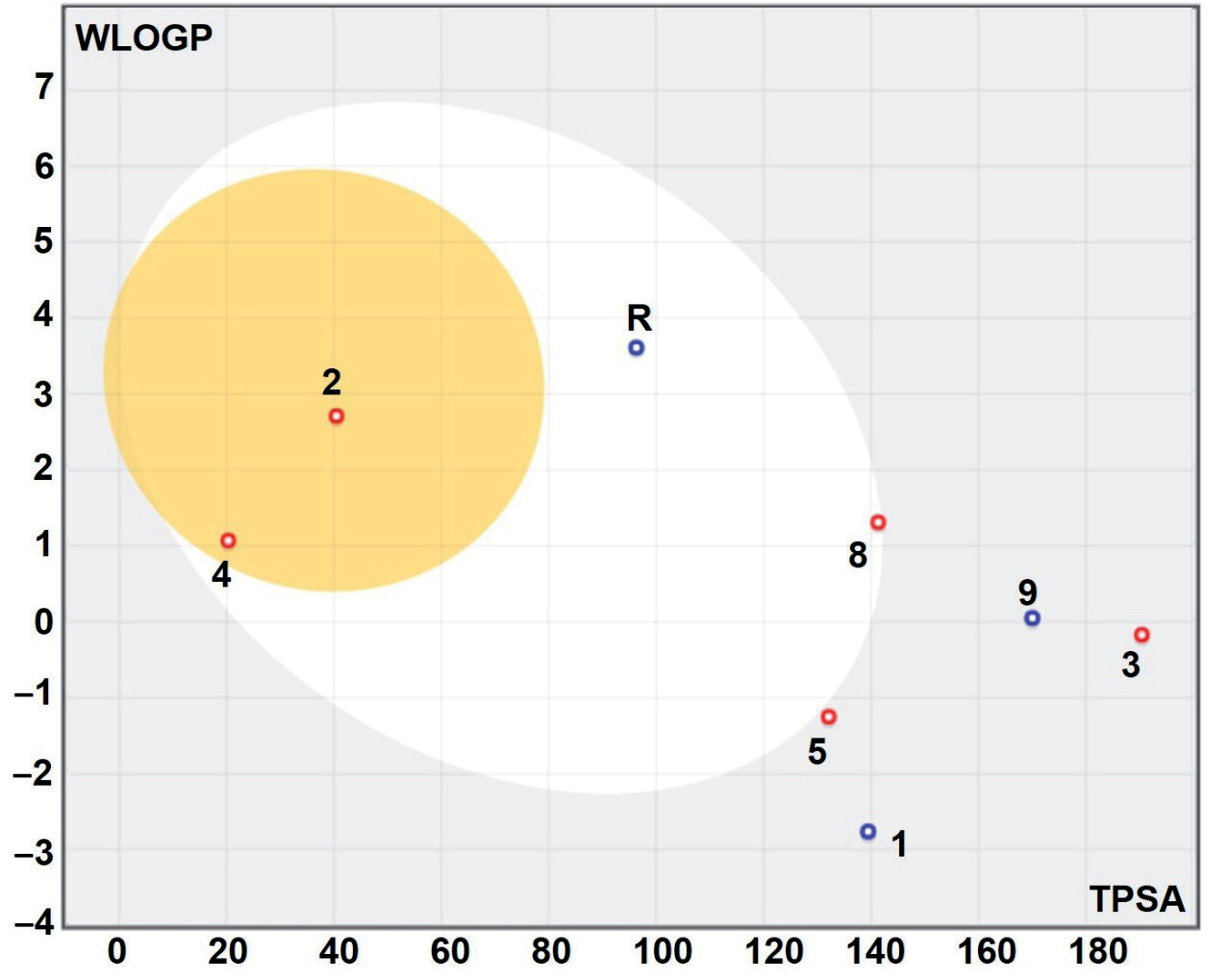
Pomegranate-identified compounds presented low to high gastrointestinal (GI) absorption. Moreover, among the identified phytochemicals, only compounds No. 2 and 4 were predicted to permeate the blood-brain barrier (BBB) (Table 3 and Fig. 3). The phyto-compounds were also assessed for the possibility of being a substrate of P-glycoprotein (P-gp). Only compound No. 9 behaved as a P-gp substrate, indicating the safe effect regarding drug distribution and metabolism. Furthermore, inhibition of the major cytochrome P450 (CYP1A2, CYP2C9, CYP2C19, CYP2D6, and CYP3A4) was evaluated for each identified phytochemical. Inhibition of these CYPs is commonly associated with metabolism disturbances that might lead to adverse toxicological outcomes [21, 71]. As none of the compounds was predicted to inhibit the various assessed CYPs, it could be deduced that the pomegranate fruit peel phytochemicals may be associated with no metabolism disruption. Taken together, our findings supported the ethno-pharmaceutical use of the pomegranate fruit peel as its chemical composition showed promising pharmacokinetic attributes without toxicological effects. In this context, the lack of toxic pores was always associated with the absence of proteins and/or DNA damage. Therefore, the effect may be comparable to the selected reference compound.
Fig. 3.
Boiled-egg model of the major identified phytochemicals in the pomegranate fruit peel and ezomeprazole (R) as a reference drug. The yellow and white areas correspond to the BBB permeation and GI absorption, respectively. Blue spots: ezomeprazole (R) and (6) may be effluated by the P-glycoprotein from the central nervous system.
Conclusion
In this study, the phytochemical characterization of pomegranate peels purchased from the city of Hail, Saudi Arabia, was reported by using LC-HRMS technique. DPPH and FRAP methods were studied to determine the antioxidant capacity of the PPME extract. According to the LC-HRMS results, thirty-five different metabolites were detected from the PPME extract, including anthocyanins and anthocyanins. The results of this study show that the dried PP is probably used as an antiulcer agent against gastric mucosal injury due to its high antioxidant activity and richness in polyphenol compounds. In silico results can also contribute to the confirmation of the good nutritional value of this by-product.