Introduction
The field of winemaking is a huge generator of waste, which creates immense problems for producers and the environment, but the proper management and recovery of wine waste is very important, although it is difficult and expensive [1]. World wine production in 2012 was about 258 million hectoliters, while wine production in Europe reached about 165 million hectoliters. Consequently, around 160 000 tons of wine yeast are accumulated worldwide annually [2]. In order to increase the overall effectiveness of the winemaking field and minimize the impact of the waste on the environment, there are measures that allow the management and efficient utilization of the waste stream in accordance with the objectives of the circular economy [3].
The relevance of this direction for the Republic of Moldova is due to the requirements for solving the problem of processing and utilization of wastes, including yeast sediments resulting from wine production and the elaboration of natural products with high biological value and practical implementation in different industries [4].
Most of natural pigments used for various purposes are obtained from different plants [5]. Anthocyanins responsible for the red, violet and blue colors, are found in various fruits and vegetables, especially grapes, blackcurrants and some tropical fruits which are characterized by a high content of anthocyanins [6]. However, these technologies face many difficulties such as seasonal dependence, loss of plant species, variations of the color shades and intensity, expensive production, problems related to stability and solubility [7]. Important biologically active components of wines are phenolic compounds, which include phenolic acids, tannins and anthocyanins [8]. The quantity of anthocyanins and other phenolic compounds extracted from grapes during winemaking determines the sensory qualities of red wines and color, which can vary due to different factors [9-11].
Monomeric anthocyanins give the intensity of the red color and their acylated derivatives provide the stability of wine color [9], having at the same time maximum adsorption affinity on the yeast cell wall [12]. Anthocyanins are predominantly 3-O-_-D-glucosides, which under the influence of β-glucosidases, release aglycated anthocyanidins with high antioxidant potential [13, 14].
Among all phenolic compounds, anthocyanins are of particular interest because they possess numerous beneficial effects on human and animal health. Various studies have revealed the biological potential of these compounds and demonstrated their ability to reduce oxidative stress, to act as antimicrobial substances and to counteract the emergence and progression of numerous non-transmissible diseases, such as neurodegenerative, cardiovascular, metabolic and cancerous diseases [6, 15, 16] and in combination with carotenoids, anthocyanins have a beneficial effect on visual function [16]. Anthocyanins and their derivatives are not toxic to living organisms, even at very high doses [17].
It is known that yeasts represent a valuable source of proteins, polysaccharides, lipids, etc. [18], at the same time, these macromolecular structures of the yeast cell wall present potential binding sites for various organic and inorganic molecules [19], present in must, including anthocyanins [20]. Saccharomyces cerevisiae yeast strains can adsorb up to 5.8% of the total anthocyanins present in wine, which gives yeast biomass after red wine fermentation an important status as a source of anthocyanins and other flavonoids [12]. Jin Wu et al. mention that the complexation of anthocyanins with mannoproteins, through the hydrophobic bonds of the protein fragment, significantly reduces the degradation of anthocyanins, which expands the possibility of applying anthocyanins as natural colorants or functional ingredients [21].
Thus, the purpose of the research was to evaluate the possibility of utilizing the biomass of Sacchromyces yeasts from the residual waste of the production of dry red wine Merlot by obtaining of the anthocyanin extract, as well as to estimate the biochemical composition, antioxidant, enzymatic and antimicrobial activities of the extract.
Material and Methods
Object of the Study
In the research the yeast sediments, obtained after the fermentation of Merlot dry red wine (RSM - Red Sediment Merlot), offered by the “Cricova” SA winery were used.
Obtaining of the Anthocyanin Extract
The yeast sediments from Merlot red wine were subjected to centrifugation to remove the remaining liquid (wine). Then the recovered yeast biomass was frozen at -18ºC. 100 g f.w. thawed yeast biomass was mixed with the 100 mL sodium phosphate buffer solution (pH-7.8) and exposed to a temperature of +45ºC for 8 hours with periodic agitation for the destruction of cell walls. The resulting suspension was centrifuged at 3500 rpm. for 15 minutes to remove the supernatant (product 1). The remaining biomass was mixed with the 50% water-ethanol solution (92 mL:100 mL) in the 1:3 v/v ratio for anthocyanin extraction by stirring at 200 rpm. for 30 minutes at room temperature. Then the suspension was centrifuged at 3500 rpm for 15 minutes for the supernatant recovery (anthocyanin extract). From the anthocyanin extract ethyl alcohol was removed with the rotary evaporator Heidolph Laborota 4000eco at the 100 rpm. and the temperature +55ºC. The aqueous anthocyanin solution was adjusted to pH-4.5. The obtained anthocyanin pigmented preparation was named RSM-AN. The remaining biomass was used for obtaining two other products.
Research Methods
The protein content was determined spectrophotometrically according to the Lowry method, with crystalline albumin from bovine serum as the standard [22].
The total carbohydrate content was determined spectrophotometrically with the Antron reagent and D-glucose as standard. The absorption was recorded at 620 nm [23].
The anthocyanin content was determined spectrophotometrically at 535 nm by extracting anthocyanins using water-ethanol solution [24].
The β-caroten content was determined spectrophotometrically by extracting β-caroten using 96% ethanol [25].
Catalase activity (CAT) was determined by the spectrophotometric method based on the ability of hydrogen peroxide to interact with molybdenum salts to form a stable colored complex [26].
Superoxide dismutase activity (SOD) was determined spectrophotometrically by method based on inhibiting the reduction of tetrazolium-nitroblue salt in the presence of TEMED and riboflavin [27].
Antioxidant activity was determined spectrophotometrically with the use of 2.2 azinobis 3-ethylbenzothiazoline-6-sulfonic acid Radical Cation (ABTS+) method [28].
Spectrophotometric assays were performed on the UV-VIS Shimadzu spectrophotometer UV-1280.
The simultaneous multielemental quantification of macro- and microelements, as well as, heavy metals was performed at the Institute of Zoology of the State University of Moldova, using ICP-OES (Inductively Coupled Plasma Optical Emission Spectrometry) at the spectrometer Thermo Scientific iCAP 6200 Duo (Thermo Fisher Scientific, United Kingdom) directed by the software iTEVA [29].
Antimicrobial activity was performed by the diffusimetric method (Kirby-Bauer), determining of the inhibition zone diameter of the test strain [30, 31]. As the test strains served Gram-positive, Gram-negative bacteria strains and fungi: Bacillus subtilis 117, Bacillus cereus fluorescens var. 47, Corynebacterium michiganense 13 A, Agrobacterium tumefaciens, Xanthomonas campestris 8003B, Erwinia carotovora, Candida pelliculosa 01, Candida albicans X and Candida tropicalis 303, offered by the National Collection of Nonpathogenic Microorganisms of Moldova.
Statistical Analysis
Statistical processing of the results was performed using the MO Excel and Statistics 9.0 software suite. The results were expressed by calculating the mean, standard deviation and confidence interval for an average of three repetitions of the entire process. All differences were considered statistically significant for P≤0.05.
Results and Discussion
Biochemical Composition
The pigmented anthocyanin extract RSM-AN, obtained from the yeast sediments of the Merlot dry red wine, after removing the ethyl alcohol, contains 20.1±0.7 mg cyanidin g-1 d.s. anthocyanins, 314.0±0.3 mg/100 g d.s. β-carotene, 12.8±0.7% d.s. proteins and 15.6±0.3% d.s. total carbohydrates (Table 1).
Extraction is an important step in isolating phenolic compounds from raw materials. Techniques of extraction can be divided into the two groups: traditional extraction techniques and alternative extraction techniques [32]. Modern techniques are often more efficient, require less extraction time, are cost-effective and can provide superior purity of the extracted molecules, but there are also various problems, namely solvent toxicity, molecule polarity, solubility, low selectivity, separation of bioactive components from the solvent [33-35].
Ethanol-water mixtures have been found to be efficient in extracting phenolic compounds from grapes [36]. These mixtures are classified with the Generally Recognized as Safe (GRAS) status and are widely used for the recovery of nutraceutical substances [37].
At the moment, various fruits and berries are used as raw material for obtaining pigmented anthocyanin extracts, especially different species of currant, from which extracts with up to 615.5±15.9 mg/100 g (FW) fresh weight anthocyanins are obtained [38] and red apples, extracts from which contain of 916.0-2310.0 mg/100 g d.s. polyphenols [39].
Other rich sources of polyphenols, including anthocyanins, are grape pomace and various by-products derived from red grapes. The quantity of anthocyanins in these sources can vary widely depending on the grape variety, extraction method, extraction conditions and other factors [40-42].
It is known that anthocyanins are sensitive to changes of the pH, temperature and intramolecular or intermolecular association with other compounds such as co-pigments, sugars, proteins, etc. [43].
Saccharomyces yeasts and various extracts from them contain a wide spectrum of minerals, macro-and microelements [44, 45], which play a colossal role in the life of living organisms [46, 47]. Macro- and microelements together with proteins, carbohydrates and vitamins are the indispensable vital components of living organisms, which serve for the formation of tissues, the running of biochemical and physiological processes. The significant effect of minerals on physiological processes is due to the fact that they are part of the so-called accessory substances: respiratory pigments, vitamins, hormones, enzymes, coenzymes and influence their activity [48].
The spectrum of macro- and microelements identified in the RSM-AN extract is diverse, being present in major quantities such elements as P - 3.41±0.03, Na - 0.99±0.09 and K - 0.96±0,09 mg/mL. Mg, Ca and S are present in amounts of 0.03±0.003-0.06±0.001 mg/mL As well, Fe, Al, Mn, Cu, Cr, Mo, Ni, Co, Zn, Ag, As and B were detected, which content is much lower and varies widely from one element to another (Table 2).
The detected elements provide biological value to the obtained extract, but the absence in the pigmented extract of heavy metals, such as Pb, Hg, Sb, highlights its harmlessness for living organisms. Traces of Ti, Ba, Bi, Sr, Ga, Cd and Tl (Table 2), less characteristic elements for yeasts, but present in the environment due to ecological problems, are introduced into the fermentation medium probably through the raw material (grapes), similar to the brewing process [49].
Biological Activity
The RSM-AN extract is characterized by high antioxidant activity, up to 52.2±0.5% inhibition and CAT enzyme activity of 180.7±2.4 mmol/min. mg protein and SOD of 219.5±13.6 U/mg protein (Table 3).
Table 1.
Biochemical composition of the anthocyanin extract RSM-AN.
| Parameter | Value |
|---|---|
| Proteins, % d.s. | 12.8±0.7 |
| Carbohydrates, % d.s. | 15.6±0.3 |
| Anthocyanins, mg cyanidin g-1 | 20.1±0.7 |
| β-carotene, mg/100 g | 314.0±0.3 |
Table 2.
The content of macro-, microelements and heavy metals in the RSM-AN anthocyanin extract.
The antioxidant activity of some extracts from brewer’s yeast biomass, evaluated by FRAP, DPPH and Ferricyanide Reducing Power, is 261±14, 59.7±2.5 and 127.6±1.0 mg TE/100 g dw respectively [50]. Red grape by-product extracts show a total antioxidant activity of 393 mgAAE/L [40] and those obtained from various fruits and leaves of 22.47±3.07-116.49±0.00 mmol trolox equivalents TE/100 g dm [39].
Previously we determined that the mannoproteic extract from the biomass of Merlot wine yeasts possesses a total antioxidant activity of 33.4±0.0% inhibition and of CAT enzyme of 525±3.1 mmol/min/mg protein and SOD enzyme of 263±4.04 U/mg protein [51].
Thus, we can mention that the total antioxidant activity of the RSM-AN pigmented extract is significantly higher compared to the activity of the mannoproteic extract, obtained from the same raw material, while the activity of the antioxidant enzymes is substantially lower. At the same time, it should be noted that the total antioxidant activity of the pigmented RSM-AN extract from wine yeasts is comparable to the activity of extracts from red grape by-products and from various fruits.
Antimicrobial Activity
The secondary metabolites extracted from S. cerevisiae displayed good antimicrobial activities against varies pathogens [52-54].
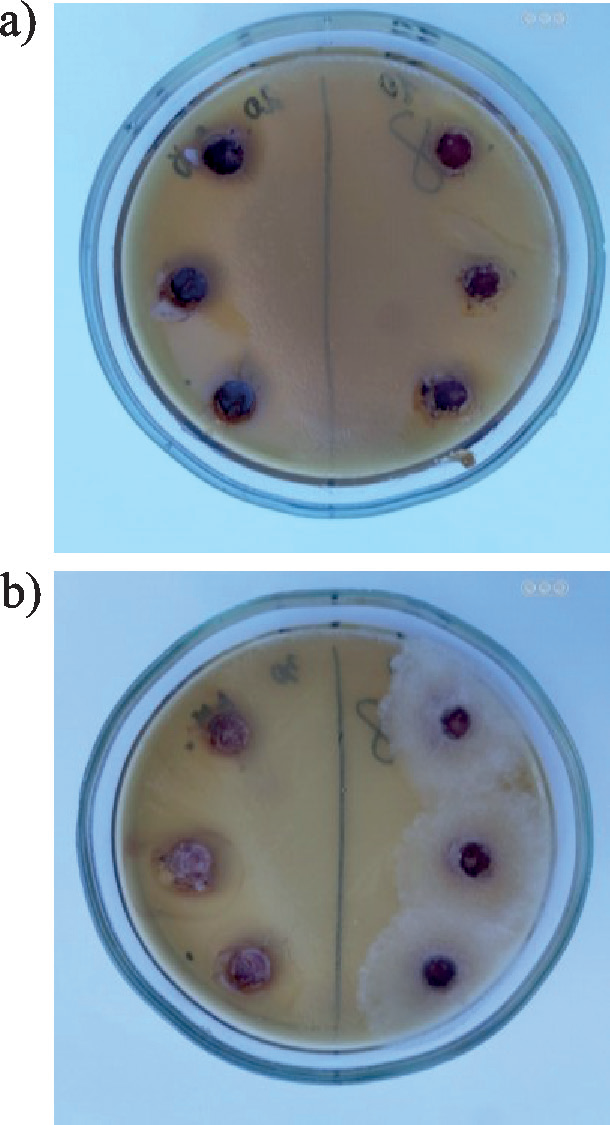
The RSM-AN pigmented extract in the concentrations of 10-50 mg/mL possesses low antibacterial activity against Gram-positive bacterial strains Bacillus cereus fluorescens var. 47, Corynebacterium michiganense 13 A and Gram-negative Xanthomonas campestris 8003B. The diameter of the growth inhibition zones of these strains varied between 8.6±0.3-14.0±0.6 mm, depending on the concentration and the taxonomic variety of the test strain. Maximum values of the diameter of the inhibition zone for all strains were established when using the concentration of 50 mg/mL (Table 4). Also, the anthocyanin extract shows pronounced antagonistic action against the Candida tropicalis 303 strain, at concentrations of 20-30 mg/mL the diameter of the inhibition zones being 21.7±2.0 and 22.3±1.5 mm respectively (Table 4, Fig. 1).
Table 3.
Antioxidant and enzymatic activities of the anthocyanin extract RSM-AN.
| Parameter | Value |
|---|---|
| Antioxidant activity, % inhibition | 52.2±0.5 |
| CAT activity, mmol/min. per mg proteins | 180.7±2.4 |
| SOD activity, U/mg proteins | 219.5±13.6 |
Table 4.
Antimicrobial activity of the RSM-AN extract.
The antimicrobial activity of anthocyanin extracts obtained from various raw materials is also known. For example, the juice obtained from Viburnum opulus strongly inhibited the growth of a wide range of human pathogenic bacteria, both Gram-negative (Salmonella typhimurium and S. agona) and Gram-positive (Staphylococcus aureus, Lysteria monocytogenes and Enterococcus faecalis) organisms. Conversely, the yeasts of Debaryomyces hansenii and Torulaspora delbrueckii showed complete resistance to the fruit juice, whereas a low sensitivity was demonstrated by Trichosporon cutaneum, Kluyveromyces marxianus var. lactis, Saccharomyces cerevisiae, S. cerevisiae 12R and Candida parapsilosis [55]. The extracts obtained from Aristotelia chilensis (Molina) Stuntz in the concentrations of 40-50 mg mL−1, inhibit growth and development of Aeromonas hydrophila and Listeria innocua [56].
Pigmented extracts from grapes and various by-products of Merlot winemaking possess high antimicrobial activity against Gram-positive strains: Sarcina lutea, Listeria monocytogenes and Staphylococcus aureus (zones of inhibition in the range of 16.3 to 19.7 mm) and against Gram-negative strains Shigella sonnei and Pseudomonas aeruginosa (zones of inhibition in the range of 15.0 to 17.7 mm) [57].
Conclusions
Thus, the RSM-AN anthocyanin extract, obtained from yeast sediments from the production of Merlot dry wine, contains balanced amounts of proteins and carbohydrates, significant amount of anthocyanins (20.1±0.7 mg cyanidin g-1 d.s.), various macro- and microelements, characterized by high antioxidant activity (52.2±0.5% inhibition) and of the antioxidant enzymes catalase and superoxide dismutase. In concentrations of 10-50 mg/mL it has antibacterial activity against strains of Gram-positive bacteria C. michiganense 13A, B. cereus fluorescens var. 47, Gram-negative X. campestris 8003B and in concentrations of 20-30 mg/mL pronounced antagonistic activity against C. tropicalis 303. The obtained results demonstrate that the yeast biomass from the waste of Merlot dry wine production is a cheap, accessible industrial source, rich in anthocyanins and other biologically active compounds. The biochemical composition, antioxidant, enzymatic and antimicrobial activities of the pigmented extract RSM-AN highlights the perspective of developing different nutraceutical, antioxidant and antimicrobial extracts based on it. Utilization of the yeast waste from the production of Merlot dry wine allows to reduce the negative impact on the environment.