


Introduction
The rapid population growth will impact various activities during which waste may develop in different variants and amounts [1]; this also applies to food waste. Efficient food waste management and conversion have become an ever more significant problem for countries worldwide. As countries worldwide waste huge amounts of food products, good strategies should be developed to transform the waste into useful resources. The annual amount of food waste is estimated to be 1.6 gigatons, representing 27% of 6 gigatons of global agricultural production for food and non-food use [2]. It is believed that nearly 1.3 billion tons of food are currently thrown out worldwide, and the number is expected to reach 2.2 billion tons by 2025 [3]. A recent FAO study states that 1.3 billion tons of food waste are created annually worldwide, corresponding to a third of all globally produced food [4]. Food waste can be defined as all food products and their inedible parts discarded from the food chain in order to be used or eliminated (including composting, plowing in unharvested crops, anaerobic digestion, bioenergy production, co-generation, combustion, disposal in sewers, on landfills, or outcast into the sea) [5]. Food waste is recommended as a raw material for biogas generation as it can produce large amounts of CH4 [6].
Food is wasted everywhere in the supply chain, from agricultural production to the final consumption in households. The share of EU households wasting food is 53% [7, 8]. On a global scale, there are more than 60%. Such an amount of food waste has significant environmental, social, and economic impacts [9], and it is expected to increase further in the next decade. The growing amount of food waste brings the capacity of recycling plants, landfills, incinerators, anaerobic digestion, and composting under huge pressure [10]. Food waste also burdens waste management systems, exacerbates food insecurity, and makes it one of the main contributors to environmental problems [11].
Taking into account the high content of organic substances and moisture, food waste can be easily contaminated, leading to emissions of bad odors during collection and transportation. These odorous gases primarily include NH3 and H2S [12]. Emissions of smelly gases are the main problem that food waste conversion technologies have to face and must be limited, namely in densely populated areas [4, 13].
Food waste amount, type, properties, and the type of collection container are important factors to consider when planning an efficient food waste management system in housing estates. Housing estates represent a significant urban, architectonic, and historical phenomenon. Many people prefer dwelling in panel houses because of their central position, good traffic service, and comfortable surrounding civic amenities [14]. Effective management of food waste and food waste processing has become an ever greater problem for countries worldwide [15]. Collection in residential developments is a decisive step in sustainable food waste management, which is sometimes underestimated as greater emphasis is put on methods of further conversion. Efficient collection can ensure high-quality inputs to increase food waste value. Manufacturers currently offer a number of containers for food waste collection, but a practical decision about suitable containers is sometimes rather difficult [16]. The collection, sorting, and reuse of food waste can not only mitigate the pressure on landfills but also open the way to creating valuable resources [17]. Introducing a suitable food waste collection system will allow the food waste to pass special treatments such as composting and biogas fermentation, thus providing organic fertilizers and renewable energy sources for agriculture and the power engineering industry [18]. Reducing food waste is a key part of UN objectives for sustainable development, where Goal 12.3 stipulates reducing food waste by half and overall food losses by 2030. Although the reduction of edible food waste would be a key strategy for the global reduction of food waste, there are still unavoidable and inedible food wastes that will require sustainable and circular system solutions [19].
This research is particularly topical because awareness about the principles of a circular economy has been globally increasing thanks to policymakers’ activities. Such an economy represents a sustainable alternative to the contemporary linear system, namely by recirculating material resources and, hence, also food waste [20].
Therefore, the main objectives of this study include testing containers for food waste collection in housing estates on the development of temperature, moisture content, pH, and gaseous parameters (characteristics of emissions) inside the containers and microbial analysis of some pathogenic bacteria using their growth on selective soils (1) and testing the effect of the additive on the evolution of gaseous parameters (characteristics of emissions), pH, and microbial analysis on selected containers (2). Results can provide valuable information for reducing emissions created during food waste collection in housing estates and possibly also for choosing the proper containers for food waste collection.
Materials and Methods
The research was conducted in real conditions for two consecutive periods in 2023. The first part focused on testing collection containers for food waste used in a housing estate (14 days). Parameters monitored were: the development of food waste pH and moisture content, temperature inside the containers, external temperature and humidity, gases (NH3, H2S, and O2) released from food waste during the experiment, and microbial analysis. The second part of the research (14 days) was focused on the testing of a possible influence of applied additives on food waste in the selected type of collection container with the identical amount and composition of food waste on the development of gaseous parameters (NH3, H2S, and O2), pH, and cultivation of bacteria on selective soils.
Description of Tested Collection Containers
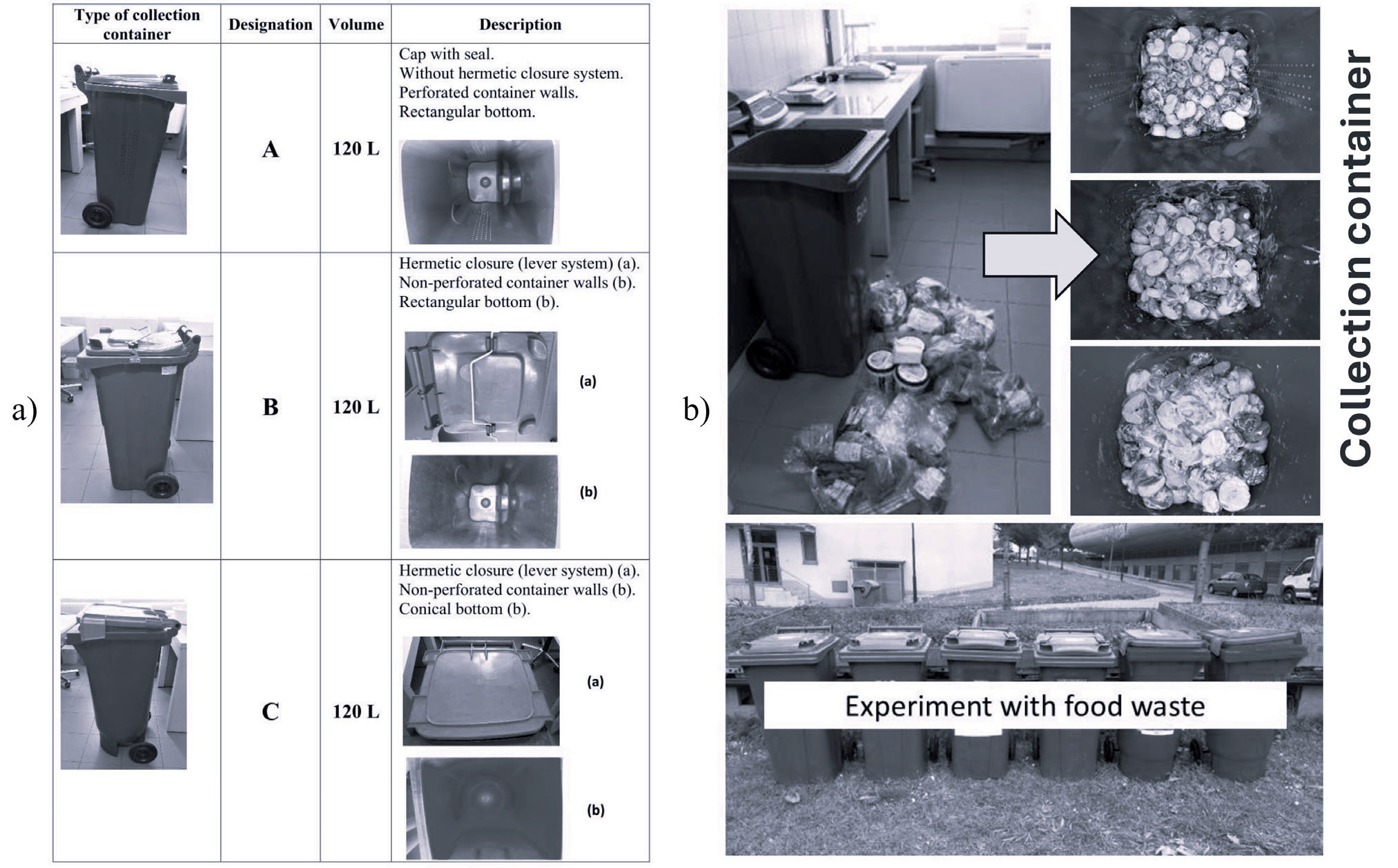
There were 3 types of bulk collection containers (Fig. 1a)). The containers were selected based on the authors’ experience and after consulting an expert with experience in waste management. The experiment always had two repetitions (A1, A2; B1, B2; and C1, C2). The containers were placed outdoors on the university’s campus (Fig. 1b)) to simulate the actual conditions of food waste collection.
Food Waste
For both parts of the experiment, each test collection container was filled with an identical amount of food waste (21.25 kg) of identical composition. Composition of food waste in each collection container: white yogurt (2500 g), potatoes (cut to quarters) (6250 g), apples (cut to quarters) (5000 g), pork meat (cut to quarters) (2000 g), Edam cheese (slices) (500g), and bread (slices) (5000g). The food waste composition was chosen based on the authors’ experience and information published in the literature [21-23].
Measurement of Food Waste Internal/External Temperatures, Moisture Content, and pH
Temperature (both internal and external, in °C) was measured hourly by a digital thermometer (Datalogger, CR) for two weeks. Termioplus, CR measured moisture content in % for an equal amount of time. The pH value was monitored using (10±0.001) g of the mixed sample with 50 mL of distilled water (DW). The sample was shaken for 10 min, and then the pH was measured in triplicate using a pH electrode (inoLab pH 720, WTW, CR).
Measurement of Gaseous Parameters
On the 1st and last days of both experiments, gases (NH3 (ppm), H2S (ppm), and O2 (%)) were monitored using a GasAlertMicro 5 instrument (BW Technologies, CR). The experimental period was 14 days.
Microbial Analysis
Cultivation of Cultures
First, 10 g of food waste was taken from each tested container in the first experiment, 10 g of food waste was treated with different additives, and 50 mL of DW was added to the waste. After 10 min of shaking at room temperature, 5 mL were taken and added into Trypton soya broth for the bacteria to multiply. The prepared suspension was left on the tempered shaker for 24 h at 37°C. After the time had passed, the suspension (100 μL) was spread onto selective agars in the center of the Petri dish and rubbed into the soil using a so-called L-shaped loop using circular movements.
Tested Selective Soils
Pseudomonad agar C-N is a highly selective medium for Pseudomonads. Its selectivity is given by the concentration of cetrimide, which is lower than in cetrimide agar. This is exactly why Pseudomonas aeruginosa is being captured with improved efficiency. Agar was left with the suspension of cultures for 40- 48 h at a temperature of 36±2°C. One of the first steps in identification is the growth of cultivation media, both basic and selective and selectively diagnostic. Pseudomonas bacteria are, however, seldom distinguishable from other Gram-negative non-fermenting sticks. This is why cultivation is not enough to identify them; other identification procedures must also be used.
Salmonella-Shigella agar (SS agar) is a selective medium for isolating pathogenic Enterococcus species, namely Salmonella and Shigella, from clinical material and food products. The selectivity of the media is based on the presence of sodium citrate and bile salts, which completely inhibit the growth of gram-positive bacteria. In addition, the medium contains lactose, which distinguishes the microorganisms. Lactose-fermenting organisms produce acid, which supports the development of red colonies in the presence of a neutral red indicator. Lactose non-fermenting microorganisms form colorless colonies. The other identification is possible based on H2S production, which is possible thanks to the presence of Na₂S₂O₃ and ferric citrate. Microorganisms producing H2S can be distinguished as black colonies or colonies with a black center. Thus, Salmonella grows on this agar as a black color and Shigella as a colorless or sometimes brownish colony [24]. Food waste health safety was tested according to EU Regulation No. 142/2011. Limits for output from the waste processing plant are findings below 50 colonies of E. coli and Enterococcus species and a negative finding for Salmonella spp.
Inoculated plates of MRS agar (Lactobacillus) Man, Rogosa, and Sharpe agar (MRS agar) of pH 5.7 were incubated aerobically for 72 h at 30°C. After 3 days of cultivating MRS agar, the colonies of lactobacilli should be regular, round, smooth, rather colorless, and 0.5-2 mm in diameter, with their characteristic trait being an acidulated odor. Selective blood agar is used to determine the bacteria Helicobacter pylori, which is a potential carcinogen [25] and exhibits the growth of a small white color that should resemble water drops [26]. Enterococcus species were determined using Bile Esculin Azide Agar, onto which a suspension was pipetted to 100 μL. Incubation of samples took place with bottom-up for 24 h at 37°C. The colonies were counted using a magnifying glass and marker (dotting method). Enterococcus species can be determined using Bile Esculin Azide Agar, on which they grow as small light colonies with a brown up to black fringe. This is why the technique of spreading with an L-shaped loop is used to assess the growth all over the dish. Enterococcus species can hydrolyze esculin into esculetin and dextrose, which reacts with ferric citrate while forming brownish-black precipitates around the colonies. Chromogenic E. coli X-gluc agar is used to selectively detect E. coli bacteria in water and food. The grown-up colonies are blue-green. An X-glucuronide (5-bromine-4-chlorine-3-indoxylβ-D-glucuronide) indicator allows its identification by changing the color to blue. The β-D-glucuronidase enzyme characteristic of E. coli splits this chromogenic substrate.
Food Waste Testing in a Selected Collection Container with Additives
Part 1 of the research (testing different collection containers and measuring key parameters) was followed by Part 2 (selecting collection containers with food waste and additives, considering measured parameters, handling containers, and maintaining them). Tea tree oil (TTO) was chosen as an additive. It is a vegetable essential oil obtained by the steam distillation of branches and leaves on Melaleuca alternifolia [27]. Active ingredients of TTO are terpinol-4, alpha-terpineol, and alpha-pinene, which positively enhance the antioxidant capacity [28]. It looks like a pale golden oil with a fresh camphoraceous smell [29]. TTO has a broad spectrum of antimicrobial activity, and non-specific cell membrane damage is a major mechanism of antibacterial action [30]. The second additive was calcium carbonate (CaCO3). CaCO3, a derivative composed of calcium, carbon, and oxygen, was available in three crystalline polymorphs: aragonite, vaterite, and calcite. Among the polymorphs, calcite is the pure and stable form of CaCO3, widely used in various industrial, biological, and pharmaceutical applications [31]. Low cost, biodegradability, and outstanding potential as antimicrobial agents [32] have prompted us to select CaCO3 as an additive. The last additive was citric acid (CA). Compared to inorganic acids, CA has biodegradable properties and less environmental impact [33, 34]. CA is not only cost-effective but also a naturally occurring component in various fruits and vegetables [35]. It is a non-toxic and environmentally friendly agent [36]. At the beginning of the experiment, the following additives were applied to each container with an identical amount and composition of food waste: A) 500 mL TTO + 1500 mL of DW (A); B) 125 g CA + 2000 mL of DW (B); C) 125 g CaCO3 + 2000 mL of DW (C); and E) = control without additives (E). Additives were used to monitor their possible influence on the parameters of gases (NH3, H2S, and O2) and pH.
Results and Discussion
Temperature, Moisture, Gases, and pH of Food Waste
Temperature and moisture content are important parameters when handling food waste. These parameters were, therefore, monitored throughout the experiment. Temperature and moisture are conservation conditions affecting food waste devaluation [37]. The course of temperatures and moisture in the tested collection containers (A, B, C, outdoor parameter) is shown in Fig. 1. Temperature is an important factor affecting microbial activity and rates of feedstock conversion [21]. Many food items are highly perishable and need temperature control to remain fresh and avoid spoilage, as high temperatures accelerate the growth of bacteria and microorganisms [38]. The course of temperatures (°C) (Fig. 2a)) inside the tested containers corresponds to the course of outdoor temperatures. The average outdoor temperature for the entire monitored period was 16.20°C. Average temperatures inside Containers A, B, and C were 14.11°C, 16.49°C, and 14.26°C, respectively. Lower average temperatures in Container A and Container C were likely due to perforation of Container A (Fig. 1) and to difficult closing and cap looseness in Container C, which led to a higher occurrence of insects and larvae inside the containers. Waste often becomes a breeding ground for mosquitoes and fruit flies, causing environmental problems. Hence, recycling such waste is crucial for solving these environmental problems [38]. Temperatures inside the tested containers did not increase excessively during the experiment, which would have resulted in more rapidly deteriorating food waste. Reduced temperatures can contribute to extending food waste durability (e.g., fruits and vegetables). This is because lower air temperatures reduce the rate of chemical reactions, thus delaying the possible growth of microbes and extending storage time [39].
Fig. 2.
a) Temperature profile (°C), b) moisture content profile (%) of food waste in collection containers (the experiment was performed in duplicate).
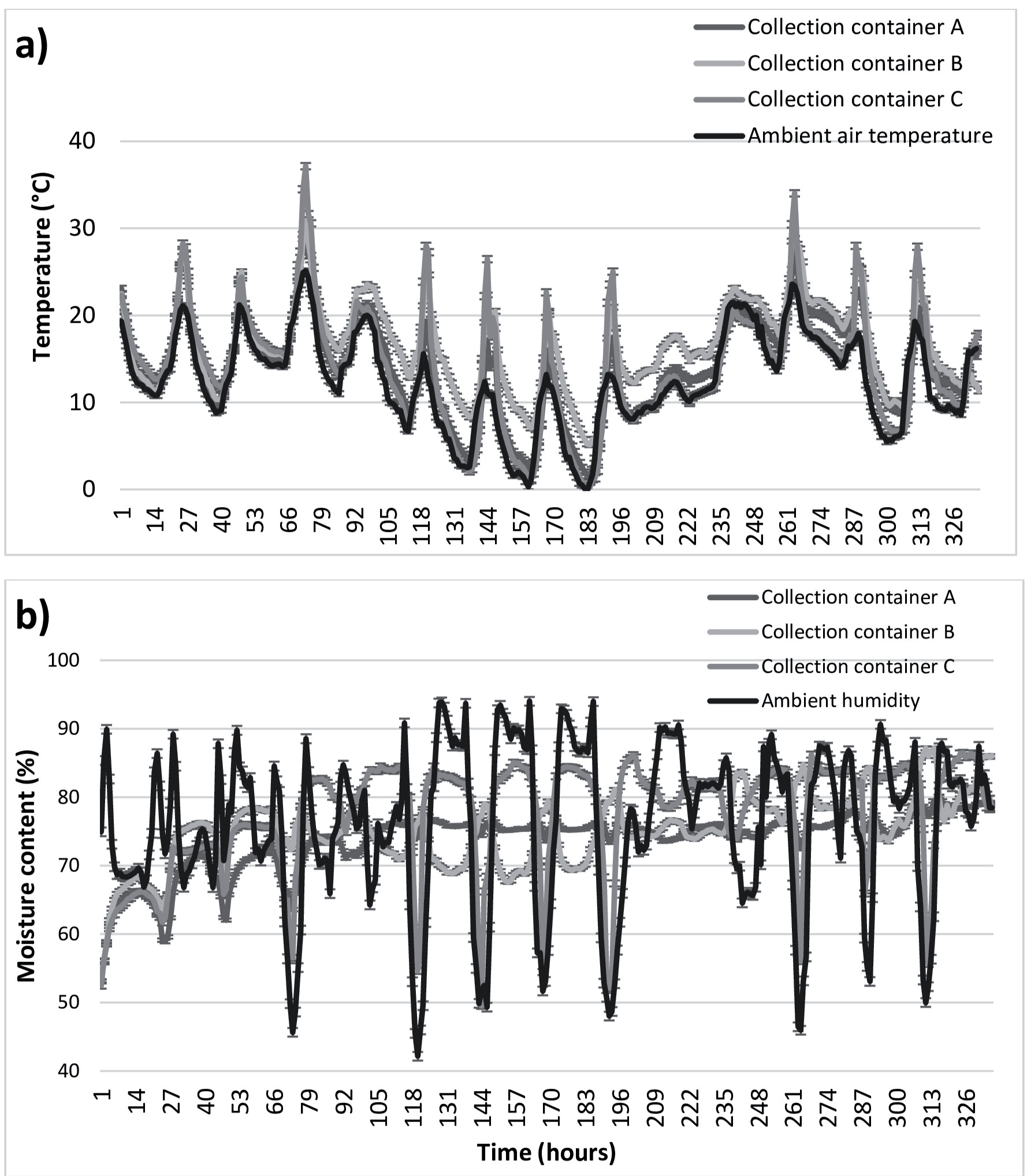
Food waste is characterized by its high moisture and organic content (carbohydrates, proteins, lipids, and lignocellulosic compounds), among other distinguishing attributes. Food waste is a common organic solid waste generated worldwide in significant quantities, and its proper treatment and management practices are hindered by high moisture content [40]. The moisture content of food waste ranges from 74-90%, depending on the food waste composition [41] and the course of moisture (%) (Fig. 2b)). The average outdoor humidity for the entire experimental period was 76.07%. Average moisture content in Containers A, B, and C was 73.67%, 75.28%, and 77.44%, respectively. The diagram in Fig. 2b) shows that outdoor humidity and moisture content in Container C fluctuated the most. Moisture (%) in Containers A and B exhibited the lowest fluctuation values. The highest moisture content at the end of the experiment was recorded in Container C (86.27%). Moisture content is an important factor in the growth of insect larvae. Reduced moisture content of food waste was found to slow down larval insect growth [42]. One of the options for recycling food waste is composting, so the initial moisture content is critical for optimizing the composting process [43]. High moisture content is also a problem in yet another alternative to food waste processing, and major thermochemical methods of food waste conversion, i.e., incineration and pyrolysis, face the major problem of high moisture content of food waste, which requires pre-drying to become energy and cost-efficient [44].
Table 1.
Average values of measured gases in each collection container * values are presented in measured units, reference values for NH3: 0-100 ppm, H2S: 0-500 ppm, and O2 (%) ppm.
There is a wide range of food waste types that contain approximately 30-60% starch, 5-10% protein, 10-40% fat, and trace elements, and demonstrate a promising potential as nutrient sources for the growth of bacteria [21], which may lead to the creation of bad odors (undesirable gaseous parameters). Besides the huge financial cost, food waste also causes numerous environmental problems, such as depletion of limited landfill space and odor creation [42]. Bad odors are considered the main burdensome factor when collecting and handling food waste. The global food system is responsible for a significant percentage of global greenhouse gas emissions (19-33%), as CO2, CH4, and N2O are produced and emitted throughout the food cycle, from production through decomposition [45]. Food waste emits harmful gases, such as CO2, H2S, CH4, and N2O, that are detrimental to human health [46]. Emission characteristics (NH3, H2S, and O2) measured in the individual tested containers were evaluated after the end of the experiment (Table 1).
The measurements revealed no NH3 (ppm) in any collection container. No H2S (ppm) was recorded in Container A and Container B, while Container C showed increasing H2S values from Day 6 of the experiment (3.5 ppm) to Day 14 at the end of the experiment (20 ppm). The average value of H2S in Container C was 6.19 ppm. In this container, the values of H2S increased with time, and at the same time, the values of O2 (%) decreased from Day 4 to the end of the experiment, when the final O2 value was 6.2% compared with the initial value of 20.9%. Container A did not show any change in O2 (%) throughout the experiment. O2 (%) in Container B began to drop from Day 4 (20.3%), and this decrease continued until the end of the experiment when the O2 value was 18%. Other parameters in Container B did not exhibit any changes. H2S is a very toxic, flammable, and corrosive gas. Exposure to an H2S concentration above 250 ppm can be fatal [47]. Accordingly, the presence of H2S brings significant health and safety risks [48, 49].
The pH value expresses the concentration of hydrogen ions in the environment, i.e., the degree of acidity or alkalinity of some substance. The cause of food waste spoilage may be due to the oxidation of lipids and proteins, microbial activity, degradation of enzymes, or pH changes [50]. The concentration of hydrogen ions in the environment strongly affects the growth of microorganisms, their biochemical activity, and also their resistance to the impact of other factors. As a rule, microorganisms can multiply only at pH ranging from 4.5-8.0. Bacteria do best in an environment with an optimal pH value of 5.0-7.0, a range corresponding to the pH values recorded in the tested containers, with the highest pH value recorded in Container B (4.86). Range average values of pH in each collection container (A, B, and C) were A (4.64-4.91, average pH 4.76), B (4.64-5.03, average pH 4.86), and C (4.42-4.81, average pH 4.71).
Microbial Analysis
Pandey et al. [51] inform that the 5 pathogens most frequently occurring in food and food waste are Salmonella enterica, Campylobacter spp., Listeria monocytogenes, Toxoplasma gondii, and norovirus. Bacteria of Streptococcus, Enterobacter, Citrobacter, Klebsiella, Proteus, Serratia, and Pseudomonas are often present in samples of household waste [52]. Wu et al. [53] claim that most bacterial strains detected in food waste originate from the food products the waste came from; in other words, most microorganisms were already in the initial product. It is useful to monitor the presence of pathogens in food waste by determining the occurrence of coliform bacteria, streptococci, E. coli, or salmonella [54].
Fig. 3.
Microbial analysis of food waste from tested containers A1, A2, B1, B2, C1, and C2. Selected agars were used for bacteria Pseudomonas a), Lactobacilli b), Salmonella c), Helicobacter pylori d), E. coli e), and Enterococcus species f).
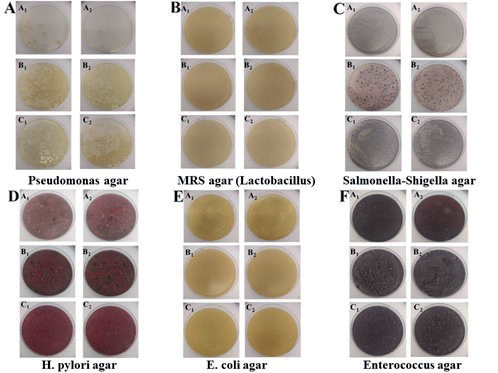
During the spoilage of food, lactic acid bacteria, including Pseudomonas (Fig. 3a)) and lactobacilli (Fig. 3b)), were the dominant species observed in this study. Similar results were observed in the study of Xu et al. [55]. The multiplication of bacteria was affected by the type of collection container because the smallest growth of Pseudomonas was observed in Container A, which was the only one perforated. Food cultures are known to grow best with aeration, regardless of media; however, Pseudomonas is capable of growing anaerobically on some carbon sources [56]. Lactobacilli were observed in all Petri dishes of the tested collection containers. Presumably, they belonged to the strains of Lactobacillus acidophilus and Lactobacillus casei, which could not be determined clearly from the selective media. Lactobacilli plays an important role in food preservation and fermentation processes by lowering pH and producing bacteriocins, which prevent the growth of pathogenic and spoilage microorganisms [57, 58]. As black colonies were not recorded on SS agar in any case, the presence of Salmonella/Shigella was not demonstrated (Fig. 3c)). Selective blood agar for Helicobacter pylori typically shows the growth of small white colonies. These were not recorded in the tested samples (Fig. 3d)). Chromogenic E. coli X-gluc agar is used to observe E. coli bacteria in food. The bluish-green colonies were not observed in any of the tested containers (Fig. 3e)). The growth of Enterococcus species during spoilage is highly disquieting because of their harmful effects on humans and subsequent economic losses; nevertheless, only a few studies were focused on the issue [53]. Enterococcus sp. were cultivated on Bile Esculin Azide Agar, on which they grow as small light colonies with a black fringe, which were not observed on the tested samples (Fig. 3f)). In this research study, pathogenic bacteria on Petri dishes were not observed in any of the collection containers (Figs. 3 (c-f)), which could have been due to low pH as well as the occurrence of lactobacilli. Moreover, harnessing the benefits of acidic conditions, exploitation of lactobacilli in waste management, and revalorizing agricultural/food waste offer an innovative approach with great potential for effective waste treatment and resource recovery. Acidic pH environments provide unique opportunities for various waste management applications, including organic matter degradation, removal of contaminants, and transformation of waste materials into valuable products [59, 60].
Gases, pH, and microbial analysis of food waste with applied additives
Sustainable food waste management is a momentous research area that has rapidly grown over recent years [61]. Food waste has become a critical issue of sustainable development. Many countries around the world encourage food waste recycling rather than landfills or direct incineration [62]. The valorization of food waste is needed for sustainable waste management in urban areas [63]. Food waste sorting and collection into suitable containers are the basic prerequisites to make recycling beneficial. Container B was chosen for the following part of the experiment based on the evaluation of monitored parameters and operational experience gained during the research. Due to its wet nature, high content of organic substances, and a mixture of chemicals, communal food waste quickly produces odors as it begins to putrefy. Volatile fatty acids and ammonia can be expected to result from the decomposition of organic matter containing carbohydrates and proteins [64]. Odors pose a risk to human health. [65]. As mentioned above, bad odors are the main burden of collecting food waste.
Fig. 4.
a) Development of O2 (%) in the experiment, b) Development of pH value after the application of different additives in the experiment.
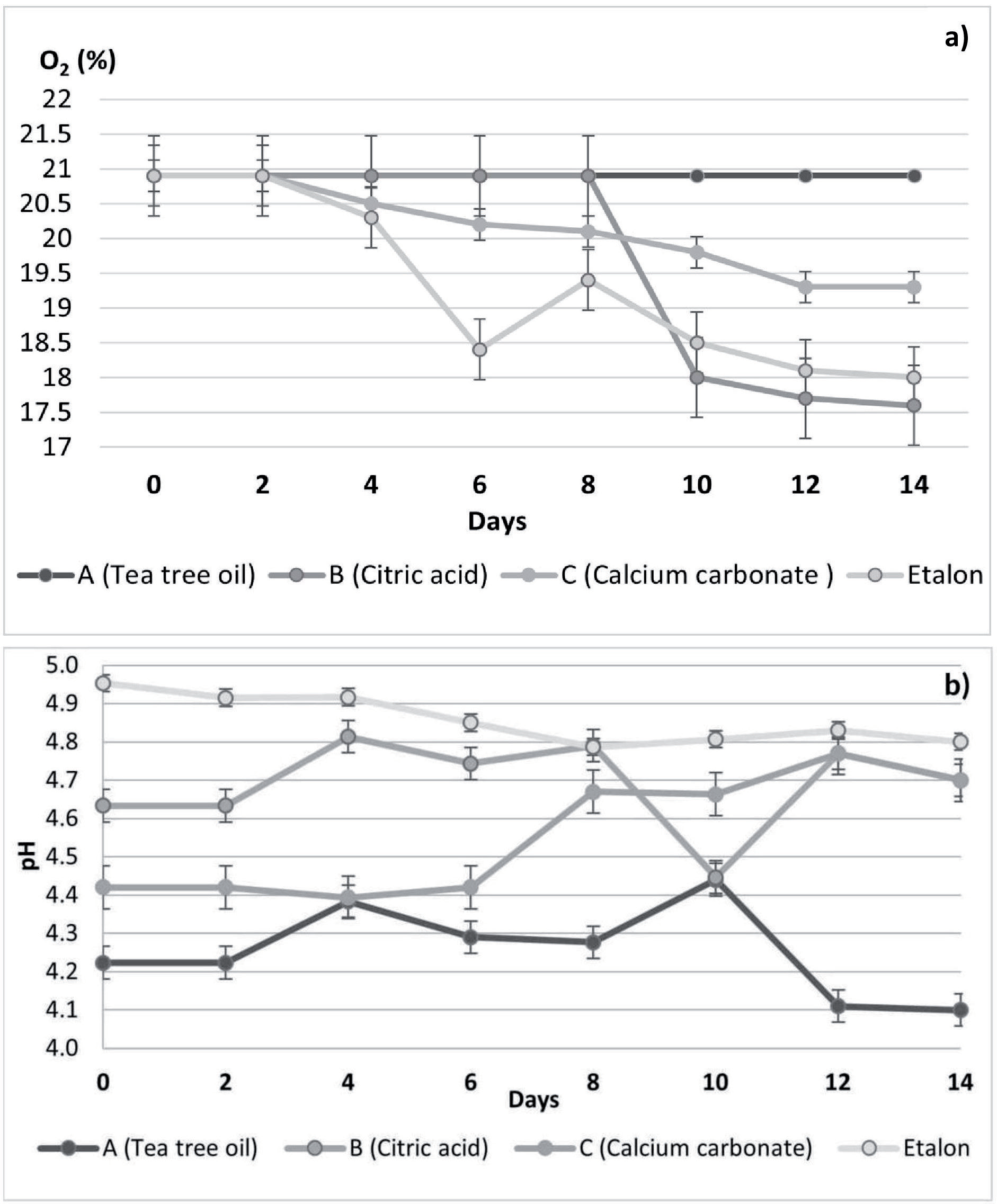
The measured values of NH3 (ppm) and H2S (ppm) were zero in all tested additives (A, B, C) as well as in the control (E) from Day 0 to Day 14. The development of O2 (%) in the tested additives is shown in the diagram (Fig. 4a)). The amount of O2 in the reference sample (E) ranged around 20.9-18%; a drop in O2 occurred from Day 2 to the end of the experiment (18%). No change in the development of O2 content was recorded in sample A (TTO), in which the O2 values were 20.9% throughout the experiment. This additive resulted neither in the decrease of O2 nor in the development of NH3 and H2S. This oil is quite common in the cosmetic, pharmaceutical, agro-food, and non-food industries. Essential oils have increased due to the increased demand for natural alternatives to chemically synthesized pharmaceutical and cosmetic products. Aromatic tea tree oil contains more than 100 different phytochemicals, mainly monoterpenes, sesquiterpenes, and their related alcohols. Terpinen-4-ol has been recognized as a major compound responsible for broad antimicrobial and anti-inflammatory activities [66].
Compared to samples E, B, and C, where the greatest O2 decrease was recorded in sample B (CA), the amount of O2 ranged around 20.9-17.6%; a drop in O2 occurred from Day 8 to the end of the experiment (Day 14) when the O2 content was 17.6%. In sample C (CaCO3), the amount of O2 ranged around 20.9-19.3%; a drop in O2 occurred from Day 2 of the experiment, but this decline was not pronounced, rather of gradual character, with the lowest value being recorded on Day 14 of the experiment (19.3%).
Fig. 5.
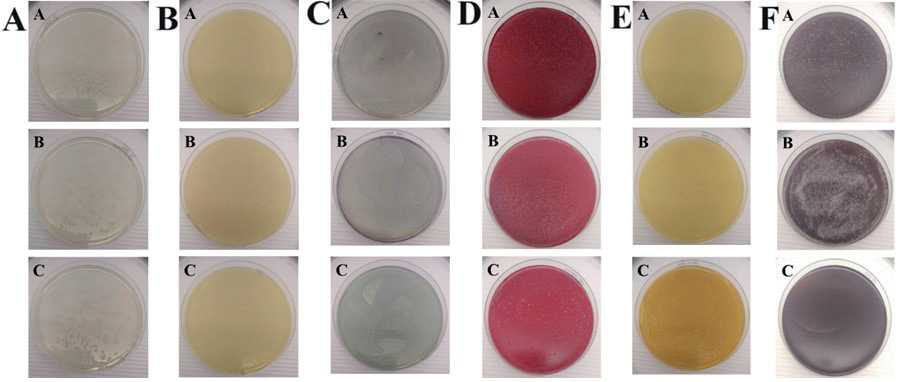
Microbial analysis of food waste from tested additives A (TTO), B (CA), and C (CaCO3). Selected agars were used for bacteria Pseudomonas a), Lactobacilli b), Salmonella c), Helicobacter pylori d), E. coli e), and Enterococcus species f).
Qamaruz-Zaman and Milke [23] reported that the odor became more intense with the prolonged storage of food waste in containers. When food waste was placed in the collection container for 14 days, and Additive A was used, acceptable emission parameters were recorded. If the food waste is placed in the collection container for 1 week and then brought for subsequent conversion, which happens with some waste collection companies, Additive B (CA) is satisfactory, too, as the changes of emission parameter O2 occurred from Day 8 of placement in the collection container. CA, a natural organic acid of biological origin, has excellent antibacterial properties and is widely used in the food industry as a safe additive [67].
The additives reduced the pH value in all cases compared with the control (Fig. 4b)), but all values, including the control, ranged from 4.0-5.0 (acidic zone). The lowest pH value (around 4.3) was detected with the use of Additive A (TTO), although it could have been assumed that CA (Additive B) would be most effective in decreasing the pH value. CaCO3 (Additive C) is a mineral additive with a high content of nutrients and the potential to resolve the problem of low pH in food waste, which was not confirmed in this study. The application of CaCO3 did not increase the pH value compared to the control. Goodrich et al. [68] claim that the pH value of the originally alkaline food waste increased thanks to the application of CaCO3. However, an increase in pH may cause a decrease in activities and the content of nutrients therein [69]. Haouas et al. [70] were applying phosphates and carbonates as additives. Applying these substances alone or mixed with other additives positively affects the food waste composting.
For the possible elimination of pathogens Pseudomonas, Salmonella, Helicobacter pylori, E. coli, Enterococcus species, and acidophilic bacteria of lactobacilli, three additives, such as TTO (A), CA (B), and CaCO3 (C) (Figs. 5 (a-f)), were compared with the reference sample, which was mixed with food waste and left in the collection containers for 14 days. This study did not observe differences among the individual additives (Figs. 5(a-f)). In the Petri dishes, a growth of Pseudomonas (Fig. 5a)), lactobacilli (Fig. 5b)), and Enterococcus species (Fig. 5f)) was detected. Enterococcus species were recorded only in the case of Additive A and Additive B. The results suggest that the growth of these pathogens was suppressed by Additive C (Fig. 5f)).
CaCO3 is a common mineral additive to increase the pH value of the resulting food waste [71]. Its pathogen-suppressing effects have not been investigated so far. This is why it was tested in this study, which indicates that it is actually an additive unsuitable for food waste, as food waste, with the application of CaCO3 as an additive, did not exhibit a decreased amount of pathogens. Another additive was CA, which is often applied to waste as it improves the properties of the resulting food waste [72]. Eliuz [73] studied the potential antimicrobial effect of CA on E. coli, Staphylococcus aureus, and Candida albicans. Lakatos et al. [74] tested the antibacterial effects of TTO on Salmonellu enteritidis and E. coli.
Conclusions
A suitable and efficient method of collecting food waste using collection containers in housing estates leads to acquiring high-quality inputs for the further improvement of food waste, for example, by composting or anaerobic digestion. The main negative factor of collecting food waste is usually the bad odor. Parameters considered in testing the three types of collection containers included the development of food waste pH value and moisture content, temperature inside the containers, outdoor temperature and humidity, the development of gases (NH3, H2S, and O2), and microbial analysis. A container type was chosen for testing containers, in which a possible influence of selected additives was tested on set-up parameters (emission characteristics, pH, microorganisms, and pathogens). The course of temperatures (°C) inside the tested containers matched the course of outdoor temperatures. Temperatures inside the tested containers showed no extreme increase that would result in a more rapid food waste depreciation. Lower temperatures in Container A and Container C were probably caused by perforation (Container A), difficulty closing the cap, and poor tightness (Container C), which also led to a greater occurrence of insects and larvae inside the containers. The greatest fluctuation of outdoor humidity and moisture content was recorded in Container C. Research studies indicate that reduced food waste moisture slows down the growth of insect larvae. Emission characteristics of NH3 (ppm) and H2S (ppm) were not established in Containers A and B. In Container C, the values of H2S were increasing with time, and O2 (%) values were decreasing simultaneously. The type of container did not influence the pH value. As expected, the food waste in the tested containers exhibited different bacteria, as it has a very variable microbial composition. Pseudomonas microorganisms, which are commonly present in food products and cause rapid spoilage, were identified most frequently in samples from the tested containers. Lactobacilli ensured proper fermentation processes and prevented the growth of pathogenic strains in all food waste samples from the tested containers. Container B was chosen for the following part of the experiment. All tested additives (tea tree oil (A), citric acid (B), calcium carbonate (C), and control without additive (E)) exhibited zero values for NH3 (ppm) and H2S (ppm) throughout the experiment. The application of Additive A resulted in acceptable emission parameters measured after 14 days of food waste in the collection container. If the food waste had been placed in the collection container for 1 week and then taken for subsequent conversion, which is a practice of some waste collecting companies, Additive B (citric acid) would be satisfactory, too, as changes in the emission parameter O2 occurred from Day 8. After applying additives, Pseudomonas microorganisms were identified, but no important pathogens, which is a good prerequisite for the correct process of food waste management. Nevertheless, applying additives reduced the pH value in all food waste samples compared to the control.

