

Introduction
In 2013, the Chinese government clearly proposed encouraging and supporting the transfer of contracted land to large professional households, family farms and farmers’ cooperatives and developing various forms of moderate-scale operation. Since that time, there has been a boom in the construction of family farms all over China [1]. By the end of 2021, there were 3.9 million family farms in China, and the grain-sown area amounted to about 290 million acres1. It is related to the sense of gain, happiness and security of hundreds of millions of farmers. Family farms have gradually become the focus of revitalizing rural industries, the growth point of farmers’ income, and the key to building a beautiful countryside. In recent years, as important new entities of agricultural operation, family farms have played an important role in guaranteeing the quality of agricultural products, food 1 http://www.gov.cn/xinwen/2022-01/21/content_5669637.htm security, and agricultural infrastructure construction [2]. Family farms have realized the appropriate scale of agricultural operations. As a new landmark in the new round of farm reform, family farms have injected new vitality into the development of the rural economy, and they are an extension and development of the household contract responsibility system in China. However, according to the authors’ practical investigation, family grain farms also face a series of problems in the process of development, such as outdated agricultural technology [3] and ecological environmental pollution [4], which hinders the sustainable development of these farms.
Ecological cognition, digital agricultural technology adoption, and the sustainable development of family grain farms are related to the food security of human society, the sustainability of agriculture, and the health of the ecological environment and have a profound impact on the global food production system and the sustainable development of the social economy. First of all, the concern for ecological cognition stems from the demand for environmental sustainability and ecological balance. With a growing global population and the impact of climate change, the proper management of land, water resources, and ecosystems is critical. By emphasizing ecological cognition, we can better understand the operation laws of the natural environment, avoid overexploitation and destruction of the ecosystem, ensure the sustainability of agricultural production, and thus ensure the stability of food production. Secondly, the adoption of digital agricultural technology is to improve agricultural production efficiency, reduce resource waste, and optimize agricultural management. With the continuous progress of science and technology, the application of digital agricultural technology can enable farmers to better monitor and manage the agricultural production process and improve the yield and quality of crops. This is essential for the growth of food production and for ensuring global food security. Finally, the sustainable development of family grain farms is a matter of agricultural sustainability and farmers’ livelihoods. By focusing on the sustainable development of family grain farms, we can promote the social, economic, and environmental sustainability of agricultural production, promote the development of rural areas, improve the living conditions of farmers, and achieve sustainable development goals in agriculture and rural areas. Therefore, attention to ecological cognition, digital agricultural technology adoption, and the sustainable development of family grain farms is not only related to food production itself, but also to the overall sustainable development of human society, involving food security, environmental protection, agricultural prosperity, farmers’ well-being, and other levels.
Ecological cognition is critical to the sustainable development of family grain farms, because it provides critical support for agricultural production at multiple levels. First, ecological cognition emphasizes harmonious symbiosis with the natural environment, making farmers pay more attention to the sustainable use and protection of land. By understanding how ecosystems interact, farmers can manage their land more intelligently and avoid overdevelopment and the misuse of chemical pesticides, thereby reducing the risk of land degradation and protecting the health of their fields. Secondly, ecological cognition involves the rational use and management of water resources. For family grain farms, water is an indispensable resource in agricultural production. By adopting eco-friendly irrigation techniques and using water efficiently, farmers can reduce water waste, improve water efficiency, and ensure the sustainability of irrigation systems, thus providing a stable water source for agricultural production. In addition, ecological cognition emphasizes the maintenance of biodiversity. Biodiversity in agroecosystems plays a key role in pest control, soil fertility maintenance, and crop disease resistance. By adopting organic farming and eco-friendly farming practices, farmers help create richer ecosystems, reduce the dependence of crops on chemical pesticides and fertilizers, and improve the resilience and self-healing ability of ecosystems. Therefore, ecological cognition plays a key role in the sustainable development of family grain farms, which not only provides guiding principles for improving agricultural production efficiency, but also provides a solid foundation for the long-term stabilization and healthy development of agricultural systems.
The concept of ecological farms in China originated in the 1980s, which explained the importance of ecological cognition for farm development. Many scholars have conducted rich research on the development of ecological farms from different angles. Some scholars have conducted relevant studies on farm development from the perspectives of creative agriculture, the Internet of Things, tourism, and leisure. He R.F. took Yuntai Farm in Jiangsu Province as an example to propose relevant suggestions on the development of farms from the perspective of creative agriculture [5]. Han R. took Hefei Shuangma Ecological Farm as an example to promote the development of ecological farms based on the Internet of Things [6]. Taking the T family farm in Shanxi as an example, Wang H.T. analyzed the feasibility of transforming a conventional farm into an ecological farm for tourism and leisure and offered relevant suggestions [7]. To promote the development of ecological farms in Beizhong Town, Zhang Q. studied the construction and development of ecological farms from the marketing model perspective [8]. Aiming to realize “green development”, Zhang J. et al. studied the development path of ecological agriculture in Anhui Province. Some scholars have analyzed the financial support mechanisms for the sustainable development of family farms [9]. Lan Y. et al. argued that policies related to the development of family farms should be improved, the internal management of family farms should be standardized, and diversified financial support for the family farm system, including credit, insurance, and futures, should be constructed to support the sustainable development of family farms [10]. Jiang L.L. proposed countermeasures and suggestions such as appropriately increasing agricultural machinery subsidies, increasing agricultural insurance support, optimizing the financial services of formal financial institutions, and guiding and standardizing the development of private lending to better promote the development of family farms. Some scholars have discussed the path for realizing the sustainable development of family farms from the perspective of ecological and environmental protection [11]. Zhang H.Y. argued that great importance should be attached to agricultural science and biotechnology to ensure the intensive cultivation of paddy fields and that the sustainable development of family farms should be promoted through the development of high-tech agriculture, ecological agriculture, and organic agriculture [12].
The existing research on the development of family farms has laid a good foundation for the follow-up research. Research on the sustainable development of family grain farms highlights concerns about the global agricultural system and food security, reflecting the urgent need for agricultural sustainability and ecological protection. First, global population growth is placing greater demands on food production. Family grain farms are becoming increasingly important in the global food supply. Therefore, research into the sustainable development of family grain farms aims to find a more intelligent, efficient, and sustainable way of agricultural production to cope with the growing demand for food. Secondly, limited land resources have become an important problem for the sustainable development of global agriculture. How to increase the yield and keep the soil healthy in the limited space of family grain farms has become an urgent problem to be solved. Research into the sustainable development of family grain farms is aimed at finding technological innovations and eco-friendly agricultural practices to maximize land use efficiency and reduce the risk of land degradation. Overall, research on the sustainable development of family grain farms stems from common concerns about global food security, agricultural sustainability, and the ecological environment and is the pursuit of innovative solutions to the many challenges currently facing global agriculture.
Based on the above, this article explores the realization path of the sustainable development of family grain farms based on the dual background of ecological agriculture and digital agriculture. At the theoretical level, the research in this article will provide a framework for us to deeply understand the mechanisms of ecosystems in agricultural production and provide theoretical support for sustainable agricultural development. First of all, the study of ecological cognition expands the intersection of environmental psychology and ecology, and provides a theoretical basis for us to understand the complex relationship between human beings and the natural environment. By exploring farmers’ cognition, understanding, and response to ecosystems, we can better grasp the delicate balance between agricultural production and the environment and provide theoretical guidance for agricultural sustainability. Secondly, the research on digital agricultural technology adoption deepens the application theory of information technology in agriculture. This field covers emerging technologies such as the Internet of Things, big data, and artificial intelligence. By understanding how farmers apply these technologies and their impact on agricultural production efficiency, this paper provides theoretical support for how scientific and technological innovation promotes agricultural modernization and sustainable development. At a practical level, this article helps guide policy-making and decision-making about actual agricultural production. First, by understanding farmers’ ecological cognition, policymakers can design environmental policies that are more in line with agricultural realities, promote the transformation of agricultural production methods in a more ecologically friendly direction, and protect the health of ecosystems. Second, research into digital agricultural technology adoption can provide scientific and technological support for governments and agricultural producers to promote the wider use of these technologies. This will not only help improve agricultural production efficiency and reduce resource waste, but also provide farmers with better information and support to help them better cope with risks such as market volatility and climate change and enhance the resilience of agricultural systems.
Material and Methods
Cognitive Learning Theory
Cognitive learning theory was developed in the 1960s and 1970s. It mainly concerns studying the learning process of people’s inner mental activities. The theory holds that consciousness is the intermediary between a stimulus and a response, and it focuses on the process of cognition and the analysis of cognitive processes. It holds that human consciousness is the foundation of learning and that only conscious learning can construct the cognitive structure of learning. It emphasizes stimulating internal learning motivation, encouraging active learning from the perspective of thinking, and gradually constructing the internal cognitive structure [13].
Based on cognitive learning theory, this paper analyzes the internal logic of ecological cognition, digital agricultural technology adoption, and the sustainable development of family grain farms. As explained above, the problems of outdated agricultural technology and ecological environmental pollution hinder the sustainable development of family grain farms. This adverse predicament or external conditions form a strong and effective stimulus for family grain farmers. Thus, after continuous learning and thinking, they form an ecological cognitive structure of farms that is more systematic and scientific, and they realize the importance of the ecological function of family grain farms and adopt digital agricultural technology as a response, which promotes the sustainable development of family grain farms.
Research Hypothesis
Learning from Jensen A., Secchi D., and Jensen T.W.’s research results [14], ecological cognition refers to farmers’ cognition of the green application of pesticides and herbicides to improve the soil and water environment of farms, their cognition of green fertilization to improve the soil and water environment of farms, and their cognition of the “three products and one standard” public brand of agricultural products advocated by policy to improve the soil and water environment of farms. By learning and understanding, farmers realize that green application, green fertilization, and the “three products and one standard” public brand of agricultural products advocated by policy can effectively improve the soil and water environment of farms, thus alleviating the problem of ecological environmental pollution and helping them carry out digital agricultural technology adoption behaviors involving the adoption of, for example, soil moisture monitoring technology, integrated water and fertilizer technology, and an agricultural big data platform system. Thus, the sustainable development of farms can be realized through the scientific formulation of the ecological development plan of farms, an effective reduction in the use of chemical fertilizers and pesticides, smooth access to certification for agricultural product safety, and an improvement in participation in environmental protection. In summary, the following research hypotheses are proposed:
H1: Ecological cognition has a significant positive impact on the sustainable development of family grain farms.
H2: Digital agricultural technology adoption has a mediating effect on the influence of ecological cognition on the sustainable development of family grain farms.
Data and Sample Information
A total of 309 valid sample data points were collected by means of an online questionnaire and offline field interviews. The basic information of the samples is presented based on five aspects: the basic characteristics of family grain farmers, the basic characteristics of family grain farms, ecological cognition, digital agricultural technology adoption, and the sustainable development of family grain farms. The details are shown in Table 1.
In terms of the basic characteristics of family farmers, among the sample of family grain farmers, 199 were male, accounting for 64.4%. A total of 44.7% of the family grain farmers were between the ages of 26 and 40, indicating a trend toward younger farmers. 22% percent of farmers had a college degree or above, 34% had a technical secondary school or high school diploma, and 31.7% had a junior high school diploma, indicating that there is still much room for improvement in the educational level of farmers. Farmers who are not party members accounted for 54% of the sample, farmers who are not village cadres accounted for 57.6%, and farmers who have non-agricultural work experience accounted for only 39.5%. These results indicate that, with the support of various favorable rural revitalization policies, ordinary farmers are actively devoting themselves to the construction of family grain farms and are committed to promoting the sustainable development of family grain farms. Additionally, they make their own contribution to the modernization of agriculture and rural areas.
In terms of the basic characteristics of family grain farms, there were 104 family grain farms with an operation scale between 50 acres and 200 acres, accounting for the highest proportion of sample farms (33.7%), indicating that most family grain farms adopt a moderate-scale operation mode. There were 307 family grain farms established within the last 6 years, accounting for 99.4% of the total. This result reflects the fact that in 2013, the Chinese government clearly proposed “encouraging and supporting the transfer of contracted land to large professional households, family farms, and farmers’ cooperatives and developing various forms of appropriate scale operation”. A series of favorable policies have been introduced to support the development of family farms in China. In recent years, there has been a boom in the construction of family farms across the country. A total of 45.3% of family grain farms were provincial demonstration family farms, and 39.5% had joined cooperatives. The labor force of family grain farms mainly consisted of 3-4 people, accounting for 49.8% of the sample. For 53.4% of family grain farms, the number of plots was 2 or 3. A total of 40.8% of family grain farms had average soil fertility.
In terms of ecological cognition, 126 family grain farmers agreed that green application can improve the soil and water environment of farms, and they accounted for the highest proportion of the sample, 40.8%. A total of 125 family grain farmers agreed that green fertilization can improve the soil and water environment to farms, accounting for the highest proportion, 40.5%. The number of family grain farmers who agreed that the “three products and one standard” public brand of agricultural products advocated by policy could improve the soil and water environment of farms was 132, accounting for the highest proportion of the sample, 42.7%.
In terms of agricutural digital technology adoption, 139 family grain farms agreed with adopting soil moisture monitoring technology, accounting for 45%; 160 family grain farms agreed with adopting integrated water and fertilizer technology, accounting for 51.8%; and 127 family grain farms agreed with using an agricultural big data platform system, accounting for the highest proportion, 41.1%.
Table 1.
Basic situation of samples.
In terms of the sustainable development of family grain farms, a total of 138 family farms agreed with developing ecological development plans, accounting for the highest proportion of the sample, 44.7%. A total of 114 family farms agreed with reducing the use of chemical fertilizers and pesticides, accounting for the highest proportion, 36.9%. A total of 130 family farms agreed with obtaining certification for agricultural product safety, accounting for the highest proportion, 42.1%. A total of 138 family farms agreed with improving participation in environmental protection, accounting for the highest proportion, 44.7%. Finally, 119 family farms agreed with increasing the rate of contract signing, accounting for the highest proportion, 38.5%.
Research Methods
Structural Equation Model
A structural equation model (SEM) is mainly used to analyze variables that are difficult to observe and to explore the causal effect between latent variables [15]. On the basis of previous studies [16], this paper adopts a structural equation model to empirically analyze the relationship between ecological cognition, digital agricultural technology adoption, and the sustainable development of family grain farms. The SEM not only solves error and measurement problems but also visually shows the path relationship between latent variables [17]. The general equation of the structural equation model is as follows:
Equations (1) and (2) are measurement equations, where P is the endogenous latent variable; M is the observable variable of P; σ is its error term; X is the exogenous latent variable; N is the observable variable of X; ε is its error term; and α and β represent the relationship coefficients between variables. Equation (3) is a structural equation reflecting the relationship between P and X and P and P through equation coefficients A and B and error γ, where P is the sustainable development of family grain farms and X is the basic characteristics of family grain farmers, ecological cognition, and digital agricultural technology adoption.
Variable Selection Description
Based on the theoretical analysis above and reality, the main factors affecting the sustainable development of family grain farms are screened out based on four aspects: the characteristics of family grain farmers, the basic characteristics of family grain farms, ecological cognition, and digital agricultural technology adoption. Variable descriptions and descriptive statistics are shown in Table 2. Gender, age, educational level, party member status, village cadre status, non-agricultural work experience and other variables are measurable variables of the basic characteristics of family farmers. ? Operation scale, age of establishment, provincial demonstration family farm, joining a cooperative, number of laborers, number of plots, and soil fertility are measurable variables of the basic characteristics of family grain farms. The cognitions that green application improves the soil and water environment of farms, that green fertilization can improves the soil and water environment of farms, and that the “three products and one standard” public brand promoted by policy improve the soil and water environment of farms are measurable variables of ecological cognition. The adoption of soil moisture monitoring technology, the adoption of integrated water and fertilizer technology, and the use of an agricultural big data platform system are measurable variables of digital agricultural technology adoption. Making ecological development plans, reducing the use of chemical fertilizers and pesticides, obtaining certification for agricultural product safety, improving participation in environmental protection, and increasing the rate of contract signing are measurable variables of the sustainable development of family grain farms.
Table 2.
Variable descriptions and descriptive statistics.
Results and Discussion
Model Reliability Analysis
Cronbach’s α was selected as the reliability index for data verification, and the KMO value and the value of Bartlett’s test of sphericity was selected as the validity test indices [18]. AMOS software was used for reliability and validity analysis.
In general, if the Cronbach’s α value of a scale or questionnaire is greater than 0.80, it indicates that the reliability coefficient of the scale or questionnaire is good. If the Cronbach’s α value of a scale or questionnaire is between 0.70 and 0.80, the reliability coefficient of the scale or questionnaire is acceptable [19]. If the Cronbach’s α value of a subscale is greater than 0.70, the reliability coefficient of the subscale is good. If the Cronbach’s α value of a subscale is between 0.60 and 0.70, it indicates that the reliability coefficient of the subscale is acceptable [20]. The Cronbach’s α reliability coefficients of the subscales represented by each factor in the formal questionnaire in this paper are all above 0.8 (as shown in Table 3). According to the criteria above, it can be concluded that the reliability coefficients of the questionnaire are good and that the reliability of the questionnaire is ideal.
Model Validity Analysis
The KMO and Bartlett’s tests of the scale are shown in Table 4. The KMO statistic = 0.923, which is greater than 0.8, indicating that the results are suitable for factor analysis [21]. In addition, Bartlett’s test of sphericity rejects the null hypothesis, and each variable has a strong correlation [22].
Table 4.
KMO and Bartlett’s test
| KMO sample appropriateness measure | 0.923 | |
|---|---|---|
| Bartlett’s test of sphericity | Approximate chi-square | 3707.183 |
| Degrees of freedom | 231 | |
| Significance | 0.000 | |
Table 3.
Reliability coefficients.
Exploratory factor analysis (EFA) was used to verify the validity of the questionnaire data [23], and the verification results are shown in Table 5. It can be seen from the variance contribution rate table that there were four common factors with eigenvalues greater than 1. Thus, the first four common factors were extracted. The accumulated variance contribution rate of the four common factors was 66.622%, indicating that the four common factors could explain 66.622% of the variance of all variables, indicating good explanatory power. Factor rotation was performed on the four common factors extracted to obtain the factor loading table after rotation. T26, T23, T25, T24, T22, T20, and T21 had a higher load on the first factor. T15, T16, T10, T14, T12, T11, and T13 had a higher load on the second factor. T28, T30, T31, T32, and T29 had a higher load on the third factor. T17, T18. and T19 had a higher load on the fourth factor. These results are consistent with the expected division of dimensions and show good validity.
Model Fit Analysis
It can be seen from the test of the degree of fit of the model [24] (as shown in Table 6) that X²/df is lower than 3, the RMR and RMSEA are lower than 0.08, and the CFI, TLI, IFI and GFI are all greater than 0.9. The structural equation model is well fitted.
Model Path Analysis
Through structural equation model path analysis [25] (as shown in Table 7 and Fig. 1), it can be seen that the basic characteristics of family grain farms have a significant positive impact on digital agricultural technology adoption (p<0.05), and the standardization coefficient is 0.36. Ecological cognition has a significant positive impact on digital agricultural technology adoption (p<0.05), and its standardization coefficient is 0.37. Digital agricultural technology adoption has a significant positive effect on the sustainable development of family grain farms (p<0.05), and the standardization coefficient is 0.276. The basic characteristics of family grain farms have a significant positive impact on the sustainable development of family grain farms (p<0.05), and the standardization coefficient is 0.174. Ecological cognition has a significant positive effect on the sustainable development of family grain farms (p<0.05), and the standardization coefficient is 0.216. Gender has no significant effect on the sustainable development of family grain farms (p>0.05). Educational level has a significant positive effect on the sustainable development of family grain farms (p<0.05), and the standardization coefficient is 0.16. Whether or not the respondent is a party member has a significant positive effect on the sustainable development of family farms (p<0.05), and the standardization coefficient is 0.137. Whether or not the respondent is a village cadre has a significant positive impact on the sustainable development of family grain farms (p<0.05), and the standardization coefficient is 0.154. For family farmers, whether or not they have non-agricultural work experience has no significant effect on the sustainable development of family farms (p>0.05). Age has a significant positive effect on the sustainable development of family grain farms (p<0.05), and the standardization coefficient is 0.128.
Table 5.
Exploratory factor analysis of the scale.
Table 6.
Test of the degree of fit of the model.
| Fit index | X²/df | RMR | RMSEA | CFI | TLI | IFI | GFI |
|---|---|---|---|---|---|---|---|
| Fit value | 1.271 | 0.021 | 0.030 | 0.978 | 0.974 | 0.978 | 0.917 |
Table 7.
Structural equation model paths.
Test of the Mediating Effect
According to the bootstrap test [26] (as shown in Table 8), the confidence interval of the indirect effect (ecological cognition -> digital agricultural technology adoption -> the sustainable development of family grain farms) does not contain 0. Thus, it can be seen that digital agricultural technology adoption has a partial mediating effect on the impact of ecological cognition on the sustainable development of family grain farms.
Therefore, digital agricultural technology adoption was subjected to mediating effect regression processing, and the regression results are shown in Table 9 [27].
In Model a2 (as shown in Table 9), the impact of the independent variable, ecological cognition, on digital agricultural technology adoption was significant at the 0.001 level. In Model a5, after controlling for the independent variable, ecological cognition, the influence of the mediating variable, digital agricultural technology adoption, on the dependent variable, the sustainable development of family grain farms, was significant at the 0.001 level, with a coefficient of 0.227. Additionally, after adding the mediating variable, the coefficient of ecological cognition decreased from 0.179 to 0.117. Based on the step-by-step test of the mediating effect [28], in the first step, in Model a4, the independent variable, ecological cognition, had a significant effect on the dependent variable (β = 0.179, p<0.001). In the second step, in Model a2, the independent variable, ecological cognition, had a significant effect on the mediating variable (β = 0.273, p<0.001). In the third step, after adding the independent variable, the mediating variable to, digital agricultural technology adoption, had a significant effect on the dependent variable (β = 0.227, p<0.001). The results indicate that the hypothesis that digital agricultural technology adoption plays a partial mediating role in the relationship between ecological cognition and the sustainable development of family grain farms is verified.
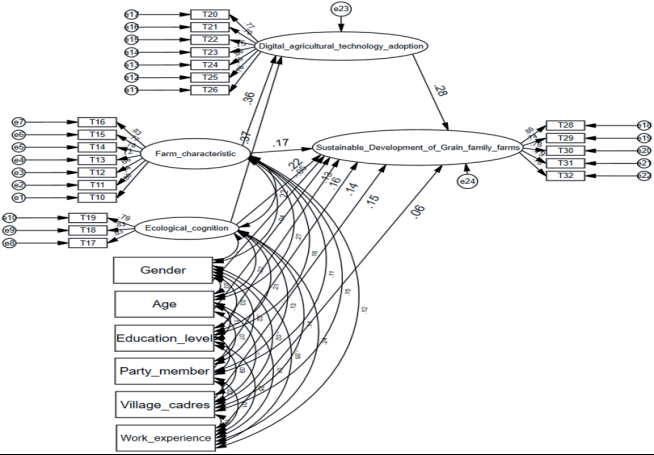
Table 8.
Test of the mediating effect.
Conclusions
Based on 309 samples of family grain farms, a structural equation model was used to analyze the ecological cognition, digital agricultural technology adoption, and the sustainable development of family grain farms. The results are in the following:
(1) Ecological cognition had a significant positive effect on the sustainable development of family grain farms. This provides profound insight and a substantial contribution to understanding and achieving sustainable agricultural production. Firstly, the study of ecological cognition provides a key theoretical framework for revealing farmers’ understanding of ecosystems and environments. By examining farmers’ perceptions, attitudes, and values, we were able to identify differences in perceptions of environmental sensitivity and ecosystem functioning, providing a theoretical basis for implementing targeted sustainable agricultural policies and practices. Secondly, studying the impact of ecological cognition on agricultural practice can help reveal how farmers apply and adjust ecological cognition in their daily agricultural activities. This research not only helps to understand farmers’ decision-making processes in land use, water management, biodiversity conservation, etc., but also provides practical guidance for designing training and education programs to promote more eco-friendly agricultural practices. (2) Digital agricultural technology adoption had a partial mediating effect on the impact of ecological cognition on the sustainable development of family grain farms. This provides key support and inspiration for achieving sustainable agriculture. First, research on digital agricultural technology adoption reveals farmers’ attitudes and behaviors towards the application of modern technologies in agriculture. Through an in-depth understanding of farmers’ applications of digital technologies such as the Internet of Things, big data, and artificial intelligence, we can identify potential application areas of digital technologies in agriculture, providing an empirical basis for the promotion of digital agricultural technologies. Secondly, research on digital agricultural technology adoption can help to understand the obstacles and drivers faced by farmers in the adoption of these technologies, provide practical suggestions for the formulation of policies and strategies to promote the application of digital agricultural technologies in family grain farms, and also help to design digital agricultural technology solutions that better meet the needs and expectations of farmers in order to accelerate their practical application in agricultural production. In addition, research on digital agricultural technology adoption also provides important clues to establish the correlation between ecological cognition and agricultural modernization. By analyzing farmers’ attitudes and practical applications of digital technologies, we are able to gain insight into the application of farmers’ ecological cognition to the sustainable development of family grain farms, thereby providing insight into the mediating role of digital agricultural technology adoption in promoting the development of agricultural production in a more eco-friendly direction.
Table 9.
Regression analysis of the mediating effect of digital agricultural technology adoption on the influence of ecological cognition on the sustainable development of family grain farms.
Based on the above analysis, the following suggestions are proposed: First, farmers’ ecological cognition level should be constantly improved to effectively promote the sustainable development of family grain farms. Improving the overall quality of ecological agriculture operators can help them master relevant practical technologies and improve the operating efficiency of family grain [29]. First, through training lectures, TV, and newspapers, and in other ways, the government should increase the publicity and reporting of agricultural ecological and environmental protection knowledge so that the development mode of ecological agriculture is embedded in the subjective consciousness of farmers.
Second, the government should select ecological agriculture development demonstration farms, set up models and examples, increase incentives, and encourage farmers to constantly improve their level of ecological cognition. At the same time, the homing plan should be implemented to support and encourage college graduates, urban talent, and entrepreneurs to devote themselves to the development of ecological agriculture, use their management and professional knowledge to better play a leading role, guide more traditional farmers to change their direction and develop ecological agriculture, and establish green and sustainable ecological consciousness.
Third, the government should increase support for the adoption of digital agricultural technologies and give full play to the mediating role of digital agricultural technologies. Using network information, artificial intelligence, and other technologies to improve the level of agricultural production, operation, management, and service is conducive to changing the traditional agricultural operation and development mode and to promoting the development of agricultural modernization [30]. It is one of the inevitable trends in the development of modern agriculture to use high-tech artificial intelligence, the Internet of Things, and other ways to build modern ecological farms. First, the government should set up a special subsidy fund for digital agricultural technology adoption to reduce the costs borne by the owners of farms. Second, the government should increase guidance and services for the use of digital agricultural technology and strengthen the maintenance and updating of digital agricultural technology.

