

Introduction
Family farms are an important microeconomic organization of modern agriculture, and they are an important part of the new large-scale, commercial, intensive, specialized, organized, and socialized modern agricultural management system [1]. Since the concept of family farms was put forwards for the first time and the major decision to develop family farms was officially made in 2013, China has paid increasing attention to the strategic foundational position of family farms in the process of agricultural and rural modernization and in promoting innovative power in agricultural management. Over the following ten years (2014-2023), China put forwards clear overall requirements for the cultivation of family farms and comprehensive development guidelines for their operation. Based on this, there has been a nationwide boom in the construction of family farms. According to official data, more than 4 million family farms were on the national list1, with an increase of approximately 10.66 times compared with 343,000 in 20152.
In recent years, by taking advantage of national support policies, realistic industrial foundations, and resource endowments, family grain farms have helped to vigorously develop the grain industry economy, strengthened their roles as “stabilizers” and “ballasts” of food security, and played a fundamental and important role in comprehensively promoting rural revitalization strategies. However, in this paper, we conducted a realistic investigation on the development status of family grain farms in commodity grain base counties (cities and districts) in major grain-producing areas, and found that family grain farms have some practical problems, such as a weak market-oriented perception, and weak abilities of organizational resilience, which restricts the sustainable development of family grain farms and prevents effective food security and sustainability.
The current research on sustainable development of family farms mainly focuses on three aspects: government regulation, operation performance, and realization approach. In terms of government regulation, Zhu W.L. et al. [2] used the DEA-Tobit method to measure the production performance of safe agricultural products on family farms, and explored the impact of government incentive regulations on the production performance of safe agricultural products of family farms and the analysis showed that government incentive regulations could significantly improve the production performance of safe agricultural products of family farms, but the improvement effect of various types of government incentive regulations on their performance was heterogeneous. Kusz B., Kusz D., Bak I., Oesterreich M., Wicki L., Zimon G. believes that the development of family farms inevitably faces the survival pressure of factor constraints, rising costs, operating difficulties, and insufficient financing, and it is urgent to use finance as a means of policy support, and fiscal policy choices should focus more on technology adoption, infrastructure construction, and other links that are not harmful to social welfare [3]. In terms of operation performance, scholars pay special attention to the factors that affect farm operation performance, for example, brand agriculture participation can significantly improve the performance of family farms [4], and farmland mortgage loan policy can significantly improve the operational performance of family farms [5]. In terms of realization approach, some scholars,from the perspective of the agricultural industrialization consortium,have proposed that joining cooperatives can help family farms manage market risks to maximize profits [6], and that signing contracts with leading enterprises for the production and marketing of agricultural products is an important way for family farms to resist market risks [7]. Some scholars have also directly studied the countermeasures to promote the development ability of family farms, for example, the “National Action to Promote New Agricultural Management Objects” (2022-2025) implemented by the Ministry of Agriculture and Rural Affairs presents an opportunity to enhance the development power of family farms [8], reconfigure agricultural production factors through institutional innovation to promote their development [9], and increase the income return of labor production factors to narrow the difference between agricultural income and non-agricultural income to promote the sustainable development of family farms [10].
To promote the sustainable development of farms, we need effective incentives from policies and regulations, and more importantly, we need farmers to recognize the value of market orientation. There are abundant research results on farm sustainable development, but there are some possibilities for expansion. One is the lack of research on the sustainable development of family farms from the psychological level of micro family farmers. The second is to ignore the impact of farm organization resilience on farm sustainable development.
Therefore, in this paper, a structural equation model and intermediary effect model were constructed to empirically analyze the relationship between market-oriented perceptions, organizational resilience, and the sustainable development of family farms from the perspective of endogenous development. For this analysis, survey data from 357 family grain farms in China were used. The marginal contributions of this article lies in two aspects: theory and practice. Theoretically, this paper innovatively applies the cognitive evaluation theory to the sustainable development of family farms and demonstrates the logical mechanism of family farms actively improving the level of market-oriented perceptions and then enhancing the ability of organizational resilience so as to achieve sustainable development in a market economy environment, which expands and enriches the research system of cognitive evaluation theory and provides theoretical support for understanding and interpreting the law of sustainable development of family grain farms. Practically, the paper explores effective ways for family farms to actively respond to market challenges and to carry out organizational innovation and reform to achieve sustainable development from the practical level, which provides important practical reference for agricultural government departments in China to make farm development policies and farm managers to make management decisions.
Material and Methods
Research Hypothesis
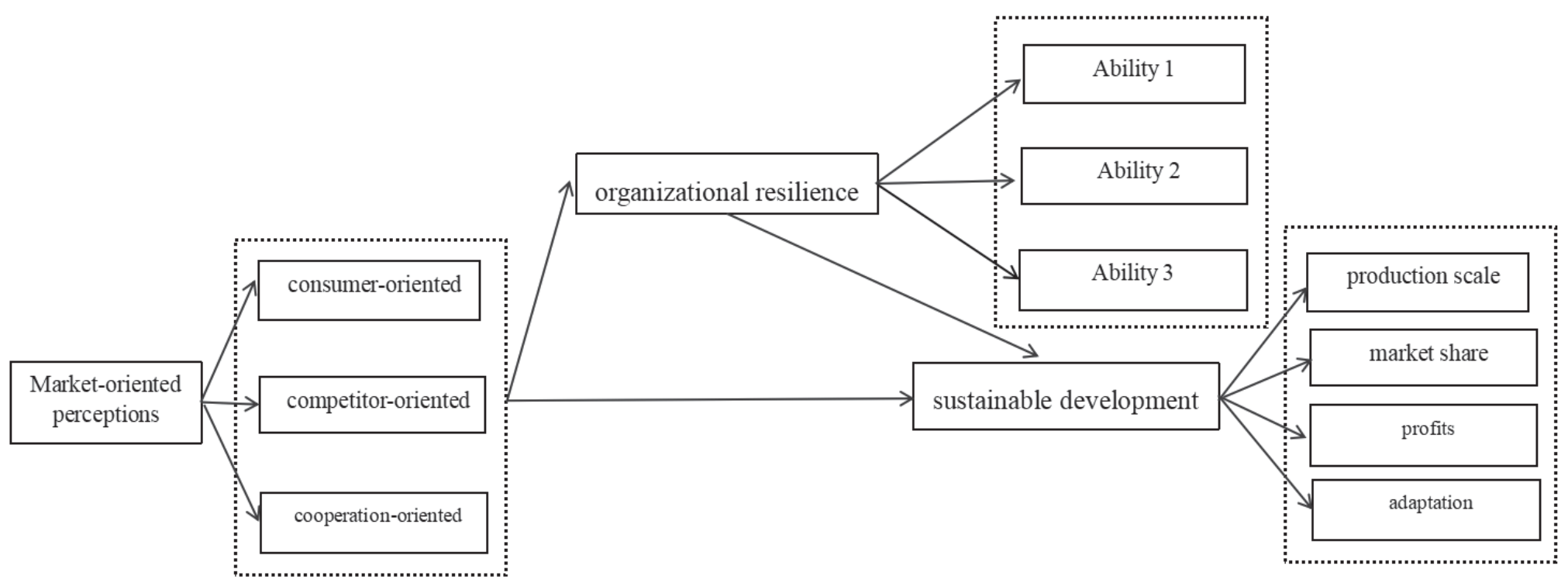
Cognitive evaluation theory is a crossover theory in psychology that combines cognition and emotion, focusing on the influence of individual psychological cognition on their emotions and behaviors [11]. Montoya R.M., Horton R.S. et al. introduced the cognitive evaluation theory into the study of sustainable development of companies, and the analysis showed that the clearer entrepreneurs’ market-oriented perceptions were, the more inclined they are to make behavioural responses that enhance organizational resilience, and the more conducive they are to promoting the sustainable development of companies [12]. Based on the cognitive evaluation theory and the research of existing scholars [13], we regard market-oriented perceptions of farms as three aspects: a consumer-oriented approach, a competitor-oriented approach and an internally cooperation-oriented approach, and comprehensively explore its impact on the sustainable development of family grain farms. A consumer-oriented approach is understanding of consumer needs, preferences and expectations. Improving the level of understanding of consumer needs can help farms better customize and develop products or services, improve the market competitiveness of products or services, increase sales and market share, reduce the risk of market failure, increase brand loyalty, and thus improve the sustainable development ability of farms. A competitor-oriented approach means to adjust market positioning of farms according to the positioning and advantages of competitors. Improved competitor-oriented perception can help farms pay close attention to market dynamics, regularly analyze competitors’ products, pricing, market share, marketing strategies, and other aspects of information, understand competitors’ strengths and weaknesses as well as the latest trends, identify competitive opportunities, and thus make timely responses to strengthen the sustainable development ability of farms. An internally cooperation-oriented approach means breaking down departmental barriers, improving organizational agility and responsiveness, and making farms more adaptable to rapidly changing markets and competitive environments. Improved internally cooperation-oriented perception can help farms better plan and allocate resources, maximize the utilization of farm resources, promote farm staff to cooperate better, share agricultural best practices, new technologies and experiences, promote agricultural innovation, improve agricultural production efficiency, and thus enable sustainable development of farms. Based on this, Hypothesis 1 is proposed:
H1: Market-oriented perceptions have a significant positive impact on the sustainable development of family grain farms.
Organizational resilience is a key variable for farms to cope, recover and grow in the face of a variety of stresses, challenges, changes, and uncertainties. Organizational resilience theory illustrates the path paradigm and logical mechanism of farm sustainable development, namely, market-oriented perception, organizational resilience and sustainable development. In the process of production and operation, farms may face a series of adverse market environment factors, such as changes in consumer demand, increasing market access thresholds, fierce trade and external competition, price fluctuations, and resource constraints. When the farm has a high degree of market orientation perception, it is conducive to the farm to accurately analyze market opportunities and risks, make behavioral responses of organizational resilience to cope with market changes, and then promote sustainable development. Based on this, Hypothesis 2 is proposed:
H2: Organizational resilience plays a mediating role in the impact of market-oriented perceptions on the sustainable development of family grain farms.
Based on the above hypothesis, the model is constructed as shown in Fig. 1.
Data and Sample Information
In 2022, our research group conducted a practical investigation of family grain farms in China by combining an online questionnaire survey and offline field survey. Drawing on Lan Y. et al.‘s research [14], a total of 370 questionnaires were issued, and 357 valid questionnaires were obtained, accounting for 96.49% of the valid questionnaires. Learning from the study of Zhang Yao et al. [15], the basic information of the samples was measured and characterized from five dimensions: basic characteristics of family grain farmers [16], basic characteristics of family grain farms [17], market-oriented perceptions, organizational resilience, and sustainable development of family grain farms [18], as shown in Table 1.
In terms of the basic characteristics of family farmers, among the sample, there were 252 men who came from 252 different family farms, accounting for 70.6% of the total, and 105 women who came from the remaining 105 different family farms, accounting for 29.4% total; these numbers reflected that there were more male farmers than female farmers. A total of 8.4% of the family grain farmers were under the age of 25, and 37.3% of the family grain farmers were between the ages of 26 and 40; that is, 45.7% of family grain farmers were under the age of 40, indicating that as an important new modern agricultural management body, with the support of a series of national policies, family grain farms are attracting young people to actively join the profession. The proportion of family grain farmers with college education or above was 16.5% of the total, the proportion of family grain farmers with secondary school or high school education was 33.9% of the total, and the proportion of family grain farmers with junior high school education is 35% of the total; this indicates that the educational level of family grain farmers is mainly concentrated at the junior high school level, with a proportion as high as 68.9% of the total, and the educational level is generally not high.
In terms of the basic characteristics of family grain farms, among the samples, the proportion of farms with an operation scale between 50 acres and 100 acres was 31.7% of the total, with that between 100 acres and 200 acres was 28.3% of the total, and with that between 200 acres and 300 acres was 12.9% of the total. In other words, the proportion of farms with a scale between 50 acres and 300 acres reached 72.9% of the total, showing an absolute advantage, which indicates that moderate scale management is most commonly adopted by China’s family grain farms; which aligns with the basic agricultural situation of “more people and less land”, and “less plains, more hills and mountains”. The proportion of farms that have operated between 2 and 5 years was the highest, 55.5% of the total, reflecting that the development of China’s family grain farms is still in its infancy, and the policy effect is more obvious. The proportion of family grain farms that have not been registered by the industrial and commercial departments of the government was 65.8% of the total, and the number of family grain farms without relatively complete financial revenue and expenditure records was 81.5% of the total, indicating that the operation of family grain farms is not standardized, the financial system is not sound and the implementation is not in place. The proportion of family farms that owned 5 to 10 agricultural machines and tools is the highest, 50.1% of the total, followed by farms with less than 5, 40.3% of the total; the proportion of family farms with agricultural machinery and tools with a value of 50,000 to 150,000 yuan is 37.8% of the total, followed by farms with such machinery and tools with a total value of 150,000 to 300,000 yuan, accounting for 33.1% of the total. Farms with a total value of more than 300,000 yuan of agricultural machinery and tools accounted for only 9.5% of the total; this reflects the continuous improvement of the mechanization level of family grain farms, however, there is still considerable room for improvement. The proportion of two-season family grain farms was the highest, which was 57.1% of the total, indicating that production factors, such as land and labor of family grain farms, were fully utilized. The proportion of family grain farms that signed sales contracts with agricultural enterprises was 75.1% of the total, indicating that most family grain farms have stable sales channels and have formed a relatively complete vertical integration operation mode.
In terms of market-oriented perception, among the 357 samples, in single choice of “strongly disagree”, “disagree”, “neutral”, “agree”, “strongly agree”, 155 family farmers agreed that family grain farms should be consumer-oriented and strive to meet the various needs of consumers for agricultural products, accounting for the highest proportion (43.4%). A total of 159 family farmers agreed that family grain farms should be competition-oriented, pay close attention to the trends of competitors, and seize the favorable position by taking effective countermeasures; they represented the highest proportion, with 44.5% of the sample. A total of 160 family farmers who agreed that family farms should be oriented by internal cooperation to produce high-quality and inexpensive agricultural products and create value for consumers accounted for the highest proportion, with 44.8% of the sample.
In terms of organizational resilience, among the samples, in single choice of “strongly disagree”, “disagree”, “neutral”, “agree”, “strongly agree”, 139 agreed that family grain farms could take various actions quickly and flexibly in the face of a consumption crisis, accounting for the highest proportion, with 38.9% of the total, and 134 agreed that family grain farms could formulate various plans in the face of adverse changes in a competitive environment to turn crises into opportunities, accounting for the highest proportion, with 37.5% of the total. A total of 133 agreed that family grain farms could ensure that internal personnel, money and assets can play their roles and enable farms to maintain good overall cooperation, accounting for the highest proportion, with 37.3% of the sample.
In terms of the sustainable development of family grain farms, among the samples, in single choice of “strongly disagree”, “disagree”, “neutral”, “agree”, “strongly agree”, 173 agreed to expand the scale of agricultural production, accounting for the highest proportion, with 48.5% of the total, and 137 agreed to increase the market share of agricultural products, accounting for the highest proportion, with 38.4%. A total of 130 agreed that the farm had increased profits, accounting for the highest proportion of 36.4% of the sample; 140 agreed that the farm could quickly adapt to external environmental development, accounting for the highest proportion of 39.2% of the sample.
Table 1.
Basic characteristics of the samples.
Research Methods
Structural Equation Model
Structural equation models are mainly used to analyze variables that are difficult to observe and to explore causal effects among latent variables [19]. Based on the research of Sun Jiajia et al. [20], the structural equation model is used to empirically analyze the relationship between market-oriented perceptions, organizational resilience, and sustainable development of family grain farms, which not only solves the error and measurement problems, but also visually displays the path relationship between latent variables [21]. The general equation of the SEM is as follows:
Equations (1) and (2) are measurement equations, where P are endogenous latent variables; M is the observable variable of P; σ is its error term; X is an exogenous latent variable; N is the observable variable of X; ε is its error term; and α and β represent the relationship coefficients between the variables. Equation (3) is the structural equation. The relationship between P and X, P and P is reflected by equation coefficients A and B and error γ, where P is the sustainable development of family grain farms; X is the basic characteristics of family grain farmers, the basic characteristics of family grain farms, market-oriented perceptions, and organizational resilience.
Variable Selection Description
Based on the model setting in the theoretical part, this paper sets three latent variables according to the cognitive evaluation theory, namely, sustainable development, market-oriented perception, and organizational resilience, and draws reference from Rossier R., Wyss B. et al. ‘s selection of various indicators to design the measurement items used in this paper [22]. Among them, “sustainable development” is measured by four observed variables: expanding the production scale of agricultural products, increasing the market share of farm agricultural products, increasing farm profits, and promoting the rapid adaptation of farms to the external development environment. “Market oriented perception” is measured by three observed variables: a consumer-oriented approach, a competitor-oriented approach, and an internally cooperation-oriented approach; “the organizational resilience” is measured by three observed variables: the ability to cope with consumption crisis, the ability to cope with adverse changes in competition, and the ability to integrate internal resources. In the measurement, this paper adopts the form of 5-level Likert scale to measure. For each question item, the survey subjects choose 1 to 5 values to represent respectively ”strongly agree“, “agree“,”neutral“, “disagree“ and ”strongly disagree“.
Additionally, referring to Smedzik-Ambrozy K., Guth M., Majchrzak A., Muntean A.C., Maican S.S. et al.‘s research [23], the control variables are respective items of basic characteristics of family grain farmers and basic characteristics of family grain farms. Items of basic characteristics of family grain farmers are gender, age, and education level, and items of basic characteristics of family grain farms are operation scale, operation years, status of registration by industrial and commercial departments, status of relatively complete financial revenue and expenditure records, the number of owned agricultural machinery and tools, the total value of its own agricultural machinery and tools, status of double cropping, and status of signed sales contracts with agricultural enterprises. The details are shown in Table 2.
Table 2.
Variable description and descriptive statistics.
Results and Discussion
Reliability, Validity, and Fitting Analysis of the Structural Equation Model
Cronbach’s α was selected as the credibility index for data verification, KMO and Bartlett sphericity were selected as the validity test indices [24], and AMOS software was used for reliability and validity analysis.
Generally, the Cronbach’s α value of the scale or questionnaire is greater than 0.80, indicating that the reliability coefficient of the scale or questionnaire is good; if the Cronbach’s α value of the scale or questionnaire is between 0.70 and 0.80, the reliability coefficient of the scale or questionnaire is acceptable [25]. If the Cronbach’s α value of the subscales is greater than 0.70, the reliability coefficient of the subscale is good; Cronbach’s α value of the subscales is between 0.60 and 0.70, indicating that the reliability coefficient of the subscales is acceptable [26]. The Cronbach’s α reliability coefficients of the subscales in the questionnaire in this paper are all above 0.7 (as shown in Table 3), and the reliability of the questionnaire is ideal according to the above criteria.
Table 4.
KMO and Bartlett tests.
| KMO sample appropriateness measure | 0.845 | |
|---|---|---|
| Bartlett sphericity test | Approximate chi-square | 1347.81 |
| Degree of freedom | 45 | |
| Significance | 0 | |
KMO and Bartlett tests of this scale are shown in Table 4. The KMO statistic = 0.845, greater than 0.8, is suitable for factor analysis[27]. In addition, Bartlett’s sphericity test rejects the null hypothesis, and each variable has a strong correlation[28].
As seen from Table 5 of the variance contribution rate, there are 3 common factors with eigenvalues greater than 1, so the first 3 common factors are extracted [29]. The cumulative variance contribution rate of the 3 common factors is 69.629%, indicating that these three common factors can explain 69.629% of the variation in all variables, and the explanation degree is good.
Factor rotation was performed on the 3 extracted common factors to obtain the factor load Table 6 after rotation [30], where T21-T24 has a higher load on the first factor, T18-T20 has a higher load on the second factor, and T15-T17 has a higher load on the third factor, which is consistent with the expected dimension division and has good validity.
According to the model fitting test in Table 7 [31], X²/df is lower than 3, RMR, and RMSEA are lower than 0.08, and CFI, TLI, IFI, and GFI are all greater than 0.9. The model is well fitted.
Path Analysis of the Structural Equation Model
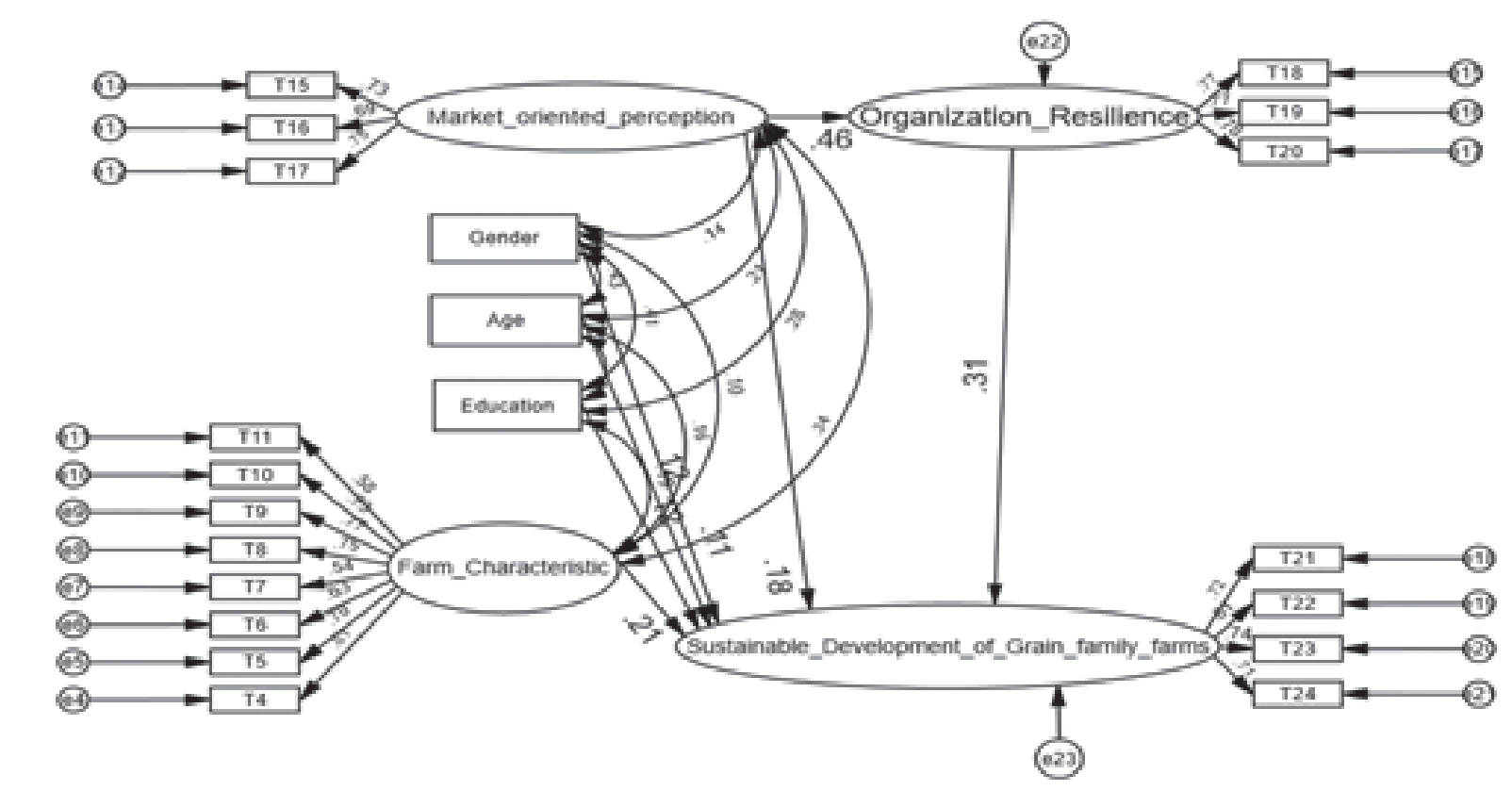
It can be seen from Table 8 of the path analysis and Fig. 1 of the model path [32] that market-oriented perception has a significant positive impact on organizational toughness (p<0.05), and its standardized coefficient is 0.461. The higher the level of market-oriented perception of farmers is, the stronger organization resilience of farms is. Organizational resilience has a significant positive impact on the sustainable development of family grain farms (p<0.05), and its standardized coefficient is 0.311. The stronger the organizational resilience of the farm is, the better it can cope with various internal and external situations, and the more it can promote its sustainable development. The basic characteristics of family grain farms have a significant positive impact on the sustainable development of family grain farms (p<0.05), and the standardized coefficient is 0.207. Market-oriented perception has a significant positive impact on the sustainable development of family grain farms (p<0.05), and its standardized coefficient is 0.178, which indicates that the higher the level of market-oriented perception of farmers is, the more able they are to understand consumer needs, respond quickly to market changes, and innovate and improve technology, so as to protect the environment through the implementation of sustainable agricultural practices, and ultimately achieve sustainable development of farms. Therefore, Hypothesis 1 is verified. Gender has a significant positive impact on the sustainable development of family grain farms (p<0.05), and its standardized coefficient is 0.108. Age had a significant positive impact on the sustainable development of family grain farms (p<0.05), and its standardized coefficient was 0.121. It may indicate that the older the farmer is, the more experienced he is in production and operation, and the more effectively he can deploy resources to achieve sustainable development of the farm. Education level had a significant positive impact on the sustainable development of family grain farms (p<0.05), and its standardized coefficient was 0.120. It may show that the more educated the farmer is, the more extensive knowledge and skills he has, the better he can understand and apply modern agricultural technology, and the more he can promote the sustainable development of the farm.
Table 3.
Reliability coefficient.
| α | Number of terms | |
|---|---|---|
| Market-oriented perceptions | 0.77 | 3 |
| Organizational resilience | 0.819 | 3 |
| Sustainable development | 0.836 | 4 |
| Overall reliability | 0.841 | 10 |
Table 5.
Total variance interpretation.
Table 6.
Component matrix after rotation.
| Component | |||
|---|---|---|---|
| 1 | 2 | 3 | |
| T21 | 0.817 | ||
| T22 | 0.815 | ||
| T24 | 0.764 | ||
| T23 | 0.758 | ||
| T19 | 0.829 | ||
| T20 | 0.823 | ||
| T18 | 0.814 | ||
| T15 | 0.826 | ||
| T17 | 0.809 | ||
| T16 | 0.786 | ||
According to the BOOTSTRAP test (as shown in Table 9) [33], the confidence interval of the indirect effect (market-oriented perception -> organizational resilience -> sustainable development of family grain farms) does not contain 0. Therefore, organizational resilience plays a mediating role in the impact of market-oriented perceptions on the sustainable development of family grain farms.
Table 7.
Model fitting degree analysis.
| Fitting index | X²/df | RMR | RMSEA | CFI | TLI | IFI | GFI |
|---|---|---|---|---|---|---|---|
| Fitting value | 1.307 | 0.041 | 0.029 | 0.981 | 0.977 | 0.981 | 0.943 |
Table 8.
Path analysis of the structural equation.
Table 9.
Test of intermediary effect.
| Effect value | Lower limit | Upper limit | P value | Effect ratio | |
|---|---|---|---|---|---|
| Direct effect | 0.178 | 0.04 | 0.301 | 0.013 | |
| Indirect effect | 0.143 | 0.075 | 0.226 | 0 | 44.55% |
| Total effect | 0.321 | 0.191 | 0.439 | 0.001 |
Therefore, organizational resilience was applied to market-oriented perceptions of the sustainable development of family grain farms through intermediary regression, and the regression results are shown in Table 10 [34].
In Model 2, the impact of the market-oriented perception of the independent variable on the organizational resilience of the intermediary variable passes the significance test at the level of 0.001. In Model 5, after controlling for the market-oriented perception of the independent variable, the impact of the organizational resilience of the intermediary variable on the sustainable development of the dependent variable passes the significance test at the level of 0.001, with a coefficient of 0.233. Moreover, after adding the intermediary variable, the coefficient of market-oriented perception decreases from 0.222 to 0.160, which is tested step by step according to the intermediary effect [35]. In the first step, in Model 4, the effect of market-oriented perception of the independent variable on the dependent variable is significant (β = 0.222, p<0.001). In the second step, in Model 2, the effect of market-oriented perception of the independent variable on the intermediary variable is significant (β = 0.265, p<0.001). Third, after adding the independent variable, the effect of organizational resilience of the intermediary variable on the dependent variable is significant (β = 0.233, p<0.001). The hypothesis that organizational resilience plays a partial mediating role between market-oriented perception and the sustainable development of family grain farms has been verified. It shows that organizational resilience of farms can help farmers better respond to market change and uncertainty, make flexible decisions, plan for long-term sustainability goals, and foster learning and innovation, thereby helping to ensure that farms remain sustainable development in a changing environment.
Table 10.
Intermediate regression analysis.
| Organizational resilience | Sustainable development | ||||
|---|---|---|---|---|---|
| Model 1 | Model 2 | Model 3 | Model 4 | Model 5 | |
| Gender | 0.147 | 0.144 | 0.190* | 0.187* | 0.153* |
| Age | 0.155** | 0.143** | 0.143** | 0.133** | 0.099* |
| Education | 0.099* | 0.072 | 0.120** | 0.098* | 0.081* |
| Operation scale | 0.064 | 0.059 | 0.054 | 0.051 | 0.037 |
| Years of operation | 0.032 | 0.014 | -0.049 | -0.065 | -0.068 |
| Registered with the Industry and Commerce Department | -0.097 | -0.116 | -0.010 | -0.026 | 0.001 |
| Has relatively complete financial revenue and expenditure records | -0.065 | -0.072 | 0.005 | -0.001 | 0.016 |
| Number of owned farm machinery | 0.243** | 0.237** | 0.101 | 0.096 | 0.041 |
| Total value of farm equipment owned (ten thousand yuan) | 0.015 | -0.005 | 0.048 | 0.032 | 0.033 |
| Double cropping condition | 0.005 | 0.010 | 0.115 | 0.119 | 0.116 |
| Sales contracts with agricultural enterprises were signed | 0.097 | 0.073 | 0.150 | 0.130 | 0.113 |
| Market-oriented perceptions | 0.265*** | 0.222*** | 0.160** | ||
| Organizational resilience | 0.233*** | ||||
| R2 | 0.199 | 0.248 | 0.266 | 0.309 | 0.359 |
| R2 variation | 0.049 | 0.042 | 0.050 | ||
| F | 7.775 | 9.461 | 11.375 | 12.792 | 14.757 |
| F variation | 22.645 | 21.089 | 26.818 | ||
Conclusions
Based on the sample data of 357 family grain farms in China, this paper uses a structural equation model and intermediate effect model to conduct empirical analysis on market-oriented perception, organizational resilience and sustainable development of family grain farms. The results show that: market-oriented perception has a significant positive impact on the sustainable development of family grain farms; and organizational resilience plays a mediating role in the impact of market-oriented perception on the sustainable development of family grain farms. Such findings, first of all, allow us to focus on how farmers perceive market needs and opportunities, and integrate market-oriented factors into the decision-making process of farm sustainability, so that we can better understand how farmers respond to market requirements to improve farm sustainability. The second is to fill the theoretical gap on how farm management adapts and responds to market challenges, thereby promoting farm sustainability and the development of agricultural systems. The details are as follows.
From the practical significance of the research conclusion,the farm must be market-oriented, pay attention to the acquisition and analysis of market information, be able to timely adjust the production structure and strategy according to the market demand, produce products that meet the market demand, take the initiative to adapt to market changes, comprehensively evaluate and manage market risks, actively introduce new technologies, improve the efficiency of resource use, and enhance market competitiveness. From the policy significance of the research conclusions, the government should actively provide market information services to farms, encourage and support farms to adjust production according to market demand, provide subsidies or other forms of financial incentives for farms that can prove that their production is aligned with market demand and adopt environmentally friendly production methods, promote sustainable agricultural practices, and formulate agricultural insurance policies that accurately cover the risk of market fluctuations and develop standards and certification systems that meet market requirements for sustainable production. In addition, we should improve organization resilience of farms, enhance the adaptability of farms, maintain the continuity and stability of farm production, and strengthen the innovation practice ability of farms. The focus of policy support should shift from single productivity to broader indicators including organizational resilience. Through education and training, we should raise farmers’ awareness of market changes, enhance their ability to cope with market fluctuations, and promote farm resilience. We should encourage agricultural, scientific, and technological innovation, including the application of agricultural smart technology, improving the adaptability and resilience of farms, and promoting the sustainable development of farms. The details are as follows.
First, we need to enhance market-oriented perceptions among family farmers. On the one hand, it is important to strengthen farmers’ training in market-oriented perceptions, clarify their important position as market objects, expand and deepen their comprehensive understanding and understanding of the policies in the economic market environment and of the agricultural product market, cultivate their market-oriented operation thinking, enhance their sensitivity to market-oriented operations, and make them respond to the market demand and changes [36]. Additionally, we should actively carry out reforms and innovations in the supply side of agricultural products and produce marketable agricultural products that meet the needs of consumers to improve the operation performance of farms. On the other hand, we should strengthen the capabilities of farmers to perform scientific research on competitive market trends and assess these trends. Farmers can also strengthen their understanding of the dynamics of competitors to accurately grasp their advantages and opportunities. This will allow farmers to strengthen their efficient cooperation and close coordination of production factors within the farm, and skillfully deal with the disadvantages and threats of normal competition [37]. Farmers can make reasonable adjustments to and optimize the farm’s strategic planning and positioning, business practices, and brand marketing strategies in a timely manner, constantly improve the core competitiveness of the farm, and effectively meet the new needs of consumers with a diversified high-quality product supply, thus creating unique value for consumers and promoting the improvement of farm operation performance [38].
Second, we should vigorously improve the organizational resilience of family grain farms. On the one hand, we can formulate and optimize a multidimensional and multifield regular response behavior plan for farms to cope with consumption crises and adverse changes in the competitive environment, construct and improve an emergency response mechanism for farms to deal with unexpected adverse events and conditions in the market that will gradually become a more mature response behavior plan for adverse changes, and improve the planning system according to the specific production and operation practices of farms in a timely manner; these measures will ensure that farms use efficient response behavior in response to adverse conditions and that these actions have good results [39]. On the other hand, we should introduce innovation into the organization and management mechanisms of the farm, adhere to the principles of unity and flexibility, strengthen the open coordination and connection of nodes within the farm organization, form a regular production and operation practice ecosystem with clear goals and unified actions, and optimize the allocation and scheduling of innovative human, financial, and material resources across multiple aspects, aligning them with the actual situation of production and operation [40]. We should actively and flexibly respond to various adverse factors, ensure the stability of the foundational framework of farm production practices, and ensure the sustainable operation of farms.
In short, the above conclusions and countermeasures can also be applied to other new types of agricultural business entities, such as farmers’ professional cooperatives, major professional households, and agricultural enterprises to a certain extent, so as to promote the sustainable development of new types of agricultural business entities and ensure food security. Of course, on the basis of the research in this paper, we can further explore the differentiated market behavior of other new agricultural management entities, such as farmers’ specialized cooperatives to achieve sustainable development. The limitation of this paper is that the sustainable development of family grain farms is only discussed from the perspective of economic benefits, which should cover multiple perspectives, such as economic benefits, social effects, and ecological benefits. Therefore, social benefits and ecological benefits should be integrated into the follow-up research.

