

Introduction
The Paris Agreement was officially implemented on November 4, 2016, which is a legally binding agreement for global action to address climate change after 2020, expressing the high attention of governments around the world, including China, to the issue of carbon mitigation. In industrialization and urbanization, China has formed an economic development model that is extremely dependent on energy factors [1]. While the economy is growing at a high speed, it is also facing enormous pressure to reduce carbon emissions. According to the “World Carbon Dioxide Emissions Report 2022” released by the Joint Research Center of the European Commission (JRC), China’s fossil carbon dioxide emissions in 2021 were 5.1 times those of 1990, making it the world’s largest carbon emitter. Realizing the synergistic effect between the economy and environment and improving carbon efficiency has become an important, urgent issue to be solved at present.
Faced with the pressure of carbon emissions, the Chinese government often seeks breakthroughs at the policy level. Currently, the government has effectively promoted China’s carbon emission reduction process through various policies and practices, such as environmental protection laws and regulations [2], environmental governance investment [3], and low-carbon city pilot projects [4]. These carbon reduction policies share a common feature, as they are mostly mandatory policies issued by the Chinese central government and implemented by local governments, which we refer to as top-down environmental regulatory policies. However, existing literature has pointed out that top-down environmental regulations, due to a lack of understanding of local affairs, can lead to inefficient environmental management [5, 6]. The RCS that we focus on is a new type of environmental regulatory policy that combines “top-down” and “bottom-up” approaches [7]. It was first born in the water management practice of Wuxi City, Jiangsu Province. After achieving governance results, it was promoted by the central government to other cities, combining the top-down management guidance of the central government with the bottom-up management autonomy of local governments to form a unique environmental management system. Therefore, compared to other governance measures, the RCS has a natural advantage in mobilizing the initiative of local governments. This advantage has been fully utilized not only in the field of water treatment, but also in the process of local governments rectifying polluting enterprises, which has reduced local carbon emissions levels. Therefore, whether the RCS can become an important breakthrough in China’s carbon emission reduction has become a question worth exploring in the context of “carbon peaking and carbon neutrality goals”.
At present, the institutional management model of the RCS has been fully explored in previous literature, and its water pollution control effect has been verified in various aspects.[8-10] Only a few studies have noticed the potential carbon reduction effects of the RCS [11] but they have not been empirically tested. In addition, there are even fewer studies that empirically test the mechanism of RCS on carbon emission efficiency. In addition, due to the lack of carbon emission data at the city level, most of the existing literature studies the performance of carbon emission efficiency at the provincial or regional level and lacks a more microscopic and detailed study, which makes it difficult to measure the conclusions and recommendations that are more in line with the reality of the city. Therefore, this paper makes use of nighttime lighting data to deduce urban carbon emission data in reverse, studies the impact of RCS on carbon emission efficiency on the basis of measuring carbon emission efficiency at the city level, discusses the specific path of this impact and the conditions of its application, explores the neighboring effect (spatial spillover effect) of this impact, and puts forward effective policy recommendations for further improving the RCS and improving carbon emission efficiency. This is also the research purpose of this paper.
Our research has made the following contributions to previous literature: 1) This study advances our understanding of RCS from a carbon emission efficiency perspective. Previous literature only focused on the effectiveness of water management under the RCS and neglected the effectiveness of carbon control, but our research fills the critical gap. 2) Based on existing literature, we further take into account the estimation bias caused by the spatial correlation between environmental governance and carbon emissions, which could enhance the credibility of this paper.
The rest of the paper is organized as follows: The second part provides the policy background and literature review, the third part provides the theoretical mechanisms and research hypotheses, the fourth part is the research design, which explains the main models and variables, the fifth part draws on and discusses the empirical results, and the sixth part summarizes the main conclusions and provides policy recommendations.
Policy Background and Literature Review
In May of 2007, a large number of cyanobacteria broke out in the Taihu Lake in Wuxi, Jiangsu Province. The Wuxi Municipal Government immediately appointed heads of districts and counties as river governors to take charge of water pollution control in rivers and lakes. One year after the implementation of the RCS, the compliance rate of 79 river assessment sections in Wuxi City has increased from 53.2% to 71.1% [12], and the water environment has significantly improved. Subsequently, the successful experience of the river chief system was replicated in Liaoning, Guizhou, Zhejiang, and other places. In 2016, a policy document called “Opinions on the Comprehensive Implementation of the River Chief System” was released by the State Council, officially clarifying the organizational form and responsibility mechanism. It is explicitly proposed to establish a comprehensive river chief system, with the main officials serving as “river chiefs” responsible for water pollution control within their jurisdiction. And regard environmental performance as one of the indicators for promoting local officials. Nowadays, many regions have also incorporated the river chief system into local regulations, leading RCS to develop in a conventional and long-term direction.
The system content of RCS includes four aspects: party and government leadership, departmental collaboration, hierarchical management [13], and assessment and supervision. Firstly, the river chief system mainly highlights the main responsibilities of local parties and government leaders. As the chief of the river, local officials are responsible for overseeing the water-related affairs in the region, including water resource protection, water pollution prevention, and water ecological restoration[8]. And the environmental governance tasks were linked to the officials’ political achievements [14]. Secondly, the river chief leads various local water-related departments [10], such as environmental protection departments, water conservancy departments, and land and resource management departments, to solve comprehensive cross-departmental water pollution control tasks and strengthen inter-departmental collaboration [15] in environmental governance through the river chief joint meeting system, information sharing system, and other measures. Thirdly, the RCS follows the principle of hierarchical management [10]. The local river leaders will refine their work objectives and allocate them to their subordinate municipal and county-level river chief offices. They will evaluate and supervise the completion of their tasks and implement environmental governance tasks for all levels of river leaders through established assessment and accountability systems and incentive systems.
The above is an analysis of RCS at the institutional level, however, in the actual environmental management process, we find that RCS plays a management effect that not only reduces the pollution of the local rivers but also influences the cleaner production of enterprises, the improvement of energy efficiency, and the change of the product structure, which indirectly affects other aspects of environmental protection such as carbon emissions management. We find that cities that have implemented the RCS earlier, such as Wuxi, Suzhou, and Foshan, are also significantly more efficient in terms of carbon emissions than other cities. Therefore, a natural question to ask is how RCS contributes to local carbon reduction practices.
A related strand of literature on this issue is the study of environmental regulation on carbon governance. In essence, the RCS is an innovative local environmental regulation policy with the basic attributes of traditional environmental regulation. The academic community has generated opposing views on how traditional environmental regulations affect carbon emissions: One is the “green paradox” hypothesis [16-18]. They argue that strict environmental regulations lead to increased carbon emissions. Sinn (2008) first proposed the “green paradox” of environmental policy and defined it as environmental policy leading to a more recent path of fossil energy extraction, and he used the Kyoto Protocol as an example to illustrate that environmental policy only depresses the world price of carbon and reduces the market expectations of energy owners, leading to accelerated fossil energy extraction [16]. On this basis, some scholars put forward a more stringent “strong green paradox” hypothesis, using the net discounted value of environmental damage of total emissions in each period as a criterion and defining the situation in which environmental policy leads to an increase in the net present value of environmental damage as the “strong green paradox” [19]; The other is the “forced emission-reduction” effect [20]. Their point is this: Environmental regulations can reduce the demand for fossil energy and encourage innovation in low-carbon production technologies, thereby limiting carbon emissions in the production process and improving carbon efficiency. Shobande et al. support this view by analyzing the impact of energy policies on carbon emissions based on dynamic stochastic general equilibrium modeling in three countries - the United States, China, and Nigeria - arguing that these strategies can reduce carbon emissions and suggesting the implementation of carbon tax reforms [21]. In addition to a carbon tax, the implementation of a carbon emissions trading system can stimulate low-carbon innovation and reduce corporate dependence on traditional energy sources [22, 23]. This phenomenon has been explained in existing articles, with Porter arguing that firm competitiveness stems from the ability to innovate and improve rather than from static efficiency and that stringent environmental regulations can increase firm competitiveness by stimulating innovation to offset the costs of compliance [24]. However, with more detailed and in-depth research on environmental regulation, many scholars have found that environmental regulation and carbon emission efficiency are not a simple linear relationship [25] if the heterogeneities of industry and environmental regulations are taken into account [26]. Some scholars believe that there is a U-shaped relationship between the intensity of environmental regulations and carbon reduction technology. When environmental regulation is at a low level, the innovation disincentive effect dominates, and after a threshold is reached, the innovation compensation effect comes into play [27]. Progress in low-carbon technology can accelerate this process [28].
Although the above literature has not drawn a unified conclusion, it still provides a useful reference for this article. As for the RCS, its impact on the environment may not fully follow the existing path of traditional environmental regulations. RCS is an institutional innovation in the local government’s environmental governance system, inherited from the supervision system of water pollution governance and the environmental accountability system [29]. It requires the delegation of environmental responsibility, clear accountability, and a strong regulatory style to greatly alleviate the serious problem of inadequate policy implementation [30], making the RCS more targeted and policy enforced than traditional environmental regulations, opening up a new path for regional environmental governance in China. Literature has examined the RCS in terms of its policy background, organizational form and hierarchy, environmental governance mechanism, effectiveness of cross-basin governance, etc. Li Jing et al. point out that there are three deficiencies in China’s water governance system: irrational division of powers and responsibilities between the central government and local authorities, fragmented governance at the horizontal level, and difficulties in environmental protection supervision. The river chief system clarifies the local authority and responsibility for governance and advocates the establishment of a regional decision-making center to solve the conflict of interest between departments and the problem of supervision [30]. Similarly, Zhang et al. believe the RCS activates the vitality of subject control through institutional embedding, eliminates the fragmentation of watershed governance through spatial embedding, and integrates the regional ecosystem into the traditional Chinese environmental governance hierarchy [31]. Scholars recognize Institutional Innovations in RCS, but most of them hold a dual attitude toward their environmental governance effects. On the one hand, scholars acknowledge that RCS has been very successful in solving the multi-departmental water control dilemma in River and Lake Protection [31]. Liu et al. used a cooperative game approach to demonstrate that RCS is an inevitable outcome of the Sustainable Water Resource Management Affairs (SWRMA) cross-regional negotiations and that RCS helps to reduce transaction costs and external costs in cross-regional negotiations and mobilizes local governments’ incentives to govern water [32]. Xiong Ye also believes that RCS addresses the lack of authority in trans-regional river governance, which uses the authority of the river chief and the river chief’s office to improve integration and implementation in trans-regional river governance. The river chief system forces collaboration through accountability and motivates regional leaders to carry out collaborative governance [29].On the other hand, scholars believe that it is questionable whether the RCS can become a long-term mechanism for environmental governance [33] because the government-dependent characteristics make it difficult to ensure real public involvement and supervision [13]. In addition, cosmetic pollution governance [30] and the lack of a principal agent and supervision [34] are also key factors that constrain the effectiveness of the RCS.
Existing studies have not reached a consistent conclusion on the relationship between environmental regulation and carbon emissions, and as the RCS is a new environmental regulation policy implemented in China in recent years, there is little literature exploring the carbon emission reduction effect of the RCS as a separate policy. Therefore, in the context of global climate change and the ongoing attempts to reduce carbon emissions in various countries, it would be interesting to explore how the RCS affects carbon emissions and to open the “black box” of local carbon governance.
Theoretical Analysis and Hypothesis
River Chief System and Carbon Emission Efficiency
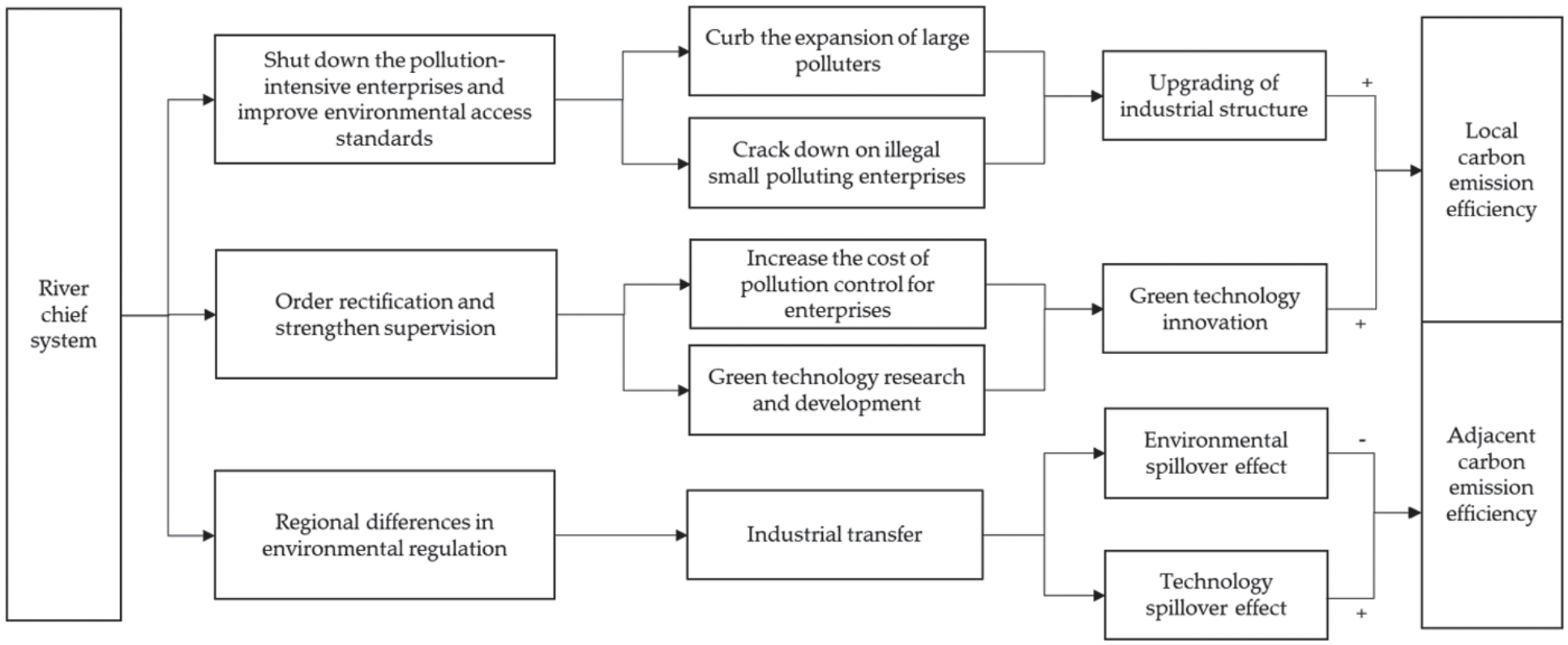
The river chiefs have exclusive property rights over regional rivers, which not only encourages local officials to use mandatory measures to control pollution and improve the efficiency of environmental governance but also achieves the effect of a “race to the top” [35] in local governments. At the same time, local river chiefs assume the responsibility of comprehensively coordinating various departments and improving integration in cross-regional river governance through the authority superposition [29], making environmental governance free from bureaucracy, which is conducive to overall environmental improvement and carbon emission efficiency improvement. This article argues that the impact of RCS on carbon emission efficiency can be summarized as two paths: industrial structure upgrading and green technology innovation, as shown in Figure 1.
Upgrade of Industrial Structure
The RCS is an order-control policy that achieves efficient environmental governance mainly by strengthening administrative control. First, governments at all levels are required to strengthen the supervision of polluting enterprises, strictly enforce local laws and regulations, penalize enterprises that violate the law by discharging pollutants, or even shut down heavily pollution-intensive enterprises that do not meet environmental protection requirements. The second is to raise environmental access standards, take full account of the impact of projects on the quality of the regional environment, and impose higher requirements on production processes and pollutant discharges. These measures have strengthened the punishment mechanism of the RCS. To avoid high pollution emission costs, enterprises continuously adjust their production behavior, reallocate internal resources, transfer production factors from high-pollution sectors to low-pollution sectors, and promote benign adjustment within the industrial structure [36].
The implementation of the RCS has led to a rise in the price of local factors in polluting production, which has also led enterprises to reconsider their location of production and sales. Specifically, it increases the intensity of regional environmental regulation. According to the “pollution shelter” effect, polluting enterprises will shift to low environmental regulation zones to avoid environmental regulation costs and facilitate the optimization of local industrial structures.
Green Technology Innovation
The impact of the RCS on the green technology innovation of enterprises is mainly based on the perspective of the dynamic competitiveness of enterprises. The local river chiefs ordered the polluting enterprises to adopt clean production methods and construct pollution treatment facilities, as well as, strengthen supervision over industrial enterprises and monitor wastewater discharge in real time. The RCS requires the establishment of an environmental protection incentive mechanism to reward and support enterprises with excellent environmental performance. These measures have also had a certain impact on enterprise innovation behavior. From previous studies, it is generally believed that there are “compliance costs” and “innovation offsets” effects [24] in the impact of environmental regulations on green technology innovation. To save pollution control costs and maximize profits under long-term conditions, enterprises must increase investment in research and development of green technologies and accelerate the transformation of the original polluting production methods, which induced innovation in clean energy technology [37]. At the same time, RCS may affect green product innovation indirectly by stimulating the demand for green products/ services [38]. Thus, we put forward Hypothesis 1: H1: The River Chief System can improve urban carbon emission efficiency through industrial structure upgrading and the innovation of green technology.
Spatial Spillover Effects
The environmental decentralization characteristic of the RCS makes environmental governance autonomous across regions, leading to regional differences in the intensity of environmental regulation [36]. Faced with intense environmental pressure, enterprises can either absorb environmental “compliance costs” through cleaner production or transfer polluting industries to surrounding areas to reduce the overall cost of environmental regulations; this is what we call regulatory arbitrage [39]. The relocation of polluting firms will lead to an increase in carbon emissions in neighboring regions, which is not conducive to the upgrading of industrial structures and the improvement of carbon emission efficiency.
From another perspective, the RCS may also generate a positive spatial spillover effect through technology spillover effects and imitation effects. If RCS induces endogenous technical change in the home region and the energy-saving innovations can freely spill over to the neighboring district [40], the neighbor’s competence in CO2 mitigation and low carbon production will be enhanced. At the same time, the dual competitive goals of the government in terms of economy and environment have led to a positive strategic interaction between local governments [41]. The innovative practices and successful experiences of the RCS can be learned and imitated by neighboring cities, providing a basis for the government to formulate a carbon emission reduction plan. The spillover of technology and experience may offset the negative spillover of RCS. Thus, we hypothesized the following: H2: There is a spatial spillover effect of the river chief system on regional carbon emission efficiency.
Materials and Methods
Model Specification
Due to the uneven timing of policy processing, this article uses a time-varying DID model [42] to explore the policy effect of RCS on carbon emission efficiency based on the quasi-natural experiment of RCS:
where
Set up the model (2) for common trend testing.
Given that a large amount of literature has conducted sufficient research on the carbon emission reduction effects of industrial structure upgrading and green technology innovation, this article only discusses the impact of the RCS on urban industrial structure upgrading and green technology innovation. The model is set as follows:
Variables Design
Explained Variable
ceeit is the carbon emission efficiency measured by the aggressive cross-efficiency model. The higher the carbon emission efficiency, the more desired output and the less undesired output obtained for the same input.
Data Envelopment Analysis (DEA) is one of the methodologies of nonparametric efficiency evaluation that has been widely used to examine the level of sustainability [43] since it was first proposed by Charnes et al. (1978) [44] because it can handle multi-input and multi-output without setting specific forms of production functions. The cross-efficiency model (CREE) uses the mean value of cross-efficiency between decision-making units to characterize the efficiency of a single agent, overcoming the deficiency of traditional self-evaluation DEA models [45]. The aggressive cross-efficiency model is derived from the traditional cross-efficiency model, aiming to minimize the average efficiency of other decision-makers while maximizing their efficiency [46]. Therefore, this article takes energy, economy and labor as input variables, and carbon emissions (undesirable output) and GDP as output variables [47] to calculate the
In the specific indicator, we use the perpetual inventory method (PIM) to calculate urban capital stock. The total energy consumption is converted into standard coal based on the total amount of urban gas supply, liquefied petroleum gas supply, social electricity consumption, and heat supply. As for the carbon emissions, we use DMSP/ OLS and NPP/VIIRS nighttime lighting data to reverse deduce urban carbon emissions. The night-time light has a statistically significant high correlation value with other parameters, specifically the total carbon emission [48]. Due to the availability and continuity of nighttime lighting data, this method has been developed and applied in various areas, such as urbanization [49], economic development [50], the environment [48], and so on. This paper uses a linear model without an intercept to fit carbon emissions. The R-square is 0.92, and samples with a relative error of less than 25% exceed 50%, meeting the requirements for estimation accuracy.
Core Explanatory Variable
The core explanatory variable is
Mediation Variables
We select two mediation variables: green technology innovation (
Control Variables
Economic development (
Fiscal revenue (
Population (
Science and technology expenditure (
Employment structure (
Table 1.
Benchmark regression, robustness testing, and mechanisms
Results and Discussions
Baseline Regression and Common Trend Test
The impact of RCS on carbon emission efficiency is shown in column 1 of Table 1. The coefficient of the core explanatory variable is positive and statistically significant. This proves that RCS significantly contributes to the city’s improved carbon efficiency and the existence of the “Porter hypothesis” in the practice of China’s RCS. Regulation creates pressure that motivates innovation and progress [24]. Under the pressure of the RCS, enterprises have increased investment in green technology research and development in order to seek long-term development while optimizing production equipment, transforming and upgrading production lines, and achieving the “forced emission reduction” effect.
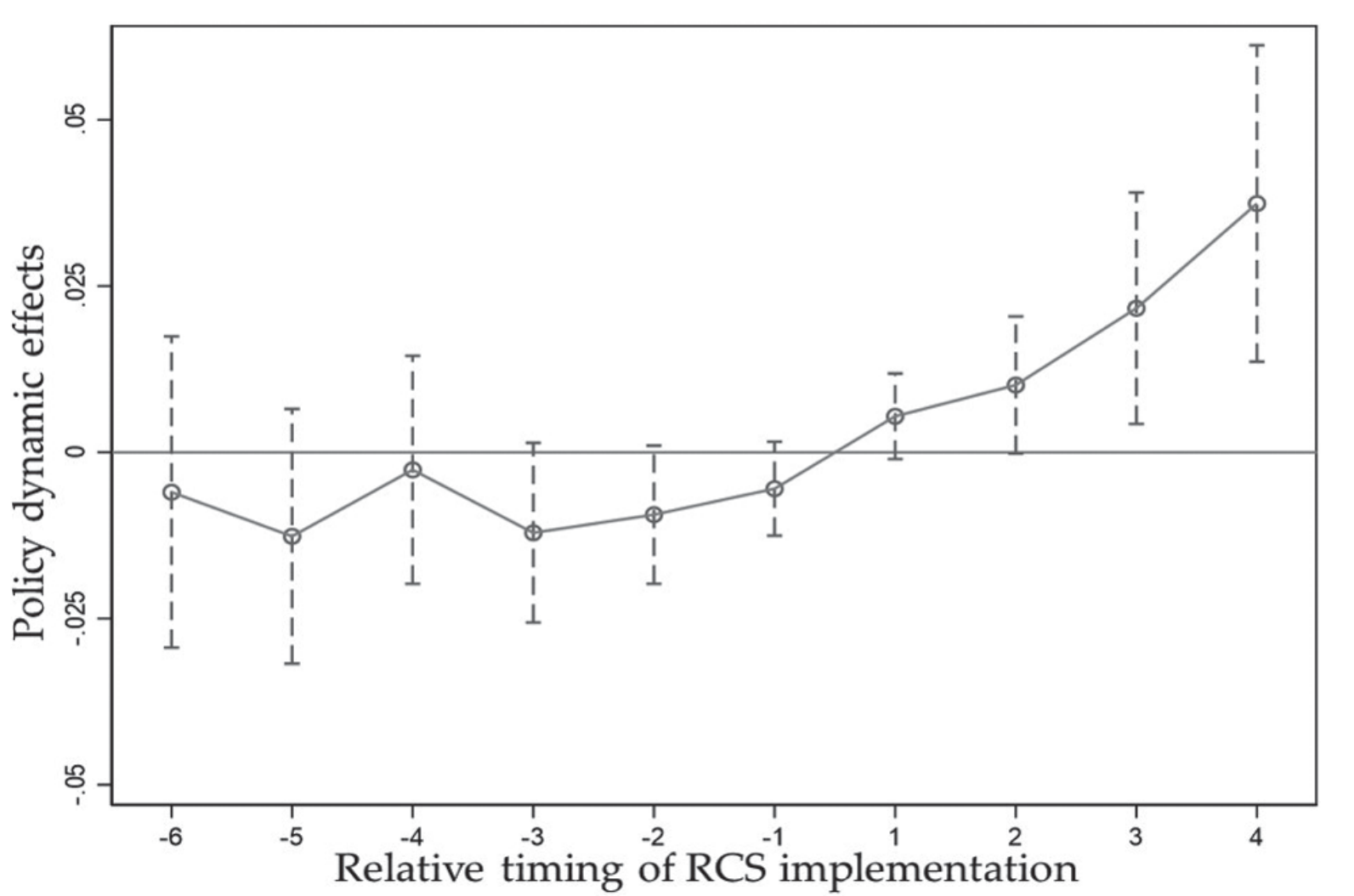
Considering that the prerequisite for the application of the DID model is to meet the common trend assumption [51], we use model 2 to verify the common trend between the treatment and control groups. As can be seen from Figure 2, the regression coefficient in the first six periods of policy implementation is not significant, while after the implementation of the RCS, carbon emission efficiency has significantly improved, and the significance test of 5% has been passed in the third and fourth periods. It indicates that there was no significant difference between the carbon emission efficiency of the treatment group and the control group before the implementation of the policy, and it has passed the parallel trend test. Moreover, after the implementation of the RCS, it has played a positive role in promoting urban carbon emission efficiency.
Robustness Test
Excluding the Interference of Other Policies
Considering that there were multiple low-carbon policies implemented during the sample period, this further interfered with the robustness of the empirical results. Therefore, use the Low Carbon City Pilot Policy (LCCP), the New Energy Demonstration City Policy (NEDC), the Carbon Emissions Trading Policy (CET), and the Environmental Information Disclosure Policy (EID) as control variables. The regression results are shown in column 2 of Table 1. After excluding other low-carbon policies, the core explanatory variable coefficients are still significantly positive, which is consistent with the baseline regression.
The Core Explanatory Variable Lags for One Period
Since the implementation of RCS is largely the result of autonomous learning, local governments will decide whether to actively imitate RCS in other regions based on local environmental conditions, and the current carbon emission efficiency may become a factor affecting the implementation of RCS. To alleviate the endogenous problem caused by reverse causality, we lag the core explanatory variables by one period, ensuring chronological order. The regression results are shown in column 3 of Table 1, and the lag coefficient of the core explanatory variable is still significantly positive.
Replace the Explained Variable
The SBM model introduces slack variables into the objective function based on the traditional DEA model, which is a non-radial and non-angular efficiency evaluation method. On this basis, Tone (2002) [52] proposed a super-efficiency SBM model for further comparison of efficiency frontier decision-making units. We recalculate carbon emission efficiency using the super-SBM model, considering unexpected output. The regression results are shown in column 4 of Table 1, which proves that the RCS is conducive to the improvement of carbon emission efficiency, supporting the robustness of our findings.
Placebo Test
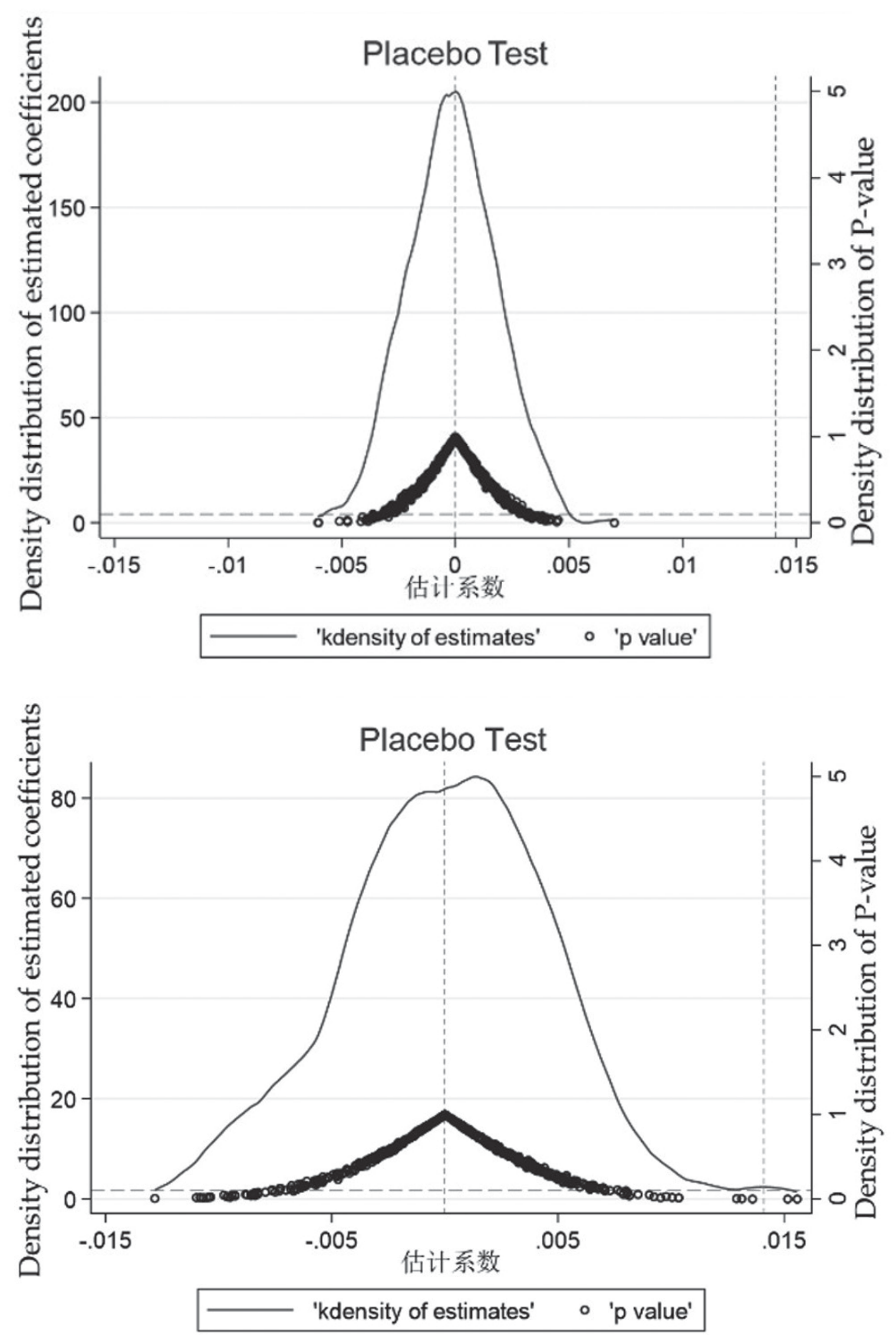
In this article, we randomly selected a treatment group and a treatment time to perform 500 regression tests as a counterfactual test and saved the estimated coefficients and P values of the core explanatory variables in each regression. We drew a placebo test chart, as shown in Figure 3. The results show that the regression coefficients estimated by the random sample are centrally distributed around 0 and most of the P-values are higher than 10%, while the coefficients of the benchmark regression are greater than most of the simulated values. The significance test at least 10% level indicates that the promotion effect of the RCS on carbon emission efficiency is not affected by other missing variables.
Mechanisms
Upgrade of Industrial Structure
We adopt the logarithm of the added value of the tertiary industry as a proxy variable for the industrial structure to test the intermediary effect. As shown in column 5 of Table 1, the regression coefficient of RCS on industrial structure is significantly positive, indicating that RCS can promote the upgrading of industrial structure. Research has shown that upgrading the industrial structure can improve labor productivity, shift high energy consumption and pollution industries, such as resource-related manufacturing, mining, and construction, towards high-tech directions, and effectively reduce CO2 intensity [53]. Combining the regression result and previous research, we can conclude that the upgrading of the regional industrial structure is still an important part of decarbonization in China. The RCS has effectively promoted the transformation of the industrial structure from traditional industries with high pollution and high energy consumption to modern industries with low pollution, low energy consumption, and high technology, driving the rapid development of clean and low-carbon industries [36].
Green Technology Innovation
Previous studies believe that there is a close linkage between environmental regulation and technological innovation, and it can promote green development through technological innovation intermediaries [54]. The difference between green technology innovation and traditional technology innovation lies in the fact that green innovation requires that the fields of innovation must be able to reduce resource input and reduce environmental damage. Therefore, this article believes that, driven by the RCS, the technological innovation behavior of enterprises is more biased toward cleaner production processes and improved energy utilization efficiency, and green technological innovation is more likely to improve urban carbon emission efficiency.
In this article, green technology innovation is measured by the number of green invention patent applications per 10,000 people. The regression results are shown in column 6 of Table 1. The results show that the RCS can indeed promote urban green technology innovation and demonstrate that the implementation of the RCS provides effective incentives and support for enterprises’ green technological innovation behavior. Previous research found that internal technology development appears to exhibit a distinct energy-saving bias [55], which is instrumental in promoting energy utilization efficiency and the adjustment of energy structure, gradually changing China’s economic development model relying on energy consumption. Therefore, green technology innovation has become a key link in improving urban carbon emission efficiency. Hypothesis 1 is proved.
Heterogeneity Analysis
Environmental Regulation Intensity
The comprehensive index of environmental regulation intensity is calculated based on the emission of industrial wastewater, industrial sulfur dioxide emissions, and industrial smoke and dust emissions. According to the comprehensive index of environmental regulation, all the samples are divided into three categories: strong environmental regulation, appropriate environmental regulation, and weak environmental regulation. It can be seen from Table 2. that only under appropriate environmental regulation can the RCS significantly promote carbon emission efficiency. In regions with weak environmental regulations, enterprises lack a foundation for innovation, so the implementation of high-intensity environmental regulations such as the RCS not only cannot pool innovative resources in the short term to achieve breakthroughs in low-carbon technology, but also squeezes out the productive resources of enterprises and reduces regional economic output (desirable output). Enterprises with appropriate environmental regulation have already possessed preliminary technological innovation conditions. The implementation of the RCS has further increased the production costs of polluting enterprises, stimulating them to maintain sustainable competitive advantages through low-carbon technological innovation. Under strong environmental regulations, enterprises have already raised their carbon emission efficiency to a high level, and the RCS will not improve the carbon emission efficiency by a large margin. Carbon emission efficiency is strongly related to the intensity of environmental regulation already in place [26], and either too high or too low a regulatory intensity can affect the policy effectiveness of RCS.
Table 2.
Heterogeneity analysis
Fig. 3.
Placebo test a) Randomly selected treatment groups Fig. 3. Placebo test b) Randomized selection of policy time
Administrative Level
According to the 2023 City Commercial Charm Ranking released by the New First-tier City Research Institute, third-tier and above cities (first tier, new first tier, second tier, and third tier) are classified as high-level cities, while other cities are classified as low-level cities for grouping regression. As the regression results from Table 2 show, RCS in high-level cities has more significant improvements in carbon emission efficiency. It indicates that high-level cities are superior to ordinary cities in terms of political resources, organizational authority, and policy execution. On the one hand, a higher level means that their river chiefs can utilize higher professional and organizational authority to achieve the integration of environmental resources, strengthen the overall coordination of environmental governance within departments and regions, and improve carbon governance efficiency. On the other hand, high-level cities are often more capable of ensuring the comprehensive implementation of the RCS in terms of funds, policies, and talent to achieve better environmental governance results.
Resource Endowment
This article divides the sample into resource-based cities and non-resource-based cities based on the “National Resource Based Urban Sustainable Development Plan (2013-2020)” released in 2013. The regression results show that the RCS has no significant effect on the carbon emission efficiency of resource-based cities, but has a strong promotion effect on the carbon emission efficiency of non-resource-based cities. It may be because resource-based cities’ dependence on resources induces energy-biased technological progress, making it impossible to change the industrial structure dominated by the secondary industry in a short period of time. In addition, due to consideration of economic performance, government officials in resource-based cities will not use arbitrary policies to shake the lifeblood of the local economy, which poses some resistance to the implementation of the RCS. Non-resource-based cities have stronger policy effects than resource-based cities. The possible reason is that industrial development in non-resource cities is more driven by capital and technological innovation, which is conducive to improving energy efficiency and accelerating the realization of technological energy savings under RCS [47].
Spatial Spillover Effects
Carbon dioxide may naturally diffuse to adjacent areas through airflow or may spread to other regions through human economic activities such as the relocation of CO2- intensive firms. Therefore, spatial factors are one of the important factors that cannot be ignored in the study of urban carbon emission efficiency. This article uses spatial econometric models to comprehensively measure the emission reduction effect of RCS.
Table 4.
Discussion on Spatial Econometric Models
Spatial Autocorrelation
The global Moran ’I is used to measure the spatial autocorrelation of carbon emission efficiency, and the specific calculation formula is as follows:
Where
Discussion on Spatial Econometric Models and Regression Results
To select the most suitable econometric model for parameter estimation, we successively conduct the LM test, Hausman test, LR test, and Wald test. The results are shown in Table 4. The spatial lag LM test and the spatial error LM test indicate the existence of spatial error and spatial lag effects, so a spatial Dubin model with both was selected. The Hausman test rejects the hypothesis of random effect models, and the LR test and Wald test show that the spatial Dubin model cannot be degenerated into the SAR model or SEM model. Considering the continuity and dynamism of carbon emission efficiency in a certain region, we add the time lag term of the dependent variable to the spatial Durbin model.
Where
In order to alleviate the systematic bias in measuring spatial spillover effects using spatial Dubin model coefficients, we decompose the total effect into direct effects and indirect effects (spatial spillover effects) based on the partial derivative matrix method [56]. The regression results are shown in Table 5. The regression coefficient of short-term carbon emission efficiency on the RCS is not significant. In the long term, the direct effect coefficient is positively significant at the 5% significance level, showing a direct promotion effect of 0.0271 units. This indicates that the implementation of the local RCS is conducive to the improvement of local long-term carbon emission efficiency, verifying the benchmark regression results. The indirect effect coefficient is -0.0244, which is significantly negative at the 5% level, indicating that implementing the RCS in this region will reduce the carbon emission efficiency of neighboring areas in the long term. Hypothesis 2 is proved.
Although the impact of the RCS on urban carbon emission efficiency does not show spatial spillover effects in the short term, the negative spillover effects on neighboring areas in the long term cannot be ignored. The possible reason for this phenomenon is the carbon pollution brought about by the cross-regional transfer of high-carbon industries. The treatment of local river chiefs by pollution industries has led high-pollution enterprises to choose to transfer to areas with weak environmental regulations. Due to local effects such as migration costs, neighboring regions have become the optimal choice for enterprise migration. Therefore, there is increased pressure on carbon emission reduction in neighboring regions. Since it takes some time from the implementation of the RCS to the structural adjustment of high-carbon industries, the spatial negative spillover effect shows obvious characteristics of time delay. The deep reason for this is that the RCS has not formed an effective collaboration mechanism. Disputes over environmental governance goals, environmental governance concepts, and interests have made it difficult to reach consensus among local governments. Each region is still in a state of isolated struggle, unable to fully communicate information and coordinate the implementation of the RCS, making the issue of cross-regional fragmentation in carbon governance prominent [9].
Table 5.
Regression results of dynamic SDM
Conclusions
This paper regards the RCS implemented in various regions as a quasi-natural experiment. Based on urban panel data from 2007 to 2019, a multi-period DID model and a spatial Dubin model are used to study the policy effects of RCS on carbon emission efficiency.
Theoretical Implications
Most of the previous studies on the factors affecting carbon emission efficiency have limited their research horizons to economic development, foreign trade and investment, industrial structure, and other top-down carbon emission governance policies, lacking more in-depth and detailed studies on the factors affecting carbon emission efficiency. This paper utilizes city-level data to provide a wealth of information for studying carbon emission efficiency at a more micro level. During this period when China’s carbon emission reduction actions are being promoted in-depth, this study utilizes the river chief system, a new type of environmental regulatory policy, as an entry point to explore the carbon emission reduction effect of the river chief system and its influencing mechanisms and spatial characteristics, bridging the gap in the field of the river chief system and carbon emission efficiency. The main conclusions drawn are as follows: (1) The river chief system can improve urban carbon emission efficiency through green technology innovation and industrial structure upgrading.
(2) Cities with appropriate intensity of environmental regulation, higher administrative levels, and lower levels of resource dependence tend to be more conducive to the role of the river chief system policy in promoting carbon emission efficiency. (3) Further exploring the spatial spillover effect of carbon emission efficiency based on existing literature, we find that carbon emission efficiency is characterized by significant clustering, and the impact of RCS on carbon emission efficiency has a delayed effect of negative spillover. This paper is a further enrichment of the research on sustainable development theory, public management theory, and environmental economics.
Policy Implications
These conclusions provide experience for us to achieve a carbon peak and carbon neutrality using RCS. First, seek industrial structure upgrading through green technology innovation. Local governments should create a favorable environment for green technology innovation to encourage the development and application of low-carbon technologies and equipment. For industrial policy, prioritize low-carbon industries such as new-energy vehicles, clean energy, low-carbon services, and so on, which is helpful for the carbon-free environment. Second, implement the RCS in line with local conditions. For resource-based cities, strictly implement the RCS to eliminate backward production capacity and achieve the upgrading of traditional industries; for non-resource cities, take the RCS as an opportunity to gather high-tech and high-quality talents and accelerate the diversified agglomeration of high-tech and high-value-added industries. At a high administrative level, cities play an important demonstrative role in the execution of RCS and share carbon reduction experience. For ordinary prefecture-level cities, reinforce the supervision over carbon emissions from enterprises to ensure the strict implementation of river chiefs’ responsibilities. At the same time, maintain an appropriate intensity of environmental regulation to avoid excessive cost burdens on enterprises. Finally, strengthen the horizontal cooperation mechanism to form a joint force for cross-regional carbon emission governance. Specifically, enhance inter-regional communication, form institutional constraints on the cooperative carbon control behavior of officials in neighboring regions, and establish a cross-regional RCS linkage mechanism.

