

Introduction
Nanotechnology has played a vital role in developing industry and technology, especially in transportation, food safety, homeland security, electronic technology, and medical and agricultural fields [1]. Nanoparticles (NPs) possess fantastic electrochemical [2], photocatalytic [3], sensing [4], anti-termite [5], therapeutic [6], and biological [7] properties, especially in their role in fuel cells [8] and supercapacitors [9], which is well recognized. They also play an important role in environmental sustainability and are useful in eliminating toxic dyes [10] and heavy metals [11] from wastewater.
Among metal oxides, strontium oxide (SrO) NPs demonstrate exceptional electrochemical performance, photocatalytic activity, good optical properties, and excellent thermal stability. These materials are promising candidates for improving battery efficiency and energy storage applications, particularly in lithium-ion batteries. They find numerous applications in electronics, lighting, wastewater treatment, etc. SrO NPs also contribute to healthier and cleaner environments because they can adsorb and immobilize contaminants and are helpful in the elimination of heavy metals and other pollutants from water and soil. They have been utilized in optoelectronic devices, FETs, LEDs, and the fabrication of sensors [12]. Strontium is used in flares, fireworks, and zinc metal refining. It is also used in plastic and paints as strontium aluminate [13]. Strontium can be used in small amounts in vacuum tubes to remove the last traces of air. It also finds applications in television screens, display units, remote weather stations, and vehicles of space and navigation [14]. In the field of biomedicine, strontium-based NPs are employed in orthopedics, bone regeneration, tissue engineering, and treatment of osteoporosis for enhancing osteoblast activity and improving bone health [13]. They have also been found effective against various strains of bacteria [12]. Strontium can control the insulin’s release and is helpful in the regulation of diabetes pathophysiology [14].
NPs can be synthesized by different procedures, including gas condensation, vacuum deposition, vapor deposition and condensation, precipitation method, ball milling, direct current, electrodeposition, and the sol-gel method [15, 16]. However, green synthesis of NPs is a topic of great interest today [17] because this route is eco-friendly and cost-effective [18] and commonly involves plant materials as reducing and stabilizing agents in the synthetic route [19].
Plant-mediated synthesis of strontium-based NPs has rarely been reported in earlier literature. Moreover, the biosynthesis of SrO NPs utilizing the leaf extract of Cymbopogon citratus (lemongrass) has never been reported earlier, which is the focus of the current study. The structural studies of the NPs were performed using FTIR, XRD, and UV-visible characterizations. Finally, the NPs were investigated for their electrochemical potential by cyclic voltammetry (CV) and electrocatalytic water splitting potential (HER and OER). Their charge transfer resistance (Rct) and electrochemically active surface area (ECSA) were also determined.
Materials and Methods
Analytical-grade chemicals, including strontium nitrate, sodium hydroxide (NaOH), and ethanol, were used for the synthesis. Pyrex-origin glassware was used, which was carefully washed with distilled water and dried in an oven before use.
Leaves of C. citratus were collected from Chack 49p (near Aab Hayat Canal) of Rahim Yar Khan, Pakistan, in April 2023. The Department of Life Sciences, Khwaja Fareed University of Engineering and Information Technology, Rahim Yar Khan, Pakistan, identified the plant species. The leaves were repeatedly washed with distilled water to remove all the dust and impurities. The samples were dried to eliminate any residual moisture and finally crushed into powder.
The crystallite sizes and crystallinity phase nature of the biosynthesized SrOaq and SrOet NPs were determined by the X'Pert Powder X-Ray Diffractometer. A Brukker-type IFS 66V FTIR spectrometer was used for the FT-IR spectroscopy of NPs. UV-visible spectra were recorded using a BIOBASE BK-D560.
Preparation of Aqueous/Ethanolic Extracts of Cymbopogon citratus
10 g of crushed leaves of C. citratus were added to 200 mL of distilled water in a round-bottom flask, and the mixture was stirred at 55°C for 2 h until its color turned light yellow. It was subsequently cooled to room temperature and finally filtered through Whatman filter paper No. 1, leaving the filtrate as an aqueous extract behind.
Table 1.
Synthetic conditions and properties of previously reported SrO NPs in various plant extracts.
For the formation of ethanolic extract, 12 g of powder of C. citratus leaves was added to 250 mL of ethanol in a round-bottom flask, and the mixture was vigorously stirred for 2 h at room temperature. Finally, it was filtered through Whatman filter paper No. 1, leaving the ethanolic extract as filtrate.
Biosynthesis of SrOaq and SrOet NPs
0.4 g of strontium nitrate was mixed into 50 mL of distilled water to prepare a clear solution. Then, 8 mL aqueous extract of C. citratus was added, which was followed by continuous stirring at 55°C. After 15 min, a few drops of dilute NaOH solution were added until the pH of the solution turned from acidic to basic. After a few minutes, the reaction mixture changed from pale yellow to dark brown, and then it was further stirred for 1.5 h. Finally, the solution was kept at room temperature for about 12 h until the NPs were settled down as precipitates, which were separated and collected by centrifugation (7,000 rpm, 7 min). The collected precipitates were subjected to washing, firstly with distilled water and then with ethanol. After drying in an oven, the NPs were finally calcined at 300°C for 5 h to leave behind the solid SrOaq.
For the preparation of SrOet NPs, a solution of 0.4 g strontium nitrate in 10 mL distilled water was stirred with an 8 mL ethanolic extract of C. citratus leaves at 55°C for 1 h, followed by the addition of a few drops of dilute NaOH until the solution became alkaline. The obtained mixture was left overnight and centrifuged to separate the precipitated NPs (7,000 rpm, 7 min). The precipitates were washed with ethanol thrice and finally calcined at 300°C for 5 h to leave behind the solid SrOet.
Electrochemical Studies
Corrtest CS2350 (electrochemical workstation) was used for the electrochemical measurements. After electrodeposition, the biosynthesized SrOaq and SrOet NPs were utilized directly as the working electrodes on nickel foam (NF). The Ag/AgCl (1 M KCl) and Pt wire were used as reference and counter electrodes, respectively. All potentials were calibrated to a reversible hydrogen electrode (RHE). Polarization curves were drawn by performing linear sweep voltammetry (LSV) and cyclic voltammetry (CV) at a scan rate of 10 mV S-1. Electrochemical impedance spectra (EIS) were recorded at 1.53 (Potential vs RHE) and a frequency range of 0.1-100000 Hz in 1 M KOH electrolyte. The double layer capacitance (Cdl) of the tested electrodes in 1 M potassium hydroxide (KOH) was used to compute the electrochemically active surface area (ECSA) by applying the following equation: ECSA = Cdl/Cs.
Results and Discussion
In the current study, we have synthesized SrOaq and SrOet NPs by utilizing the aqueous and ethanolic extracts of C. citratus. The NPs were analyzed by XRD, FTIR, and UV-visible spectroscopy and were also investigated for their electrocatalytic water-splitting potential.
Green synthesis has attracted the focus of material energy scientists due to its eco-friendly and sustainable pathways. It often utilizes readily available, natural, and sustainable resources, thus reducing the need for expensive reagents and specialized equipment. Earlier studies had reported the biosynthesis of SrO NPs only in Elodea canadensis [20], Ocimum sanctum [21], Albizia julibrissin [22], and Vitis vinifera [23] (Table 1), but there are still no reports on the production of C. citratus-mediated SrO. We have chosen C. citratus leaves to prepare strontium oxide NPs because this plant is an important source of numerous phytochemical and antioxidant constituents (Table 2) [24]. The aqueous and ethanolic extracts of C. citratus contained 4.07 and 47.09 mg/100 g, respectively, of total phenolic content (TPC) and 2.43 and 65.09 mg/100 g, respectively, of total flavonoid content (TFC). The ethanolic extract of C. citratus is a better source of phenolics (e.g., caffeic acid, gallic acid, and sinapic acid) and flavonoids (e.g., myricetin) compared to its aqueous counterpart (extract), which contains only caffeic acid (phenolic) [24]. These phytochemicals and antioxidants enable C. citratus leaves to act as good reducing and stabilizing agents for generating SrO NPs from strontium nitrate. The leaf extracts of C. citratus were prepared using water and ethanol solvents, which are easily available and have no toxic side effects.
Table 2.
Important phytochemical constituents in aqueous/ethanolic extracts of C. citratus leaves [24].
Structural Studies
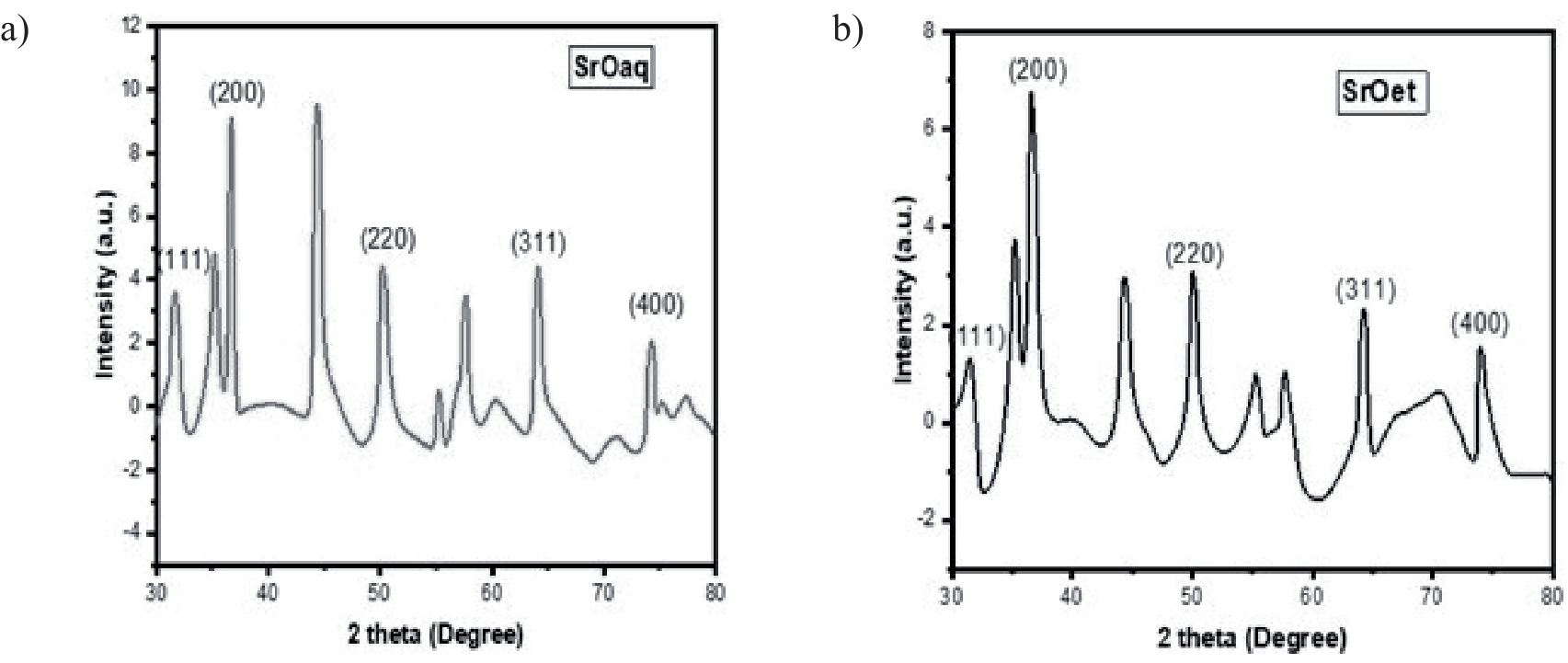
The XRD graphs of SrOaq and SrOet NPs have shown almost the same XRD patterns (Fig. 1). The diffraction peaks in SrOaq were displayed at 2θ values of 31.86, 36.6, 50.36, 64.11, and 74.25°, which correspond to the Miller indices of (111), (200), (220), (311), and (400), respectively (Fig. 1a)). In SrOet NPs, the most intense and characteristic diffraction peaks appeared at 31.5, 36.8, 50.2, 64.8, and 74.39°, which can be assigned to the (111), (200), (220), (311), and (400) crystal planes, respectively (Fig. 1) [25]. Both SrOaq and SrOet NMs displayed cubic structures [26] with JCPD card number 74-1227 [27]. The crystalline sizes were calculated using the Debye–Scherrer Equation [28] and were found to be 31.62 and 28.43 nm for SrOaq and SrOet NPs, respectively. The smaller crystalline size of SrOet indicates its greater surface area than that of SrOaq. The larger surface area results in an enhanced surface-to-volume ratio of NPs and improves their reactivities [29]. The obtained results are thus in complete agreement with the higher electrocatalytic water splitting (HER and OER) performance of SrOet than of SrOet, which will be discussed in the coming sections.
Fourier Transform Infrared Spectroscopy (FTIR)
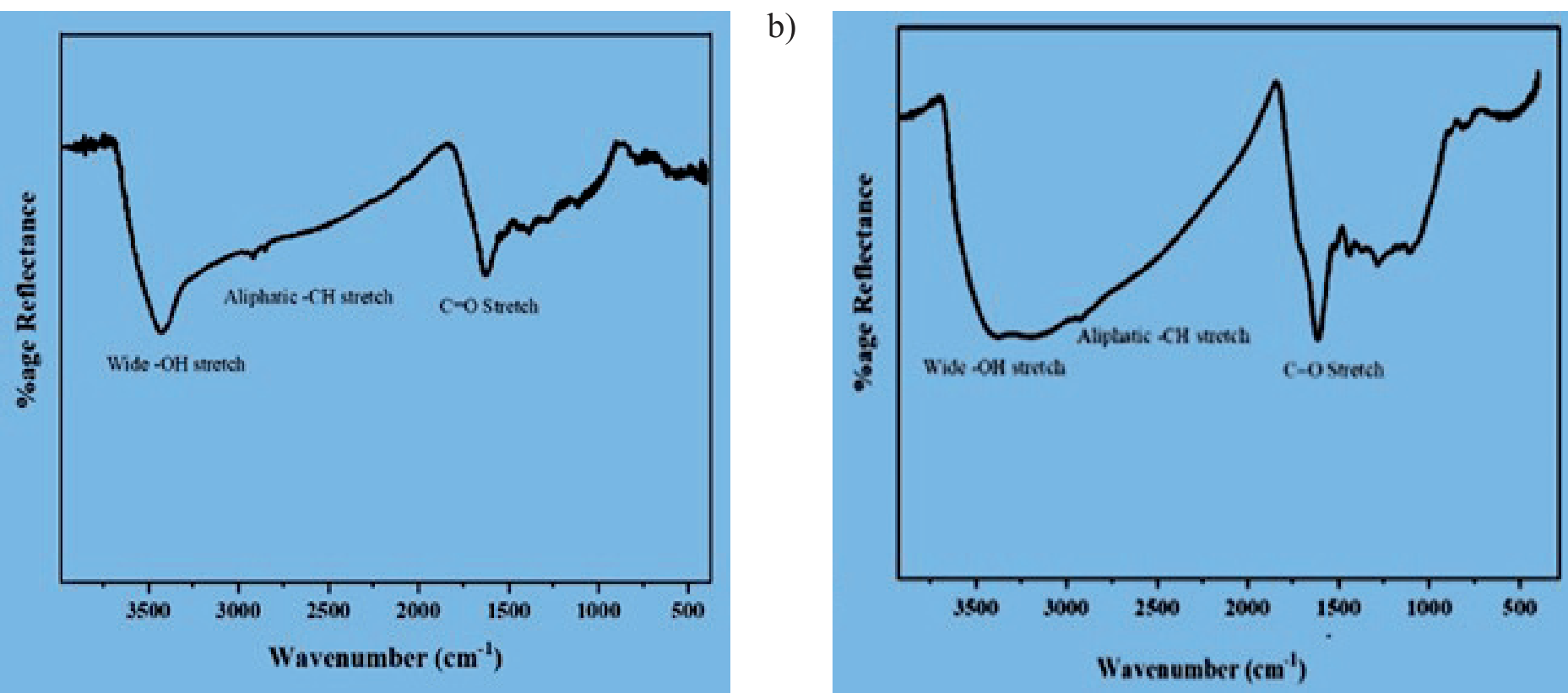
The FT-IR spectra of the synthesized NPs were recorded in the wave number range of 400-4000 cm-1 and are shown in Fig. 2. The FTIR spectroscopy displayed the existence of Sr-O vibrations, which appeared at 546 and 531 cm-1 in SrOaq and SrOet, respectively [30]. The obtained spectra (Fig. 2) have also shown the presence of aliphatic (C-H), hydroxyl (-OH), and carbonyl (C=O) compounds; these organic moieties are attributed to the coating of plant extracts upon the surfaces of biosynthesized NPs.
Fig. 1.
XRD spectra of a) SrOaq and b) SrOet nanoparticles synthesized using aqueous and ethanolic extracts, respectively, of C. citratus leaves.
a)
a)
UV-Visible Analysis
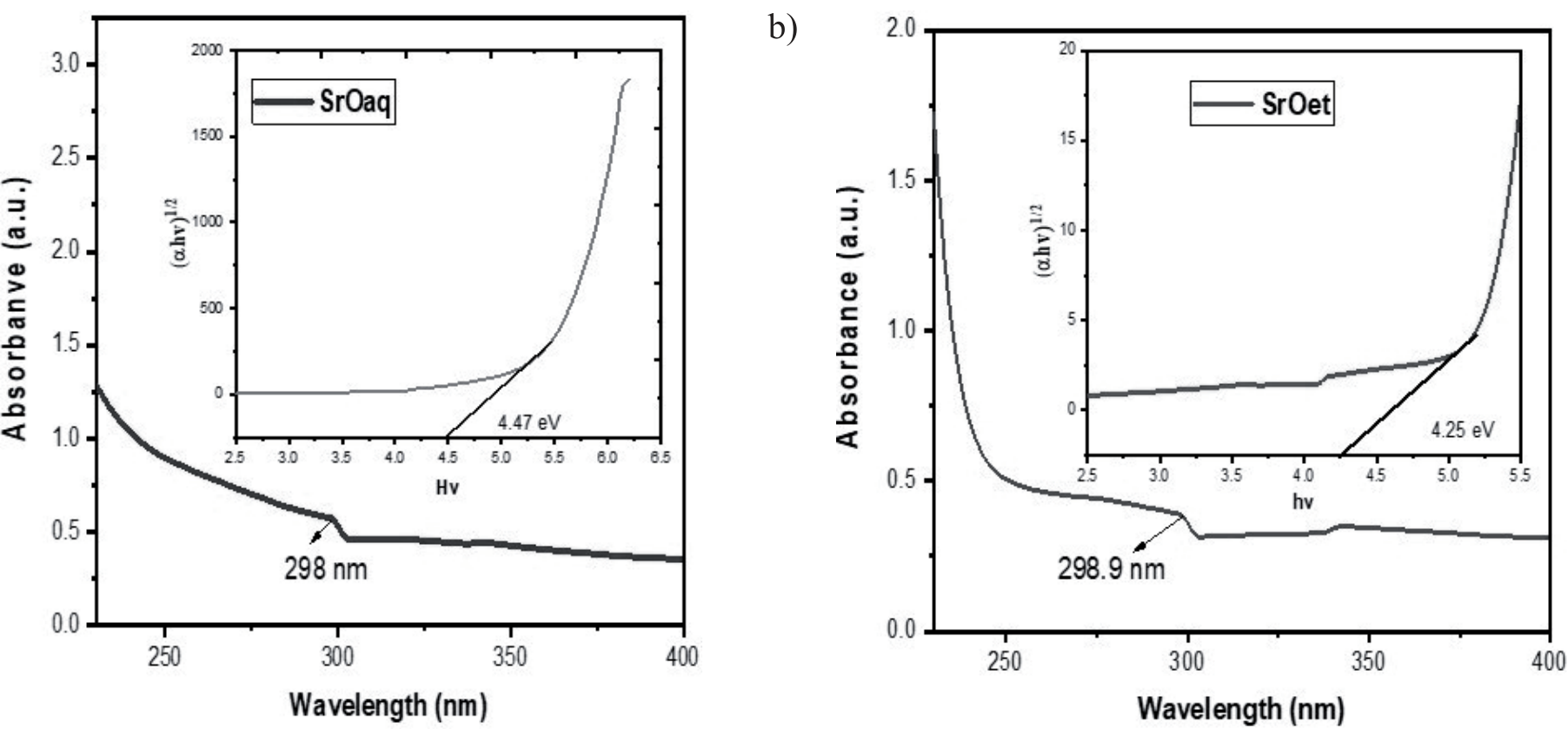
The optical studies of SrOaq and SrOet nanostructures were performed at room temperature in the range of 200 to 400 nm. The UV-visible spectra are shown in Fig. 3. A strong absorption was observed at 298.0 and 298.9 nm (representing the band edge transition) in SrOaq and SrOet, respectively, revealing the sample's photoelectrical characteristics. The band gaps of the investigated nanoparticles were calculated using Tauc’s Equation (Eq. (1)).
Where v is the energy of the photon, a is the coefficient of absorption, h is Planck’s constant, n = 1/2 for an indirect transition and n = 2 for a direct transition, Eg is the energy of the band gap, and A represents the proportionality constant [31]. It was found (Fig. 3) that SrOet has a smaller band gap (4.25 eV) than that of SrOaq (4.47 eV). The smaller band gap of a nanomaterial contributes to its electrocatalytic water-splitting efficiency [32]. The obtained results thus clarify the higher catalytic potential of SrOet than that of SrOaq, which will be discussed in the coming sections.
Oxygen Evolution Reaction (OER)
The oxygen evolution reaction (OER) serves as a rate-determining step in alkaline water electrolysis. The OER of the tested SrOaq and SrOet electrodes on the Ni foam was performed in a 1 M potassium hydroxide solution at a scan rate of 10 mV/s; the obtained LSV OER data are graphically plotted in Fig. 4.
Fig. 4.
LSV OER curves of a) SrOaq and SrOet and b) their corresponding Tafel slopes; LSV HER curves of c) SrOaq and SrOet and d) their corresponding Tafel slopes.
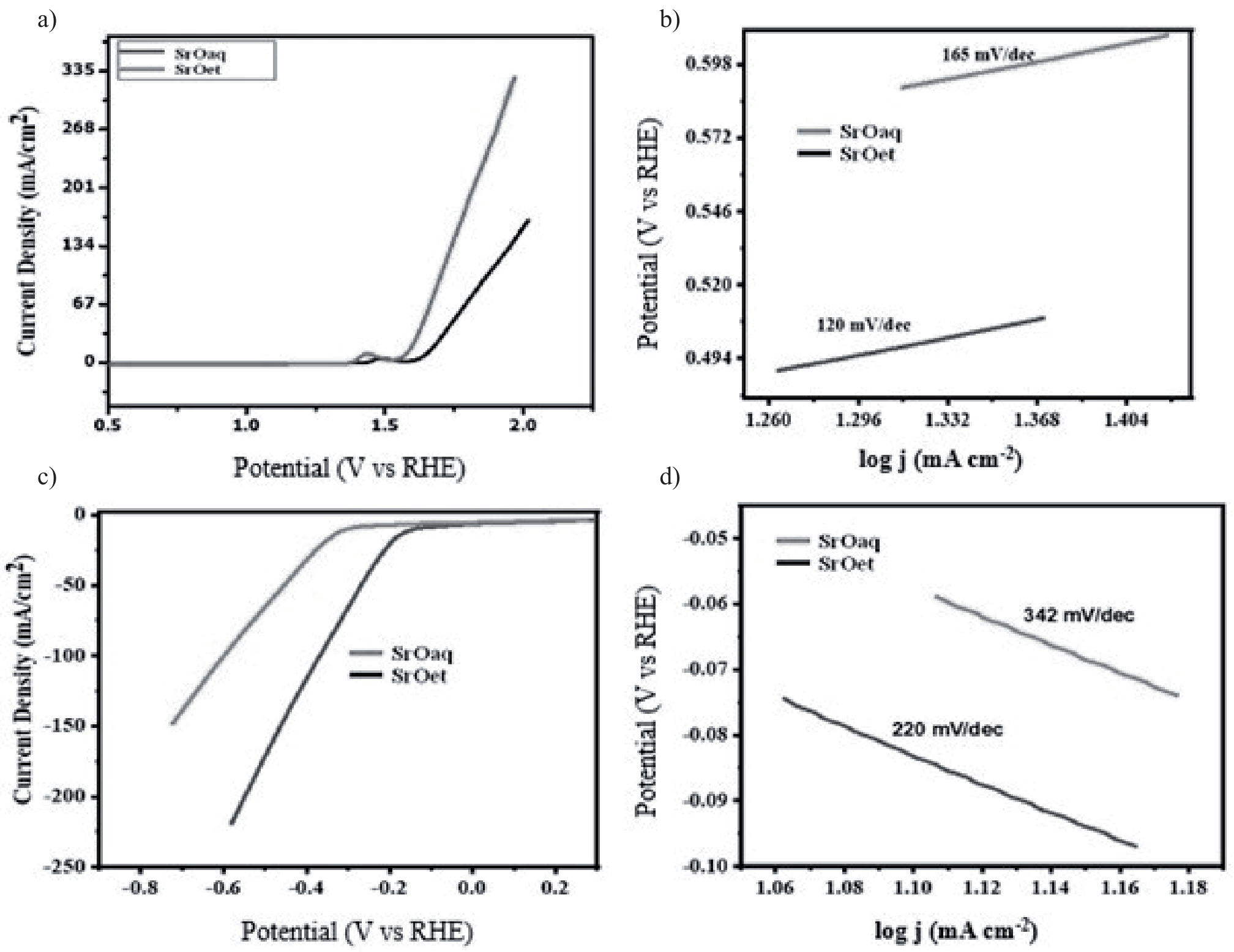
It was found that an onset potential of 1.51 and 1.59 (Potential vs RHE) was required by SrOet and SrOaq electrocatalysts, respectively, to initiate the OER process (Fig. 4). The excellent catalytic effectiveness of the SrOet electrocatalyst was reflected in its significantly higher value of current density (340 mAcm-2) than that of SrOaq (135 mAcm-2) [33]. However, it is worth mentioning that both SrOaq and SrOet nanostructures demonstrated significantly better OER performance and enhanced ion conductivity. The SrOet electrode also exhibited a lower value of Tafel slope (120 mV/dec) than that (165 mV/ dec) of SrOaq (Fig. 4), indicating the faster OER rate in the former. It is important to mention that the smaller Tafel slope value demonstrates a faster electrocatalytic reaction and an increased OER activity [33]. The results thus agree that SrOet is one of the most effective and non-precious catalysts for oxidizing alkaline water.
Hydrogen Evolution Reaction (HER)
HER serves as the rate-determining step in water electrolysis. Fig. 4c) shows the HER curves of the biosynthesized nanomaterials. The electrocatalytic efficacy of SrOaq and SrOet on the Ni foam substrate toward HER in an alkaline medium was significantly higher than that of highly conductive and porous Ni foam. To initiate the HER process, the onset potential of -0.4 and -0.1 (Potential vs RHE) was used by SrOaq and SrOet electrocatalysts, respectively (Fig. 4). SrOet electrode also exhibited a lower value of Tafel slope (176 mV/dec, Fig. 5) than SrOaq (210 mV/dec), indicating faster HER kinetics in the former. According to the aforementioned findings, SrOet is one of the most effective and non-precious catalysts for oxidizing alkaline water. The obtained results thus clarify that SrOet is a significantly better electrocatalyst due to its lower overpotential and smaller Tafel slope and offers better HER and OER performance than that of SrOaq.
Cyclic Voltammetry and Electrochemically Active Surface Area (ECSA)
We performed the CV tests at various scan rates (20 to 100 mV s-1) in a potential range of 1.34-1.48 V; the obtained results are displayed in Fig. 5. The presence of clear oxidation-reduction peaks (Fig. 5) indicates a reversible redox behavior and thus depicts that the charging process is reversible in the investigated SrOaq and SrOet nanomaterials [18, 19].
Fig. 5.
a) CV Graph of SrOaq; b) CV Graph of SrOet; c) Cdl of SrOaq and SrOet at various scan rates; d) EIS of SrOaq and SrOet.
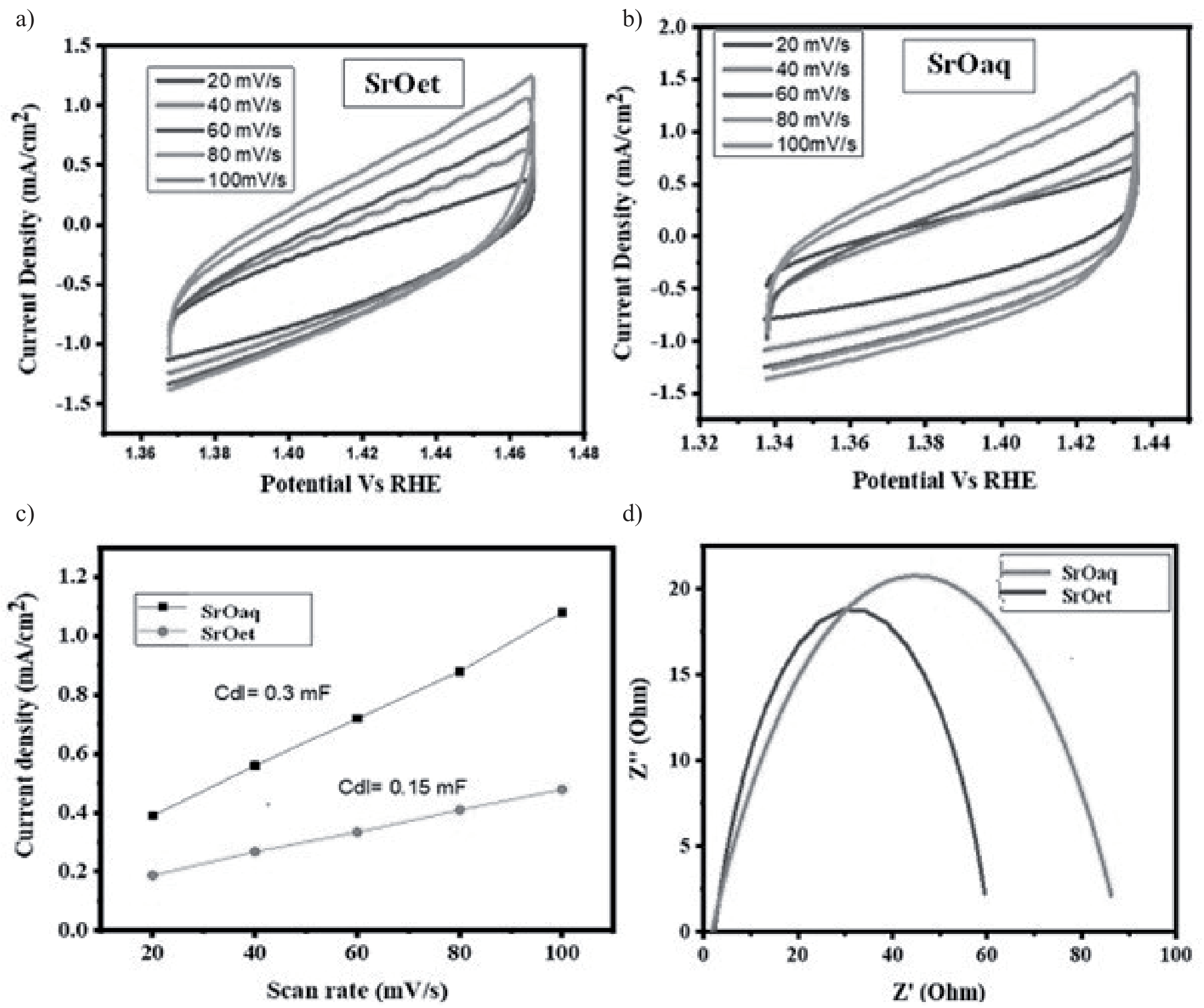
Before conducting any other electrochemical experiment, knowing about the electrochemically active surface area (ECSA) is crucial. The inherent ECSA generally indicates an electrocatalyst’s active region and acts as a decisive parameter in electrocatalytic water-splitting. The differences between the current densities of the anode and the cathode were plotted against various scan rates to determine the Cdl values of the investigated NPs (Fig. 5). A greater Cdl value reflects a higher ECSA and indicates more accessible active sites. The higher value of ECSA usually supports the enhanced electrocatalytic efficiency of a catalyst [33]. The greater Cdl value of SrOet (0.3 mF) than that of SrOaq (0.15 mF) reflects its higher ECSA, further indicating its improved electrocatalytic characteristics in terms of OER and HER. The formula ECSA = Cdl/ Cs was used to determine the ECSA. The higher ECSA value of SrOet (75 cm2) than that of SrOaq (37.5 cm2) evidently depicts the greater surface area of the former (SrOet). This thus supports the higher electrocatalytic water splitting (HER and OER) potential of SrOet than that of SrOaq, which was also discussed in the previous two sections (OER and HER).
Electrode Impedance Spectroscopy (EIS)
Electrode impedance spectroscopy (EIS) is usually performed to elucidate the OER reaction charge transfer and kinetic processes. We have performed the EIS measurements in a 100000-0.1 Hz frequency range by employing an alternating current amplitude value of 5 mV. The EIS plots are shown in Fig. 5. The charge transfer resistance (Rct) value was calculated by fitting a simple Randle’s circuit to the low-frequency area of the Nyquist plot. The diameter of the semicircle demonstrates the Rct [33], which indicates the resistance to charge transfer of an Eredox reaction. EIS measurements revealed that the charge transfer resistance (Rct) of SrOet (60Ω) is smaller than that of SrOaq (86Ω). The lower value of Rct reflects higher conductivity and speedy charge-transfer ability and minimizes the ohmic loss. The obtained results thus demonstrate a much faster electron transfer and, thus, better OER electrocatalytic efficiency of SrOet than that of SrOaq.
Conclusions
We successfully established a green synthetic route for producing SrOaq and SrOet NPs by utilizing the aqueous and ethanolic extracts of C. citratus leaves. The investigated NPs were analyzed by FTIR, XRD, and UV-visible spectroscopies. FTIR analysis has shown the existence of Sr-O vibrations and organic moieties in the biosynthesized nanoparticles. UV-visible spectroscopy displayed absorption peaks at 298.0 and 298.9 nm in SrOaq and SrOet, respectively. SrOaq has shown a smaller band gap than that of SrOet. Both the nanomaterials (SrOaq and SrOet) possessed well-defined crystalline structures and have shown good electrocatalytic water-splitting potential. However, SrOet was proven to be a better OER and OER electrocatalyst due to its higher electrochemically active surface area (EASA) and smaller charge transfer resistance than SrOaq. It is recommended that C. citratus-mediated biosynthesized strontium oxide (SrO) NPs are effective electrocatalysts and can be successfully applied for water-splitting applications.

