

Introduction
At present, China has entered a new development stage of the “Fourteenth Five-Year Plan” and needs to thoroughly implement the new development concept of “innovation, coordination, greenness and sharing.” Green development has become an inevitable requirement of this new stage. In 2020, President Xi Jinping announced to the United Nations General Assembly that China will strive to achieve a carbon peak by 2030 and carbon neutrality by 2060. As an environmental and economic policy, green finance has attracted attention from all sectors of society. Green finance refers to financial activities aimed at promoting environmental improvement, coping with climate change and using resources efficiently. Only customers with qualified environmental and social performance can be granted credit meant to promote the energy-saving transformation of traditional industries and to support development of green industries. At present, China has initially formed a multilevel green financial product and its market system, including green loans, green bonds and green insurance. Unfortunately, China’s green financial market has problems such as insufficient disclosure of green information data, low data quality, unreasonable resource allocation, imperfect regulatory and control measures, and limited coverage of financial products, resulting in the underdevelopment of the entire market.
In this paper, we propose the acceleration of theIn this paper, we propose the acceleration of the construction of a Chinese social credit system, especially in the field of ecological environmental protection, which can help solve referenced problems. The social credit system is also known as the Chinese credit management system, or the Chinese credit system. Unlike the traditional credit system, the operation mechanism behind China’s credit management is summarized as follows: government departments at all levels and in all fields develop a set of clear standards and scoring criteria to measure the performance of social subjects, calculate specific credit scores, and push them to other government departments or financial departments. Thus, different reward and punishment strategies are implemented [1]. The credit system is mostly used for public management, such as strengthening market supervision or political control [2-4], but has also been used for environmental protection. However, as with the traditional control strategy, China’s credit management system mostly applies administrative control or punishment, and its positioning of incentives is insufficient [5]. Since the credit system is based on the collection, sharing and application of various kinds of behavioral data, we propose that environmental credit governance accelerates the transformation of green behavioral data into practical production factors, that is, data factorization. This process is very important. It not only solves the “data island” issue that occurs between the ecological sector and various regions and departments but also provides financial institutions with necessary data support to effectively and accurately allocate financial resources and promote the development of green finance [6-8]. This research provides several marginal contributions. First, the quasinatural experiment of the national credit construction demonstration city policy is used to demonstrate the data empowerment and financial empowerment effects of credit for the first time, thus responding to the previous call to expand the unique credit system in the Chinese context. Second, from the perspective of data, it innovatively reveals the fact that the data element has produced positive effects, provided a subtle explanation mechanism for the new environmental protection governance strategy, and enriched the literature in the field of ecological environmental protection [9-11]. Third, we conduct a detailed analysis of the effects of environmental credit governance at the administrative level and at a specific geographical location, which may inspire the relevant government departments in China to formulate more targeted management strategies.
Theoretical Background and Hypotheses
Problems in the Development of Green Finance in China and Their Causes
Green finance refers to economic activities meant to support environmental improvement, respond to climate change and save resources through more efficient use, that is, financial services provided for project investment and financing, project operation, risk management, etc. in the fields of environmental protection, energy conservation, clean energy, green transportation, green buildings, etc [12]. There are a wide range of green financial products, including green credit, green bonds, green insurance, green trust PPP, green leasing, and more [13-15]. Compared with developed countries, the development of China’s green financial market has many deficiencies, which are manifested in a lack of market-oriented mechanism design, financial activities that rely on policy support, imperfect green system construction, smooth green information flow, and other problems, resulting in the emergence of the “float green” phenomenon (which posits that enterprises obtain investment and financing by deliberately misrepresenting the quantity and proportion of green products in production) of financing enterprises, the flagging enthusiasm of investors’ for investment and financing, the lack of regulatory grip by relevant departments, and the low level of regulatory efficiency [16]. Specifically, the underlying reason for the above problems is as follows:
First, information asymmetry increases the cost of identification and risk management for financial institutions. At present, financial institutions, enterprises and regulatory authorities lack an effective information communication mechanism and sharing platform, and the current green information disclosure and sharing mechanism is not sound, especially regarding the lack of consistent and clear data, which results in the provided information no longer being interactively shared, or being shared only after a time lag. On the other hand, because environmental protection information is not classified as a data type requiring legal collection and disclosure, some small and medium-sized enterprises are not standardized in their operation and management, have poor information disclosure, and even conceal negative environmental protection information and other phenomena. A series of awards and subsidies, special funds, tax incentives and other incentive policies formulated by various regions for the promotion of green projects has spurred some enterprises to forge green labels or fabricate green projects to defraud green credit preferences, further increasing the green identification costs for financial institutions. For approved green credit or green projects, institutions need to invest a large amount of funds in risk management to ensure that the applicant can meet their payments and that the funds are not misappropriated, which increases the risk management costs for financial institutions.
Second, the mismatch of financial resources leads to the long-term persistence of difficult and expensive financing for green projects. Due to the poor data exchange and sharing mechanism between the ecological and environmental protection departments of enterprises and financial institutions, the approval process of a single financial institution for an enterprise’s green project faces problems such as cumbersome steps, complex processes and repeated verification, resulting in the large amount of time spanning between the application and issuance of green loans. In addition, the number of credit institutions involved in green financial services is limited, and the accessibility and inclusiveness of green financial services to certain regions or small enterprises are still at low levels due to the limitations of the scope of the physical network, personnel level, service costs, and other limiting factors.
Green projects lack consistency with the ultimate goal of financial institutions. Projects applying for green finance need to account for the needs of energy conservation and emission reduction in environmental protection, as well as enterprise income maximization. Generally, such projects entail a long investment cycle, high risks, and high development and utilization costs but low expected benefits. Therefore, the above characteristics are inconsistent with the goal of profit maximization that is pursued by financial institutions. In the context of the above problems, financial institutions lack the motivation to provide green credit and other financial services, and a large number of projects with long-term and mismatched risk and income are faced with financing difficulties and high financing costs, that is, faced with a mismatch of the term structure of financial resources, which ultimately critically hampers the development of the green financial market.
Third, the green financial supervisory and reward and punishment mechanisms are not perfect, and market chaos is endless. It is difficult to ensure the stability of the financial market due to the lagging development of regulatory tools. Preventing and resolving systemic risks is the basis for maintaining national economic and financial stability. In the context of the rapid development of information technology and the gradual tightening of financial supervision, higher requirements are imposed for green financial supervision tools. In order to unify regulatory rules; innovate and carry out green project supervision from the perspective of feasibility analysis, project implementation progress detection, implementation effect evaluation and other aspects; prevent the high leverage ratio of green projects; avoid the problems of capital idling and green washing, and prevent new financial risks from emerging, the innovation of additional regulatory tools is urgent.
The accountability for green violations is light, and the endogenous demand of the financial market is low. At present, the level of administrative punishment for environmental violations is low, disciplinary measures are few, and the efficiency of law enforcement is insufficient. Enterprises prefer to break the law rather than meet environmental protection requirements, and the demand for green financial business is insufficient. From the perspective of investors and the public, if the legal responsibilities of enterprises are not sufficiently robust, they will not truly care about the environmental protection of the company. In this case, even with the establishment of green security systems, such as environmental information disclosure, it remains difficult to achieve the expected effects, and it is impossible to generate environmental pressure on listed companies to urge them to seek green financial service support.
Fourth, the market trading mechanism is deficient, and green financial products are single and innovative. The green financial market is small, and the overall financial supply is insufficient. Although China has formed a multilevel green financial system that includes green loans, green bonds, green insurance, green funds, green trusts, etc., under the restrictions of limited data sharing and the poor mining of customer demand at different levels, current financial institutions mainly develop products and services that are meant for mature enterprises or projects.
In addition to the carbon trading pilot projects that have been carried out, the exploration into the transformation of environmental rights and interests, such as emission rights and energy rights, into capital financing through mortgage, pledge, repurchases and asset securitization has lagged behind, resulting in the slow development of the national green financial market and a serious shortage of total supply. Domestic green finance mainly focuses on green credit and green bonds. The small scale of funds, trust, insurance, carbon finance and other businesses is not conducive to guiding enterprises towards the development of specific environmental protection goals.
Impact of Environmental Credit Governance on Green Finance
As mentioned above, due to high uncertainty and a long income cycle, enterprises often lack the motivation to carry out green production and transformation. On the one hand, technological upgrading under cost constraints inevitably exerts a “crowding out” effect on production input. In addition, as long as the cost of pollution discharge is lower than the production income, enterprises will not actively improve their energy technology or increase their green innovation input. From the perspective of domestic and foreign research, government departments mainly adopt the administrative order type of environmental regulation for enterprises, but research on China’s local environmental regulation strategy fails to consider it in conjunction with market-oriented regulation tools. At present, the social credit system has become an important part of China’s modern governance system [1]. Since 2000, the Ministry of Ecology and Environment of the People’s Republic of China has combined the concept, method and means of credit with that of the construction of ecological civilization to carry out the evaluation and follow-up supervision of enterprise environmental credit ratings, which we define as environmental credit governance. Specifically, the ecological environment department determines the code of conduct, monitors enterprises’ levels of dishonesty and trustworthiness and depicts the true credit score and grade of enterprises with scientific models by improving the connection and data sharing among business departments. Using the different grades and scores as a guide, the environmental supervision department can distribute supervision resources and implement rewards and punishment appropriately [14, 15, 17].
According to the literature, Chinese environmental credit governance is an important means of improving the efficiency of environmental governance in China [9, 17, 18]. The advantage of credit endowment can impact the incentive mechanism of resource allocation and has the characteristics of full-cycle governance and the function of initial governance, which means that environmental governance can play a role at the beginning of production and throughout the entire production process [19]. Unlike general environmental control measures, dishonesty punishment is highly specific and mandatory. The marginal cost of production of enterprises being punished for dishonesty increases, while the reputation of those companies declines significantly [1]. In contrast, trustworthy entities have access to the “green channel” in market transactions, government procurement and capital acquisition, which undoubtedly accelerates the flow of factor resources to these more efficient enterprises. We propose that the implementation of environmental credit control may accelerate the development of green finance from the following aspects.
First, it can alleviate the problem of information asymmetry in the field of green finance. The green financial system as based on the public and environmental credit information platforms can collect a large number of enterprise-level digital footprints, including business flow, revenue trends, trading networks, and environmental public opinion, that effectively reflect the enterprise’s behavioral characteristics, financial conditions, social networks and other characteristics, which provides a large amount of data support for the green identification and risk management of financial institutions and can effectively reduce the cost of identification and risk management for financial institutions [20].
Second, the service level and efficiency of green financial institutions should be improved. Connecting the business system comprising financial institutions with the underlying platform of the enterprise green credit information system of the ecological environment department, building the social relationship network of green project financiers and generating benefit evaluation reports will help to improve the procedural and decentralized financial service process under the traditional financial system, shorten the identification time of green enterprises or projects, and improve the efficiency of green financial services.
Third, innovative financial regulatory tools can significantly improve regulatory efficiency. Cross-regional and cross-level enterprise green credit information systems based on blockchain and big data technology can collect and process the credit information of different channels and types in real time to realize data traceability, comparability and measurability [21]. The credit supervision early warning model based on artificial intelligence technology is continuously self-learning and self-optimizing, and the cross-validation of credit information accumulated from different departments, fields and channels can not only improve the timeliness and accuracy of supervision but also help to realize the full-process of effective supervision of financial business.
Fourth, harnessing advanced technologies such as big data, cloud computing, and blockchain within the realm of Chinese environmental credit governance offers the opportunity to effectively collect and process extensive behavioral data related to entities. This data can be pivotal in accurately discerning the financial requirements of enterprises and customers across diverse scenarios and timeframes, thereby facilitating the development and supply of new financial products by financial institutions. Utilizing blockchain, internet, and Internet of Things technologies enables precise income estimation and risk monitoring for investment, financing activities, and business operations. It also allows for the timely identification, elimination, or updating of financial products, aligning them with the evolving environmental and economic landscape.
Based on the above analysis, we propose the following:
H1: Environmental credit governance can promote the development of green finance.
Impact of Environmental Credit Governance on Data Factorization
The Fourteenth Five-Year Plan for the Development of the Digital Economy pointed out that following the agricultural economy and industrial economy, the digital economy has become the new economic form, and the data element is the core engine of the all-factor digital transformation. However, unlike talent, capital and other innovative elements, data elements cannot directly produce tangible materials and products, but the flow and sharing of data elements can shorten the production and circulation time of talent, capital and other innovative elements, as well as optimizing the spatial allocation and improve the matching efficiency of innovation elements [8, 22, 23]. In this regard, we define data factorization as the process of collecting, integrating and processing the behavioral data of market subjects, establishing them as important production factors, and participating in social production and operation activities [8, 11]. As a new innovation element, data factorization can promote the optimal allocation of other innovation elements, trigger profound changes in innovation methods, and bring a strong impetus to the development of economic innovation [24]. In the era of the digital economy, the real economy has been continuously empowered by digital information technologies such as cloud computing, artificial intelligence and 5G, which have accelerated the digital transformation of traditional element resources [25]. In reality, data elements are dependent on the real economy, and smart industrial policies will require various industries to continue gathering and deriving data elements, and the manufacturing and service industries are also concentrated in areas where data elements are densely distributed, which will inevitably generate a large amount of data and subsequently promote data element clustering.
At present, the important infrastructure for the construction of an environmental protection credit system under the leadership of the Ministry of Ecology and Environment of the People’s Republic of China has been basically completed, and it plays an important role in solving problems such as information asymmetry and the insufficient efficiency of financial resource allocation [13, 15]. Starting from the essence of data as an element, we propose from the closed-loop complete path of its generation, collection, integration and application that the implementation of environmental credit governance can accelerate data factorization. From the perspective of data generation and collection, according to the Key Points of Government Information Disclosure and the Law of the People’s Republic of China on the Construction of a Social Credit System issued by the State Council, environmental protection regulatory departments at all levels are required to assure the disclosure of information on air quality, water environment quality, pollutant emissions, pollution sources, and environmental impact assessment of construction projects and promote the in-depth analysis and application of public data by enterprises, third-party institutions and individuals [8, 25]. National, provincial and municipal ecological and environmental departments have realized the function of collecting and sorting the fragmented information scattered in various corners by clarifying the data collection, integration, storage, processing and trading standards [18, 26, 27]. From the perspective of data fusion and sharing, the competent department in the field of ecological environment requires the relevant enterprises and institutions to disclose environmental information in accordance with national regulations, and the relevant information is shared with banks, securities, insurance and other institutions as environmental protection credit information. In the case of dishonesty on the part of small and medium-sized enterprises, the latest behavior information will be synchronously shared to the environmental credit information platform, thus forming a new data set for adjusting credit lines [6]. Finally, the application result orientation of environmental credit governance promotes the development of data elements from production resources to practical applications, which may drive the ecological environment departments, enterprises and financial institutions to continuously optimize the environmental protection data catalog, thus improving the standards and quality of data collection [25, 27, 28].
Based on the above analysis, the following assumptions are proposed:
H2: Environmental credit governance can promote data factorization
The Impact of Data Factorization on Green Finance
Data factorization reduces the loss of links in production and improves the productivity and resource utilization efficiency of enterprises [11]. We believe that integrating digital technology into green finance not only accelerates financial digitization but also promotes the development of green finance.
First, data factorization means that regions can effectively integrate the human, financial and technological resources in different regions and promote the development of green finance in both local and neighboring regions by improving the efficiency of factor allocation [8]. The free flow of data elements can help reduce the mismatch of talent and capital innovation elements in the region and can also improve the matching efficiency of innovation elements in neighboring regions. With the popularization of the internet and big data technology, the cost of data element flow has been greatly reduced, which enables the breaking of the space barrier, enhances the spatial relevance of element flow, and optimizes the spatial allocation of innovation elements [7, 24].
Second, the flow of data elements can exert a resource agglomeration effect by regulating the free flow of innovative elements such as talent and capital and driving the development of green finance in neighboring regions through the promoting of green technology innovation and green technology spillover [8]. According to the theory of new economic geography, the free flow of production factors across regions inevitably produces agglomeration effects and then induces economies of scale effects [11]. Under the effect of economies of scale, the cost of green finance decreases greatly, which is conducive to the progress of green technology. At the same time, spatial agglomeration promotes the free flow of green knowledge and green technology among regions and realizes the development of green finance in local and neighboring regions through the spatial spillover effect of green technology progress.
Third, the data element can directly empower the reasonable decision-making of financial institutions. Massive data provide comprehensive and systematic information for green finance. The larger the amount of data is, the more accurate the information. Big data can not only improve the ability of financial institutions to obtain green finance customers but also carry out risk early warning measures through the establishment of an early warning risk indicator system and improve the ability to judge levels of customer risk, which is conducive to improving the design of financial products, optimizing business models, etc. [6, 29]. In addition, financial institutions constantly update the customer categories of green finance through changes in various data and associated information, implement hierarchical management, and constantly optimize the customer structure.
Finally, data factorization overcomes the weakness of the traditional financial industry regarding risk monitoring and product development in the green industry. On the one hand, through the risk management system, relevant information about green financial service objects is captured and recorded, and credit risk identification, comparison and judgment are carried out to scientifically determine the existing risks. In terms of product digital innovation, financial products need to be designed according to market demand and the opportunities provided by financial institutions. The product design scheme based on data elements can avoid the simple greening of conventional financial products and realize the systematization, standardization and branding of green financial products according to the characteristics of the subject’s life cycle, industry type, scale, etc. Based on the above analysis, the following assumptions are proposed:
H3: Data factorization promotes the development of green finance.
Taken together, we suggest that environmental credit governance plays a crucial role in promoting the development of green finance by accelerating data factorization.
Reducing Information Asymmetry: Environmental credit governance facilitates the collection and sharing of environmental credit information, reducing information asymmetry between financial institutions, enterprises, and regulatory authorities. By providing a comprehensive view of an entity’s environmental performance and creditworthiness, data factorization empowers financial institutions to make more informed decisions about green finance. This, in turn, lowers the cost of identifying and managing risks, making green investments more attractive to financial institutions.
Enhancing Service Efficiency: Through data factorization, environmental credit information is made accessible to financial institutions, improving the efficiency of green financial services. Streamlining the identification and approval process for green projects and enterprises leads to quicker and more efficient access to green loans and investments. This efficiency is crucial for encouraging more widespread participation in green finance.
Innovative Regulatory Tools: Data factorization supports the development of innovative regulatory tools. By using blockchain and big data technology to gather and process data, environmental regulators can monitor and enforce environmental regulations more effectively. This not only ensures that green projects adhere to environmental standards but also contributes to the overall stability and credibility of the green finance market.
Incentivizing Environmental Responsibility: Data factorization enables the evaluation of an entity’s environmental credit score, which can be used as a basis for rewards and penalties. Trustworthy entities gain access to preferential treatment and financial incentives, creating a strong incentive for companies to prioritize environmental responsibility. This leads to greater compliance with environmental regulations and an increased demand for green financial services.
Diversifying Green Financial Products: Data factorization can also facilitate the development of a wider range of green financial products. By systematically collecting and processing data related to various aspects of green projects, financial institutions can design more tailored and innovative financial products that cater to the specific needs of green enterprises. This diversification broadens the scope and appeal of green finance.
In summary, environmental credit governance, supported by data factorization, addresses key challenges in the green finance market by reducing information asymmetry, improving service efficiency, enhancing regulatory tools, incentivizing environmental responsibility, and diversifying financial products. These advancements are pivotal in driving the growth of green finance and aligning it with environmental protection and sustainable development goals.
H4: Environmental credit governance promotes the development of green finance by accelerating data factorization.
Experimental Procedures
Model Settings
Benchmark model: Up to 2022, a total of 43 cities have been approved to be the credit-system demonstration cities, which provides a condition to conduct quasi-natural experiment to investigate the impact of credit-based environmental regulation on green finance by Differences-in-Differences method [25, 30]. According to the list of demonstration cities approved by the National Development and Reform Commission, this paper sets up a treatment group and a control group. Specifically, we regard 43 demonstration cities as the treat group, and the rest cities that have not been approved constitute the control group. Given that the approval of demonstration cities is not one-off but by stages, the relationship between credit-based environmental regulation and green finance is evaluated by a multi-stage Differences-in-Differences method. Our specific model is set as follows:
In the above formula, GreenFinit is the explained variable, indicating the green financial level of city i in the t year. νt represents the time fixed effect and μt is the individual fixed effect of each city. εit indicates the random error term. Xit is a series of variables that may have an impact on the regional carbon emission level. As the core explanatory variable of this paper, Creditit represents the virtual variable of credit system construction demonstration city, and its coefficient is used to evaluate the impact of implementing credit-based environmental regulation on green financial level. If β is positive and significant, it means that the implementation of such regulation promotes the development of green finance.
Transmission mechanism: we suggest that credit-based environmental regulation may promote the development of green finance by accelerating data elementarisation, that is, data elementarisation may be a potential mediating variable. Based on the benchmark model and referring to Baron and Kenny [31], the mechanism is tested by setting the following formula:
In the above formula, DataFacit indicates the mediating variable(i.e., data elementarisation).
Interpretation of Variables
Green Finance (GreenFin): According to “Guiding Opinions on Building a Green Financial System” put forward by the State Council, China, green finance mainly includes green credit, green securities, green insurance and green investment, etc. We referred to this policy to construct our index system for green finance (Table 1). Among them, the index selection and measurement of green insurance and green investment refer to the common practices of related research, and the indicators of green credit and green securities are optimized on the basis of existing research [22, 26, 27]. Green credit is measured by the proportion of interest expenses of non-six high-energy-consuming industries in industrial interest and the proportion of green credit balance in regional GDP. Due to the lack of data on the balance of green credit, we use the proportion of regional financial institutions’ loans to the national financial institutions’ loans to replace the proportion of regional green credit balance to the national green credit balance, and then calculate the green credit balance of each sample region according to the total national green credit balance. To eliminate the inconsistency in order of magnitude and dimension, the original data are standardized by the range method, and then the green financial development index of each region during the sample period is calculated by the entropy method [14, 15].
Credit-Based Environmental Regulation (Credit): The choice of using a dummy variable indicating whether or not a credit model city has been established as a measurement index for corporate environmental credit management is a strategic decision rooted in several key considerations:
Policy Significance: Credit model cities are a central element of China’s environmental credit governance strategy. These cities serve as pilot initiatives where innovative environmental credit management practices are tested and refined. Their establishment is emblematic of the Chinese government’s commitment to improving environmental stewardship by incentivizing companies to adhere to environmental regulations and best practices.
Table 1.
Green finance measurement index system.
Government Guidance: Credit model cities are selected and supported by government authorities based on rigorous criteria and guidelines. These criteria include the adoption of advanced environmental management practices, compliance with environmental laws and regulations, and a commitment to sustainable and green development. As such, the presence of a credit model city signifies the endorsement and support of environmental credit management at the local and national levels.
Representative Nature: Credit model cities are chosen to represent and demonstrate effective environmental credit management. They are expected to serve as examples for other regions and industries to follow. As such, they embody the principles and practices of corporate environmental credit management, making them a representative and practical indicator for this concept.
Impact on Corporate Behavior: The establishment of a credit model city has a direct impact on corporate behavior within its jurisdiction. Companies operating in these cities face increased scrutiny and incentives to improve their environmental performance. They are encouraged to adopt environmentally responsible practices, making this indicator an effective proxy for measuring how corporate environmental credit management influences sustainable development within the green finance sector.
According to the list of demonstration cities for credit system construction published by the National Development and Reform Commission and the official website of the People’s Bank of China, we assigns values for each city. Specifically, the demonstration cities were assigned as 1 at the year they are identified and afterward, and other cities were 0 (City). Also, the year when a city is rated as a credit demonstration city and the following years are assigned as 1, otherwise it is 0 (Year). Since the list of demonstration cities is published in the second half of the year, this paper defines the next year when the list is published as the year of policy implementation. The final treat group is the multiplication of individual city and year (i.e., City×Year).
Data Elementarisation (DataFac): In this paper, the data elementarisation level (DataFac1) and the data elementarisation efficiency (DataFac2) of each region are calculated respectively. The difference between the two is that the former focuses on the various processes of data collection and application, while the latter examines the allocation efficiency of data as a resource from the perspective of input-output ratio. Based on prior study [25, 34], we propose that DataFac1 takes four dimensions reflecting the regional data elementarisation as the core variables: the basic level of digitalization, digital equipment, digital application and digital effectiveness. They are measured by the proportion of employees in the information industry to the total number of urban employees, the penetration rate of mobile phones, the penetration rate of the Internet, and the proportion of telecommute business income to GDP. We used the entropy method to obtain the final data elementarisation level (DataFac1). DataFac2 is calculated using a two-stage process proposed by “market-oriented construction-value allocation” provided by the China Academy of Sciences [22, 24, 34]. The final value interval of DataFac2 is [0, 1]. The closer to 1, the higher the allocation efficiency.
Control variables: To control the influence from other irrelevant factors that may affect green finance, we also included a series of control variables [32], including:
(1) Economic development (lnpgdp). Economic growth is an important driving factor for the region to implement the environmental protection strategy. We used the logarithm of the actual per capita GDP after price reduction to measure this variable.
(2) Population agglomeration (lnpd). In the period of rapid urbanization, population agglomeration is the main factor causing environmental pollution, which is measured by the logarithm of urban population to the total population of the region.
(3) The level of foreign investment (fdi). Existing literature still casts doubt on the effects of foreign investment on the government’s environmental protection strategy. We used the proportion of FDI in regional GDP to control the potential impact.
(4) Traditional financial development (fin). In this paper, the ratio of loans from financial institutions to regional GDP was used as a proxy variable for financial development to control the role of traditional financial markets in green finance.
(5) R&D investment (rd). IIncreasing R&D investment is an effective way to implement novel environmental protection control. This paper measured R&D investment by the proportion of fiscal expenditure on science and technology..
(6) Industrial structure level (ind). One of the manifestations of industrial structure optimization and upgrading is that the region’s dependence on the primary industry is declining. We used the industrial structure upgrading index to measure this variable, and the calculation formula is ind = ∑indi×i(1≤i≤3), where indi represents the proportion of the output value of the industry i to the total output value.
Data Sources
The research sample is the panel data of 280 prefecture-level cities in China from 2010 to 2021. The demonstration cities of credit system construction come from the official websites of the National Development and Reform Commission and the People’s Bank of China, and the other data come from the Statistical Yearbook of China City, the Statistical Yearbook of China and the statistical yearbooks of various cities. We supplements the missing data of individual cities by interpolation method. Table 2 is the descriptive statistical results of our core variables.
Table 2.
Descriptive statistics of variables.
Results
Benchmark Regression
Table 3 reports the fixed effect for the influence of credit construction demonstration cities on local green finance under various conditions (Model 1: without control variables; Model 2: control the fixed effect; Model 3: Add control variables; Model 4: Considering the control variables and fixed effects at the same time). Since the coefficient of the explanatory variable (GreenFin) is always positive under all conditions, we believe that the implementation of credit-based environmental regulation can improve the development of green finance.
Parallel Trend Test and Dynamic Effect Analysis
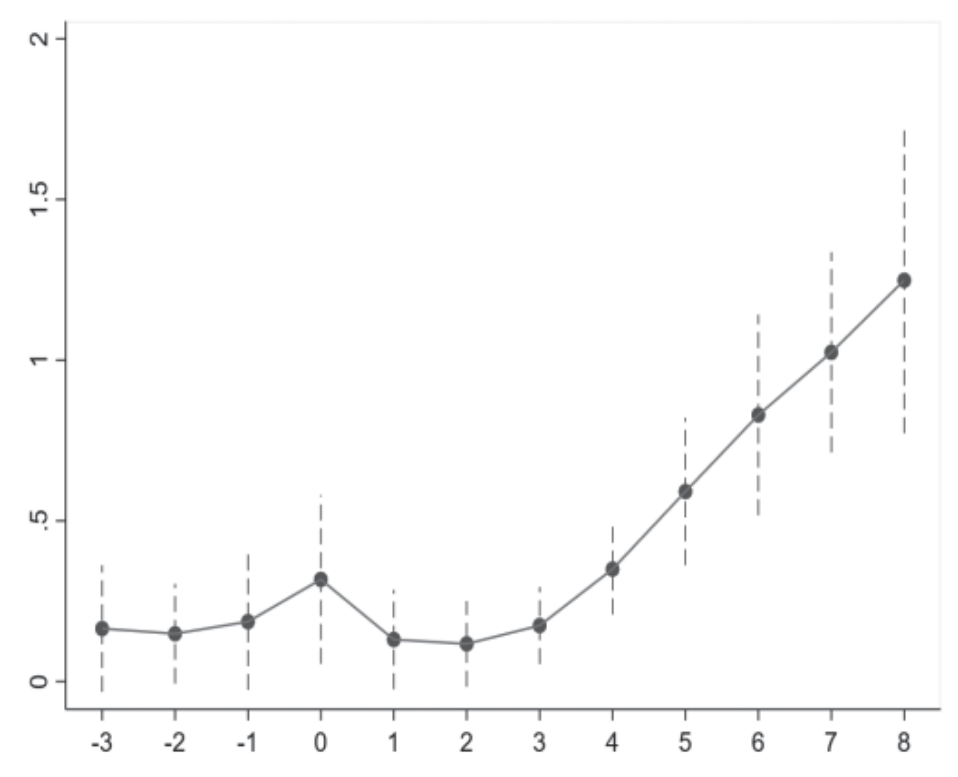
The premise of adopting the multi-point DID model is that the treat group and the control group keep the same change trend before the policy occurs, that is, meeting the hypothesis of parallel trend test [30]. Because the cities have different time to accept the policy effect, we cannot simply set a virtual variable of time as the critical point of policy implementation. Rather, we should set a virtual variable of relative time value for the implementation of policies in demonstration cities. The specific equation is as follows:
(4)
The time dummy variables are the observed values of the cities in the n years before, in the current year and in the n years after they were established as demonstration cities. The dummy variables of non-demonstration cities are all zero. Because the observation period of this paper is 2010-2021, and the policy implementation year of the first batch of demonstration cities is 2014, some cities do not have more than four sample values. As such, it is necessary to merge the time before the fourth period of other cities into –4 period and eliminate this time dummy variable.
The results in Fig. 1 show that the virtual variable coefficients before the policy occurred are not significant and the values are small, which indicates that there is no significant difference in green finance between the treat group and the control group before the policy was implemented. Therefore, the policies of the demonstration cities conform to the hypothesis of parallel trend. As for the dynamic effects, this paper mainly analyzed the dynamic effects in eight periods. The results show that the effects occurred in the year after the policy was implemented, but were not stable. After three years of implementation, the impact of the demonstration cities are significantly positive and constantly improving. This indicates that the demonstration cities promote the development of green finance. Overall, our H1-H3 is supported.
Robustness Test
Robustness Test Based on Model Setting
We carried out a robustness test based on the multi-time PSM-DID model. Given that PSM is suitable for cross-section data while DID is suitable for panel data, there are two solutions in the literature: one is to construct cross-section PSM, that is, to re-match panel data as cross-section data; The second is to match the trend score with reference to the methods adopted by Böckerman and Ilmakunnas [33]. In this paper, the panel data conversion method and the phase-by-phase matching method are used in turn to match the trend score.
The specific methods are as follows: (1) Set the controlled variables studied as matching variables.
(2) Two sets of data sets are obtained in two ways. First, constructing section PSM, That is, the nearest neighbor matching method is used to find the optimal control group that meets the common conditions for all demonstration cities, and the non-common parts are eliminated, so as to obtain a new data set. Second, phase-by-phase matching method: the city samples are matched year by year, and then the matched data in each year are vertically merged into a data set to generate the panel data needed for regression. (3) The balance of the two sets of matching data is tested and the matching effect is analyzed. (4) The effect is re-estimated by using the multi-time DID method. The PSM-DID results of the two methods are shown in Table 4.
Excluding the Influence of Other Policies
During the investigation period, China has set up three pilot cities of smart city and big data comprehensive experimental city, both of which are closely related to our theme. Therefore, in the benchmark regression model, we add the year dummy variables of the two policies to control their influence on the estimation results as much as possible. The results are shown in Table 4. It can be found that after controlling this policy, the coefficient of demonstration cities is still significantly positive. The result is still robust.
Table 3.
Benchmark regression results.
Table 4.
Robustness test.
Placebo Test
Although this paper has controlled a large number of urban characteristic variables, there may still be some non-observed factors that affect the effect of demonstration cities. Referring to Liu and Lu [34], we randomly select the sample equivalent to the real demonstration city from all the samples as the treatment group. However, due to the differences in the policy impact time of the demonstration cities in the multi-time DID, we regard the sample period for each sample object as its policy time. Therefore, we construct 1000 random impacts of the policy of pseudo-demonstration cities on 280 sample cities, and each time 43 cities are randomly selected as the experimental group, and the policy time is given randomly, and 1000 groups of virtual variables are obtained. Then, we present the kernel density of the coefficients of 1000 dummy variables and their P-value distributions in the graph. The results are shown in Fig. 2 that the coefficients generated in random processing are mainly concentrated around 0, and the p values are mostly higher than 0.1, while the estimation coefficient of the actual policy is 0.30, significantly different from the placebo results. Our quantitative evaluation results are not obviously affected by potential factors, and the results are robust.
Regional Heterogeneity Test
The results of benchmark regression confirm our theory. However, there are great differences among different regions in China. Is there a great difference in the influence of credit-based environmental regulation under different regional characteristics?
Heterogeneity of urban administrative grades. This paper analyzes the heterogeneity according to the administrative grades of cities, and assigns the virtual variables of provincial capital cities, cities with separate plans and special economic zones to 1, and other cities to 0. On this basis, By adding the interactive term (Rank× Credit_Policy) between the city rank virtual variable (Rank) and the demonstration city virtual variable (Credit _ Policy) to the benchmark model, we find that the coefficient is significantly positive at the level of 5% (γ = 0.211, s.e.=0.106, t = 1.980). It shows that the model city policy plays a stronger role in promoting green finance in cities with higher administrative levels. Compared with ordinary prefecture-level cities, provincial capital cities, cities with separate plans and special economic zones are relatively superior in economic strength, infrastructure and other conditions, and the institutional environment is relatively perfect, thus giving full play to the agglomeration effect of data elementarisation resources and promoting the rapid development of green finance.
Heterogeneity of spatial geography. The Hu Huanyong Line is the boundary of a region suitable for human survival. The northwest side of this line is vast and sparsely populated, but it is rich in mineral resources, and may rely more on traditional industries and manufacturing industries. Insufficient attention to digital industry may lead to a weak development process of green finance. This paper constructs a virtual variable of location characteristics (Hu_Line) based on the Hu Huanyong Line. The northwest city of the Hu Huanyong Line is assigned a value of 1. The cities that the Hu Huanyong Line passes through and the cities in the southeast are assigned 0. We find that the interactive coefficient of Hu_Line× Credit_Policy is significantly negative (γ = -0.172, s.e. = 0.070, t = -2.491). This shows that the credit demonstration cities still have positive policy effects on the cities in the northwest of the Hu Huanyong Line, but they are weaker than those in the Hu Huanyong Line and its southeast. The agglomeration phenomenon caused by the spatial flow of data elementarisation resources is essentially the result of the combined action of urban attraction and repulsion. Compared with the cities east of the Hu Huanyong Line, the cities west of the city have insufficient infrastructure construction, such as big data platform construction, system construction, and talent attraction, so the agglomeration ability of data elementarisation is relatively weak, which affects the full play of credit-based environmental regulation strategy to some extent.
Mechanism Test
Based on the analysis above, the credit-based environmental regulation may promote green finance by accelerating data elementarisation. In formulas (2)-(3), if the coefficients β and ρ are significant, the indirect effect is confirmed. Table 5 presents the results of the transmission mechanism analysis, with a focus on the relationship between DataFac1 (level of data factorization), DataFac2 (data factorization efficiency), and their impact on GreenFin (green finance), alongside the influence of credit in this context. The table is divided into four separate models (1 to 4) to assess these relationships comprehensively.
Fig. 2.
Placebo test. Note: The X-axis represents the estimated coefficients from 500 randomly assigned Treat period. The red curve is the estimated kernel density distribution. The dark dot is p-value.
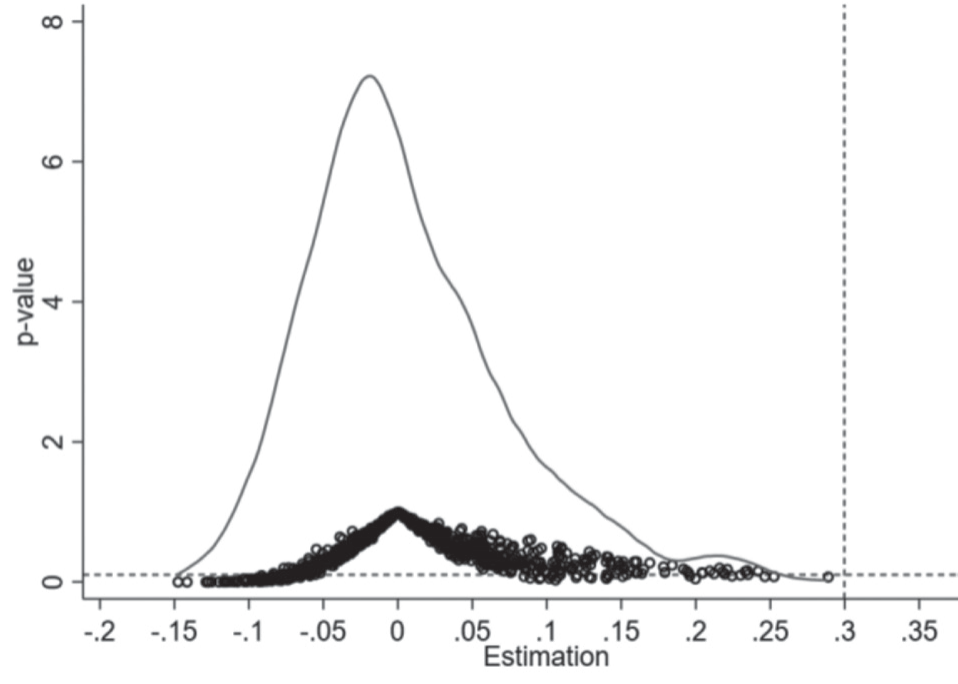
Table 5.
Result of transmission mechanism.
Model 1: Data Factorization (DataFac1) and Credit: In this model, we observe that there is a statistically significant positive relationship between credit and DataFac1 (0.022*, p<0.10). This indicates that as credit in the context of corporate environmental credit management increases, the level of data factorization also tends to increase, contributing positively to the promotion of green finance. This result suggests that corporate environmental credit management plays a vital role in advancing data factorization, which, in turn, facilitates green finance development.
Model 2: Data Factorization (DataFac1) and Green Finance: Model 2 introduces the impact of DataFac1 on GreenFin. The results show a significant positive relationship between DataFac1 and GreenFin (0.229**, p<0.05). This implies that an increased level of data factorization is associated with higher levels of green finance. It suggests that the process of collecting, integrating, and processing behavioral data regarding entities is conducive to the development of green finance.
Model 3: Data Factorization Efficiency (DataFac2) and Credit: Model 3 explores the influence of data factorization efficiency on credit. The findings reveal a highly significant positive association between DataFac2 and Credit (0.003**, p<0.05). This indicates that as data factorization efficiency improves, credit in corporate environmental credit management also tends to increase, potentially leading to a more supportive environment for green finance.
Model 4: Data Factorization Efficiency (DataFac2) and Green Finance: The final model examines the effect of data factorization efficiency (DataFac2) on GreenFin. The results demonstrate a notably significant positive relationship between DataFac2 and GreenFin (0.273**, p<0.05). This finding suggests that as data factorization efficiency improves, it is linked to higher levels of green finance. Data factorization efficiency’s role in accurately identifying the financial needs of enterprises and customers in various scenarios and time periods appears to be a key driver for promoting green finance.
In all four models, controls and fixed effects are included, ensuring that the analysis accounts for relevant variables and individual variations, thus enhancing the robustness of the findings. The sample size (N) is consistent across all models, providing a substantial dataset for analysis, and the coefficients of determination (R2) indicate that the models account for a substantial portion of the variance in GreenFin, with R2 values ranging from 0.100 to 0.398.
Overall, the results in Table 5 highlight the pivotal role of both data factorization (DataFac1) and data factorization efficiency (DataFac2) in promoting green finance, as well as the positive relationship between corporate environmental credit management (Credit) and these data-related mechanisms. These findings contribute to a deeper understanding of the transmission mechanisms at play in the context of green finance development, emphasizing the importance of robust data practices and efficient data utilization. As such, H4 is supported.
Conclusions
At present, China’s economic and social development has entered a new stage, and its economic development has transitioned from high-speed growth to high-quality development. The government has fully realized the importance of protecting the ecological environment. How to steadily promote high-quality economic development and progress while accounting for the healthy development and high-quality development of the ecological environment is one of the core issues of China’s economic and social development in the coming decades. In this paper, a quasinatural experiment was carried out with the help of 43 state-approved demonstration cities for the construction of the credit system. Using the panel data of 280 prefecture-level cities from 2010 to 2021, a multiple-timepoint difference-in-differences model was constructed to systematically assess the impact of Chinese environmental credit regulation on green finance.
We found that credit construction demonstration cities significantly improved the level of local green finance during the investigation period, and this conclusion was supported by a series of robustness tests. The mechanism test shows that environmental credit governance exerts a positive impact mainly by accelerating data factorization. Heterogeneity analysis found that the difference in the role of model-city credit policies on green finance is closely related to the administrative level and geographical location of those cities. Among urban groups with higher administrative levels and better location advantages, the promotion effect of environmental credit governance on green finance is more obvious. However, before the start of this study, the 20th National Congress of the CPC stressed the need to accelerate green transformation and development in the future. In the same year, the National Development and Reform Commission approved the third batch of credit construction demonstration cities and issued a special legal document on credit system construction entitled the Social Credit Law. Unfortunately, under the condition of multiple contexts, we have not been able to assess whether and how these new policies affect environmental credit governance and green finance. Future research can take this as an important research direction.
The practical implications of our research, outlined in this section, provide valuable insights into the acceleration of the construction of a Chinese social credit system, with a particular focus on ecological environmental protection. As we have discussed in the introduction, China is committed to green development as part of its “Fourteenth Five-Year Plan” and aims to achieve carbon neutrality by 2060. Green finance, which promotes environmental improvement and resource efficiency, plays a pivotal role in realizing these goals. To address the existing challenges within China’s green financial market, our proposed solution is the utilization of the social credit system, also known as the Chinese credit management system, with a specific emphasis on ecological environmental protection. Traditionally, the credit system in China has been used for public management and control. However, our research suggests that it can be harnessed to incentivize environmentally friendly behavior and promote green finance.
One of the key practical implications of our research is the concept of data factorization, which involves the transformation of green behavioral data into practical production factors. This process bridges the existing “data island” gap between the ecological sector and various government departments, enabling more effective allocation of financial resources and, in turn, fostering the development of green finance. By emphasizing the importance of data sharing and application, our research addresses the critical need for data-driven decision-making in the realm of environmental credit governance.
Our research also introduces the notion of the data empowerment and financial empowerment effects of the credit system, which we demonstrate through the quasinatural experiment of the national credit construction demonstration city policy. This not only expands the role of the Chinese credit system but also provides a mechanism for understanding the positive impact of data elements in the context of environmental protection governance.
Furthermore, our research offers a detailed analysis of the effects of environmental credit governance at the administrative and geographical levels. This analysis can serve as a valuable resource for government departments in China, inspiring the development of more targeted and effective management strategies in the field of ecological environmental protection.
In conclusion, our research provides practical guidance for the acceleration of the Chinese social credit system, particularly in the context of ecological environmental protection. By harnessing the power of data factorization and understanding the data empowerment and financial empowerment effects of the credit system, we aim to facilitate the growth of green finance and contribute to China’s sustainable development objectives.
We wish to highlight a few limitations that warrant consideration. First, our study primarily relies on retrospective data, which may have inherent biases or data quality issues. While we have taken measures to ensure data accuracy and reliability, there is always the possibility of unforeseen factors affecting our results. Second, the dispersed nature of our sample, which spans various regions and industries, posed challenges in conducting meaningful regional heterogeneity tests. Given the diversity of our sample, such tests may not have yielded robust results. Third, while our data factorization measurement framework is grounded in existing literature, the specific calculation methods for data factorization efficiency may vary depending on context. Providing a universally applicable method is a complex task that we aim to address in future research. Finally, as with any empirical study, our research reflects the conditions and dynamics at the time of data collection. Environmental credit governance, data factorization, and green finance are continuously evolving fields, and the findings of this study may not fully capture their long-term impact. We view these limitations as opportunities for further exploration and refinement of our research. By transparently acknowledging these constraints, we aim to encourage future research endeavors to build upon our work and address these limitations in a more comprehensive manner.