

Introduction
Extending biopesticides is an important way to achieve the target of chemical pesticide reduction [1]. In the past, humans used large chemical pesticides to stabilize crop yields and solve basic survival problems [2]. However, the characteristics of chemical pesticides, such as high toxicity, easy residue, difficult degradation, and pest resistance, have not only seriously endangered human health but also caused ecological damage and environmental pollution [3,4]. Therefore, the extension of biopesticides is an inevitable result of meeting the requirements of the times and responding to the pursuit of sustainable development [5]. This is because biopesticides not only bring economic benefits to humans but also increase food safety and environmental benefits [6]. As the world’s largest producer and consumer of pesticides, it is even more urgent and important for China to realize its vision for biopesticide extension [7].
The Chinese government has put forward higher requirements for green development and high-quality development in agriculture, which provides a good opportunity and great potential for biopesticide extension [4]. For example, in 2015, the Chinese government implemented a “zero growth” plan for chemical pesticides. This favorable policy environment has led to a trend of significant growth in the number of biopesticide product registrations. However, it is important to note that the current market share of biopesticide products in China is only about 10%. Most scholars have found that the current diffusion of biopesticides in China is characterized by “insufficient motivation for technology extension and low adoption rate by farmers” [8, 9]. On the one hand, public and private extension organizations are perceived to have insufficient incentives to promote biopesticides in terms of publicity, training, demonstration, and subsidies [10, 11]. Biopesticide extension is a complex system involving multi-agent participation in real situations. On the supply side of biotechnology are two types of agents that can extend biopesticides directly to farmers: Government agricultural extension agents (GAEA) and market agricultural extension agents (MAEA). On the other hand, the majority of farmers rarely adopt biopesticides for pest management [12], especially smallholder farmers [13].
Based on the demand side of biopesticide, scholars are working to identify and remove the influencing factors that prevent farmers from adopting biopesticide. They have empirically analyzed how the following factors can be optimized to promote biopesticide adoption by farmers: Technical attributes, pesticide knowledge, ecological cognition, risk preferences, market factors, and government regulation, among others [14-16]. For example, Huang et al. [4] pointed out that biopesticides have disadvantages such as slow efficacy, few products, high prices, and a narrow control spectrum. Saddam et al. [17] found that farmers’ cognitive biases and lack of capacity negatively affect the choice of safe pesticides. Benoît et al. [18] indicated that farmers’ risk preferences and policy perceptions greatly influence pesticide choice and use behavior. Wang et al. [19] found that market-related economic factors such as asymmetric information on green agricultural markets and low private returns are key barriers to biopesticide adoption. Constantine et al. [1] found that some agricultural extension mechanisms, such as a lack of agricultural technology training and subsidies, hinder biopesticide extension.
Unfortunately, few scholars have studied the behavior of biopesticide extension agents from the supply side. Most scholars only look at external technology extension as an important factor and study its direct impact on farmers’ biopesticide adoption [20, 21]. This will lead to unsystematic and incomplete findings: First, most studies assume that agrotechnical stations and pesticide retailers will proactively extend biopesticides to farmers. However, public agrotechnical stations are government agricultural extension agents serving multiple policy objectives, while private pesticide retailers are market agricultural extension agents seeking market profits. Furthermore, there is considerable uncertainty about the willingness of GAEA and MAEA to actively extend biopesticides [11]. Second, the dynamics of the interplay of decisions between multiple agents involved in the biopesticide extension system have largely been ignored. Scholars have only argued for the unilateral influence of agrotechnical stations and pesticide retailers on farmers’ biopesticide adoption behavior [1, 4]. Not only are the effects between GAEA and MAEA extension decisions ignored, but the inverse effects of farmers’ decisions to adopt or not adopt biopesticides on the extension decisions of GAEA and MAEA are not argued.
This paper focuses on the supply and demand of the biopesticide extension, arguing two questions: How do decisions among the three participants (GAEA, MAEA, and farmers) interact with each other? How can GAEA and MAEA be motivated to actively extend biopesticide to farmers? Scientific answers to the above questions have important practical and theoretical value for the country in formulating biopesticide extension. The contributions of this paper are as follows: First, we construct a dynamic model of a biopesticide extension system with multi-agent participation by using evolutionary game theory, including GAEA, MAEA, and farmers. The equilibrium evolution results of biopesticide extension are deduced theoretically. Second, based on Matlab software, an evolutionary analysis of the three agents’ participation in the system’s decisions is carried out by assigning values to system parameters. We not only verify the results of the theoretical derivation but also observe the dynamic effects of policy changes in system parameters, such as financial funding, policy target constraints, and subsidies, on agents’ decision evolution.
Material and Methods
Biopesticide Extension System
Biopesticide extension is a complex system that can involve multi-agent participation in real situations. On the supply side of biotechnology, two types of agents can extend biopesticides directly to farmers: Government agricultural extension agents (GAEA) and market agricultural extension agents (MAEA) [22]. On the demand side, the success of biopesticide extension is also linked to farmers’ adoption or non-adoption.
Model
We will use the research model from Thu [23] and Ju et al. [24]. An evolutionary game theory based on the participation of three agents is used to analyze the combination of GAEA and MAEA’s biopesticide extension decisions and farmers’ adoption decisions. Theoretically, agents’ learning ability, information mastery, and forecasting ability are limited. Each agent cannot predict the decisions of another in the short term and also cannot accurately account for their own costs and benefits in the future. Therefore, they can only reach a stable equilibrium decision in the process of correction, adjustment, and optimization over a long period of time. Based on the realistic context of our research and the basic requirements of evolutionary game theory, the following assumptions are presupposed.
Three agents are involved in the game of the biopesticide extension system (GAEA, MAEA, and farmers), and they all have limited rationality. We define the probability of GAEA extending biopesticide as x(0≤x≤1), then not extending as 1−x; similarly, the probability of MAEA extending biopesticide is defined as y(0≤y≤1), then not extending as 1−y; the probability of farmers adopting biopesticide is z(0≤z≤1), then not adopting as 1−z.
GAEA is the agent of the national government and serves government objectives. GAEA implements biopesticide extension activities, including publicity, demonstration, training, and subsidies. GAEA subsidizes the registration, storage, and transportation of biopesticides for MAEA as b1. Of course, GAEA can receive financial funding from the national government for the extension of biopesticide as ƒ. The non-subsidized cost of GAEA’s public extension of biopesticide is b2. The high rate of biopesticide use can effectively reduce environmental pollution, increasing regional farmers’ environmental utility as e, and the government performance of GAEA will be enhanced a. Conversely, if GAEA does not extend biopesticide, it will not be able to obtain financial support and will bear punishment v , because the pesticide-reduction policy goals cannot be achieved. For maximum profitability, GAEA will extend biopesticide when ƒ+a>(b1+b2)q.
MAEA is a private organization that extends biotechnology by selling biopesticide products at the same time. For example, pesticide retailers will introduce the types, functions, and operating standards of biopesticide products. MAEA is the only seller of biopesticide, and MAEA needs to bear the cost of c(c>0) for each unit of biopesticide extension. The total market demand for pesticides from farmers is q. The unit costs of biopesticides and chemical pesticides are p1 and p2(p1>p2). For maximum profitability, MAEA will extend biopesticides when p1+b1>c.
Farmers are the demanders and adopters of biopesticides. Their pesticide use can obtain base utility u(u>p2). Farmers can additionally increase the food safety utility w(w>0) from each unit of biopesticide adoption. Considering the positive externalities of biopesticides, then p1>u. For maximum profitability, farmers will adopt biopesticide when u+w>p1.
Then, the payoff matrix for GAEA, MAEA, and farmers in different scenarios can be obtained, as shown in Tables 1 and 2.
Replicator Dynamic Analysis of Agents
Importantly, we need to introduce a temporal element and discuss the evolution of different agents’ decisions over time [25]. We can calculate the replicator dynamic equations for each agent based on the payoff matrix. GAEA that chooses to “extend” and “not extend” biopesticide will receive expected payoffs of
Similarly, MAEA that choose to “extend” and “not extend” biopesticides will receive expected payoffs of
Farmers who choose to “adopt” and “not adopt” biopesticides will receive expected payoffs of
Results and Discussion
Dynamic Game: Evolutionary Stable Strategy Analysis
To obtain the evolutionary path of the equilibrium strategies of GAEA, MAEA, and farmers in the long-term extension of biopesticides, we will use dynamic differential equations to calculate the evolutionary stabilization strategy (ESS). Of course, the ESS has to satisfy the necessary conditions of dF(x)/dx<0, dF(y)/dy<0, and dF(z)/dz<0. Next, the ESS of GAEA, MAEA, farmers, and the system are discussed separately.
The ESS of GAEA
The partial derivative of GAEA’s replicator dynamic equation can be obtained:
In order to simplify the formula and facilitate discussion, let
The findings can be inferred from the above analysis: First, the probability of GAEA extending biopesticide will increase as the probability of MAEA extension and farmer adoption decreases. Second, when GAEA can get financial funding ƒ>b1q+b2q from the national government for biopesticide extension,
The ESS of MAEA
The partial derivative of MAEA’s replicator dynamic equation can be obtained:
Simply define
The findings can also be inferred from the above analysis: First, there is a positive correlation between the probability of MAEA extension of biopesticide and the probability of GAEA extension and farmers’ adoption. Second, when MAEA’s benefit is smaller from biopesticide extension, consistent with
The ESS of Farmers
The partial derivative of the farmers’ replicator dynamic equation can be obtained:
We can define
The findings can also be inferred from the above analysis: First, there is a positive correlation between the probability of a farmer’s biopesticide adoption and the probability of MAEA’s biopesticide extension. Second, when the utility of food safety and the environment is small for
The ESS of the System
According to Eqs. (1), (2), and (3), we can further obtain the systems’ set of replicator dynamic equations.
(7)
Theoretically, solving Eq. (7) for F(x)=0, F(y)=0, and F(z)=0 results in nine potential ESS of the system (x, y, z): E1(0, 0, 0), E2(1, 0, 0), E3(0, 0, 1), E4(0, 1, 0), E5(1, 1, 0), E6(0, 1, 1), E7(1, 0, 1), E8(1, 1, 1), E9(
The calculation process of the Jacobian matrix of the system is as follows:
The specific coordinate values of the six potential ESS are brought into the matrix in turn, and then solved to obtain all the characteristic roots, and the results are shown in Table 3. It can be observed that only E1, E2, E5, and E8 have the highest probability of becoming ESS, but they still need to satisfy certain preconditions to remain stable.
Fig. 1.
ESS evolutionary path of the system. Notes: Scenarios 1-6 are the results obtained using Matlab simulation after giving different parameter values according to Eq. (7). The colored lines indicate the evolutionary paths and directions of the decision combinations of GAEA, MAEA, and the farmers. The x and y axes represent the probability of biopesticide extension by GAEA and MAEA, and z axes represent the probability of the farmer’s adoption.
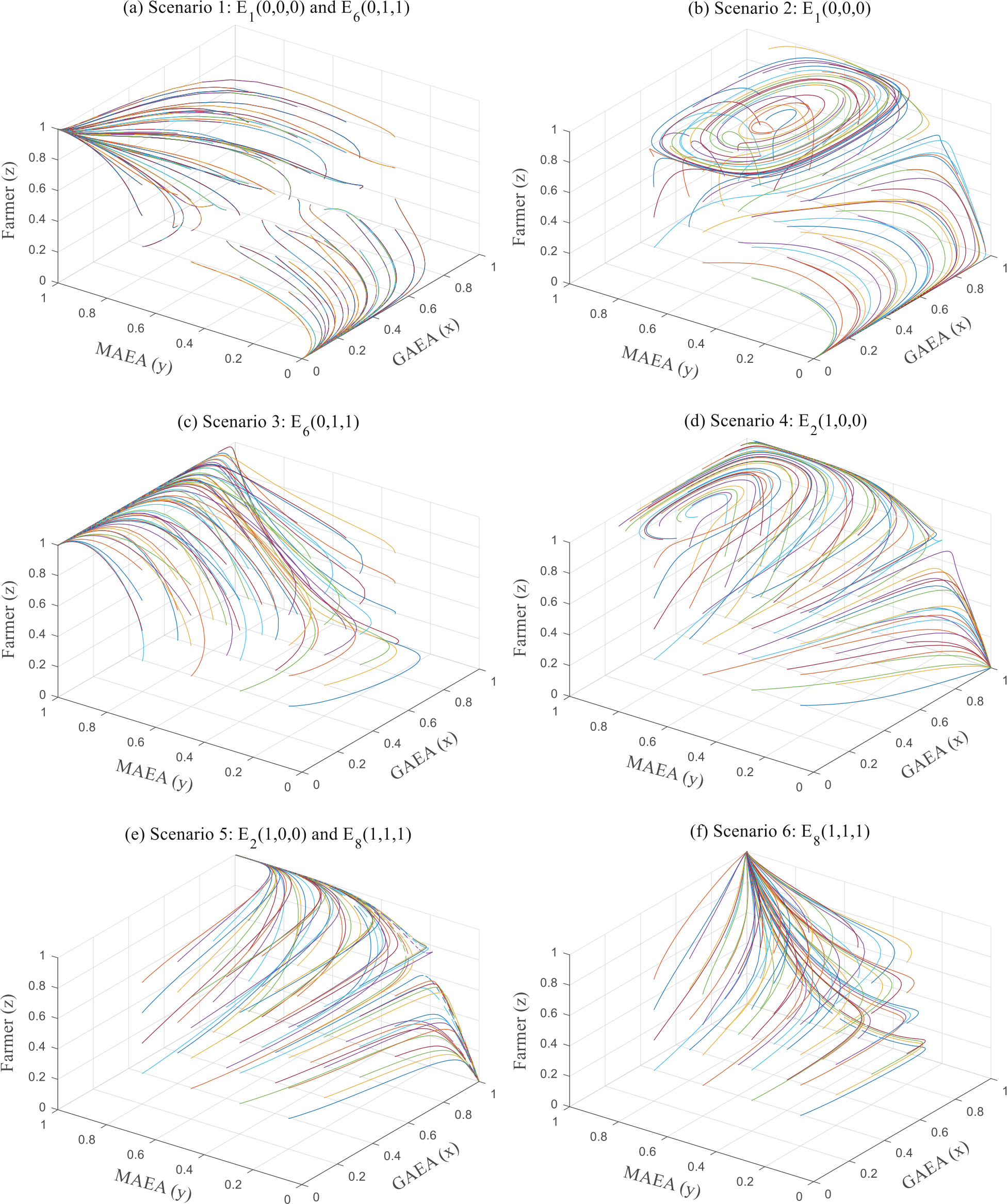
Fig. 2.
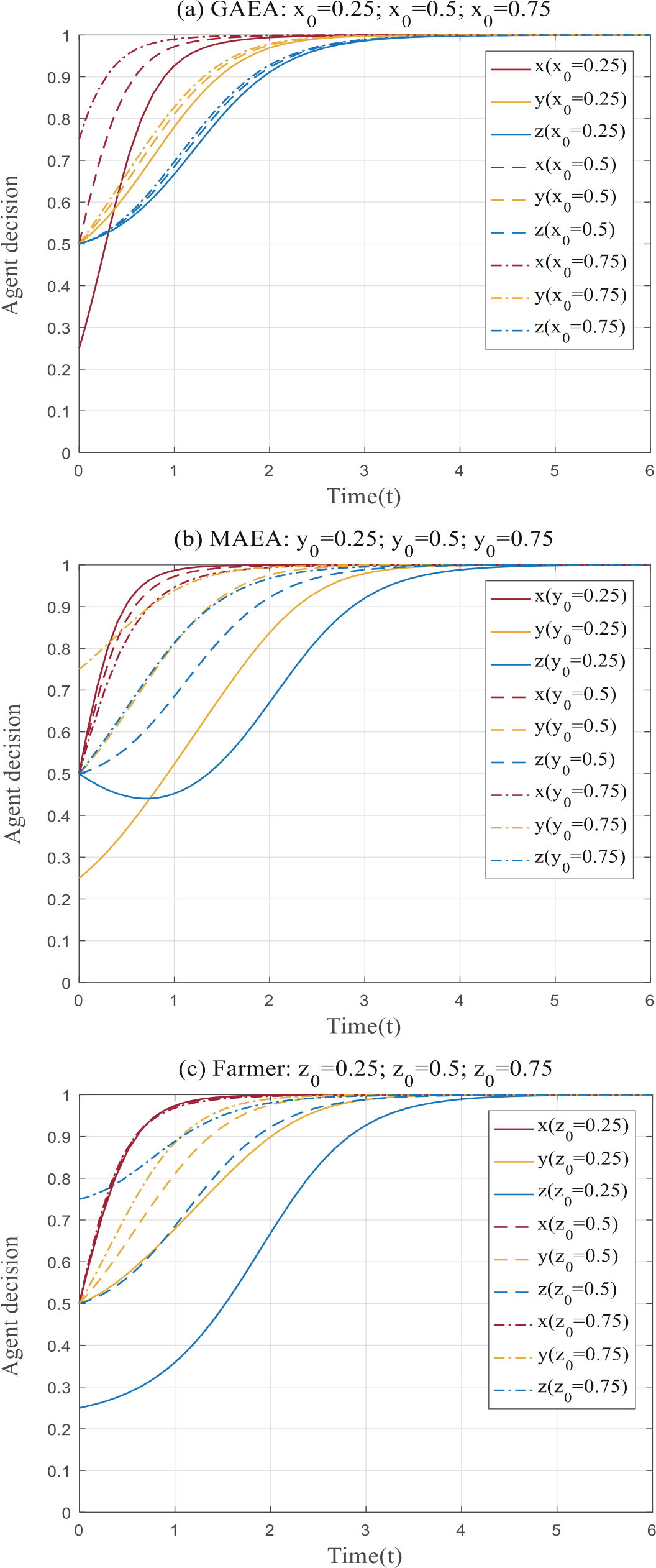
Interaction between agents’ decision. Notes: The starting point of the evolution is set to x0=0.5, y0=0.5, and z0=0.5. Only the parameter settings of x0, y0, and z0 are changed in (a)(b)(c), respectively. The horizontal axes indicate the time required for the agent’s decision to evolve to x=1, y=1, and z=1. Longer times indicate a slower rate of evolution.
Simulation Experiments: Matlab Software Platform
Game Scenarios and System Evolution
The impact of system parameter changes on the evolution of GAEA, MAEA, and farmers’ decisions is further visualized. Based on the dynamic functional relationship in Eq. (7), a simulation model of the dynamics of the biopesticide extension system with the participation of three agents can be developed. Matlab, Vensim, Python, and Swarm software are commonly used in academia to conduct system simulation experiments. Among them, Matlab is widely used in the field of socioeconomic research because it can better implement the operation of matrices and obtain open evolutionary images. Therefore, Matlab was used for the simulation experiments in this study.
The assignment of system parameters is the basis for performing simulation experiments. Of course, these parameters are only virtual payoff values for each agent. First, we have to satisfy all the conditions in the system assumptions: ƒ+a>(b1+b2)q, p1+b1>c, u+w>p1, and u>p2. From the stability of the ESS in Table 3, the following six scenarios can be obtained:
Scenario 1. The sink E1(0, 0, 0) and E6(0, 1, 1) are ESS when ƒ<b2q−v and c<p1. To simulate, set b1=1, b2=2, f=0.5, e=1, a=3, ν=1, c=1, q=1, p1=2, p2=1, u=2, and w=1. The evolutionary path of the system’s decisions is shown in Fig. 1a. The results of the simulation experiments are consistent with those of the game derivation. The economic implication indicated by this finding is that GAEA will have no incentive to extend biopesticide when the financial support given by the national government for biopesticide extension is at a low level.
Scenario 2. The sink E1(0, 0, 0) is ESS when ƒ<b2q−v and c>p1. To simulate, set b1=1, b2=2, f=0.5, e=1, a=3, ν=1, c=1, q=1, p1=0.5, p2=1, u=2, and w=1. The evolutionary path of the system’s decisions is shown in Fig. 1b. The results of the simulation experiment are also the same as those of the game derivation. This shows that when the cost of biopesticide extension is too high for MAEA, they will withdraw from biopesticide extension based on Scenario 1. Both MAEA and GAEA in this scenario have no preference for extending biopesticides, and farmers will not adopt biopesticides.
Scenario 3. The sink E6(0, 1, 1) is ESS when b2q−v<ƒ<(b1+b2)q and c<p1. To simulate, set b1=1, b2=2, f=2, e=1, a=3, ν=1, c=0.3, q=1, p1=2, p2=0.5, u=2, and w=1. The evolutionary path of the system’s decisions is shown in Fig. 1c. The simulation experiments are consistent with the results of the game derivation. This means MAEA will extend biopesticide when the unit cost of biopesticide extension is low and the subsidy level is high. This is because the extension of biopesticides can be profitable and subsequently beneficial for farmers to adopt them.
Scenario 4. The sink E2(1, 0, 0) is ESS when b2q− v<ƒ<(b1+b2)q and b1<c+p2. To simulate, set b1=1, b2=2, f=2, e=1, a=3, ν=1, c=1, q=1, p1=0.5, p2=1, u=2, and w=1. The evolutionary path of the system’s decisions is shown in Fig. 1d. The simulation experiments are consistent with the results of the game derivation. On the one hand, GAEA can get a medium level of financial funding from the national government and does not have to bear excessive subsidy expenditure. So, GAEA are bound to be willing to extend biopesticide. On the other hand, MAEA can get fewer subsidies to extend biopesticides and bear high extension costs, which leads to lower comparative benefits of biopesticide extension than chemical pesticides, so MAEA will eventually “not extend” biopesticide.
Scenario 5. The sink E2(1, 0, 0) and E8(1, 1, 1) are ESS when ƒ>(b1+b2)q and b1<c+p2. To simulate, set b1=1, b2=2, f=5, e=1, a=3, ν=1, c=1, q=1, p1=0.5, p2=1, u=2, and w=1. The evolutionary path of the system’s decisions is shown in Fig. 1e. The simulation experiments are consistent with the results of the game derivation. This indicates that GAEA receives a high level of financial funding from the national government, and therefore, GAEA chooses to “extend” biopesticide, regardless of other parameters.
Scenario 6. The sink E8(1, 1, 1) is ESS when ƒ>(b1+b2)q and b1>c+p2. To simulate, set b1=1, b2=2, f=5, e=1, a=3, ν=1, c=0.3, q=1, p1=2, p2=0.5, u=2, and w=1. The evolutionary path of the system’s decisions is shown in Fig. 1f. The simulation experiments are consistent with the results of the game derivation. This indicates that GAEA can obtain higher financial funding from the national government, while GAEA will give MAEA higher subsidies for biopesticide extension. In this scenario, both GAEA and MAEA can gain more benefits, and both prefer to “extend” biopesticide.
Interaction of Agents’ Decisions
To demonstrate the interaction between the decisions of the three agents, GAEA, MAEA, and farmers, we simulate the system evolution by varying the initial decision probability values of different agents. We will take E8 (1, 1, 1) of the optimal ESS as an example. The initial decision probabilities of GAEA, MAEA, and farmers are set to x0=0.5, y0=0.5, and z0=0.5. The time is set to 6, and the step size is set to 1 in Matlab software.
For GAEA, set x0 is equal to 0.25, 0.5, and 0.75 in order. However, y0=0.5 and z0=0.5 were still used to obtain the results shown in Fig. 2a. The results show that as the initial decision probability of GAEA increases, the rate of evolution of GAEA decision probability to x=1 in the system is significantly faster. Also, the speed of evolution of MAEA decision probability to y=1 and the evolution of the farmer’s decision probability to z=1 increased. That is, the higher the initial probability of biopesticide extension by GAEA, the shorter the time it takes for system participants to reach a synergistic decision to extend and adopt biopesticide. Therefore, it is important to enhance the motivation and commitment of GAEA to extend biopesticide, which will benefit their better and faster diffusion.
Fig. 3.
Impact of policy changes on the evolution of the system. Notes: The reference for the simulation in the Matlab software is the parameter setting of E8 in scenario 6. The principle of each adjustment is to double the value of the processing variable but keep other parameters in the system unchanged. The vertical axis coordinates represent the evolution of the system decision from the initial point (0.5, 0.5, 0.5) to (1, 1, 1). The horizontal axis coordinates indicate the time taken by each agent to evolve to (1, 1, 1). Shorter sum times indicate faster evolution.
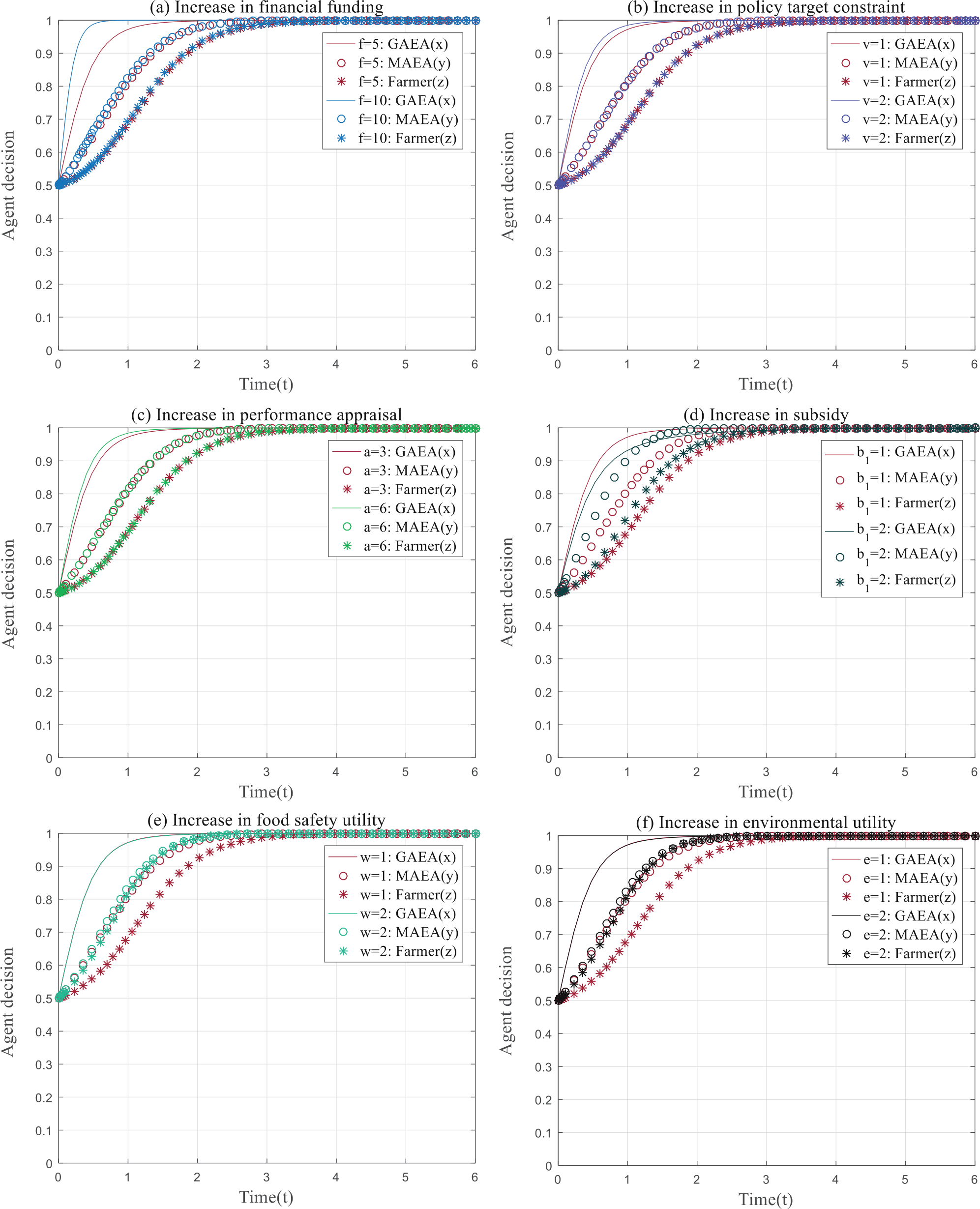
Table 1.
Payoff matrix for each agent when biopesticides are adopted by farmers (z).
Table 2.
Payoff matrix for each agent when biopesticides are not adopted by farmers (1−z).
Table 3.
Characteristic root solution results and system ESS stability.
For MAEA, set y0 is equal to 0.25, 0.5, and 0.75 in order. However, x0=0.5 and z0=0.5 were still used to obtain the results shown in Fig. 2b. The results show that as the initial decision probability of MAEA increased, the rate of evolution of MAEA decision probability y=1 and farmers’ decision probability z=1 in the system accelerated significantly. However, the speed of evolution of GAEA decision probability to x=1 decreased. That is, increasing the initial probability of biopesticide extension by GAEA can only accelerate farmers’ adoption. However, it is worth noting that in the situation of MAEA’s strong extension of biopesticide, it is important to avoid GAEA’s “free-rider” behavior (using MAEA’s extension to gain performance appraisal). The occurrence of “free-rider” can reduce the overall evolutionary rate of the system, thus delaying the diffusion of biopesticide.
For farmers, set z0 equal to 0.25, 0.5, and 0.75 in order. However, x0=0.5 and y0=0.5 were still used to obtain the results shown in Fig. 2c. The results show that as the initial decision probability of biopesticide adoption by farmers increases, the rate of evolution of GAEA decisions to x=1 in the system remains almost unchanged. In contrast, the rate of evolution of MAEA decisions to y=1 accelerates significantly. That is, the probability of farmers’ adoption will increase the market demand for it. MAEA is the only supplier of biopesticide products to farmers and plays a key role in farmers’ biopesticide adoption decisions. In other words, farmers’ market demand for biopesticides will also promote the extension of biopesticides by MAEA as soon as possible.
Heterogeneous Impact of Policy Change
Reasonable and effective policy design strongly guarantees biopesticide extension [27]. The parameters that can be adjusted through policies in the three-agent participatory biopesticide extension system are financial funding f, policy target constraints v, performance appraisal a, biopesticide extension subsidy b1, and the rice farmer’s utility of food safety w and utility of environment e. Still taking E8(1, 1, 1) of the system as an example, with x0=0.5, y0=0.5, and z0=0.5, and further discussing the effects of the above parameter changes on the evolutionary results in Scenario 6.
(1) Policy changes for GAEA
Changing the financial funding f, policy target constraints v, and performance appraisal a can directly affect the benefit maximization goal of GAEA [28]. In the Matlab simulation experiments, we sequentially expand the values of f, v, and a and present the results in Fig. 3a, 3b, 3c. First, when the financial funding the national government gave to GAEA was increased, the evolution of GAEA’s decision to extend biopesticide accelerated significantly, and the speed of decision evolution of MAEA and farmers increased slightly. That is, increasing financial funding can effectively increase the rate of evolution of system decisions to (1, 1, 1). This effect is especially significant for GAEA. Second, when the policy target constraint of pesticide reduction the national government gives to GAEA is increased, the rate of decision evolution of GAEA increases slightly, but the rate of decision evolution of MAEA and farmers remains almost unchanged. It can be seen that increasing the pesticide reduction target constraint only leads to pressure directed at GAEA and has little effect on MAEA and farmers. Third, the rate of decision evolution of GAEA increased slightly when the performance appraisal for biopesticide extension was increased, but the rate of decision evolution of MAEA and farmers remained almost unchanged. This evolutionary result is similar to the effect of increasing the pesticide reduction target constraint. The extension of biopesticides in China is still in its infancy, and the current financial funding and subsidy policy system is not yet perfect. Many studies have pointed out that the vast majority of Chinese regions have low financial resources for biopesticides, and there are gaps in biopesticide subsidies [4, 11].
(2) Policy changes for MAEA
Changing subsidies for biopesticide extension would directly affect MAEA’s benefit maximization goal. When the value of the b1 parameter is expanded to twice the value, the evolutionary path is shown in Fig. 3d. The results show that the evolution of decision becomes slower for GAEA, while the evolution of decision increases significantly for both MAEA and farmers. A possible explanation is that in the case of GAEA, with limited financial funding from the national government, increasing subsidies for biopesticide extension would increase GAEA’s financial burden and subsequently slow down its decision to extend biopesticide. However, for MAEA, subsidies can effectively increase the profit potential of its biopesticide extension and subsequently accelerate its biopesticide extension decision, thus helping farmers to adopt biopesticide more quickly. However, it is also “not a smart” policy for the national government to bear the financial costs of biopesticide extension in the long term [28].
(3) Policy changes for farmers
Changing the farmers’ food safety and environmental utility will directly affect their utility maximization goal. The willingness to pay for biopesticides will increase as farmers’ demand preferences for food safety and environmental utility increase [5, 12]. When the parameter value of w and e is doubled, the evolutionary results are shown in Fig. 3e, 3f. The results show that the speed of decision evolution of GAEA to extend biopesticide in the above two situations did not change significantly, and the speed of decision evolution of MAEA increased slightly, but the speed of decision evolution of farmers increased significantly. The comparative advantage of biopesticides over chemical pesticides is currently reflected in the reduction of pesticide residues and pollution. Increasing farmers’ access to utility in biopesticide adoption can compensate for the lack of economic benefits. Therefore, awareness of food safety and environmental protection should be increased through GAEA and MAEA extension activities, such as advocacy, training, and demonstration [5].
Conclusions
This study uses dynamic evolutionary game theory to construct a theoretical model of a biopesticide extension system with multi-agent participation and uses Matlab software for parametric simulation. We answered two main questions: How do the agents in a biopesticide extension system interact with each other? How can GAEA and MAEA be motivated to actively extend biopesticide? The main conclusions obtained are as follows:
One is that in the biopesticide extension system, there is a strong dynamic interaction between the extension decisions of GAEA and MAEA and the farmer’s adoption decision. Specifically, an increase in the probability of GAEA extending biopesticide will increase the probability and speed of GEAE’s biopesticide extension and the farmer’s biopesticide adoption; an increase in the probability of MAEA extending biopesticide will reduce the probability and speed of GEAE’s biopesticide extension but increase the probability and speed of farmers’ biopesticide adoption; an increase in the probability of farmers adopting biopesticide will increase the probability and speed of GEAE’s biopesticide extension. It is important to note that GAEA has a possibility of free-riding behavior to take advantage of MAEA’s biopesticide extension, and farmers’ adoption behavior is more likely to be related to the extension of MAEA. These findings are of great practical guidance for building a multi-party interest collaborative biopesticide promotion mechanism. The efficiency of unilateral efforts by government departments or market organizations to promote biopesticides is low.
The other is that policy changes will heterogeneously affect the rate of evolution of GAEA, MAEA, and farmer decisions in biopesticide extension systems. Specifically, increasing national government funding, policy target constraints, and performance appraisal are effective means of accelerating the extension of biopesticide in GAEA. Increasing subsidies significantly speeds up the evolution of decisions for MAEA’s biopesticide extension and farmers’ adoption. Increasing the level of food safety and environmental utility for farmers can effectively speed up the evolution of adoption decisions and accelerate the extension of biopesticides by MAEA. Similarly, it is worth noting that financial funding and subsidies play an extremely important role in the initial stages of biopesticide extension. A balance of interests needs to be achieved between GAEA, MAEA, and farmers to create an incentive synergistic biopesticide extension system. The practical guidance value of these findings lies in the importance of government financial subsidies and technical training, especially in the early stages of promoting biopesticides. At the same time, the farmer’s ecological protection and food safety awareness are also very important.

