

Introduction
The cigarette beetle, Lasioderma serricorne (Fabricius) (Coleoptera: Anobiidae), is a major threat to food and other plant-derived products [1]. In the tobacco industry, the economic impact of this pest is most severe. This beetle causes annual 0.7%-1.0% losses globally to tobacco production [1]. The traits of the cigarette beetle further complicate the control of this pest. It is very difficult to distinguish between males and females because the species showed minimal sexual dimorphism. During the life span, a female can lay over 100 eggs and create holes in the packaging and stored products for oviposition [2]. Larval stages are primarily responsible for damaging stored products, but the presence of adult insect fragments can also reduce product quality.
Presently, like pest control in stored food and processing factories, management of L. serricorne in cigarette manufacturing factories has always depended heavily on sanitation [3]. For the management of L. serricorne, contact and residual chemical insecticides are used as a control measure [4]. The applications of organophosphate and carbamate pesticides in cigarette manufacturing factories are inadequate because of the unpleasant smell and higher mammalian toxicity [4]. The positive aspect of Pyrethroid insecticides with broad-spectrum neurotoxins is that they have less toxicity to nontarget organisms, minimum environmental persistence, and no bioaccumulation. Moreover, they have been widely used to control L. serricorne in cigarette manufacturing factories and food processing factories with positive effects [2]. Continued use of pesticides against insect pests can lead to the development of resistance, reducing their overall effectiveness. Consequently, researchers have shifted away from relying on potent insecticides and are now focusing on environmentally sustainable pest control strategies. The first report of pyrethroid resistance was confirmed in 1985 in the population of Heliothis virescens (Fabricius) (Lepidoptera: Noctuidae) in West Texas [5]. Due to the injudicious use of pyrethroids and other insecticides, it is also observed that Coleoptera stored product pests, including Sitophilus zeamais, Tribolium confusum, and Tribolium castaneum, developed resistance against various levels of insecticides [6].
The tobacco industries of developing countries have employed various strategies to protect stored tobacco products from insect infestations. Among these strategies, the use of synthetic insecticides in the form of fumigants is the most common. However, extensive use of synthetic insecticides has led to several issues, including insect resistance, adverse effects on non-target organisms, and overall environmental contamination [7], [8] and [9]. Consequently, the search for alternative management strategies is crucial that is environmentally safe to manage L. serricorne while maintaining product quality. One promising approach is the use of botanical pesticides. The biocompounds derived from various plant species offer a more environmentally friendly and sustainable approach to pest management [10]. Moreover, these biocompounds are readily biodegradable with low mammalian toxicity and less harm to the environment [11] and are an effective alternative for controlling insect pests with a novel mode of action, and insect pests encounter challenges in developing resistance [11].
Gaining knowledge on the efficacy of plant extracts, including those derived from chrysanthemum, garlic, or neem, can help to develop eco-friendly pest control techniques by enabling these extracts to potentially act as insecticidal agents against L. serricorne [12].
In order to develop an integrated pest management approach for the sustainable management of L. serricorne in the tobacco sector, this study aims to examine and evaluate the toxicity and repellency responses of L. serricorne against the investigated botanicals.
Materials and Methods
Laboratory Culture of L. serricorne
Lasioderma serricorne were collected from Pak Hill (Private company) godown and were reared in jars containing diets (wheat feed/yeast, 10:1, w/w) in incubators in the dark (29±1ºC, 70-80% r.h.). All the insects used in all the experiments were about the same age and similar size regardless of gender [13].
Plant and Sample Preparation
The leaves of five different plant species at the vegetative stage used in the experiment were collected in and around the University of Haripur, located in Northern Pakistan (Table 1). For the authentication of plant species, they were identified by a botanist in the Department of Biology, the University of Haripur, and the plant specimens were deposited in Herbarium (Voucher no. F.No. UH/Hort/2514). For fifteen days, the plant leaves were air-dried at room temperature. The dried samples were ground to make a fine powder. One kg of each sample was separated by maceration (1 * 2L) in 12 h intervals using concentrations of 50% at room temperature. The macerated samples were filtered, and under low temperatures and pressure, the solvents were removed using a rotary evaporator (Buchi, R-210) in the Food Science Laboratory at the University of Haripur. The yield obtained was Parthenium hysterophorus 46 g, Thuja orientalis 63 g, Azadirachta indica 51 g, Adhatoda vasica 48, and Nigella sativa 55 g, which were then stored at less than 4ºC temperature.
Preliminary screening: Preliminary screening of extracts from five different plant species was carried out at various concentrations based on yield (500-4,000 mg/L) for their efficacy against adults of L. serricorne. Six different concentrations, i.e. (250 mg/L, 500 mg/L, 750 mg/L, 1000 mg/L, 1250 mg/L, and 1500 mg/L) were selected on the basis of preliminary data and evaluated against L. serricorne in the final bioassays.
Qualitative Analysis of Plant Species Extracts
Preparation of Plant Extracts
Whole or coarsely ground plant drugs were macerated (for fluid extraction) by keeping them in contact with the solvent using a lidded vessel for a predetermined amount of time while stirring frequently until a homogenized mixture was achieved [14].
Wegners tests for alkaloids: The herbal extract samples were separately mixed with dilute HCl (1.5%) and filtered through filter paper (Whatman No. 1). A small amount of potassium iodide was added to the filtrate. The occurrence of alkaloids in the sample was indicated by the presence of reddish-brown precipitates [15].
Ferric Chloride Test for phenols: To assess the plant extracts for phenols, a few drops of ferric chloride solution were added to the extract in a 5 ml test tube. The presence of phenols was indicated by the emergence of a bluish-black color in the solution [16].
Salkowski’s test for phytosterols: Chloroform was added to the plant extract solution. After this, the mixture was subjected to filtration using Whatman no. 1 filter paper. Three to four drops of H2SO4 (concentrated) were then added to the filtrate, which was vortexed and allowed to rest for some time. The solution turned golden yellow due to the presence of phytosterol [16].
Tests for di-terpenes: To identify terpenes, copper acetate solution (2-3 drops) was added to the plant extracts. The development of a bright green hue suggested the presence of diterpenes [16].
Tests for Saponins: In a test tube, 2 ml of plant extract was diluted with distilled water, followed by vortexing for five minutes. The presence of white foam at the surface for more than 10 minutes confirmed the presence of saponins [15].
Alkaline reagent tests for flavonoids: To determine whether flavonoids were present in the plant aqueous extracts, a few drops of lead acetate solution and diluted acid were added. The appearance of a brilliant yellow hue indicated the presence of flavonoids in the extracts [17].
Residual Toxicity
A 6x6 factorial design was used for the current experiment. Residual toxicity of five plant species was tested against adult of L. serricorne by the Potter spray method as per the standard method [18]. Briefly, six concentrations of plant extracts (250-1500 mg/L were used. We placed a paper filter at the bottom of the Petri dishes, and 10 adults of L. serricorne were released at the center of each Petri dish. The treatment was replicated thrice. Six different concentrations (25 mg/L to 1500 mg/L) were sprayed and incubated under controlled conditions. The mortalities of beetles were observed at 24 h intervals and up to 96 h. Distilled water was used as a control. Mortality data were corrected using Abbott’s formula. The LC50 and LC90were determined via probit analysis [19].
Topical (Direct) Toxicity
A 7x7 factorial design was used for the topical toxicity. 210 adults of L. serricorne were used. In each treatment, 30 adults of L. serricorne were used (three replications per treatment, and each replicate contained 10 beetles). The Beetle mortalities were checked after post-treatment of 24 h and up to 96 h. L. serricorne adults were considered dead when they failed to respond to gentle touch with a camel hairbrush or finger grasping. The mortality was assessed at 24 h intervals to 96 h. Abbott’s formula was employed to correct the mortality rate, and LC50 and LC90 were determined via probit analysis [19].
Table 1.
List of plant species tested against L. serricorne at six different concentrations.
Repellent Effect of Plant Extracts Against L. Serricorne
The repellent effect of five plant species with six different concentrations was checked using the method of [20] with a slight modification against L. serricorne. We used Petri plates of 16 cm diameter and divided the bottom of Petri plates by cutting into two halves of Whatman filter paper no. 1 and then past it. We treated half portion of the filter paper with plant species extract (250 mg/L, 500 mg/L, 750 mg/L, 1000 mg/L, 1250 mg/L, and 1500 mg/L), and the other half was treated with distilled water. The filter paper was air dried for 20 minutes and, afterward, carefully placed into uniform and equally edged by edge.
Twenty newly emerged adult beetles, mostly of the same size and age, were arranged in ten pairs and released in the center of the treated area within the Petri dishes. To prevent insect escape, the Petri dishes were secured with muslin cloth and kept in an incubator at 27±C and a relative humidity of 65±5%. For each treatment, 30 beetles were used, each treatment contained three replications, and 10 beetles were present in each replication. The distribution of the insects was observed every hour for 1 h, 12 h, 24h, 48 h, 72 h, and post 96 h. After this exposure period, the percentage repellency (PR%) was calculated according to [21] using the formula shown below:
Nc = Number of beetles counted in the untreated arena
Nt = Number of beetles counted in the treated arena
where Nc represents the number of insects in the control segment, and Nt represents the number of insects in the treated section [22]. Different classes were assigned as per the average repellence percentage, which included Class 0 = PR of 0-0.1%; Class I (0.2-10%); Class II (20.1-40%); Class III (40.1-60%); Class IV (60.1-80%); and Class V (80.1-100% [23].
Data Analysis
The mortality data of L. serricorne based on the residual and direct toxicity of plant species extracts were compiled. The median lethal concentration values (LC50 and LC90) and other regression parameters were determined by Probit [24, 25] using SPSS 10 software, version 16. Similarly, the percentage mortality data against L. serricone were also analyzed by one-way analysis of variance, and the means were compared using Tukey’s post hoc test.
Results
Qualitative Analysis of Phytochemicals from Selected Plant Species: Phytochemical Screening of Plant Extracts for Their Chemical Constituents
The results in Table 2 showed that all the tested plant species’ aqueous extracts contain phytochemicals. Among the plant species, alkaloids, flavonoids, phenols, phytosterol, di tarphenes, and saponins are higher in A. indica as compared to other plant species. A. vasica also exhibited higher alkaloids and saponins. Saponobs and flavonoids are also higher in P. hyterophorous as compared to N. sativa and T. orientalis. In T. orientalis. The percentage occurrence of all the phytochemicals was low.
Potencyof Plant Extracts on L. Serricorne According to a Topical Toxicity Bioassay
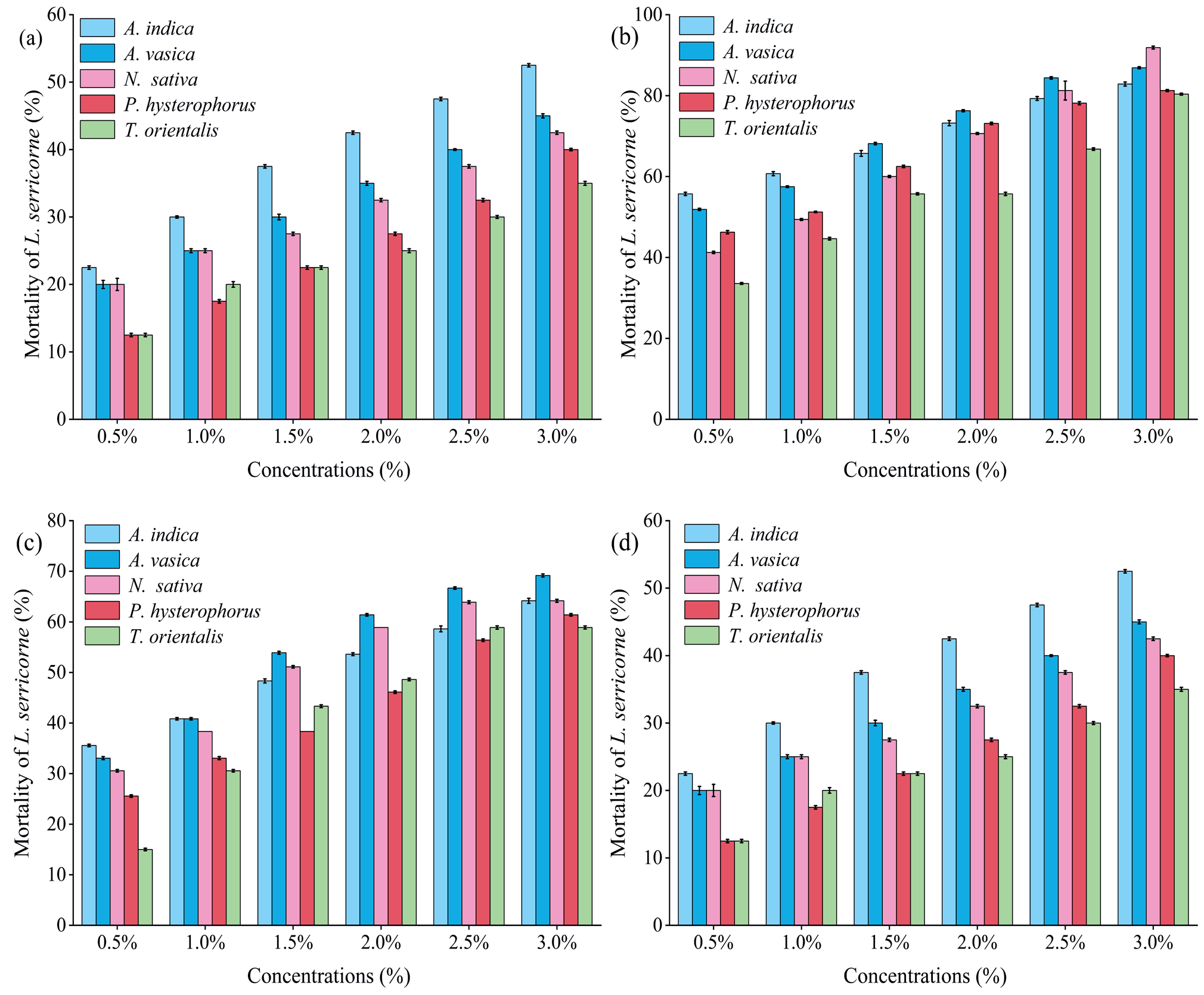
The lethal effects of the plant extracts increased as their concentrations increased. Among the plant species after 24 h exposure, A. indica exhibited the lowest LC50 = 6.80 mg/L and LC90 = 95.78 mg/L, respectively (Table 3). Among the tested plant species extracted at 3.0% concentration, A. indica exhibited 52.50% mortality, whereas T. orientalis exhibited 35.00% lowest mortality against L. serricorne (Fig. 1a). After 48 hours, A. vasica exhibited the lowest LC50 = 3.40 mg/L and LC90 = 25.60 mg/L, respectively, against L. serricorne. Similarly, A. indica with LC50 =3.71 mg/L and LC90 = 71.78 mg/L were the second most lethal plant extracts. The mean percentage mortality among the plant extracts was higher for A. vasica (69.00%) (Fig. 1b) (Table 3). Similarly, the LC50 = 1.15 mg/L and LC90 = .30 mg/L of the A. vasica extract were significantly lower than those of the other plant species extracts after 72 h against L. serricorne. Among the plant species, the least toxic plant species was T. orientalis, which exhibited LC50 = 1.85 mg/L and LC90 = 31.29 mg/L). At a maximum 3.0% concentration, A. vasica caused 87.00 % mean percent mortality to L. serricorne (Fig. 1c) (Table 3). After 96 h exposure period among the plant species extracts, maximum toxicity was observed with A. indica having LC50 = 0.46 mg/L and LC90 = 6.62 mg/L and A. vasica with LC50 = 0.92 mg/L and LC90 = 6.58 mg/L against L. serricorne. The least effective among the plant species was T. orientalis, which exhibited the least toxicity, having LC50 = 1.82 mg/L and LC90 = 12.86 mg/L (Table 3). Furthermore, the mean percentage mortality of L. serricorne was higher at 90.00% for A. indica and 89.00% for A. vasica at 3.00% concentration (Fig. 1d)).
Table 2.
Occurrence of phytochemicals in five plant species extracts.
| Plants Species | Alkaloids | Flavonoids | Saponins | Di-terpenes | Phyto-sterol | Phenols |
|---|---|---|---|---|---|---|
| T. orientalis | + | + | + | + | + | + |
| P. hysterophorus | + | ++ | ++ | + | + | + |
| N. sativa | + | + | + | + | + | + |
| A. vasica | ++ | + | ++ | + | + | + |
| A. indica | +++ | +++ | ++ | ++ | +++ | +++ |
Table 3.
Direct toxicity of plant extracts to L. serricorne after 24 h, 48 h, 72 h, and 96 h.
Residual Toxicity of Plant Species Extracts Against L. Serricorne
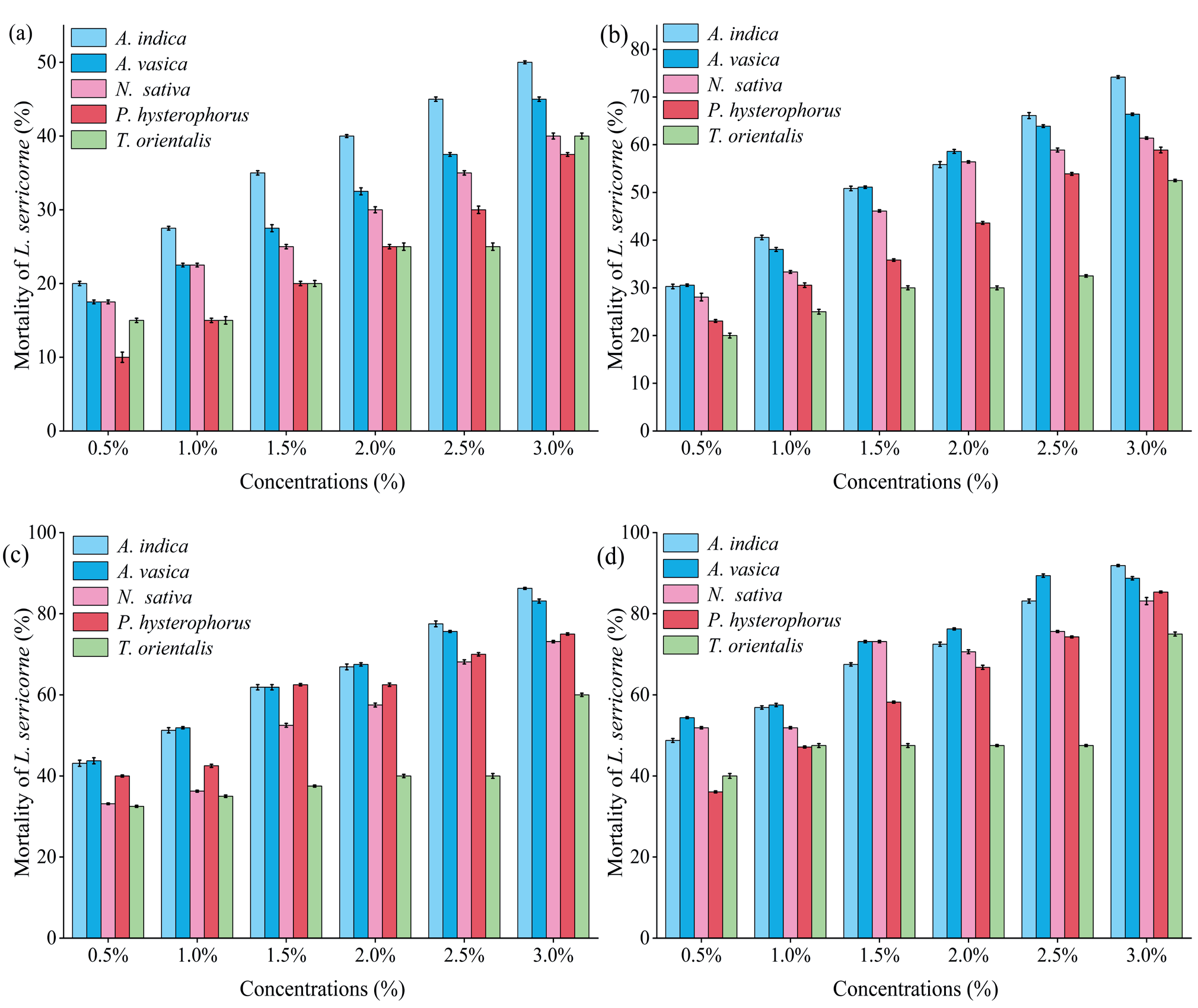
With increasing concentrations of botanical extracts, the LC50 and LC90 values also decreased. A. indica was showed the most toxic plant extract due to its lowest LC50 = 10.02 mg/L and LC90 = 108.61 mg/L, respectively, after 24 h, while the least effective plant species was T. orientalis, having LC50 = 14.12 mg/L and LC90 = 188.12 mg/L (Table 4). The highest mean mortality of 77.00% was observed for the A. indica and the lowest mortality of 40.00% were recorded for T. orientalis against L. serricorne at 3.00% concentrations (Fig. 2a). After 48 h, A. indica was shown to be the most effective, with the lowest LC50 = 2.60 mg/L and LC90 = 28.77 mg/L against L. serricorne (Table 4). Among the plant species extracts at 3.00% concentrations, maximum mean% mortalities of 74.11% were seen with A. indica, and the minimum mortalities were shown with T. orientalis (52.00%) against L. serricorne (Fig. 2b). After 72 h exposure period, A. indica exhibited maximum toxicity to L. serricorne in terms of lowest LC50 = 1.33 mg/L and LC90 = 12.08 mg/L. Among the plant species extracts, the least toxic plant species was T. orientalis, which exhibited LC50 = 4.16 mg/L and LC90 = 79.41 mg/L, as shown in Table 4. At 3.00% concentration, the highest mean percentage mortality of L. serricorne was observed with A. indica (86.25%), whereas T. orientalis showed minimum mean% mortality (60.00%) against L. serricorne (Fig. 2c). A. vasica among the plant species extracts showed maximum toxicity to L. serricorne in terms of LC50 = 0.95 mg/L and LC90 = 8.70 mg/L followed by A. indica having LC50 = 1.15 mg/L and LC90 = 8.05 mg/L) against L. serricorne. Similarly, T. orientalis showed the least toxicity, having LC50 = 3.40 mg/L and LC90 = 40.50 mg/L, as shown in (Table 4). Furthermore, the mean percentage mortality after 96 h was higher for A. vasica (90.00%), while the lowest mean percent mortalities was observed for T. orientalis (50.83%) against L. serricorne after 96 h at 3.00% concentrations (Fig. 2d).
Repellency of L. Serricorne Towards Plant Extracts
L. serricorne repellency was directly correlated with the increase in the concentration of plant extracts such that at 0.5% concentration, the repellency was minimal, whereas it was at the peak when the concentration of plant extracts increased to 3% and vice versa.
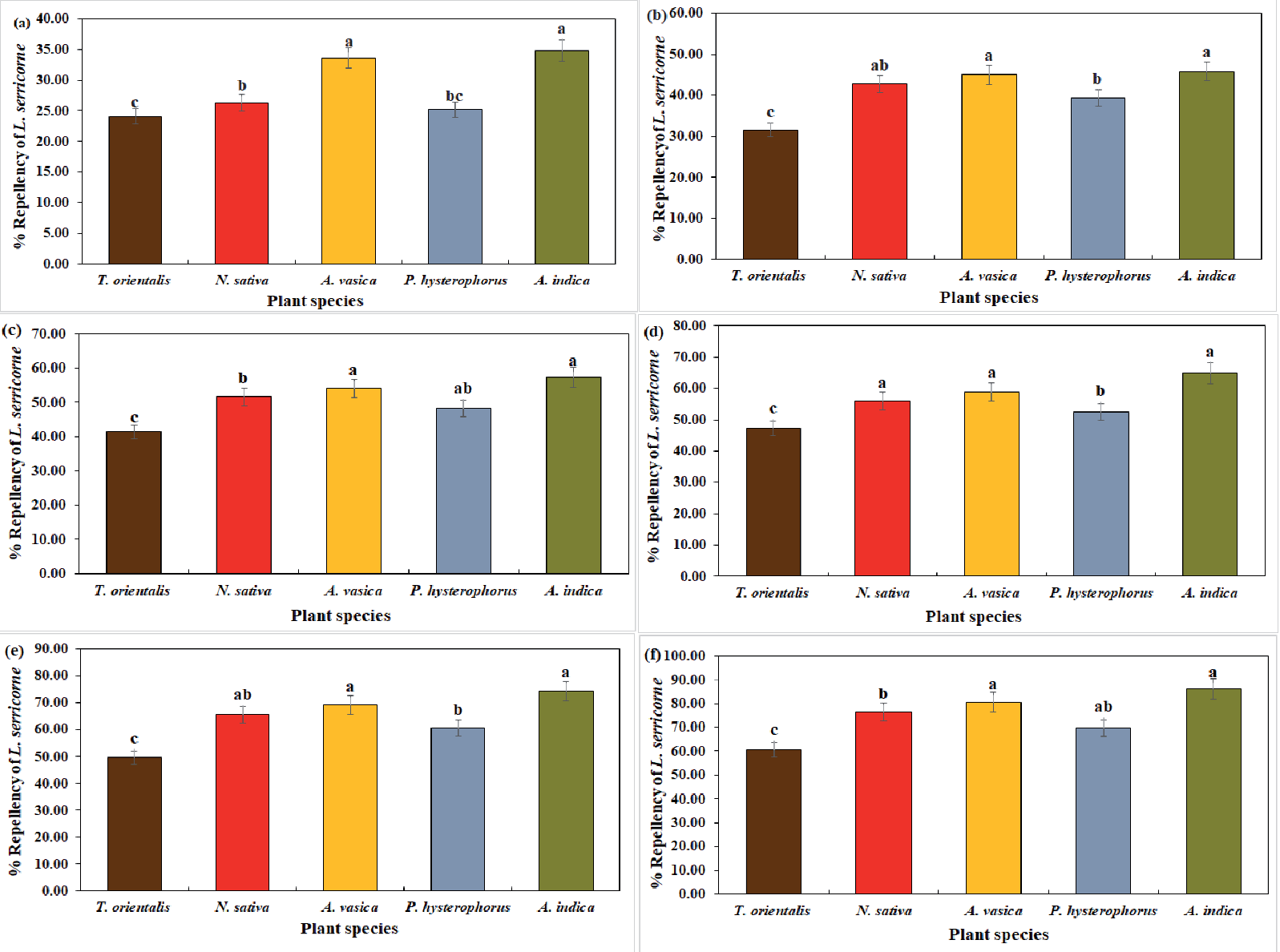
After one hour of exposure to various plant extracts, the repellency of L. serricorne to A. indica reached a maximum (Class III) at 250 mg/L, 500 mg/L, 750 mg/L, and 1000 mg/L; however, the repellency of insects to A. vasica extracts was slightly lower than the repellency of the test insect recorded at 1250 mg/L and 1500 mg/L (Table 5). Nevertheless, there was no statistically significant difference between the repellency of L. serricorne on various concentrations of A. indica and A. vasica; however, it was significantly greater than that of T. orientalis, N. sativa, and P. hysterophorus (Class II). The mean percentage repellency of L. serricorne was highest with the A. indica extracts (34.9%), and the lowest percentage repellency was observed against T. orientalis (24.1%) (Fig. 3a). After 12 h and 24 h, the insects in the experiment exhibited the greatest repellency to all concentrations of A. indica (31.44%, 35.30%, 43.35%, 49.10%, 52.37% and 63.54%) (Class IV), whereas all concentrations of T. orientalis resulted in the least repellency (20.50%, 24.22%, 28.74%, 33.63%, 38.50% and 43.92%) (Class III) (Table 5). Similarly, the mean percentage repellency of L. serricorne was significantly greater (47.8% and 53.30%) on A. indica than on the other plant extracts. On the other hand, T. orientalis exhibited significantly lower repellency (31.6% and 41.5%) to L. serricorne after 12 h and 24 h, respectively (Fig. 3b and c). After exposure of L. serricorne to various concentrations of the five plant extracts, its repellency was significantly greater at all six concentrations of A. indica (45.10%, 54.22%, 59.25%, 67.50%, 77.62%, and 85.60%) (Class-V). In contrast, T. orientalis was the least avoided extract by the test insect, as indicated by the lowest percentage repellency of the insect against its six concentrations (30.05%, 36.55%, 43.05%, 52.00%, 60.22%, and 65.25%) (Class IV) (Table 5). The mean percentage repellency of the A. indica extracts was significantly greater than that of the T. orientalis and P. hysterophorus extracts, whereas no significant difference was found in the repellency of the A. indica, N. sativa, and A. vasica extracts. Repellency caused by T. orientalis and P. hysterophorus was significantly lower than that caused by the other three plant species extracts (Fig. 3d). After 72 h and 96 h, L. serricorne had significantly greater repellent effects on six concentrations of A. indica: 54.50%, 63.23%, 71.12%, 79.10%, 85.50% and 93.20% and 62.10%, 78.72%, 84.52%, 92.10%, 100.00% and 100.00% (Class V). Although the repellency of T. orientalis increased with exposure time, the repellency of T. orientalis remained significantly lower at all six concentrations (35.225%, 40.62%, 46.32%, 52.50%, 58.22% and 65.22% and 42.22%, 51.23%, 58.64%, 62.70%, 71.33% and 78.33%, respectively) (Class-IV) (Table 5). Similarly, the mean percentage repellency of the test insects was significantly greater (74.4% and 86.2%, respectively) for A. indica and significantly lower (49.7% and 60.7%, respectively) for T. orientalis (Fig. 3e and f).
Table 4.
Residual toxicity of plant species extracts to L. serricorne on five after 24 h, 48 h, 72 h, and 96 h.
Discussion
The active phytochemicals present in the plant species extracts may be involved in the insecticidal activities of the plant extracts, and phytochemical screening gave an idea about the qualitative nature of active compounds. The phytochemical analysis of aqueous extracts of P. hysterophorus, T. orientalis, A. indica, A. vasica, and N. sativa indicated the presence of alkaloids, flavonoids, saponins, di tarphenes, phytosterol, and phenols. Other researchers have also reported the presence of phytochemicals in aqueous acetone and methanol extracts, along with other plant species extracts, that are responsible for killing stored insect pests [26, 27, 28]. Based on our recent investigations, a considerable knockdown was observed for most plant species extract, but immediate mortality was not observed. Moreover, this knockdown eventually resulted in mortality, even though the insects were removed from the treated Petri plates [29, 30]. In the current research, A. indica exhibited the greatest contact toxicity, followed closely by A. vasica when used against L. serricorne. This finding suggests that there is a possibility for the mass production of these specific plant species as grain protectors, given that they were able to achieve a 50% mortality rate of L. serricorne with the smallest amount of extract after a 96-hour exposure period. Recently, numerous investigations have been conducted to assess the efficacy of plant extracts in combating L. serricorne. According to the reports of [31], the extracts from Elsholtzia densa have a higher contact effect, having LD50 = 24.29 mg/L when used against L. serricorne. Similar results were also revealed by [32], who stated that extracts of Artemisia lavandulaefolia showed a promising contact toxicity LD50 = 13.51 mg/L against L. serricorne. A. indica showed the greatest toxicity against C. maculatus, a phenomenon that can be attributed to the presence of azadirachtin, which has been identified as highly toxic to insect pests. The toxic nature of botanical pesticides can be attributed to their ability to disrupt nervous and hormonal systems (e.g., azadirachtin) or interfere with mitochondrial functions (e.g., rotenone) [33]. Furthermore, it has been reported that A. vasica possesses insecticidal properties, with the major constituents of this plant being vasicine, vascinone, and saponine [34]. The observed activity of A. vasica can be attributed to the collective or independent effects of these compounds. The anthelmintic activity of A. vasica water extract has also been documented [35]. A. indica exhibited the greatest toxicity against C. maculatus, which could be attributed to the presence of azadrichtin, a compound that is highly toxic to insect pests. The toxicity of botanical pesticides can stem from their ability to disrupt the nervous and hormonal systems of insects, such as azadirachtin, or interfere with mitochondrial function, such as rotenone [18].
Table 5.
Repellency of L. serricorne on various concentrations of five plant species extracts after 1 h, 12 h, 24 h, 48 h, 72 h, and 96 h exposure.
Fig. 3.
Mean percentage repellency of L. serricorne on five plant species extract after exposure of (a) 1 h, (b) 12 h, (c) 24 h, (d) 48 h, (e) 72 h, and (f) 96 h. The different lowercase letters above the error bars indicate significant differences among the various treatments at a 0.5% significance level.
Likewise, P. hysterophorus exhibited both toxic and repellent effects on L. serricorne, which can be attributed to the presence of parthenin, the active ingredient in P. hysterophorus. Notably, the use of the entire plant extract of P. hysterophorus against fifth instar larvae of S. litura resulted in an adverse impact on the growth of the insects [36]. The compound parthenin, which is present in P. hysterophorus, exhibits a diverse array of biological characteristics. These include cytotoxic, antitumor, allergic, antimicrobial, antifeedant, phytotoxic, and insecticidal properties [37], [38]. The increased mortality observed with these botanical substances can be ascribed to their capacity to disrupt fundamental metabolic, biochemical, behavioral, and physiological aspects in insects. Moreover, elevated concentrations of these substances can induce insect mortality by influencing nerve cells in insects [39]. The potential toxicity or repellent characteristics of these essential extracts vary based on the chemical composition of the oil and the sensitivity displayed by the insect [40]. A study conducted by [32] revealed a total of 32 components, with the majority being monoterpenes such as p-cymene (38%), carvacrol (5-11%), and -pinene (5-14%). These specific components have been scientifically proven to possess insecticidal activities against various phytophagous insects, including Tribolium confusum, Ceratitis capitata, and Rhopalosiphum padi [41, 42] .
Although the current study revealed a significant reduction in insect infestation in packaged storage goods treated with plant extracts, any infestation in packaged food is still unacceptable to its consumer market. Therefore, it is essential to address whether infestation can be entirely prevented by employing plant extracts. The efficacy of plant extracts on L. serricorne and their potential for use in insect-resistant materials are influenced by various factors, predominantly the application dose of these extracts, their application techniques, the developmental stages of the insects, and other variables. Further research is essential to determine the optimal formulation, appropriate dosage, suitable application methods, effects of environmental conditions, and comprehensive composition analysis of the plant extract for effectively protecting stored products from L. serricorne infestations.
Conclusions
The present study demonstrated that plant species, particularly A. indica and A. vasica, exhibit strong potential for controlling L. serricorne through both toxicity and repellency. A. indica showed the highest topical and repellent effectiveness, while A. vasica excelled in residual toxicity. These findings suggest that plant-based extracts offer an environmentally friendly, cost-effective, and socially acceptable alternative to synthetic pesticides, especially in tropical and subtropical regions. Incorporating these botanicals into pest management strategies could reduce environmental pollution and health risks associated with chemical insecticides.

