

Introduction
In recent years, global economic and technological development has been at high speed, but with the deterioration of the environment, resource shortages and other issues are becoming increasingly prominent. To achieve sustainable development, environmental governance has become one of the crucial tasks facing the development of enterprises. In the 1990s, China took a sustainable concept of scientific development into an important position, and corporate environmental performance began to be emphasized and developed. Since the 18th Party Congress, “green mountains are golden mountains” has been deeply rooted in people’s hearts. 2022, the 20th Party Congress re-emphasized the “promotion of green development, promoting the harmonious coexistence of man and nature.” Promote green development and harmonious coexistence between human beings and nature”. Promoting corporate environmental performance is a necessary way for the country to promote the coordination of high-quality economic development and ecological civilization. With China’s supply-side structural reform, realizing green development transformation and upgrading is imperative. Through green technological innovation, enterprises realize that following the laws of the ecological economy, saving resources and energy, and avoiding or even eliminating environmental pollution from new technological changes are the main driving forces of green development. Through green development, various resource and cost-saving products improve resource utilization, reduce operating costs, and improve competitiveness. Enterprises realize green development and show their social responsibility, thus establishing a good corporate image, which is conducive to enhancing their customer preference advantage. Enterprises, as the main body of the transition to high-quality development and as one of the factors that have the most significant impact on the ecological environment, should focus on cultivating a green culture, building a green development structure, implementing the concept of green development in management activities such as performance evaluation, information disclosure, risk control, etc., and proactively assuming social responsibility.
As the implementers of central government policies, local governments are the main body for safeguarding people’s livelihoods, developing the economy, managing society, and promoting the modernization of national governance. The different functions of local government accounting form an organic whole of government accounting, which respectively play different degrees of influence on economic and social development, and it is an essential means for the government to carry out macro-control and implement the national development strategy. The government plays an irreplaceable role in ecological and environmental governance and is the leading promoter of investment in environmental protection [1]. Therefore, this paper will deeply study the impact of local government accounting functions on corporate environmental performance.
This paper has the following important contributions: First, at the macro level, the contribution of this paper is to further refine the research perspective of the sustainable and healthy development of finance and economic society, especially through the unique perspective of government accounting, which reveals its important role in promoting sustainable economic development. The research in this paper is helpful for policymakers to better understand the key role of government accounting in macroeconomic regulation and provide a theoretical basis for building a more stable and sustainable financial system. Second, from the micro level, this paper explores how government accounting functions can individually and synergistically improve corporate environmental performance. The introduction of this perspective not only enriches the theoretical system of corporate environmental performance research, but also provides new ideas for corporate environmental management practice. The research shows that government accounting is not only a tool of financial management, but also an important external driving force to promote the green transformation of enterprises and achieve sustainable development. Third, this paper breaks through the limitations of previous studies on single government functions and discusses the complex influence mechanism of different functional combinations of government accounting on corporate environmental performance from a comprehensive perspective for the first time. The introduction of this comprehensive perspective not only deepens our understanding of the mechanism of government accounting, but also provides policymakers with more comprehensive and systematic optimization strategies. It emphasizes that the government should attach importance to the synergies between accounting functions and maximize the overall efficiency through rational allocation of resources and optimization of functional layout. Fourthly, in a practical sense, the research results of this paper provide specific and feasible suggestions for local governments to optimize the structure of financial departments and improve governance capabilities. On the one hand, the government should focus on strengthening key functions such as fiscal transparency, audit supervision, and cost management to ensure the efficient use of public resources and the smooth realization of environmental protection objectives. On the other hand, we should also pay attention to the appropriate development of other functions, promote coordination and balance between functions, and avoid the waste of resources and functional conflicts. In addition, this paper emphasizes the importance of personnel training and resource allocation, which provides a useful reference for the government in building an efficient and professional accounting management system.
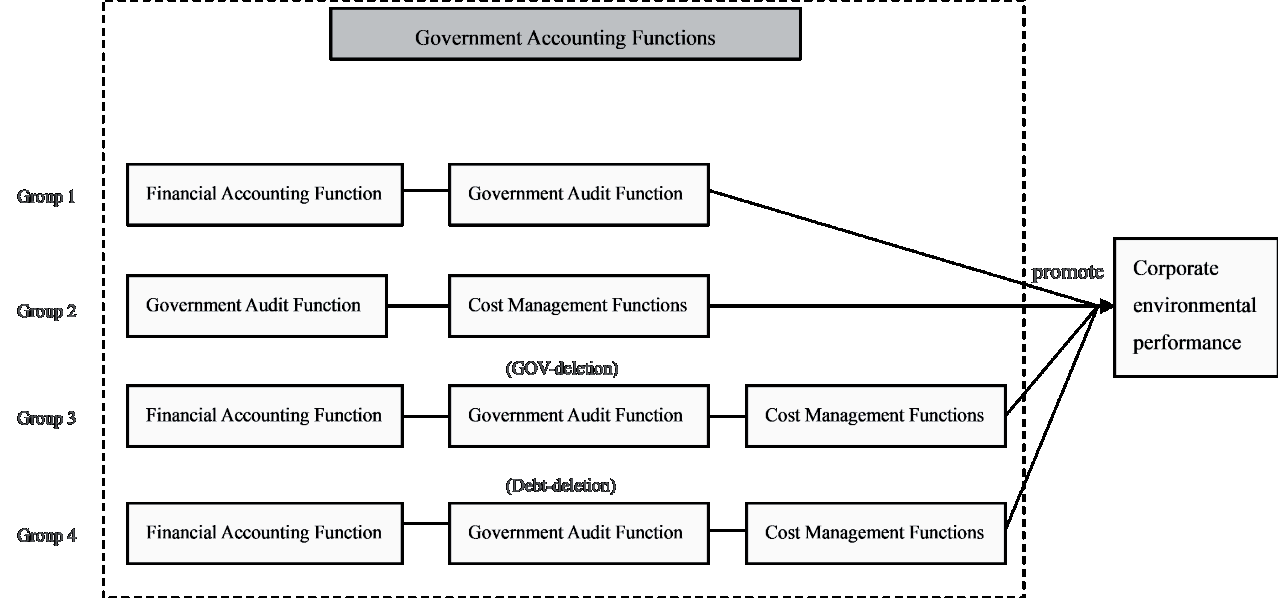
The main conclusions of this paper are as follows: We found that there are four ways to promote the improvement of corporate environmental performance. The first is the government financial accounting function – government audit function – promotion mode; the second is the government audit function – government cost management function – promotion mode; and the other two are two different types of government financial accounting function – government audit function – government cost management function – promotion mode. The analysis shows that the environmental performance of enterprises is affected by many factors, and it is difficult for a single government accounting function to promote the environmental performance of enterprises.
The remaining sections of this paper are structured as follows: In the literature review section, we summarize the relevant literature on the impact of various functions of government accounting on corporate environmental performance. In the research design section, this paper’s theoretical framework, data, and methods are expounded. In the results and discussion section, the results obtained by fsQCA are analyzed and discussed. In the robustness test part, the robustness of the conclusion of this paper is tested. Finally, it is the section on conclusions and policy recommendations.
Literature Review
The Impact of Government Financial Accounting on Corporate Greening
In the realm of exploring the influence of government financial accounting practices on corporate greening initiatives, a multifaceted picture emerges from the amalgamation of relevant literature. Research on government fiscal transparency primarily delves into its repercussions on various stakeholders, including the government itself, the broader public, macroeconomic conditions, and microenterprises. The seminal definition by Kopits and Craig underscores fiscal transparency as the timely, accurate, and comprehensible disclosure of the government’s managerial functions, structural framework, policymaking intentions, and departmental account information to the public [2]. This transparency has been empirically linked to enhanced operational efficiency among enterprises and increased opportunities for external financing, as noted by Hope et al. [3]. Furthermore, the revelation of government environmental protection information fosters transparency in governance, enabling enterprises to gauge the government’s commitment to and execution of environmental policies, thereby facilitating green innovation endeavors [4, 5].
The Impact of Government Audits on Corporate Greening
Turning to the impact of government audits on corporate greening, the literature underscores their pivotal role in environmental governance. Government environmental audits have emerged as indispensable tools [6], not only propelling urban green transformation with regional heterogeneity in their effects [7], but also augmenting regional innovation capabilities to foster green development [8]. These audits contribute to improved environmental management across enterprises, governments, and institutions, mitigating environmental risks, reducing operational costs, and bolstering societal reputation [9, 10]. Specifically, they encourage enterprises to invest in environmental protection, foster clean and green technologies, and diminish environmental pollution [11]. Notably, the Natural Resources Accountability Audit, as a pivotal reform measure, exhibits significant environmental governance outcomes [12, 13].
The Impact of Government Management Accounting Functions on Corporate Greening
In the in-depth study of the complex relationship between government management accounting and corporate green, it is necessary to distinguish the different roles played by various functions of government management accounting, which will help us to deeply analyze the impact of various functions of government accounting on corporate environmental performance.
Government Budget Management Function
Within the ambit of government management accounting functions, the literature explores various facets. Government budget management, encompassing the stewardship of budget fund utilization processes and outcomes, remains a relatively underexplored domain. Nonetheless, studies suggest that government R&D budgets significantly influence green technology innovation, with environmental sector budget investments acting as pivotal drivers of environmental governance [14, 15]. However, discrepancies exist, with some research indicating that R&D budgets may not fully align with environmental quality improvement goals [16].
Government Cost Management Function
Government cost management, exemplified by various financial expenditures, particularly environmental protection spending, has garnered substantial attention. Multiple studies underscore the environmental governance efficacy of such spending, highlighting its role in reducing CO2 emissions, mitigating other pollutants, and enhancing overall environmental quality [17-19]. Specifically, local environmental protection expenditure has been found to effectively diminish industrial pollution emissions, exhibiting spatial spillover effects that amplify cross-regional governance outcomes [20].
Government Performance Management Function
The literature on government performance management underscores its direct reflection of national institutional implementation capabilities and governance standards. While studies examining the macro and micro green development impacts of government governance are scarce, existing research highlights the interplay between corporate social responsibility, government governance, and environmental regulations in shaping green innovation [21, 22]. Additionally, the government’s environmental interventions have been shown to mitigate smog pollution and propel high-quality economic development while also enhancing the green competitiveness of the manufacturing sector [23, 24].
The Impact of Government Financial Management on Corporate Greening
In delving into the intricate relationship between government financial management and corporate greening, it is imperative to distinguish the distinct roles played by its various functions and to analyze their contrasting viewpoints. This revised literature review highlights the key differences in perspectives, offering insights into how government investment management and debt management uniquely influence corporate environmental performance.
Government Investment Management Function
At the core of government financial management lies its investment function, which has been shown to exert a nuanced influence on corporate greening. Jiang et al. [25] empirical analysis underscores a threshold effect in the guiding role of government investment funds; within a certain range, these funds effectively steer social capital toward innovative and entrepreneurial enterprises, fostering green development. However, as Xia notes, the promotion of scientific and technological innovation through government investment funds surpasses that of private venture capital, emphasizing the specificity of the government’s role in this regard [26]. Chen et al.’s study further elucidates the temporal dynamics of this effect, revealing a positive impact during the initial stages of fund development that tapers off or reverses once industrial funding becomes saturated [27].
In the realm of environmental protection, the investment function takes on an even more pronounced role. Deng and Liu underscored the multifaceted benefits of environmental protection investment, driving green total factor productivity growth through technological advancements and enhanced regional resource allocation [28]. Liu and Tian’s findings complement this by revealing the synergy between urbanization, environmental protection investment, and green technology innovation, with significant positive spatial spillovers [29]. Kang et al., on the other hand, provide a regional perspective, demonstrating how government green investment in the middle Yellow River region can propel high-quality economic development, albeit with a cautionary note of negative spillover effects [30].
Government Debt Management Function
In contrast to the investment function, the debt management function of government financial management presents a more complex picture of its influence on corporate greening. Zhang’s empirical analysis using panel data from GMM reveals that local government debt, particularly in the form of urban investment bonds, can mitigate regional environmental pollution, highlighting a social benefit that counteracts the negative environmental consequences of fiscal decentralization [31]. However, Guo and Xue’s work exposes a nonlinear U-shaped relationship, suggesting that while an initial expansion of debt can bolster local governments’ financial resources and strengthen environmental oversight, excessive debt burdens lead to increased corporate pollution emissions [32]. Zhang and Deng’s investment-financing perspective underscores this dilemma, finding that local government debt significantly hinders corporate green governance performance [33].
Comprehensive Perspective
Taken together, these differing perspectives and functional effects of government accounting underscore the need for a comprehensive approach to understanding their impact on corporate greening. While individual functions undoubtedly play significant roles, their combined effects and interactions remain understudied. Therefore, a pressing research agenda emerges to explore the intricate pathways and relative importance of various government accounting functions in promoting corporate environmental sustainability. This endeavor holds immense potential for informing policy interventions aimed at fostering a greener business landscape.
Research Design
Research Framework
The fsQCA (Fuzzy-Set Qualitative Comparative Analysis) is used to analyze complex social science phenomena, reveal the causal relationship between variables, and explore the influence of multiple combinations of conditions on the results. This method is particularly suitable for studying problems that are difficult to deal with using traditional quantitative methods. By identifying and analyzing a combination of conditional variables, it reveals multiple paths leading to a particular outcome.
The significance and uses of fsQCA are mainly reflected in the following aspects: First, to deal with complex social science problems. In social science research, many phenomena are affected by multiple factors, and there may be complex interactions among these factors. The fsQCA can handle this complexity by analyzing the combination of condition variables, which reveals how many factors work together to produce a result. Second, explore multiple paths. Unlike traditional regression analysis, fsQCA is not limited to looking for a single causal relationship; it explores the influence of multiple combinations of conditions on the outcome. This approach reveals how configurations (a particular combination of condition variables) work together to produce a result. Third, reveal the configuration effect. The configuration effect refers to the effect it has on an outcome when multiple condition variables are combined in a particular way. The fsQCA constructs truth tables and analyzes configurations, reveals the existence of these configurations and their effects on the results, and provides a deeper understanding of the phenomenon.
Based on the above analysis, this paper adopts the fsQCA method to analyze the impact of government accounting functions on corporate environmental performance from a group perspective. This paper focuses on two causal relationships: (1) whether and to what extent government accounting functions are necessary to influence corporate environmental performance, and (2) how these government accounting functions interact with each other to produce effects on corporate environmental performance. Therefore, we believe that fsQCA provides a new research perspective and method, which is used to explore the nonlinear relationship and complex interaction among variables. Analyzing the combination and configuration effects of conditional variables provides a new research perspective and methodological tool for the research on the environmental performance of government financial departments and enterprises. It will contribute to a deeper understanding of the formation mechanisms and development paths of complex social phenomena.
Sample Selection and Data Sources
This paper selects the listed companies of heavy polluters in Shanghai and Shenzhen A-shares from 2011 to 2020 as the research object, and the relevant data of provincial governments and heavy polluters in their jurisdictions in 30 provinces, municipalities, and autonomous regions of China, except Tibet, Hong Kong, Macao, and Taiwan, to study the impact of the government’s accounting function on the corporate environmental performance. The Government Fiscal Transparency Report compiled by the Shanghai University of Finance and Economics is an authoritative data set widely used to measure the fiscal transparency of provincial governments in China. However, because the report was updated in 2018, updated data is not available. In order to ensure data rigor, fiscal transparency is calculated at the rate of growth over the last five years to 2020, however, based on the availability of data and the non-public nature of the data used to calculate implicit government debt, the data range chosen here is 2011-2020. The corporate environmental performance data comes from the China Stock Market and Accounting Research (CSMAR) database, as well as Corporate Social Responsibility (CSR) reports and annual reports. Provincial fiscal transparency comes from the China Fiscal Transparency Report published by Shanghai University of Finance and Economics. Government audit data are manually organized from the China Audit Yearbook. Data related to the government budget are hand-arranged from the China Statistical Yearbook and websites of provincial statistical bureaus. Relevant data on government expenditure on energy conservation and environmental protection are hand-arranged from the China Statistical Yearbook. Data on government governance performance are hand-curated from the China Statistical Yearbook, websites of provincial statistical bureaus, and the China Environmental Statistics Yearbook. Data related to government investment are hand-curated from the China Statistical Yearbook. Data related to government debt come from the manual collation of the China Statistical Yearbook, websites of provincial statistical bureaus, the China Financial Yearbook, and the China Labor Statistics Yearbook. To avoid the interference of extreme values and outliers on the research results, the upper and lower 1% of all continuous variables were winsorized. And excludes the samples of the financial industry and Special Treatment firms. The Special Treatment firms indicate that the company has incurred losses for two consecutive years, while ST* indicates a duration of three years. Considering the applicability of the fsQCA method, the mean value of each variable from 2011 to 2020 is used to study the grouping of government accounting functions on corporate environmental performance. This paper uses fsQCA 4.0 software.
Measurements
The study mainly consists of one outcome variable and seven conditional variables. The outcome variable is corporate environmental performance, and the conditional variables are the government financial accounting function, government auditing function, government budget management function, government cost management function, government performance management function, government investment function, and government debt management function, which are defined as follows.
The outcome variable is corporate environmental performance (GD). Some studies measure corporate environmental performance by obtaining corporate pollutant emission data from annual reports or other databases [34]. However, this approach is not suitable for Chinese companies due to the serious lack of corporate pollutant emissions data. Therefore, we draw on Zhang et al.’s [35] environmental scoring approach, and in order to more comprehensively reflect the performance of enterprises in pollution emissions, implementation of environmental policies, and investment in environmental governance, we comprehensively examine the environmental performance of enterprises based on the CSMAR database’s statistics of enterprise environmental information disclosure. The specific measurement methods are as follows: We construct environmental performance evaluation indexes, measuring corporate environmental performance in six dimensions: exhaust gas emission reduction and governance (GD1), wastewater emission reduction and governance (GD2), dust and soot governance (GD3), solid waste utilization and disposal (GD4), noise, light pollution, radiation, and other governance (GD5), and cleaner production implementation (GD6). Specific evaluation methods: (1) Identify the above six-dimensional indicators through the social responsibility reports disclosed by heavy polluters. (2) Score the six indicators separately, assigning a value of 2 if an indicator has a quantitative value, assigning a value of 1 if it has only a qualitative description, and assigning a value of 0 if there is neither a quantitative value nor a qualitative description. (3) Finally, the six indicators are summed to the corporate environmental performance score.
Conditional variables: (1) Government financial accounting function (Ft). Since the government accounting function is ultimately embodied in the government financial report, but the government financial report is not publicly available at the moment, fiscal transparency (Ft) is used to refer to it based on data availability [36]. This paper uses the natural logarithm of provincial fiscal transparency scores published by the Shanghai University of Finance and Economics to measure fiscal transparency (Ft). Since the latest data from the China Fiscal Transparency Report is as of 2018, fiscal transparency for 2019 and 2020 is calculated from the average growth rate of provincial transparency over the last five years.
(2) Government Audit Function (AUD). As a supervision mechanism, government audits can directly affect the environmental protection behavior of enterprises, such as government environmental audits and economic responsibility audits [37]. To reflect the comprehensive function of government auditing and take into account practical issues and data availability, this paper draws on the existing research [37] to measure government auditing by using the sum of government environmental auditing projects carried out by prefectural-level city auditing bureaus, provincial auditing bureaus, and the Audit Office of the Government of the People’s Republic of China.
(3) Government Budget Management Function (Sbc). The deviation between local fiscal revenues and expenditures and those before the budget reflects the implementation of the national fiscal budget. Wang [38] defined the formula for calculating the degree of deviation in final accounts, that is, the degree of deviation in final accounts = (government expenditure in final accounts - government budget expenditure) / government budget expenditure. If it is positive, it means that the final account exceeds the budget, which is “overspending”; otherwise, it is “saving”. Therefore, in order to eliminate the difference in economic scale in different regions, this paper uses the ratio of the difference between the local government’s current budget expenditures and revenues to GDP to measure the budget management function.
(4) Government cost management function (FEE). Government environmental expenditure is also an important factor that directly affects regional environmental development. Through the construction of environmental infrastructure, environmental subsidies, and policy incentives for enterprises, government environmental spending can significantly promote enterprises’ green technology innovation and industrial structure upgrading [39]. Therefore, the natural logarithm of the amount of energy efficiency and environmental protection expenditures in local public finance expenditures is used to measure the FEE function.
(5) Government Performance Management Functions (Gov). High-quality government self-management is not only conducive to promoting the efficient operation of the government, but also conducive to guiding and promoting the active participation of the public in public governance. In order to explore whether government governance ability has an impact on environmental development, this paper draws on Liu et al. [40] and constructs comprehensive indicators to measure government governance based on data availability, as detailed in Table 1. To avoid subjectivity, the entropy method is used to determine the weights of each secondary indicator, while the data are standardized.
(6) Government Investment Management Functions (Inv). Government investment is an important driving force to guide the flow of social funds and promote economic development. The importance and intensity of government investment in different investment projects will indirectly affect the overall development of society [41]. In order to test the impact of the difference in the proportion of government investment on the environmental performance of enterprises, this paper draws on Yuan’s [42] methodology, expenditure items with investment benefits in local financial expenditures, such as science and technology, education, agriculture, forestry and water affairs, transportation, land resources and meteorology, energy conservation and environmental protection costs, and medical and health expenditures, are selected and summarized using the cumulative method, and the summarized results are divided by the total population of each province to obtain per capita government investment expenditures to measure the scale of local government investment.
Table 1.
System of Government Governance Indicators.
(7) Government Debt Management Function (Debt). Reasonable government debt is conducive to the government’s investment in public utilities and stimulates the vitality of economic development. However, excessive government debt is also detrimental to healthy economic and social development. When the scale of government debt is too large, it will crowd out the government’s funds for green environmental protection undertakings and then indirectly affect the environmental performance of enterprises. Considering the different degrees of influence of various types of government debt, this paper draws on Zhao and Zhang [43] based on the financial risk matrix (as shown in Table 2). It takes into account the elimination of differences in the population size of each province and measures the ratio of China’s total local government debt to the total population at the end of the year from 2011 to 2020 to measure government debt.
Results and Discussion
Data Calibration
Data calibration is the process of assigning set affiliation scores to the variables, which are first calibrated to fuzzy set affiliation scores between 0 and 1. The full affiliation point for each variable in the sample data of this paper is at the 95% quantile, the crossover point is at the 50% quantile, and the full unaffiliated point is at the 5% quantile. The calibrated anchor points for each variable are shown in Table 3.
Analysis of Necessary Conditions
The fsQCA method is designed to study the different groupings of variables that affect the outcome. We set the consistency threshold at 0.9, and a consistency score greater than this threshold is judged to be a necessary condition for promoting corporate environmental performance. The results of the necessity analysis of each variable are shown in Table 4. It can be seen that the consistency scores of the presence and absence of all conditional variables are lower than 0.9, i.e., they do not constitute a single necessary condition for corporate environmental performance. It also shows that the interpretability of individual condition variables to the outcome variables is weak, i.e., the promotion of corporate environmental performance results from the joint action of multiple functions of government accounting.
Table 2.
Financial risk matrix
Table 3.
Calibration of variable data.
Configuration Adequacy Analysis
The variables are imported into fsQCA 4.0 software to construct the truth table and assign values to the grouping results. Referring to the existing research and combining with the actual characteristics of the data used in this paper, the consistency threshold is set to 0.8, the PRI threshold is set to 0.7, and the frequency threshold is set to 1. After arithmetic to obtain the complex solution, the simple solution, and the intermediate solution, referring to the existing research, the conditions that appear in the intermediate solution and the simple solution at the same time are the core conditions, and the conditions that appear in the intermediate solution are the edge conditions. The four condition groupings (H1, H2, H3, and H4) for the promotion of corporate environmental performance are obtained as shown in Table 5. We constructed a research framework, which is shown in Fig. 1, demonstrating the joint role of multiple elements on corporate environmental performance.
Table 5 shows four paths that can promote corporate environmental performance. Existing studies consider that the solution is accepted if the overall solution consistency is greater than 0.8 and the overall solution coverage is higher than 0.5. The overall solution consistency in the table is 0.888 and coverage is 0.612, which satisfies the consistency and coverage threshold conditions. The individual solution consistency levels are all higher than 0.8, indicating that all four groupings are sufficiently conditional combinations for corporate environmental performance.
Specific Analysis of the Configuration
Government Financial Accounting Function - Government Audit Function Driven
In the H1 configuration, the core conditions are a high government financial accounting function (Ft), high government audit function (AUD), low government budget management function (~Sbc), and low government investment management function (~Inv). The edge conditions are low government cost management function (~FEE), high government performance management function (GOV), and high government debt management function (Debt). On this path, various government accounting functions can interact to form a comprehensive environment conducive to improving corporate environmental performance. First, a strong government financial accounting function can ensure the transparency and accuracy of government fund flows. This will help governments to better track and evaluate investment in environmental protection and sustainable development, ensuring that these funds are used effectively and in compliance. Clear financial reporting also increases public trust in government environmental policies and actions and incentivizes companies to operate more environmentally. Second, an effective government audit mechanism can monitor and evaluate the implementation of government policies, including environmental policies. Through audits, misconduct or inefficiencies in the use of funds can be revealed and improvements can be driven. This helps ensure that environmental funds are actually used for their intended purposes, while at the same time driving companies to comply with environmental regulations and improve environmental performance. Third, the relative interpretation of low government budget management function and low government investment management function. “Low” here does not mean a total lack or ineffectiveness, but emphasizes that in a given context, relatively less direct intervention in budget and investment management may be more conducive to improving environmental performance. Excessive budget management and investment controls can limit innovation and flexibility, especially in areas that require rapid response to environmental changes or the roll-out of new environmentally friendly technologies. Therefore, a modest hand to the market and companies to adjust their strategies according to their own needs may be more conducive to the improvement of environmental performance. Fourth, low government cost management function. “Low” here may mean that the government does not impose excessive costs on enterprises directly through administrative means, but encourages enterprises to take voluntary environmental actions through policy guidance and market mechanisms. Reducing unnecessary government intervention and expenses can reduce the operating costs of enterprises, so that enterprises have more resources to invest in environmental protection technologies and measures, thereby improving environmental performance. Fifth, a strong government performance management function can ensure the effective implementation and continuous improvement of government policies. By setting clear environmental performance targets and providing them with regular assessment and feedback, governments can motivate businesses and the public sector to continuously improve their environmental management. This performance-oriented management approach can form a positive cycle and promote the continuous improvement of environmental performance. Finally, good government debt management ensures the stability and sustainability of government finances. This helps governments plan for and invest in public utilities such as environmental protection in the long term; without worrying about short-term financial pressures. The stable fiscal position provides a solid foundation for the government to implement environmental protection policies, provide environmental protection subsidies, and support environmental technology innovation. Moreover, the original coverage of this grouping is 0.233, which is the lowest among the four groupings, indicating that this grouping is not common in corporate environmental performance.
Table 4.
Analysis of necessary conditions.
Table 5.
Grouping of conditions to promote corporate environmental performance.
In summary, by enhancing the transparency and efficiency of government financial accounting and auditing, moderately reducing unnecessary budget and investment management interventions, reducing unnecessary government costs, strengthening performance management, and ensuring fiscal stability, governments can create a challenging and supportive environment for enterprises and incentivises them to adopt more environmentally friendly business practices. Jointly promote the sustainable development of society.
Government Audit Function - Government Cost Management Function Driven
In the H2 configuration, the core conditions are high government auditing function (AUD), low government budget management function (~Sbc), and high government cost management function (FEE). The edge conditions are low government financial accounting function (~Ft), high government performance management function (GOV), high government investment management function (Inv), and high government debt management function (Debt). For the core condition. First, the high government audit function ensures transparency and compliance with government funding, especially in the areas of environmental protection and sustainable development. Audits not only expose possible abuses or inefficiencies; they also promote trust between government and business. This trust mechanism encourages companies to become more actively involved in environmental activities because they know that government oversight is strict and the cost of non-compliance is high. Second, the low government budget management function does not mean the complete absence of budget management, but refers to relatively less direct intervention and more flexible budget management methods. This flexibility allows the government to respond more quickly to market changes and business needs, especially in promoting environmentally friendly technologies and innovations. It reduces cumbersome approval processes and enables companies to obtain the necessary financial support faster, thus accelerating their environmental performance. Third, the high government cost management function ensures the efficient use of public resources, including investment in environmental protection. Through strict cost control and efficiency evaluation, the government ensures that every penny is spent wisely. This efficient cost management not only reduces the financial pressure on the government, but also sets an example for enterprises to adopt similar cost-saving and efficiency improvement measures. These measures are often closely related to environmental protection because reducing waste and improving resource utilization are themselves important aspects of environmental protection.
About the role of edge conditions. First, while a low government financial accounting function may not be the central condition, it may reflect some inadequacies in government financial transparency. However, in this configuration, the high audit capability may compensate for this deficiency to some extent. The rigor of the audit ensures that even if the financial accounting is not transparent, the flow and use of environmental protection funds are still subject to strict supervision. Secondly, the function of high government performance management provides a strong driving force for the implementation of government policies. By setting clear environmental performance targets and providing regular assessments and feedback to businesses and the public sector, governments can motivate them to continuously improve their environmental management. This performance-oriented management approach helps to form a virtuous cycle and continuously promotes the improvement of corporate environmental performance. Third, the high government investment management function ensures the effectiveness and sustainability of environmental investment. Through professional investment management and risk assessment, the government ensures that environmental funds are invested in areas most likely to produce environmental benefits. This can help reduce waste and failed investment projects and improve the overall effectiveness of environmental investments. Fourth, a stable fiscal position is an important guarantee for the implementation of long-term environmental protection policies. The high government debt management function ensures the stability and sustainability of government finances and provides a solid foundation for the government to plan and invest in public services such as environmental protection in the long term. This stability helps reduce financial risk and market uncertainty for companies, thus encouraging them to become more active in environmental activities.
Based on the above analysis, Path 2 can also play a positive role in contributing to a high level of corporate environmental performance.
Government Financial Accounting Function - Government Audit Function - Government Cost Management Function Driven (Type 1)
In the H3 configuration, the core conditions are high government financial accounting function (Ft), high government auditing function (AUD), high government cost management function (FEE), and low government budget management function (~Sbc) and low government investment function (~Inv). The marginal condition is the low government debt management function (~Debt). About the role of core conditions: First, the high government financial accounting function ensures the accuracy and transparency of government financial information. This transparency not only increases public trust in government, but also provides a clear signal to businesses that the government is serious and responsible about environmental investment and spending. Companies are therefore more motivated to improve their environmental performance in line with government and society’s expectations for sustainable development. Second, the high government audit function, as an intensive supervision and management mechanism, ensures the scientific and efficient use of government environmental protection funds. Audits not only expose potential abuse and waste, but also promote improved management within the government. This strict supervision has prompted both governments and companies to be more careful with environmental funds, thus improving the efficiency of the use of funds and environmental performance. Third, the high government cost management function ensures the effective use of public resources in the field of environmental protection. Through detailed cost control and efficiency assessment, the government has reduced unnecessary waste and improved the overall benefit of environmental protection investment. This efficient cost management not only reduces the financial pressure on the government, but also sets an example for enterprises to adopt similar cost-saving and efficiency-improvement measures. Fourth, low government budget management function and low government investment function. These two conditions may reflect the government’s relative flexibility in budget and investment management. A low-budget management function could mean less direct intervention and a faster decision-making process, enabling companies to access the necessary environmental funding more quickly. The low investment function may mean that the government is more focused on the effective implementation of existing projects rather than blindly expanding the scale of investment. This flexibility helps companies respond more quickly to market changes and improve environmental performance.
About the effect of marginal conditions. First, while the low government debt management function is not a core condition, it may reflect some strategy of the government in terms of fiscal management. In some cases, governments may choose to devote more resources to public works, such as environmental protection rather than to debt repayment. Although this strategy may increase the financial risk of the government, it also provides more environmental protection financial support for enterprises, thus promoting the improvement of environmental performance. However, it is important to note that long-term low debt management can harm the fiscal stability of the government, so a balance needs to be found between short-term benefits and long-term sustainability.
Finally, in the H3 configuration, government performance management has no significant impact on corporate environmental performance. This may be because other core conditions (such as high financial accounting, high auditing, and high cost management functions) have provided sufficient impetus and support for the improvement of corporate environmental performance. In addition, the function of government performance management may focus more on the efficiency and effectiveness of management within the government rather than directly affecting the environmental performance of enterprises. Thus, in this particular configuration, the absence of a government performance management function did not significantly affect the outcome of corporate environmental performance. It can be seen that the original coverage rate of this grouping is 0.455, which is the highest among all groupings, indicating that this grouping has the widest coverage in high corporate environmental performance, i.e., the result of high corporate environmental performance will be realized when most of the provinces have high financial transparency, auditing function, and cost management function, and low budget management function, investment management function, and debt management function.
Government Financial Accounting Function - Government Audit Function - Government Cost Management Function Driven (Type 2)
The H4 grouping is similar to the H3 grouping, with low government performance management function as the edge condition of H4, high or low government debt management function does not affect corporate environmental performance, and the rest of the core conditions are exactly the same as those of H3. First, the role of core conditions is similar to that of H3. Secondly, as the marginal condition of H4, a low government performance management function indicates that the absence of a government performance management function does not significantly affect the improvement of corporate environmental performance. This may be because other core conditions already provide effective control and oversight mechanisms within the government to ensure the proper use of funds even if the performance management function is inadequate. In addition, the function of government debt management is neutral. In the H4 group, the level of government debt management function does not affect the environmental performance of enterprises. This may be because the high level of government financial accounting function and the high level of government audit function are strong enough to weaken the potential impact of government debt management function on corporate environmental performance. In other words, even if the government debt management function is not ideal, as long as the financial accounting and audit functions are guaranteed, the corporate environmental performance can remain high.
To some extent, you can think of H3 and H4 as a combination of two paths, H1 and H2. H1 and H2 may represent the influence paths of different aspects of government finance and management functions on corporate environmental performance, respectively. H3 and H4, by integrating these aspects, form a more comprehensive and powerful influence mechanism. In this mechanism, high government financial accounting function, high government audit function, and high government cost management function work together to promote the improvement of corporate environmental performance, while the influence of government performance management function and government debt management function is relatively weak or negligible.
In summary, the analysis of the H4 group further validates the core logic of the H3 group, that is, under the high-level functions of government financial accounting, auditing, and cost management, an effective control and supervision mechanism can be formed within the government so as to ensure the scientific and efficient use of environmental protection funds and promote the improvement of corporate environmental performance. At the same time, it also shows that in some cases, the absence or insufficiency of government performance management functions and government debt management functions will not significantly affect the process.
Robustness Tests
The corporate environmental performance (GDS) under different measurement methods is selected as the outcome variable for the robustness test. Rebuild the indicators to measure environmental performance, from whether pollutant emission standards, environmental and sustainable development, whether to set environmental protection goals, whether to obtain environmental protection honors or awards, whether to respond to the “three simultaneous systems1,” whether to carry out environmental protection special activities, whether to carry out environmental protection education and training, and whether to have environmental protection concepts - these eight aspects to measure the corporate environmental performance. The specific variable measurement method is as follows: (1) To distinguish and identify the above eight indicators through the keywords in the social responsibility report and annual report disclosed by heavy polluting enterprises. (2) Dummy variables are set for the above eight indicators. If the enterprise has carried out relevant activities in the current year, it is recorded as 1; otherwise, it is recorded as 0. (3) Summarize the eight indicators, which are generally divided into corporate environmental performance (GDS) scores.
The results of the robustness test are shown in Table 6. It can be seen that there are also four paths to achieve high corporate environmental performance results, and the structure of the grouping is the same as the original grouping. In H1, the core conditions are high government financial accounting function (Ft), high government audit function (AUD), low government budget management function (~Sbc), and low government investment management function (~Inv). The edge conditions are low government cost management function (~FEE), high government performance management function (GOV), and high government debt management function (Debt). In H2, the core conditions are high government audit function (AUD), low government budget management function (~Sbc), and high government cost management function (FEE). The edge conditions are low government financial accounting function (~Ft), high government performance management function (GOV), high government investment management function (Inv), and high government debt management function (Debt). In H3, the core conditions are a high government financial accounting function (Ft), high government auditing function (AUD), high government cost management function (FEE), low government budget management function (~Sbc), and low government investment function (~Inv). The edge condition is the low government debt management function (~Debt). In H4, the core conditions are high government financial accounting function (Ft), high government audit function (AUD), and high government cost management function (FEE), as well as low government budget management function (~Sbc) and low government investment function (~Inv). The edge condition is low government performance management function (GOV). The overall solution coverage is 0.641, and consistency is 0.895, which passes the robustness test.
Conclusions and Recommendations
This paper systematically combs the relevant literature on corporate environmental performance and government accounting. On this basis, it empirically analyzes the impact of government accounting function on corporate environmental performance by using the fsQCA method, and the main research conclusions are as follows:
There are four main paths to promote the improvement of the level of corporate environmental performance: government financial accounting function-government auditing function-promoted, government auditing function-government cost management function-promoted, and two kinds of government financial accounting function-government auditing function-government cost management function-promoted. The research results show the importance of core conditions. High government financial accounting function, high government audit function, and high government cost management function are generally confirmed as the core conditions for improving corporate environmental performance in different paths. In addition, we also notice the relativity of edge conditions. The government performance management function and government debt management function are regarded as marginal conditions in some subgroups, and their impact on corporate environmental performance is relatively small or negligible. This suggests that, under certain conditions, the absence or insufficiency of these functions does not significantly hinder the improvement of corporate environmental performance. The analysis shows that corporate environmental performance is influenced by various factors, and it is difficult for a single government accounting function to play a role in promoting corporate environmental performance.
Based on the different impact paths, the following suggestions are made for local governments to promote corporate environmental performance.
According to path H1, the local government should strengthen the synergistic effect of financial accounting and audit, use high financial accounting functions to ensure the transparency of the use of environmental protection funds, and conduct strict financial audits in combination with high audit functions to ensure that funds are earmarked for special purposes and avoid misappropriation and waste. Second, optimize budget and investment management. Although the budget management function is relatively low, a flexible budget adjustment mechanism should be established to ensure that environmental protection projects can be replenished in a timely manner when funds are insufficient. At the same time, through policy guidance and market mechanisms, social capital is encouraged to participate in environmental protection investment and make up for the lack of government investment function. In addition, focus on improving performance management and debt management capabilities. Although the cost management function is weak, the high-performance management function should be used to set clear environmental goals and establish a performance evaluation system. At the same time, we will strengthen debt management to ensure that environmental protection debt is under control and does not affect the continuous progress of environmental protection projects due to debt problems.
According to path H2, local governments should strengthen the core role of audit in the management of environmental protection funds and use high audit functions to audit the whole process of raising, distributing, and using environmental protection funds to ensure the compliance and efficiency of the use of funds. Secondly, improve the cost management and budget management levels. Although the function of budget management is weak, the cost of environmental protection projects should be controlled, and the efficiency of fund use should be improved through the effective play of the cost management function. At the same time, explore the establishment of a more scientific and reasonable budget management system to provide stable financial support for environmental protection projects. In addition, the positive interaction between investment and performance management is promoted, the high investment management function is used to guide social capital to invest in the field of environmental protection, and the performance evaluation and tracking of investment projects are combined with the high-performance management function to ensure the investment effect.
According to paths H3 and H4, local governments should establish a sound environmental protection fund management system. Integrate the functions of financial accounting, auditing, and cost management, and form an efficient and transparent environmental protection fund management system to ensure the scientific, normative, and efficient use of funds. Second, flexibly respond to the challenges of budget management and investment management. In the case of weak budget management functions and limited investment functions, through policy innovation and market mechanisms, more social capital will be attracted to participate in environmental protection projects to reduce the pressure on government finances. In addition, focus on the robustness of performance management and debt management. Although the debt management function is not a core condition, it is still necessary to remain vigilant to ensure that environmental debt is under control, avoid debt problems affecting the continued progress of environmental projects, and focus on maintaining the stability of government performance.
To sum up, government financial transparency, government audits, and cost management are the key factors affecting the environmental performance of enterprises. Therefore, we believe that enterprises should actively seek cooperation with the government and take advantage of the government’s high transparency of financial accounting, strict audits, and efficient cost management to jointly promote the implementation of environmental protection projects. At the same time, strengthen their own environmental awareness and responsibility, adopt advanced environmental protection technology and management methods, improve resource utilization efficiency, reduce pollutant emissions, and jointly promote the significant improvement of environmental performance.
This study still has the following shortcomings: First, data timeliness and comprehensiveness. Although this study may have made every effort to collect and analyze relevant data, due to the adjustment of macro policies and the limitation of non-public financial data, some data may have insufficient timeliness. For example, the Shanghai University of Finance and Economics has no longer updated the provincial fiscal transparency data in recent years, and future scholars can consider adopting a more comprehensive and novel method to calculate the level of fiscal transparency of various provinces and cities. Second, although this study attempts to explore the impact of government accounting on corporate environmental performance from the perspective of different functions, the construction of the theoretical framework may need to be further expanded and improved. For example, the interaction mechanism between different functions and the influence of external environmental factors (such as policies and regulations, market competition, etc.) on functional effects may require more theoretical discussion and empirical testing. Third, the conclusions of this paper should be carefully applied, and attention should be paid to the differences in economic development level, government governance ability, and enterprise environmental performance level in different regions, so adjustments and optimization should be made according to specific conditions in practical application.
The future directions are worth further research. First, future research should pay more attention to the timeliness and comprehensiveness of data and adopt a variety of data sources and advanced data analysis methods to improve the accuracy and universality of research conclusions. At the same time, cooperation with international financial organizations and research institutions can be strengthened to jointly promote research progress in the field of financial and environmental performance. Second, in order to more deeply reveal the impact mechanism of government accounting functions on corporate environmental performance, future research should strengthen quantitative research and empirical analysis. By building a reasonable measurement model and collecting abundant sample data, the relationship between government accounting function and enterprise environmental performance is analyzed more accurately and comprehensively. Third, future scholars can also consider adopting more advanced algorithms, such as the entropy weight method and input-output method, to measure comprehensive indicators that can more comprehensively reflect various functions and further verify and expand the research conclusions of this paper.
List of Abbreviations
fsQCA
Fuzzy-Set Qualitative Comparative Analysis
CSR
Corporate Social Responsibility
GD
Corporate environmental performance
GDS
Corporate environmental performance
Ft
Government financial accounting function
AUD
Government Audit Function
Sbc
Government Budget Management Function
FEE
Government cost management function
Gov
Government Performance Management Functions
Inv
Government Investment Management Functions
Debt
Government Debt Management Function
PPP
Public-Private-Partnerships project

