

Introduction
In recent years, global climate change has intensified, with total carbon emissions continuing to rise, posing a severe threat to the natural environment and human society [1]. Reducing carbon emissions and energy consumption has become an inevitable choice to alleviate environmental problems and realize sustainable development [2]. Consequently, low-carbon innovation has gained substantial attention as a core direction for advancing sustainable development [3]. As one of the leading carbon emitters, China has committed to reaching carbon peaking by 2030 and carbon neutrality by 2060. While China’s low-carbon innovation initiatives have achieved remarkable progress, a disparity still persists between its low-carbon innovation capacity and that of developed countries. Moreover, the uneven development of low-carbon innovation presents a significant challenge to provincial low-carbon development [4]. Thus, low-carbon innovation has become imperative for mitigating global climate change, promoting ecological civilization, and realizing low-carbon growth.
Existing studies have conducted extensive discussions on how to drive low-carbon innovation. Scholars have primarily taken enterprises as the research object [5, 6] and explored the impacting factors of low-carbon innovation from three aspects: resources, technology, and environment. In terms of resources, scholars have examined the impacts of information disclosure [7], green credit [8], and low-carbon innovation financing [9] on low-carbon innovation. In terms of technology, scholars have focused on the impacts of digital technology [10], digital transformation [11], and industrial internet platforms [6] on low-carbon innovation. In terms of environment, scholars have investigated the impacts of low-carbon city pilot policies [12], digital economy [13, 14], free trade pilot zone [1], and institutional change [15] on low-carbon innovation. However, these studies predominantly adopt regression methods for analysis, focusing on the “net effect” of a single factor on low-carbon innovation while neglecting the “configuration effect” of multi-factors. In fact, low-carbon innovation is a complex coupling process driven by the joint action of multi-factors. The fuzzy-set Qualitative Comparative Analysis (fsQCA) method, based on the configuration perspective, facilitates the exploration of multiple concurrent relationships among various conditions and the identification of different causal paths leading to outcomes, as it can effectively address configuration effects involving more than three variables, thus demonstrating strong suitability for interpreting the driving paths of low-carbon innovation. In addition, by identifying multiple driving paths for high/non-high provincial low-carbon innovation, the fsQCA method can better explain the causal asymmetry between the paths of high and non-high low-carbon innovation. To address the above limitations, some scholars have employed the fsQCA method based on the TOE framework to explore the driving paths of low-carbon innovation from the configuration perspective [16, 17]. Nevertheless, the current innovation paradigm has begun to shift toward an ecological and organic innovation ecosystem, and the evolution of innovation ecosystems serves as a crucial prerequisite for advancing low-carbon technology development and enhancing low-carbon innovation efficiency [18]. However, existing research lacks studies on the driving paths of low-carbon innovation based on the innovation ecosystem theory. Therefore, based on the innovation ecosystem theory and from the configuration perspective, this study employs the fsQCA method to reveal the complex causal relationships between various factors and low-carbon innovation in the innovation ecosystem, aiming to clarify whether a single factor constitutes a necessary condition for high/non-high low-carbon innovation and identify which configurations lead to high/non-high low-carbon innovation.
Compared to existing studies, this study makes two main contributions. Firstly, previous studies [11, 14, 15] have adopted a regression method to analyze the impact factors of low-carbon innovation. The explanatory power of traditional quantitative regression is limited in analyzing triple-interactions, making it challenging to explore the complex causal relationships between multi-factors and low-carbon innovation. From a holistic perspective, this study investigates the linkage effects and multiple concurrent relationships among different antecedent variables in the process of achieving provincial low-carbon innovation, thereby deepening the research on the driving mechanism of low-carbon innovation. Secondly, previous studies have mainly explored the driving paths of low-carbon innovation based on the TOE framework [16, 17], focusing primarily on the impacts of technological, organizational, and environmental factors on low-carbon innovation from the internal organizational perspective while neglecting the interactions between innovation subjects as well as between innovation subjects and the environment, especially failing to consider the key role of innovation resources in the process of low-carbon innovation. The innovation resources and innovation environment contained in the innovation ecosystem facilitate innovation subjects in achieving common goals [19]. Based on the innovation ecosystem theory, this study constructs the antecedent configuration model of low-carbon innovation, identifies the driving factors of low-carbon innovation, reveals multiple driving paths of high/non-high provincial low-carbon innovation, and thus expands the application of the innovation ecosystem theory in the field of low-carbon innovation.
Literature Review and Model Construction
Literature Review
To address global climate change, low-carbon innovation has attracted widespread attention, yet a unified conclusion on the concept of low-carbon innovation has not been formed [20]. From the perspective of innovation motivation, low-carbon innovation can be divided into substantive low-carbon innovation and strategic low-carbon innovation [11]. From the perspective of innovation models, low-carbon innovation can be categorized into incremental low-carbon innovation and breakthrough low-carbon innovation [21]. Currently, the widely recognized definition of low-carbon innovation is that it refers to any innovation that helps reduce carbon emissions in processes and production procedures [22]. In terms of characteristics, low-carbon innovation features long cycles, high risks, and dual externalities of technology and environment [23]. Existing studies have verified that low-carbon innovation can reduce environmental governance costs [24] and promote the transformation and upgrading of traditional industries [23]. Regarding how to drive low-carbon innovation, existing studies have mainly explored the impacting factors of low-carbon innovation from three aspects: resources, technology, and environment. Specifically, in terms of resources, information disclosure can alleviate information asymmetry and stimulate various subjects to participate in low-carbon innovation [7], while green credit can strengthen R&D investment and promote low-carbon innovation [8]. In terms of technology, digital technology reduces enterprises’ knowledge search costs and optimizes internal governance, thereby facilitating low-carbon innovation [10]. Digital transformation can enhance management capabilities, R&D capabilities, and environmental information disclosure capabilities, thus driving low-carbon innovation [11]. Industrial internet platforms provide industrial intelligence and advanced technical support, which can help enterprises build low-carbon innovation systems [6]. In terms of environment, from the perspective of institutional environment, scholars have found that low-carbon city pilot policies can exert regulatory pressure, prompting enterprises to carry out low-carbon innovation, improve energy efficiency, and reduce pollution emissions in the production process [12, 25]. Administrative intervention will weaken the momentum of institutional change and hinder the cultivation of low-carbon innovation [15]. Meanwhile, from the perspective of market environment, scholars have found that the development of the digital economy can reduce financing constraints and environmental uncertainty, thereby stimulating enterprises to engage in low-carbon innovation [13, 14]. The free trade pilot zone, as a representative policy of trade opening, can attract high-quality foreign investment and drive the inflow of innovation factors, thus promoting low-carbon innovation [1]. It is evident that low-carbon innovation is affected by multi-factors. At the same time, existing studies mainly adopt regression methods for analysis, focusing on the “net effect” of a single factor on low-carbon innovation while failing to consider the configuration impact of multi-factors. However, low-carbon innovation is a complex process involving the interaction of multi-factors, and a single factor is difficult to fully reveal the internal mechanism. It is necessary to consider the configuration effect of how different driving factors cooperate under specific conditions to jointly promote low-carbon innovation from a holistic perspective. Furthermore, existing studies have explored the driving paths of low-carbon innovation based on the QCA framework [16, 17]. However, the TOE framework pays more attention to the impact of various factors within the organization, with insufficient focus on external organizational impacting factors. The innovation ecosystem theory emphasizes the interaction between various subjects within the innovation ecosystem and the external environment, which can incorporate external organizational factors into consideration and help interpret the driving paths of low-carbon innovation from a more comprehensive perspective. Nevertheless, existing studies lack exploration of the driving paths of low-carbon innovation based on the innovation ecosystem theory. Therefore, based on the innovation ecosystem theory, this study constructs the research framework and employs the fsQCA method to deeply explore how different innovation subjects within the innovation ecosystem achieve efficient linkage under specific innovation resources and innovation environment to promote provincial low-carbon innovation.
Model Construction
In 1992, Cooke proposed the concept of a regional innovation system, emphasizing the interaction among the subjects within the system and between subjects and the environment [26]. The innovation ecosystem theory conceptualizes innovation as a complex ecosystem characterized by the interaction and interdependence among innovation subjects, innovation resources, and innovation environment. In this system, innovation subjects, driven by common goals, integrate innovation resources and collaboratively construct an innovation network, with the aim of achieving mutual benefit [27]. As Neto et al. [19] asserted, the innovation ecosystem comprises multiple participants, with the embedded innovation resources and environment jointly facilitating the achievement of common goals. Provincial low-carbon innovation is a dynamic, multifaceted, and complex process, arising from the synergistic interaction among innovation subjects, innovation resources, and innovation environment. Consequently, it is essential to analyze the factors of the innovation ecosystem within the research framework from the configuration perspective.
Innovation Subjects and Provincial Low-Carbon Innovation
According to innovation ecosystem theory, the generation of innovative activities necessitates the presence of a knowledge space, a consensus space, and an innovation space. The knowledge space is characterized by the concentration of enterprises, universities, and R&D institutions, as well as the intensity of knowledge spillovers. When the knowledge space attains a critical threshold, the knowledge in the space can be transformed into innovative resources or productive factors [28]. Consequently, innovation subjects represented by enterprises, universities, and R&D institutions can facilitate knowledge spillover, knowledge sharing, and interactive learning related to low-carbon development [26], thereby advancing provincial low-carbon innovation. Innovation subjects include market innovation subjects represented by enterprises and R&D innovation subjects represented by universities and R&D institutions [29].
(1) Market innovation subjects and provincial low-carbon innovation. Market innovation subjects are primarily centered on enterprises as the principal carrier. As generators of new technologies, products, and processes, enterprises play an increasingly pivotal role in driving low-carbon innovation [1]. Their core functions encompass learning, innovating, creating, and disseminating technologies [26]. Enterprises serve as engines that stimulate technological demand and propel technological advancement [30]. By constructing comprehensive innovation networks, enterprises can effectively facilitate the diffusion and marketization of innovation outcomes, thereby realizing value creation [31, 32].
(2) R&D innovation subjects and provincial low-carbon innovation. R&D innovation subjects, with universities and R&D institutions as the principal carriers, serve as the generators of new knowledge, new ideas, and new skills, with their principal function being the generation, dissemination, and integration of knowledge [30]. As open, highly complex, and nonlinear systems of knowledge production, universities play a vital role in promoting the creation, transmission, and application of knowledge [33]. For R&D institutions, low-carbon innovation can be achieved through learning and accumulating new low-carbon technologies [34]. Accordingly, it is essential to incorporate universities and R&D institutions into the analytical framework to examine how the contributions can be fully leveraged in promoting low-carbon innovation.
Innovation Resources and Provincial Low-Carbon Innovation
According to resource-based theory, valuable, rare, and inimitable resources serve as the fundamental source of competitive advantage, particularly in dynamic markets characterized by rapid technological change. Sustainable competitive advantage is attained through the continuous integration of innovation resources from both internal and external environments [35]. Innovation resources refer to the essential inputs required to support innovation activities [36] and constitute critical elements in facilitating provincial low-carbon innovation. Innovation resources mainly include human resources as carriers of knowledge, financial resources necessary for conducting scientific and technological innovation, and information resources that ensure the effective functioning of low-carbon innovation.
(1) Human resources and provincial low-carbon innovation. Human resources refer to the people who are directly engaged in scientific and technological activities and those who provide direct services to scientific and technological activities. Human resources are important carriers of skills and knowledge. Human resources are the most dynamic and creative resources with advanced knowledge and technological skills [37] that can drive the development of low-carbon innovation [38]. On the one hand, human resources play an important role in the absorption, transmission, and assimilation of low-carbon knowledge. On the other hand, human resources are the core competitiveness of scientific and technological achievements and play a role in the authorization of low-carbon patents and the sale of new low-carbon products.
(2) Financial resources and provincial low-carbon innovation. Financial resources allocated to basic research, applied research, and new product development reflect the province’s support for innovation activities. As a vital indicator of innovation capacity, financial resources serve as a key driver in facilitating the commercialization of innovation outcomes and enhancing innovation output. Financial resources can support independent R&D of new products and technologies, and promote the introduction of advanced equipment to enhance technological capabilities, thereby ensuring the quantity and quality of low-carbon innovation. Existing studies have confirmed the positive impact of financial resources on low-carbon innovation from the perspectives of green credit [8] and climate finance [9]. These findings underscore the role of financial resources as a critical enabler of low-carbon innovation activities [38].
(3) Information resources and provincial low-carbon innovation. Information resources refer to the information that ensures the operation of innovative activities. Dong et al. [7] explored the positive impact of information resources on low-carbon innovation from the perspective of information disclosure, which can alleviate information asymmetry and stimulate the participation of various subjects in low-carbon innovation. Information resources make significant contributions to technological advancement and productivity enhancement, and exhibit positive spillover effects [39]. From the perspective of information processing, the availability of information resources can quickly access external information and effectively shorten the low-carbon innovation process [40]. In the context of increasing external competition, the ability to gather external information has an important impact on the realization of low-carbon innovation.
Innovation Environment and Provincial Low-Carbon Innovation
According to the innovation environment theory, the innovation environment connects spatial agglomeration phenomena with the innovation process, underscoring the collective efficiency of innovation subjects and the synergy of innovation activities. The innovation environment is the social relationship formed by innovation subjects within the innovation ecosystem based on long-term formal or informal synergy and collective learning [41]. A favorable innovation environment is an important guarantee for sustainable innovation [42]. The innovation environment mainly consists of government support as the “visible hand” and market orientation as the “invisible hand”.
(1) Government support and provincial low-carbon innovation. Government support is the sum of all actions taken by government departments to support the development of enterprises [43]. The development of science and technology cannot be separated from the strong support of the government, and the development of innovative activities also depends on government support [44]. Innovation activities have strong characteristics of high cost and high risk, and may face market failures in resource allocation. Government support can promote rational allocation of resources and provide external guarantees for low-carbon innovation activities. In addition, government support can alleviate the problem of insufficient capital [45] and promote the transformation of low-carbon scientific and technological achievements. The formulation of policy is an effective means of government support, and existing studies have confirmed that low-carbon city pilot policies [25], pilot free trade zones [1], carbon trading pilot policies [46], and comprehensive big data pilot zone policies [14] have a positive impact on low-carbon innovation.
(2) Market orientation and provincial low-carbon innovation. Market orientation is an external driving force for innovation activities and one of the drivers of innovation efficiency [31], and is closely related to the degree of market openness and the scale of market demand. Market openness promotes the flow and matching of innovation factors, while market demand propels advancements in products and technologies. On the one hand, a more open market environment enhances the efficiency of collaborative innovation and resource integration among various innovation subjects [47] and fosters adaptive coordination between innovation subjects and innovation environment. On the other hand, market orientation guides researchers to focus on market demand, adjust research direction, promote the transformation of achievements, and form a technological innovation system. Hoicka et al. [48] argued that technology market demand can drive low-carbon technology supply. Greater market demand facilitates the commercialization of scientific research outcomes and further promotes low-carbon innovation across various subjects. Through market-based instruments, carbon emissions trading schemes ensure the efficient allocation of carbon quotas, thereby encouraging manufacturers to transition from conventional to cleaner production technologies [49].
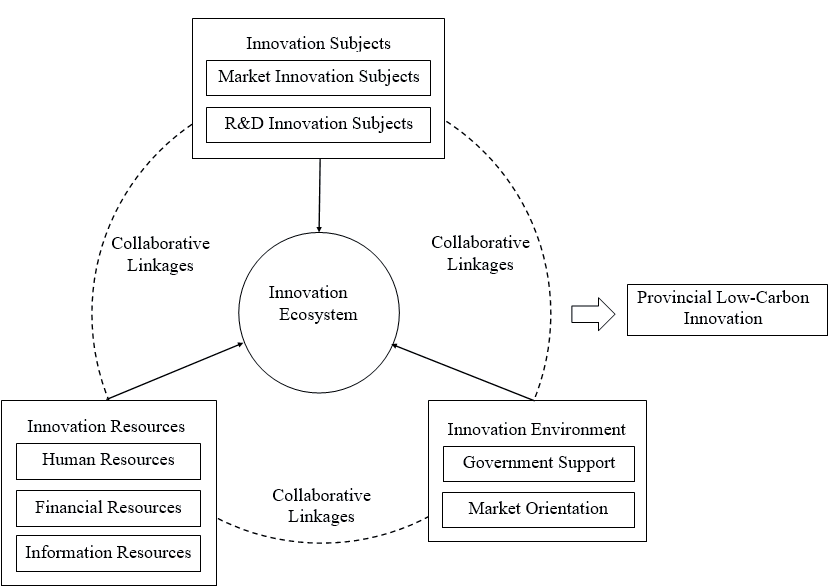
Based on the innovation ecosystem theory, this study constructs a configuration model of the antecedents of provincial low-carbon innovation from the three aspects of innovation subjects, innovation resources, and innovation environment. Specifically, this study selects market innovation subjects and R&D innovation subjects as variables at the innovation subjects level, human resources, financial resources, and information resources as variables at the innovation resources level, and government support and market orientation as variables at the innovation environment level. This study employs the fsQCA method to explore the synergistic impact of seven factors on provincial low-carbon innovation. Within the innovation ecosystem, innovative subjects promote low-carbon innovation through the creation of low-carbon knowledge, the research and development of low-carbon technologies, and the production of low-carbon products, with government support and market orientation as environmental constraints. Human resources, financial resources, and information resources ensure the efficiency of resource matching among innovation subjects, thus promoting provincial low-carbon innovation. The configuration model proposed in this study is shown in Fig. 1.
Materials and Methods
Research Method
The fsQCA method is designed to identify sufficient or necessary subset relationships by conceptualizing cases as distinct configurations of attributes [50]. This study adopts the fsQCA method for the following reasons.
Table 1.
CPC low-carbon technology classification and patent fields.
Firstly, unlike traditional regression methods that examine the “net effect” of an independent variable on the dependent variable in isolation, the fsQCA method captures the complex causal relationship among multiple influencing factors and provincial low-carbon innovation. This study argues that provincial low-carbon innovation is shaped by the interplay of various conditions. The fsQCA method facilitates the exploration of multiple concurrent relationships between multiple conditions and identifies different causal pathways leading to specific outcomes [51]. Furthermore, the fsQCA method is particularly effective in addressing the configuration effects of more than three variables and offers nuanced insights into the mechanisms driving provincial low-carbon innovation. Secondly, the fsQCA method can explain the causal asymmetry between high and non-high provincial low-carbon innovation paths by identifying the multiple driving paths that generate high or non-high low-carbon innovation. Thirdly, this study involves both continuous and discrete variables. While the csQCA and mvQCA methods are only suitable for dealing with categorical problems, the fsQCA method can deal with degree change and partial affiliation problems by assigning an affiliation score between 0 and 1 to each case, thereby capturing the subtle impacts of continuous variables on varying levels of low-carbon innovation.
Data Sources and Variable Measurements
Data Sources
The data of the sample come from 30 provinces in the Chinese mainland from 2019 to 2020. Tibet is not included due to serious relevant data missing. Among them, the data on market innovation subjects, R&D innovation subjects, human resources, financial resources, information resources, and government support can be obtained from the China Statistical Yearbook. The data on market orientation can be obtained from the NERI Index of Marketization of China’s Provinces Report. The data on provincial low-carbon innovation can be obtained from the Consolidated Patent Classification (CPC). Specifically, the data on low-carbon patent applications used in this study need to rely on the public disclosure of the official database of the State Intellectual Property Office. According to the publication rules of the Annual Report of China Patent Statistics, the data for 2021 and beyond are at the stage of application review and statistical calibration, with a significant disclosure lag. Given that the impact of the innovation ecosystem on low-carbon innovation has a certain degree of time-lag effect, this study selects the data of the antecedent variables in 2019 and the data of the outcome variable in 2020 for analysis.
Variable Measurements
(1) Outcome Variable. The European Patent Office and the US Patent Office have constructed the Combined Patent Classification (CPC), which is based on the research results of the United Nations Environment Program and the International Centre for Trade and Sustainable Development on the classification of low-carbon patents. Following the study of Veefkind et al. [52], the sum of the number of patent applications for subjects Y02B, Y02C, Y02E, Y02P, Y02T, and Y02W in the Y02 series under the Y classification is used to measure provincial low-carbon innovation. The specific classification numbers and the fields to which the patents apply are shown in Table 1.
(2) Antecedent variables. Following the study of Su et al. [53], the number of industrial enterprises above the designated size is used to measure the market innovation subjects, and the sum of the number of universities and the number of R&D institutions is used to measure the R&D innovation subjects. Following the study of Miao et al. [54], the full-time equivalent of R&D personnel is used to measure human resources. Following the study of Fu and Geng [55], the share of R&D expenditure to GDP is used to measure financial resources. Following the study of Duan and Wu [56], two indicators, namely, the internet broadband access ports and the mobile phone penetration, are used to measure information resources. Following the study of Wang and Zhang [57], the share of science and technology expenditures in the fiscal expenditure of local government is used to measure government support. Following the study of Yuan et al. [58], the total marketization index in the NERI Index of Marketization of China’s Provinces Report is used to measure the market orientation. The description for the seven variables is shown in Table 2.
Table 2.
Description of antecedent variables.
Calibration of Variables
Calibration is the process of assigning affiliation scores to each collection of cases. In this study, secondary data were selected, and a direct calibration method was used. Following the study of Fiss [51], the three key breakpoints for causal conditions and results were set at 75%, 50%, and 25% of the quantile. In addition, some of the values coincide with intersections that result in a fuzzy set affiliation score of 0.5. Thus, for all antecedent variables with an affiliation of 0.5, a constant of 0.001 was added. The calibration of antecedent variables and the outcome variable is shown in Table 3.
Results and Discussion
Necessary Conditions Analysis
A necessary condition can be regarded as a superset of results and will definitely be included in the resultant configuration. If the necessary condition is included in the truth table analysis, it may be simplified away in the parsimonious solution obtained by incorporating the logical remainder. Therefore, a necessary condition analysis is required before performing the sufficiency analysis. A condition is defined as “necessary” if the consistency result is greater than 0.9 [59]. This study analyzes whether causal conditions are necessary for high or non-high provincial low-carbon innovation. The fsQCA 3.0 software was used to conduct the necessary analysis. As shown in Table 4, the consistency results of all causal conditions are less than 0.9. Therefore, there is no single necessary condition that generates high or non-high provincial low-carbon innovation.
Table 3.
Calibration of variables.
Table 4.
Analysis of necessary conditions under fsQCA.
Sufficiency Analysis of Provincial Low-Carbon Innovation
Following the study of Morgan [60], this study sets the raw consistency threshold at 0.8, the PRI consistency threshold at 0.7 [61], and the case frequency threshold at 1. Due to the lack of definitive theory and evidence to support the status of the independent conditions in generating the results, this study conducted a factual analysis by choosing “present or absent”.
Configurations of High Provincial Low-Carbon Innovation
The fsQCA derives five configurations for high provincial low-carbon innovation, H1 to H5, and the results are presented in Table 5. The results show that five configurations generate high provincial low-carbon innovation, with consistency levels of 0.958, 0.953, 0.995, 0.997, and 0.992, respectively, exceeding the generally accepted threshold of 0.8.
Configuration H1 shows that high R&D innovation subjects and high human resources, serving as core conditions, along with high market innovation subjects, high financial resources, high information resources, and non-high market orientation as edge conditions, can generate high provincial low-carbon innovation. Shi et al. [62] found that the extensive participation of various innovative subjects can enhance green technology innovation and promote low-carbon innovation. A complete cooperation and innovation system is formed among innovation subjects through interaction and coordination of division of labor, which guides innovation resources to gather in the key chain of low-carbon innovation, and makes up for the adverse effects of poor market orientation, so as to realize provincial low-carbon innovation. Configuration H1 emphasizes the importance of innovation subjects and innovation resources. Therefore, Configuration H1 is named the driven type of “innovation subjects-innovation resources”.
Configuration H2 shows that high R&D innovation subjects and high human resources, serving as core conditions, along with high market innovation subjects, high financial resources, high government support, and high market orientation as edge conditions, can generate high provincial low-carbon innovation. Good market orientation and strong government support can fully stimulate the innovation vitality of the two types of innovation subjects and provide a good guarantee for cooperation among innovation subjects. In addition, Wang and Zhang [57] found that government support had a significant positive effect on the stage of innovation resource development and overall efficiency. The linkage between innovation subjects and innovation environment can promote the flow of talents and capital, improve the efficiency of resource allocation, and promote provincial low-carbon innovation. Based on the innovation environment, Configuration H2 highlights the importance of innovation subjects, human resources, and financial resources, so it is named the driven type of “innovation subjects - human resources + financial resources - innovation environment”.
Table 5.
Configuration results of high provincial low-carbon innovation.
Configuration H3 shows that high R&D innovation subjects and high human resources, serving as core conditions, along with high market innovation subjects, non-high financial resources, high information resources, non-high government support, and high market orientation as edge conditions, can generate high provincial low-carbon innovation. Tjahjadi et al. [63] found that green market orientation affected green innovation. Good market orientation can guide the innovation subjects to actively participate in low-carbon innovation activities and accelerate the process of research and development of low-carbon technology. In addition, adequate talents and information can strengthen the sensitivity of innovation subjects to technological innovation, quickly target valuable low-carbon innovative technologies, effectively make up for the unfavorable impacts of insufficient financial resources and low government support, thus promoting provincial low-carbon innovation. Based on market orientation, Configuration H3 highlights the importance of innovation subjects, human resources, and information resources, so it is named the driven type of “innovation subjects - human resources + information resources - market orientation”.
Configuration H4 shows that high information resources and high government support, serving as core conditions, along with high market innovation subjects, high human resources, high financial resources, and high market orientation as edge conditions, can generate high provincial low-carbon innovation. Han et al. [64] found that green innovation vitality can be improved by enhancing public environmental concern and strengthening government support. It indicates that the innovation environment and government support have a positive impact on low-carbon innovation. Good market orientation and strong government support can fully stimulate the innovation vitality of the market innovation subjects and provide a good environment for the market innovation subjects to carry out low-carbon innovation activities. In addition, the linkage between market innovation subjects and the innovation environment can promote the flow of talents, capital, and information, and help market innovation subjects integrate resources to carry out low-carbon innovation, thus promoting provincial low-carbon innovation. Based on the innovation environment, Configuration H4 highlights the importance of the market innovation subjects and innovation resources, so it is named the driven type of “market innovation subjects - innovation resources - innovation environment”.
Configuration H5 shows that high information resources and high government support, serving as core conditions, along with non-high market innovation subjects, high R&D innovation subjects, non-high human resources, non-high financial resources, and high market orientation as edge conditions, can generate high provincial low-carbon innovation. Government support can stimulate the innovation vitality of R&D innovation subjects and is an important guarantee for low-carbon innovation activities. In addition, Liu and Chen [65] found that low-carbon innovation can be improved by giving full play to the internal and external information effect. Sufficient information improves the sensitivity of innovation subjects to external information, mitigates the negative impacts of a smaller number of market innovation subjects, insufficient talent, and insufficient capital, thus realizing provincial low-carbon innovation. Based on the innovation environment, Configuration H5 highlights the importance of R&D innovation subjects and information resources, so it is named the driven type of “R&D innovation subjects-information resources-innovation environment”.
Table 6.
Configuration results of non-high provincial low-carbon innovation.
Configurations of Non-High Provincial Low-Carbon Innovation
The configurations that generate non-high provincial low-carbon innovation are shown in Table 6. As shown, there are three configurations for non-high provincial low-carbon innovation, with consistency levels of 0.983, 0.967, and 0.991, and an overall consistency level of 0.962.
Configuration NH1 suggests that non-high provincial low-carbon innovation will be achieved as long as the provinces have non-high market innovation subjects and non-high market orientation, complemented by non-high innovation resources and non-high government support. Configuration NH2 suggests that non-high provincial low-carbon innovation will be achieved as long as the provinces have non-high market innovation subjects and non-high market orientation, complemented by non-high R&D innovation subjects, non-high human resources, non-high financial resources, and non-high government support. Configuration NH3 suggests that provinces with non-high market innovation subjects and non-high market orientation, complemented by non-high R&D innovation subjects and non-high innovation resources, will experience non-high provincial low-carbon innovation, even if high government support is present.
According to NH1, NH2, and NH3, all three configurations that generate non-high provincial low-carbon innovation contain core conditions of non-high market subjects and non-high market orientation, and edge conditions of non-high human resources and non-high financial resources. The result is similar to the finding of Tjahjadi et al. [63]. Tjahjadi et al. [63] found that green market orientation had a positive impact on green innovation. An insufficient number of market innovation subjects reduces the opportunities to utilize complementary and interactive learning and slows down the process of creating low-carbon knowledge and technology. Insufficient market orientation reduces the responsiveness to market demands and market changes, reduces opportunities for learning in the market environment and reduces low-carbon innovation outputs. Liu et al. [66] found that adequate talent and finance played a positive role in low-carbon innovation. Insufficient investment in human and financial resources will lead to a lack of incentives for low-carbon innovation and a slower process of commercialization of low-carbon knowledge and technologies. If a province has non-high information resources and non-high government support, or non-high R&D innovation subjects, or even if it has high government support but non-high R&D subjects, it will still experience insufficient innovation power and limited innovation activity, resulting in non-high provincial low-carbon innovation.
Robustness Tests
This study conducts robustness checks on the configuration results by raising the original consistency threshold and the PRI consistency threshold. Following the studies of Huang et al. [67] and Zhang and Long [68], the original consistency threshold is raised from 0.8 to 0.85, yielding consistent configurations as previously discussed. Additionally, following the study of Huang et al. [69], the PRI consistency threshold is raised from 0.7 to 0.75, also producing the same configurations as before. This confirms the robustness of the study’s findings.
Discussion
Firstly, through necessary condition analysis, this study finds that no single factor constitutes a necessary condition for generating high/non-high low-carbon innovation, indicating that low-carbon innovation is a complex, systematic project and that the configuration impact of the linkage of multi-factors on low-carbon innovation needs to be considered. Against the trend of global carbon emission reduction, the innovation ecosystem plays a crucial role in low-carbon innovation [70]. In terms of innovation subjects, existing studies have mainly verified the positive role of enterprises in the field of low-carbon innovation [5, 6], with insufficient exploration of the roles of universities and R&D institutions. In terms of innovation resources, Dong et al. [7] found that information disclosure can alleviate information asymmetry and stimulate various subjects to participate in low-carbon innovation. From the perspective of financial resources, scholars have found that green credit [8] and digital finance [5] can strengthen R&D investment and promote low-carbon innovation. In addition, Han et al. [71] discovered that talent resources play an important role in the formation of low-carbon innovation networks. In terms of innovation environment, from the perspective of market environment, scholars have found that the development of the digital economy can reduce financing constraints and environmental uncertainty, thereby stimulating enterprises to carry out low-carbon innovation [13, 14]. The free trade pilot zone can promote trade openness, attract high-quality foreign investment, and thus drive low-carbon innovation [1]. From the perspective of government support, some scholars have found that the carbon trading pilot policy [46], the low-carbon city pilot policy [12, 21], and the big data comprehensive pilot zone [14] significantly promote low-carbon innovation. At the same time, Han et al. [71] found that environmental regulation is an important factor in low-carbon innovation, while administrative intervention weakens institutional change and hinders low-carbon innovation [15]. It can be observed that existing studies mainly adopt regression methods for analysis, and the conclusions reflect the “net effect” of variables. In addition, Liu and Sun [72] have explored the impact of the interaction between marketization level, green consumption concepts, and carbon emission trading systems on low-carbon innovation. However, due to methodological limitations, the regression methods cannot unravel complex nonlinear relationships and interactions between three or more variables [10]. In contrast, studies based on the fsQCA method focus on the configuration effects between variables and can reveal multiple concurrent causal relationships, which cannot be explained by the “net effect” in regression studies. Furthermore, this study adopts the fsQCA method and constructs an antecedent configuration model of low-carbon innovation based on the innovation ecosystem theory. Through configuration analysis, this study found that the three configurations that generate high provincial low-carbon innovation all contain the two core conditions of high R&D innovation subjects and high human resources, and the edge condition of high market innovation subjects, which fully illustrates the key role of innovation subjects and human resources in provincial low-carbon innovation. This echoes the findings of existing studies, where Xu and Yu [73] found that high innovation subjects and high human resources were the core conditions driving high provincial innovation. Guo et al. [74] found that high innovation subjects were the core condition generating high urban green innovation efficiency. Qiao and Niu [75] found that high innovation subjects were the core condition generating high enterprise innovation performance, and high R&D human resources were the edge condition generating high enterprise innovation performance. The innovation ecosystem, as an important factor in promoting innovation development [73], can promote industrial upgrading and green development [76]. In the innovation ecosystem, innovation subjects can promote innovation development through knowledge exchange [24]. With government support and market orientation, the integration of innovation resources promotes green technology innovation, which in turn promotes low-carbon innovation [62]. In addition, the three configurations that generate non-high provincial low-carbon innovation all contain two core conditions of non-high market innovation subjects and non-high market orientation, and two edge conditions of non-high human resources and non-high financial resources. This echoes the findings of Guo et al. [74] and Qiao and Niu [75]. Guo et al. [74] found that when enterprise innovation subjects and innovation resources in urban innovation ecosystems performed poorly, urban innovation ecosystems were ineffective and did not produce high urban green innovation efficiency. In analyzing the impact of the innovation ecosystem on enterprise innovation performance, Qiao and Niu [75] found that the market innovation subjects had an important impact on improving the innovation performance of enterprises. An insufficient number of enterprises involved in innovation will lead to limited innovation investment and innovation resources. At the same time, if the introduction of human resources is neglected, innovation resources cannot be effectively transformed into R&D results, which leads to low innovation efficiency. At the same time, the lack of clear market orientation will lead to provinces’ inability to effectively integrate resources for promoting the transformation of innovation results, accurately match market demand with innovation supply, and consequently, low-carbon innovation often lacks vitality. Distinct from traditional regression methods, fsQCA overcomes the limitation of the “net effect” in regression analysis. By identifying multiple equivalent paths that generate the outcome, the results derived from fsQCA analysis are able to provide more targeted implications for low-carbon innovation.
Conclusions
Using the data of 30 provinces in the Chinese mainland, this study employs the fsQCA method to construct a research framework for low-carbon innovation based on innovation ecosystems theory, analyzes the linkage effects of multi-factors affecting provincial low-carbon innovation, and draws the following conclusions.
Firstly, no single necessary condition generates high or non-high provincial low-carbon innovation. The generation of provincial low-carbon innovation is a complex process, and the single factor does not constitute the determinant of provincial low-carbon innovation, and the linkage effects of multi-factors need to be taken into account when formulating low-carbon innovation policies.
Secondly, five configurations can generate high provincial low-carbon innovation. Specifically, Configuration H1 is the driven type of “innovation subjects-innovation resources”. Configuration H2 is the driven type of “innovation subjects-human resources+financial resources-innovation environment”. Configuration H3 is the driven type of “innovation subjects-human resources+information resources-market orientation”. Configuration H4 is the driven type of “market innovation subjects - innovation resources-innovation environment”. Configuration H5 is the driven type of “R&D innovation subjects-information resources-innovation environment”. It can be seen that there is more than one configuration that generates high provincial low-carbon innovation, which indicates there are multiple instances of concurrency and equivalence. At the same time, the three configurations that generate high provincial low-carbon innovation all contain the two core conditions of high R&D innovation subjects and high human resources, and the edge condition of high market innovation subjects, which indicates the key role of innovation subjects and human resources in provincial low-carbon innovation. Relevant departments need to give full play to the role of innovation subjects and human resources in the process of formulating low-carbon innovation policies. At the same time, relevant departments need to comprehensively consider the impact of the different combinations of innovation subjects, innovation resources, and innovation environment, and formulate corresponding low-carbon innovation policies based on the configurations that generate high provincial low-carbon innovation.
Thirdly, three configurations can generate non-high provincial low-carbon innovation, which shows an asymmetric relationship with the configurations that generate high provincial low-carbon innovation. The three configurations that generate non-high provincial low-carbon innovation contain core conditions of non-high market innovation subjects and non-high market orientation, and edge conditions of non-high human resources and non-high financial resources. Specifically, provinces with non-high market innovation subjects and non-high innovation resources in a non-high innovation environment, or with non-high innovation subjects, non-high human resources and non-high financial resources in a non-high innovation environment, or with non-high innovation subjects and non-high innovation resources in high government support and non-high market orientation, all generate non-high provincial low-carbon innovation. These conclusions suggest that it is not possible to reverse-engineer the configurations that generate high provincial low-carbon innovation to the configurations that generate non-high provincial low-carbon innovation. Relevant departments need to be alert to the emergence of combinations of antecedent conditions in the configurations that generate non-high provincial low-carbon innovation when formulating low-carbon innovation policies, so as to avoid generating non-high provincial low-carbon innovations.
Implications
Firstly, relevant departments should adopt a localized approach to achieving provincial low-carbon innovation by accurately identifying and leveraging various affecting factors. Specifically, relevant departments need to formulate corresponding low-carbon innovation strategies based on different configurations and rationally allocate resources to realize provincial low-carbon innovation.
According to Configuration H1, relevant departments should focus on the linkage between innovation subjects and innovation resources, deepen industry-university-research cooperation in low-carbon innovation, strengthen personnel exchanges among enterprises, universities, and R&D institutions, and conduct joint research on low-carbon technologies. Guide social capital to invest in low-carbon innovation projects to alleviate the capital pressure of enterprises. Build low-carbon information sharing platforms, integrate industry R&D data, policy dynamics, and other information to provide accurate information support for enterprises. Make up for the adverse impacts caused by insufficient market orientation through the above measures to achieve provincial low-carbon innovation.
According to Configuration H2, relevant departments should strengthen the cultivation of market innovation subjects and R&D innovation subjects, establish a benefit-sharing mechanism to stimulate the enthusiasm for industry-university-research cooperation. In terms of human resources, relevant departments should support enterprises in cooperating with universities and R&D institutions to carry out talent training to address the shortage of low-carbon innovation talents. In terms of financial resources, relevant departments should promote capital market financing, and expand indirect financing channels. Meanwhile, relevant departments should focus on optimizing the innovation environment, build low-carbon technology trading platforms, and improve the intellectual property protection system to achieve provincial low-carbon innovation.
According to Configuration H3, relevant departments should intensify efforts to cultivate market innovation subjects and R&D innovation subjects. In terms of human resources, relevant departments should support universities in offering majors related to low-carbon innovation and jointly train talents with low-carbon technology backgrounds and market experience in collaboration with enterprises and R&D institutions. In terms of information resources, relevant departments should build a systematic, complete, efficient, and practical information infrastructure system. At the same time, relevant departments should improve the fair competition system, strengthen market orientation, and establish low-carbon technology transformation bases to promote the sustainable development of low-carbon technologies. These measures can alleviate the adverse impacts of insufficient financial resources and weak government support to achieve provincial low-carbon innovation.
According to Configuration H4, relevant departments should focus on cultivating market innovation subjects and regularly organize low-carbon technology cooperation between enterprises and industry associations. Relevant departments should build an information network to realize the sharing of technical patents and market information and establish the low-carbon talent sharing platform to integrate human resources from enterprises, universities, and R&D institutions. Develop low-carbon innovation financial products to provide financial guarantees for low-carbon innovation. Meanwhile, relevant departments should optimize the innovation environment to achieve provincial low-carbon innovation.
According to Configuration H5, relevant departments should focus on supporting R&D innovation subjects, cooperate with domestic universities and R&D institutions to establish low-carbon technology laboratories, and realize the sharing of data, technologies, and achievements. Relevant departments should strengthen the construction of information technology infrastructure, integrate low-carbon technology patents, R&D data, policy dynamics, market demands, and other information. Relevant departments should rely on government big data platforms to push adaptive policies in a targeted manner. Regularly organize market promotion conferences to promote low-carbon innovation achievements to expand market share. By creating a favorable innovation environment, relevant departments can make up for the adverse impacts of insufficient market innovation subjects, human resources, and financial resources, thereby achieving provincial low-carbon innovation.
Secondly, relevant departments need to complement each other to avoid the generation of non-high provincial low-carbon innovation. According to Configurations NH1, NH2, and NH3, relevant departments should avoid the combination of four conditions: non-high market innovation subjects, non-high market orientation, non-high human resources, and non-high financial resources. Specifically, relevant departments should strive to support the development of market innovation subjects, further promote industry-university-research cooperation, and comprehensively promote the coordinated development among innovation subjects. Secondly, relevant departments should establish trading markets for low-carbon technology and products, to help innovation subjects, especially enterprises, accurately grasp market orientation. Thirdly, relevant departments should support innovation subjects in jointly cultivating low-carbon innovation talents to break the talent bottleneck. Finally, relevant departments should expand financing channels for low-carbon innovation and encourage financial institutions to increase the issuance of low-carbon credit loans.
Limitations and Future Directions
The following shortcomings in this study need to be further studied. First, there are many factors affecting provincial low-carbon innovation, and this study only selects some important factors based on the innovation ecosystem theory to carry out research, which may miss some potential affecting factors. In the future, more affecting factors can be included based on different theoretical frameworks to conduct more in-depth research on the antecedents of low-carbon innovation. Second, the static secondary data used in this study cannot fully portray the dynamics of provincial low-carbon innovation activities. In the future, panel data can be collected, and dynamic QCA methods can be used to carry out the analysis of the evolutionary process. Third, the research object of this study is 30 provinces in the Chinese mainland, which may not be able to explain the complex causal mechanism of multiple factors affecting low-carbon innovation. In the future, we can consider refining the research object to the city or the enterprise level to analyze the configurations of low-carbon innovation more specifically.

