

Introduction
Black nightshade is a dicotyledonous Solanaceae herbaceous plant. It has the characteristics of strong fecundity, vigorous growth, and short growth period. It is a hyperaccumulator with strong tolerance and enrichment ability to cadmium (Cd) found in China in 2005 [1]. This plant exhibits characteristics such as robust reproductive capacity, vigorous growth, and a short life cycle. Hydroponic studies conducted by Peng et al. revealed that black nightshade showed no signs of toxicity even when exposed to aboveground Cd concentrations as high as 262 mg/kg [2]. In soil contaminated with 25 mg/kg of Cd, Wei et al. found that the roots of black nightshade contained only 59.9 mg/kg of Cd, while the stems and leaves exceeded the critical threshold of 100 mg/kg, characteristic of super-accumulating plants [3]. Thus, black nightshade holds promise for the bioremediation of heavy metal contamination.
Chelation induction technology has gained significant attention in the field of soil heavy metal remediation to enhance the effectiveness of plant-based remediation of heavy metals in soil. Metal ions can displace hydrogen (or sodium) from their coordination sites and form water-soluble chelates within the chelating ring, which can then be washed away [4]. The reason for this is that the molecule has lone pairs of electrons that are open to coordination. The chelating agent can therefore have a life-saving impact on the formation of heavy metals in the soil by enhancing their activity [5], increasing their mobility, and making them more receptive to plant absorption and usage [6]. Iminodisuccinic acid (IDS), a biodegradable chelating agent that is regarded as green and ecologically benign [7], can not only form chelates with metal ions but also has good biodegradable characteristics. IDS is a brand-new class of degradable green chelating agent with low toxicity, a low potential for secondary pollution, a quick rate of decomposition, and a strong capacity to chelate heavy metals [8]. Under the right conditions of use, IDS has no impact on crop growth, but it has a very significant impact on biomass at high concentrations. According to Zhao et al.’s research, IDS treatment significantly increased the aboveground Cd content of maize plants compared to control treatment [9]. Numerous abiotic stressors have been alleviated by the application of plant growth regulators [10], such as salicylic acid, strigolactones (SLS), have shown that plant growth regulators can increase the stress resistance of plants to heavy metals by regulating plant physiological and biological processes [13]. For example, plant growth regulators can expand the area of their roots’ absorption to increase the amount of water and nutrients they can absorb while also promoting cell division and growth to increase their resistance to heavy metals [14]. The antioxidant enzyme activity of tomato seedlings rose under Cu stress using brassinolide, according to research by Jia et al. [15].
At present, there are many studies on the remediation of soil heavy metal pollution with novel biodegradable chelators GLDA and IDS, and the combination treatment of plant growth regulators and chelators and plant growth regulators has also been confirmed to have good application prospects for soil heavy metal pollution remediation [16]. In this study, a combination of a biodegradable chelating agent (iminodisuccinic acid, IDS) and a plant growth regulator (28-epibrassinolide, BR) was applied to the Cd superaccumulation plant black nightshade to examine its effects on Cd accumulation and understand the underlying response mechanisms. This research provides theoretical support for the remediation of cadmium-contaminated soil
Materials and Methods
Soil Collection and Soil Cultivation
The experimental soil was selected from the surface soil of Cd-contaminated farmland in Taicang, China (121°11′E, 31°37′N), the soil type was brown soil; the main planting method in this area was rice and wheat rotation; the collection depth was 0~20 cm of topsoil; the soil samples were fully mixed and dried naturally; and a 2 mm nylon sieve was used for backup. The basic physical and chemical properties of soil are shown in Table 1.
In this experiment, the exogenous addition concentration of soil cadmium was 10 mg/kg, and the actual amount of CdCl2 was 16.31 mg/kg. The test soil was placed in a white pot, and CdCl2 was added to the soil as a solution and stirred well. The soil is protected from light and rests for 45 days, which passivates heavy metals.
Test Materials and Reagents
The seeds of black nightshade were purchased from Suqian City’s Chunmanyuan Seed Industry. After soaking the seeds in a 2% H2O2 solution for 30 minutes, rinsing them with tap water and distilled water, protecting them from light in a plant incubator to promote germination, and selecting uniformly sized seedlings for use after 7 days of growth.
Table 1.
Physicochemical properties of the test soils.
| pH | Organic matter (g/kg) | Available phosphorus (mg/kg) | Fast-acting potassium (mg/kg) | Total nitrogen (g/kg) | Total Cd (mg/kg) |
|---|---|---|---|---|---|
| 7.11 | 23.70 | 36.80 | 147.65 | 1.60 | 2.00 |
Table 2.
Experimental design.
Anhydrous cadmium chloride (CdCl2) is an excellent-grade pure product purchased from Shanghai Zhanyun Chemical Co., Ltd. The biodegradable chelating agent, tetrasodium iminodisuccinate, was purchased from Shanghai Macklin Biochemical Technology Co., Ltd. The plant growth regulator, 28-epiparoperabrassinolide (0.01%), was purchased from Shandong Feixiang Agricultural Materials Co., Ltd.
Test Methods
Six different treatments were set up for the experiment, which was conducted at the experimental greenhouse of the College of Environmental Science and Engineering, Yangzhou University (Table 2). Each pot (diameter 20 cm, height 16 cm) was filled with 3 kg of soil, 60 g of organic fertilizer was applied as bottom fertilizer, and 1 seedling of black nightshade was transplanted per pot. Five replicates were treated per pot. During the black nightshade plant’s blooming, fruiting, and expansion stages, 0.02 mg/L 28-epibrassinolide in 100 ml was sprayed, and 100 ml of iminodisuccinic acid tetrasodium was evenly sprayed on the soil surface in each pot at the expansion stage. The whole growth cycle of black nightshade was 90 days.
Sample Collection, Processing and Analysis
After black nightshade reaches maturity, gather the plants, wash the above-ground and underground parts with tap water, then rinse them three times with deionized water, absorb the remaining water on the filter paper, take a portion of the sample and refrigerate, kill it at 105ºC for 30 min, dry it at 80ºC to a constant weight, calculate the dry weight, and then grind it through a 0.15 mm nylon sieve. Using a wet digestion of HNO3-HClO4 and an inductively coupled plasma spectrometer (Optima 7300 DV, USA), the cadmium content of black nightshade plants was measured. Simultaneously, black nightshade potting soil was collected, and plant remnants were eliminated after air drying and passing through a 1 mm nylon screen. The total soil Cd was digested by a HNO3-HF-HClO4 electric hot plate digestion system, and the Cd content was determined by the BCR [17] continuous extraction method for different forms of Cd and an inductively coupled plasma spectrometer (Optima 7300 DV, USA).
Soil catalase was determined by KMnO4 titration [18], soil urease was determined by the phenol sodium-sodium hypochlorite colorimetric method, and soil sucrase was determined by the 3,5-dinitrosalicylic acid method [19]. The activity of catalase (CAT) in leaves of black nightshade was determined by the ultraviolet absorption method. The activity of peroxidase (POD) was determined by the guaiacol method [20], and the activity of superoxide dismutase (SOD) was determined by the nitroblue tetrazolium photoreduction method.
Data Processing and Analysis
Data processing using Microsoft Excel 2016, statistical analysis using SPSS 17.0 software, one-way ANOVA and least significant difference (LSD) tests, and Origin 8.5 tabulation for graphing.
To quantify metal uptake from soil and incorporation into the roots and leaves of blackberries, the respective bioconcentration factors (BCF) were calculated as follows :
where CSoil and CLeaf are the metal concentrations in soil and leaf, respectively. A BCF>1 indicates metal accumulation by the plant.
To quantify metal translocation from roots to aboveground plant parts, the translocation factor (TF) was calculated as the ratio of the bioconcentration factors determined for leaves and roots of the sampled blackberries:
Results and Analysis
Effects of Different Treatments on Black Nightshade Biomass
Table 3 displays the results of several interventions on the biomass of black nightshade. The subsurface biomass ranged from 0.35 g to 0.49 g, whereas the aboveground biomass per pot varied from 3.28 g to 3.93 g. The biomass of black nightshade treated with IDS5 and IDS10 decreased by 10.8% and 17.0%, respectively, and the biomass of black nightshade treated with IDS10 decreased by 13.6% and 28.6%, respectively. This data shows that the concentration of iminodisuccinic acid has a direct correlation with how well black nightshade is inhibited from growing and that the inhibitory effect of chelating agents on the underground growth of black nightshade The above- and underground biomass of black nightshade decreased by 5.3% and 15.0%, respectively, and by 8.7% and 26.5%, respectively, when black nightshade was treated with IDS10+BR, indicating that 28-epiparoryinolide reduced the inhibitory effect of iminodisuccinic acid on the growth of black nightshade. However, BR application alone could lessen the effect of Cd on the growth of black nightshade [21].
Effects of Different Treatments on Cd Content in the Underground and Aboveground Parts of Black Nightshade
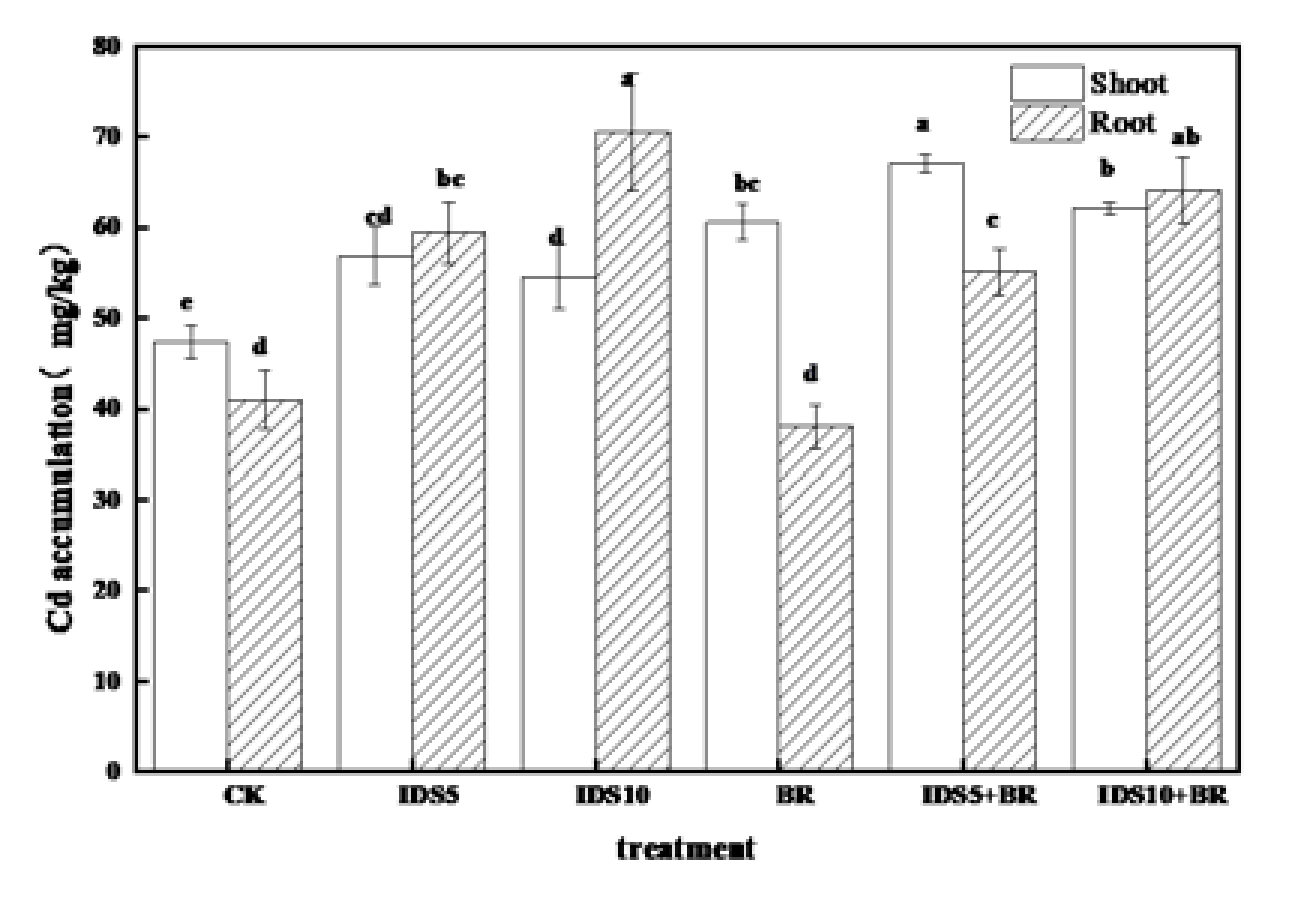
Fig. 1 depicts the impact of several treatments on the Cd concentration in the aboveground and subsurface sections of the black nightshade. The underground parts of IDS5, IDS5+BR, IDS10, and IDS10+BR all had Cd content that was significantly higher than the control, ranging from 38.07 mg/kg to 70.57 mg/kg, with an increase of 34.5% to 72.1%. IDS10 had the highest underground Cd content, at 70.57 mg/kg. On the other hand, the Cd concentration in the black nightshade subterranean portion was unaffected by BR treatment [22].
The contents ranged from 54.56 mg/kg to 67.11 mg/kg and increased by 15.0%-41.5%. The IDS5+BR and IDS10+BR treatments increased the Cd content of the black nightshade’s aerial part by 41.5% and 30.9%, respectively. These results show that 28-epibrassinolide had a positive impact on the accumulation of aboveground Cd in the black nightshade’s aerial part [23].
Effects of Different Treatments on Cd Content in Different Soil Forms
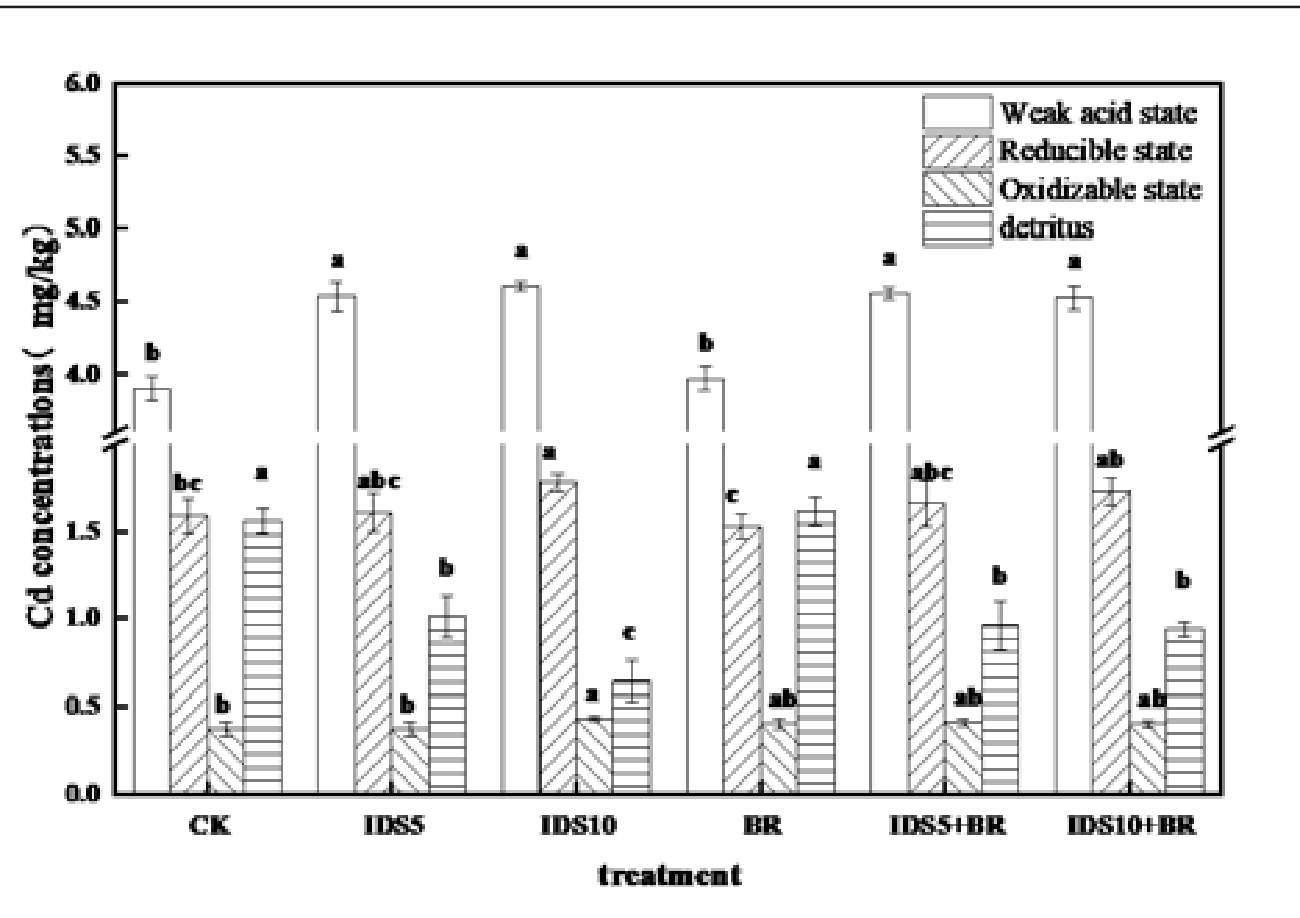
Fig. 2 illustrates how various treatments affect the morphological Cd concentration of soil. IDS5, IDS5+BR, IDS10, and IDS10+BR treatments all significantly increased the amount of weak acid Cd in soil when compared to the control; the IDS10 treatment had the highest amount of weak acid Cd at 4.61 mg/kg, up 17.0%; and the BR treatment had the least amount of weak acid Cd relative to the control. The other treatments had no discernible impact on the Cd concentration in reduced and oxidizable states, but the IDS10 treatment considerably raised the Cd content in these states. The Cd level of soil residue decreased in all treatments by 0.64 mg/kg to 1.01 mg/kg, with a drop range of 35.5% to 59.0% as compared to CK. The findings demonstrated that iminodisuccinic acid activated soil Cd, transforming it into weakly acidic and reducible Cd, but BR-treated residual Cd did not differ substantially from the control treatment [24].
Effects of Different Treatments on the Repair Efficiency of Black Nightshade
For assessing super-accumulated plants, it’s crucial to consider the enrichment coefficient and the heavy metal transport coefficient by plants [14]. The enrichment coefficient (BCF) and transport coefficient (TF) were calculated to reflect the absorption and transfer capacity of Cd [24], where the transfer coefficient (TF) is the ratio of the heavy metal content in the plant’s above-ground portion to the corresponding heavy metal content in the soil [25], reflecting the plant’s capacity to absorb heavy metals from the soil. Table 4 demonstrates that BCF with various treatments has Table 4 demonstrates that, as compared to CK, BCF has greatly improved with various therapies. The biggest rise in BCF of black nightshade was caused by the IDS5+BR treatment, which raised it by 42.0%. This was followed by the IDS10+BR treatment, which increased it by 31.4%, and the IDS5 and IDS10 treatments, which increased it by 20.4% and 15.5%, respectively. This shows that 28-epilubrassinolide encourages the enrichment of Cd by solanine supplemented with iminodisuccinic acid. The TF value of the black nightshade significantly increased with the BR treatment when compared to the control, and it significantly decreased by 33.1% and 17.2% when subjected to IDS5 and IDS10 treatments, respectively. However, the TF values of IDS5+BR and IDS10+BR treatments were higher than those of IDS5 and IDS10 treatments, indicating that 28-epiparochromyolactone could facilitate the growth of the aerial biomass of Solanum nigrum in accordance with the findings of Li et al. [31], black nightshade based on Cd has a higher absorption and transport capability than iminodisuccinic acid alone. In studying the exogenous application of plant growth regulators to enhance the accumulation of Cd in brassica plants [26].
Effects of Different Treatments on the Antioxidant Enzyme System of Black Nightshade
Table 5 displays the impact of various treatments on the CAT, SOD, and POD activities in black nightshade leaves. When compared to CK, IDS5, and IDS10’s CAT activity dropped by 5.8% and 13.0%, respectively. As shown by the slower decline in CAT activity in the black nightshade leaves treated with IDS5+BR and IDS10+BR compared to those treated with IDS5 and IDS10, 28-epiparorunolide may be able to increase plant antioxidant capacity, lessen the oxidative damage brought on by heavy metals, and increase plant tolerance to Cd. The trend of SOD activity and CAT activity was similar; IDS5 and IDS10 treatments decreased by 10.9% and 18.3% compared with CK, respectively; BR treatments increased by 20.2%; and IDS5+BR treatment had the highest increase in SOD activity in black nightshade leaf, increasing by 35.0% compared with CK, followed by IDS10+BR treatment, which increased by 26.0% compared with CK. In the plant antioxidant enzyme system, the antioxidant enzymes CAT and superoxide dismutase SOD cooperate to reduce the formation of oxidative free radicals by converting O2- and H2O2 into O2 and H2O [25]. The activity of SOD and CAT is sensitive to Cd concentration, and an increase in Cd concentration causes the number of O2- to exceed the loading capacity of SOD and CAT [26], impairing cell function and causing the enzyme system to be destroyed.
Table 4.
Effects of different treatments on transport coefficient and enrichment coefficient of black nightshade.
| Dispose | CK | IDS5 | IDS10 | BR | IDS5+BR | IDS10+BR |
|---|---|---|---|---|---|---|
| BCF | 6.32±0.24 e | 7.59±0.42 cd | 7.28±0.48 d | 8.08±0.26bc | 8.95±0.14 a | 8.28±0.09 b |
| TF | 1.16±0.13 b | 0.96±0.10 c | 0.78±0.06 d | 1.60±0.12a | 1.22±0.05 b | 0.97±0.06 c |
Table 5.
Activities of CAT, SOD and POD in black nightshade leaves.
Table 6.
Effects of different treatments on soil enzyme activity of black nightshade.
The intensity of the plant’s own aberrant metabolic symptoms is reflected in POD activity [27]. When compared to CK, the POD activity treated by IDS5 and IDS10 increased by 7.3% and 17.0%, respectively. Processing for IDS5+BR and IDS10+BR increased in comparison to CK by 18.0% and 22.3%, respectively. Similar to the findings of this investigation [28], Šimončičová et al. also showed that the intensity of the plant’s own abnormal metabolic symptoms is related to pod activity, it was shown in related studies that the activation impact of wheat antioxidant enzymes on POD in a lead-stressed environment increased with the degree of stress. In contrast, CAT and SOD showed a little rise followed by a steady decline. In this trial, the POD activity of black nightshade leaves was significantly improved after the application of 28-epibrassinolide alone, which had the same effect as after IAA administration [29]. It has been discovered that the application of the plant growth regulator IAA can increase the POD activity of plants [25].
Effects of Different Treatments on Soil Enzyme Activity
The effects of different treatments on soil enzyme activities are shown in Table 6, and the content of soil catalase in IDS5 and IDS10 decreased by 11.5% and 27.0% compared with CK, respectively. The catalase activity of soil treated with IDS5+BR and IDS10+BR decreased by 3.3% and 20.8% compared with CK, respectively, indicating that 28-epibrassinolide had a mitigating effect on the decline of soil catalase activity, which may be due to iminodisuccinic acid increasing the content of available Cd in soil, and Cd binds to relevant groups of enzyme molecules into the activity center of the enzyme, inhibiting the catalytic function of the enzyme, destroying the structural integrity of enzyme, thereby reducing enzyme activity [29], and 28-epibrassinolide can promote the growth of black nightshade, enhance the enrichment and transport of available Cd in the soil in the aboveground, and alleviate the damage of Cd to enzyme function and structure to a certain extent [30].
As an amide enzyme, urease is positively correlated with the number of soil microorganisms [31], Li et al. also showed that urease is positively correlated with the number of soil microorganisms. organic matter content [32], total nitrogen, and available nitrogen content [33], and its activity often represents the nitrogen status of the soil [34]. This result is consistent with previous studies. The urease content of BR-treated soil decreased by 8.7% compared with CK, while the overall urease activity of soil after other treatments showed an upward trend, among which IDS10+BR-treated soil urease activity increased the most, increasing by 41.9% compared with CK, followed by IDS10 treatment, which increased by 38.1% compared with CK.
Different treatments improved soil sucrase activity to varying degrees, with increases ranging from 8.3% to 21.8%. BR treatment increased soil sucrase activity to 7.86 mg/g·24h, which was the largest increase when compared to CK, up 21.8%, while IDS10 treatment increased soil sucrase activity to 6.98 mg/g·24h, which was the smallest increase, up 8.3%. According to studies, there is a sizable concentration impact that Cd has on sucrase [21].
Conclusion
(1) While 28-epiparomyobrassinolide may lessen the stress effect of iminodisuccinic acid on the development of black nightshade, the content of weakly acidic and reducible Cd in soil rose with the increase in iminodisuccinic acid concentration on the suppression of black nightshade growth. The treatment of black nightshade with 5 mmol/L iminodisuccinic acid and 0.02 mg/L 28-epilubrassinolide resulted in the greatest rise in the aboveground Cd content, which was 41.5%.
(2) Iminodisuccinic acid reduced CAT and SOD activities in taro leaves and increased POD activity, while 28-epiparoperbrassinolide could alleviate the oxidative stress effect of black nightshade.
(3) With the increase in iminodisuccinic acid concentration, soil catalase activity and sucrase activity decreased and urease activity increased, while 28-epiparoperbrassinolide could improve soil catalase activity and sucrase activity.
(4) Treatment with 5 mmol/L iminodisuccinic acid and 0.02 mg/L 28-epihorastinolide could increase the accumulation of Cd in the aboveground part of black nightshade, which was an effective measure to remediate Cd-contaminated soil.

