

Introduction
Since the discovery of the first asymmetric reverse osmosis membranes, investigations have been focused on finding optimal polymeric membrane materials for membranes with advanced properties. Throughout the last four decades, thin film composite (TFC) membranes have dominated the market due to their higher permeability and selectivity compared to cellulose acetate (CA) membranes. CA membranes and their derivatives, among a broad range of TFC membranes, still exist and are used for specific applications due to exceptional overall chlorine resistance, long durability, and outstanding desalination efficiency, which are worth recalling to address the current shortcomings caused by polyamide reverse osmosis (RO) membranes [1]. The primary disadvantages of membranes are biofouling, hydrolysis, and so on. To increase performance, it is also necessary to take a fresh perspective and create new ways for modifying membranes in response to complicated issues. RO membrane performance was optimized via polymer reactions and additives. The selection of new polymers, improvement of the interfacial polymerization process, surface modification of conventional materials by physical and chemical methods, and hybrid organic/ inorganic RO membranes have been continuously studied to improve membrane properties [2]. The modification of membranes, optimization of parameters, the addition of inorganic and organic materials, etc., is an ongoing process. Recently, membranes prepared from ZNO/y-FeOOH nanoparticles embedded in polyethylene terephthalate have shown enhanced hydrophilicity, antifouling behavior, selectivity, and improvement of mechanical properties. They are applicable for the removal of COD and industrial effluents [3, 4]
In order to control specific membrane properties such as molecular cut-offs (MWCO), surface hydrophilicity/ hydrophobicity, surface charge density, or antifouling properties, various modification techniques such as coating, blending, chemical grafting or a combination of these methods have been used [5]. In this regard, improvement of the properties of existing materials by modifying the membrane surface is more convenient and probably less costly than synthesizing new materials. Moreover, water permeability has been significantly improved while maintaining high rejection (and in some cases, a slight increase in rejection) through the phase inversion process with polymer-polymer, polymer-particle blends of different materials. Cellulose acetate mixed with polyethersulfone and polyethylene glycol blend membranes was investigated. These blended membranes had higher porosity (permeability) and chlorine tolerance than pristine CA membranes [6]. The addition of sodium hexametaphosphate as a masking agent to Cellulose triacetate (CTA) inhibited oxidative degradation of the cellulose triacetate membrane by chlorine [7]. It was found that dispersing silver nanoparticles on the CA membrane surface would increase its biological stability while maintaining permeability and salt rejection [8]. The application of a phospholipid polymer to a CA membrane during phase conversion resulted in a fouling-resistant membrane with high water flux [9]. There were attempts to improve the water flux by adjusting the structure of the membrane either by phase separation or by the use of additives [10-13]. These structural changes affect antifouling, anti-bacterial, anti-chlorine, durability, and thermo-mechanical properties. A water-based extract of sunflower seeds (Helianthus annuus) was utilized as a novel environmentally acceptable additive to enhance the performance and anti-biofouling capabilities of cellulose acetate RO membranes [14]. A grafted/ crosslinked cellulose acetate/cellulose triacetate mix RO membrane using N-isopropylacrylamide (N-IPAAm) as a monomer and N, N-methylene bisacrylamide (MBAAm) as a crosslink has been produced. Adding 0.1% N-IPAAm to the grafted CA/CTA-RO membrane resulted in the greatest salt rejection rate of 98.12% and a water flux of 3.29 L/m2h at 10 bar [15].
Native coal, as an additive, has a considerable impact on the preparation of heterogeneous reverse osmosis membranes with superior performance [16]. The modification of carbon surface with aryl groups derived from aryldiazonium salts is now a very efficient and widely used method. The key step in this process is the generation of aryl radicals in the vicinity of the carbon surface during the electrochemical or chemical reduction of the aryldiazonium cations, which are very reactive and immediately attack the carbon surface and are covalently attached to it [17].
Aryl radicals are also capable of attacking already attached aryl groups and creating multilayers of different thicknesses. The formation of monolayers of aryl groups on gold, copper, and hydrogenated silicon is made possible by the use of aryldiazonium salts bearing bulky groups in the meta position to the diazonium group. This procedure is further used to graft highly ordered pyrolytic graphite (HOPG) and graphene [18, 19]. Aryldiazonium salt containing methyl groups in the ortho position to the diazonium group allowed the indirect grafting of the solvent, acetonitrile, and alkyl halides during its reduction [20]. This process is made possible by diverting the reactivity of aryl radicals, which did not graft to the substrate surface due to steric effects but are able to remove a hydrogen or halogen atom from the solvent or alkyl halide and generate alkyl radicals, which are grafted to the substrate surface [21–23]. Organic layers that tethered different types of carbon surfaces have served different purposes, such as biosensors for metal cations, enzyme sensors, coupling in organic medium, click chemistry, immobilization of nano-objects, etc. [24]. The modification of polyethersulfone membranes by chemical reduction of aryldiazonium salts demonstrated that the chemical reduction of aryl diazonium salts could be successfully applied to the covalent functionalization of ultrafiltration PES membranes [25–28]. The presence of an attached organic layer showed a significant impact on their separation properties due to the electrostatic repulsions between the tethered membrane with 4-benzyltriphenyl-phosphonium moieties and tylosin [25].
We have previously shown that heterogeneous asymmetric membranes of cellulose acetate containing coal particles modified with aryldiazonium salts have revealed better properties than membranes without modified coal [29]. These membranes have been used successfully for the removal of heavy metals from wastewater effluents using biowaste materials pretreatment [30, 31].
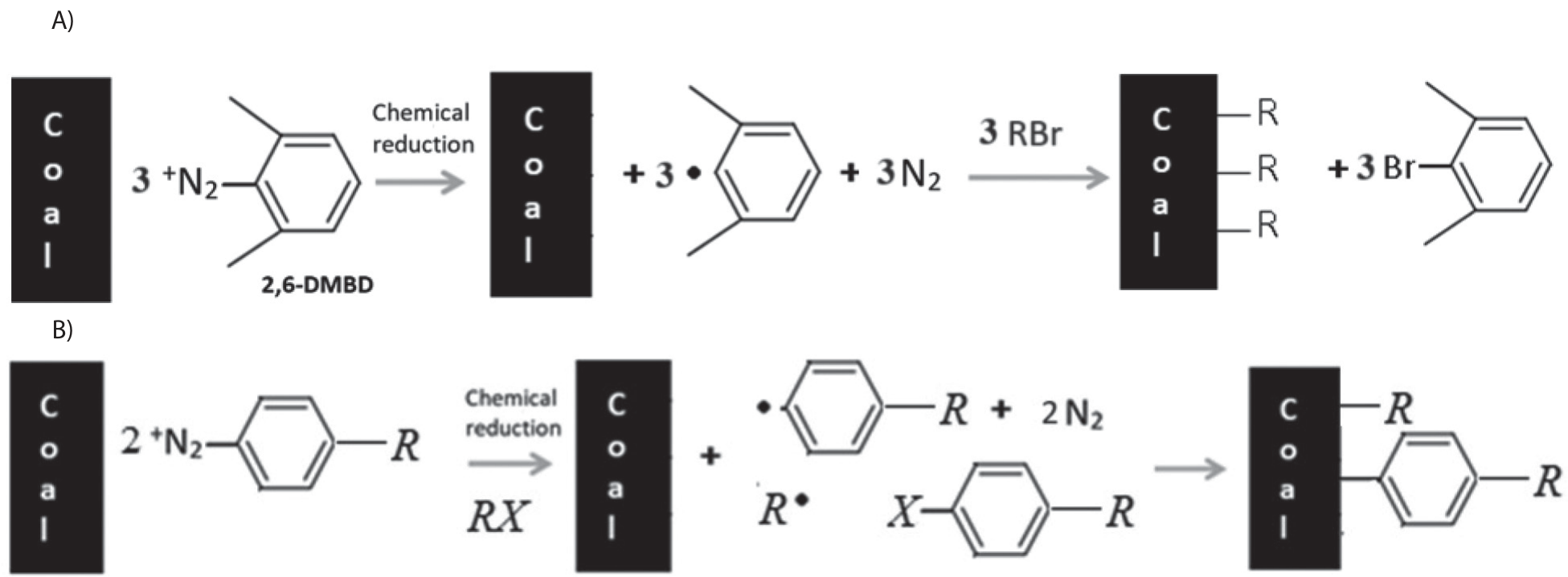
In this paper, we have tested the performance of reverse osmosis heterogeneous asymmetric membranes prepared with coal particles modified with an alkyl or mixed alkyl-aryl layer. Recently, we have shown that coal surfaces can be modified with alkyl and mixed alkyl/aryl layers [32]. We have used such a procedure to tether the coal surface that is used for the membrane preparation. A general scheme is shown below: 2,6-Dimethylbenzen diazonium salt is reduced chemically and gives 2,6-dimethylphenyl radicals, which are not attached to the coal surface due to steric effects [21], but they can remove a bromine atom and generate alkyl radicals which attach to the coal surface, Fig. 1A) [32]. When other aryl diazonium salts are reduced, the aryl radicals that are generated can attack the coal surface and bind on it and also can remove the halogen atom from the alkyl halide and create alkyl radical that is grafted on the coal surface, Fig. 1B) [23, 32].
Fig. 1.
Tethering coal surface with alkyl or mixed alkyl-aryl layer (by activation of molecules of: A) alkyl bromides with 2,6-dimethylphenyl radicals; or B) alkyl halides with other aryl radicals.
The introduction of alkyl groups onto the coal surface by use of alkyl diazonium salts instead of alkyl halides is not possible due to the very high instability of these compounds, which are immediately decomposed, liberating nitrogen and carbocation [33].
Materials and Methods
Cellulose acetate Eastman Kodak 398-3 with a degree of acetylation of 39.85% and Kosova’s coal of location Bardh i Madh (Republic of KOSOVA), namely lignite, was used for the preparation of heterogeneous asymmetric RO membranes.
Chemicals
6-bromohexanoic cid, Br-CH2(CH2)4COOH (97%), 2,6-dimethylaniline, 2,6-(CH3)2-C6H3NH2 (99%), sodium nitrite, NaNO2 (97%), 2-bromoethanoic acid, Br-CH2COOH (97%), 4-iodobutanoic acid, I-CH2(CH2)2COOH (97%), 8-bromooctanoic acid, Br-CH2(CH2)6COOH (97%), 4-nitrobenzendiazonium tetrafluoroborate, 4-NO2-C6H4N2+BF4- (97%), Mg(ClO4)2, acetone 99.8%, and hydrochloric acid 36% were purchased from Sigma Aldrich. 3,5-bis-trifluoromethylbenzenediazonium tetrafluoroborate (CF3)2C6H3BF4 and 3,5-biscarboxylic acid benzendiazonium tetrafluoroborate 3,5-(COOH)2-C6H3N2+BF4- are prepared in situ according to the procedure used elsewhere [34].
Infrared Attenuated Total Reflection Spectroscopy (ATR)
Spectra of the modified coal were recorded using a purged (low CO2, dry air) Jasco FT/IR-6100 Fourier transform IR spectrometer equipped with a germanium ATR accessory (Jasco ATRPR0470-H). For each spectrum, 1000 scans were accumulated with a spectral resolution of 4 cm-1. Note that the ATR spectra are recorded with unmodified coal as a blank, therefore they represent only the contribution of the grafted film.
Coal Modification Procedure
Coal modification is made in an aqueous acid solution by using the standard procedure that is described in detail in our recent work [32]. In brief, the coal specimens of 8.0 g, once prepared, were added to 50 cm3 aqueous solution of 0.5 M of HCl containing aryl diazonium salt and alkyl halide at a concentration of 20 mM. In order to enhance the chemical reduction, we have used potassium iodide [35] or ultrasonication. Coal surface modification procedure with different alkyl and mixed alkyl/aryl groups is presented in Table 1.
Film Casting Details
Film casting solutions contained 10% by weight of cellulose acetate (E 398-3), 15 wt.% of coal with corresponding amounts of acetone (61.3 wt.%), water (12.25 wt.%), and magnesium perchlorate (1.45 wt.%) at 24°C and ambient air (relative humidity 60%). The films were cast on a clean glass plate (22 × 38 cm) with the use of a metal cylinder with uplifted edges to obtain the required film thickness (0.12 mm). The glass plate was kept at the same temperature (24°C) as the casting solution. The casting solution temperature and the external conditions of solvent evaporation time (0 s) during film casting were the same for all series of films studied. The cast solution was immediately immersed in a gelation bath consisting of ice-cold water (0°C) for 1 h. Before the reverse osmosis experiment, the membranes were preshrunk under water at various temperatures, and initially, each film was subjected to pure water pressure treatment for 1 h at 20% higher pressure than that to be used in the reverse osmosis run (17.6 MPa). The membranes were tested in the reverse osmosis setup already described elsewhere [29].
Table 1.
Composition of coal specimens (constituents) modified with alkyl and alkyl/aryl groups.
The membrane performance data were obtained for conditions of feed concentration of sodium chloride 6.8×10⁻³ moldm-3, and a feed flow rate of 450 cm3/min was used, giving a mass transport coefficient k = 45×10-4 cm/s on the high-pressure side of the membrane. All performance data (i.e., data on solute separation and product rate) were compared at the above value of k, which was constant in all experiments.
The permeate flow rate Q (g/h) refers to the membrane-permeated solution adjusted to 25°C, and the rejection factor R (%) is defined as:
where Cp and Cf, meaning permeate and feed concentrations (mg/dm3), were measured in every test. A conductivity meter (Radiometer CDM-3) was used to assess sodium chloride concentrations.
The solute transport parameter DAM/kδ (cm/s) and the pure water permeability constant A (mol/cm2 s Pa) were measured using sodium chloride as the reference system for all films examined. Constant A was determined using the following Equation:
where PWR is product water rate (g/h), M – Molecular mass of water (g/mol H2O), S – effective membrane surface area (cm2), and P – pressure (Pa), whereas the solute transport parameter DAM/kδ was calculated from the experimental data of solute separation (f) and product rate (PR) of sodium chloride for all films tested by the following expression:
where S – effective membrane surface area (cm2), k – mass transfer coefficient on a high-pressure side of the membrane (cm/s), 3600 – time (s) and PR – product rate (g/h), and d – density of solution g/dm3.
The Scanning Eelectron Microscopy of the Membranes
The samples were dewatered by the gradual replacement of water by ethanol. Then, the membranes were placed in liquid N2 and fractured. Thin layers of graphite and gold were subsequently deposited on them in a vacuum. Micrographs were recorded by Zeiss scanning electron microscope at 20 kV.
Results and Discussion
Alkyl layer. The coal surface is tethered with alkyl groups originating from alkyl bromides and iodides during the reaction of these compounds with 2,6-DMBD in aqueous acid solution according to the described procedure in the experimental part. Coal-modified samples were rinsed under sonication with ethanol and acetone and dried at 80°C.
ATR-IR and XPS spectra for the modified coal with butanoic acid and hexanoic acid groups derived from 4-iodobutyric acid and 6-bromohexanoic acid during crossover reaction with 2,6-DMBD were shown in our previous work [32]. Here, we show the ATR-IR spectra in the region 1900-1500 cm-1 of coal modified with octanoic acid groups derived from 8-bromooctanoic acid, see Fig. 2A) and 2B). One can see the presence of large absorption bands in both spectra at about 1700 cm-1.
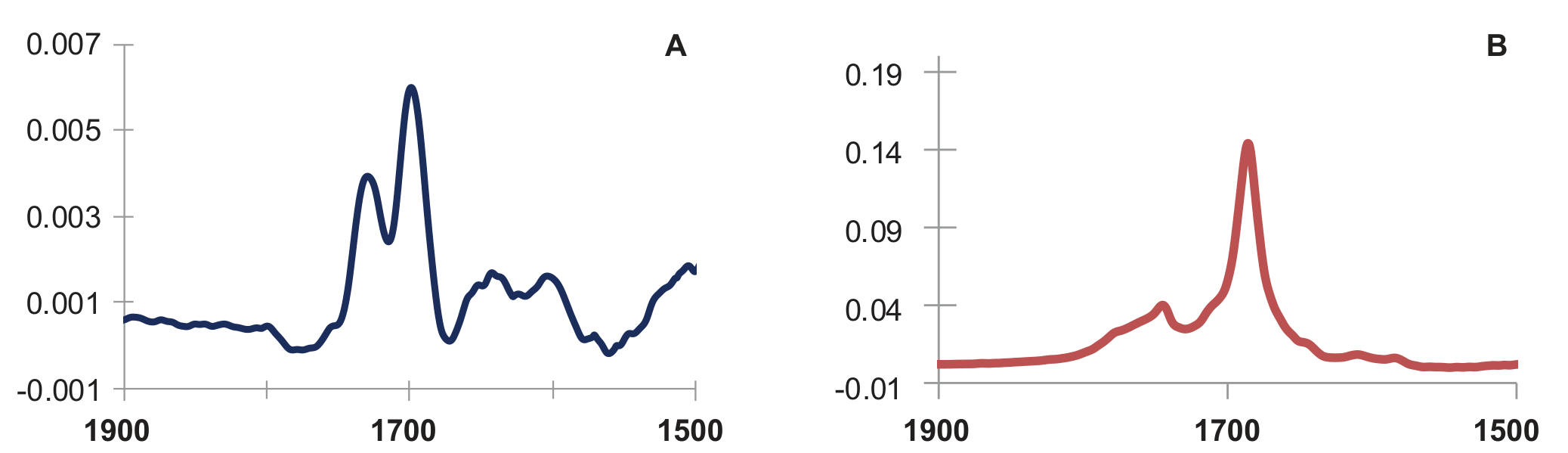
Table 2.
Reverse osmosis membranes performance CA-Coal modified with alkyl groups (Batch 319K-III) at pressure 1.763 MPa. System: NaCl–H2O; Feed cons.: 400 mg/dm3; Membrane area: 11.92 cm2; k: 450 cm3/min.
Alkyl-Aryl Mixed Layer
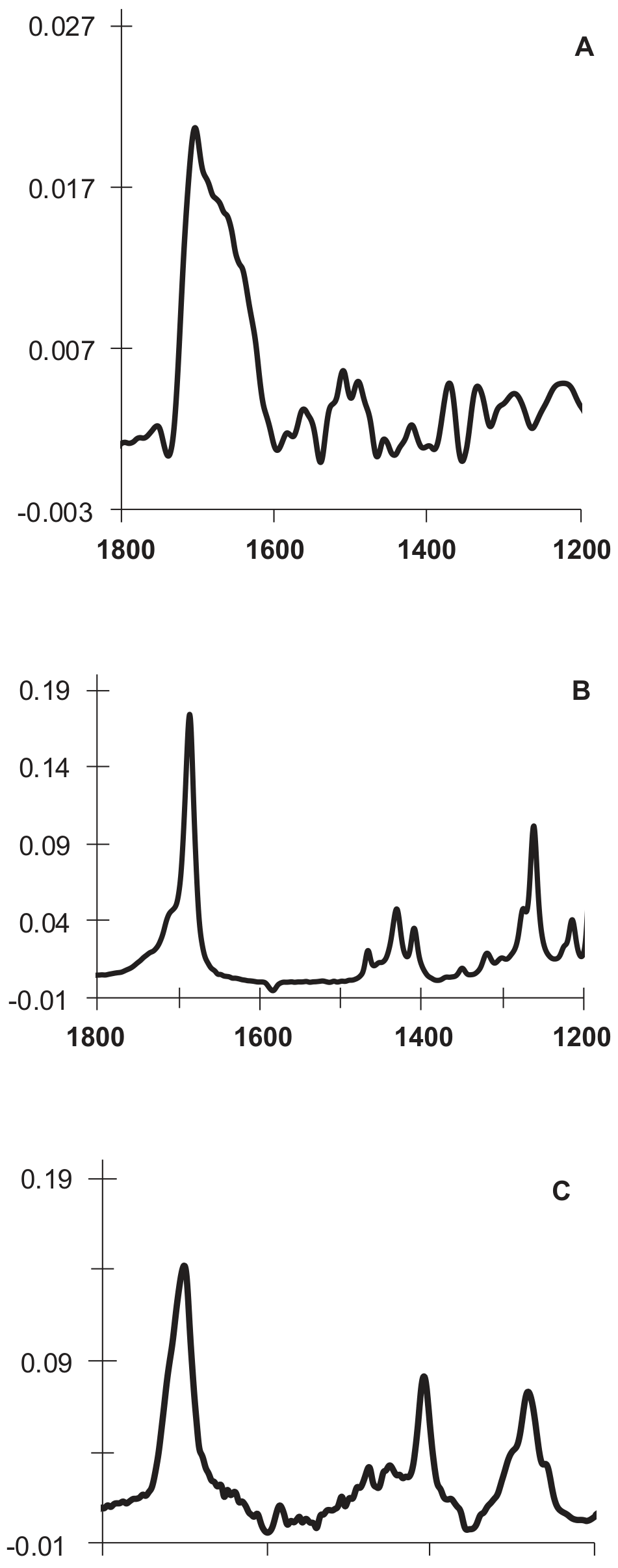
Fig. 3 gives ATR-IR spectra of coal modified with 3,5-biscarboxylic acid benzene diazonium and hexanoic acid groups derived from 6-bromohexanoic acid. One can observe a large absorption band with a peak at 1700 cm-1 due to C=O groups present in 3,5-biscarboxylic acid benzen diazonium; see for comparison the ATR IR spectrum of this compound in Fig. 3C) and a shoulder with the peak at 1680 cm-1, which is attributed to the C=O groups present in hexanoic acid groups derived from 6-bromohexanoic acid, which spectrum is shown in the Fig. 3B).
Modified coal with alkyl or alkyl/aryl layers was used as filler for the preparation of asymmetric heterogeneous reverse osmosis membranes of cellulose acetate. Experimental data of heterogeneous reverse osmosis membranes modified with alkyl groups (Batches 319K-3,) and alkyl/aryl groups (Batches 319K-III) in terms of many parameters such as pure water permeability constant A, and solute transport parameter DAM/kδ, for aqueous solution NaCl-H2O as referent system of feed concentration c = 6.8×10⁻³ mol dm-3 at 1.763 MPa are given in Table 2, and Fig. 2 and 3.
Apart from solute separation, product rate and product water rate of sodium chloride in Table 2 also presented the data of DAM/kδ. Lower values of DAM/kδ indicate a relatively smaller overage pore size, less solute transport through the membrane, and hence higher solute separation [29]. Both types of membranes showed improved performance. At 90.05% and 91.30% levels of solute separation and feed flow conditions (corresponding to e mass transfer coefficient of 45×10-4 cm/s), the productivities of membranes are 4.82×10⁻² and 4.53×10⁻² m3/h m2 respectively at 1.763 MPa.
Fig. 3.
ATR IR spectrum of: A) (3,5-bisCOOH-C6H3)+-C5H10 COOH; B) 6-Br CH2(CH2)4COOH and C) diazonium salt of 3,5-bisCOOH-C6H3N2+BF4-.
The performance correlation data of membranes (Batches 319K-0, 1, 2, 3, 4 and 319K-0, I, II, III, IV, V) are given in Fig. 4A) and 4B).
The membrane performance depends on both the average size and the effective number of pores on the membrane surface. The results presented in the lower part of the diagram in Fig. 4A) show that at given levels of solute separation, membrane productivity increases in order Batches 319K-3 > 319K-2 > 319K-1 ≈ 319K-4. Fig. 4A) also indicates the changes occurring in the effective number of pores as a result of changes in casting solution composition, modifying the composition of coal particles, respectively. The shrinkage temperature profiles and productivities of Batches 319K-2 and 319K-1 are not significantly different, indicating that the average size and effective number of pores on their surfaces are not too far different from each other. The location of these curves is shifted to the right in the direction of improved productivity, i.e., closer to the best membranes of Batch 319K-3, respectively. The initial average pore size in Batch 319K- 3 is smaller, and productivity is slightly better than that of 319K-2. These data indicate that Batch 319K- 3 initially has more pores on its surface. The Batch 319K-1 and 319K-4 type membranes have even smaller pores under their respective casting conditions, but their effective number is insufficient to give the same productivity as the Batch 319K-3 type membranes. So, from the point of view of productivity, the Batch 319K-3 type membranes emerge as the best among the three others. The performance data (product rate vs. solute separation) for a set of films CA-coal modified with aryl/alkyl groups Batches 319K-I, II, III, IV, and V type membranes along their shrinkage temperature profiles are given in Fig. 3B). The productivity of membranes increases in order 319K-V ≈ 319K-III > 319K-II > 319K-I > 319K-IV.
Fig. 4.
A) Shrinkage temperature profiles curves vs. separation of membranes from coal modified with alkyl groups (Batches 319K-0 to 4) and B) of membranes from coal modified with aryl/alkyl groups (Batches 319K-0 to 5) at 1.763 MPa.
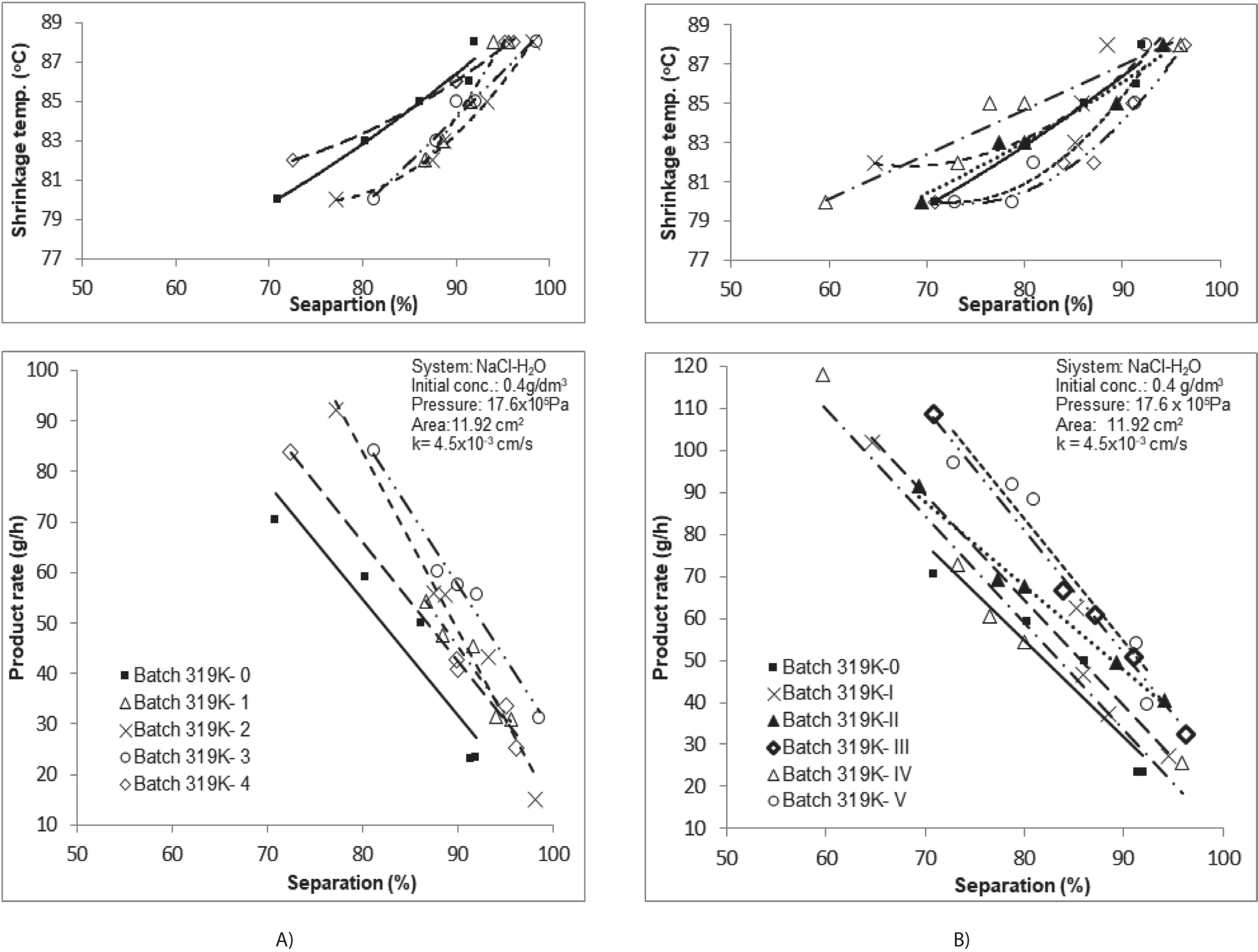
The productivity of Batches 319K-III and 319K-V type membranes is almost the same and the best among the others. The shrinkage temperature profile (i.e., correlation between shrinkage temperature and solute separation) for membranes Batch 319K-I lies above all other profiles, indicating that the initial pore size on the surface of these membranes is relatively larger and more uniform than that obtained in the other Batches of these membrane types. Therefore, it can be concluded that the composition of the casting solution with different coal modifiers creates pores of different and uniform sizes. Membrane-type Batches 319K-V and 319K-II lie below all others near the same curve, indicating that the surface pores are smaller and need to be shrunk at a lower temperature to give the same level of separation of solutes. As the composition of the casting solution differs only among modified coals and the preparation procedure is the same for all membrane types, the variation in relative porosities can only be attributed to modified coals with different organic molecules, respectively aryl/alkyl groups derived from diazonium salts, which in turn.
Compared to the best membranes from coal modified with aryl groups (Batch 319K-3) and aryl/alkyl (Batch 319K-V), respectively, their product rate and solute separation are slightly different.
Scanning Electron Microscopy (SEM) of the Membrane
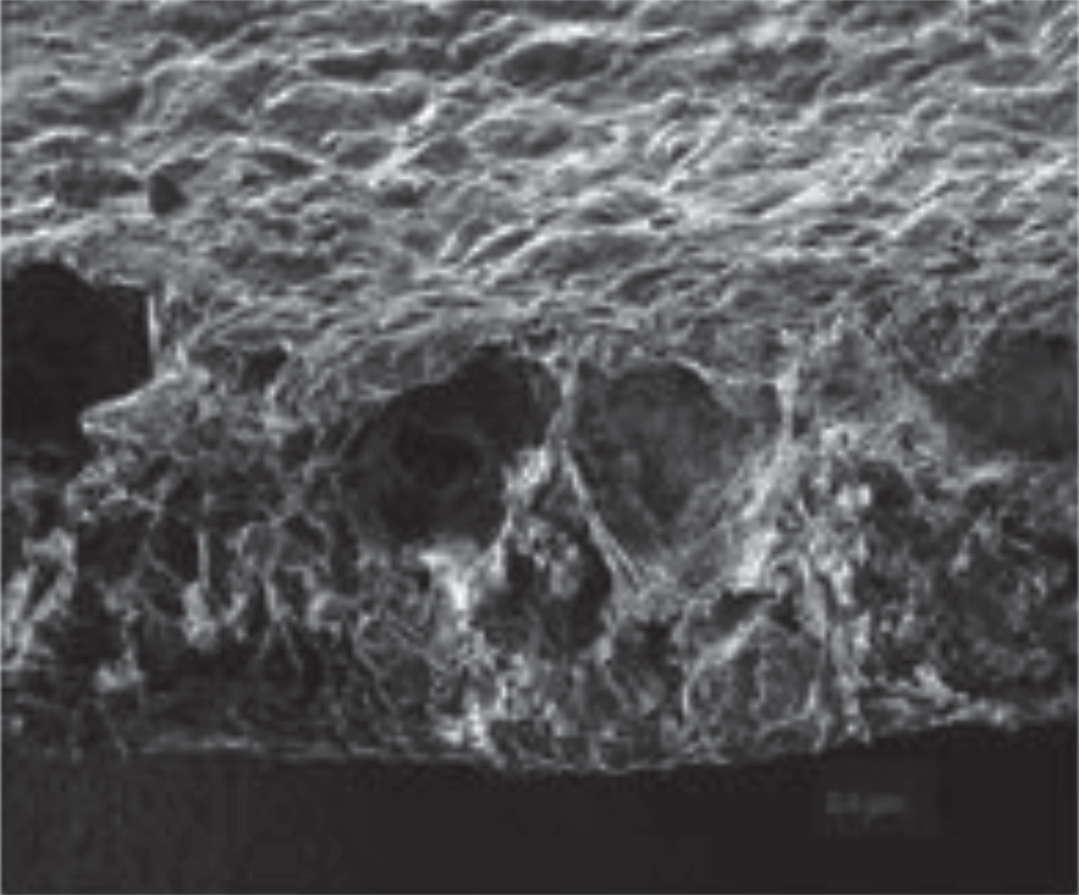
The morphology of the modified heterogeneous asymmetric reverse osmosis membrane (HAROM) was characterized by SEM. The SEM image of the best HAROM membrane type Batches 319K-V is presented in Fig. 5.
The morphology of the cellulose-coal-modified membrane shows an asymmetric (anisotropic) structure consisting of an upper skin layer on the top and a porous sublayer. Both the skin layer and porous sub-layer have identical chemical composition. This membrane exhibits irregularity of pore structure with skin layer on the top and increasing pore size in substructure from the top to the bottom surface of the membrane. The pores of this membrane are more rounded than elongated, which is identical to a membrane made with CA- modified coal with aryldiazonium salts.
From the analyzed data in this paper, the improvement of the performance of HAROM, in general, is attributed to the changes in rheology and morphology of membrane structure, and the method is becoming promising for making a more productive membrane.
Conclusions
A versatile approach to surface functionalization of cellulose acetate membranes by tethering coal with aryl and aryl/alkyl layers showed a significant impact on their performance. The best results were achieved with alkyl (Q-2.6 BMBD)+Br-hexanoic acid) and alkyl/aryl (4-NO2Ph+CH2 COOH) groups, respectively. Tethering coal particles with aryl, aryl/alkyl films containing various functional groups is considered a sustainable and effective method for membrane surface modification, enhancing their applicability in water desalination and pollutant removal. The modified membranes showed significant improvement in reverse osmosis parameters, such as increased permeability and rejection capabilities, compared to unmodified cellulose acetate membranes. They also demonstrated better performance in terms of product rate and solute separation, achieving higher flux and similar or better rejection rates for solutes. The results suggest that these modification techniques could be used to enhance the productivity of specific reverse osmosis membranes, leading to the development of membranes with improved performance for industrial applications. The research demonstrates that modifying coal particles with specific functional groups can significantly enhance the performance of reverse osmosis membranes. This approach is sustainable and widely applicable for improving water treatment and desalination processes.

