

Introduction
In the context where the environmental awareness of the public is enhanced, the environmental performance of enterprises receives increasing attention from interested parties. In 2021, the China Securities Regulatory Commission (CSRC) issued a new version of criteria concerning both content and the format of the annual report. It is explicitly stipulated that all listed companies must disclose administrative penalties executed for their environmental problems [1]. Corporate environmental violations signify that an enterprise violates laws and regulations on environmental protection in the process of production and management, bringing about adverse effects such as environmental pollution, ecological damages, and health hazards and imposing an unfavorable influence on economic growth. Under the current background of eco-environmental protection in grave difficulties, investigating how to control corporate environmental violations has great significance in protecting the eco-environment and promoting sustainable development [2-3].
As one of the important approaches to implementing green transformation in enterprises, green finance is aimed at promoting environmental protection and sustainable development by financial means. It consists of green bonds, green securities, green loans, and green funds [3] By providing investment in economic transformation, green finance can popularize the use of clean energy and boost the development of environmentally friendly technology. Moreover, the inhibitory effects of green finance on corporate environmental violations are embodied in the following aspects [4]. First, green finance encourages enterprises to establish sound environmental protection management systems, including specifications on environmental risk assessment, environmental impact evaluation, and environmental monitoring and statement, etc. In this way, it is expected to reduce corporate environmental violations [5]. Second, green finance provides environment-friendly financial products and services, so as to encourage enterprises to raise their investment in and expenditures for environmental protection, put more efforts into environmental technology transformation, energy conservation and emission reduction and environmental governance, as well as lower pollutant discharge and resource consumptions [6]. As a result, both the risk and frequency of environmental violations can be reduced [7].
Domestic and overseas scholars probe into influencing factors on corporate environmental behavior from perspectives of the internal institutional cultural construction of enterprises and external supervision. In terms of internal systems, the impacts of the nature of property rights on corporate environmental behavior were explored specifically for listed companies in China’s five major polluting sectors from 2016 to 2019, pointing out that state-owned enterprises take more initiative to perform environmental protection actions than private enterprises do [8]. Besides, Khan et al. (2017) investigated the strong threshold effects of corporate ownership diversification on the environment, and they found that raising nationalization levels is not the main path for any industry to enhance their environmental awareness [9]. In another piece of literature, environmental awareness enhancement was proven to increase energy utilization efficiency and promote sustainable development capability in enterprises [10]. From the other perspective of external supervision on enterprises, the influential Porter hypothesis was put forward through a case study [11]. According to this hypothesis, rigorous and appropriate environmental stipulations result in high productivity based on innovation incentives, efficiency improvement, and reallocation in enterprises, etc. Although Porter hypothesis gains favor with many scholars, it’s still worth noting that corporate environmental behavior is under the insignificant influence of social factors in the opinions of some experts for the following reasons [12-14]. Administrative means not only play a positive role but also exert dramatically negative impacts. An enterprise may get involved in financial difficulties due to administrative penalties, which affect its operation and growth [15]. Therefore, such enterprises select not to fully publicize environmental information if not necessary. In this context, information asymmetry between both parties takes form, and social supervision effects can be thus alleviated [11, 16].
Green finance is an external direct economic incentive. By providing green financial products and services, it encourages enterprises to carry out environmentally friendly businesses and projects, so as to enhance their environmental awareness and raise their green investment [17]. In the current academic circle, factors that affect corporate environmental violations have been investigated from various perspectives in the existing literature [18]. Despite that, unfortunately, the influence of green finance on corporate environmental violations is seldom explored. Regarding a few empirical studies on green finance, there may also exist certain defects in index measurement irrationality and endogeneity, etc. In June 2017, the State Council of the People’s Republic of China designated Guangdong, Zhejiang, Jiangxi, Guizhou, and Xinjiang as the first batch of green finance reform and innovation pilot zones; and Gansu was approved to be another pilot zone of green finance reform and innovation in 2019. This provides a preferable quasi-experimental design for this study [19]. On this basis, a dual model was built to investigate the impacts of green finance on corporate environmental violations and the corresponding potential mechanisms.
To be specific, a panel data set was acquired from A-share1 listed heavy-polluting enterprises in 2003-2019, and then used as samples for this research. Depending on the quasi-experimental design of green finance reform and innovation pilot zones (hereinafter referred to as green finance2), a dual difference method was utilized to empirically verify how green finance affects corporate environmental violations on one hand, and further explores the corresponding influencing mechanisms in detail.
The main marginal contributions of this study can be elaborated on in the following three aspects. First, this paper verifies that green finance policies have the effect of maintaining the bottom line of environmental protection. This concerns not only green finance, but also the literature on environmental regulation has been widely demonstrated to have positive effects, such as promoting energy conservation and emission reduction, facilitating technological innovation and efficiency enhancement in firms, and so on [17-19]. However, these positive effects do not necessarily mean that environmental violations are reduced. Strict environmental regulations may also lead to more negative behavior by some firms [20]. The “symmetry” of environmental protection is reflected in its two sides: on the one hand, the implementation of environmental policies has led to green innovation and efficiency improvement; on the other hand, we should not ignore the research on curbing environmental violations. Environmental non-compliance is the bottom line of environmental protection, especially at this time of change, when many firms are not always concerned with high-quality development, but are seeking ways to maintain normal development in the midst of change. This paper demonstrates that external green finance policies can incentivize firms to reduce environmental violations, rather than relying solely on firms’ initiatives.
Then, based on the theory of environmental legitimacy, this paper explores the potential mechanisms and boundary conditions under which green finance policies incentivize firms to reduce environmental violations. On the one hand, environmental violations are a more direct and objective measure of environmental legitimacy than innovation compensation and efficiency gains. Therefore, in terms of theoretical contributions, this paper provides newer and more direct evidence in support of environmental legitimacy theory based on green finance policies. On the other hand, the exploration of potential mechanisms and boundary conditions helps us to understand the logic and rationality of green finance policies, based on which this paper puts forward targeted policy recommendations, which can help further promote and improve green finance policies and is of great significance to the global promotion of green finance.
At last, green finance is selected as a quasi-experimental design here to construct a dual difference model for assessment of its effects. In comparison with the existing literature where green finance development indexes are established, the method adopted in this paper can avoid endogenous problems arising between the variables of green finance and corporate environmental violations, so that “noise” in empirical study can be eliminated.
Institutional Background and Theoretical Mechanism
Institutional Background
Data published in 2021 by the environmental protection department show that about 30% of enterprises in China commit environmental violations each year. This signifies that China still faces serious challenges in environmental protection and restricting corporate environmental violations [20-22]. As far back as the early and middle 1990s, the Environmental Protection Law of the People’s Republic of China was issued by the Chinese government. It is stipulated in the Law that an environmental department has the right to impose administrative penalties against environmental violations committed by an enterprise [23]. From late 1990 to 2010, a series of punitive measures were taken in China to deal with corporate environmental violations, such as a monetary penalty system for environmental protection, environmental protection taxation, and accountability for environmental pollution. Without a doubt, administrative means may work in a short time and also produce dramatic negative impacts [24]. For example, an enterprise may be trapped in financial distress because of administrative penalties, so as to adversely affect its operation and development.
After 2010, the environmental protection acts of the Chinese government began to resort to a transformation from administrative means to market means [25]. The Guidance on Promoting Green Finance Development was formally issued in December 2016. It is aimed at boosting economic restructuring and upgrading without discouraging enterprises’ enthusiasm about green finance, and facilitating coordinated development of economy and environmental protection [26]. However, advances in China’s green finance are still confronted with some obstacles. First is insufficient policy support. Although a series of policies and measures supporting green loan development have been published at national and regional levels, they fail to be thoroughly implemented. In addition, there are also some other problems such as unstable capital sources and inadequate incentives [27]. Second is information intransparency. At present, it is difficult for financial institutions to comprehensively and profoundly learn about information relating to green projects due to a lack of information transparency, and for the same reason, investors also have certain difficulties in gaining knowledge about relevant risks and benefits [28]. Third is a high demand matching difficulty. The majority of green projects belong to middle and small-sized enterprises, with decentralized financing needs and small financing scales. Regarding large financial institutions such as banks, their credit approval procedures and management, etc. are comparatively more tedious, which makes them less likely to meet the demands of middle and small-sized enterprises [29].
In June 2017, the State Council decided to build the first batch of green finance reform and innovation pilot zones, incorporating Guangdong, Zhejiang, Jiangxi, Guizhou, and Xinjiang. In 2019, Gansu was approved to join them. Moreover, green finance reform and innovation pilot zones are special areas built in China with the aim of accelerating green finance development and exploring ways to combine green finance innovation with institutional reform. The concrete content and characteristics of the pilot zones are as follows: ① Coverage of each pilot zone should be designed by the top level of the Chinese government. They are comprehensively distributed in Eastern, Middle, and Western China, where economic development levels are different [30]. ② The market-oriented green finance market can operate effectively. In pilot zones, financial institutions need to perform green finance product and service innovations, actively promote advances in green loans, green bonds, green insurance, and the carbon market, etc., and boost cooperation and exchanges among green finance markets at all levels [9-10]. ③ In-depth integration of green finance and real economy should be further promoted. Enterprises in pilot zones are encouraged to develop green industries, reinforce in-depth integration between green finance and real economy, and carry forward both ecological civilization construction and sustainable development [20].
As green finance construction further advances, green finance policy systems in provinces or cities in which pilot zones are situated should be improved gradually, making sure that the green finance market rapidly progresses [31]. According to statistics, the green loan balance reached RMB 236.83 billion in pilot zones by the end of 2020, representing a proportion of 15.1% of the total loan balance and 4.3 percent higher than the national average loan balance. The balance of green bonds was up to RMB 135.0 billion, increasing by 66% on a year-on-year basis3. This manifests rapid pilot zone development from the perspectives of green loans and green bonds on one hand, and on the other, it is also indicated that important financing channels can be thus provided for green technology innovation, green transformation, and upgrading in microenterprises [32].
Theoretical Mechanism
According to the Legitimacy Theory of political sociology, corporate environmental behavior is under the influence of surrounding social and political environments [6]. The greater the expected value of social and political environments, the higher the probability for an enterprise to observe relevant environmental stipulations. On one hand, green finance has the potential to improve environmental information disclosure mechanisms, assist heavy-polluting enterprises in realizing green transformation, enhance environmental awareness, and improve the environmental liability senses of enterprises by reinforcing a credit rating system for environmental protection [33]. On the other hand, green finance is capable of establishing a green incentive mechanism, formulating preferential policies for enterprises that conform to green standards and encouraging enterprises to take more environmental protection actions [34]. Considering this, it is believed in this paper that the policy of green finance reform and innovation pilot zones is able to inhibit corporate environmental violations internally and externally for the following reasons:
As stipulated in an environmental protection management system, an enterprise needs to protect the environment, abide by laws and regulations on environmental protection, and standardize its environmental behavior [18]. It is composed of an environmental management hierarchy, environmental protection accountability, environmental protection institutions, environmental monitoring and assessment, and environmental emergency plans. As the basis for environmental protection work in an enterprise, the environmental protection management system should be continuously improved and implemented to effectively inhibit corporate environmental violations [6, 13]. By bettering the environmental protection management system, green finance succeeds in suppressing environmental violations in enterprises, which is mainly embodied in the following aspects: (1) Information disclosure and information transparency in enterprises are highlighted. Green finance requires enterprises to standardize environmental information disclosure and publicize their environment-related information, which urges enterprises to attach more importance to environmental issues and reinforce their internal management and supervision. Additionally, the disclosed environmental information can facilitate external supervision and supervision by public opinion, so that environmental violations in enterprises can be more effectively inhibited [27]. (2) Green finance raises society’s expectations of environmental legitimacy and promotes the popularization of environmental protection philosophy. The formation of such an environmental protection consensus may further strengthen corporate environmental awareness, enabling the management layer and employees to pay more attention to their environmental legitimacy. In this way, not only are environmental protection measures implemented, but it is also beneficial for enterprises to build a good social image, form a corporate culture of environmental protection, and improve and carry on environmental protection systems [5]. (3) Green finance boosts the formation of a good environmental protection atmosphere in different sectors. Improvements in enterprises’ environmental protection behavior and management levels contribute to sustainable development in enterprises and the environmental protection cause in the whole society. Furthermore, enterprises with environmental behavior win resource support from society and also win their competitors who imitate and learn from them. Through mutual learning and exchanges about environmental protection, environmental protection enterprises share their experiences and techniques in environmental protection. As a result, the overall environmental protection level in the corresponding industry can be raised, which urges enterprises to improve their own environmental protection systems and fulfill their social responsibilities better [3, 16]. Therefore, this paper proposes Hypothesis 1.
Hypothesis 1: Green finance restricts corporate environmental violations by promoting improvements in the environmental protection management systems of enterprises.
Expenditures for environmental protection in an enterprise play an effective role in suppressing corporate environmental violations [24]. On one hand, such expenditures are provided by enterprises to protect the environment and reduce environmental pollution, including those for pollutant treatment and recycling, factory/park greening, and environmental restoration [35]. On the other hand, expenditures for environmental protection help the corresponding enterprise gain more support from green finance and acquire continuous economic incentives. In this way, the cost incurred by environmental protection and governance can be lowered in the enterprise to form a virtuous cycle. Green finance imposes an inhibitory effect on corporate environmental violations by raising their expenses on environmental protection, which is mainly reflected in the following three aspects. First, a green incentive system is established to provide more environmental protection and governance subsidies. Thanks to a green loan mechanism, green finance directs funds to flow towards environmental protection fields and provides enterprises that meet environmental protection standards with more preferential loan rates and more flexible repayment modes, so as to encourage the enterprises to invest more in environmental protection [39]. Second, a punishment mechanism is set up against environmental violations, forcing enterprises to reduce their acts to the prejudice of environmental protection. By strengthening financing constraints over enterprises conducting environmental violations, canceling their credit ratings and creating a blacklist, etc., green finance urges enterprises to raise their investment in environmental protection and effectively curb the occurrence of environmental violations [3]. Finally, green finance reinforces environmental information disclosure in enterprises and alleviates environmental information asymmetry between the enterprise and the public. To meet the requirements of environmental protection legitimacy, an enterprise must increase its expenditures for environmental protection, reduce environmental pollution and adverse impacts on the environment, and develop a trusting relationship with society [23]. Therefore, this paper proposes Hypothesis 1.
Hypothesis 1: Green finance requires enterprises to increase their expenses on environmental protection, so as to inhibit their environmental violations.
Research Design
Model Building
To relieve endogenous problems, a dual difference model was utilized in this study to estimate the effects produced by the green finance reform and innovation pilot zone policy. The model is built as follows:
Where,
Variable Definitions
Explanatory Variables: Green Finance Reform And Innovation Pilot Zones
Time×Treat: The present study selects a dual difference model to measure green finance reform and innovation pilot zones. Specifically speaking, a dummy variable known as Time was set up to represent the time of designating a pilot zone. If it is designated in 2017 and afterwards, 1 is assigned to Time; otherwise, it is 0. In addition, another dummy variable, Treat, was also designed to represent the place where the designated pilot zone was located. If an enterprise is registered in a province in which the pilot zone is situated, 1 is assigned to Treat, otherwise, it is equal to 0. To eliminate interferences from data produced by Gansu province approved to be a pilot zone in 2019, samples associated with Gansu are all removed here.
Therefore, the result of Time×Treat is 1 only when the corresponding sample is an enterprise in a province of the pilot zone in 2018 and afterwards. In this way, it is capable of accurately measuring the green finance reform and innovation pilot zones.
Explained Variables: Corporate Environmental Violations
Ln(1+pollution): The total number of years when records of environmental violations are made in heavy-polluting enterprises and their affiliated firms was selected for the corresponding measurement in this study. Considering that the number of environmental violations is a counting variable, the total number of years plus 1 experienced logarithmic processing.
Samples And Data
Initial samples of this study are A-shared listed heavy-polluting enterprises on the Shanghai and Shenzhen Stock Exchanges from 2010 to 2019. By referring to relevant research achievements and observing the Industry Classification Management Catalogue for Environmental Protection Inspections in Listed Enterprises issued in 2008 by the Chinese government, heavy-polluting sectors were identified here through a comparison with a 2012 version of industry classification released by the China Securities Regulatory Commission (CSRC) [36]. If a listed enterprise falls into the category of heavy-polluting industry, it is deemed a heavy-polluting enterprise. However, the present study still has some limitations, especially where the data selected is collected from IPE, losing validity in 2019.
Table 1.
Definition of control variables
Furthermore, samples were selected by following the steps below: (1) Eliminating ST and *ST enterprises;
(2) eliminating enterprises with the time to market at 1 year and below; (3) eliminating enterprises with the asset-liability ratio greater than 1; and (4) eliminating enterprises with missing data about environmental violations. Eventually, 871 listed enterprises were adopted for this study, involving 6,278 observed values in total.
Based on the selected samples, their financial data were collected from the China Stock Market Accounting Research (CSMAR) database. Regarding other data about their environmental violations, they were provided by the Institute of Public and Environmental Affairs (IPE). Besides, economic data at a provincial level were acquired from the China Statistical Yearbook.
Empirical Analyses
Descriptive Statistics
Table 2 presents the descriptive statistical results of the main variables. Annually, the frequencies of corporate environmental violations average 0.116, and the minimum and maximum frequencies are found to be 0 and 20, respectively, on an annual basis. This indicates that the number of corporate environmental violations is comparatively high overall. The standard deviation of the samples is calculated to be 0.694, which shows a large fluctuation in the frequencies of corporate environmental violations and proves that great differences lie in such frequencies among different enterprises4. Therefore, this study adds 1 to the data about environmental violations and then takes the logarithm of their results. As for other variables, they are listed in the table below.
Benchmark Regression
Dynamic Effect Inspection
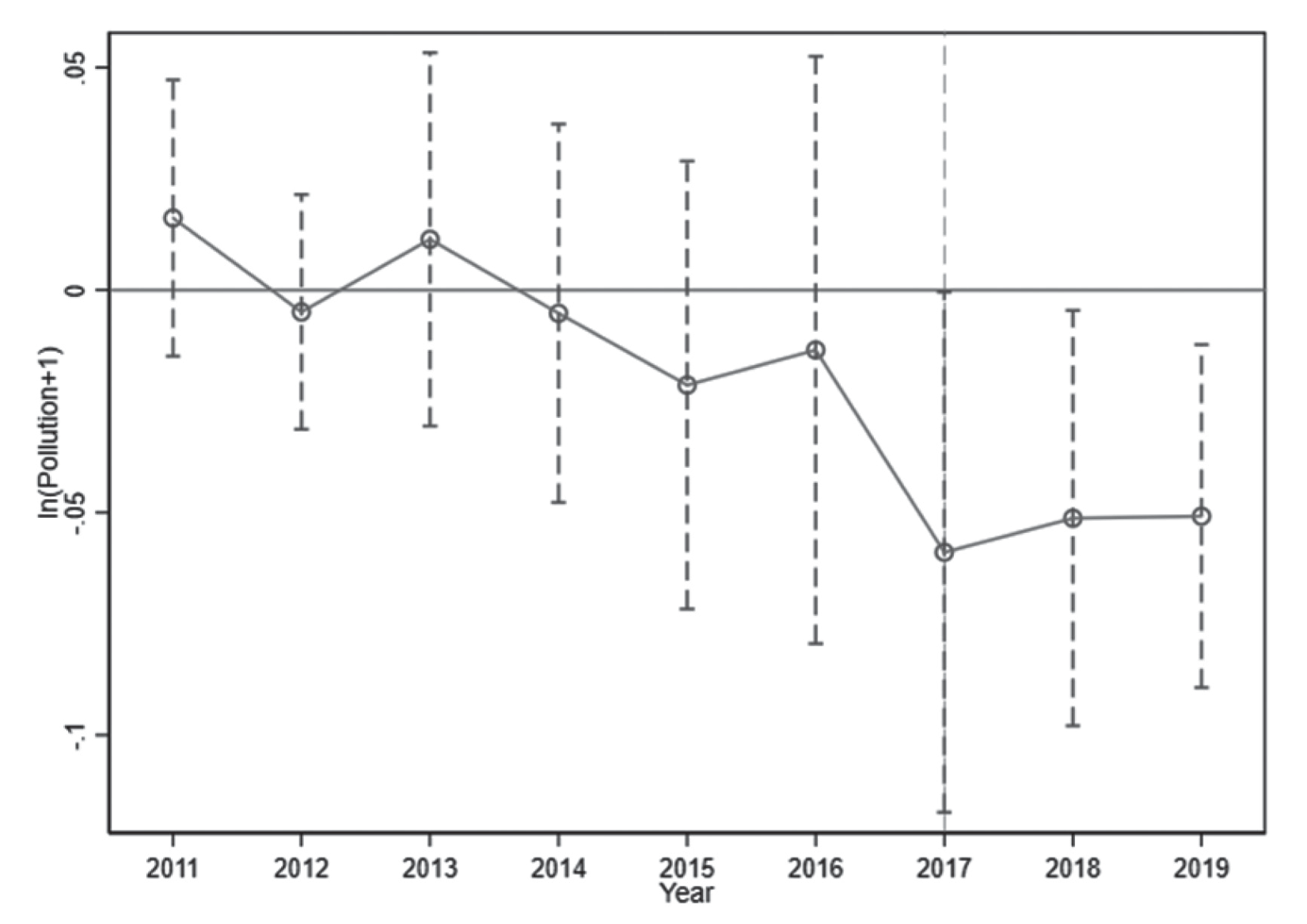
To ensure consistency of results estimated based on the dual difference model, both treatment and control groups underwent parallel trends tests. Independent of impacts from the green finance reform and innovation pilot zone policy, corporate environmental violation variation trends remain consistent in zones of treatment and control groups. This study uses the Event Study Approach[17] for reference to empirically inspect the dynamic effects of the above pilot zone policy and also construct a model as follows:
Figure 1 depicts dynamic effects, where hollow dots represent regression coefficients and dotted line segments refer to 90% confidence intervals. As shown in this figure, regression coefficients were around 0 before 2017, and the corresponding confidence intervals cover 0. This signifies that no significant interaction terms exist before the pilot zone policy is released. In other words, treatment and control groups had no obvious differences prior to the implementation of this policy, which satisfies the parallel trends hypothesis [19]. In 2017 and afterwards, regression coefficients are significantly negative, implying that the pilot zone policy takes effect.
Table 2.
Descriptive statistics
Benchmark Regression Results
Benchmark regression results are summarized in Table 3. Column (1) of the table reports regression results that are obtained by excluding control variables, but controlling the fixed effects of the year and the individuals. The interaction term Time×Treat produces a regression coefficient of -0.054, which satisfies the 1% level of significance. Column (2) includes control variables. In this case, the regression coefficient of Time×Treat turns into -0.052, and it also meets the 1% level of significance. Moreover, their regression results remain basically unchanged. Considering this, the green finance reform and innovation pilot zone policy is believed to form a significant correlation with corporate environmental violations. Thanks to the implementation of this policy, the environmental violations of heavy-polluting enterprises are reduced by 0.699(e-0.054-1) per year.
A possible reason why the green finance reform and innovation pilot zone policy can significantly inhibit corporate environmental violations is that green finance urges heavy-polluting enterprises to improve their environmental management systems, increase their investments in environmental protection, and thus reduce the frequency of their environmental violations [15].
Heterogeneity Analyses
Enterprises in Eastern, Middle, and Western China
Among the samples of listed companies selected for this study, statistical regression is made for enterprises in Eastern, Middle, and Western China. While Column (1) of Table 4 presents the regression results of enterprises in Eastern China, Column (2) describes those in the Midwest of China. According to these regression results, the coefficient value of the interaction term Time×Treat is -0.068 as far as the influence of green finance reform and innovation pilot zone policy on enterprises in eastern China is concerned, which satisfies the 1% level of significance. Regarding enterprises in the Midwest of China, Time×Treat has a coefficient value of -0.019 that fails the test of 10% level of significance. This indicates that green finance has a more significant influence on enterprises in Eastern China.
Corresponding reasons can be elaborated on as follows. On one hand, regions in eastern China are more developed and possess a stronger concept of environmental protection. An enterprise intending to invest may lay more emphasis on its social appraisal and environmental risks. Therefore, enterprises in Eastern China have to attach greater importance to environmental protection and environmental protection expenses. On the other hand, there are differences in administrative environmental protection management between Eastern, Middle, and Western China. In the east of China, environmental issues are incorporated into their administrative assessment criteria earlier, which means that the local government in different places of Eastern China raise more rigorous requirements for environmental protection among enterprises [7, 15].
Table 3.
Benchmark regression results
Enterprise Scale
Based on specific sizes of total assets in the involved enterprises, they were divided into two groups of small and large scales for respective inspections, the results are shown in Table 5. Relevant regression results for small and large enterprises are presented in Columns (1) and (2), respectively. These results demonstrate that the interaction term Time×Treat expressing the influence of green finance reform and innovation pilot zone policy on small-sized enterprises obtains a coefficient value of -0.049, and for large-sized enterprises, the coefficient value of this interaction term turns out to be -0.058. Both of them satisfy the 1% level of significance, which signifies that the influence of green finance on large-sized enterprises is more significant.
Two possible reasons for the above results can be described as follows. First, large-sized enterprises outperform those of small scale in credit quality and project guarantees, so green finance provides such large-sized enterprises with more environmental protective incentives. Second, large-sized enterprises are more eager to realize their sustainable development and green transformation, which leads to more active responses to the government policy of green finance [20].
Management Shareholding
Finally, the heterogeneity of management shareholding conditions in enterprises is analyzed. Column (1) in Table 6 shows the regression results of enterprises where the management holds minorities of shares, while the regression results of enterprises with the management holding majorities of shares are listed in Column (2). As can be observed from these results, the influence of green finance reform and innovation pilot zone policy on small-sized enterprises enables the corresponding interaction term Time×Treat to obtain a coefficient value of -0.033. Regarding large-sized enterprises, the coefficient value of their interaction term Time×Treat is figured out to be -0.052. Both of them pass the test of the 5% level of significance, which manifests that green finance places a more significant influence on enterprises with the management holding more shares.
Concerning the above results, there are two possible reasons. First, an enterprise whose management holds more shares tends to be more concerned about its long-term growth, its social responsibilities, and its environmental protection behavior. Second, an enterprise where the management holds minorities of shares generally focuses on short-term benefits and financial performance, so it puts comparatively smaller investment in environmental protection [40].
Robustness Check
Placebo Test
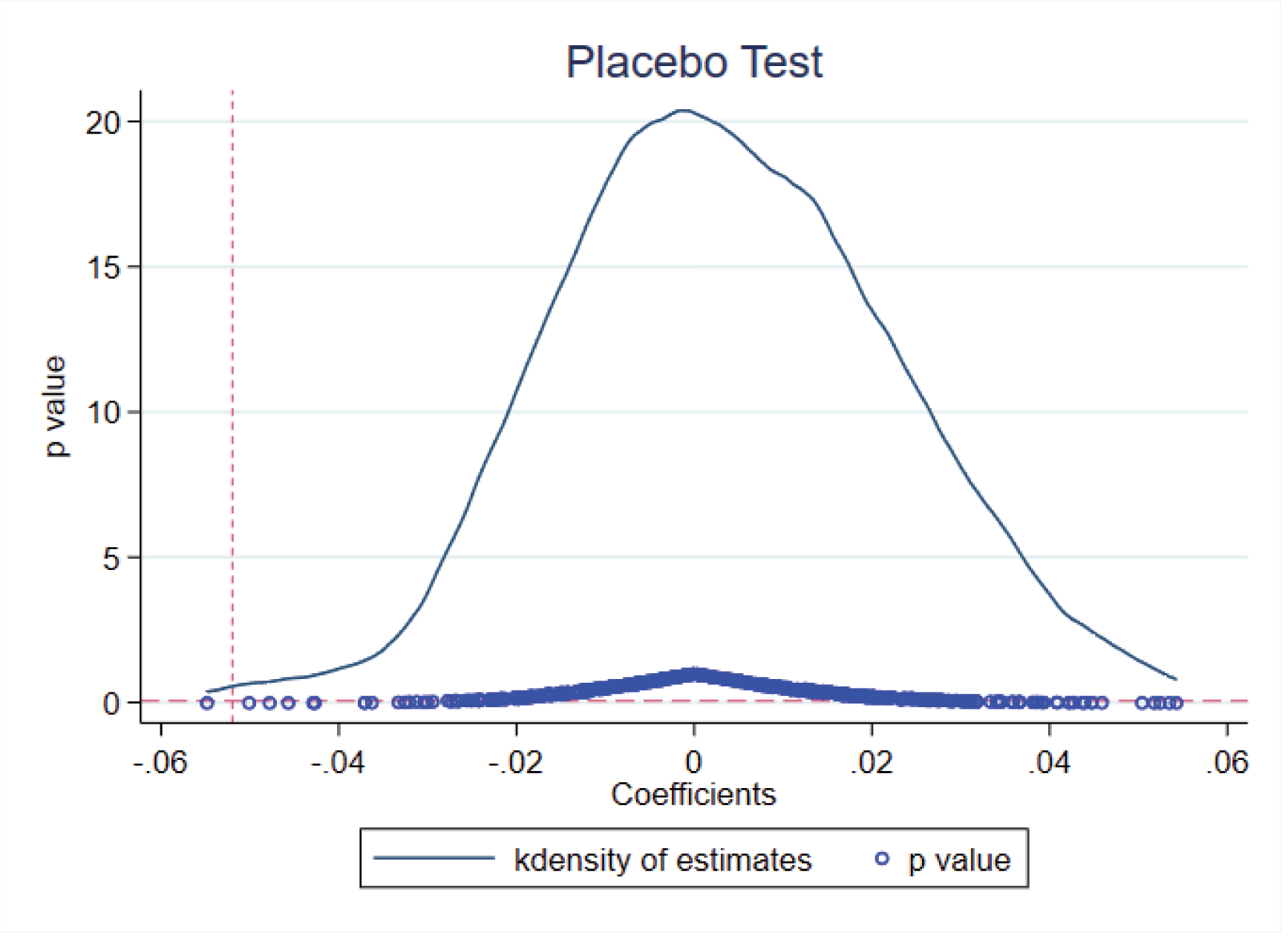
Errors in estimated results may be attributed to missing variables at individual-time levels. To remove the influence of potential unobservable factors, placebo tests are conducted in this study. Particularly, samples were randomly selected from the experimental group, and the selected samples served as a “pseudo-treatment group”. Considering that the “pseudo-treatment group” is randomly formed and suffers no impacts from the policy in practice, its dummy variable coefficients of the policy should be close to 0; that is, dummy variables of the policy apply no obvious influences on explained variables. In this paper, 500 placebo tests were repeatedly performed to raise their credibility.
A placebo test curve is depicted in Figure 2. Blue hollow dots stand for specific values of regression coefficients, the solid line for sampling kernel density, vertical lines at the horizontal axis for regression coefficients adopted in this study [see Column (2) of the table], and horizontal lines at the vertical axis for a 0.1 level of significance. As can be observed from this figure, the kernel density curve is roughly in normal distribution, reflecting that random sampling standards are satisfied here. Besides, the kernel density curve reaches its peak around 0, which manifests that most participants in the “pseudo-treatment group” fail to realize the policy effect described in this study [6]. At last, the practical regression results of the present study are actually outliers, pointing out that almost no impacts of unobservable factors can be found.
Table 5.
Heterogeneity of firm size
| (1) | (2) | |
|---|---|---|
| Small scale | Large scale | |
| Time×Treat | -0.049** | -0.058*** |
| (0.022) | (0.021) | |
| _cons | 0.163 | 0.893* |
| (0.446) | (0.497) | |
| Controls | Yes | Yes |
| Year FE | Yes | Yes |
| Id FE | Yes | Yes |
| N | 3095 | 3106 |
| R2 | 0.273 | 0.323 |
DID With Multiple Time Periods
Based on DID with multiple time periods, time dimensions are introduced in the conventional DID framework, and observed values of multiple time periods are deemed the panel data for analyses.
Because Gansu was incorporated in 2019, it was eliminated in previous sections of this study. However, a new model of DID with multiple time periods was built here considering that specific circumstances in Gansu province may affect estimation results. If DID for enterprises in the first five provinces described above is 1 after 2017, that for enterprises in Gansu should also be 1 in 2019. As for other enterprises, their DID are all 0. Corresponding regression results are listed in Column (1), Table 7. Clearly, the interaction term Time×Treat has a coefficient value of -0.053, satisfying the 1% level of significance. Hence, the conclusions made in this study are believed to be robust.
PSM-DID Model
In essence, the policy in practice is a non-randomized study design (also known as a quasi-experimental design). A policy is usually formulated with certain inclinations, which may affect experimental group selection and lead to significant differences between experimental and control groups. Propensity Score Matching (PSM) is capable of matching respective samples in the treatment group well with a specific sample of the control group, making the quasi-experimental design similar to a random experiment. Therefore, PSM is selected to carry out sample selection and matching in this paper, expecting to eliminate interference factors in experimental group selection [37].
To be concrete, all the control variables selected for this study are concomitant variables in the first place. Secondly, propensity scores were figured out here to fulfill matching by means of the nearest neighbor 1:4 matching. At last, samples matched experience DID-based regression. As given in Column (2) of Table 7, 3,926 observed values are adopted for PSM in total. It is proven that regression results from the influence of green finance on corporate environmental violations still satisfy the 1% level of significance. Therefore, the conclusions made in this paper are considered robust.
Control over Transforming Environmental Expenses into Taxes
The Environmental Protection Tax Law of the People’s Republic of China was approved at the 24th Session of the Standing Committee of the National People’s Congress in 2016, and was formally implemented on December 29 of the same year. According to the Law, tax is levied on pollutant discharge behavior and used for environmental protection. Promulgation and implementation of the Law have significance for encouraging enterprises to reduce emissions, improving environmental quality, and facilitating coordinated development between environmental protection and economic growth.
Table 7.
Robustness test
Table 8.
Environmental protection management system
| (1)E | (2)ESG | |
|---|---|---|
| Time×Treat | 0.725** | 1.817** |
| (0.287) | (0.808) | |
| _cons | -15.688*** | -66.597*** |
| (5.611) | (15.909) | |
| Controls | Yes | Yes |
| Year FE | Yes | Yes |
| Id FE | Yes | Yes |
| N | 6278 | 6278 |
| R2 | 0.522 | 0.572 |
Under the circumstance that the 2016 Law may have a certain impact on research findings here, we check whether the involved enterprises have paid environmental taxes according to the statement of “Tax Payable”. If they are paid, it is denoted as 1; otherwise, it is 0. Then, this term is incorporated as a control variable in the regression model, as presented in Column (3), Table 7. Relevant outcomes show that the interaction term Time×Treat has a coefficient value of -0.052, satisfying the 1% level of significance. Therefore, the conclusions of this paper are robust.
Replacement of the Regression Model and Measures
To ensure robustness of estimation results, both the regression model and measures are substituted in this study. Based on the alternate model, negative binomial regression of panel data was carried out in this section to fulfill regression of initial values, so as to further ensure model robustness. In Column (4) of Table 7, it is clear that the interaction term Time×Treat has a coefficient value of -0.611, which satisfies the 5% level of significance and proves that the green finance reform and innovation pilot zone policy exerts significant inhibitory effects on corporate environmental violations [38].
In terms of measure replacement, variables in a range of 0-1 were generated in this section based on whether an enterprise conducts any environmental violations. If it is, the variable is set at 1, otherwise, it is 0. Logit regression results for panel data are listed in Column (5) of Table 7, where the coefficient value of Time×Treat is -0.935 and satisfies the 1% level of significance. Without a doubt, the conclusions of this study are proven to be robust.
Further Analyses
Mechanism Inspection
Environmental Protection Management System
The green finance reform and innovation pilot zone policy suppresses corporate environmental violations by improving environmental protection management systems [19]. To make sure whether such a transmission mechanism is established, the ESG rating methodology proposed by China Securities Index Co., Ltd. was selected as a proxy variable of the environmental protection management system to perform empirical tests. Moreover, the ESG rating covers multiple aspects, such as environmental influence, social responsibilities, and governance structures. It is one of the authoritative ESG rating systems on the Chinese market [18].
Table 8 reports mechanism testing results for environmental protection management systems in green finance. In this table, Column (1) presents scores assigned to the environment by virtue of this methodology, while Column (2) gives the total scores. It is revealed in empirical testing results that coefficient values of the interaction term Time×Treat are worked out to be 0.725 and 1.817, both of which satisfy the 5% level of significance. Besides, it also proves that the green finance reform and innovation pilot zone policy significantly improves environmental protection management systems in enterprises.
Improvements in corporate environmental protection management systems are beneficial for inhibiting corporate environmental violations. On one hand, an environmental protection management system defines environmental protection responsibilities and obligations in enterprises, standardizes their environmental behavior and environmental protection management procedures, forces them to observe environmental laws and regulations, and eventually lowers the risks of conducting environmental violations. On the other hand, improving the environmental protection management system can assist enterprises in gaining more green finance support and investment, which in turn promotes their sustainable development [30].
Expenditure on Environmental Protection Costs
By raising enterprises’ expenditure on environmental protection costs, the green finance reform and innovation pilot zone policy can reduce corporate environmental violations. To verify such a transmission mechanism, two measuring variables were selected in this study to perform empirical inspections. Column (1) of Table 9 expresses Ln(1+ Environmental protection expenses), measuring the specific expenses spent by enterprises on environmental protection; and Column (2) in this table describes the results of environmental protection expenses divided by total assets, which expresses a proportion taken by environmental protection expenses in the total assets.
Regarding the influence of green finance on corporate environmental violations, environmental protection management system mechanism inspection results are summarized in Table 9. It is demonstrated in such empirical results that coefficient values of the interaction term Time×Treat are calculated to be 0.815 and 0.106, and the corresponding regression results respectively satisfy 1% and 5% levels of significance. This proves that the green finance reform and innovation pilot zone policy is significantly effective in raising enterprises’ expenses on environmental protection.
Enterprises’ environmental protection expenses contribute to environmental violation reduction for the following two reasons. First, environmental protection expenses can be spent on directly reducing pollutant discharge, enhancing cyclic utilization rates of pollutants, and lowering the risks of corporate environmental violations. Second, requiring enterprises to raise their expenditures for environmental protection can urge them to attach more importance to environmental protection, and further boost environmental awareness of the management level and employees, which is also beneficial for alleviating corporate environmental violations [39].
Conclusions And Policy Recommendations
To prevent environmental pollution and ecosystem destruction from becoming increasingly severe and realize coordinated development of economy and environment, the Chinese government needs to highlight green finance that plays a critical role in promoting the green transformation of economy [41]. For this purpose, this study starts with corporate environmental violations and constructs a panel data set of China’s A-share listed heavy-polluting companies as research samples. Based on the quasi-experimental design of the 2017 green finance reform and innovation pilot zone policy, a dual difference model is utilized to empirically inspect the impacts of green finance on corporate environmental violations and corresponding influencing mechanisms and boundary conditions. It is found in this study that in addition to significantly reducing corporate environmental violations, green finance can act on corporate environmental violations by two means: (1) urging enterprises to improve their environmental protection systems; and (2) encouraging them to raise their expenses on environmental protection. Through heterogeneity analyses, the inhibitory impacts of green finance on corporate environmental violations are proven to be more significant in enterprises in eastern China, large-sized enterprises, or enterprises with the management holding more shares.
On account of the above summary, the following policy suggestions are made. Firstly, implementation of the green finance reform and innovation pilot zone policy should abide by the principle of combining the government’s macroeconomic regulation and control with the market mechanism, that is, to give play to the decisive effects of the market and also increase subsidies and incentives for environmental protection and governance behavior in heavy-polluting enterprises by virtue of the government’s ability of regulation and control [42]. Then, green finance should be implemented to encourage enterprises to improve their environmental protection management systems. The government may facilitate the construction of a uniform ESG rating system by improving stipulations on environmental information disclosure in enterprises, enabling the public, the media, and investors to be more concerned about corporate environmental violations, and urging enterprises to improve their own environmental protection management systems [43]. Third, green finance should be adopted to encourage enterprises to increase their expenses on environmental protection. In terms of enterprise selection, green finance needs to mainly support enterprises with a strong awareness of green investment and provide them with more policy support and subsidies. In this way, it is expected to effectively leverage the role of green finance in promoting green transformation in enterprises [28]. At last, the improvements in the green finance policy should be adjusted according to local conditions and the specific situations of respective enterprises. In other words, differentiated regional green finance pilot policies are formulated depending on local economic development levels, industrial structures, and energy structures, etc. [44].