

Introduction
The Energy Roadmap 2050 outlines 10 fundamental reforms for the energy system transformation to accomplish an 80% reduction in GHG emissions by 2050 compared to the 1990 emission level [1]. Under the Sustainable Development Agenda for 2030, the United Nations has recommended a series of 17 sustainable development goals (SDGs) and 169 targets that institute a global policy framework to overcome poverty, eradicate inequality, and address climate change and environmental issues [2]. The SDG-7 core objective is to pledge humankind access to reliable, cost-effective, and clean energy, mainly for the less-developed and developing nations [2].
In recent decades, due to rapid growth and development, a large amount of waste has been produced daily, putting great pressure on governments and municipalities. Inadequate handling of this tremendous waste can not only create serious health and environmental issues but also destroy our ecosystem. Biomass, such as agricultural and forest residues, municipal solid waste, sewage sludge, food waste, cattle and poultry manure, aquatic biomass like fish residues and algal biomass, and industrial waste, has been extensively studied for the production of biomethane, bioethanol, biohydrogen, biodiesel, and biochar [3-6]. Bioenergy is usually regarded as “green” energy for numerous reasons, as biomass has proven to be an economically stable source of energy feedstock, as well as a carbon sink in terms of carbon dioxide (CO2) emissions [7, 8]. High-value byproducts and waste reduction indirectly improve economic and environmental efficiency. For example, agricultural and forest residues such as fuel pellets could be more eco-friendly with high bulk density and lower ash contents than forest wood for energy production. The fuel pellet industry has the potential to expressively enhance the economic well-being of local communities. On the other hand, the open pile burning of woody biomass and crop residues in the field is a routine activity in many countries, which causes severe health and environmental issues [9-12]. Therefore, the efficient utilization of biomass wastes not only solves the problems of energy crises [13, 14] but also minimizes the potential threats to food security, biodiversity, and ecosystems [15]. Hence, recycling biomass waste into energy could be considered an indirect route of energy conservation. [16, 17].
Various studies are available regarding research trends concerning bioenergy and biofuels. For instance, using bibliometric analysis, Ampese et al. [18] investigated the research trends on bioenergy production from anaerobic digestion (AD). He reported that the amount of relevant literature has exponentially grown from 2015 to 2020, corresponding to around 46% of all studies on AD published since 1980. Recently, Jiménez-Islas et al. [19] performed a bibliometric analysis of research development in biofuel production from sugar beet between 1985 and mid-2020, reporting an increase in the publication rate. Knapczyk et al. investigated the thermal treatment of biomass in terms of torrefaction through bibliometric analysis from 1945 to 2019, reporting significant growth in research between 2010 and 2019 [20]. Another study [21] evaluated the research trends on biomass and bioenergy using bibliometric analysis and found that the annual publication numbers grew significantly from 21 to 773 between 2000 and 2019, respectively. The results of these studies suggested that increasing environmental awareness during the last years has augmented the interest in recovery, recycling, and conservation of natural resources for long-term sustainable development.
Bibliometrics and scientometrics are two important tools for measuring scientific research output [22]. Bibliometric analysis has become increasingly relevant in the scientific community for its application to assess scientific progress [23, 24]. Based on quantitative research methods, bibliometric analysis comprises keywords, authors, journals, publication years, institutions, literature contents, and citation information of relevant research articles to reveal the research emphases and future research directions in a particular academic field. Scientometrics provides in-depth qualitative features to present an intellectual map of research evolution on a particular topic and an analysis of co-citation references [25]. This study aims to conduct a comprehensive literature review, examining current research trends, the state of scientific knowledge, and future prospects in biomass and energy conservation research. Despite the recent interest in this field, there are no up-to-date studies of biomass and energy conservation with a global approach, which is why this study is novel. This study aims to investigate global research trends, the state of knowledge, and future research directions on the topic of biomass and energy conservation.
In this endeavor, we employed scientometric analysis techniques (Fig. 1a)) to achieve the following objectives:
(i) track the research progress in the biomass and energy conservation field; (ii) highlight the most influential countries, co-authors, organizations (institutions), co-cited journals, and co-cited references; and (iii) uncover the prominent keywords and burst keywords. Our research aims to bridge existing gaps and provide a comprehensive understanding of current and future research trends in the areas of biomass and energy conservation.
Fig. 1.
Showing a) conceptual model of the scientometric analysis study b) trend of yearly trends of yearly published research work in biomass and energy conservation (Jan. 2000 - Dec. 2021).
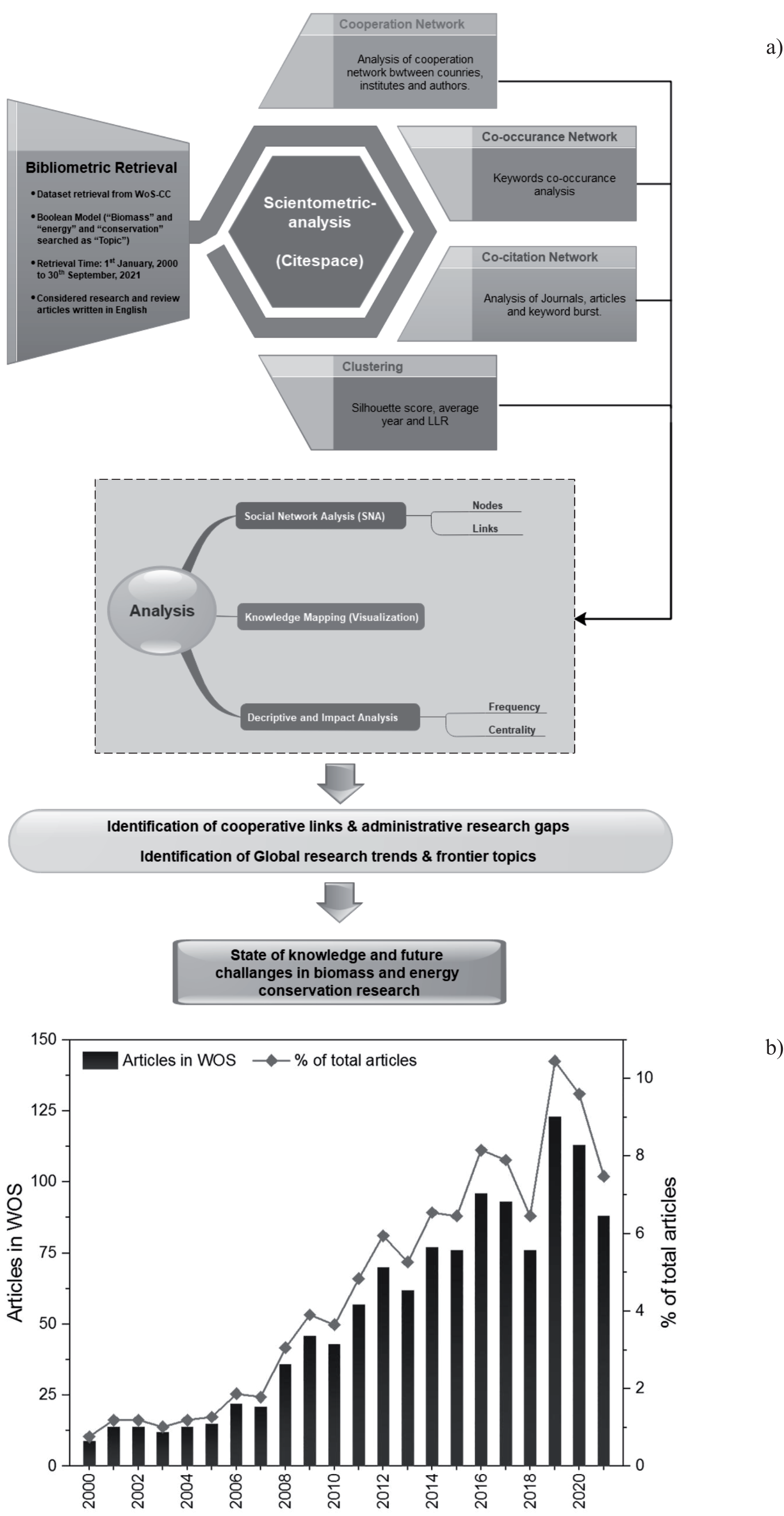
Fig. 2.
Evidence showing visualization map of the collaborative network of a) countries, b) authors, c) institutions, and d) co-citation journals.
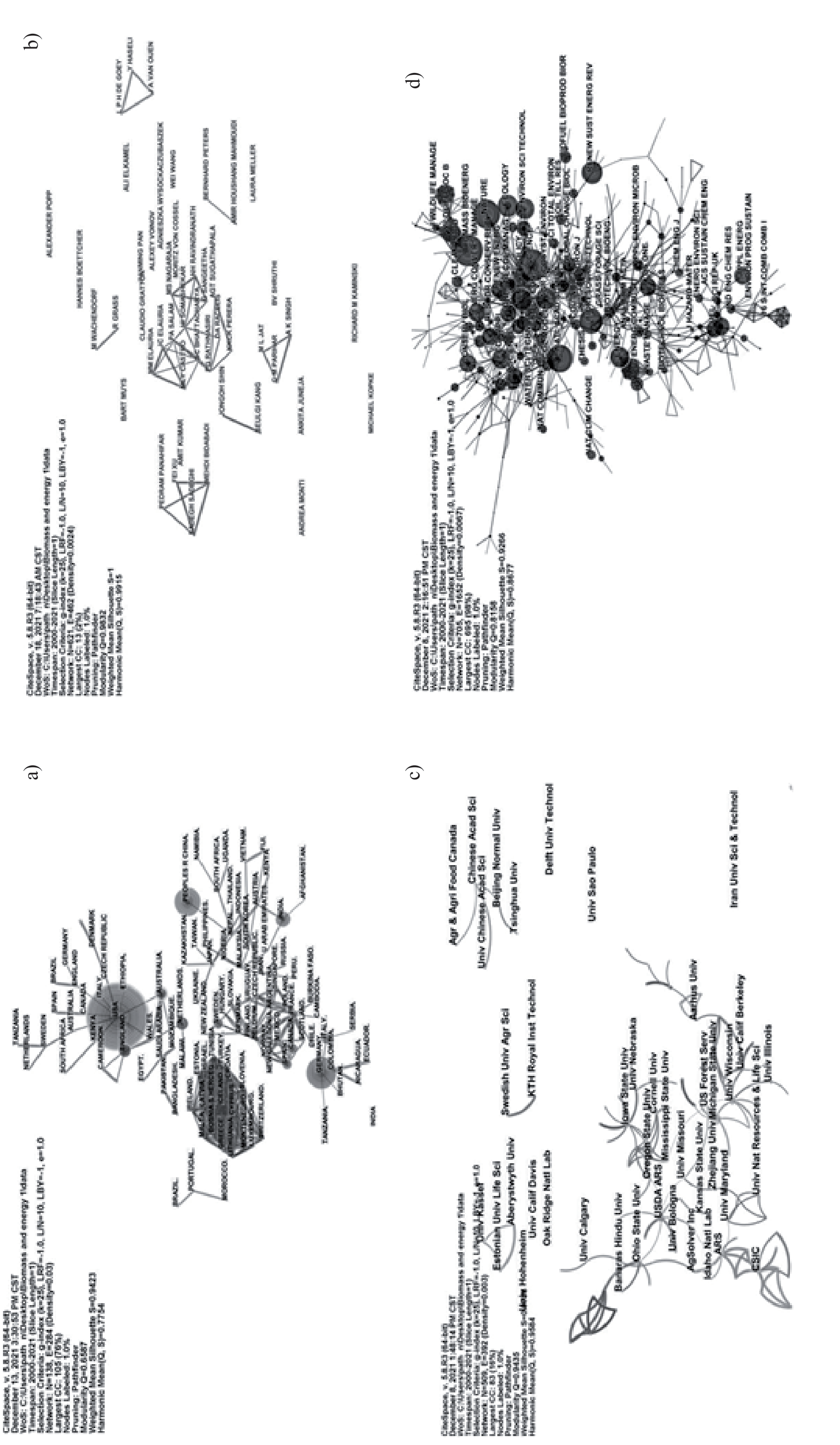
Table 1.
Representing the top 20 countries with higher frequency and centrality.
Materials and Methods
Data Source and Processing
This study consists of a dataset obtained from the Web of Science Core Collection (WOS-CC) of Clarivate Analytics. The retrieval formula for the literature search consists of the keywords “biomass”, “energy”, and “conservation” included either in the title, abstract, keywords, or keywords plus. The retrieval time range was set from January 2000 to September 2021. The initial search yielded 1177 research articles and excluded 123 conference proceedings, book chapters, and other research reports. This study only included the research articles published in English; 13 articles written in other languages were discarded. Scientometric analysis was conducted using the CiteSpace software, following the methodology outlined by Farooqi et al. (2022 and 2024) [22, 26]. The study identified the most productive countries, institutions, and authors to assist new researchers in establishing possible collaborations in the field. Moreover, the keyword analysis results highlighted research hotspots and emerging frontier topics within the domain [26, 27].
Results and Discussion
Publication Trends
The annual distribution trend of scientific literature on biomass and energy conservation shows an ascending trend in the published research work, with a total number of 1177 articles from 2000 to 2021 (Fig. 1b)). Trend highlights the increasing importance of the topic among the scientific community. It can be divided into three phases: the first phase, from 2000 to 2007, is a period of relatively slow growth with only a few annual publications contributing only 10.3% of the total; the second phase, from 2008 to 2015, shows an average growth, contributing 39.7% of the publications; in the third phase, from 2016 to 2021, the number of publications increased greatly, totaling 50% in just five years, with the highest observed publication peak in 2019.
Research Cooperative Network of Countries, Institutions, and Authors
Cooperative Network of Countries
The results indicate the spatial distribution of cooperative networks of countries/regions related to biomass and energy conservation mapped in Fig. 2a). The visual representation of international networks consists of 138 nodes and 284 links, the size of a particular node, which represents the number of publications published in each country on a particular subject. The analysis revealed that the United States of America (USA) has published 345 cooperation articles and ranked first in the list of leading productive countries, followed by China, Germany, India, and England with 140, 126, 69, and 65 articles, respectively. The share of these top 20 countries in producing articles on the topic is around 73% of the whole world’s contribution to the dataset. Europe is at the top with 42%, North America contributed 31%, Asia 19%, Oceania 4%, and South American countries 4% (Table 1). Therefore, a substantial number of research articles are produced by European and North American countries, which means that these countries are working on an advanced level in this field of research. Regarding the cooperative centrality of countries, which shows those countries that have contributed substantially to enhancing international communication and cooperation associated with the research topic, the USA has the highest centrality of 0.36, followed by Australia and Japan with a centrality of 0.30 and 0.23, respectively (Table 1).
One of the reasons might be the source of GHG emissions, as research highlighted that developing nations, especially China and India, as well as developed nations (the USA and Europe), contributed almost equally to greenhouse gas emissions, which might be one of the aspects for intensifying research productivity related to bioenergy [28]. Asia produces almost 40% of its electricity from biomass [29]. However, in the current situation, the energy production from biomass is higher in the USA, followed by China, Germany, Japan, and India [30]. For example, thanks to recent advances in genetic engineering and biotechnology, the USA enhanced its biomass properties and production potential for bioenergy without compromising the country’s food security [31, 32]. Bioethanol production in the USA (from corn) and Brazil (from sugarcane) collectively makes both countries the world’s leading bioethanol producers [33], around 85% of production in the world [34]. Moreover, the majority of biofuel companies that are using microalgal biomass for the production of bioenergy are located in the USA (78%) and Europe (13%) [35, 36]. Success in new technologies, such as advanced AD of biomass, has become a commonly used technology in many developed nations to generate renewable energy, highlighting the relevance of research in this field [37]. The biogas industry in Europe is more industrialized and commercialized than in developing countries like China [38], accounting for 50% of the global biogas production [39]. Similarly, Iran has abundant biomass resources in agricultural waste (59%) and animal waste (28%); their biomass energy potential is about 13% of crude oil sales, which might be a promising reason for the upsurge in research related to the topic [40]. Finally, the African continent has the highest consumption of renewable energy (47.3%) due to traditional biomass burning for heating and cooking purposes, which accounts for 52% of the total carbon emissions, including 44% of CO2 emissions and 36% of CH4 emissions [41, 42]. This indicates huge potential in bioenergy sectors in African regions; however, the research productivity of these countries is greatly lacking.
Cooperative Network of Authors
The co-authorship network shown in Fig. 2b) consists of 621 nodes and 462 links, where nodes represent authors and links show their collaboration. The node size indicates how many articles a specific author has published, whereas the thickness of links represents the amount of collaboration between authors. The analysis found a few closed-loop circuits that showed a collaborative network between these authors. However, the overall number of links is less than the total number of nodes, which indicates that the research cooperation among authors on the topic is weak.
The leading, most productive authors in the field are those with higher node size, as shown in Fig. 2b). The majority of the leading authors are from the European, Asian, and North American regions. The analysis revealed that the topmost productive authors, each with 7 publications in the field of biomass and energy conservation, are Prof. Mehdi Bidabadi, Sadegh Sadeghi (Ph.D. student) (both are from the Mechanical Engineering Department, Iran University of Science and Technology), and Prof. Bernhard Peters (Faculty of Science, Technology, and Communication, the University of Luxembourg). These are followed by Alexander Popp from the Potsdam Institute for Climate Impact Research, Germany; Andrea Monti from the University of Bologna, Italy; J A Van Oijen from Mechanical Engineering at Eindhoven University of Technology, the Netherlands; and SC Bhattacharya and PA Salam, both from the Asian Institute of Technology, Thailand. As for the area of interest, leading authors are related to combustion technology, renewable energy, genetics/genome research, fluid mechanics, remote sensing, and conservation ecology, which highlights the multidisciplinary nature of the topic.
Cooperative Network of Institutions
The analysis results regarding the most productive universities/institutions in biomass and energy conservation topics found a cooperative network of organizations consisting of 509 nodes and 392 links (Fig. 2c)). The study found that the Chinese Academy of Sciences is the most productive institution globally. The superior position of Chinese institutions in the results might be because, in recent years, China has made remarkable academic and institutional improvements, particularly in science and technology [43]. Similarly, recent research found that Chinese funding for biomass energy research is second in the world after the USA [30], which might be the prime reason for the higher number of publications on this topic. The overall visualization shows that the majority of the leading institutions are from North America (with many from the USA and 1 from Canada), Europe, Asia, and South America.
Fig. 3.
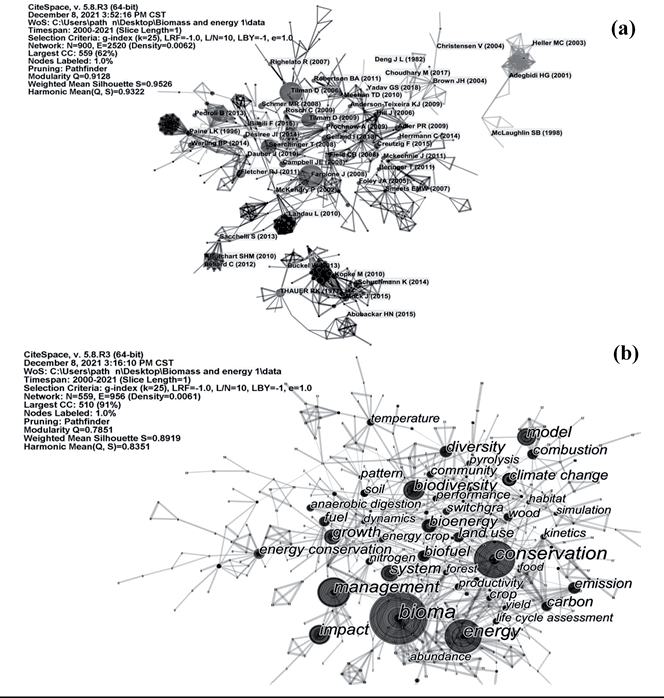
Visualization of a) co-citation network of articles and b) scattered diagram of keyword co-occurrence analysis.
In this analysis, a larger number of nodes and fewer links suggest that research cooperative linkages between world institutions are weak. Even if such research collaboration exists, it mainly lies within different departments and scholars of the same institution. Therefore, those institutions need to increase their collaborative research work by adopting more internationalization and teamwork efforts in biomass and energy conservation research directions. This will enhance research output, researcher proficiency, and novel findings that can help resolve the research gaps in this field.
Performance of Co-Citations Journals, Co-Citations Articles, and Co-Occurrence Keywords
Journal Co-citation Analysis
The analysis revealed that 705 academic journals published articles related to biomass and energy conservation during the period 2000-2021, with 1652 cooperative links among journals (Fig. 2d)). This network visualization helps to identify the most relevant journals related to biomass and energy conservation and allows the authors to sort out an appropriate journal for their future publications. In our analysis, the journal Biomass and Bioenergy ranked first, followed by Science, Proceedings of the National Academy of Sciences, Nature, and Renewable and Sustainable Energy Reviews. Among the leading co-cited productive journals, the majority belong to Europe (UK, Netherlands, Germany, etc.) and North America (mainly from the USA). Similarly, “Forest Ecology and Management” shows the highest centrality, followed by Energy and Fuel Processing Technology, PNAS, USA, Agronomy Journal, and Energy. These results indicate that these journals are playing a vital role in highlighting the frontier topic of biomass and energy conservation research.
Table 2.
Top 5 co-cited articles in the research field of biomass and energy conservation.
Research Hotspots Based on Reference Co-Citation Analysis
Research hotspots are the interconnection of articles or topics discussed during a certain period. Co-cited references, co-occurring keywords, and cluster keywords are the criteria for identifying research hotspots [44]. The visual distribution of highly cited papers and authors related to biomass and energy conservation consists of 900 nodes and 2520 links (Fig. 3a)). The research article entitled “Carbon-negative biofuels from low-input, high-diversity grassland biomass” published in “Science” by Tilman et al. received the most citations (54). He explains the importance of eco-friendly and energy-rich switchgrass for biofuel production compared to corn grain-producing ethanol or soybean for biodiesel [45]. A detailed list of the top 5 co-cited articles is shown in Table 2. These authors, their institutions, and journals played an exceptional role in this evolving field of research. Cluster analysis indicated the following themes in the domain: bioenergy production, ecosystem service, global economic long-term potential, gas fermentation, short-term bird response, and wildflowers-perennial wild plant mixture.
Research Hotspots Based on Keywords Co-Occurrence Analysis
This analysis consists of keywords obtained from the abstract, title, author keywords, and keywords plus to develop the keyword co-occurring network. The visual representation of the scientific knowledge of keywords consists of 559 nodes and 954 links in this network (Fig. 3b)). The highest quantity of nodes was noted in “bioma”, here representing biomass, which appeared 213 times and had a centrality of 0.18, followed by “conservation” (142, 0.16), “energy” (110, 0.14), “management” (94, 0.09), “impact” (70, 0.05), “biodiversity” (61, 0.09), “model” (58, 0.02), “growth” (55, 0.08), and “diversity” (52, 0.06).
Cluster analysis of the co-occurrence of keywords was divided into five clusters: Cluster-1 was “metabolic pathway” with major keywords “growth”, “energy conservation”, and “Escherichia coli”; Cluster-2 was “Clostridium ljungdahlii”, with major keywords “bioenergy”, “land use”, and “fuel”; Cluster-3 was “short-term harvesting” with major keywords “switchgrass”, “community”, and “soil”. Cluster-4 was “economic analyses” with major keywords “pattern”, “performance”, and “anaerobic digestion”; Cluster-5 was “environmental impacts” with major keywords “wood”, “temperature”, and “water”. According to cluster analysis, the hot topics of research related to biomass and energy conservation generally emphasized five aspects: advancements in bioengineering, land use and cover changes, alternate cropping systems, efficient technology, and impacts of deforestation.
Table 3.
Top 20 keywords exhibiting the highest burst strength within the co-occurrence network.
The world population is increasing at an alarming rate and requires huge amounts of energy resources to fulfill their daily requirements. Currently, the majority of energy is derived from fossil fuels, which need to be supplemented with sustainable energy sources. This can be achieved by utilizing renewable resources, such as microbiota and green plants, to address the growing energy demands driven by industrialization and civilization [46]. Anaerobic digestion technologies are widely used worldwide to produce bioethanol, biomethane, and biofertilizers. High-solid anaerobic digestion has become the mainstream technology for treating organic wastes [6]. All these techniques have certain advantages, and comprehensive and advanced research is needed to cope with the difficulties and challenges in the biomass energy research field. For instance, Escherichia coli is widely used in biotechnology and industrial applications to produce biofuels [47, 48]. However, an in-depth understanding of the molecular mechanisms underlying these processes through advanced technologies such as metagenomics, metatranscriptomics, and proteomics could help to optimize the process by developing innovative novel bioenergy strategies [49]. Another key technology for bioenergy production is the microbial fuel cell (MFC), which uses microbial metabolism to transform biomass energy into electricity [50]. Microbes heavily rely on synthetic biology to produce biofuel. Researchers have also found that certain bacterial and archaeal strains, such as Clostridium ljungdahlii sp., Fastidiosipila, Paeniclostridium, Ruminofilibacter, Cloacimonetes, Smithella, Methanosarcina, Methanosaeta, Methanoculleus, and Methanomassiliicoccales, etc., have great potential to produce biofuel [48]. For example, Methanosarcina and Methanosaeta are two well-known acetoclastic methanogens dominating anaerobic digesters. Methanomassiliicoccus can reduce methanol with H2 and utilize mono-, di-, tri-methylamine, and dimethylsulphide as a substrate in high-solid digestion [51]. Moreover, during gas fermentation with pure carbon monoxide, Clostridium ljungdahlii produces ethanol more quickly and with greater specificity when acetate is added [52].
The measurement of switchgrass (Panicum virgatum L.) biomass yield is important to predict the future of bioenergy production and its impacts on biodiversity with changing climate scenarios [53]. Mixed-species grasslands are one potential bioenergy system since they may produce biomass for energy while also providing other ecosystem services, such as biodiversity conservation [54]. The extensive use of certain keywords on biomass energy conservation can lead the researcher to the latest and most advanced research directions, as shown in Fig. 3b). The overlapping of these keywords can lead the researcher to find hot topics and research gaps by analyzing past research findings.
Global Research Trends/Frontier Topics
Global Trends in Research Based on Keyword Burst-Citation Analysis
The global trends for biomass and energy conservation research were investigated using the burst-citation of keywords. Keyword bursts can be used to ascertain frontier topics or emerging trends [55]. The top three keywords with higher burst-citations are “cover-crop”, “climate change”, and “performance” (Table 3). In recent years, the use of cover crops has been gaining more and more attention for the sustainable production of bioenergy due to the reliance on balancing carbon (C) and nitrogen (N) levels in the soil [56]. A systematic review specified the prime role of cover crops in enhancing soil physical properties and offsetting crop residue removal effects on soil [57]. Introducing cover crops after harvesting bioenergy crops is a critical management practice because cover crops can enhance N and C levels and reduce the N-leaching process [58]. For example, an investigation by Austin et al. revealed that the induction of cover crops in a corn bioenergy system could be helpful for an increase in biomass production, enhancing the soil carbon pool and minimizing the losses after corn residue removal [59]. Nevertheless, it is still unclear whether the cover cropping system is a viable long-term solution for bioenergy crop production [60]. Therefore, more advancements in crop management systems can help us understand the future potential of bioenergy.
The performance of various technologies and the role of bioenergy are gaining special attention to achieve more productivity, energy conservation, and eco-friendly objectives. Ronzon and Sanjuán emphasize that the change in practices, technical and technological innovations, and application are the key areas of action for increasing the performance of the bio-economy [61]. The researchers highlighted that the energy conservation objective had been achieved through the efficient performance of various machinery using bioenergy products [62]. However, inadequate energy resources need to be conserved for future generations. Thus, there is a dire need to focus on high-performance, energy-efficient devices and sustainable alternatives and minimize the dependency on non-renewable resources to achieve a healthier society and clean environmental objectives.
As far as the link between biomass-derived energy and climate change is concerned, many research gaps need to be addressed. A systematic review of 17 biomass studies highlighted that it is still difficult to answer to what extent bioenergy has the potential for climate change mitigation [63] because of many uncertainties about future agricultural yield advancements and the availability of land for plantations. Land use and cover changes to replace forests with agricultural land for biofuel crop production might backfire, as land conversion may cause higher carbon and water resource losses [64]. Moreover, excessive fertilizer use for biofuels will significantly increase the atmosphere’s heat-trapping molecules, i.e., nitrous oxide [65]. Another agricultural model in a USA-based study simulated that corn for ethanol production nearly doubled GHG emissions over thirty years [66]. These significant variations in results highlight the uncertainties about the future of bioenergy. Therefore, more integrated efforts from various disciplines are required to fill existing research gaps and balance forestry, agriculture, and bioenergy production. This could be very helpful for developing a sound climate change mitigation strategy along with maximum socio-economic benefits for society.
Prospects for Future Research and Practical Challenges in the Field of Biomass and Energy Conservation
In this final section, we list a number of important research questions and real-world issues that need to be resolved in the field of bioenergy conservation research. It is imperative that more in-depth research be done to address the following issues: optimizing the use of biomass feedstock for energy production without affecting the climate; identifying unutilized/less utilized biomass feedstock resources; and comprehending the complex interactions between human demands, bioenergy production, climate change, biodiversity, and ecosystem functioning. Previous studies have mostly concentrated on the relationship between bioenergy production and population dynamics and demands. More research and multidisciplinary cooperation are needed to achieve these goals. Despite the expansive scope of bioenergy conservation research, we propose several research questions for further investigation because our analysis has shown that these areas have received relatively little attention. In addition, we support a greater emphasis on research in less-studied countries throughout the world, particularly in Africa and Asia, in order to obtain a thorough grasp of cutting-edge methods, the potential of biomass as a feedstock for bioenergy, and the role of biomass in mitigating climate change and its effects on human welfare. Furthermore, considering anthropogenic influences, we advise developing integrated conceptual and statistical models to create significant connections between bioenergy feedstock, production indicators, biodiversity, and socio-economic aspects. Addressing the following research questions will be crucial for better understanding the optimal and sustainable utilization of various biomass feedstocks for bioenergy production. Based on the keyword burst analysis, we have suggested the following frontier topics in the research domain.
Future Research Prospects
1. How can cutting-edge techniques such as pyrolysis, gasification, and anaerobic digestion be upgraded to convert various biomass feedstocks into bioenergy efficiently, and what will be the comparative benefits and drawbacks of each approach in various biomass feedstocks?
2. How can the comparative potential of various biomass feedstocks in energy production on a local, regional, and global scale be assessed?
3. How can the effective assortment of biomass feedstocks contribute to mitigating climate change, and what measures should be used to optimize feedstock selections for maximum environmental advantages?
4. How is a cover cropping system a feasible long-term solution for bioenergy crop production, and how does it impact soil health, biomass yield, and overall sustainability?
5. How can the efforts of bioenergy, climate change, biodiversity, economic, and societal experts, as well as other stakeholders, be efficiently incorporated to attain long-term and sustainable bioenergy solutions that address the challenges posed by human needs and climate change?
Conclusions
The results of this study revealed a considerable lack of cooperation and coordination between institutions and co-authors in the research field of biomass and energy conservation. The research status indicated that the topic has excellent development potential; countries like China, Germany, and India need to further strengthen their research cooperation beyond borders. More global research fund allocation for research and publications will likely be necessary for enhancing research output from developing countries in African and Asian regions. Research hotspots mainly involve “metabolic pathway”, “Clostridium ljungdahlii”, “short-term harvesting”, “anaerobic digestion”, “environmental impacts”, “management of biomass resources”, “food security and biodiversity”, and “prediction models”. Future research trends focus on cutting-edge technologies, biomass feedstock’s potential for bioenergy, biomass feedstocks’ role in mitigating climate change, cover crops as a supplement for bioenergy crop production, and the performance of machinery/tools. Interdisciplinary approaches, in particular, are urged to be used in this field to enhance the quality of novel, innovative research. Therefore, the future potential of bioenergy is dependent on integrated efforts from several departments and institutions at national and international levels to come up with novel ideas to fill the research gaps and to develop state-of-the-art technologies for biomass production and utilization.

