

Introduction
China’s urbanization and industrialization have advanced significantly since the reform and opening up; however, environmental pollution remains a challenge to China’s long-term sustainable development. As the conflict between resource depletion, environmental degradation, and economic growth has gained prominence, people’s emphasis has shifted towards sustainable development. Most innovations that use fewer fossil fuels and produce minimal pollutants are called “green innovations” [1]. Green innovation plays a crucial role in finding a balance between China’s environment and economy, serving as a primary solution to the conflict between ecological preservation and economic growth [2, 3]. Sustainable economic development in China relies heavily on green innovation. However, owing to regional differences in innovation, capital, human resources, and other factor endowments, green innovation capacity diverges, further aggravating regional environmental inequality and seriously restricting China’s sustainable and coordinated development. As science and technology have become primary factors in modern productivity development and economic growth, the root cause of regional environmental inequality is increasingly centered on gaps in green innovation capacity [4, 5]. Green innovation is the primary driver of efforts to reduce regional environmental inequality, advance sustainable regional development, and achieve peaceful cohabitation between humans and the natural world [6]. Therefore, narrowing the gap between regional green innovation capabilities has become key to alleviating environmental inequality in China.
Green innovation growth encounters different challenges compared with conventional innovation activities [7]. Investment in green innovation activities is far from adequate because of the high upfront capital investment, high-quality talent requirements, relatively long payback periods, innovation failure risk, and unpredictability [8, 9]. Furthermore, in various regions, eco-friendly innovation progress necessitates dependence not only on the region’s innovative elements, but also on the influx of innovative factors from external regions. Thus, identifying and accelerating financing sources for regional innovation initiatives is crucial. Digital finance emerged after artificial intelligence and big data analytics were introduced and used in the financial industry. The development of digital finance represents a new financial business model, which is essentially a financial innovation [10]. In contrast to traditional financing, digital financing provides better support for financing green innovation activities [11]. Digital finance enables financial players to connect, leading to cost reductions, enhanced service quality, improved transparency, reduced information inequality, and increased stability and diversity [12]. In addition to providing the financial support that businesses require to engage in green innovation, the emergence of digital finance has also led to the reduction of high risks and uncertainties that businesses face when executing green innovation management activities. All these factors have made it easier for businesses to take significant steps toward green innovation. With digital finance’s rapid growth, an increasing number of researchers have shifted their focus to examining its effects, especially in relation to eco-friendly innovation and digital finance.
Most of these studies verified the positive impact of digital financing on the expansion of green innovation. However, research on this subject is limited, bringing people together to investigate the relationship between digital finance and regional differences in green innovation. Digital finance significantly enhances inclusiveness by reducing entry barriers and offering more accessible services. Financing green innovation initiatives is aided by the financial market’s ability to accommodate larger, long-tailed groups. Thus, their capacity to receive contributions from small investors has increased [13]. Furthermore, large-scale data, cloud computing, and other information technologies are used in digital finance to address the issue of insufficient information during the implementation of eco-friendly innovation projects, reduce information imbalances in transactions, and depict individuals’ credit histories [14]. Digital finance enables risk dispersion related to green innovation endeavors over broad areas, thereby amplifying the motivation to engage in green innovation activities while diminishing the associated risk. In conclusion, by lowering transaction costs and default risks, expanding the sources of financing channels, keeping traditional financial markets from being adversely selected, and reducing the information asymmetry of the “financial sector-financing subject,” digital finance opens up new avenues as a means of promoting green innovation. Increasing use of digital finance has profound implications for the quick flow of innovative factors, increasing sources of funding for green innovation, improving the efficiency of factor allocation, enhancing regional green innovation vitality, and changing patterns of regional green innovation.
What internal mechanisms does digital finance growth have regarding the regional green innovation gap? How does this affect the regional innovation gap in green technologies? Is there a specific timeframe within which this impact occurs? By offering a more unbiased comprehension of the impact of digital finance on the synchronized advancement of regional green innovation, these inquiries will aid in the scientific development of China’s local green innovation strategy and the advancement of China’s national innovation strategy. This study demonstrates how digital finance advancements have affected green innovation disparities in terms of both theory and application. This study evaluates the impact of digital financial development on green innovation gaps in Chinese cities, based on a panel dataset covering 284 prefecture-level cities from 2011 to 2020. This study employs benchmark and threshold regression models as well as dynamic effects and heterogeneity analyses to comprehensively investigate the relationship. The research findings hold great practical significance, as they will assist the government in effectively exploiting the digital finance sector’s advantages to bridge the gap in urban green innovation development and promote coordinated green innovation development among regions, thereby facilitating the coordinated development of cities’ economies and natural environments in China.
In summary, this study contributes to the existing literature as follows: (1) Firstly, by advancing studies on coordinated growth of regional green innovation through integrating digital financial development elements into the framework for researching the green innovation gap. In light of China’s rapidly expanding urbanization and digital economy, this study provides a theoretical framework for how digital finance affects a city’s green innovation gap. (2) Secondly, by thoroughly investigating the impact of digital finance on the green innovation gap through specific channels and establishing the mediating role of digital finance by considering variables such as financing restrictions, resource mismatch, market demand, and urban innovation vitality. A step-by-step regression method is employed to confirm and uncover the influence of disparity in eco-friendly advancements on digital monetary systems. (3) Thirdly, by conducting an empirical analysis on how digital finance affects the green innovation gap by lagging digital finance by one to three periods, conducting a dimensionality reduction analysis of digital finance and the green innovation gap, and investigating the heterogeneity features of digital finance that contribute to the widening of the gap. This provides an in-depth understanding of how the expansion of digital finance impacts the urban green innovation gap and vital empirical data that support the theoretical underpinnings of the study and empirical evidence on the relationship between digital finance and the green innovation gap. (4) Finally, achieving universal digital finance at the green innovation level by developing an adjustment model based on internal and external governance. This is necessary because there is significant evidence of a “Matthew effect” on green innovation gaps in cities. Furthermore, corrective actions are proposed and validated to address this issue. This study investigates the correlation between the emergence of digital finance and the disparity in green innovation to provide empirical evidence that green innovation and ecological and environmental conservation may coexist in emerging economies. It also provides novel suggestions for developing countries to address climate change during the digital age.
The following section begins by outlining the hypotheses and mechanisms through which digital finance influences the green innovation gap. We then introduce the research models, variables, and data sources employed in this study. Next, we analyze and discuss the results of our baseline regression, robustness and endogeneity tests, mechanism analysis, and investigations into the nonlinear characteristics, dynamic effects, heterogeneity, and potential correction measures related to digital finance’s impact on the green innovation gap. Finally, we summarize our research conclusions and offer policy recommendations.
Materials and Methods
Research Hypothesis and Mechanism Analysis
Green innovation, a crucial force driving the transformation of China’s economic development model, is an effective tool for achieving a high-quality economy. Most existing literature focuses on the assessment of factors impacting eco-friendly advancement, with scholars emphasizing the influence of government grants, economic progress and expansion, intellectual resources, and ecological policies on green innovation. According to previous studies, the digital economy may have a significant impact on technological innovation. Coordination of regional green innovation development appears to be lacking in the current context of digital economic growth, owing to rapid advancements in technologies such as big data and artificial intelligence, the merging of traditional finance with new information technology, and the gradual emergence of digital finance. The green innovation level seems to be misaligned to green initiative expansion.
Understanding the impact of the emergence of digital finance on the disparity in green innovation between regions and its contribution to the coordinated advancement of regional green innovation is crucial. Scholars are currently at odds regarding how recently created digital financial products affect the green innovation gap. Further investigation is therefore required to provide robust theoretical support and empirical data. Hence, this study focuses on the impact of digital finance on disparities in eco-friendly advancements by assessing this influence mechanism from two angles, Matthew and diffusion effects, and suggesting relevant research questions.
Matthew Effects of Digital Finance on the Green Innovation Gap
The impact of digital finance on market demand and urban innovation vitality across different regions and the extent to which it benefits developed and underdeveloped regions determine its influence on the green innovation gap. By maximizing the interaction of various factors, accelerating information exchange, and enriching innovation resources, digital finance can foster innovation and entrepreneurship vitality. Encouraging innovation and entrepreneurship can bridge the gap in the advancement of green innovation. Beyond the limitations of traditional finance, digital finance improves permeability, encourages social capital development, and strengthens the demonstration effect created by successful entrepreneurship while simultaneously satisfying entrepreneurs’ demand for information access and stimulating innovative and entrepreneurial activities through practical information exchange platforms. A study conducted in 2015 found a positive correlation between internet usage and involvement in entrepreneurial endeavors [15]. Entrepreneurial motivation is greatly impacted by socioeconomic factors and the presence of support, both financial and non-financial [16]. Digital finance utilizes digital platforms and advanced Internet and data analysis technologies to enhance risk assessment models and optimize the allocation of credit resources for entrepreneurs. This stimulates individual entrepreneurial activity and supports enterprise innovation, enhancing resource penetration and synergy to facilitate the reorganization and integration of entrepreneurial resources, ultimately contributing to the innovation and entrepreneurial spirit of cities [17, 18]. Consequently, influenced by the foot voting mechanism, these factors rapidly migrate and concentrate in regions that possess advantages in green innovation development. This boosts innovation and entrepreneurial energy while expediting efficiency and the range of innovation resource allocation. The phenomenon known as the “siphon effect” across regions would facilitate the transfer of advanced production sectors and industries from less developed regions to more developed regions therefore stimulating the advancement of green innovation in advanced areas and intensifying the reduction of financing sources for green innovation in trailing areas. The “Matthew effect” will result in potentially widening the gap between the advancement of green innovation in underdeveloped and developed regions.
On the other hand, according to the “demand-led innovation” idea, the underlying driver behind technical innovation is market demand. Consumers can access idle funds through digital finance, which drives product innovation across geographic boundaries, boosts social consumption, and fosters local green technological innovation. In addition, as digital finance has gained popularity, the close relationship between e-commerce platforms and digital finance has encouraged online consumption, further boosting regional market demand. However, when comparing advanced and backward regions, developed regions have more advantages in terms of digital technology and other resource endowments, and because of the developmental benefits of digital finance, it is easier for them to overcome economic, environmental, and geographical barriers. Cities with higher levels of development possess a stronger economic base and greater human capital [19], facilitating the utilization of digital finance to enhance the potential for green innovation. This helps them understand market needs and trends [20], enhances consumer desire, amplifies market demand, and fosters the expansion of eco-friendly innovation. Underdeveloped regions face difficulties attracting consumer funds and experience low consumer motivation and market demand because of insufficient foundations for digital technology and limited digital literacy. This results in a limited capacity to produce green goods and a progressive widening of the innovation gap between them and the developed regions. The development of digital finance is marked by a distinct separation in terms of access and understanding, commonly referred to as the “digital divide”. If not addressed, these divisions will inevitably lead to digital finance having a minimal or even negligible impact on local green innovation. The potential impact of digital finance on regional green innovation may be minimal or nonexistent because of digital and knowledge gaps. Because digital finance has developed differently in advanced and developing regions, its application in supporting green innovation growth differs. These differences and personalized digital technology delivery will inevitably affect the scope of information received in various locations and widen the information gap between the areas, making it impossible for the initial gap to close and possibly grow even wider. Thus, Hypothesis 1 is proposed.
Hypothesis 1: Digital finance may produce a polarization effect that can expand the regional green innovation gap. Particularly in underdeveloped regions, the advancement of digital finance has steadily broadened its reach to encompass additional areas. The digital finance Matthew effect leads to an increasing gap in inter-regional green innovation, as advanced areas experience greater growth in green innovation than underdeveloped regions.
The Diffusion Effects of Digital Finance on the Green Innovation Gap
The example below demonstrates the impact of digital finance spread on the disparity in green innovation across regions. By eliminating financial constraints, digital finance can effectively bridge the regional gaps in green innovation. Openness, sharing, universality, and non-pollution are qualities of digital finance itself, which are bolstered by cutting-edge technologies such as artificial intelligence, big data, and the internet [21]. It integrates a small amount of idle funds through third-party payment channels, expanding available financial resources in the market and alleviating high costs and financing constraints faced by different regions in implementing green innovation [22]. Traditional financial service often ignores the financial needs in the long tail of the industry and tends to cater to certain high-end customer groups [23]. For areas that lag in the development of green innovation, digital finance’s “long-tail effect” can provide new and additional sources of financing, thus ensuring the success of green innovation activities [24].
However, by resolving the resource mismatch issue, digital finance bridges the innovation gap in green technology between regions. According to the resource-based theory, a firm’s capacity to access resources dictates its responsiveness to its internal and external environments. Digital finance uses the internet, big data, and various technologies to aid financial institutions in establishing digital platforms for exchanging financial information, allowing them to collect, integrate, and analyze massive amounts of fragmented information that reduce information asymmetry [25]. Information exchange between financial institutions and financing subjects, including corporate clients, is facilitated, which reduces economic friction and transaction costs [26].
Furthermore, digital finance can assist business operators in promptly monitoring operational status and green innovation initiatives, minimizing post-event ethical risks and detrimental selection, improving risk control capabilities [27], reducing investor risk, promoting green innovation investment in relatively underdeveloped areas, enhancing financing availability and efficiency, and resolving financial mismatch issues. Most importantly, backed by digital technology, digital finance can identify additional potential green innovation ventures for investors, highlight green innovation activities, channel capital towards higher-quality green innovation projects, enhance capital allocation efficiency, and bridge the green innovation development gap within a specific region. Thus, Hypothesis 2 was proposed.
Hypothesis 2 proposes that the spread of digital finance can reduce the gap in green innovation across different areas. Due to the trickle-down impact of digital finance, its steady convergence growth in various regions, particularly underdeveloped ones, can foster green innovation initiatives and bridge the interregional green innovation gap.
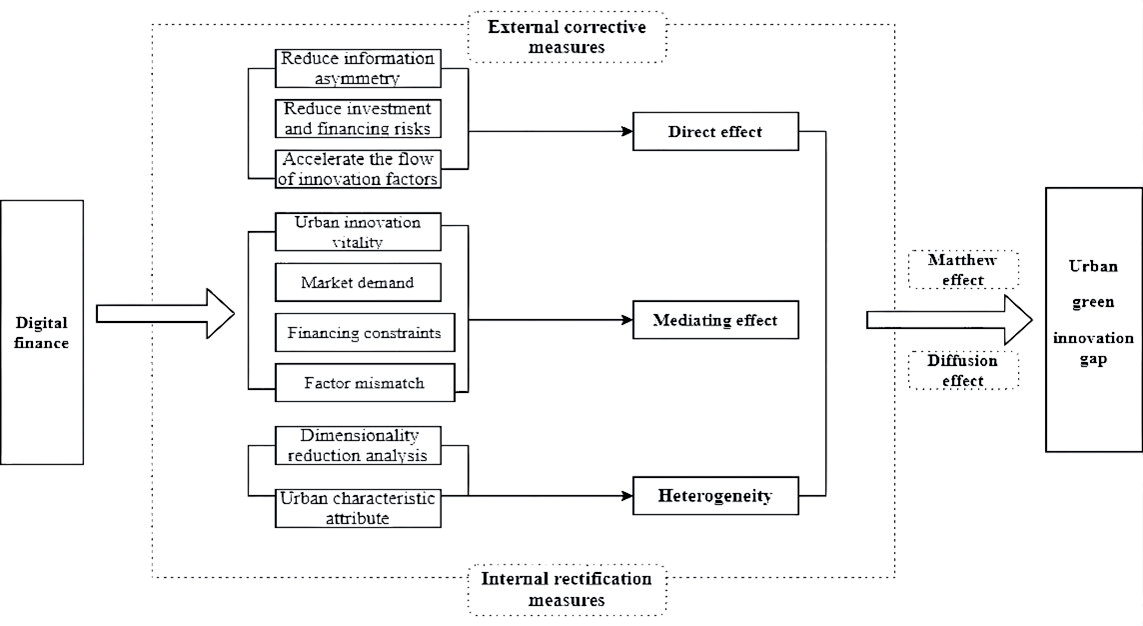
This study also recommends influencing mechanisms that digital finance may use to widen or close regional differences in green innovation. This implies that urban innovation vitality, market demand, financing constraints, and resource mismatch are influencing the impact of digital finance on the regional green innovation gap. This is accomplished by integrating relevant accounts of the digital finance diffusion impact and the Matthew effect on the regional green innovation gap. Thus, Hypothesis 3 was proposed.
Hypothesis 3: Digital finance helps close regional differences in green innovation by reducing financing barriers and resolving resource mismatches. However, it also increases the gap by boosting market demand and urban innovation. Fig. 1 illustrates the impact mechanism used in this study.
Model Setting
According to Wu et al. [28], this econometric model, which explores the impact of digital finance on the disparity in green innovation, is developed in line with the theoretical insights derived from the preceding analysis. This study employs a fixed effects model to analyze the relationship between digital finance and green innovation in order to control for unobserved heterogeneity. The fixed effects model effectively controls for individual characteristics and temporal variations, reducing potential biases.
In year T, GAPit represents the disparity in green technology within a city; Dfinit signifies the level of advancement in digital finance for the i city in the t year; β1 measures the influence of digital finance on the gap in green innovation; controlit represents the group of control variables;
Equation (1) illustrates how the green innovation gap is directly impacted by digital finance. To explore the potential indirect impact mechanisms of digital finance on the green innovation gap, (1) suggests the inclusion of mediating factors for further investigation. We employ mediation effect analysis [29] to explore the indirect impact of digital finance on the green innovation gap, thereby clarifying the relationships among various factors. The following mediating effect model was constructed:
In Equations (2) and (3), If
Definition of the Variables
Explained Variables
The number of green patent filings in every urban area was established by utilizing environmental technology categories that align with the International Patent Classification (IPC) as a benchmark and by consulting the IPC Green Patent Inventory released by the World Intellectual Property Organization (WIPO) in 2010 [8]. Inspired by Zhang et al. [30], this deviation was selected to characterize the urban green innovation gap. The deviation, denoted as GAP, was calculated by dividing the green innovation index of a region for a given year by the mean value of the green innovation index of all regions for that year.
Explanatory Variable
Digital Finance (Dfin), the Peking University Digital Financial Inclusion Index, is a measure of China’s digital finance landscape [31]. It was created in partnership with the Ant Group and released by Peking University’s Digital Finance Research Center. Dfin was obtained through logarithmic processing.
Control Variables
To minimize the impact of external factors on disparities in green innovation, the model included seven control variables. lnPGDP indicates the extent of economic progress. Innovation and economic development are closely correlated in nations and regions. The phenomenon known as the “siphon effect” frequently arises in regions with varying economic growth and innovation factors, leading to an expansion of green innovation disparity. The gross domestic product (GDP) per capita natural logarithm was hence employed [32]. Environmental regulations (EV) compel regional green innovation to lower the cost increase caused by environmental pollution, and GDP’s inverse ratio of industrial emissions (powder dust) was determined. Population growth rate was calculated using natural population growth rate (Prate). The industrial structure (Inst4) was calculated using the percentage of tertiary industry’s value-added to GDP. Urbanization was determined using the ratio of urban to overall population (city). The country’s degree of openness to the outside world was measured using the ratio of actual foreign capital use to GDP (FDI). According to L. Wang et al. [33], fiscal support (GOV) is the ratio of government fiscal spending to the GDP. Greater financial investment can lead to enhanced green innovation.
Sources of Data and Statistical Descriptions
The China Digital Financial Inclusion Index, released by the Digital Finance Research Centre at Peking University, provided digital finance data. Data from the incoPat patent database were used to analyze the green patent applications. The China City Statistical Yearbook was the primary source of the control variables used to retrieve patents based on data from the IPC Green List, such as the classification number, city of application, and application time. The missing data were filled in by referring to the yearly statistical bulletin of each municipality, statistical yearbooks of each province, and interpolation methods. The study sample consisted of panel data from 284 cities between 2011 and 2020. As the digital finance index started in 2011, all economic factors that impact monetary value in this study were deflated based on that year.
Table 1 presents the definitions of the major variables and their corresponding descriptive statistics. According to the study, the highest possible value of digital finance was 5.813, whereas the lowest value was 2.834, with a standard deviation of 0.515. The data indicates a notable disparity in the extent of digital finance advancement among various urban areas, commonly referred to as the “digital divide” among other cities [34]. The level of development for green innovation ranged between 0.693-9.303, with a standard deviation of 1.626. The ranking of green innovation development fluctuates significantly among cities.
Results and Discussion
Results of Baseline Regression
The expected outcomes of the baseline regression model are shown in Table 2. The OLS, time-fixed, individual-fixed, and double-fixed-effects models are presented in columns (1), (2), (3), and (4), respectively. Column (5) introduces the control variables based on paragraph (4). Overall, the digital finance coefficient consistently showed a positive trend at either the 1% or 10% significance level, indicating its contribution to the widening urban green innovation gap. This aligns with the “Matthew effect” on how digital finance primarily affects green innovation, which is supported by Hypothesis 1, but the actual outcome is differs from the existing literature [35]. The reason for this could be that, despite its potential to improve the efficiency with which financial resources are allocated and the accessibility of those resources in developing areas, digital finance retains the characteristics of traditional resources of “dislike the poor and favor the rich”, making it less inclusive of the relatively underdeveloped regions in the green economy. Additionally, the “digital divide” widens the “innovation gap,” emphasizing the current geographical disparity in the growth of digital banking [30].
Table 1.
Descriptive analysis of main variables.
Table 2.
Baseline regression estimation results.
Robustness and Endogeneity
Endogeneity Test Results
The estimated results may be inaccurate when measuring endogenous issues owing to reverse causality, measurement errors, and missing factors. Hence, addressing inherent internal issues of the model to precisely assess the impact of the digital economy on the disparity in eco-friendly advancements is crucial. This study used instrumental variables and difference-in-difference (DID) methods to reduce potential endogeneity.
(1) The DID method: The People’s Bank of China proposed in its 2016 publication of the G20 Advanced Principles for Digital Financial Inclusion (hereinafter referred to as the “Advanced Principles”) that digital finance progress should maintain a balance between the risks associated with innovation and the convenience for users. The challenges in this study are determined using the differential difference technique since the application of the “Higher Principles” affects urban green innovation differently depending on the financial development stage. Cities are classified with low and high digital financial development levels into two categories according to each city’s median digital financial index of the year before policy adoption [36]. A DID model was used to assess the influence of treatment and control groups on green innovation disparity. The results are shown in Column (1) of Table 3. Additional evidence supporting Hypothesis 1 is derived from the DID coefficient, which is 0.047 and exhibits a statistically significant positive effect at the 10% significance level.
Table 3.
Results of endogenous test.
(2) The instrumental variable: To precisely evaluate the influence of digital finance on green innovation disparity and address the internal factors within the model, the instrumental variables method was used. First, Du and Zhang [37] and Zhong et al. [38] chose lnMob, which represents the number of individuals using mobile phones per 100 people, and lnTel, which indicates the overall telecommunication services available per person. Second, according to Guo et al.[39] and X. Zhang et al. [40], digital finance growth is influenced by geographic factors, making it more challenging to promote in areas farther away from Hangzhou despite online platforms being the primary channels for implementation. The instrumental variable chosen in this study was the distance from this prefecture-level city to Hangzhou [35]. Finally, the average of other cities in the same province’s digital financial development (OFMean) was chosen [40]. Table 3 shows the outcomes of the two-stage least squares method’s regression findings in columns (2)–(7). Considering endogeneity, the F-values of the initial stage in the instrumental variable regression outcomes exceeded 10, indicating the absence of weak instrumental variables and confirming that each instrumental variable has successfully passed the correlation examination, thus supporting the conclusion of the study.
Robustness Test Results
We adopted the following methods to conduct the robustness test: (1) Replacing the explained variables: In this study, the re-estimation focuses on the explained variable of green innovation deviation per 10,000 individuals, which yields robust results. (2) Replacing explanatory variables: Considering the lagged effect of digital finance on green innovation, this study replaces the current era of digital finance with a combination of lagged and current periods. (3) Adjusting the time window: The Registered Capital Registration System Reform Plan, released by the Chinese State Council in 2014, mandates that newly established businesses discontinue their use of a paid-in system. This move could potentially address the green innovation gap in digital finance. Using 2014 as the analytical boundary, this study splits the sample into pre- and post-commercial reforms. The results are summarized in Table 4. (4) Excluding the provincial capital and key cities under construction: This study’s re-estimation excludes the provincial capital and suggested central city owing to their significant differences in terms of economic size, administrative rank, and population compared with other prefecture-level cities. The results indicate that the robustness analysis findings from the different approaches align with the estimates from the baseline model presented in Table 4.
Table 4.
Results of robustness test.
Mechanism Analysis
Digital finance’s “Matthew effect” has been scientifically proven. However, how it occurs remains unclear. This study details the precise routes through which digital finance affects green innovation gaps. After the theoretical analysis described above, this study uses the stepwise regression approach to assess the intermediate effect, referring to the work of L. Wang et al. [33], to confirm the influence channels such as financial constraints, capital mismatch, market demand, and innovation and entrepreneurship vitality. To consider funding limitations, financial institutions in prefecture-level cities divide the total loans issued by the end of the year by GDP [41]. The factor mismatch index was derived using the research conducted by Bai and Liu [42]. According to Saunila [43] and Zhao et al. [44], the sub-index of the number of newly registered businesses can be used as a proxy index of urban entrepreneurial activity. The GDP percentage of all social consumer products served as a proxy for market demand [39], because higher market demand results in a higher supply of social consumer goods, which encourages more innovation. These findings are presented in Table 5.
Table 5 presents the empirical results of financial limitations (Fcon) as a mechanism factor in Columns (1) and (2). According to systematic regression analysis results, digital finance has the ability to reduce financing constraints. Digital finance solves the credit shortage problem of small and medium-sized enterprises, solves traditional financial challenges, and improves technological progress [45, 46]. This finding is supported by the significantly negative coefficient of digital finance on financing restrictions, which was statistically significant at the 1% level. In addition, there was a significant negative regression coefficient for financial limitations. Accordingly, these constraints represent a partial intermediary effect, accounting for 4.4% of the total gap between digital finance and regional green innovation. This study’s conclusion proves Hypothesis 3 is valid.
Table 5 displays the empirical results of capital misallocation (CMA) as a mechanism variable in columns (3) and (4). Stepwise regression findings show that digital finance can reduce resource misallocation because its coefficient of resource misallocation was significantly negative at the 5% level. Capital misallocation makes enterprises unable to obtain timely financial support, thus missing opportunities for production, innovation, and research and development [47]. Digital finance can help narrow the gap in green innovation between regions by alleviating the distortion of capital factors, leading to a better allocation of resources. The development of digital finance makes up for the shortcomings of the traditional financial system [48], helps the healthy competition among traditional financial institutions, and alleviates capital misallocation to a certain extent. Different green financial products and services, including green loans, green bonds, financing for renewable energy sources, and financing for environmental protection projects, can be introduced by digital financial institutions [46]. Digital finance can help ease capital misallocation, thereby increasing green projects and promoting green technology development. This intermediary effect contributes 1.6% of the overall impact. This result is similar to that of the study of Li and Pang [49]. The regression coefficient of resource misallocation is strongly negative, indicating that resource misallocation has a partial mediating effect between digital finance and the green innovation gap. This conclusion supports Hypothesis 3 as valid.
Table 5.
Regression results of the intermediary effect model.
Columns (5) and (6) of Table 5 report the empirical findings for urban innovation vitality (Cinov1) as a mechanism variable. According to the stepwise regression results, the coefficient of digital finance on urban innovation vitality was positively significant at the 1% level. This suggests that digital finance has the potential to enhance the vitality of urban innovation. The advancement of the digital economy has greatly decreased expenses and enhanced the advantages of innovation vitality. Moreover, a significant positive relationship exists between the regression coefficient of digital finance and the regional gap in green innovation, suggesting that urban innovation vitality acts as a partial mediator between these two variables. This intermediary effect accounted for 34.1% of the difference between the two variables. The results of this study verify Hypothesis 3.
Columns (7) and (8) report the empirical findings for market demand (market) as a mechanism variable. According to the stepwise regression findings, the coefficient of digital finance on the vitality of entrepreneurship and innovation was positive and significant at the 1% level. This finding suggests that digital finance can promote these two phenomena. Additionally, there was a strong positive correlation between the regression coefficient of digital finance and innovation, as well as entrepreneurial spirit, indicating a partially mediating effect between the two. Specifically, digital finance stimulates market demand to support demand-led innovation, widening the regional green innovation gap; its intermediary effect accounts for 0.5% of the total. This section of the conclusion supports Hypothesis 3.
To summarize, digital finance has the capacity to diminish local green innovation disparity by alleviating financial constraints and addressing resource imbalances while amplifying the cross-regional green innovation gap through heightened market demand and urban innovation vitality.
The Non-Linear Characteristics of Digital Finance on the Green Innovation Gap
It is commonly known that digital finance has a linear impact on the growth of regional differences in green innovation. Nevertheless, the green innovation gap can be affected in a nonlinear manner by digital finance because of the interaction between its polarization and spillover impacts. This study investigated the impact of digital finance on the green innovation gap using Hansen’s panel threshold model [50], which reveals nonlinear effects at various time intervals [36]. The model is configured as follows:
Where
This study employed the bootstrap self-sampling technique to ascertain the presence of a panel threshold. As shown in Table 6, the test results were obtained after 400 iterations of sampling, which passed the double-threshold test with threshold values of 5.521 and 5.396, respectively, at a significance level of 1%. Comparable threshold values apply to environmental regulation (0.793) and human capital (4.615) for their respective threshold effects.
Nonlinear features of green innovation disparity resulting from the limitations of digital finance, human capital, and environmental regulation are individually estimated and tested using the findings from the self-sampling test for threshold effects. The results are summarized in Table 7. When the digital finance value was less than 5.521, its estimated coefficient was 0.242, which is significant at the 1% level. It decreased significantly to 0.233 when the digital finance value was between 5.521–5.396. The estimated coefficient of digital financing dropped to 0.222 when the value surpassed 5.396. Based on these findings, the “Matthew effect” of digital finance growth on green innovation decreased marginally when the digital finance threshold was applied. Second, the estimated coefficient of digital finance decreased from 0.313 to 0.308 when the human capital value surpassed 4.615. Under the human capital threshold constraint, the 1% significance test indicates that the gap in green innovation experiences a decreasing trend in its marginal impact on digital finance. Finally, when environmental regulation exceeded 0.793, the digital finance coefficient increased from 0.309 to 0.314, indicating that as environmental regulation continues to improve, digital finance exacerbates the regional disparity in green innovation.
Table 6.
Results of self-sampling inspection of panel threshold.
Dynamic Effect
To evaluate the long-term effect of digital finance on the green innovation gap, this study also investigated potential influences across various timeframes. Following Liu et al. [52], the impact of the disparity in eco-friendly advancements was investigated by considering a time lag of one to three periods. Columns (1) to (3) of Table 8 present these results. Digital finance continues to have a notable and favorable impact on bridging the gap in green innovation. In other words, the disparity in eco-friendly advancements between cities could potentially widen owing to the lasting influence of the expansion of digital finance on the green innovation gap. However, the problem that cannot be ignored is that digital finance’s “Matthew effect” showed a marginally decreasing superposition effect over time.
Table 7.
Panel threshold regression estimation results.
Heterogeneity
The Impact of Digital Finance on the Green Innovation Gap Through Dimensionality Reduction Analysis
To provide a more precise depiction of the impact of digital finance on green innovation, this study investigated the variations in structure between the “Matthew effect” and diverse effects on the green innovation gap. Dimensionality reduction was applied to both digital finance and the green innovation gap index (Table 9, Columns 1-2). Results indicate that digital finance significantly impacts both green inventions and utility model innovation, leading to a more pronounced effect on the innovation gap in green inventions. Consequently, the “Matthew effect” of digital finance widens the regional green innovation gap due to disparities in green invention innovation. Digital finance plays a significant role in enhancing the degree of green invention and innovation in various regions. However, it also expands regional disparities in green innovation.
Table 9 (Columns 3-5) presents the regression results for digital finance’s dimensionality reduction. Results show this positive impact is attributable to three digital finance indices – breadth of coverage (lnCB), depth of usage (lnUD), and degree of digitization (lnDL) – with some variation [34]. Uneven internet development across China’s regions has created significant access cost disparities, hindering digital technology’s positive impact and widening regional green innovation gaps.
Geographic Region, Administrative Level, Business Environment Heterogeneity
This study further examined how geographic region, administrative level, and business environment influence the diverse impacts of digital finance on the green innovation gap. Cities were first categorized into three geographic regions: eastern, central, and western. Of these, 184 were located in the central and western regions, while 100 were in the east. Table 10 (Columns 1-2) shows that the estimated coefficient of digital finance leans towards the eastern, central, and western regions. Second, following [44], cities were categorized as either peripheral cities or central cities (municipalities directly under the central government, provincial capitals, and sub-provincial cities). Table 10 (Columns 3-4) suggests digital finance’s impact on the green innovation gap is more pronounced in central cities than in peripheral cities.
Table 8.
Dynamic impact of digital financing on the regional gap in green innovation.
Table 9.
Analysis of heterogeneity by dimension.
In an assessment of the commercial attractiveness of cities in 2020, the New First-Tier Cities Research Institute classified 284 cities into 19 first-tier cities, 70 third-tier cities, and 165 cities belonging to the fourth and fifth tiers. Columns (5), (6), and (7) of Table 10 display the estimated findings. The green innovation gap is most noticeable in third-, fourth-, and fifth-tier cities, where the impact of digital finance is primarily seen through the “Matthew effect.” While first-tier cities’ coefficients remained noteworthy, the impact of digital finance on the green innovation gap in these cities is limited. However, it exacerbates the green innovation gap in third-tier cities, as indicated by its coefficient being lower than those of third-, fourth-, and fifth-tier cities. The following may explain this result: In terms of innovation status, first-tier cities hold a dominant position because of their significantly higher levels of green innovation compared to third-tier cities. The development of green innovation activities is better supported in first-tier cities due to their innovative goals and available resources for infrastructure construction. Despite a strong desire for innovation, lower-tier cities (third, fourth, and fifth tiers) may face challenges in producing substantial outcomes in the field of green innovation because of their limited resources [30].
Further Investigation: How Might the “Matthew Effect” of Digital Finance on Green Innovation be Mitigated?
In the discussion above, it was established that the “Matthew effect” significantly influences local green innovation. Digital finance has a positive impact on the environment, energy, and economy. Consequently, to accomplish the inclusion of digital finance at the green innovation level, adopting measures to correct this deviation is crucial. Building on the regulatory effect model used by Qin et al. [53], this study addresses this divergence by developing a model based on internal and external governance levels, as illustrated below.
Where M represents the internal and external regulatory variables. At the internal governance level, ENS, as calculated based on the study conducted by Fang et al. [54], represents the proportion of the overall population in a specific region consisting of private companies and self-employed households. Financial regulations and intellectual property protection were adopted at the external governance level. Among these, financial regulation was the first to consider internet financial regulations. In July 2015, the People’s Bank of China and other agencies released the “Guiding Opinions on Promoting the Healthy Development of Internet Finance” to regulate internet finance. Therefore, this study defines 2016 and the years that follow as 1; otherwise, it is 0 and denoted as Fsup1. Second, it is represented as the percentage of financial supervision expenses in the added value of the province in which the city is situated. If it is higher than the median value, it is defined as 1; otherwise, it is 0 and recorded as Fsup2.
Table 10.
Analysis of heterogeneity by dimension.
The local level of intellectual property protection is indicated by the proportion of technology market turnover to the GDP of the province in which the city is located. If it is higher than the median value, it is defined as 1; otherwise, it is 0 and denoted as KP1. The second is to determine whether the city is a national intellectual property demonstration city and express whether it is defined as 1 in the year of identification and after, otherwise 0 and recorded as KP2.
The first column of Table 11 shows how the impact of entrepreneurship on digital finance mitigates the green innovation gap. Entrepreneurship can help reduce the impact of the “Matthew effect” of digital finance on green innovation, as indicated by Table 11. The coefficient for digital finance is highly positive, whereas that for the cross-multiplication term (Dfin*ENS) is notably negative, which could be influenced by business owners’ recognition of eco-friendly technology advancements. Encouraging and supporting entrepreneurs, especially by fostering a sense of appreciation and respect, is crucial for driving and coordinating the implementation of green technological innovation. Entrepreneurship facilitates the diffusion of green technological innovation.
Table 11 (columns 2 & 3) presents the intellectual property protection (IPP) correction mechanism. Enhanced IPP may mitigate the impact of digital money on the green innovation gap, as innovation fosters positive externalities. This finding is evidenced by the significantly negative coefficient of the interaction term (Dfin*KP1, Dfin*KP2) in Table 11, regardless of IPP measurement. Essentially, IPP safeguards innovation entities, prevents infringement, reduces spillover losses, and encourages information disclosure, ultimately mitigating resource misallocation.
Table 11 (columns 4 & 5) illustrates the positive role of financial supervision in mitigating the potential risks of digital finance, ultimately stabilizing the financial system and bridging the green innovation gap. The significantly negative coefficients of the cross-multiplication terms for digital finance and financial regulation in Table 11 indicate that financial regulation can mitigate the “Matthew effect” of digital finance on green innovation. As a crucial external factor, financial regulation can control the growth of digital finance, reduce risk amplification, and increase the accessibility of financial resources for innovation, ultimately ensuring a safer and more inclusive green innovation process.
Conclusions and Policy Implications
Conclusions
By utilizing the green innovation gap as a foundation, this study provides empirical evidence for the impact of the “Matthew and Diffusion effects” of digital finance on local green innovation. This research was based on sample data collected from 284 cities in China from 2011 to 2020. It aimed to unravel the previously unknown influence mechanism by investigating the effects of digital finance on green innovation at a local level. The core discoveries are as follows: (1) Regional green innovation exhibits the “Matthew effect” in digital finance, with notable variations in digital finance existing in pairs. This conclusion remains robust under multi-dimensional situations such as instrumental variables and DID tests. In addition, the “Matthew effect” shows a dynamic superposition effect with a diminishing marginal effect in the time dimension. (2) Digital finance lessens the “Matthew effect” by reducing financing limitations and capital mismatch, but it also widens the regional green innovation gap by driving market demand, innovation, and entrepreneurship vitality. (3) The results of the heterogeneity study show that digital finance has a greater influence on the urban green innovation gap in cities with less urban commercial appeal. (4) Further research shows that internal and external governance factors such as entrepreneurship, intellectual property protection, and financial regulation are essential to correct the “Matthew effect.” Overall, digital finance’s opportunities and challenges for regional green innovation development cannot be ignored, as its impact on regional green innovation can contribute to narrowing the gap in marginalized areas that lack traditional financial support, offering them alternative avenues for growth and development. On the other hand, the impact of digital finance on green innovation in different regions, known as the “Matthew effect,” could create challenges for disadvantaged areas. However, these areas can provide crucial empirical evidence and policy insights to effectively implement strategies for the coordinated development of regional green innovation.
Table 11.
Correction mechanism of the “Matthew effect” of digital finance.
Policy Implications
As a start, the potential of digital finance in bridging the regional disparity in green innovation should be reassessed. Next, with government assistance, barriers to entry of digital finance in areas where digital finance services are lacking should be reduced. Finally, the diversity of applications for digital finance should be increased.
Currently, China’s digital finance landscape is strong in the South and weak in the North, vital in the East but weak in the West. Therefore, it is imperative to leverage the “diffusion effect” of digital finance to close the green innovation gap and accelerate sectoral development in vulnerable areas. To fully achieve the spread of digital finance, it is important to take advantage of new developments in digitally inclusive finance. This includes increasing the allocation of digital technology resources and policies to vulnerable areas such as the central and western regions, ensuring the widespread adoption of digital finance in these areas, establishing digital platforms, addressing financing limitations, reducing distortions in capital factors, and narrowing regional development disparity.
Furthermore, cities that do not have a strong commercial draw should concentrate more on their interactions with regions that do. These cities should also absorb the radiation and spillover effects of the digital financial center region, as well as a large portion of the green innovation spillover effect in advanced areas. For these cities to use the “diffusion effect” of digital finance on the green innovation gap more effectively, particularly third-, fourth-, and fifth-tier cities, they should prioritize developing their digital infrastructure and establishing channels and sources of funding for green innovation projects.
Moreover, as digital finance develops, geographical boundaries are partially broken, allowing green innovation components to freely move across regions; however, the limited availability of eco-friendly innovation components and insufficient advancement of digital technology in underprivileged regions have emerged as significant factors contributing to financial challenges and distortion of capital elements in these areas. Consequently, every area ought to fully capitalize on its endowment of urban resources, accelerate the advancement of digital technology, and fortify and enhance the establishment of digital financial institutions and information platforms. Nevertheless, considering the influence of digital finance’s expansion on knowledge exchange is important, which has gradually enhanced creativity. First, all regions should identify their advantages, focus on promoting green innovation activities in the field of characteristic benefits, build a green innovation evaluation system through a combination of pre- and post-incentives, fully stimulate multi-subject enthusiasm for green innovation, use the emergence of digital finance as an opportunity to create unique regional plans for the growth of green innovation and expand financing and investment channels. Talent introduction and development processes were enhanced to increase the effectiveness of a region’s internal and external innovation factor allocation. Second, it is imperative that all regions consider the functioning of the digital infrastructure, facilitate the regulation of knowledge components across regions via the exchange of data elements, and create a geographical spillover effect on digital financial innovation.
Furthermore, the correction of the “Matthew effect” in digital finance relies on crucial internal and external governance elements, including but not limited to entrepreneurship, safeguarding intellectual property, and enforcing financial regulations. At an organizational level, entrepreneurs should be guided and motivated to actively participate in green innovation, their entrepreneurial spirit fostered, their understanding of green technology innovation enhanced, their significance in strategizing and implementing the entire green technology innovation process emphasized, and their influence on green innovation endeavors strengthened. Social recognition, greater enthusiasm for green innovation, a favorable environment for the spread of green technological innovation, and a reduction in the “Matthew effect” of digital financing on green innovation are possible results of entrepreneurs’ green innovation behavior. Furthermore, intellectual property must be protected, a conducive atmosphere for sustainable innovation fostered, and green innovation initiatives actively promoted. These are all useful tasks that the government must undertake. The government’s efforts and position in safeguarding intellectual property and ensuring essential legal and administrative safeguards for establishing a fundamental intellectual property protection system must be enhanced. Opportunities for building demonstration cities to expedite the development of Chinese strategies and practices in intellectual property protection must be seized to foster effective collaboration between central and local authorities in this domain. From the financial sector’s perspective, the advent of digital finance has introduced financial oversight challenges. A timely and stable financial regulatory system enables the establishment and improvement of digital finance, enhances the connection between the advancement of digital finance and the synchronized development of regional green innovation, and facilitates more accurate anticipation of market expectations. Preserving the continuity and stability of policies and enhancing the top-level architecture of digital financial supervision is therefore crucial.
Research Deficiency and Prospect
Limitations of the study listed below necessitate further research in the future. The Matthew and Diffusion effects are two ways in which digital finance affects the urban green technology innovation gap. When considering the combined effects, the urban green innovation gap may demonstrate nonlinear characteristics owing to the impact of digital finance. However, the origin and mechanism of nonlinear features in the growth of digital finance are not explained further in this study. Moreover, this study considers four factors - financial limitations, mismatched capital, market needs, and innovation and entrepreneurship vitality – when investigating particular avenues through which digital finance impacts urban green technology innovation. Other crucial avenues include human capital development and industrial reform. Additional studies are required to overcome these constraints.

