

Introduction
The manufacturing industry is an important part of China’s national economy and the largest energy consumption industry in China. Green technology innovation helps to improve the energy efficiency of manufacturing enterprises, reduce carbon emissions, and promote sustainable economic development. Green technology innovation includes sustaining green technology innovation and disruptive green technological innovation [1]. Among them, the maintenance green technology innovation focuses on the user value attributes of the mainstream market, and advocates that enterprises fine-tune existing green technologies and products; disruptive green technological innovation means that enterprises put forward new value propositions to reshape the existing market structure and even create new green markets. In the face of multiple uncertain environments such as technology, market, organization and resources, it is difficult for enterprises to meet the complex and changeable market requirements only by focusing on maintenance green technology innovation. Disruptive green technological innovation has become the key to achieving sustainable competitive advantage [2]. The existing literature points out that the external environment [3], market positioning ability, technology opportunity perception ability and self-substitution ability of enterprises have a positive impact on disruptive technology innovation [4]. Compared with sustaining green technology innovation, disruptive green technological innovation needs more abundant novelty knowledge, so enterprises must actively acquire external knowledge. Relevant research believes that knowledge acquisition methods mainly include inter-organizational learning, external knowledge search and network relationships, but inter-organizational learning has problems such as complex and diverse learning content, unreasonable learning methods, and difficulty in evaluating learning results [5]. For external knowledge search, the depth and breadth of knowledge source search is difficult to accurately identify, and has a certain search cost [6, 7]. Social network theory holds that enterprises can obtain external knowledge resources through network structure and network relationship, and create market value through interaction with other members in the network [8]. Compared with other knowledge acquisition methods, network embeddedness has the advantages of low cost and convenience. Therefore, it is necessary to explore the impact of network embeddedness on disruptive green technological innovation of manufacturing enterprises.
Generally, the novel knowledge acquired by enterprises through network embeddedness cannot be directly applied to disruptive green technological innovation [9]. Instead, it is necessary to integrate and collaborate with existing knowledge resources of enterprises to form a new green knowledge system to maximize the value of external network resources. Resource concert is an activity in which enterprises integrate, allocate and utilize knowledge resources dynamically and blend new knowledge resources with existing knowledge resources [10]. Through resource orchestration, enterprises can realize the effective integration of internal and external knowledge resources, thus improving the success rate of disruptive green technological innovation. Enterprise resource action may affect the benefit degree of external network, so it is necessary to explore disruptive green technological innovation from the perspective of resource orchestration by integrating external network and internal resource action. However, the existing researches focus on the influence of internal capability (absorptive capability [11], dynamic capability [12] and integration capability [13]) on the innovation process, but neglect the key role of resource orchestration. Therefore, this paper focuses on exploring the intermediary effect of resource orchestration between network embeddedness and disruptive green technological innovation.
To carry out disruptive green technological innovation, enterprises need to constantly adapt to the dynamic changing external environment. Dynamic capability refers to the ability of an enterprise to adjust its production and operation mode to adapt to changes in the external environment by integrating, constructing and reorganizing internal and external resources [14]. Environmental insight capability can help an enterprise to detect and identify changes in the external environment. Therefore, faced with the external environment of ambiguous market boundaries and business models, enterprises need to have environmental insight and quickly acquire new knowledge to maintain competitive advantages. The ability of environmental insight affects the acquisition of knowledge resources [15], which in turn affects the disruptive green technological innovation of enterprises. Existing studies mainly discuss the influence of dynamic capability on enterprise innovation or the situational role of dynamic capability in the innovation process, but pay little attention to environmental insight capability. The ever-changing market environment and ever-changing green technology contain abundant business opportunities. Environmental insight can help enterprises adapt to changes in external technology and market environment, guide enterprises to reconfigure knowledge resources needed to carry out disruptive green technological innovation, change corporate learning objectives, and launch green products that meet consumers' green technology needs. The stronger the enterprise's environmental insight capacity, the more significant the impact of network embeddedness on disruptive green technological innovation. Therefore, this paper focuses on the moderating effect of environmental insight capacity between network embeddedness and disruptive green technological innovation in manufacturing enterprises.
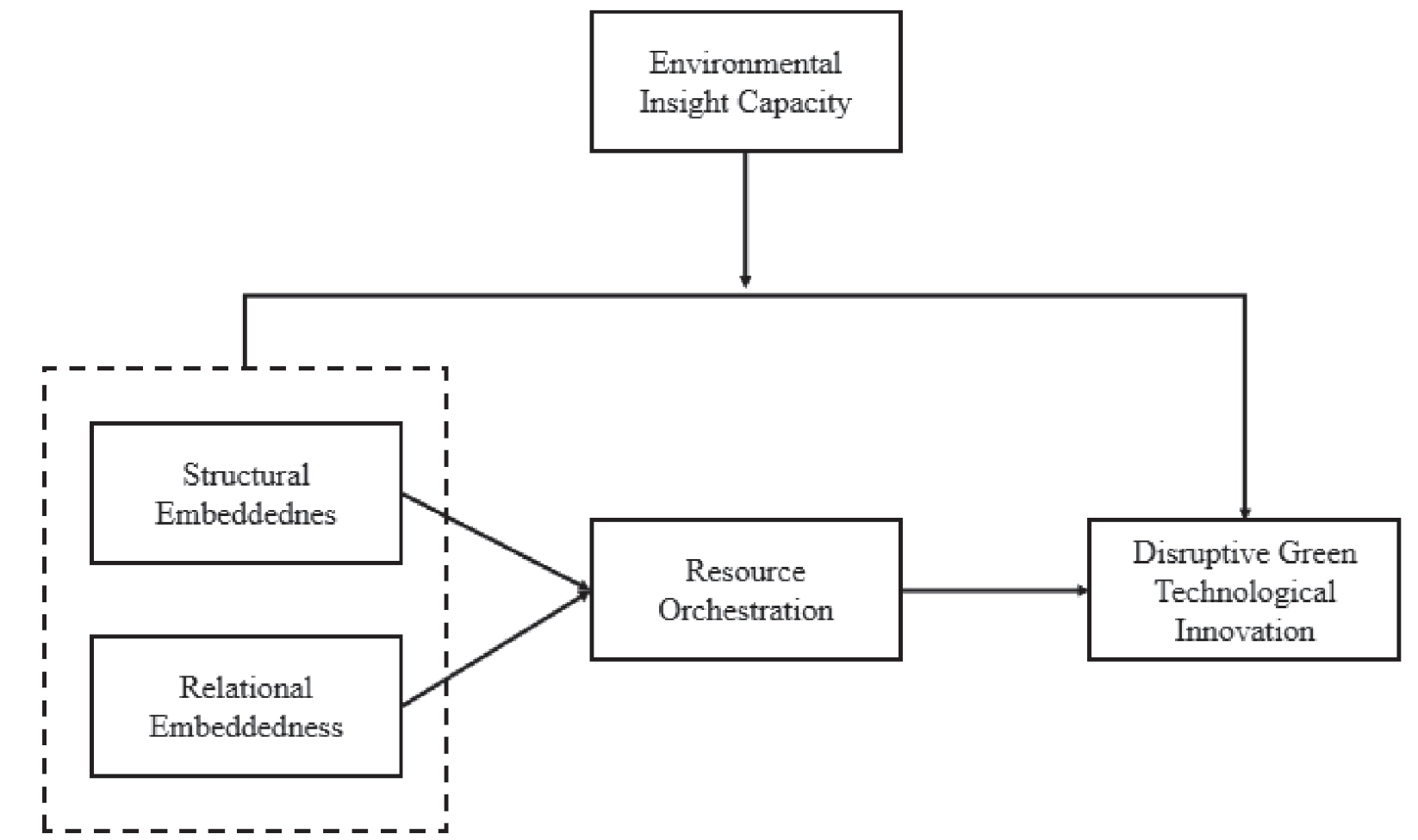
Based on this, this paper uses social network theory and resource orchestration theory to explore the impact of network embeddedness on disruptive green technological innovation of 222 manufacturing enterprises, and analyzes the mediating role of resource orchestration and the moderating role of environmental insight capacity. By expanding the antecedents of disruptive green technological innovation, this paper reveals the influence path of network embeddedness on disruptive green technological innovation through resource orchestration, clarates the regulatory effect of environmental insight capacity on disruptive green technological innovation, clarates the mechanism of network embeddedness on disruptive green technological innovation of manufacturing enterprises, and provides theoretical support for manufacturing enterprises to carry out disruptive green technological innovation.
Literature Review and Analysis Framework
Network Embeddedness and Disruptive Green Technological Innovation
Network embeddedness is the organizational form of economic activities carried out by enterprises with certain network relations [16, 17], which can be generally divided into two types: relationship embeddedness and structure embeddedness. Among them, structural embeddedness is used to describe the structural characteristics of social networks and the influence of network location on economic activities, which is generally measured by three indicators: network size, centrality and heterogeneity. Relational embeddedness is used to describe the relationship between nodes in a social network, and is usually measured by relationship strength and relationship quality.
The relationship between structural embeddedness and disruptive green technological innovation can be analyzed from three aspects: network scale, network heterogeneity and network centrality [18]. First of all, from the perspective of network scale, the more partners an enterprise has and the more diversified network structure, the more channels enterprise can access external knowledge resources [19]. The larger the network scale, the more green knowledge, environmental protection information, green technology and resources for enterprises to absorb, integrate and utilize, the more help enterprises to supplement and improve their own green knowledge structure, increase green knowledge reserves, create more new technical knowledge combinations, and thus provide strong support for disruptive green technological innovation activities [20]. Secondly, from the perspective of network heterogeneity, a good cooperative relationship between enterprises and customers can effectively meet the green needs of consumers [21]; Maintaining a good cooperative relationship with raw material and technology suppliers can obtain the latest market information and various government policy support, and then develop green new products or services that are different from the existing technology trajectory [22]. Thirdly, from the perspective of network centrality, the higher the network centrality of the enterprise, the closer the connection between the enterprise and other network members [23]. Generally speaking, enterprises in the center of the network have stronger influence and more right to speak, which helps enterprises to obtain external knowledge resources more conveniently. Berchicci (2013) pointed out that the opportunities and difficulties of acquiring external technology and knowledge are different with different network locations. Lin et al. (2020) believes that enterprises that occupy a dominant position in the network have stronger coordination and control of innovation resources, can better reduce the risk of cooperation with other network members, and are more conducive to the smooth development of disruptive green technological innovation.
In addition, relational embeddedness may also affect disruptive green technological innovation. From the perspective of relationship strength, the degree of connection between enterprises and stakeholders affects the acquisition of external knowledge resources. Strong ties can reduce transaction costs and transaction uncertainty, and help to promote the flow of knowledge and information. The higher the degree of enterprise relational embeddedness, the more accurate the grasp of green technology development trend, customer green demand, green policy orientation, and the more accurate the positioning of external resources, the more likely it is to launch disruptive green technology products. From the perspective of relationship quality, the absorptive capacity of tacit knowledge is the main factor affecting disruptive green technological innovation [24]. Good relationship quality means a high degree of tacit knowledge flow among enterprises. The more trust among network members, the closer the relationship, the higher the cost of violating network practices, and the more conducive to the establishment of mutually beneficial norms among enterprises. Enterprises are more willing to actively share key information and cooperate with higher quality, so as to realize green knowledge transfer [25]. In addition, relational embeddedness can also reduce the cost of knowledge exchange between enterprises, eliminate barriers to cross-functional exchange and learning, and promote the development of disruptive green technological innovation. Accordingly, this paper puts forward the following hypothesis:
H1a: Structural embeddedness has a positive impact on disruptive green technological innovation;
H1b: Relational embeddedness has a positive impact on disruptive green technological innovation.
Network Embeddedness and Resource Orchestration
Network embeddedness is the beginning of resource orchestration, and good network relationship helps to promote enterprise resource orchestration behavior [26]. Enterprises with high network connectivity have higher integration and utilization efficiency of innovative resources such as green technology and green knowledge. For partners and competitors, it is more convenient and time-saving for enterprises in the center of the network to search network resources, which provides convenient conditions for enterprise resource orchestration, helps enterprises to optimize and reorganize existing knowledge resources, and improves the efficiency of resource orchestration [27]. Network embeddedness determines the knowledge resources that enterprises can gather, integrate and allocate in the external knowledge network, thus affecting the resource orchestration behavior of enterprises [28]. The communication and learning between enterprises and other network members can access to more diversified knowledge [29]. By combining with their own experience, it is helpful to improve the resource orchestration ability of enterprises.
Strong relational embeddedness means that the frequency of knowledge interaction between different departments of the enterprise is higher, and the efficiency of green knowledge and technology transfer and sharing among different individuals and different departments is also higher [30]. Through cooperation with different types of network members, it is beneficial for enterprises to integrate existing knowledge resources and new knowledge, and launch green products that are more in line with market development trends, thereby improving the quality of resource orchestration. The close network relationship between enterprises and network members means that there is a strong trust and interaction between each other, which helps to enhance the willingness of enterprise resource replacement and information sharing, thus promoting knowledge transfer and diffusion. The communication between enterprises can encourage enterprises to find more new market opportunities, and then stimulate enterprises' resource orchestration behavior for new projects. Accordingly, this paper puts forward the following hypothesis:
H2a: Structural embeddedness has a positive impact on resource orchestration;
H2b: Relational embeddedness has a positive impact on resource orchestration.
Resource Orchestration and Disruptive Green Technological Innovation
The scattered knowledge obtained by enterprises from the network relationship needs to be integrated and coordinated with their own knowledge to create value [31]. The impact of resource orchestration on disruptive green technological innovation is mainly reflected in the following three aspects: First, resource orchestration is conducive to promoting enterprise innovation. Enterprises regulate and coordinate green innovation resources through resource orchestration behavior, and apply key resources to specific production and operation links, which can effectively improve the innovation ability of enterprises. Carnes et al. (2017) confirmed that resource orchestration helps to accelerate the speed of enterprise innovation and expand the scope of enterprise innovation; secondly, resource orchestration can reduce the R & D cost of enterprises. Xie et al. (2018) believed that the effective management of internal and external knowledge can effectively solve the problems encountered in the process of innovation and promote the smooth development of enterprise innovation activities. Finally, resource orchestration helps enterprises identify and grasp innovation opportunities. Zhao et al. (2012) found that static knowledge resources cannot bring competitive advantages to enterprises. Only knowledge resources through resource orchestration can help enterprises launch green technology products that meet the diverse needs of consumers in a dynamic environment. The external knowledge and internal knowledge acquired by enterprises through network embeddedness can deepen the understanding of resource distribution, and obtain market information and environmental regulation information from multiple channels, and launch green products and services that adapt to changes in the external environment, thus completing disruptive green technological innovation. Accordingly, this paper puts forward the following hypothesis:
H3: Resource orchestration has a positive impact on disruptive green technological innovation.
The Mediating Role of Resource Orchestration
Network embeddedness affects the resource orchestration behavior of enterprises. Structural embeddedness can help enterprises broaden the access to external knowledge resources, so that enterprises can quickly and comprehensively obtain the environmental protection technology and information resources needed for disruptive green technological innovation. By optimizing and restructuring these knowledge resources, it is helpful to improve the efficiency of enterprise resource orchestration and promote the development of green products [32]. The resource orchestration can break the boundaries between different functional departments, improve team cohesion, enable employees to actively share knowledge, skills and experience, explore innovative ways to solve problems, and then launch new green products and accumulate disruptive green technological innovation experience. Normative and formal resource orchestration can stimulate employees' willingness to share complex knowledge and tacit knowledge, promote enterprises to screen and absorb heterogeneous green knowledge, improve enterprise knowledge structure, and increase innovation resource reserves. Resource orchestration can also create a knowledge sharing atmosphere for enterprises and help enterprises accelerate knowledge dissemination and diffusion [33]. High frequency communication and exchange between employees can solve the problems encountered in the process of production and operation, optimize the production process of enterprises, adjust the R & D objectives of new products at any time according to the changes of external environment, so that new products can meet the diversified needs of consumers, and then complete the disruptive green technological innovation.
The lasting cooperative relationship between enterprises and network members can reduce the path dependence in the process of knowledge transfer, improve the efficiency of knowledge transfer, promote the integration of external knowledge resources and their own knowledge resources, reduce the cost of green technology research and development, and improve the success rate of green product research and development through internal and external knowledge concerto [34]. Through the resource orchestration, enterprises can quickly digest and absorb external knowledge resources of different sources, different levels and different structures, establish the core green knowledge base of enterprises, and speed up the development and change of green products to adapt to the changes of market environment [35]. The coordination and integration of internal and external knowledge resources by enterprises is helpful to understand the distribution of their own resources and reduce the uncertainty risk of green new products, so as to complete the disruptive green technological innovation. Based on this, this study proposes the following hypothesis:
H4a: Resource orchestration plays a mediating role between structural embeddedness and disruptive green technological innovation;
H4b: Resource orchestration plays a mediating role between relational embeddedness and disruptive green technological innovation.
The Moderating Role of Environmental Insight Capacity
With the continuous iteration of green technology, competition among enterprises is becoming increasingly fierce [36]. In order to tap new market opportunities, enterprises need to continuously search for external knowledge resources, always pay attention to consumers’ potential green demand, industry structure changes and possible strategies adopted by competitors. The social network embedded by enterprises has rich external knowledge resources, which can help enterprises to understand the market situation, technology frontier, consumer demand and the latest policies and regulations in a timely manner. The ability of environmental insight affects the enterprise’s acquisition of external knowledge resources, and then affects the enterprise’s disruptive green technological innovation [37]. Enterprises with strong environmental insight can accurately predict technological development trends, lead competitors to discover new innovation opportunities, improve their green technologies and products to meet market demand, and enable enterprises to occupy a leading position. After exploring new market opportunities, enterprises also need to comprehensively evaluate the market competition pattern, upstream and downstream enterprises' reaction ability and green technology development trend, determine feasible green technology products or service promotion paths, and help enterprises achieve disruptive innovation. In addition, strong environmental insight can also encourage enterprises to regularly check whether the green technology products launched can meet the green needs of consumers, and develop new environmentally friendly products by scheduling and deploying resources, so as to enhance the ability of enterprises to cope with highly uncertain external market environment.
In addition, environmental insight can also coordinate the relationship between enterprises and other partners, balance the time and energy spent by each partner, and thus transform external innovation resources into subversive green technology products. Liao (2016) pointed out that environmental insight can help enterprises identify and capture new market opportunities and reduce the time and cost of technology and product innovation. Jin et al. (2019) believed that environmental insight can help enterprises to strengthen the search and monitoring of technological trends and market trends, so that enterprises can timely obtain consumer green demand, government environmental regulation and cutting-edge green technology information, and then complete disruptive green technological innovation. In addition, enterprises with strong environmental insight have stronger willingness and motivation to obtain market information, can more effectively identify valuable green knowledge, and effectively integrate it with internal knowledge, so as to realize disruptive green technological innovation. Accordingly, this study proposes the following hypothesis:
H5a: Environmental insight has a positive moderating effect on structural embeddedness and disruptive green technological innovation;
H5b: Environmental insight has a positive moderating effect on relationship embeddedness and disruptive green technological innovation.
In summary, this paper constructs a theoretical model, as shown in Fig. 1.
Research Design
Sample Selection and Data Source
This study takes manufacturing enterprises as the research object, and adopts the questionnaire research method to collect data, focusing on exploring the impact of network embeddedness and resource orchestration on the disruptive green technological innovation of enterprises, and requiring the respondents to have a more objective understanding of the disruptive green technological innovation of enterprises, so the middle and senior managers of the manufacturing enterprises are selected as the research object. Starting from November 2020, the team firstly utilized the team's social network relationship to send electronic questionnaires to the managers of relevant manufacturing enterprises, and pushed them again a week later for some of the emails that were not replied in time; secondly, paper questionnaires were distributed to the top managers of the field research enterprises; finally, paper questionnaires were distributed to the management trainees in the MBA class of the University who are working in the manufacturing enterprises. As of March 2021, 240 electronic questionnaires were distributed using social relations and 143 valid questionnaires were collected; 20 paper questionnaires were distributed to the field research companies and 20 valid questionnaires were collected; 100 paper questionnaires were distributed to the management trainees of MBA classes and 59 valid questionnaires were collected. 360 questionnaires were distributed through the three channels and 276 questionnaires were collected, excluding invalid questionnaires due to missing data and logical errors, and the total number of questionnaires obtained was 360, and 276 questionnaires were collected. Excluding invalid questionnaires with data omissions and logical errors, a total of 222 valid questionnaires were obtained, and the effective recovery rate of the questionnaires was 61.67%, which meets the data processing requirements of the empirical analysis. The basic characteristics of valid questionnaires are as follows: (1) from the nature of enterprises, state-owned enterprises accounted for 45.50%, private enterprises accounted for 36.49%, Chinese-foreign joint ventures accounted for 5.85%, and foreign-funded enterprises accounted for 12.16%; (2) from the perspective of the industry to which they belonged to, the petroleum, coal and other fuel processing industry accounted for 14.86%. Chemical fuels and chemicals manufacturing industry accounts for 9.46%. Railroad, ship, aerospace and other transportation equipment manufacturing industry accounted for 16.67%. Computer, communications and other electronic equipment manufacturing industry accounted for 18.02%. Metal products, machinery and equipment repair industry accounted for 7.21%. Paper and paper products industry accounted for 2.25%, medical manufacturing industry accounted for 4.95%, other manufacturing industries accounted for 26.58%.
(3) In terms of years of establishment, 5 years and below accounted for 9.91%, 6 to 10 years accounted for 24.32%, 11 to 15 years accounted for 22.52%, 16 to 20 years accounted for 17.57%, 21 years and above accounted for 25.68%. (4) In terms of asset size, less than 5 million yuan accounted for 21.17%, 5.01 million yuan to 10 million yuan accounted for 13.96%, 10.01 million yuan to 100 million yuan accounted for 21.62%, 100 million yuan to 1 billion yuan accounted for 18.47%, and more than 1 billion yuan accounted for 24.78%; (5) In terms of the number of employees, 500 and less accounted for 29.74%, 501 to 1,000 people accounted for 24.77%, 1,001~1,500 employees accounted for 12.61%, and 1,501 and above accounted for 32.88%.
Variable Measurement
First, the initial research questionnaire was designed by drawing on mature scales used by scholars at home and abroad; second, field research was carried out in Xi’an BYD Automobile Company Limited, Shaanxi Blower Group Company Limited, Yanchang Petroleum Company Limited and other enterprises, and 30 pre-survey questionnaires were distributed, and the questionnaire content was modified through interviews with managers, senior engineers and experts in the marketing department who understand the current situation of the development of the enterprises, so as to form the Final questionnaire. The questionnaire consists of two parts: the basic information examines the nature of the enterprise, the industry to which it belongs, the number of years since its establishment, the size of its assets and the number of its employees, and it contains 4 questions; the measurement scale contains 20 questions, and it is designed by using the Likert 7 scale method, with 1~7 indicating the range from “strongly disagree” to “strongly agree”. “The measurement scale consists of 20 items.
For network embeddedness, four items were designed to measure structural embeddedness, such as “Compared with peers, the company has more partners”, based on Vacca et al. (2018) ‘s scale; four items were designed to measure structural embeddedness, such as “Compared with peers, the company communicates with its partners more frequently”, based on Chotpitayasunondh and Douglas (2018) scale. “Drawing on Hansen’s scale, we designed a 4-item scale to measure relational embeddedness. For resource orchestration, three items were designed to measure “the company’s ability to absorb external knowledge resources efficiently” based on Sirmon et al. (2007) scale. For environmental insight capacity, five measurement items are designed based on Liu and Borthwick (2011) scale, including "the company's ability to quickly understand and grasp policies related to green development". For disruptive green technological innovation, four measurement items are designed based on the scale of Guo et al. (2019), such as "The performance of new products introduced by the company through disruptive green technological innovation is usually not valued by customers in mainstream green market".
In addition, this paper also sets the following control variables: nature of the enterprise, industry, years of establishment, asset size and number of employees. Among them, the nature of the enterprise includes four categories of state-owned enterprises, private enterprises, Sino-foreign joint ventures and foreign-funded enterprises; the industry of the enterprise includes eight categories of computers, communications and other electronic equipment; the age of the enterprise is divided into five grades according to the time of the enterprise's founding; the size of the assets is divided into five grades; and the number of employees is divided into four grades.
Homology Deviation Test
Since all the questions in the questionnaire of this study were filled in by the same person, the problem of homologous method bias may exist. Three separate models were constructed for comparison with reference to Podsakoff et al. (2012). Among them, the five-factor ten-CMV model adds a common method latent factor (CMV) for all measurement question items on the basis of the five-factor model, and the results of the model analysis are shown in Table 1. As can be seen from Table 1, the change in the fitting index of the five-factor + CMV model is smaller than the discriminant criterion, which indicates that the five-factor + CMV model did not produce significant changes compared with the five-factor model, so there is no large homologous method bias problem.
Results
Reliability and Validity Test
In this study, Cronbach ‘s α coefficient and composite reliability (CR) were used to test the consistency of variable items. The results are shown in Table 2. If the Cronbach ‘s a coefficient is above 0.7, the scale has high reliability. It can be seen from Table 2 that the Cronbach ‘α value and CR value of all variables are above 0.8, indicating that each variable has high reliability.
In this study, the convergence validity of the scale was tested by measuring the standardized factor load of the item and the average variation extraction AVE. The correlation coefficient between the square root of the average variation extraction AVE of each variable and the variables was used to test the discriminant validity of the variables. Exploratory factor analysis was performed using SPSS24.0 software. First of all, the test results show that the KMO value of the scale is 0.923, the Bartlett sphericity test approximate chi-square value is 3461.274, and the Sig.is 0.000, indicating that the sample data is suitable for factor analysis; secondly, the principal component analysis of the scale was carried out, and the factors with eigenvalues greater than 1 were extracted. The maximum variance method was used for rotation, and the cumulative variance interpretation rate of the five factors was 77.966 %. The load values of the measurement items on the corresponding factors were greater than 0.6, and the load values on other factors were less than 0.5, indicating that the selected scale can better reflect the construct of this study. At the same time, the average variation extraction AVE of each variable is greater than 0.5, indicating that the convergence validity of the scale is high. The correlation coefficient between the variables and the AVE square root test results are shown in table 3. It can be seen that the square root of the AVE of each variable is greater than the correlation coefficient between the variables, indicating that the scale has high discrimination validity.
Table 1.
Results of common method variance.
| Model | X2/df | RMSEA | CFI | TLI |
|---|---|---|---|---|
| Single factor model | 7.794 | 0.175 | 0.656 | 0.577 |
| Five factors model | 1.913 | 0.070 | 0.949 | 0.932 |
| Five factors + CMV model | 1.902 | 0.062 | 0.948 | 0.965 |
Table 2.
Results of reliability and validity analysis.
Correlation Analysis
In this study, the mean, standard deviation and Person correlation coefficient of each variable were analyzed using SPSS24.0 software, and the results are shown in Table 3. As shown in Table 3, structural embeddedness is significantly and positively correlated with resource orchestration (r = 0.532, p<0.01) and disruptive green technological innovation (r = 0.600, p<0.01). Relational embeddedness is significantly and positively related to resource concertina (r = 0.440, p<0.01) and disruptive green technological innovation (r = 0.522, p<0.01). Resource orchestration is significantly and positively related to disruptive green technological innovation (r = 0.548, p<0.01). There is no significant correlation between the nature of the enterprise, the industry to which it belongs, the number of years of establishment, the size of assets, and the number of employees and resource concertina and disruptive green technological innovation, indicating that resource concertina and disruptive green technological innovation are less affected by the nature of the enterprise, the industry to which it belongs, the number of years of establishment, the size of assets, and the number of employees.
Hypothesis Testing
This study uses the hierarchical regression method to test the research hypothesis. A total of 8 models are designed in the regression equation. The dependent variables of Model 1 and Model 2 are resource orchestration, and the dependent variables of Model 3 to Model 8 are disruptive green technological innovation. The regression results are shown in Table 4.
Main effect. Firstly, the disruptive green technological innovation is set as the dependent variable, and then the nature of the enterprise, the industry, the years of establishment, the scale of assets and the number of employees are added. Finally, the structural embeddedness and relational embeddedness are put into the regression equation. From Model 3 and Model 4, it can be seen that the influence of control variables on disruptive green technological innovation is not significant, and structural embeddedness and relational embeddedness have a significant positive impact on disruptive green technological innovation (β = 0.456, p<0.001; β= 0.340, p<0.001), and the effect of structural embeddedness on disruptive green technological innovation is greater than that of relational embeddedness on disruptive green technological innovation. Hypothesis H1a and Hypothesis H1b are verified.
Table 3.
Means, standard deviations and correlations analysis results.
Table 4.
Results of regression analysis.
Mediating effect. The hierarchical regression method is used to test the mediating role of resource orchestration. Firstly, the disruptive green technological innovation and resource orchestration are set as dependent variables, and then the control variables are added, and then the independent variable structure embedding and relational embeddedness are added. Finally, the mediating variable resource orchestration is put into the regression equation. It can be seen from Table 4 that structural embeddedness and relational embeddedness have a significant impact on disruptive green technological innovation (β = 0.456, p<0.001; structural embeddedness and relational embeddedness have significant positive effects on resource orchestration (β = 0.421, p<0.001; β = 0.340, p<0.001). β = 0.257, p<0.001) had a significant positive effect, assuming that H2a and H2b were verified. Resource orchestration has a significant positive impact on disruptive green technological innovation (β = 0.549, p<0.001), and H3 is verified. After adding the mediating variable of resource orchestration, structural embeddedness and relational embeddedness still affect disruptive green technological innovation (β = 0.354, p<0.001; β = 0.278, p<0.001) had a significant positive effect, but the effect was weakened. It can be seen that resource orchestration plays a partial mediating role between structural embeddedness and disruptive green technological innovation, and between relational embeddedness and disruptive green technological innovation. Hypothesis H4a and H4b are verified.
Moderating effect. First, disruptive green technological innovation is added into the regression model as the dependent variable, then the control variables, independent variables structural embeddedness and relational embeddedness are added step by step, and then the moderating variable environmental insight capacity is added, and finally the interaction term of structural embeddedness, relational embeddedness and environmental insight capacity is placed into the regression equation. As can be seen from Table 4, the effect of the interaction term of structural embeddedness and environmental insight capacity on disruptive green technological innovation (β = -0.008) is not significant, indicating that the environmental insight capacity does not have a significant effect on the relationship between structural embeddedness and disruptive green technological innovation, and Hypothesis H5a has not passed the test. The interaction term of relational embeddedness and environmental insight capability has a significant positive effect on disruptive green technological innovation (β = 0.119, p<0.05), indicating that the stronger the firm’s environmental insight capability, the more significant the positive relationship between relational embeddedness and disruptive green technological innovation, and Hypothesis H5b is verified. Further, this paper plots the effect of different levels of environmental insight capability on the relationship between relational embeddedness and disruptive green technological innovation, as shown in Fig. 2. It can be seen that the positive relationship between relational embeddedness and disruptive green technological innovation is more significant at high levels of environmental insight capability compared to low levels of environmental insight capability.
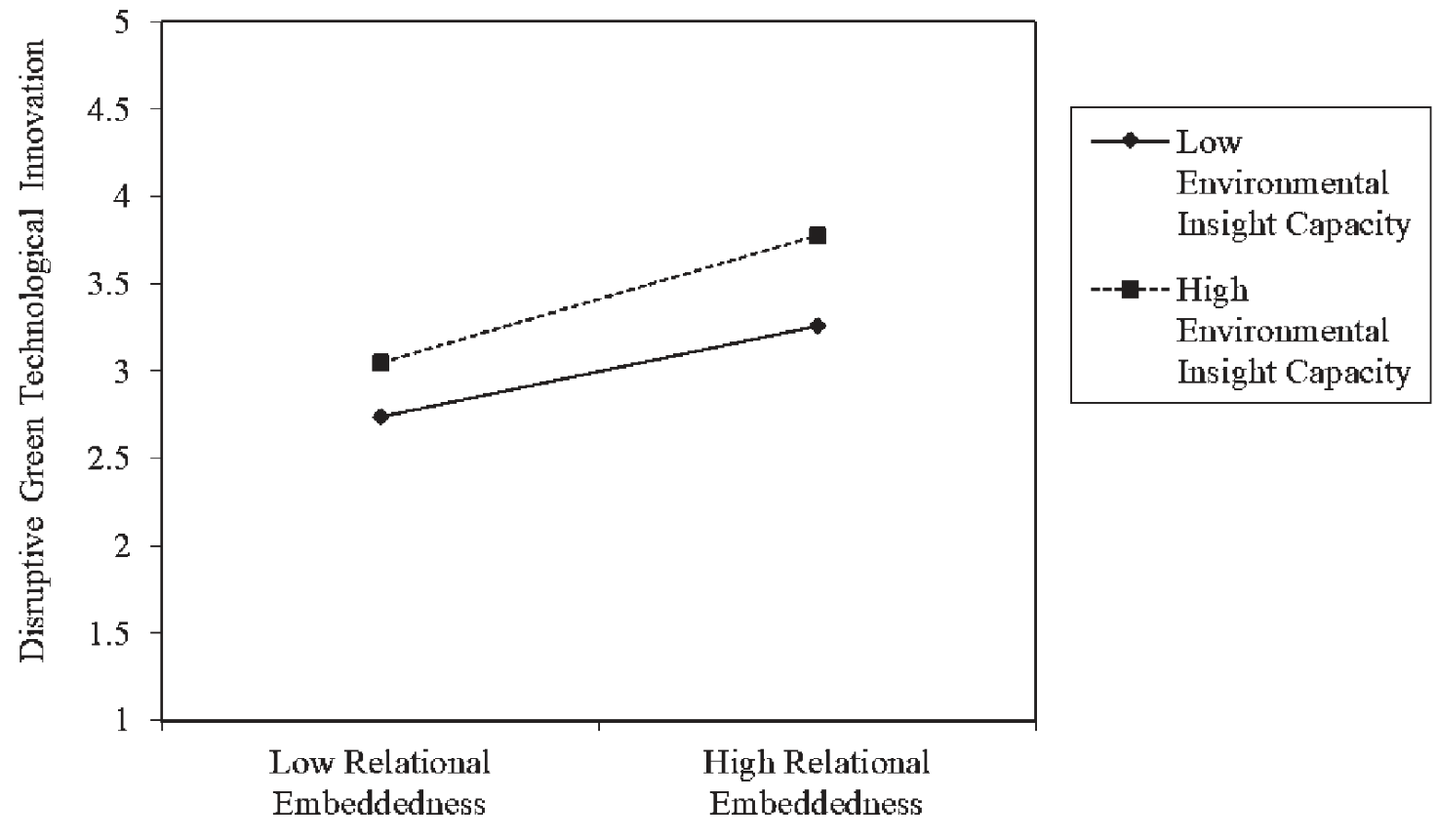
Table 5.
Bootstrap robustness test results of direct effects.
Table 6.
Bootstrap robustness test results of indirect effects.
Robustness Testing
In this study, Bootstrap method was used to conduct robustness tests for direct and mediated effects, and the results are shown in Table 5 and Table 6. As can be seen, the point estimate of the direct effect of structural embeddedness is 0.6707 with a 95% confidence interval of [0.5553, 0.7861], and the point estimate of the indirect effect is 0.1856 with a 95% confidence interval of [0.0640, 0.3263], and the confidence interval does not contain 0, which achieves the significance level. This indicates that structural embeddedness has a significant positive effect on disruptive green technological innovation, and resource orchestration plays a partially mediating role between structural embeddedness and disruptive green technological innovation, and hypotheses H1a and H4a are further verified. The point estimate of the direct effect of relational embeddedness is 0.3888 with a 95% confidence interval of [0.4516, 0.6809], and the point estimate of the indirect effect is 0.1775 with a 95% confidence interval of [0.0997, 0.2690], with a confidence interval that does not contain 0, reaching the significance level. This indicates that relational embeddedness has a significant positive effect on disruptive green technological innovation, and resource orchestration plays a partially mediating role between relational embeddedness and disruptive green technological innovation, and hypotheses H1b and H4b are further verified.
Conclusions and Discussion
Conclusion
Taking manufacturing enterprises as the research object, this paper utilizes social network theory and resource orchestration theory to explore the impact of network embeddedness on disruptive green technological innovation of manufacturing enterprises, and examines the mediating role of resource orchestration as well as the moderating role of environmental insight capacity. It is found that structural embeddedness and relational embeddedness not only have a significant positive effect on disruptive green technological innovation, but also have a significant positive effect on resource orchestration; resource orchestration plays a partial mediating role between network embeddedness and disruptive green technological innovation. That is to say, structural embeddedness and relational embeddedness not only have a direct influence on disruptive green technological innovation, but also play an indirect influence on disruptive green technological innovation through resource orchestration. Environmental insight capacity has a moderating role between relational embeddedness and disruptive green technological innovation, i.e., the stronger the environmental insight capacity, the more significant the positive impact of relational embeddedness on disruptive green technological innovation.
Theoretical Contribution
Based on social network theory, this study explores the impact of network embeddedness on corporate disruptive green technological innovation. The results found that structural embeddedness and relational embeddedness have a significant positive impact on disruptive green technological innovation, which is consistent with the findings of Andersen (2023) [38]. While Lien et al. (2017) [39] found that relational embeddedness has a more significant positive impact on firms' innovation performance than structural embeddedness, this paper finds that structural embeddedness has a more significant role in promoting disruptive green technological innovation. The reason is that firms need to spend more costs to maintain good relational embeddedness, which leads to the benefits gained by firms through relational embeddedness being smaller than those gained through structural embeddedness. Enterprises in a dominant position in the social network tend to have more voice and influence, and the cost of acquiring heterogeneous knowledge resources is lower, the resource orchestration efficiency is higher, and the possibility of accomplishing disruptive green technological innovations is also higher.
From the theory of resource orchestration, it is found that resource orchestration plays a partial mediating role between network embeddedness and disruptive green technological innovation. It reveals the important influence of resource orchestration on disruptive green technological innovation, expands the scope of application of resource orchestration theory, provides a new perspective on the relationship between network embeddedness and disruptive green technological innovation, and expands the findings of Yan et al. (2020) [40]. Reddy (2015) [41] take four manufacturing companies as research objects and use case study method to conclude that corporate market opportunities need to be concerted by resources in order to launch services and products that satisfy customers' needs. In addition, this paper also verifies the conclusion of Zhou et al. (2017) [42] 's study that resource orchestration is not the only strategy for firms to build sustained competitive advantage.
Using environmental insight capability as a moderating variable, we explore the impact of network embeddedness and environmental insight capability interaction on disruptive green technological innovation. The results found that environmental insight capability plays a positive moderating role between relational embeddedness and disruptive green technological innovation, refining the findings of Yang et al. (2019) [43]. In addition, the dimensional division of dynamic capabilities reveals that the moderating effect of environmental insight capabilities on the relationship between corporate network embeddedness and disruptive green technological innovation is more significant, which clarifies the relationship between environmental insight capabilities and disruptive green technological innovation, and reveals the boundary of the role of environmental insight capabilities on disruptive green technological innovation.
Management Contribution
Based on the above findings, this paper proposes the following insights:
Structural embeddedness and relational embeddedness positively affect disruptive green technological innovation. Firstly, manufacturing enterprises should proactively manage and maintain the relationship with other network members in the social network to adjust the position of the enterprise network and improve the degree of enterprise network embeddedness in order to carry out disruptive green technological innovation according to their own needs. Secondly, manufacturing enterprises should proactively participate in the construction of external networks, engage in all-round interaction and communication with other enterprises, and establish a close and mutually beneficial network relationship. Thirdly, enterprises should adjust the network scale in a timely manner, not only to gradually attract new partners to join the network, expand their own network scale, broaden the boundaries of enterprise resources, and enrich the enterprise’s external knowledge sources, but also to timely eliminate partners with similarity and high redundancy with their own, so as to avoid the impact of duplicated information on the disruptive green technological innovation. Finally, regular training meetings and related forums should be held to enhance communication and cooperation, actively participate in exchange meetings organized by network members, increase the frequency of interaction with partners, enhance the trust of network members, collide new knowledge through communication, generate new ideas, and promote knowledge accumulation and transfer.
Enterprises should not only pay attention to the role of structural embeddedness and relational embeddedness in promoting disruptive green technological innovation, but also pay attention to resource orchestration. Only through good resource synergy can enterprises integrate network knowledge resources with existing knowledge to form a brand-new knowledge system, thus promoting disruptive green technological innovation. For example, through the organization of regular team meetings, environmental knowledge and technology learning activities to enhance mutual affection, eliminate cross-departmental communication barriers, so that knowledge resources in the flow of the full integration, to speed up the absorption and utilization of external green knowledge, enhance the enterprise resource orchestration ability.
Environmental insight capacity helps enterprises to recognize new knowledge and accumulate valuable knowledge, which in turn promotes disruptive green technological innovation. Enterprises with low environmental insight capability are prone to miss opportunities and find it difficult to grasp the direction of market change. Therefore, enterprises should set up an information intelligence department to search for the latest green products and green technology information in the market, use intelligence to assess the industry development trend and analyze potential competitors’ technological leap track, so as to provide references for the formulation and adjustment of enterprise strategic decisions. In addition, enterprises can also employ some compound talents who are proficient in marketing and technological development to search for internal and external green technology frontier information, improve the sensitivity of value information, and set up expert committees to effectively identify business opportunities in order to enhance the ability of environmental insight.
Limitations and Future Research Directions
This study has the following shortcomings: The use of cross-sectional data does not reflect the impact of network embeddedness over time on disruptive green technological innovation, and time-series research data can be used in the future to make the research conclusions more objective and reliable. The resource orchestration dimension is not divided, and the influence of enterprise competition relationship on the acquisition of external knowledge resources is not considered. In the future, the resource orchestration dimension should be divided, and moderating variables such as competition relationship should be added, so that the theoretical model can be further improved and the intrinsic connection between network embeddedness and disruptive green technological innovation can be further explored.

